Inter-Annotator Agreement in Sentiment Analysis:
Machine Learning Perspective
Victoria Bobicev
Department of Informatics and Systems Engineering
Technical University of Moldova
Marina Sokolova
IBDA@Dalhousie University, Halifax, NS, Canada, and
University of Ottawa, Ottawa, ON, Canada
Abstract
Manual text annotation is an essential part of Big Text analytics. Although annotators work with limited parts of data sets, their results are extrapolated by automated text classification and affect the final classifi-cation results. Reliability of annotations and adequacy of assigned labels are espe-cially important in the case of sentiment annotations. In the current study we exam-ine inter-annotator agreement in multi-class, multi-label sentiment annotation of messages. We used several annotation agreement measures, as well as statistical analysis and Machine Learning to assess the resulting annotations.
1
Introduction
Automated text analytics methods rely on manu-ally annotated data while building their heuris-tics. Although manually annotated texts com-prise a small part of a data set, learning algo-rithms extrapolate the results to the remaining part of the data set and beyond it. At the same time, development of annotation schemes and methods and their implementation attract consid-erably less research attention than building elec-tronic resources or development of Machine Learning techniques. In this work, we study mul-ti-class sentiment annotation of a new data set. The texts have been collected from an online health forum; three annotators annotated each text. Annotators could assign each text with one or more sentiment labels; 4 labels were prede-fined (facts, gratitude, encouragement, confu-sion) and could be supplemented by other senti-ment labels, if annotators deemed the four given labels insufficient to cover sentiments found in the text. Our results show that metrics estimating inter-annotator agreement can be effectively used
in deciding of sentiment categories and establish-ing annotation protocols. We apply Machine Learning (ML) techniques to compare human and automated recognition of sentiment labels.
2
Related Work
Inter-annotator agreement of multi-class sen-timent annotations was analyzed in (Steinert, 2017). The author worked with 3255 German documents collected from social networks. Texts were 50 words in average, thus limiting topics and sentiments conveyed by individual messages. Six annotators annotated the docu-ments with one of the following labels: Neg, Neut, Pos, No Sent, Undecided, and Irrelevant. Each document was annotated by three partici-pants. Cohen kappa was used to estimate inter-annotator agreements between each pair of all the six annotators. The best kappa was 0.747 and the worst kappa was 0.480. The final message labels were selected by a majority voting algo-rithm.
Manual annotations and automated annota-tions were compared by Emi Ishita et al. (2010). The authors worked with 1,783 sentences col-lected from written statements of hearings held by a U.S. Senate Committee. Four annotators could annotate a sentence into 10 possible labels; each sentence obtained 3 labels on average; the obtained agreement was 0.30. Then a k-NN algo-rithm was applied to classify the sentences; it ob-tained F-score = 0.4. Then human annotations were evaluated in the same way as the automated classification, i.e. obtaining F measures against the final annotation called “ground truth”. The best F-measure for human annotation was 0.70.
600 sentences collected from English-language Spine-health forum were manually an-notated by 60 Master’s students, who were not health professionals (Melzi et al, 2014). Annota-tors used 6 basic emotions (Ekman, 1992): anger, disgust, fear, joy, sadness and surprise. Each sen-tence was annotated by two annotators. The in-ter-annotation coefficient Kappa was 0.26. 150 sentences from the same corpus were annotated by two health professionals. The agreement be-tween health professional annotators and non-professionals was moderate, 0.46. The authors nevertheless proceeded with machine learning experiments; their best F-score was equal to 0.65.
150 topics from 115 documents (from the Blog Track at TREC 2008) were annotated in (Bermingham and Alan, 2009). An average of 3.6 annotators worked with each topic. Annota-tors’ agreement was evaluated by Krippendorf alpha (Hayes and Krippendorf, 2007). Unlike Cohen and Fleiss kappa, the measure can assess agreement among a variable number of annota-tors and accepts non-annotated examples. The value of 0.4219 was obtained for sentence-level annotation for 5-class annotation; the authors considered such agreement as moderate. Bermingham and Alan emphasized necessity of further studies of different levels of annotations, i.e., sentence, paragraph and document levels.
3
The Data Set and Annotation
The data set. To build this data set, we collected messages posted on Introduction and IVF/FET/IUI Cycle Buddies sub-forums of InVi-troFertilization.ca forum1. The structure of the posted discussions is similar to those posted on other online forums: a participant starts discus-sion by posting the first message; other partici-pants join discussion by replying on the initial postor the following messages, thuscreating co-herent online conversations. The Introduction sub-forum contained 2,913 discussions, whereas the IVF/FET/IUI Cycle Buddies contained 3,771 discussions. The number of messages in a single discussion varied considerably: from hundreds to only a few messages.
Due to budgetary limitations, we restricted the number of annotated discussions. We selected 65 medium length discussions, with 10-20 posts in each discussion. Those discussions yielded in
1 www.ivf.ca
tal 1000 posts. The messages were comparatively long, 126 words on average.
Annotation procedure. We adopted four la-bels from a label set proposed in (Sokolova and Bobicev, 2013); the label set was further analyzed in (Navindgi et al., 2016). We used three senti-ment labels: confusion, encouragesenti-ment and grat-itude and the label facts for neutral factual infor-mation. We discarded the label endorsement that was created as combination of two labels facts
and encouragement (Bobicev et al., 2015).
Navindgi et al. (2016) demonstrated that this label confused machine learning algorithms and was not recognized properly.
As one message often conveyed > 1 sentiment, the resulting sentiment mosaic posed challenges to both one label and multi-labeled post annotation: • one label annotation can be directly mapped
into a multi-class classification problem; however, deciding on one sentiment label will artificially restrict annotators’ choices, thus, leaving side important information about message sentiment and their annotation. • multi-labeled annotation represents diversity
of sentiments in individual posts; however, mapping multitudes of labels into multi-label machine learning is not a trivial task.
In this study, we have decided to combine the two approaches: first, allow multiple labels for one post; then generalize the received annotations into one label per post.
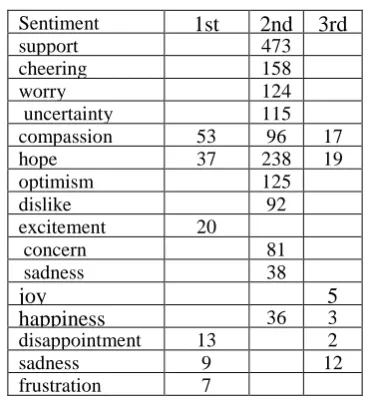
Preliminary text annotation.In the annotation guidelines we presented three sentiment labels and one for neural/factual information as default labels and then suggested that for each message annota-tors can indicate as many sentiments as they con-sidered appropriate. Although the annotators were allowed to attach any number of any labels, in many cases they assigned only one predefined la-bel per post: approx. 85% of the assigned lala-bels were from the predefined set. New labels suggest-ed by the annotators are reportsuggest-ed in Table 1.
posts. (3) All three annotators assigned same two labels for a post; no other labels were assigned; it happened for 26 posts; one annotator indicated the importance of the labels; we used this information and assigned the label she indicated first. (4) Of all labels attached to the post by all annotators on-ly one label was used twice; this label was select-ed as the final one: 214 posts (5) Two or even three labels were used twice in annotation of the same post; in this case we kept the label marked as the most important; it happened for 95 posts; in four cases the most important label was not re-peated by other annotators; we did not use these posts in the experiments. (6) All the annotators at-tached different labels to a post. This happened for 14 posts. Those posts remained ambiguous with-out the final label.
Figure 1 reports labels assigned by annotators after we merged the additional labels. The first annotator tended to use more neutral labels whilst the second annotator attached more labels with sentiments. This problem was discussed in (Melzi et al., 2014) as health forums are about health problems, diagnosis, treatment, etc. Thus, some annotators, by empathy, associated negative emo-tion to factual informaemo-tion about diseases, symp-toms and diagnoses.
In general, the first annotator attached fewer la-bels (average lala-bels per post is 1.17; 83% of posts annotated with only one label); the second and the third annotators attached more labels (average la-bels per post is 1.35, 68% of posts annotated with only one label).
4 Assessment of Inter-Annotator
Agree-ment
Several inter-annotators metrics were proposed for inter-annotator agreement evaluation.
Per cent of agreement is the easiest and the most straightforward measure. The measure is of-ten criticized (it does not differentiate between categories) but still it gives a basic approximation of annotators’ agreement. As we have multiple la-bels per post, inter-annotator agreement was cal-culated for each label separately and the average for these four labels. The same situation is for three annotators. The pairwise agreement calcu-lated for each pair of the annotators and the aver-age are presented in Table 2.
The average agreement is 79.6%; it shows a strong agreement. Agreement between pairs of the three annotators is almost uniform; we cannot say that some are better than others.
Comparing agreement per labels we see that lesser agreement was reached on encouragement and facts. This may be explained by the specific of the text: participants often asked to tell success stories to encourage them fighting with health is-sues. Thus, factual stories of illness and following
Figure 1: The ratio of labels used by all three annota-tors in the order: 1st, 2nd, 3rd.
0% 10% 20% 30% 40% 50% 60%
Table 2: Per cent inter-annotator agreement for the four labels and three annotators. A1, A2, A3 are the annota-tors; the labels are: lab1 (encouragement), lab2 (facts),
lab3 (confusion), lab4 (gratitude).
lab1 lab2 lab3 lab4
A1vs A2 73% 72% 85% 88%
A2vs A3 73% 70% 83% 93%
A1vs A3 78% 74% 81% 87%
average 74.6% 71.8% 82.7% 89.1%
Table 1: New sentiments of 1st, 2nd and 3rd
anno-tators.
Sentiment 1st 2nd 3rd
support 473
cheering 158
worry 124
uncertainty 115
compassion 53 96 17
hope 37 238 19
optimism 125
dislike 92
excitement 20
concern 81
sadness 38
joy 5
happiness 36 3
disappointment 13 2
sadness 9 12
recovery were frequently perceived as encour-agement.
Inter-annotator agreement is often evaluated by Cohen’s kappa (κ), Fleiss’ kappa (K), Krip-pendorf’s alpha (α) (Artstein, Poesio, 2008). Co-hen’s kappa and Fleiss kappa are Chance-Corrected Coefficients which means that they measure above chance agreement. The general formula for these coefficients is:
𝑘 = (𝐴𝑜 − 𝐴𝑒)/(1 − 𝐴𝑒) (1) where Ao is observed agreement and Ae is ex-pected agreement by chance if the annotators pick the labels randomly.
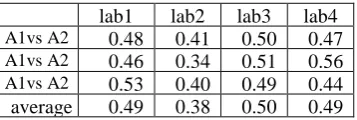
Cohen k. In case of Cohen k the expected agreement Ae is calculated basing on the as-sumption that random assignment of categories to the items is governed by prior distributions that are unique to each coder, and which are ob-served from their actual distribution. Cohen k is applied to two annotators only, thus we calculat-ed it for each pair of our annotators (Table 3)
The average Cohen’s k = 0.46 shows moderate agreement.
Fleiss k is generalization to more than two annotators; expected agreement is calculated on the basis on the assumption that random assign-ment of categories to items, by any annotator, is governed by the distribution of items among cat-egories in the actual world (Table 4).
Krippendorf’s alpha (α) is an agreement coeffi-cient based on assumptions that expected agree-ment is calculated by looking at the overall distri-bution of judgments without regard to which cod-ers produced these judgments. It applies to multi-ple coders, and it allows missing values. As in previous cases α is calculated for each label and then averaged in Table 5.
The average agreement is equal to 0.46 in all cal-culated metrics which is similar to 0.48 reported in (Bobicev, Sokolova, 2017) and is considered as moderate in (Artstein, Poesio, 2008).
In the current study, there was no considerable difference between the results of the inter-annotator metrics. Nevertheless, we conjecture that pairwise metrics can serve for the detection of the best annotator. For example, Nowak and Roger (2010) identified the best and the worst annotators (among 11 annotators) by calculating correlation between their labels and the final la-beled set.
On the other hand, we can calculate annotator agreement per label and then use the result as an indicator of the label identification difficulty: la-bels with the best agreement are the easiest to de-tect and, vice versa, the worst agreement shows labels with the most problems for the annotators. Finally, annotator agreement can be used in analysis of the label sets and annotation instruc-tions in order to improve annotation process and resolve annotation difficulties.
5
Experiments
We worked with the following sets of text: (1) 970 posts, each post identified with one la-bel;
(2) 326 posts with exact match of the labels as-signed by the three annotators;
(3) 297 posts with a principal match: all 3 anno-tators agreed on 1 label but other labels were add-ed;
(4) 214 posts with a partial agreement: two an-notators selected one label which was considered the final one;
The complete set of 970 messages has the fol-lowing distribution of labels: confusion: 146, en-couragement: 494, gratitude: 69, facts: 261.
To estimate reliability of annotations (see Sec 4), we have run ML experiments on sets (1) – (3). We used several sets of features:
1. BOW – Bag of Words. All words from the whole corpus with the frequency at least 2; 3497 features.
Table 5: Krippendorf’s alpha (α)
lab1 lab2 lab3 lab4 average α 0.48 0.38 0.49 0.48 0.46
Table 4: Fleiss k for the annotation.
lab1 lab2 lab3 lab4 average Fleiss k 0.48 0.38 0.49 0.48 0.46 observed
agreement
0.75 0.72 0.83 0.89 0.80 expected
agreement
0.51 0.55 0.66 0.79 0.63 Table 3: Cohen’s k for the annotation
lab1 lab2 lab3 lab4
A1vs A2 0.48 0.41 0.50 0.47
A1vs A2 0.46 0.34 0.51 0.56
A1vs A2 0.53 0.40 0.49 0.44
2. SS – SentiStrength (Thelwall et al., 2012). All terms from SentiStrength lexicon which appear in our corpus.
3. SWN – SentiWordNet (Esuli, Sebastiani, 2006). All terms from SentiWordNet lexicon which appear in our corpus.
4. DM – DepecheMood (Staiano, Guerini, 2014). All terms from DepecheMood lexicon which appear in our corpus.
5. HA – HealthAffect (Sokolova, Bobicev, 2013). All terms from HealthAffect lexicon which appear in our corpus.
Note that SS, SWN, DM, HA showed reliable re-sults in sentiment analysis studies (Bobicev et al., 2015). We applied Naive Bayes (NB), NB Text, NB multinomial, SVM machine learning algo-rithms in our experiments. To select the best re-sults, we used 10-fold cross-validation and com-puted F-score (F). We used the majority class baseline. We run four experiments using the cre-ated sub-corpora (Table 6):
(1) 326 posts with exact match; baseline=0.536. (2) 297 posts with agreement; baseline=0.362. (3) 214 posts with partial agreement;
base-line=0.283.
(4) All the 970 posts with one label; base-line=0.344.
The best result F=0.794 was obtained for the sub-corpus with exact match. For the whole cor-pus the best F-measure=0.571 was too obtained on the BOW feature set.
Feature selection Feature sets consisting of all words from the texts or from lexicons were com-paratively large. We used Correlation-based Fea-ture Subset Selection (Hall, 1999) which evaluates the worth of a subset of features by considering the individual predictive ability of each feature along with the degree of redundancy between them. We created a set of selected features from all 4 lexicons’ merged features and have run the same 6 experiments on them. The results are pre-sented in Table 7. Feature selection improved the learning results: F measure for the whole set is 0.652 which is much better than 0.571 on BOW features.
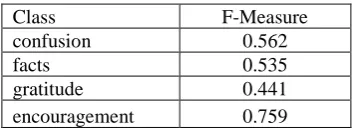
F-measures for the individual labels are pre-sented in Table 8. We used the feature selection results obtained on all the 970 posts with 1 label, i.e. experiment # 4 in Table 7. Encouragement was classified significantly better than other cate-gories: F-score = 0.759; the lowest F-score= 0.441 was obtained for classification of gratitude.
Those results may be explained by imbalanced distribution of categories: almost half of posts were labeled by encouragement (i.e., 494 posts out of 970 posts) while gratitude had been as-signed to the smallest number of posts (i.e., 69 out of 970). Thus, the automate method had enough training data to recognize encouragement, but not enough training data for recognition of gratitude.
To compare automated classification and hu-man annotation we calculated agreement between the results of automated analysis and the final set of labels used in the experiments. Cohen kappa is the worst for facts (0.380) and the best for en-couragement (0.489) (Table 9). Thus, humans and
Table 9: Inter-annotator agreement calculated for automated classification and final labels.
label
Per cent Agreement
Cohen kappa
confusion 85.9 0.478
facts 76.7 0.380
gratitude 93.2 0.405
encouragement 74.5 0.489 Table 8: Classification per label
Class F-Measure
confusion 0.562
facts 0.535
gratitude 0.441
encouragement 0.759
Table 7: Results of the 2nd set of the experiments on the selected set of features.
exper-iment
F algorithm
1 0.797 NB Multinomial 2 0.628 NB Multinomial 3 0.527 NB Multinomial 4 0.646 NB Multinomial
Table 6: Results of the 1st set of the experiments.
exper-iment
F
Fea-tures
algorithm
1 0.794 BOW NB Multinomial 2 0.504 BOW SVM
automated methods disagree more when they as-sign facts than when they asas-sign encouragement.
6
Conclusions and Future Work
We have presented a study of multi-class sen-timent annotation. We worked with a new data set of 970 texts collected from a health-related forum. To estimate the quality of annotations, we have applied several inter-annotation agreement met-rics. We have shown how those metrics can be used in evaluation of sentiment categories and an-notation schemes. Finally, we applied Machine Learning techniques to compare automated classi-fication and human annotation of the same data.
Our future work will expand current studies to new data sets. We aim to investigate various pro-tocols and procedures of generalization of senti-ment annotations, and how those procedures af-fect Machine Learning sentiment classification.
References
Ron Artstein, Massimo Poesio. 2008 Inter-coder agreement for computational linguistics. Computa-tional Linguistics Journal Volume 34 Issue 4, pages 555-596. doi: 10.1162/coli.07-034-R2
Adam Bermingham, Alan F. Smeaton. 2009 A study of inter-annotator agreement for opinion retrieval. In: SIGIR 2009 - The 32nd Annual ACM SIGIR Conference, pages 784-785.
Victoria Bobicev, Marina Sokolova and Michael Oak-es. 2015. What Goes Around Comes Around: Learning Sentiments in Online Medical Forums. Cognitive Computation, 7(5): 609-621.
http://dx.doi.org/10.1007/s12559-015-9327-y.
Victoria Bobicev, Marina Sokolova. 2017. Confused and Thankful: Multi-label Sentiment Classification of Health Forums. In: Mouhoub M., Langlais P. (eds) Advances in Artificial Intelligence. AI 2017. DOI: 10.1007/978-3-319-57351-9_33
Paul Ekman. 1992. An argument for basic emotions. Cognition and Emotion, vol. 6(3-4), pp. 169–200.
Andrea Esuli and Fabrizio Sebastiani. 2006. SENTI-WORDNET: A Publicly Available Lexical Re-source for Opinion Mining, In Proceedings of the 5th Conference on Language Resources and Evalu-ation (LREC’06), pages 417-422.
Mark A. Hall. 1999. Correlation-based Feature Selec-tion for Machine Learning, Ph.D. thesis, University of Waikato.
Andrew F. Hayes and Klaus Krippendorff. 2007. An-swering the Call for a Standard Reliability Measure
for Coding Data. Communication Methods and Measures Journal Volume 1, Issue 1, pp. 77-89.
Emi Ishita, Douglas W. Oard, Kenneth R. Fleisch-mann, An-Shou Cheng, Thomas Clay Templeton. 2010. Investigating multi-label classification for human values. Proceedings of the Association for Information Science and Technology. http://dx.doi.org/10.1002/meet.14504701116
Soumia Melzi, Amine Abdaoui, Jérôme Azé, Sandra Bringay, Pascal Poncelet, Florence Galtier. 2014. Patient's rationale: Patient Knowledge retrieval from health forums. eTELEMED 2014 : The Sixth International Conference on eHealth, Telemedi-cine, and Social Medicine.
Soumia Melzi, Amine Abdaoui, Jérôme Azé, Sandra Bringay, Pascal Poncelet, Florence Galtier. 2014. Patient's rationale: Patient Knowledge retrieval from health forums. eTELEMED 2014 : The Sixth International Conference on eHealth, Telemedi-cine, and Social Medicine.
Stefanie Nowak, Stefan Roger. 2010. How reliable are annotations via crowdsourcing? a study about in-ter-annotator agreement for multi-label image an-notation. In: Proceedings of the international con-ference on Multimedia information retrieval - MIR’10, p. 557.
Marina Sokolova and Victoria Bobicev. 2013. What Sentiments Can Be Found in Medical Forums? In Galia Angelova, Kalina Bontcheva, Ruslan Mitkov: Recent Advances in Natural Language Processing, RANLP 2013, Bulgaria.
Jacopo Staiano, Marco Guerini. 2014. DepecheMood: a Lexicon for Emotion Analysis from Crowd-Annotated News. Proceedings of the 52nd Annual Meeting of the Association for Computational
Lin-guistics, pages 427-433.
http://www.anthology.aclweb.org/P/P14/
Kai Steinert. 2017 Collaborative Web-Based Short Text Annotation with Online Label Suggestion. MA Thesis, TU Darmstadt.