Causal analysis of task completion errors in spoken music retrieval interactions
†
Sunao Hara,
‡Norihide Kitaoka,
‡Kazuya Takeda
†Graduate school of information science, Nara Institute of Science and Technology,
8916-5, Takayama-cho, Ikoma, Nara, Japan
‡Graduate school of information science, Nagoya University,
Furo-cho, Chikusa-ku, Nagoya, Aichi, Japan †[email protected],‡{kitaoka, kazuya.takeda}@nagoya-u.jp
Abstract
In this paper, we analyze the causes of task completion errors in spoken dialog systems, using a decision tree with N-gram features of the dialog to detect task-incomplete dialogs. The dialog for a music retrieval task is described by a sequence of tags related to user and system utterances and behaviors. The dialogs are manually classified into two classes: completed and uncompleted music retrieval tasks. Differences in tag classification performance between the two classes are discussed. We then construct decision trees which can detect if a dialog finished with the task completed or not, using information gain criterion. Decision trees using N-grams of manual tags and automatic tags achieved 74.2% and 80.4% classification accuracy, respectively, while the tree using interaction parameters achieved an accuracy rate of 65.7%. We also discuss more details of the causality of task incompletion for spoken dialog systems using such trees.
Keywords:Spoken dialog, Task incompletion, Interaction parameters
1.
Introduction
Estimating performance is a key issue in the design of spo-ken dialog systems, and the task completion rate is com-monly used as a performance metric. Generally, the task completion rate is calculated based on manually labeled transcriptions of dialog data. However, automatic perfor-mance assessment (e.g. assessment based on objective fea-tures) would generally be preferable from a cost stand-point. In addition, if a spoken dialog system can estimate its own performance on-line and in real time, the system can change its dialog strategies, reducing the risk of prob-lematic dialogs.
There have been a number of studies focused on detecting problematic dialogs in Interactive Voice Responses (IVRs) installed in call centers, e.g. (Walker et al., 2002; Kim, 2007; Herm et al., 2008; Engelbrecht and M¨oller, 2010). We have also proposed methods for predicting task comple-tion errors during music retrieval tasks (Hara et al., 2010; Hara et al., 2011a; Hara et al., 2011b). These studies were aimed at the detection of problematic dialogs, however the causality of these problematic dialogs has still not been in-vestigated sufficiently.
We based our study on the construction a model to esti-mate user satisfaction while using spoken dialog systems. From the users’ point of view, only the system’s output, such as speech prompts or responses, can be observed, not the system’s internal states. Therefore, a system’s outputs are assumed to strongly influence a user’s impression of the
system, which directly affects user satisfaction. Previously, we proposed an estimation method of user satisfaction for a spoken dialog system using an N-gram-based dialog history model (Hara et al., 2011a). The N-gram model was trained with user and system utterance sequences, which were en-coded according to the users’ and the system’s dialog utter-ances for each user satisfaction level. In this paper, we in-vestigate why users could not finished their music retrieval dialog tasks. For this purpose, we analyzed corpus specifi-cations, focusing on tag classification performance, which is the first step toward understanding overall system per-formance, and heavily related to our proposed method for detecting incomplete dialog problems. We then constructed decision trees for each of two features using our method; N-gram features and interaction parameter features. The trees were assumed to clarify the rank of importance of the com-ponent containing each feature.
Table 1: Relative frequency of user’s utterance-and-behavior tags in the corpus.
Definition of User tags Relative frequency of manual tags Relative frequency of automatic tags Total COMPLETE INCOMPLETE Total COMPLETE INCOMPLETE
REQUEST-BYARTIST 9.5 % 9.8 % 14.2 % 5.8 % 8.1 % 6.6 % REQUEST-BYMUSIC 14.7 % 21.9 % 15.5 % 11.8 % 19.2 % 10.8 % ANSWER-YES 7.3 % 10.8 % 7.8 % 5.9 % 8.6 % 6.4 % ANSWER-NO 2.1 % 2.1 % 3.2 % 5.2 % 4.4 % 8.6 %
CMD-THESONG 1.9 % 3.4 % 1.5 % 3.2 % 4.0 % 4.2 %
CMD-NEXTSONG 1.7 % 3.1 % 1.2 % 2.8 % 4.0 % 3.1 %
CMD-PREVIOUSSONG 0.8 % 1.4 % 0.6 % 1.5 % 1.8 % 1.9 %
CMD-HELLO 1.4 % 0.8 % 2.7 % 1.3 % 1.0 % 2.3 %
CMD-MICTEST 0.8 % 0.3 % 1.8 % 1.0 % 0.6 % 2.0 %
CMD-RESPEECH 0.7 % 1.0 % 0.7 % 0.9 % 1.1 % 1.2 % CMD-BACKHISTORY 0.2 % 0.2 % 0.2 % 0.8 % 0.6 % 1.4 %
CMD-STOP 6.2 % 8.3 % 7.3 % 5.3 % 7.1 % 6.3 %
CMD-INITIALIZE 1.2 % 0.7 % 2.4 % 1.9 % 1.1 % 3.6 %
CMD-EXIT 1.5 % 0.6 % 3.3 % 1.7 % 0.9 % 3.3 %
PUSH-INITIALIZEBUTTON 1.2 % 0.7 % 2.4 % 1.9 % 1.1 % 3.6 %
CATCHNOISE-TOOSHORT 0.3 % 0.3 % 0.3 % 0.4 % 0.4 % 0.4 %
CATCHNOISE-GMM 39.0 % 27.8 % 67.4 % 43.9 % 31.7 % 76.1 %
CATCHNOISE-ASR 0.0 % 0.0 % 0.0 % 2.4 % 2.2 % 3.8 %
UNDEFINED 10.2 % 7.4 % 18.4 % 3.6 % 2.8 % 6.3 %
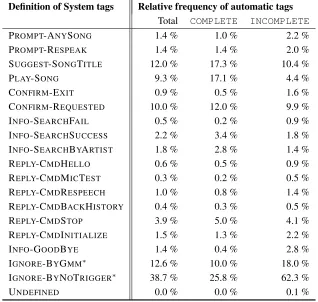
Table 2: Relative frequency of system’s utterance-and-behavior tags in the corpus. Definition of System tags Relative frequency of automatic tags
Total COMPLETE INCOMPLETE
PROMPT-ANYSONG 1.4 % 1.0 % 2.2 % PROMPT-RESPEAK 1.4 % 1.4 % 2.0 % SUGGEST-SONGTITLE 12.0 % 17.3 % 10.4 %
PLAY-SONG 9.3 % 17.1 % 4.4 %
CONFIRM-EXIT 0.9 % 0.5 % 1.6 % CONFIRM-REQUESTED 10.0 % 12.0 % 9.9 % INFO-SEARCHFAIL 0.5 % 0.2 % 0.9 % INFO-SEARCHSUCCESS 2.2 % 3.4 % 1.8 % INFO-SEARCHBYARTIST 1.8 % 2.8 % 1.4 %
REPLY-CMDHELLO 0.6 % 0.5 % 0.9 %
REPLY-CMDMICTEST 0.3 % 0.2 % 0.5 %
REPLY-CMDRESPEECH 1.0 % 0.8 % 1.4 % REPLY-CMDBACKHISTORY 0.4 % 0.3 % 0.5 %
REPLY-CMDSTOP 3.9 % 5.0 % 4.1 %
REPLY-CMDINITIALIZE 1.5 % 1.3 % 2.2 %
INFO-GOODBYE 1.4 % 0.4 % 2.8 %
System’s prompt / response and user’s utterance Utterance-and-behavior tags
USR: “SIMON AND GARFUNKEL”. REQUEST-BYARTIST SYS: Do you want to retrieve songs by “Simon and Garfunkel”? CONFIRM-KEYWORD USR: Yes. ANSWER-YES
SYS: Now, retrieving the songs by “SIMON AND GARFUNKEL”. INFO-SEARCHBYARTIST
SYS: 60 songs were found. INFO-SEARCHSUCCESS
SYS: “I AM A ROCK”. SUGGEST-SONGTITLE
SYS: “BRIDGE OVER TROUBLED WATER”. SUGGEST-SONGTITLE USR: That one, please. CMD-THESONG
SYS: Now, playing the song “BRIDGE OVER TROUBLED WATER”
by “SIMON AND GARFUNKEL.” (The system plays the song.) PLAY-SONG USR: Stop. CMD-STOP
SYS: OK, the song is stopped. (The system stops the song.) REPLY-CMDSTOP
Figure 1: Example of dialog and its corresponding encoded tags.
tion/incompletion dialog classification task. Tables 3 and 4 show the classification performance regarding “recall”, whose denominator is the number of manual tags, and “pre-cision”, whose denominator is the number of automatic (es-timated) tags.These tables also show the relative frequen-cies of major and minor errors along with the error rates for each manual and automatic tag.
As shown in the Table 3, the recalls of “REQUEST -BYARTIST” and “REQUEST-BYMUSIC” were low because of unknown words. We could also find many major errors due to estimation as CATCHNOISE-GMM. This means that MusicNavi2 was used in acoustically noisy environments. According to MusicNavi2’s dialog management strategy, ANSWER-YES and CMD-THESONG are the most impor-tant keywords, however there were a high number of errors that were unrecognized as CATCHNOISE-GMM. This er-ror might be one of the reason why users could not finished their music retrieval tasks.
The Table 4 shows that CATCHNOISE-TOOSHORT, CATCHNOISE-GMM, and CATCHNOISE-ASR achieved high precision rates, while UNDEFINED was misrecog-nized, making it of no use to the system. Attention should be also paid to the low precision rate of ANSWER-NO. This might be the cause of difficulty in recovery from misrecog-nition errors using the user’s negative representation, and it might also be the cause of user dissatisfaction. These re-sults also suggest that the noise rejection function should be performed more carefully.
3.2. N-gram feature of tag sequence
The N-gram, or N-order Markov chain, is a simple assump-tion for modeling sequential data, but is also a very use-ful modeling method (Kim, 2007; Engelbrecht and M¨oller, 2010; Hara et al., 2011a). We compared N-grams with
N=1, 2, 3 and denoted them as 1-, 1-2 and 1-3 grams, respectively; e.g., a 1-3 gram represents the features con-structed from the frequencies of 1-gram, 2-gram, and 3-gram1. The number of unique N-grams in the entire cor-pus were 38, 1036, 7798, respectively. For this experiment, we calculate the number of unique N-gram tags limited by two or more occurrences, which we called N-gram tag cut-offs, for both the manual tag and the automatic tag corpora. The manual tag corpus contained 38, 780, and 4144 unique cutoff N-grams, and the automatic tag corpus contained 38, 939, and 4576 unique cutoff N-grams. These numbers cor-respond to the feature vector lengths, which are used to con-struct decision trees in a following section.
3.3. Interaction parameters
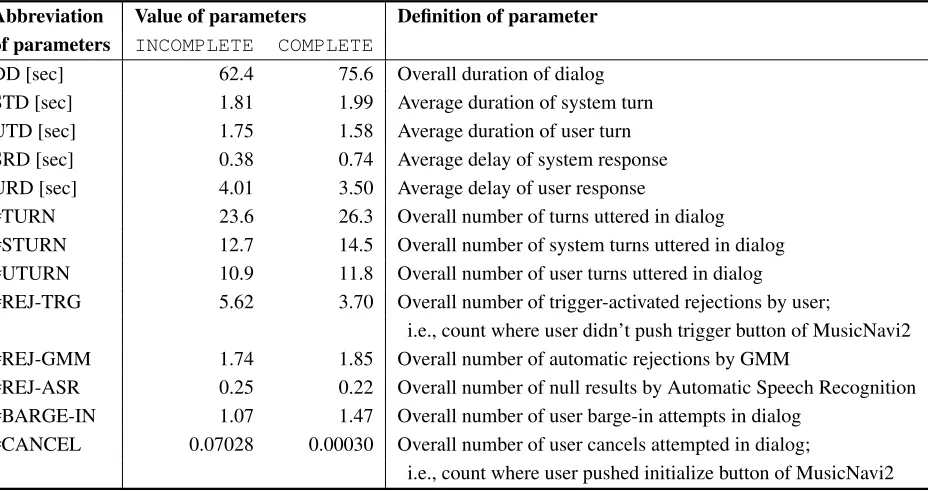
Interaction parameters were used for dialog quality evalua-tion (Schmitt et al., 2010; Engelbrecht and M¨oller, 2010; M¨oller, 2005), and one standardization has been estab-lished as the ITU-T Recommendation (ITU-T, 2005). In this study, we extracted 13 interaction parameters whose definitions and average parameters are shown in Table 5. Note that parameters REJ-GMM and REJ-TRG are the ex-tended parameters for our MusicNavi2 system and its cor-pus. Since the parameters in Table 5 are automatically ex-tracted from the system logs, they include errors caused by the speech recognition function of the system, as was the case with the automatic user tags.
4.
Structure of decision trees
We trained decision trees to detect task-incompletion us-ing the WEKA toolkit (Hall et al., 2009). The trees were
1We also tried usingN = 4and higher N-grams, however
Table 3: Recall of tag classification and relative frequencies of major/minor errors for manual tags. Tag (Manual) Recall Rel. frequency of major error Rel. frequency of minor error
REQUEST-BYARTIST 46.7 % CATCHNOISE-GMM 15.3 % REQUEST-BYMUSIC 6.9 % REQUEST-BYMUSIC 55.3 % CATCHNOISE-GMM 12.0 % UNDEFINED 6.5 % ANSWER-YES 64.9 % CATCHNOISE-GMM 28.2 % ANSWER-NO 3.9 % ANSWER-NO 83.0 % CATCHNOISE-GMM 12.3 % REQUEST-BYMUSIC 2.3 % CMD-THESONG 66.6 % CATCHNOISE-GMM 23.7 % REQUEST-BYMUSIC 3.0 % CMD-NEXTSONG 79.4 % CATCHNOISE-GMM 11.7 % ANSWER-NO 3.1 % CMD-PREVIOUSSONG 79.3 % CATCHNOISE-GMM 10.4 % REQUEST-BYMUSIC 4.6 % CMD-HELLO 65.6 % CATCHNOISE-GMM 15.9 % ANSWER-NO 5.5 % CMD-MICTEST 61.5 % CATCHNOISE-GMM 22.7 % CMD-PREVIOUSSONG 5.7 % CMD-RESPEECH 77.5 % CATCHNOISE-GMM 10.4 % REQUEST-BYMUSIC 2.6 % CMD-BACKHISTORY 69.8 % CATCHNOISE-GMM 14.5 % REQUEST-BYMUSIC 8.2 % CMD-STOP 62.3 % CATCHNOISE-GMM 24.2 % REQUEST-BYMUSIC 3.3 % CMD-INITIALIZE 81.4 % CATCHNOISE-GMM 9.9 % ANSWER-NO 3.2 % CMD-EXIT 68.0 % ANSWER-NO 10.4 % CATCHNOISE-GMM 6.5 % PUSH-INITIALIZEBUTTON 100.0 % — —
CATCHNOISE-TOOSHORT 100.0 % — —
CATCHNOISE-GMM 81.0 % CATCHNOISE-ASR 5.5 % REQUEST-BYMUSIC 3.1 % CATCHNOISE-ASR 62.5 % CATCHNOISE-GMM 25.0 % ANSWER-YES 12.5 % UNDEFINED 8.8 % CATCHNOISE-GMM 35.5 % REQUEST-BYMUSIC 12.5 %
Table 4: Precision of tag classification and relative frequencies of major/minor errors for automatic tags. Tag (Automatic) Precision Rel. frequency of major error Rel. frequency of minor error
REQUEST-BYARTIST 76.4 % REQUEST-BYMUSIC 7.2 % UNDEFINED 6.9 % REQUEST-BYMUSIC 68.8 % UNDEFINED 10.7 % CATCHNOISE-GMM 9.7 % ANSWER-YES 80.8 % UNDEFINED 6.8 % CATCHNOISE-GMM 4.7 % ANSWER-NO 33.3 % CATCHNOISE-GMM 17.7 % UNDEFINED 14.8 % CMD-THESONG 39.8 % UNDEFINED 17.7 % REQUEST-BYMUSIC 16.1 % CMD-NEXTSONG 47.5 % REQUEST-BYMUSIC 14.8 % CATCHNOISE-GMM 11.3 % CMD-PREVIOUSSONG 41.0 % UNDEFINED 16.0 % REQUEST-BYMUSIC 15.2 % CMD-HELLO 69.0 % CATCHNOISE-GMM 9.1 % REQUEST-BYMUSIC 7.6 % CMD-MICTEST 48.6 % REQUEST-BYMUSIC 17.2 % UNDEFINED 14.5 % CMD-RESPEECH 57.9 % REQUEST-BYMUSIC 12.2 % UNDEFINED 12.2 % CMD-BACKHISTORY 14.6 % REQUEST-BYMUSIC 26.4 % UNDEFINED 23.5 %
CMD-STOP 72.7 % UNDEFINED 8.9 % REQUEST-BYMUSIC 6.8 %
CMD-INITIALIZE 52.4 % REQUEST-BYMUSIC 15.1 % REQUEST-BYARTIST 12.2 % CMD-EXIT 62.5 % UNDEFINED 14.0 % REQUEST-BYMUSIC 12.4 % PUSH-INITIALIZEBUTTON 100.0 % — — CATCHNOISE-TOOSHORT 67.5 % UNDEFINED 26.6 % ANSWER-YES 1.9 % CATCHNOISE-GMM 71.5 % UNDEFINED 8.5 % ANSWER-YES 4.9 % CATCHNOISE-ASR 0.2 % CATCHNOISE-GMM 87.1 % UNDEFINED 8.3 % UNDEFINED 24.9 % REQUEST-BYMUSIC 26.7 % CATCHNOISE-GMM 22.2 %
constructed based on information gain, and its maximum depth was constrained to 52. Two decision trees were
con-2
We used the ’REPtree’ method of WEKA, which can more easily control the depth of the tree than ’J48’ method, with only
structed, one for manual tags and one for automatic tags. Input features were vectors consisting of N-gram frequen-cies of automatic utterance-and-behavior tags for each
Table 5: Interaction parameters of dialog data in corpus, their value and definitions. Abbreviation Value of parameters Definition of parameter
of parameters INCOMPLETE COMPLETE
DD [sec] 62.4 75.6 Overall duration of dialog STD [sec] 1.81 1.99 Average duration of system turn UTD [sec] 1.75 1.58 Average duration of user turn SRD [sec] 0.38 0.74 Average delay of system response URD [sec] 4.01 3.50 Average delay of user response
#TURN 23.6 26.3 Overall number of turns uttered in dialog #STURN 12.7 14.5 Overall number of system turns uttered in dialog #UTURN 10.9 11.8 Overall number of user turns uttered in dialog
#REJ-TRG 5.62 3.70 Overall number of trigger-activated rejections by user;
i.e., count where user didn’t push trigger button of MusicNavi2 #REJ-GMM 1.74 1.85 Overall number of automatic rejections by GMM
#REJ-ASR 0.25 0.22 Overall number of null results by Automatic Speech Recognition #BARGE-IN 1.07 1.47 Overall number of user barge-in attempts in dialog
#CANCEL 0.07028 0.00030 Overall number of user cancels attempted in dialog;
i.e., count where user pushed initialize button of MusicNavi2
log, or the interaction parameters for each dialog.
4.1. N-gram feature of tag sequence
Figures 2(a) and 2(b) show the structures of the decision trees using 3-gram frequencies with manual tags and auto-matic tags, respectively. These trees achieved 74.2% and 80.4% discrimination accuracy by 10-fold cross validation, respectively.
These figures show that the automatic tags needed the 3-gram, but that it was not needed with the manual tags. This might be caused by differences in the complexity of the N-gram tag patterns in each corpus. Interestingly, the accu-racy rate achieved using the automatic tags was the same as the rate using the manual tags. This was because the auto-matic tags included the misrecognition errors of the speech recognition system. In other words, although the automatic tag corpus contains only the system’s understanding of re-sults and actions, the tags represent the actual interaction between the user and the system.
4.2. Interaction parameters
Figure 3 shows the structure of the tree using interaction parameters. This tree achieved 65.7% discrimination accu-racy by 10-fold cross validation.
The results shown in the figure suggest the importance of the parameter “SRD” for task-incomplete detection. The “#CANCEL” parameter was used in the 2nd stage, however this was not important because users could restart their mu-sic retrieval dialog using the “cancel button” on the GUI of MusicNavi2. Regarding the usage of the parameters shown
in Figure 3, there were 9 important parameters, namely; SRD, #CANCEL, URD, STD, #REJECT-TRG, DD, UTD, URD, and #STURN.
The N-gram features and interaction parameters could be concatenated, and the concatenated parameters could be used to construct a more accurate decision tree than if only individual features are used, but this is a topic for future work.
5.
Summary
The causes of task completion errors in spoken dialog systems were analyzed using detection trees with N-gram features of the music retrieval dialog. Results using this method suggested that higher order N-grams are note par-ticularly effective for increasing the detection rate, but also illustrated the importance of the last part of the dialog for detecting task completion.
These findings should be applied to methods for detection of task-incompletion dialogs or other problematic dialogs in future work. This study used only linguistic information, however, acoustic information must also be important. This is also a subject for future work.
6.
Acknowledgements
This work was supported in part by the NEDO Grant for Industrial Technology Research Program (07A12203a) and KAKENHI (23500209).
7.
References
(a) Using the manual tags
(b) Using the automatic tags