EFFECT OF TABATA INTERVAL METHODS ON BODY FAT AND VO2MAX OF SCHOOL STUDENTS
R.SARAVANAN
Physical Education Teacher, Government Hr. Sec. School., PoyyundarKottai, Tanjore District.
Dr. SUGUMAR.C.
Deputy Director of Physical Education, GandhigramRural Institute - Deemed
University, Gandhigram,Dindigul
Abstract :
The purpose of the study was to find out the effect of tabata interval methods on body fat and Vo2max among school students. In this study forty-five school student those who represented
Divisional and State level competitions irrespective of sports and games were selected randomly from the Navbharath Matriculation Higher Secondary School, Ponnaiyah Ramajayam Public Higher Secondary School and St. Antony’s Higher Secondary School, Thanjavur, Tamil Nadu, India. Data were collected from each subject before and after the training period. The collected data were statistically analysed by using dependent ‘t’ test and analysis of covariance (ANCOVA). It was found that there was significant reduction on body fat percentage and increase the Vo2max level of experimental groups when compared to the
control group.
KEY WORDS:
Tabata Training, Interval Training, Body fat and Vo2max level
INTRODUCTION
The increasing standard of economic conditions during the last decades enabling the full availability of food and allowing for changes in the composition of dietary intake has been contributing not only to an accelerated growth in height and weight, but also to a disproportional development of body composition, resulting in overweight and obesity. In 2011, more than 40 million children under the age of five were overweight globally, including developing countries (WHO, 2013). WHO’s Asia-Pacific standard of obesity, people with a BMI of <23, ≥23 but<25 and ≥25 were defined as normal, overweight, and obese, respectively, and males with a waist circumference of ≥90cm were defined as obese (WHO, 2000). Obesity has become one of the major health concerns of modern times. It is estimated that over 700 million people across the world are currently either overweight or obese (Scully, 2012).
Body weight and body composition should not be the sole criterion for participation in sports. Optimal body fat levels depend upon the sex, age, and heredity of the athlete, and may be sport-specific (Rodriguez, Di Marco and Langley, 2009). Body composition, sports performance and body fat percentage of athletes varies depending on the sex of the athlete and the sport. The estimated minimal level of body fat compatible with health is 5% for men and 12% for women (Heymsfield, et al., 2005); however, optimal body fat percentages for an individual athlete may be much higher than these minimums and should be determined on an individual basis (Marfell, et al., 2006). Body composition analysis should not be used as a criterion for selection of athletes for athletic teams. Weight management interventions should be thoughtfully designed to avoid detrimental outcomes with specific regard for performance, as well as body composition (ie, loss of lean body mass).
considered the best indicator of cardio-respiratory endurance and aerobic fitness (Carey and Richardson, 2003). Of course, in elite athletes VO2max is not a good predictor of performance. While a high VO2max
may be a prerequisite for performance in endurance events at the highest level, other markers such as anaerobic threshold are more predictive of performance (Willmore and Costill, 2005).
Interval training is based on a very simple concept: go fast then go slow. For those who are always using the excuse that there is not enough time to exercise, there is a new solution – Tabata Training. The full Tabata program is four minutes long; it will probably feel like the longest four minutes of one’s life. Tabata Training is the fastest way to fitness and fat loss. Tabata interval training is the single most effective type of high intensity interval training, it’s also the most intense by far, and surprisingly it’s the shortest in duration, it only last for four minutes… but those four minutes produce remarkable effects. Lose Fat, Get Fit in four minutes (http://www.intervaltraining.net/tabata.html). Tabata and a variety of short HIIT formats are highly popular intense forms of interval training. Research shows that Tabata and short HIIT workouts can be used to increase both aerobic and anaerobic fitness, promote fat loss, and even improve blood pressure, insulin sensitivity, and glucose regulation in a relatively short time (Olson,2014). After having gone through the various studies, investigator planned to study the effect of tabata interval methods of various durations on body fat and Vo2max among school students.
OBJECTIVES OF THE STUDY
The following are the specific objectives of this study.
1. To find out the effect of tabata interval method of 1 : 1 ratio (20 seconds active period : 20 seconds rest period) on body fat and VO2max among school students.
2. To find out the effect of tabata interval method of 1 :0.5 ratio (20 seconds active period : 10 seconds rest period) on body fat and VO2max among school students.
3. To find out the best training method to maintain the body fat and VO2max among school students.
METHODOLOGY
To achieve the purpose of the study, forty-five school students those who represented Divisional and State level competitions irrespective of sports and games were selected randomly from the Navbharath Matriculation Higher Secondary School, Ponnaiyah Ramajayam Public Higher Secondary School and St. Antony’s Higher Secondary School, Thanjavur, Tamil Nadu, India. The age of the subjects ranged between 15-17 years. The selected subjects were divided into two experimental groups: Group I (TTG1 - Tabata Interval Training group with 1:1 ratio (20seconds active period :20seconds rest period), Group II (TTG2 - Tabata Interval Training group with 1: 0.5 ratio (20seconds active period:10seconds rest period)) and a control group (CG) with fifteen subjects (n=15) each. The following physiological variables namely body fat and VO2max were selected and it was tested by using Karada Scan Test and Bleep Test.
The pre test data were collected two days before the training programme and the posttest data were collected three days after the training programme.
ANALYSIS OF DATA
TABLE I
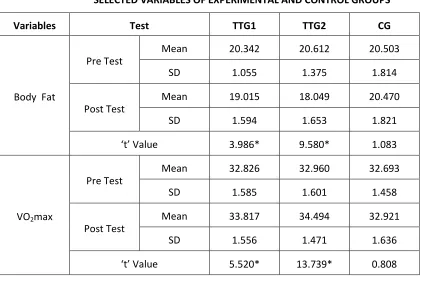
SUMMARY OF MEAN STANDARD DEVIATION AND DEPENDENT‘t’ TEST FOR THE PRE AND POST ON SELECTED VARIABLES OF EXPERIMENTAL AND CONTROL GROUPS
Variables Test TTG1 TTG2 CG
Body Fat
Pre Test
Mean 20.342 20.612 20.503
SD 1.055 1.375 1.814
Post Test
Mean 19.015 18.049 20.470
SD 1.594 1.653 1.821
‘t’ Value 3.986* 9.580* 1.083
VO2max
Pre Test
Mean 32.826 32.960 32.693
SD 1.585 1.601 1.458
Post Test
Mean 33.817 34.494 32.921
SD 1.556 1.471 1.636
‘t’ Value 5.520* 13.739* 0.808
*Significant at .05 level.
The table value required for .05 level of significance with df14 is 1.761.
TABLEII
ANALYSIS OF COVARIANCE ON CRITERION VARIABLES OF EXPERIMENTAL AND CONTROL GROUPS
Variables
Adjusted Post Test Mean S O V
Sum of Squares df
Mean
Squares F-Ratio TTG1 TTG2 CG
Body Fat
19.151 17.929 20.454
B 47.789 2 23.894
23.894*
W 41.000 41 1.000
VO2max
33.818 34.368 33.046
B 13.161 2 6.581
22.252*
W 12.125 41 0.296
* Significant at 0.05 level of confidence.
TABLE III
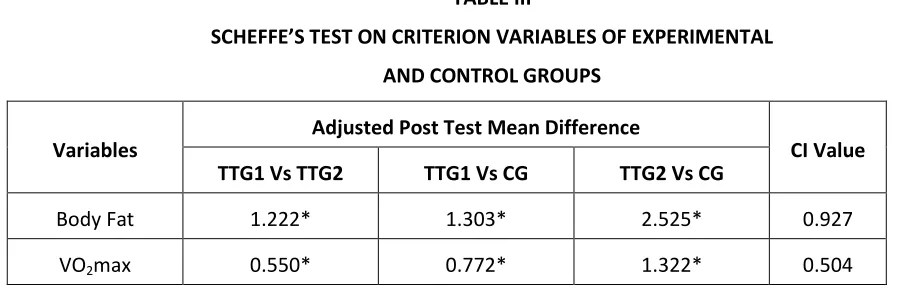
SCHEFFE’S TEST ON CRITERION VARIABLES OF EXPERIMENTAL
AND CONTROL GROUPS
Variables Adjusted Post Test Mean Difference CI Value TTG1 Vs TTG2 TTG1 Vs CG TTG2 Vs CG
Body Fat 1.222* 1.303* 2.525* 0.927
VO2max 0.550* 0.772* 1.322* 0.504
* Significant at 0.05 level.
RESULTS
The results of the study indicate that significant difference exist among the pre, post and adjusted post test means of experimental and control groups on body fat and VO2max among school
students.
DISCUSSION
Physical activity increases fat oxidation (Schrauwen and Esterterp, 2000), Moderate-intensity exercise yields the most grams of fat used for oxidation in the average individual (Hansen, et al., 2005), inactivity reduces the oxidation of saturated but not monounsaturated dietary fat (Bergouignan, et al., 2006), and exercise increases monounsaturated fat oxidation more than saturated fat oxidation regardless of exercise intensity (Votruba, et al.,2003). A combination of a high-fat intake and physical inactivity has a higher risk for obesity than a combination of a high-carbohydrate diet and physical inactivity (Shepard, et al., 2001). Thus, regular physical activity is protective and helps to maintain a healthy body composition (Hansen, et al., 2007). Baquet, et al., (2002),suggested that after seven weeks of HIIT training the experimental group significantly improved absolute peak VO2 and VO2 peak relative to body mass. The increase in fat mass in children has occurred concomitantly with a decline in cardio-respiratory fitness (Tomkinson, et al., 2003). Boutcher (2011), concluded that high intensity intermittent exercise induced body fat loss. The result of the present research findings also incorporated with the findings of Buchheit and Laursen (2013); Helgerud, et al., (2007); and Tabata, et al., (1997),Tremblay, et al., (1994); Hasan, et al., (2014); and Costigan, et al., (2015).
CONCLUSIONS
The current study spotlights on tabata interval training with 1:1 ratio and tabata interval training with 1:0.5 ratio on selected criterion variables among school students. At the same time 20: 10 seconds tabata interval training reduces body fat and increases VO2max level than tabata interval training
REFERENCES
1. Baquet, G., Berthoin, S., Dupont, G., Blondel, N., Fabre, C., and Van Praagh, E., (2002), Effects of High Intensity Intermittent Training on Peak VO2 in PrepubertalChildren”, International Journal of Sports
Medicine, 23, 439-444.
2. Bergouignan A, Schoeller DA, Normand S, Gauquelin-Koch G, Laville M, Shriver T, (2006), “Effect of Physical Inactivity on the Oxidation of Saturated and Monounsaturated Dietary Fatty Acids: Results of a Randomized Trial”, PLoSClin Trials., 1:e27.
3. Boutcher, S.H., (2011), “High-Intensity Intermittent Exercise and Fat Loss”, Journal of Obesity : 868305. doi: 10.1155/2011/868305. Epub 2010 Nov 24.
4. Buchheit, M. and Laursen, P.B. (2013), “High-Intensity Interval Training, Solutions to the Programming Puzzle. Part II: Anaerobic Energy, Neuromuscular Load and Practical Applications”, Sports Medicine, 43(10), PP.927-54.
5. Carey, D.G. and Richardson, M,T., (2003), “Can aerobic and anaerobic power be measured in a 60-second maximal test?”, J Sports Sci Med., 2, PP.151—7.
6. Costigan, S.A.,Eather, N., Plotnikoff, R C., Taaffe, D R. and Lubans, D R., (2015), “High-Intensity Interval Training For Improving Health-Related Fitness In Adolescents: A Systematic Review and Meta-Analysis”, British Journal of Sports Medicine, 49, PP.1253-1261.
7. Craig, N.P. and Norton, K.I., (2001), “Characteristics of track cycling”, Sports Med, 31, PP.457-468.
8. Hansen K, Shriver T, Schoeller D. (2005), “The Effects of Exercise on the Storage and Oxidation of Dietary Fat”, Sports Med., 35, pp.163–73.
9. Hansen KC, Zhang Z, Gomez T, Adams AK, Schoeller DA. (2007), “Exercise Increases the Proportion of Fat Utilization during Short-Term Consumption of a High-Fat Diet”, Am J ClinNutr., 85, pp.109–16.
10. Hasan Matinhomaee, JamshidBanaei, MohammadaliAzarbayjani and VahidZolaktaf, (2014), “Effects of 12-Week High-Intensity Interval Training on Plasma VisfatinConcentration and Insulin Resistance in Overweight Men”, Journal of Exercise Science & Fitness, 22, PP.1-6.
11. Helgerud, J., Hoydal, K., Wang, E., Karlsen, T., Berg., and Palr., (2007), “Aerobic High Intensity Intervals Improve VO2max More than Moderate Training”. Medicine and Science in Sports and
Exercise, 39(4), PP.665-671.
12. Heymsfield, S., Lohman, T., Wang, Z. and Going, S., (2005), Human Body Composition. 2nd ed. Champaign, Illinois : Human Kinetics.
13. Marfell-Jones M, Olds T, Stewart A, Carter L. (2006), International Standards for Anthropometric
Assessment. Potchefstroom (Africa): International Society for the Advancement of
Kinanthropometry (ISAK).
14. Olsen. M., (2014), “Tabata It’s a HIIT”, ACSM’s Health and Fitness Journal, 18(5), PP.17-24.
15. Rodriguez, N.R., Di Marco, N.M. and Langley, S., (2009),“Nutrition and athletic performance”, Med Sci Sports Exerc., 41(3), PP.709-31.
16. Schrauwen P, Westerterp KR. (2000), “The Role of High-Fat Diets and Physical Activity in the Regulation of Body Weight”, Br J Nutr., 84, pp.417–27.
18. Shepard TY, Weil KM, Sharp TA, Grunwald GK, Bell ML, Hill JO, (2001), “Occasional Physical Inactivity Combined with a High-Fat Diet may be Important in the Development and Maintenance of Obesity in Human Subjects”, Am J ClinNutr., 73,pp.703–8.
19. Tabata, I., Irisawa, K., Kouzaki, M., Nishimura, K., Ogita, F. and Miyachi, M. (1997), “Metabolic Profile of High Intensity Intermittent Exercises”, Medicine and Science in Sports and Exercise, 29(3), PP.390-5.
20. Tomkinson GR, Leger LA, Olds TS, Cazorla G.(2003), “Secular Trends in the Performance of Children and Adolescents (1980-2000): an Analysis of 55 Studies of the 20m Shuttle Run Test in 11 Sountries”,Sports Med., 33, pp.285-300.
21. Tremblay, A., Simoneau, J.A. and Bouchard, C., (1994), “Impact of Exercise Intensity on Body Fatness and Skeletal Muscle Metabolism”, Metabolism, 43(7), PP.814-8.
22. Votruba SB, Atkinson RL, Schoeller DA. (2003), “Prior Exercise Increases Dietary Oleate but not Palmitate Oxidation”, Obes Res., 11, pp.1509–18.
23. World Health Organization, (2013), “Obesity and Overweight”, Fact Sheet No 311, Updated March 2013.
24. WHO/IASO/IOTF. (2000), The Asia-Pacific perspective: redefining obesity and its treatment. Melbourne: Health Communications Australia.