Testing Of Validity And Reliability Of The
Construction Of Job Satisfaction In Teachers Of
X Elementary School In Tenggarong
Danu Fareza, Fatwa Tentama
Abstract: The purpose of this study is to analyze the validity and reliability of the construction of job satisfaction, and to find dimensions and indicators that can shape the construction of job satisfaction. The data collection method used a scale of job satisfaction. The scale of job satisfaction is measured by five dimensions, namely pay, work itself, coworkers, promotions, and supervision. The subjects in this study were 60 teachers who worked at the "X" elementary school in Tenggarong. Sampling used a random sampling technique. Data in this study were analyzed using Structural Equation Modeling (SEM) SmartPLS 3.2.8 with reflective construction through CFA 2nd Order. Based on the results of the analysis of constructive validity and reliability, the dimensions and indicators that make up job satisfaction for teachers are declared valid and reliable. All dimensions and indicators can significantly form the construction of job satisfaction. Thus the model can be accepted because the theory that describes job satisfaction in accordance with empirical data obtained. The dimension that has a dominant influence on job satisfaction is supervision (leadership) with a loading factor of 0.913.
Abstract: CFA 2nd Order, Coworkers, Job Satisfaction, Partial Least Square, Pay, Promotion, Supervision
—————————— ——————————
1.
INTRODUCTION
The main task of the teacher as a professional educator includes educating, teaching, guiding, directing, training, assessing and evaluating students with formal education, basic education, and secondary education [1]. The teacher is one of the important factors in improving the quality of education. The teacher becomes an inseparable part of the education system and is directly involved in the teaching and learning process. Teacher quality can be seen from the teacher's professionalism in teaching. Job satisfaction of every teacher in the field has almost the same thing, which is related to the pay that can be obtained, related to coworkers, promotion, and supervision (leadership). The results of interviews with eight teachers revealed that teachers have not been able to understand the tasks that must be done well. However, the existence of mutual assistance between teachers makes teachers feel satisfaction while working. Hasibuan [2] state that high demands on teacher job satisfaction must be accompanied by supporting policies, because it is feared to be counter-productive. Job satisfaction in teachers is important because it can affect the educational process and teacher performance [3]. Other results show that job satisfaction influences organizational culture, commitment and performance [4], [5]. Low job satisfaction is related to turnover [6], occupational injuries [7], decrease in health [8], and poor emotional control [9].
The definition of job satisfaction over the years has been developed by many experts. Hoppok and Spielgler [10] mention that job satisfaction is a set of integrated psychological, physiological and environmental conditions, which encourage employees to recognize that they are satisfied or happy with their work. Furthermore Vroom [11] states that job satisfaction is the emotional orientation of employees towards the roles they perform in the workplace. Job satisfaction is an important component for employees’ motivation and encouragement for better performance. Clark [12] argues that if employees feel dissatisfied with the tasks
assigned, they are not sure about the factors that support job satisfaction itself, such as their rights, unsafe working conditions, uncooperative coworkers, supervisors do not respect them and they are not considered in the decision making process, that making them feel separated from the organization. This study uses the grand theory of Smith, Kendall and Hullin [13] which states that job satisfaction is closely related to emotional states that are pleasant or unpleasant according to the way employees view their work. Locke [14] defines job satisfaction as a positive or pleasant emotional as the results of personal appreciation of their own work or experience. Meanwhile, according to Judge and Robbins [15] job satisfaction is an individual's general attitude towards his job. Work requires interaction with colleagues and superiors follows organizational rules and policies, meets performance standards, lives in working conditions that are often less than ideal, and other similar things. Besides Grifin, and Moorhead [16] revealed that job satisfaction is the extent to which someone feels satisfied or dissatisfied with his work. Job satisfaction will reflect the degree to which people find satisfaction in their work. Levy [17] defines job satisfaction as a positive and pleasant emotional as the results of a cognitive assessment of personal work or work experience. Empirical studies of job satisfaction have been going on for years. The results of the study show that job satisfaction influences employee’s benefits, human resource policies, retention [18], and organizational citizenship behavior [19]. Job satisfaction also affects working stress [20], as well as working performance and achievement [21], [22]. Smith, Kendall and Hullin [13] state that there are five dimensions create job satisfaction; 1) Pay, which is the employee's desire for fairness of the compensation system and promotion policies. Fairness will be felt if the provision of salaries is in accordance with the demands of the job, individual skill levels, and community wage standards. 2) Job itself, employees tend to prefer jobs that provide opportunities to use their abilities and skills, freedom, and feedback on how well they work. This makes the work feel more challenging. Less challenging work creates boredom, but too much challenge can also create frustration and failure. 3) Colleagues, working colleagues play a role to fill the need for social interaction. Therefore it is not surprising that having friendly and supportive colleagues will increase job ————————————————
Danu Fareza, Faculty of Psychology Ahmad Dahlan University, Yogyakarta, PH-082354889905. E-mail: [email protected] Fatwa Tentama, Faculty of Psychology Ahmad Dahlan University,
355 satisfaction. 4) Promotion, when promoted employees
generally face increasing demands, expertise, abilities and responsibilities. Most employees feel positive because they are promoted. 5) Supervision (supervisor), this relates to employees directly and affects employees in doing their work. Employees generally prefer to have fair, open-minded and cooperative supervisor.
H: The dimensions of pay, work itself, coworkers, promotions and supervision can create job satisfaction.
One of approaches that can be used in testing the construction of a measuring instrument is Confirmatory Factor Analysis. Confirmatory Factor Analysis (CFA) is one of the main approaches in factor analysis. CFA can be used to test the dimensionality of a construction. This test is used to measure the model (model measurement) so that it can describe the dimensions and indicators of behavior in reflecting latent variables namely job satisfaction by looking at the factor loading of each dimension that forms a construction. Confirmatory Factor Analysis (CFA) is also used to test the constructive validity and reliability of the indicators (items) forming latent construction [23]. The CFA used in this study is a second order confirmatory factor analysis (2nd Order CFA), a measurement model that consists of two levels. The first level of analysis is carried out from the latent construction of the dimension to its indicators and the second analysis is carried out from the latent construction to its dimension construction [23].Based on the description above, the problem identification in this study are: 1) Is the construction of job satisfaction valid and reliable? 2) Are the salary indicators, job itself, coworkers, promotion and supervision able to create the construction of job satisfaction?. The objective of this research is to: 1) Know the validity and reliability of the construction of job satisfaction. 2) Find indicators that can create the construction of job satisfaction.
2 RESEARCH METHOD
2.1 Research Participant
The participant in this research were 60 elementary school teachers in Tenggarong, Kutai Kartanegara Regency of East Kalimantan Province. This research uses a sampling
technique that is a random sampling technique.
2.2 Research Design
The design in this research is semi-construction, where the scale design will be conducted using theoretical collaborative studies with information directly obtained from field data. The advantage of using this semi-construction design is to strengthen existing theories and reproduce as many behavioral indicators as possible. Then testing the psychometric properties, including content validity analysis, discriminating power, confirmatory factor analysis, and external concurrency validity [24].
2.3 Data Collecting Method
The preparation of job satisfaction scale uses a differential semantic scale. This scale is based on the dimensions of job satisfaction expressed by Luthans [13], namely pay, work itself, job promotion, and supervision. It can be seen in the table 1 below.
TABLE 1
EXAMPLES OF PAY DIMENSION ITEMS AND COWORKERS DIMENSION
In my opinion, the pay that I got ...
Enough 1 2 3 4 5 Less
Fair 1 2 3 4 5 Not fair
In my opinion, my coworkers at work are ...
Friendly 1 2 3 4 5 Annoying
Kind 1 2 3 4 5 Bad
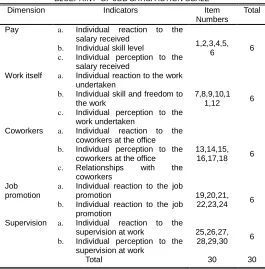
The making of items in this research refers to the blueprint scale of job satisfaction which can be seen in table 2.
TABLE 2
BLUEPRINT OF JOB SATISFACTION SCALE
Dimension Indicators Item
Numbers Total
Pay a. Individual reaction to the salary received
b. Individual skill level
c. Individual perception to the salary received
1,2,3,4,5,
6 6
Work itself a. Individual reaction to the work undertaken
b. Individual skill and freedom to the work
c. Individual perception to the work undertaken
7,8,9,10,1
1,12 6
Coworkers a. Individual reaction to the coworkers at the office b. Individual perception to the
coworkers at the office c. Relationships with the
coworkers
13,14,15, 16,17,18 6
Job promotion
a. Individual reaction to the job promotion
b. Individual reaction to the job promotion
19,20,21, 22,23,24 6
Supervision a. Individual reaction to the supervision at work
b. Individual perception to the supervision at work
25,26,27, 28,29,30 6
Total 30 30
Job Satisfaction Pay
Supervision Promotion Coworkers Work itself
2.4 Validity and Reliability
This research is aimed to test the constructive reliability and validity of measuring instruments for job satisfaction with an outer model test. The constructive validity test conducted is confirmatory in order to show how well the results obtained from the use of measuring instruments with reference to the theory used in defining the construction. The constructive validity test included convergent validity, referring to the results of the loading factor value > 0.5, the average variance extracted value or AVE > 0.05 and the discriminant validity was performed by comparing the roots of the average variance extracted or AVE where the value must be higher than the correlation among the existing dimensions. Next is a reliability test with the aim to show internal consistency in the measuring instruments used. The method is by looking at the value of composite reliability and Cronbach's alpha which according to Cooper the value that must be owned is > 0.7 [25].
2.5 Data Analysis
The data in this research were analyzed using the SmartPLS 3.2.8 program with reflective construction through the 2nd Order CFA. According to Abdillah and Hartono [26] PLS is a variance-based structural equation analysis (SEM) that can simultaneously testing the measurement models to test validity and reliability.
3 RESULT
Based on the results of outer model test analysis on the scale of job satisfaction conducted using the SmartPLS 3.2.8 program, the results can be seen as shown in the figure2 below:
3.1 The Validity Test Result 3.1.1 Convergent Validity
Based on the convergent validity test on the outer model, it was found that the factor loading values from variables to dimensions had values > 0.5 as shown in table 3.
TABLE 3
LOADING FACTOR VALUES (VARIABLE-DIMENSION)
Dimension Loading factor Annotation
Salary 0.585 Valid
Work itself 0.848 Valid
Coworkers 0.839 Valid
Job promotion 0.895 Valid
Supervision 0.913 Valid
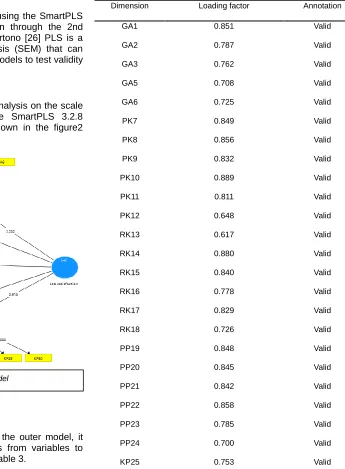
Based on the convergent validity test on the outer model, it was found that the factor loading value from dimensions to indicators has a value> 0.5, which is shown in table 4.
TABLE 4
FACTOR LOADING VALUE (DIMENSION-INDICATOR)
Dimension Loading factor Annotation
GA1 0.851 Valid
GA2 0.787 Valid
GA3 0.762 Valid
GA5 0.708 Valid
GA6 0.725 Valid
PK7 0.849 Valid
PK8 0.856 Valid
PK9 0.832 Valid
PK10 0.889 Valid
PK11 0.811 Valid
PK12 0.648 Valid
RK13 0.617 Valid
RK14 0.880 Valid
RK15 0.840 Valid
RK16 0.778 Valid
RK17 0.829 Valid
RK18 0.726 Valid
PP19 0.848 Valid
PP20 0.845 Valid
PP21 0.842 Valid
PP22 0.858 Valid
PP23 0.785 Valid
PP24 0.700 Valid
KP25 0.753 Valid
357
KP26 0.781 Valid
KP27 0.917 Valid
KP28 0.920 Valid
KP29 0.692 Valid
KP30 0.888 Valid
Based on the convergent validity test value shows the average variance extracted or AVE in the construction of job satisfaction by 0.523 with the average variance extracted or AVE value in each dimension can be seen in table 5.
TABLE 5
AVERAGE VARIABLE EXTRACTED VALUE OF THE CONSTRUCTION OF JOB SATISFACTION
Dimension AVE Annotation
GA 0.590 Valid
PK 0.669 Valid
RK 0.613 Valid
PP 0.664 Valid
KP 0.689 Valid
3.1.2 Discriminant Validity
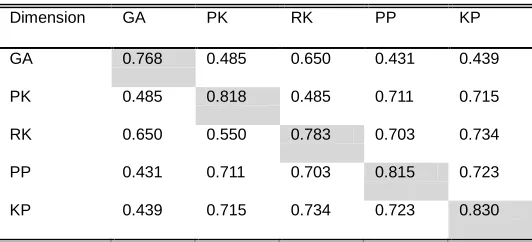
Based on the discriminant validity test values, it shows that the root results of the Average Variance Extracted or AVE in each dimension are higher than the average variance extracted root or AVE in other dimensions, so that the discriminant validity criteria are fulfilled. Average Variance Extracted (AVE) root value of the construction of job satisfaction can be seen in table 6.
TABLE 6
AVE ROOT VALUE OF THE CONSTRUCTION OF JOB SATISFACTION
Dimension GA PK RK PP KP
GA 0.768 0.485 0.650 0.431 0.439
PK 0.485 0.818 0.485 0.711 0.715
RK 0.650 0.550 0.783 0.703 0.734
PP 0.431 0.711 0.703 0.815 0.723
KP 0.439 0.715 0.734 0.723 0.830
The constructive validity in SEM (Confirmatory Factor Analysis / CFA) shows that all four dimensions are valid with a loading factor value (λ) ≥ 0.5.
3.2 The Construct of Reliability Test
Based on the results of the constructive reliability test conducted, the Composite Reliability and Cronbach’s Alpha values > 0.7 can be obtained so that the items used in this study are reliable.
TABLE 7
COMPOSITE RELIABILITY AND CRONBACH ALPHA OF JOB SATISFACTION
Variable Composite Reliability
Cronbach
alpha Annotation
Job satisfaction 0.961 0.957 Valid
The results of constructive reliability testing using Confirmatory Factor Analysis 2nd Order in Table 6 above shows that construction have good reliability and give meaning that the dimensions that measure constructions of job satisfaction are fulfilled the unidimensional criteria [27]. This is indicated by the value of Composite Reliability 0.961 and Cronbach’s Alpha 0.957.Constructive validity and reliability test produces valid and reliable items that are able to reflect the dimensions of job satisfaction, namely items on numbers 1, 2, 3, 5, 6, 7, 8, 9, 10, 11, 12, 13, 14, 15, 16, 17, 18, 19, 20, 21, 22, 23, 24, 25, 26, 27, 28, 29, and 30. While there is only one item that is not able to reflect job satisfaction, that is the item at number 4. Based on the processing and analysis of research data on the dimensions of the construction of job satisfaction formed using the 2nd Order Confirmatory Factor Analysis, the results show that the model is acceptable, because all dimensions are able to reflect on the construction formed.
4 DISCUSSION
satisfaction.
5 CONCLUSION
Based on the results of the analysis and discussions, it can be concluded that the job satisfaction construction fulfills good validity and reliability. All dimensions or indicators can significantly create the construction of job satisfaction; with the dimension that has a dominant influence on job satisfaction is supervision (leadership) with a loading factor of 91.3%. Thus, the findings of this research are able to provide theoretical implications in the development and practical implications of teachers’ job satisfaction. Advanced researchers can test the model of job satisfaction in relation to other variables, to broaden different research so that research results can be generalized.
ACKNOWLEDGMENT
The author would like to thank Ahmad Dahlan University and the Master of Psychology Programe University of Ahmad Dahlan for supporting the implementation of this research.
REFERENCES
[1] Slameto, Learning and Factors That Influence It (in Indonesia). Jakarta: Rineka Cipta, 2003.
[2] M..S.P. Hasibuan, Human Resource Management (in Indonesia). Jakarta: PT. Bumi Aksara, 2003.
[3] J. Griffith, ―Relation of Principal Transformational Leadership to School Staff Job Satisfaction, Staff Turnover, and School Performance,‖ Journal of Educational Administration, vol. 42, no. 3, pp. 333-356, 2004.
[4] W. Vandenabeele, ―The Mediating Effect of Job Satisfaction and Organizational Commitment on Self-Reported Performance: More Robust Evidence of The Psm—Performance Relationship,‖ International Review of Administrative Sciences, vol. 75, no. 1, pp. 11-34, 2009.
[5] J.H. Syauta, E.A. Troena, and M.S. Setiawan, ―The Influence of Organizational Culture, Organizational Commitment to Job Satisfaction and Employee Performance (Study at Municipal Waterworks of Jayapura, Papua Indonesia),‖ International Journal of Business and Management Invention, vol. 1, no. 1, pp. 69-76, 2012.
[6] O.S. Olusegun, ―Influence of Job Satisfaction on Turnover Intentions of Library Personnel in Selected Univerisities in South West Nigeria,‖ Library Philosophy and Practice (e-journal), 2013. [7] J. Barling, E.K. Kelloway, and R.D. Iverson, ―High-Quality Work, Job Satisfaction, and Occupational Injuries,‖ Journal of Applied Psychology, vol. 88, no. 2, pp. 276–283, 2003.
[8] W.E. Hoogendoorn, P.M. Bongers, H.C.W. De Vet, G.A.M. Ariens, W.V. Mechelen, and L.M. Bouter, ―High Physical Work Load and Low Job Satisfaction Increase The Risk of Sickness Absence due to Low Back Pain: Results of a Prospective Cohort Study,‖ Occupational and Environmental Medicine, vol. 59, no. 5, pp. 323-328, 2002.
[9] K.A. Lewig, and M.F. Dollard, ―Emotional Dissonance, Emotional Exhaustion and Job Satisfaction in Call Centre Workers,‖ European Journal of Work and Organizational Psychology, vol. 12, no. 4, pp. 366-392, 2003.
[10] R. Hoppok and Spielgler, ―Job Satisfaction,‖ Occupations: The Vocational Guidance Journal, vol. 16, no. 7, pp. 636-643, 1938. [11] V. H. Vroom, Work and Motivation. New York: Wiley, 1964. [12] A.E. Clark, ―Job Satisfaction and Gender: Why are Women so
Happy at Work?,‖ Labour economics, vol. 4, no. 4, pp. 341-372,
1997.
[13] F. Luthans, Organizational Behavior. Tokyo: Mc Graw-Hill International Book Co, 2011.
[14] Z. Demirtas, ―Teachers’ Job Satisfaction Levels,‖ Procedia-Social and Behavioral Sciences, vol. 9, pp. 1069-1073, 2010. [15] T.A. Judge and S.P. Robbins, Essentials of Organizational
Behavior. New York: Pearson Education, 2017.
[16] W.R. Grifin and G. Moorhead, Organizational Behavior Managing People and Organizations. South-Western: Cengage Learning, 2010.
[17] E.P. Levy, Industrial Organizational Psychology. New York: Macmilan, 2009 .
[18] D.O. Kwenin, S. Muathe, and R. Nzulwa, ―The Influence of Employee Rewards, Human Resource Policies and Job Satisfaction on The Retention of Employees in Vodafone Ghana Limited,‖ European Journal of Business and Management, vol. 5, no. 12, pp. 13-20, 2013.
[19] H. Zeinabadi, ―Job Satisfaction and Organizational Commitment as Antecedents of Organizational Citizenship Behavior (OCB) of Teachers,‖ Procedia-Social and Behavioral Sciences, vol. 5, pp. 998-1003, 2010.
[20] K.Y. Lu, L.C. Chang, and H.L. Wu, ―Relationships Between Professional Commitment, Job Satisfaction, and Work Stress in Public Health Nurses in Taiwan,‖ Journal of Professional Nursing, vol. 23, no. 2, pp. 110-116, 2007.
[21] A. Hussin, ―The Relationship Between Job Satisfaction and Job Performance Among Employees in Tradewinds Group of Companies,‖ Doctoral Dissertation, Open University, Malaysia, 2011.
[22] C. Platis, P. Reklitis, and S. Zimeras, ―Relation Between Job Satisfaction and Job Performance in Healthcare Services,‖ Procedia-Social and Behavioral Sciences, vol. 175, pp. 480-487, 2015.
[23] H. Latan, Structural Equation Modeling Concepts and Applications using LISREL 8,80 (in Indonesia). Bandung: Alfabeta, 2012.
[24] T.R. Hinkin, J.B. Tracey, and C.A. Enz, ―Scale Construction: Developing Reliable and Valid Measurement Instruments,‖ Journal of Hospitality & Tourism Research, vol. 21, no. 1, pp. 100-120, 1997.
[25] H.M. Jogiyanto, The Concept and Application of Variance-Based Structural Equation Modeling in Business Research (in Indonesia). Yogyakarta: UPP STIM YKPN, 2011.
[26] W. Abdillah and J. Hartono, Partial Least Square (PLS): Alternative of Structural Equation Modeling (SEM) in Business Research (in Indonesia). Yogyakarta: Penerbit Andi, 2015. [27] Jr.J.F. Hair, G.T.M. Hult, C. Ringle, and M. Sarstedt, A Primer on
Partial Least Squares Structural Equation Modeling (PLS-SEM). New York: Sage Publications, 2016.
[28] J.H. Syauta, E.A. Troena, and M.S. Setiawan, ―The Influence of Organizational Culture, Organizational Commitment to Job Satisfaction and Employee Performance (Study at Municipal Waterworks of Jayapura, Papua Indonesia),‖ International Journal of Business and Management Invention, vol. 1, no. 1, pp. 69-76, 2012.
[29] Z. Awang, J.H. Ahmad, and N.M. Zin, ―Modelling Job Satisfaction and Work Commitment Among Lecturers: A Case of UiTM Kelantan,‖ Journal of Statistical Modeling and Analytics, vol. 1, no. 2, pp. 45-59, 2010.