IJEDR1501072
International Journal of Engineering Development and Research (www.ijedr.org)390
Single Carrier Frequency Domain Equalizer with
Alamouti Signalling Using Zero Forcing Equalizer
for MIMO System
Rupali Hulwan1, Sudhirkumar Dhotre2
1,2Department of Electronics & Telecommunication Engineering, NKOCET, Solapur, India
________________________________________________________________________________________________________ Abstract- In wireless communication, multipath propagation results in several fading effect. To equalize such long fading channel traditional single carrier time domain equalization becomes infeasible due to its large computational complexity. Single-carrier frequency-domain equalization (SCFDE) offers low complexity, minimum peak to average power ratio as well as less sensitive to carrier frequency offset compared with orthogonal frequency division multiplexing (OFDM). In this paper we proposed SCFDE combining with space time block coding (Alamouti like scheme) for linear zero forcing equalizer achieves significant diversity gain at low computational complexity over frequency selective fading channel also we show that diversity depends not only on antenna configuration and channel memory but also on data block length and data transmission rate.
Index term- single carrier, cyclic prefix, zero forcing equalization, Alamouti signalling, diversity.
________________________________________________________________________________________________________
I. INTRODUCTION
Single carrier frequency domain equalization (SCFDE) was shown to be alternative method for broadband wireless communication instead orthogonal frequency division multiplexing (OFDM). SCFDE avoids several drawbacks of OFDM like high peak to average power ratio (PAPR) and high sensitivity to carrier offset [1]. Also SCFDE provides application for LTE uplink [1], [2]. The MIMO stands for multiple input multiple output.
A MIMO wireless communication system in which we have multiple antennas at the transmitter as well as receiver. The very important goal of MIMO wireless technology is to improve quality of communication that is to improve the bit error rate of signal also data rate of communication. Increase in number of antennas in MIMO system refers increase in capacity of communication.one of the advantage of MIMO can obtain multiplexing gain and diversity gain linearly increase in the system capacity as well as improving reliability of wireless link. The advantage of MIMO technology can be divided in three categories, spatial multiplexing, transmit diversity technique, and beam forming for enhancing transmission rate, enhancing robustness i.e. BER of transmission using space time coding and other application respectively [3]. Today the lots of interest in mobile communication research is preferred because of enormous capacity increase in MIMO system gained [4], [5]. An essential problem in wireless communication system is multipath fading, it occurs as signal follows multiple paths between transmit and receive antennas. For certain condition, the incident signals will add up destructively, reducing the received power to zero or near to zero. At this situation no reliable communication is possible. This fading can be mitigate by diversity, which means that the signal is transmitted not only ones but several times, it will possible that at least one of the replicas not affected by fading. In this paper we analyze the performance of SCFDE combing with Alamouti signalling. We characterize the diversity as function of transmission block length, channel memory, no of antennas and data rate. The process containing first checking the diversity for different targeted rate r= 2, 4, 6 b/s/Hz. Second obtaining threshold rate (as function of data block length, channel memory, and no of antennas) below which full diversity is achieved.
A brief survey of related literature is as follows. It has been proposed that SCFDE in single antenna (i.e. SISO) system shows diversity as function of data rate and transmission block length [6]. SCFDE also analyzed for multi-stream MIMO system [7]. Al-Dhahir has proposed Alamouti SCFDE but only shows that the effective channel gain of Alamouti SCFDE is a sum of two independent components and also shows the diversity is two [8]. Design rules are provides for achieving maximum diversity with maximum likelihood (ML) decoding for linear pre-coded OFDM [9]. The linear equalizers achieve maximum multipath diversity in linearly pre-coded OFDM system by Tepedelenlioglu in [10]. The zero padded SC system along with linear equalization was shown that the full diversity is achievable by ZF equalizer [11]. This paper is organized as follows. In section 2 we discuss the basic concept of space-time coding. Section 3 follows brief description on space time block code. Section 4 provides system model for two transmitter receiver antenna system. Section 5 shows the Simulink result of the system. In section 6 conclusion and discussion given.
II.SPACE-TIMECODING
IJEDR1501072
International Journal of Engineering Development and Research (www.ijedr.org)391
the diversity gain, coding gain, as well as high spectral efficiency are achieved. Space-time coding finds its application in cellular communications as well as in wireless local area networks because its property to improve the reliability of data transmission. There are various coding methods as space-time trellis codes (STTC), space-time block codes (STBC), space-time turbo trellis codes and layered space-time (LST) codes. A main issue in all these schemes is the exploitation of redundancy to achieve high reliability, high spectral efficiency and high performance gain [14]. To design STC first find code matrix which satisfy certain optimality criteria. Also it allows to achieve goals of maintaining a simple decoding algorithm, low error probability and maximizing information rate.III. SPACE-TIMEBLOCKCODING
The simplest spatial temporal codes are Space-Time Block Codes (STBCs which exploit the diversity for several transmit antennas. [15] Shows Alamouti scheme for simple diversity technique with two transmits antennas gives full diversity. This scheme requires simple linear operation for transmission and reception of data. On block of transmission symbol the encoding decoding process are performed. [14] The transmit diversity technique proposed by Alamouti was space time block code (STBC). By using set of two modulated symbol the encoding decoding operation is performed. Hence, the information data bits are first modulated and mapped into their corresponding constellation points.
Therefore let us assume s₀ and s₁ are two modulated symbols that enter the space-time encoder. Usually for the system with only one transmit antennas; these two modulated symbols are transmitted at two consecutive time instances t₁ and t₂. The constant time duration T is the time separation between the t₁ and t₂. For Alamouti scheme for first time instance the symbol s₀ and s₁ are transmitted by first and second antenna element respectively. Now for second time instance t₂, the negative of the conjugate of the second symbol, i.e., - s₁* is sent by first antenna at that time conjugate of first constellation point, i.e., s₀* is transmitted by second antenna. The space–time encoding mapping of Alamouti‟s two-branch -transmit diversity technique can be represented by the coding matrix:
S=* ₀ ₁ ₁ ₀ + (1)
The subscript index S of coding matrix represents the transmit rate. The rows and columns of the matrix represents transmit antennas and different time instances respectively. For Alamouti system the transmission rate is „1‟.
IV.SYSTEMMODEL.
a) ALAMOUTI SYSTEM
The block diagram of Alamouti scheme is shown in fig 1.
Fig.1. Block diagram of Alamouti‟s scheme- 2Tx & Rx For first time slot the received signal is
[ ] = [
] * + + * + (2)
Assume that the channel remains constant for second time slot for transmission of data. The received signal in second time slot is
[ ] = [
] [
] + * + (3)
Here,
IJEDR1501072
International Journal of Engineering Development and Research (www.ijedr.org)392
by received antenna 1,2 respectively.[ ] is represents the received information in time slot 2 by received antenna 1,2 respectively.is the channel from received antenna to the transmit antenna. , are the transmitted symbols. * + is represents the noise in time slot 1 for received antennas 1, 2 respectively, and * + is represents the noise
in time slot 2 for received antenna 1, 2 respectively. Now combine the equations 2 and 3
[ ]
= [
] * + + [ ] (4)
To know the values of * + , we have to calculate inverse of H. Inverse of H:
= (5)
The term ( ) is,
( ) = [
] [
] (6)
By solving we get,
( ) = [| | | | | | | |
| | | | | | | | ] (7)
Since this is the diagonal matrix, the inverse is the inverse of diagonal elements, that is
= [| | | | | | | |
| | | | | | | |
] (8)
Now estimate the transmitted symbols are as follows,
* + =
[ ]
(9)
b) ZERO FORCING EQUALIZER.
The linear zero forcing equalizer is given by [16],
W = (10)
The matrix is the channel which is to be equalized. The definition of diversity gain is,
d
IJEDR1501072
International Journal of Engineering Development and Research (www.ijedr.org)393
(12) Where is the pairwise error, is the outage probability where is given by
, here is mutual information between x and y, andR is target rate.
Now we analyze the ZF equalization for Alamouti transmission scheme. It can be represent as the outage probability of ZF Alamouti STBC scheme is,
∑ (13)
The Alamouti scheme of STBC can also be characterized as transmit diversity scheme. We can show that Alamouti signalling preserve the transmit diversity and thus provides larger diversity gain above the threshold rate. Here we consider single carrier block transmission over the frequency selective channel with additive white Gaussian noise with the memory v. The model supports 2*2 system and can be extended to 2*N system.
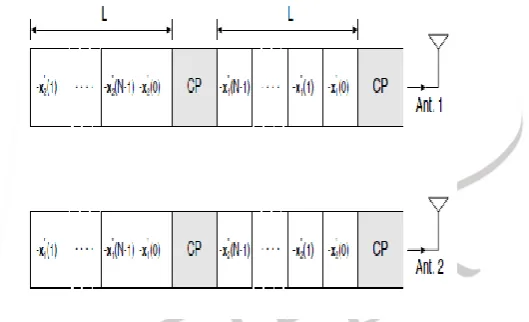
Each block of data length L is appended with a cyclic prefix (CP) of length v to eliminate inter block interference (IBI). Represents the symbol n of transmission block k from antenna i. At an even time slots, pair of length n blocks and are generated. The transmission scheme is,
= -
= -
(14)
for n =0,1,…., N-1 and k = 0,2,4,…., shows conjugate. CP of length v is added to each transmission block. The total transmission power is divided equally among the antennas. The transmission scheme is shown in Figure 2.
Fig 2. Transmission scheme for communication over frequency selective fading channels. In time k and k + 1, the received signal blocks are given by,
= √
+ √ + for j = k, k + 1 (15)
Where and are both circulant matrix, and is noise vector for block j. A DFT is applied to (15) to diagonalize the channels as follows
= √
+ √ + for j = k, k + 1
Where , and are the DFT vectors of (15), and are diagonal matrix which contain DFT coefficient of channel impulse responses. Assume channel is fixed over two consecutive blocks of k and k + 1 as follows,
Y ( ) ( ) (√
√ ) + (
) (16)
Now multiplying both the side of (16) by orthogonal matrix we get
Ỹ Y = ( ̃ ̃) (
√
√ ) +
̃ (17)
IJEDR1501072
International Journal of Engineering Development and Research (www.ijedr.org)394
| | + | | (18)V. SIMULINKRESULTANDDISSCUSION
Fig.1. BER for BPSK modulation with 2Tx, 2Rx Alamouti STBC (Rayleigh channel)
Fig 1 shows the Alamouti STBC scheme only for two transmit and receive antennas for BPSK modulation over the Raleigh channel. Transmit diversity scheme Alamouti shows theoretical and Simulink result.
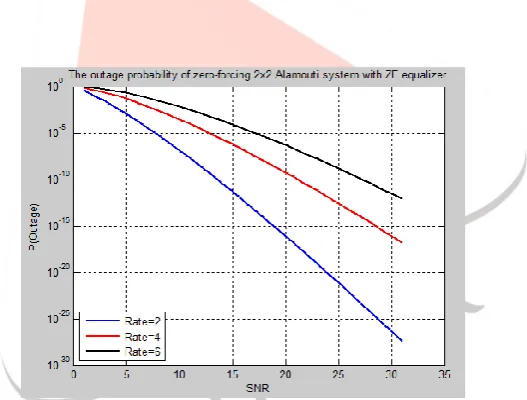
Fig. 2. The outage probability of zero forcing in 2 2 Alamouti system for rate 2, 4, and 6. VI. CONCLUSION
The transmit diversity scheme Alamouti STBC with 2*2 antennas shows bit error rate (BER) of 1.1 and signal to noise ratio is 13dB. So the Alamouti scheme shows better performance. It is possible because the effective channel information from two receive antennas over two symbols results in diversity order four. In generally can say that receive antennas, the order of diversity for 2 transmit antenna Alamouti STBC scheme is 2 . In calculation is diagonal matrix represents that there is no cross talk between s₀, s₁ after the equalization and noise term is still white Gaussian. We characterize the diversity for Alamouti scheme at all spectral efficiency. We obtain threshold rate below which full spatial temporal diversity is achieved. Also we show that diversity depends not only on antenna configuration and channel memory but also on data block length and data transmission rate.
REFERENCES
[1] F. Pancaldi, G. Vitetta, R. Kalbasi, N. Al-Dhahir, M. Uysal, and H. Mheidat, “Single-carrier frequency domain equalization,” IEEE SignalProcess. Mag., vol. 25, no. 5, pp. 37–56, Sept. 2008.
[2] D. Falconer, S. Ariyavisitakul, A. Benyamin- Seeyar, and B. Eidson, “Frequency domain equalization for single-carrier broadband wireless systems,” IEEE Commun. Mag., vol. 40, no. 4, pp. 58–66, Apr. 2002.
[3] G. Tsoulos, MIMO system technology for wireless communications. CRC Press, 2006.
[4] I.E.Telatar. Capacity of Multi-Antenna Gaussian Channels‖, AT&T Bell
IJEDR1501072
International Journal of Engineering Development and Research (www.ijedr.org)395
[5] G. J. Foschini, M. J. Gans, “On Limits of Wireless Communications in Fading Environments when Using MultipleAntennas,” Wireless Personal Communications, vol. 6, pp. 311-335, March 1998.
[6] A. Tajer and A. Nosratinia, “Diversity order in ISI channels with single carrier frequency-domain equalizer,” IEEE Trans. Wireless Commun. vol. 9, no. 3, pp. 1022–1032, Mar. 2010.
[7] A. Hesham Mehana and A. Nosratinia, “The diversity of MMSE receiver over frequency-selective MIMO channel,” in
Proc. 2011 IEEE ISIT.
[8] N. Al-Dhahir, “Single-carrier domain equalization for space time block-coded transmissions over frequency-selective fading channels,” IEEE Commun. Lett., vol. 5, no. 7, pp. 304–306, July 2001.
[9] Z. Wang and G. Giannakis, “Linearly precoded or coded OFDM against wireless channel fades?” in Proc. 2001 IEEE Signal Process. AdvancesWireless Commun., pp. 267–270.
[10] C. Tepedelenlioglu, “Maximum multipath diversity with linear equalization in precoded OFDM systems,” IEEE Trans. Inf. Theory, vol. 50, pp. 232–235, Jan. 2004.
[11] C. Tepedelenlioglu and Q. Ma, “On the performance of linear equalizers for block transmission systems,” in Proc. 2005 IEEE GLOBECOM, vol. 6.
[12] V. Tarokh, N. Seshadri, A. R. Calderbank, ―Space-Time Codes for High Data Rate Wireless Communication: Performance Criterion and Code Construction‖, IEEE Trans. Inform. Theory, vol. 44,no. 2, pp. 744-765, March 1998. [13] Vucetic, B., and Yuan, J.: “Space-time coding” ( John Wiley & Sons Ltd., Chichester, UK, 2003)
[14] A. Slaney and Y. Sun: „Space-time coding for wireless communications: an overview„, IEE Proc. -Commun., Vol. 153, No. 4, August 2006
[15] J. Akhtar and D. Gesbert. 2004. “Extending orthogonal block codes with partial feedback.” IEEE Trans. Wireless Comm., 3, Nov. 2004, pp.1959–1962