Encouraging Consistent Translation Choices
Ferhan Ture,1Douglas W. Oard,2,4Philip Resnik3,4 1Department of Computer Science
2College of Information Studies 3Department of Linguistics
4Institute for Advanced Computer Studies
University of Maryland, College Park, MD 20740 USA [email protected],[email protected],[email protected]
Abstract
It has long been observed that monolingual text exhibits a tendency toward “one sense per dis-course,” and it has been argued that a related “one translation per discourse” constraint is op-erative in bilingual contexts as well. In this pa-per, we introduce a novel method using forced decoding to confirm the validity of this con-straint, and we demonstrate that it can be ex-ploited in order to improve machine translation quality. Three ways of incorporating such a preference into a hierarchical phrase-based MT model are proposed, and the approach where all three are combined yields the greatest improve-ments for both Arabic-English and Chinese-English translation experiments.
1 Introduction
In statistical Machine Translation (MT), the state-of-the-art approach is to translate phrases in the context of a sentence and to re-order those phrases appro-priately. Intuitively, it seems as if it should also be possible to draw on information outside of a single sentence to further improve translation quality. In this paper, we challenge the conventional approach of translating each sentence independently, and ar-gue that it can indeed also be beneficial to consider document-scale context when translating text. Mo-tivated by the success of a “one sense per discourse” heuristic in Word Sense Disambiguation (WSD), we explore the potential benefit of leveraging a “one translation per discourse” heuristic in MT.
The paper is organized as follows. We begin with related work in Section 2. Next, we provide new
confirmation that the hypothesized one-translation-per-discourse condition does indeed often hold, based on a novel analysis using forced decoding (Section 3). We incorporate this idea into a hierarchi-cal MT framework by adding three new document-scale features to the translation model (Section 4). We then present experimental results demonstrat-ing solid improvements in translation quality ob-tained by leveraging these features, both for Arabic-English (Ar-En) and Chinese-Arabic-English (Zh-En) trans-lation (Section 5). Conclusions and future work are presented in Section 6.
2 Related work
Exploiting discourse-level context has to date received only limited attention in MT re-search (e.g., (Gim´enez and M`arquez, 2007; Liu
et al., 2010; Carpuat, 2009; Brown, 2008; Xiao et al., 2011)). Exploratory analysis of reference trans-lations by Carpuat (2009) motivates a hypothesis that MT systems might benefit from the “one sense per discourse” heuristic, first introduced by Gale et al. (1992), which has proven to be effective in the context of WSD (Yarowsky, 1995). Carpuat’s ap-proach was to do post-processing on the translation output to impose a “one translation per discourse” constraint where the system would otherwise have made a different choice. A manual evaluation on a sample of sentences suggested promise from the technique, which Carpuat suggested in favor of exploring more integrated approaches.
Xiao et al. (2011) took this one step further and implement an approach where they identified am-biguous translations within each document, and
tempt to fix them by replacing each ambiguity with the most frequent translation choice. Based on their error analysis, the authors indicate two shortcomings when trying to find the correct translation of a given phrase. First, frequency may not provide sufficient information to distinguish between translation can-didates, which is why we take rareness into account when scoring translation candidates. Another prob-lem is, like any other heuristic, that there may be cases where the heuristic fails and there are multi-ple senses per discourse. Guaranteeing consistency hurts performance in such situations, which is why we implement the heuristic as a model feature, and let the model score decide for each case.
We are aware of a few other analyses that have shown promising results based on a similar motiva-tion. For instance, Wasser and Dorr (2008)’s ap-proach biases the MT system based on term statistics from relevant documents in comparable corpora. Ma et al. (2011) show that a translation memory can be used to find similar source sentences, and consecu-tively adapt translation choices towards consistency. Domain adaptation for MT has has also been shown to be useful in some cases (Bertoldi and Federico, 2009; Hildebrand et al., 2005; Sanchis-Trilles and Casacuberta, 2010; Tiedemann, 2010; Zhao et al., 2004), so to the extent we consider documents to be micro-domains we might expect similar approaches to be useful at document scale. Indeed, hints that such ideas may work have been available for some time. For example, there is clear evidence that the behavior of human translators can provide evidence that is often useful for automating WSD (Diab and Resnik, 2002; Ng et al., 2003). When coupled with the one-sense-per-discourse heuristic, this suggests that the reverse may also be true.
3 Exploratory analysis
It is well known that writing styles vary by genre, and in particular that the amount of vocabulary vari-ation within a document depends to some extent on the genre (e.g., higher in poetry than in engineering writing). The degree to which authors tend to make consistent word choices in any particular genre is, therefore, an empirical question. In order to gain in-sight into the extent to which human translators make consistent vocabulary choices in the types of
materi-als that we wish to translate (in this work, news sto-ries), we first explore the degree of support for our one-translation-per-discourse hypothesis in the ref-erence translations of a standard MT test collection. We used the Ar-En MT08 data set, which con-tains 74 newswire documents with a total of 813 sentences, each of which has four reference trans-lations. Throughout this paper we consistently use the document (i.e., one news story) as a conve-nient discourse unit, although of course finer-scale or broader-scale discourse units might also be explored in future work. Moreover, throughout this paper we use the hierarchical phrase-based translation system (Hiero), which is based on a synchronous
context-free grammar (SCFG) model (Chiang, 2005). In a SCFG, the rule[X] ||| α ||| β indicates that
con-text free expansionX → α in the source language
can occur synchronously withX → β in the target
language. In this case, we callα the left hand side
(LHS) of the rule, andβ the right hand side (RHS)
of the rule.
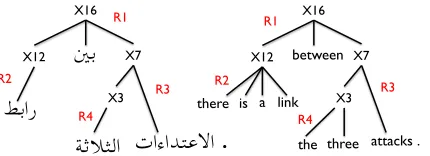
To determine the extent and nature of translation consistency choices made by human translators, we randomly selected one of the four sets of reference translations (first set, with id 0) and we used forced decoding to find all possible sequences of rules that could transform the source sentence into the target sentence. In forced decoding, given a pair of source and target sentences, and a grammar consisting of learned translation rules with associated probabili-ties, the decoder searches all possible derivations for the one sequence of rules that is most likely (under the learned translation model) to synchronously pro-duce the source sentence on the LHS and the target sentence on the RHS. For instance, consider the fol-lowing Arabic sentence as input:
طبار نيب تاءادتعالا ةثالثلا .
and its uncased reference translation:
there is a link between the three attacks .
X16
X7
ﲔﺑ
X12
X3
ﺔﺛﻼﺜﻟا
ﻂﺑار
تاءاﺪﺘﻋﻻا
.
R1R2
R3 R4
X16
X7
between
X12
X3
the there
attacks . three is a link
R1
R2 R3
[image:3.612.82.297.50.128.2]R4
Figure 1: Illustration of forced decoding.
target-side reference translation.1
R1. [X12] |||
طبار
||| there is a linkR2. [X16] ||| [2]
نيب
[1]||| [X12, 1] between [X7, 2]R3. [X7] ||| [1]
تاءادتعالا
. ||| [X3, 1] attacks .R4. [X3] |||
ةثالثلا
||| the threeFigure 1 illustrates how the decoder uses these rules to produce the source and target sides syn-chronously.
As we repeated this procedure for all sentence pairs, we kept track of all rules that were actually used by the decoder to generate a reference English translation from the corresponding Arabic sentences. Our next step was to identify cases in which the SCFG could reasonably have produced a substan-tially different translation. Whenever an Arabic phrasef occurs multiple times in a document, andf
appears on the LHS of two or more different gram-mar rules in the SCFG, we count this as a single “case”.2 These cases correspond to unique (source
phrasef, document d) pairs in which a translation
process using that SCFGcould havechosen to pro-duce two or more different translations of f in d.
Since the multiple appearances off are distributed
among sentences of d, each counted case may
cor-respond to a number of sentences ranging from 1 to the number of sentences in that document.
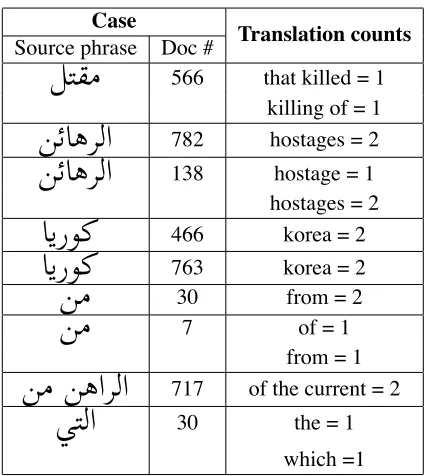
Table 1 shows a small sample of the cases (i.e., (source phrasef, documentd) pairs) identified as a
result of forced decoding. There were 321 such cases in our dataset and there were 672 sentences in which at least one case occurred. This is not an uncommon phenomenon; these 672 sentences comprise 83% of
1Since our goal was an exploratory analysis, the MT08 test
set was combined with the training set in order to ensure reach-ability of the reference translations using the learned grammar. Proper train/dev/test splits were, of course, used for the evalua-tion results reported in Secevalua-tion 5.
2We define a phrase as any text that constitutes the entire
LHS of a grammar rule.
the test set. However, many of these cases repre-sent either unlikely choices or inconsequential dif-ferences, so some post-processing is called for.
Since grammar rules are typically more fine-grained than is necessary for our purposes (e.g., to capture various punctuation and determiner differ-ences that do not affect the “sense” of the transla-tion), we applied a few simple heuristics to edit the source and target sides and group all such minor variations into a single “mega-rule” (e.g., “how”∼“, how”, “third”∼“a third”, “want”∼“we want”). For this, we removed nonterminal symbols and punc-tuation, and considered two target phrases e and e′ to be different only if edit distance(e, e′) > max(length(e), length(e′))/2, where the edit
dis-tance is based on character removal and insertion. For instance, the third example in Table 1 would have been considered to be translated consistently as a result of this heuristic, as opposed to the first example. We also eliminated cases in which no rea-sonable alternatives were available in the translation grammar (i.e., cases where the second most probable rule with the same LHS was assigned a probability below 0.1 in the grammar). Cases 4 and 5 would have been removed by this heuristic.
After this filtering and aggregation we were left with 176 (f,d) pairs in which the translation model
could reasonably have selected between rules that would have produced substantially different English translations of f ind(such as cases 1–3 and 6–9).
It was these 176 cases, affecting a total of 512 sen-tences (63% of test set) for which we then examined what forced decoding could tell us about translation consistency.
trans-Case Translation counts
Source phrase Doc #
لتقم
566 that killed = 1 killing of = 1نئاهرلا
782 hostages = 2نئاهرلا
138 hostage = 1 hostages = 2ايروك
466 korea = 2ايروك
763 korea = 2نم
30 from = 2نم
7 of = 1from = 1
نم نهارلا
717 of the current = 2يتلا
30 the = 1 [image:4.612.79.292.54.292.2]which =1
Table 1: A sample of cases (i.e., (source phrasef,
docu-mentd) pairs) identified as a result of forced decoding.
lation of 455 sentences (56% of the test set), suggest-ing that if we can replicate this human behavior in a system, it might affect a nontrivial number of trans-lation choices.
[image:4.612.312.411.55.134.2] [image:4.612.72.286.534.616.2]These statistics also suggest, however, that there may be some risk incurred in such a process, since in 48 of the 176 cases, the human translator opted for a substantially different translation. When we closely examined these 48 instances, we found that 19 (40%) involved changing a content-bearing word (sometimes to a word with similar meaning). The re-maining 29 (60%) involved function words or simi-lar constructions. See Figures 2 and 3 for examples.
1a. [X] |||
تحمس
||| had allowed 1b. [X] |||تحمس
||| has permitted 2a. [X] ||| [X,1]سردت
||| examining [X,1] 2b. [X] ||| [X,1]سردت
||| is considering [X,1] 3a. [X] ||| [X,1]راوجلا
||| neighbors3b. [X] ||| [X,1]
راوجلا
||| neighboring countriesFigure 2: Examples of differences in lexical choice for content-bearing words within the same document.
We can make several observations based on this analysis. First, there does indeed seem to be ev-idence to support the one-translation-per-discourse heuristic, and to suggest that respecting that
heuris-4a. [X] |||
يف
||| on4b. [X] |||
يف
||| in4c. [X] |||
يف
||| ’s5a. [X] |||
دق
||| had 5b. [X] |||دق
||| wasFigure 3: Examples of differences in lexical choice for other types of lexical units within the same document.
tic could improve translation outcomes for a substan-tial number of sentences. Second, even when a ref-erence translation contains different translations of the same phrase, this may sometimes be the result of stylistic choices rather than an intent by the transla-tor to affect the expressed meaning. If a system were try to “fix” such cases by enforcing consistent trans-lation, the resulting translation might be somewhat more stilted, but perhaps not less accurate or less in-telligible. Finally, sentence structure conventions or other language-specific phenomena may sometimes require the same phrase to be translated differently, so some way of encouraging consistency while still allowing the model to consider other contextual fac-tors might be better than always imposing a hard con-sistency constraint.
4 Approach
we simply note that this approach doubles the run-ning time of the decoder and that future work on a more elegant implementation might be productive.
We explore three ways to compute features in this section. The essential idea behind all of them is to define some feature function that increases monoton-ically with an increase in some count that we believe to be informative, and in which the rate of increase is damped more strongly as that count increases. Sev-eral feature functions could satisfy those broad re-quirements; in this section, we describe three vari-ants,C1,C2andC3, and discuss the potential
bene-fits and drawbacks of each.
C1: Counting rules In this variant, we count
in-stances of the same entire grammar rule, where a rule
r contains both the source phrasef and the target
phrasee. During the first pass, whenever a grammar
rule is chosen by the decoder for the one-best output, the count for that rule is incremented. Given a gram-mar rulerand the number of timesrwas counted in
the first pass (given byN{r}), the consistency
fea-ture score is computed as follows:
C1(r) =
2.2N{r}
1.2 +N{r} (1)
Equation 1 is the term frequency component of the well known Okapi BM25 term weighting function, when parameters are set to the conventional values
k = 1.2, b = 0. This is an increasing and
con-cave function in which the count has a diminishing marginal effect on the feature score. It has proven to be useful in information retrieval applications, in which the goal is to model “aboutness” based on term counts (Robertson et al., 1994). Because our goal is to demonstrate the potential of consistency features, it seemed reasonable to work with some simple func-tion that has a shape like the one we desired. We leave exploration of optimal damping functions for future work.
A drawback of thisC1 approach is that as we saw
in Section 3, grammar rules in phrase-based MT sys-tems tend to be somewhat more fine-grained than seems optimal for constructing a consistency fea-ture. For instance, consider the following rules that all translate the same Arabic term:
R1. [X] ||| [X,1]
ةزهجا
||| [X,1] the bodiesR2. [X] ||| [X,1]
ةزهجا
||| [X,1] the organsR3. [X] ||| [X,1]
ةزهجا
||| [X,1] organsR4. [X] |||
ةزهجا
[X,1] ||| the organs of [X,1]R5. [X] |||
ةزهجا
[X,1] ||| [X,1] bodiesBased on these grammar rules, we as human read-ers infer that this Arabic phrase can be translated in two different ways: asorgansor asbodies. An opti-mal application of the one-translation-per-discourse heuristic would thus group the rules based on the presence of one of those words. However, in theC1
variant, each of these rules would be counted sepa-rately because of differences that in some cases do not directly affect the choice of content words. For instance, on the source side, the Arabic token ap-pears to the right of the nonterminal symbol inR1,
R2andR3, while it is to the left of the nonterminal in
R4andR5. On the target side, differences are due to
both nonterminal symbol position and the existence of determiners. Motivated by many examples like this, we came up with an alternative way of count-ing rules.
C2: Counting target tokens To partially address
this sparseness issue, variantC2 focuses only on the
target side. We extract all target tokens whenever a grammar rule is used by the decoder in a one-best derivation and increment a counter for each. Since we are mainly interested in content words (e.g. bod-ies,organs), we use simple pattern matching to dis-card nonterminal symbols and punctuation, and we ignore terms that appear in more than 50% of all doc-uments (a convenient way of discarding common to-kens such asthe,or,and). This approach separates the rules in the example above into two groups: rules withbodieson the target side and rules withorgans
on the target side. Upon completion of the first pass, the consistency feature score for rule r is then
de-termined by first computing a score for each unique target-side tokenwusing:
bm25(w) = 2.2N{w} 1.2 +N{w}log
D+ 1
DF(w) + 0.5 (2)
where in this caseN{w}maps tokens to their
respec-tive counts in the document,Dis the total number
of documents in the collection, andDF (document
are rewarded. We then set the feature score for each rulerto the maximum score of any of its target-side
terminal tokens:
C2(r) = max
e∈RHS(r)bm25(e) (3)
Our motivation for choosing the maximum is that when there is more than one content word that sur-vives the pruning of common terms, we want the score to be influenced most strongly by the most im-portant of those terms. Since BM25 term weights can be thought of as a measure of term importance, taking the maximum is a simple expedient.
Although counting only target-side tokens yields coarser granularity than counting rules, ignoring the source side of the rule risks combining target side statistics from translations of unrelated source lan-guage terms. Consider the following grammar rule:
R6. [X] ||| <s> [X,1]
ةزهجا
||| <s> [X,1] life supportSince the counter for life andsupport will both be incremented whenever ruleR6 fires in the one-best
decoding during the first pass, problems could arise if a rule with a different LHS that also contains sup-porton the RHS were to fire in the same document, for example:
R7. [X] |||
اهرالا
||| supportIf we don’t take the source side into account, both oc-currences ofsupportwill be grouped together when counting and R7 will receive extra score from the
consistency feature wheneverR6is used by the
de-coder. Of course, this problem will only arise when the LHS ofR6andR7 are present in the same
doc-ument, and how often that happens (and thus how large the risk from this factor is) is an empirical ques-tion. We therefore developed a third alternative as a middle ground between the fine-grainedC1 and the
coarse-grainedC2.
C3: Counting token translation pairs In this
variant, we count each terminal (source token, tar-get token) pair that survives pruning. Specifically, if grammar rule[X]|||f1f2...fm|||e1e2...enfires, we
increment the count of every pair⟨fi, ej⟩, wherefi
is aligned toej. After the first pass, we compute the
feature value of each observed pair, based on this count and theDF of the target-side of the pair. We
chose to use only the target token in the DF
com-putation (i.e., aggregating over all source tokens) to
reduce sparsity effects. Similar toC2, the feature of
a ruler is defined by the maximum of scores of all
pairs extracted fromr.
C3(r) = max
f∈LHS(r)
e∈RHS(r)
⟨f,e⟩aligned
bm25(⟨f, e⟩) (4)
Since each variant has its benefits and drawbacks, we can include all three in the system and let the tuning process decide on how each should be weighted.
5 Evaluation and Discussion
We have evaluated the one-translation-per-discourse feature using thecdecMT system (Dyer et al., 2010).
We started by building a baseline system using stan-dard features in cdec: lexical and phrase
transla-tion probabilities in both directransla-tions, word and arity penalty features, and a 5-gram language model. We then added each of the three consistency feature vari-ants, along with all two-way and the one three-way combinations of them, thus yielding a total of eight systems for comparison, including the baseline.
For training the Ar-En system, we used the dataset from the DARPA GALE evaluation (Olive et al., 2011), which consists of NIST and LDC releases. The corpus was filtered to remove sentence pairs with anomalous length ratios and subsampled to yield a training set containing 3.4 million parallel sentence pairs. The Arabic text was preprocessed to produce two different segmentations (simple punctu-ation tokenizpunctu-ation with orthographic normalizpunctu-ation, and LDC’s ATBv3 representation (Maamouri et al., 2008)), represented together usingcdec’s lattice
in-put format (Dyer et al., 2008).
The Zh-En system was trained on parallel train-ing text consisttrain-ing of the UN portions and non-HK Hansards portions of the NIST training corpora. Chinese was automatically segmented by the Stan-ford segmenter (Tseng et al., 2005), and traditional characters were simplified. After subsampling and filtering, we obtain a training corpus of 1.6 million parallel sentences.
sets with four references for each language pair, and MIRA was used for tuning (Crammer et al., 2006). In our experiments, we run the first decoding phase using feature weights that are guessed heuristically based on weights from previously tuned systems. All feature weights, including the discourse feature, were then tuned together, based on the output of the second decoding phase. For Ar-En parame-ter tuning, we used the MT06 newswire dataset, which contains 104 documents and a total of 1,797 sentences. For testing, we used the MT08 dataset described above (74 documents, 813 sentences). For Zh-En experiments, the MT02 newswire dataset (100 documents, 878 sentences) was used for tuning, and evaluation was done on the MT06 test set (79 documents, 1,664 sentences). For both language pairs, DF values were computed from the tuning
set for both tuning and evaluation experiments. When we used NIST’s official metric (BLEU-4) to compare our results to the official NIST evalu-ation (NIST, 2006; NIST, 2008), our baseline sys-tem achieved 54.70 for Ar-En and 31.69 for Zh-En. Based on reported NIST results, our baseline would have ranked 4th in the Zh-En MT06
evalua-tion, and would have outperformed all Ar-En MT08 systems. We used a slightly different IBM-BLEU metric for the rest of our evaluation. In this case, the baseline system achieved 53.07 BLEU points for Ar-En and 30.43 points for Zh-En. Among more recent papers, the best reported results were 56.87 for Ar-En MT08 (Zhao et al., 2011a) and 35.87 for Zh-En MT06 (Zhao et al., 2011b), although many papers report BLEU scores below 53 points for Arabic (Carpuat et al., 2011) and 32 points for Chinese (Monz, 2011). The systems that outper-formed our baseline applied novel techniques, and used larger language models, as well as many non-standard features. We argue that these novelties are complementary to our approach, and therefore do not damage the credibility of our baseline.
Among the single-feature runs, C3 had the best
performance in Ar-En experiments, with 53.84 BLEU points, whereas C2 yielded the best results
for Zh-En with a BLEU score of 30.96. In any case, all three variants outperformed the baseline (see Ta-ble 2). When multiple features were combined, we generally observed an increase in BLEU, suggesting that our features have usefully different error
char-Method BLEU
Ar-En Zh-En Baseline 53.07 30.43
C1 53.82 30.59
C2 53.70 30.96
C3 53.84 30.54
C12 53.82 30.79
C13 53.82 30.76
C23 53.88 30.63
[image:7.612.360.491.55.199.2]C123 53.98 31.42
Table 2: Evaluation results: BLEU scores with four ref-erences for Ar-En and Zh-En experiments.
Method # documents
Ar-En Zh-En
Docs 74 79
C1 37 30
C2 37 35
C3 42 36
C123 43 41
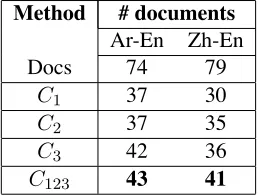
Table 3: Doc-level analysis: Number of documents where each variant outperforms baseline.
acteristics. The combination of all three variants,
C123, yielded the best results, nearly 1.0 BLEU point
higher than the baseline for both language pairs. Evaluation results are summarized in Table 2.
Given our focus on documents, it is natural to ask what fraction of the documents were helped or harmed by consistency features. Document-level BLEU scores for Arabic-to-English transla-tions show thatC3 outperformed the baseline on a
larger number of documents than any other single feature (42/74=57%), compared with 37/74 (50%) for bothC1andC2.C123did better by this measure
as well, with BLEU increasing for 43 of the docu-ments. There were no documents where the BLEU score was exactly the same, therefore the BLEU score declined for the remaining documents. As Ta-ble 3 indicates, document-level BLEU for the Zh-En experiments shows similar results.
We can also look at our results in a more fine-grained way, focusing on differences in how each system translated the same source-language phrase. For this analysis, we defined English phrases e
[image:7.612.361.490.244.342.2]Method Ar-En Zh-En
Cases Test set Cases Test set
C1 77 24% 401 48%
C2 127 35% 686 60%
C3 101 33% 491 53%
Any 197 68% 968 94%
[image:8.612.76.292.56.156.2]C123 141 41% 651 59%
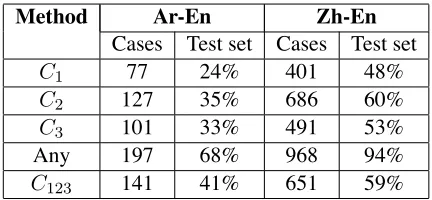
Table 4: Effect of applying variants of the consistency feature (Any=C1orC2orC3).
max(length(e), length(e′))/2. By this way of
counting, there are 197 unique (Arabic phrase, docu-ment) pairs for which at least one single-feature sys-tem produced translations differently from the base-line system. Together, these cases affect 553 sen-tences (68%) in 67 of the 74 documents, with as many as 12 differences observed in a single doc-ument. The number of such differences is even higher for Chinese-to-English translation, probably due to lower confidence from the translation model and longer documents. Table 4 shows the number of changes by each system, and the percentage of the test set affected by these changes.
In order to gain greater insight into the effect of the consistency features, we randomly sampled 60 of the 197 cases and analyzed the influence of the change to the document BLEU score. In 25 of the sampled cases, at least one of the three systems made a change that improved the BLEU score, whereas the score was adversely affected for at least one system in 13 cases. BLEU remained unchanged in the re-maining 22 cases, mostly due to the use of multi-ple reference translations. When we analyze the ef-fect of each system separately, we see that C2 was
the most aggressive, making 25 changes that influ-enced BLEU (16 positive, 9 negative). C1 was the
most conservative, with only 13 such changes (8 pos-itive, 5 negative). Consistent with the overall BLEU scores,C3 evidenced the best ratio between benefit
and harm, making 20 changes that affected the score (16 positive, 4 negative).
Looking at specific cases can yield some insight into how the consistency features achieve improve-ments. For example, results improved when trans-lating the phrase
ةيميظنت
, (Eng. organizational,regulatory), which appears in the context of
organi-zational groups that support terrorist ideology. The baseline system translated this asorganizationalin one case, and regulatory in another. Variants C1
andC2changed this behavior, so that the translation
wasorganizationalin both cases. One of the refer-ence translations usedorganizationalin one case and dropped the phrase in the other, and the other three translators provided consistent translations (using
organizedandorganizational). As a result, applying the one-translation-per-discourse heuristic improved the multi-reference BLEU score.
On the other hand, here is one of the cases where our feature hurt performance. The phrase 边防 部队(Eng. border/frontier troops/guards) appears
in two sentences of a Chinese news story about vio-lence along the India - Nepal border. All reference translations consistently used the wordborderin the translation, as it is a better choice in this context. The baseline system translated the phrase as fron-tier guardsandborder troopsin the two sentences. All system variants replacedborderwithfrontierto maintain consistency, and therefore produced worse translations, causing a decrease in BLEU score.
Examples can, however, also point up limitations in our ability to measure improvements. In one of the test documents, the Arabic phrase
للستلا يلا
(Eng. sneak,infiltrate, enter without approval) ap-pears in the context of Turkey trying to enter the Eu-ropean Union. This was translated by the baseline system assneak intoin one occurrence andinfiltrate into in another. C1 didn’t change the output, butC2 andC3 translated the phrase asinfiltrate intoin
both cases. Although all of the four reference trans-lators were consistent within their choices, each of them chose different translations, namely worm its way, enter, sneak andsneak into. This resulted in a decrease in BLEU score for the two systems that chose infiltrate into. This case illustrates a limita-tion to fine-grained use of BLEU alone as a basis for analysis, since we might argue thatinfiltrate into
we conclude that BLEU is a somewhat conservative measure when used in this way, and that the actual overall improvement in translation quality over our baseline may be somewhat more than our roughly 1.0 measured BLEU improvement would suggest.
6 Conclusions and Future Work
In this paper, we started with a new way of look-ing at, and largely supportlook-ing, the “one translation per discourse” hypothesis using forced decoding of human reference translations. We then leveraged insights from that analysis to design the transla-tion model consistency features, obtaining solid im-provements for both Ar-En and Zh-En translation. In future work, we plan to explore additional vari-ants. For example, we can further address sparsity by incorporating monolingual paraphrase detection on the source side, the target side or both. We can and should explore other monotonically increasing con-cave feature functions in addition to the Okapi BM25 function that we have found to be useful in this work, we should explore alternatives to our use of the max-imum function in C2 and C3, and we should
con-sider optimizing to measures other than BLEU (e.g., METEOR) that extend the range of rewarded lexical choices by leveraging monolingual paraphrase evi-dence.
In designing our features we were guided by our intuition about which kinds of consistency should be rewarded. Data can be superior to intuition, how-ever, and our forced decoding technique might also be helpful in generating new insights that could help to guide the design of even more useful features. For example, our forced decoding clearly points to cases in which translators have chosen different structural variants when translating the same phrase, and closer examination of these cases might help us to automat-ically detect which kinds of structural variation can most profitably be moderated using a consistency feature. We should also note that we have only done forced decoding to date in one language pair (Ar-En), and there might be more to be learned about language-specific issues from doing the same anal-ysis for additional language pairs.
Finally, the time seems propitious to reconsider our choice of document-scale as our discourse con-text. Documents have much to recommend them, but
much of the content that we might wish to translate (conversational speech, text chat, email threads, ...) doesn’t present the kinds of obvious and unambigu-ous document boundaries that we find in MT test collections that are built from news stories. More-over, some documents (e.g., textbooks) may be too diverse for an entire document to be the right scale for consistency. We might also be able to produc-tively group similar documents into clusters in which the vocabulary choices are (or should be) mutually reinforcing.
We therefore end where we began, with many questions to be answered. Now, however, we have somewhat different questions – not whether to en-courage consistency at a super-sentential scale, but ratherwhenandhow bestto do that.
Acknowledgements
This research was supported in part by the BOLT program of the Defense Advanced Research Projects Agency, Contract No. HR0011-12-C-0015. Any opinions, findings, conclusions or recommendations expressed in this paper are those of the authors and do not necessarily reflect the view of DARPA.
References
Nicola Bertoldi and Marcello Federico. 2009. Do-main adaptation for statistical machine translation with monolingual resources. InProceedings of the Fourth Workshop on Statistical Machine Translation (StatMT ’09), pages 182–189.
Ralf D. Brown. 2008. Exploiting document-level context for data-driven machine translation. InProceedings of the the Eighth Conference of the Association for Ma-chine Translation in the Americas (AMTA ’08). Marine Carpuat, Yuval Marton, and Nizar Habash. 2011.
Improved Arabic-to-English statistical machine trans-lation by reordering post-verbal subjects for word alignment. Machine Translation, pages 1–16.
Marine Carpuat. 2009. One translation per discourse. In
Proceedings of the Workshop on Semantic Evaluations: Recent Achievements and Future Directions, DEW ’09, pages 19–27.
David Chiang. 2005. A hierarchical phrase-based model for statistical machine translation. InProceedings of ACL ’05.
Koby Crammer, Ofer Dekel, Joseph Keshet, Shai Shalev-Shwartz, and Yoram Singer. 2006. Online passive-aggressive algorithms. Journal of Machine Learning Research, 7:551–585.
Mona Diab and Philip Resnik. 2002. An unsupervised method for word sense tagging using parallel corpora. InProceedings of ACL ’02.
Christopher Dyer, Smaranda Muresan, and Philip Resnik. 2008. Generalizing Word Lattice Translation. In Pro-ceedings of ACL-HLT’08, pages 1012–1020, June. Chris Dyer, Jonathan Weese, Hendra Setiawan, Adam
Lopez, Ferhan Ture, Vladimir Eidelman, Juri Ganitke-vitch, Phil Blunsom, and Philip Resnik. 2010. cdec: a decoder, alignment, and learning framework for finite-state and context-free translation models. In ACLDe-mos ’10, pages 7–12.
William A. Gale, Kenneth W. Church, and David Yarowsky. 1992. One sense per discourse. In Pro-ceedings of the workshop on Speech and Natural Lan-guage, HLT ’91, pages 233–237.
Jes´us Gim´enez and Llu´ıs M`arquez. 2007. Context-aware
discriminative phrase selection for statistical machine translation. In Proceedings of StatMT ’07, pages 159–166.
AS Hildebrand, M Eck, S Vogel, and Alex Waibel. 2005. Adaptation of the translation model for statistical ma-chine translation based on information retrieval. In
Proceedings of The European Association for Machine Translation (EAMT ’05).
Zhanyi Liu, Haifeng Wang, Hua Wu, and Sheng Li. 2010. Improving statistical machine translation with mono-lingual collocation. InACL ’10.
Yanjun Ma, Yifan He, Andy Way, and Josef van Gen-abith. 2011. Consistent translation using discrimina-tive learning: a translation memory-inspired approach. InProceedings of ACL-HLT’11, pages 1239–1248. Mohamed Maamouri, Ann Bies, and Seth Kulick. 2008.
Enhancing the Arabic Treebank: A Collaborative Ef-fort toward New Annotation Guidelines. InLREC ’08. Christof Monz. 2011. Statistical Machine Translation
with Local Language Models. InEMNLP ’11. Hwee Tou Ng, Bin Wang, and Yee Seng Chan. 2003.
Ex-ploiting parallel texts for word sense disambiguation: an empirical study. InACL ’03.
NIST. 2006. http://www.itl.nist.gov/iad/mig/tests/mt/2006/. NIST. 2008. http://www.itl.nist.gov/iad/mig/tests/mt/2008/. Franz Och and Hermann Ney. 2003. A systematic
com-parison of various statistical alignment models. Com-putational Linguistics, 29(1):19–51.
Joseph Olive, Caitlin Christianson, and John McCary. 2011. Handbook of Natural Language Processing and Machine Translation: DARPA Global Autonomous Language Exploitation. Springer Publishing Com-pany, Inc., 1st edition.
Kishore Papineni, Salim Roukos, Todd Ward, and Wei-Jing Zhu. 2002. BLEU: a method for automatic eval-uation of machine translation. InACL ’02.
Stephen E. Robertson, Steve Walker, Susan Jones, Miche-line Hancock-Beaulieu, and Mike Gatford. 1994. Okapi at TREC-3. InTREC.
Germ´an Sanchis-Trilles and Francisco Casacuberta.
2010. Bayesian adaptation for statistical machine translation. InProceedings of the workshop on Struc-tural and Syntactic Pattern Recognition (SSPR ’10), pages 620–629.
J¨org Tiedemann. 2010. Context adaptation in statistical
machine translation using models with exponentially decaying cache. InProceedings of the workshop on Domain Adaptation for Natural Language Processing (DANLP ’10), pages 8–15.
Huihsin Tseng, Pi-Chuan Chang, Galen Andrew, Daniel Jurafsky, and Christopher Manning. 2005. A con-ditional random field word segmenter. In Fourth SIGHAN Workshop on Chinese Language Processing. Michael M. Wasser and Bonnie Dorr. 2008. Ma-chine translation with cross-lingual information re-trieval based document relevance scores. Unpublished. Tong Xiao, Jingbo Zhu, Shujie Yao, and Hao Zhang. 2011. Document-level consistency verification in ma-chine translation. InMachine Translation Summit XIII (MTS’11).
David Yarowsky. 1995. Unsupervised word sense dis-ambiguation rivaling supervised methods. InACL ’95. Bing Zhao, Matthias Eck, and Stephan Vogel. 2004. Lan-guage model adaptation for statistical machine transla-tion with structured query models. InCOLING ’04. Bing Zhao, Young-Suk Lee, Xiaoqiang Luo, and Liu Li.
2011a. Learning to transform and select elementary trees for improved syntax-based machine translations. InACL-HLT ’11, pages 846–855.