Simple task-specific bilingual word embeddings
∗Stephan Gouws Stellenbosch University
Anders Søgaard University of Copenhagen
Abstract
We introduce a simple wrapper method that uses off-the-shelf word embedding algorithms to learn task-specific bilingual word em-beddings. We use a small dictionary of easily-obtainable task-specific word equiva-lence classes to produce mixed context-target pairs that we use to train off-the-shelf em-bedding models. Our model has the advan-tage that it (a) is independent of the choice of embedding algorithm, (b) does not re-quire parallel data, and (c) can be adapted to specific tasks by re-defining the equivalence classes. We show how our method outper-forms off-the-shelf bilingual embeddings on the task of unsupervised cross-language part-of-speech (POS) tagging, as well as on the task of semi-supervised cross-language super sense (SuS) tagging.
1 Introduction
Using multi-layered neural networks to learn word embeddings has become standard in NLP (Turian et al., 2010; Guo et al., 2014). While there is still some controversy whether such methods are superior to older methods (Levy and Goldberg, 2014; Baroni et al., 2014), there is little doubt that continuous word representations can potentially solve some of the data sparsity problems inherent in NLP.
Most research on word embeddings has focused on learning representations for the words in a sin-gle language, making syntactically or semantically similar words appear close in the embedding space. Embeddings have been applied to many tasks, from
∗
The authors contributed equally to this work. The second author is funded by the ERC Starting Grant LOWLANDS No. 313695.
named entity recognition (Turian et al., 2010) to de-pendency parsing (Bansal et al., 2014). It has fur-thermore been shown that weakly supervised em-bedding algorithms can also lead to huge improve-ments for tasks like sentiment analysis (Tang et al., 2014). In this work, we also use weak or distant su-pervision, relying on small dictionary seeds.
This paper, however, considers the problem of learningbilingualword embeddings, i.e., word em-beddings such that similar words in two different languages end up close in the embedding space. Such bilingual word embeddings can potentially be used for better cross-language transfer of NLP mod-els, as we show in this paper. Previous work on bilin-gual word embeddings have defined similar words as translation equivalents and evaluated embeddings in the context of document classification tasks (Kle-mentiev et al., 2012; Kocisky et al., 2014). In this paper, we present a simple wrapper method to ex-isting monolingual word embedding algorithms that can learn task-specific bilingual embeddings, e.g., for POS tagging, named entity recognition, or sen-timent analysis. Our algorithm is simpler and per-forms better on the tasks where we could compare performance to existing algorithms. Also, we note that our approach, unlike existing algorithms (Kle-mentiev et al., 2012), is as fast as learning monolin-gual embeddings.
Our contributions In this paper we introduce a new approach for learning bilingual word embed-dings and revisit the task of unsupervised cross-language POS tagging (Das and Petrov, 2011). Our bilingual embedding model, which we callBilingual Adaptive Reshuffling with Individual Stochastic Al-ternatives(BARISTA), takes two (non-parallel)
cor-pora and a small dictionary as input. The
nary is essentially a list of words in the two lan-guages that are equivalent with respect to some task, e.g., English car and French maison (‘house’) are both nouns, and hence “equivalent” in POS tagging; English clerk and chauffeur are both persons, and hence “equivalent” in SuS tagging;house and mai-sonare equivalent in machine translation. BARISTA
has the advantage that it (a) is independent of the choice of embedding algorithm, (b) does not require parallel data, and (c) can be adapted to specific tasks by using appropriate dictionaries. We use the bilin-gual embeddings directly to train a target language POS tagger on source language training data. In-stead of lexical features, we use the bilingual embed-dings. We show our bilingual embedding method outperforms using off-the-shelf bilingual embed-dings on this task, and that our system is competitive to state-of-the-art approaches for cross-language POS tagging. Finally, we show that the same embed-dings also lead to significantly better performance in semi-supervised cross-language SuS tagging. The code will be made publicly available at https:
//github.com/gouwsmeister/barista.
2 Our approach
Standard monolingual neural language models are unsupervised models that train on raw text, learning word features that enable the model to predict the next word (the target) from a sequence of words (the context). In the process, the model learns to cluster words into soft equivalence classes (words that have similar distributions).
Several authors have proposed bilingual cluster-ing and embeddcluster-ing algorithms based on parallel data (T¨ackstr¨om et al., 2012; Klementiev et al., 2012; Zou et al., 2013; Kocisky et al., 2014; Hermann and Blunsom, 2014b). These authors have all eval-uated their embeddings on document classification and machine translation, and not yet structured pre-diction tasks like POS/SuS tagging or syntactic pars-ing. A notable exception is Hermann and Blunsom (2014a), who do not rely on parallel data and do not use word alignments, but they still use comparable data and sentence alignments, and they only evalu-ate their embeddings in document classification.
The assumption that large amounts of parallel data exists for a language pair of interest is some-times too strong (Hermann and Blunsom, 2014a).
On the other hand, we often have access to small samples of near-equivalences from knowledge bases of various forms. For example, for POS tagging, we often have access to small-to-sizeable crowd-sourced tag dictionaries (e.g. Wiktionary). For SuS tagging, which is the other example considered in this paper, we sometimes have access to WordNets or similar resources. If we have such resources for both source and target language, we can extract word-equivalences from them and use these to learn bilingual embeddings using our proposed method.
In this paper, we experiment with using
both equivalences based on word alignments (e.g.,
house∼maison), and equivalences based on knowl-edge bases (e.g.,car∼maison). Crucially, our ap-proach to learning bilingual embeddings only as-sumes a small seed of equivalences, no parallel data. It then uses these to produce a set of mixed context-target pairs.
Our input is a source corpusCs and a target cor-pusCt, as well as a set of bilingual equivalencesR∼. We begin by shuffling the concatenation ofCs and
Ct. We then pass over this mixed corpus, and for each wordw, if {w0 | w, w0 ∈ R∼} is non-empty and of cardinality k, i.e., w is in the seed list of equivalences, we replacewwithw0with probability
1/2k. In other words, we flip a coin whether to re-placew, and then randomly choose one of its equiva-lences as our replacement. For example, using trans-lation equivalence classes, one could generate any of the following mixed texts from the English sentence
build the house:construire the house,build la mai-son,build the maison, etc., or any other combination of English and French words with the English word order. With POS equivalence classes, any of the words inbuild the housecan be replaced with words with overlapping syntactic categories, e.g.,build the voiture.
3 Experiments
Figure 1: t-SNE visualization of BARISTAembeddings trained with POS classes.
use the CBOW model inword2vecfor training the word embeddings.1
Both our POS tagging evaluation datasets, as well as the Wiktionaries,2are mapped to Google’s
univer-sal tagset (Petrov et al., 2011). We use the derived dictionaries for extracting bilingual POS equiva-lence classes. For SuS tagging, we only consider English-Danish and extract equivalence classes from Princeton WordNet and DanNet. For translation equivalents, we made use of Google Translate.
3.1 Qualitative Evaluation
In our main experiments (§3.2–3.3), we use data from Wikipedia, but we first present a qualitative evaluation of English-German bilingual embeddings learned from the smaller Europarl corpus.3 Note that
while this is parallel data, we do not exploit its par-allel nature.
POS classes The embeddings learned from English-German Europarl using POS classes from Wiktionary were visualized using the t-SNE tech-nique (Van der Maaten and Hinton, 2008), and are shown in Fig 1. The model learns to cluster words very distinctively by their POS tag. Monolingual word embedding models with short context win-dows typically cluster by POS, but here we see the same effect for bilingual embeddings, i.e. words from bothlanguages with the same POS tag clus-ter together. Individual words, on the other hand, do not appear to retain the fine-grained relationships we
1https://code.google.com/p/word2vec/ 2https://code.google.com/p/
wikily-supervised-pos-tagger/
3http://www.statmt.org/europarl/
(a)
[image:3.612.83.294.70.191.2](b)
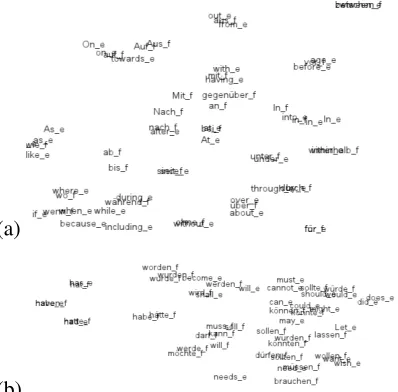
Figure 2: t-SNE visualizations of BARISTA embedding subspaces for (a) prepositions and (b) modals.
normally observe in word embeddings (where simi-lar words cluster closer together). The question thus is whether such embeddings are more or less useful for cross-language POS tagging than bilingual em-beddings based on translation equivalencies.
Translation classes Next, we induced English-German bilingual embeddings on Europarl using translations obtained from Google Translate. We derived a dictionary of the top 20k most frequent words in English, translated into German. The em-beddings are shown in Fig 2. The visualizations show that the models are able to extract very fine-grained bilingual relationships, and some clusters still correspond to POS.
3.2 Cross-language part-of-speech tagging Next we evaluated the embeddings in the context of unsupervised cross-language POS tagging (Das and Petrov, 2011). The goal is to train a tagger – in our case, we use SEARN(Daume et al., 2009),
follow-ing (Johannsen et al., 2014)– on labeled English data decorated with bilingual embeddings, and then eval-uate the model on another target language. We use data from Danish, German, Spanish, Italian, Dutch, Portuguese, and Swedish. Training and test data, which are the same used in Das and Petrov (2011), were converted to use the same12universal parts of speech proposed by Petrov et al. (2011).
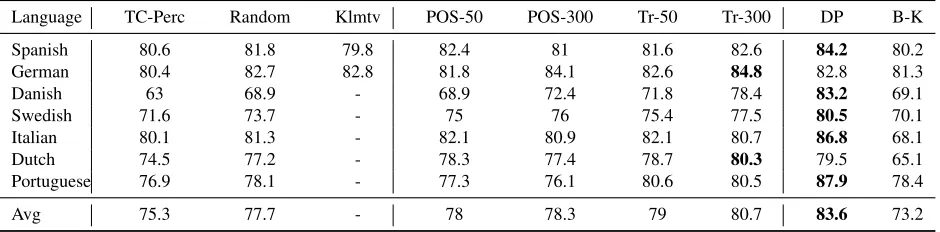
publicly-Language TC-Perc Random Klmtv POS-50 POS-300 Tr-50 Tr-300 DP B-K
Spanish 80.6 81.8 79.8 82.4 81 81.6 82.6 84.2 80.2
German 80.4 82.7 82.8 81.8 84.1 82.6 84.8 82.8 81.3
Danish 63 68.9 - 68.9 72.4 71.8 78.4 83.2 69.1
Swedish 71.6 73.7 - 75 76 75.4 77.5 80.5 70.1
Italian 80.1 81.3 - 82.1 80.9 82.1 80.7 86.8 68.1
Dutch 74.5 77.2 - 78.3 77.4 78.7 80.3 79.5 65.1
Portuguese 76.9 78.1 - 77.3 76.1 80.6 80.5 87.9 78.4
[image:4.612.74.544.61.177.2]Avg 75.3 77.7 - 78 78.3 79 80.7 83.6 73.2
Table 1: Cross-language POS tagging. TC-Perc: type-constrained structured perceptron.
available, pre-tokenized versions of Wikipedia,4and
then using the trained embeddings as features in a publicly available implementation of the structured perceptron.5 We use ortographic features, as well
as the embedding vector of the target word. In ad-dition, we use type constraints from Wiktionary to prune the search lattice during decoding (T¨ackstr¨om et al., 2013). We scaled the embedding features in the same way as Turian et al. (2010) with scaling parameter 0.01 (set on Spanish POS data).
Our baseline method is a type-constrained struc-tured perceptron with only ortographic features, which are expected to transfer across languages. We also experiment with usingrandomembeddings, as well as the embeddings provided by Klemen-tiev et al. (2012) (Klmtv).6 Our results are
dis-played in Table 1. POS-X refer to X-dimensional BARISTA embeddings trained with POS
equiva-lence classes, and Tr-X isX-dimensional BARISTA
embeddings trained using translation equivalence classes. We note that random embeddings improve over our baseline, suggesting that the random fea-tures act as regularizers. The embeddings provided by Klementiev et al. (2012) seem to lead to worse performance than random embeddings, presumably because they capture mostly semantic (topic) simi-larity. We also compare our results to those reported by Berg-Kirkpatrick et al. (2010) (B-K) and Das and Petrov (2011) (DP), but note that their approaches require in-sample unlabeled data, and in the latter case, also parallel bilingual data.
4https://sites.google.com/site/rmyeid/
projects/polyglot
5https://github.com/coastalcph/rungsted 6http://people.mmci.uni-saarland.de/
˜aklement/data/distrib/
While training with POS classes improves over the random baseline, training with translation equiv-alence classes gives even better performance. For both approaches, using more embedding features improves the performance (500 dimensions did not improve significantly over 300). Our model is gener-ally better than Berg-Kirkpatrick et al. (2010) – but worse than Das and Petrov (2011).
3.3 Cross-language super sense tagging
Finally, we also tried using the BARISTA
-embeddings for English-Danish (with parameters still set on Spanish POS) on another task, namely super sense tagging (Ciaramita and Altun, 2006). We train a system on a mixture of 1000 randomly sampled sentences from English SemCor7and 320
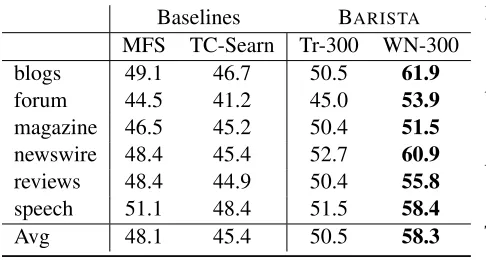
labeled Danish sentences (see below) and compare using bilingual embeddings trained with equiva-lence classes from English and Danish wordnets (WN-300), to embeddings trained using translation equivalence classes (Tr-300). We use 300 dimen-sional embeddings. We use a POS-sensitive most frequent sense baseline (MFS), as well as structured perceptron model trained only with ortographic and POS features, as well as MFS features (Johannsen et al., 2014). Our metric is a weighted average overF1-scores for the (41) semantic classes. Note that using the knowledge base is superior to using translation equivalences, but both embeddings are superior to both our baselines. The Danish training (newswire only) and test data (six different domains) – is made publicly available.8
7http://web.eecs.umich.edu/˜mihalcea/
downloads.html#semcor
8https://github.com/coastalcph/noda2015_
Baselines BARISTA
MFS TC-Searn Tr-300 WN-300
blogs 49.1 46.7 50.5 61.9
forum 44.5 41.2 45.0 53.9
magazine 46.5 45.2 50.4 51.5 newswire 48.4 45.4 52.7 60.9 reviews 48.4 44.9 50.4 55.8
speech 51.1 48.4 51.5 58.4
[image:5.612.71.314.62.192.2]Avg 48.1 45.4 50.5 58.3
Table 2: Cross-language SuS tagging.
4 Conclusions
We presented a simple approach, BARISTA, to
learn-ing billearn-ingual embeddlearn-ings. BARISTAhas the
advan-tages that it (a) is independent of the choice of em-bedding algorithm, (b) does not require parallel data, and (c) can be adapted to specific tasks by using ap-propriate dictionaries. Our embeddings proved use-ful for cross-language POS/SuS tagging.
References
Mohit Bansal, Kevin Gimpel, and Karen Livescu. 2014. Tailoring continuous word representations for depen-dency parsing. InACL.
Marco Baroni, Georgiana Dinu, and German Kruszewski. 2014. Don’t count, predict! a systematic compari-son of context-counting vs. context-predicting seman-tic vectors. InACL.
Taylor Berg-Kirkpatrick, Alexandre Cote, John DeNero, and Dan Klein. 2010. Painless unsupervised learning with features. InNAACL.
Massimiliano Ciaramita and Yasemin Altun. 2006. Broad-coverage sense disambiguation and information extraction with a supersense sequence tagger. InProc. of EMNLP, pages 594–602, Sydney, Australia, July. Dipanjan Das and Slav Petrov. 2011. Unsupervised
part-of-speech tagging with bilingual graph-based projec-tions. InACL.
Hal Daume, John Langford, and Daniel Marcu. 2009. Search-based structured prediction. Machine Learn-ing, 75:297–325.
Jiang Guo, Wanxiang Che, Haifeng Wang, and Ting Liu. 2014. Revisiting embedding features for simple semi-supervised learning. InEMNLP.
Karl Hermann and Phil Blunsom. 2014a. Multilingual distributed representations without word alignment. In ICLR.
Karl Hermann and Phil Blunsom. 2014b. Multilingual models for compositional distributed semantics. In ACL.
Anders Johannsen, Dirk Hovy, Hector Martinez Alonso, and Anders Søgaard. 2014. More or less supervised super-sense tagging of twitter. In*SEM.
Alexandre Klementiev, Ivan Titov, and Binod Bhattarai. 2012. Inducing crosslingual distributed representa-tions of words. InCOLING.
Tomas Kocisky, Moritz Hermann, and Phil Blunsom. 2014. Learning bilingual word representations by marginalizing alignments. InACL.
Omer Levy and Yoav Goldberg. 2014. Neural word em-beddings as implicit matrix factorization. InNIPS. Slav Petrov, Dipanjan Das, and Ryan McDonald.
2011. A universal part-of-speech tagset. CoRR abs/1104.2086.
Oscar T¨ackstr¨om, Ryan McDonald, and Jakob Uszkoreit. 2012. Cross-lingual word clusters for direct transfer of linguistic structure. InNAACL.
Oscar T¨ackstr¨om, Dipanjan Das, Slav Petrov, Ryan Mc-Donald, and Joakim Nivre. 2013. Token and type constraints for cross-lingual part-of-speech tagging. TACL, 1:1–12.
Duyu Tang, Furu Wei, Nan Yang, Ming Zhou, Ting Liu, and Bing Qin. 2014. Learning sentiment-specific word embedding for Twitter sentiment classification. InACL.
Joseph Turian, Lev Ratinov, and Yoshua Bengio. 2010. Word representations: a simple and general method for semi-supervised learning. InACL.
Laurens Van der Maaten and Geoffrey Hinton. 2008. Vi-sualizing data using t-sne. Journal of Machine Learn-ing Research, 9(2579-2605):85.