Brian Tritton
Competency-based Learning
in
Higher Education
Submitted in fulfillment of the requirements for the degree of
Master of Education (Research)
Table of Contents
Declaration of Originality iii
Acknowledgements iv
Abstract v
List of Acronyms vi
Chapter 1
ORIENTATION TO THE STUDY 11.1 Introduction 1
1.2 Aim of the Research 2
1.3 Study Design 3
1.4 Evolvement of Myotherapy in Australia 3
1.5 Curriculum 6
1.6 Education and Training 8
Chapter 2
CONTEXT OF THE STUDY 142.1 Introduction 14
2.2 Rationale for Competency-based Education and Training 15 2.3 Learning Process and Competency-based Programs 16
2.4 Development of CBE/T in Australia 18
2.5 National Training Packages 20
Chapter 3
LITERATURE REVIEW 243.1 Introduction 24
3.2 Defining Competency 25
3.3 Competency-based Education and Training 28
3.4 Competency-based Curriculum 30
3.5 Curriculum in Higher Education 32
3.6 Competency-based Approaches and Higher Education 36 3.7 Articulation and Cross-sectoral Linkages 40
Chapter 4
METHODOLOGY 444.1 Introduction 44
4.2 Research Methodology 44
4.2.1 Grounded Theory 46
4.3 Data Collection 47
4.3.1 Selection of Participants 48
4.3.2 Profile of Participants 49
4.3.3 The Descriptive Survey 52
4.3.4 The Interviews 52
4.4 Ethical Considerations 53
Chapter 5
DATA ANALYSIS AND INTERPRETATION 575.1 Introduction 57
5.2 Coding and Classifying of Participant Data 58
5.3 Research Findings 60
5.3.1 Attitudes to CBE/T 61
5.3.2 Defining CBE/T 63
5.3.3 Experience of CBE/T 64
5.3.4 Participants perceptions of attitudes in HE towards CBE/T 66 5.3.5 Opinions on introducing CBE/T into Units of a H/Ed Program 68
5.4 Analysis and Interpretation 69
5.4.1 Concepts 70
5.4.2 Perspectives 72
5.4.3 Integration 75
Chapter 6
CONCLUSION 826.1 Introduction 82
6.2 The Concept of CBE/T in Australia 83
6.3 Attitudes and Perceptions of CBE/T 84
6.4 Integrating CBE/T into Procedural Aspects of Higher Education 87
6.5 Further Research 91
REFERENCES 95
APPENDICES 106
Appendix A Background to Myotherapy. 107 Appendix B Basic units of competency used to develop
the Advanced Diploma of Myotherapy. 112 Appendix C Key features in competency-based learning
programs. 113
Appendix D Introductory information for participants. 114 Appendix E Focus questions in the Descriptive Survey. 120
Personal background information
Tables
Figure 1.1 Manual skills and underpinning cognitive skills 9
Declaration of Originality
I, Brian Stratton Tritton, declare that the Masters by Research thesis entitled
‘Competency-based Learning in Higher Education’ is no more than 60,000 words in length including quotes and exclusive of tables, figures, appendices, bibliography, references and footnotes. This thesis contains no material that has been submitted previously, in whole or in part, for the award of any other academic degree or diploma. Except where otherwise indicated, this thesis is my own work.
Acknowledgements
Firstly I would like to express my sincere thanks to the participants in this study. Their preparedness to share their experience, perceptions and views has been very much appreciated and I am indebted to their willingness to put aside valuable time, from their busy schedule in order to contribute to this research.
I would also like to acknowledge and thank my supervisor Dr Margaret Malloch whose encouragement, understanding and patience were always there, through both the good and the despairing times. Her suggestions, guidance and general input have been an invaluable contribution for which I am extremely grateful.
The co-supervisor for this study, Dr Carolyn Woodley, has also contributed to this thesis with many valuable and constructive suggestions. I would like to acknowledge her support and counsel in providing advice and direction throughout this project.
The pioneering research of Drs Janet Travell and David Simons in the field of myofascial pain and advocacy of education in this area has been inspirational.
Abstract
In 2004 the Victorian Office of Higher Education accredited a four-year undergraduate degree: Bachelor of Health Science (Myotherapy). This degree had stemmed from a three-year competency-based, Advanced Diploma of Myotherapy which is no longer accredited in the Vocational Education and Training (VET) sector. Myotherapy can be defined as the treatment and management of musculoskeletal pain. The Myotherapy degree program was developed as a content-based curriculum without a formal competency-content-based component. As with many vocational programs in the Higher Education (HE) sector, Myotherapy requires the development of both underpinning and acquired knowledge to carry out a number of procedural tasks. Consequently, this study intended to ascertain if there is a place for the formalisation of Competency-based Learning in Higher Education.
A qualitative methodology using principles of grounded theory was used for the study. The data examined comprised documentation pertaining to competency-based programs combined with information from descriptive surveys and semi-structured interviews conducted with a cohort of participants experienced in teaching, lecturing and/or designing curriculum for competency-based programs in the VET and HE sectors. Data collected was coded throughout the collection process and analysed for identification of themes and interpretation.
Results of the study suggest that competency-based learning has a place in the higher education sector and can be effective in those elements of a course which place an emphasis on procedural tasks. Its suitability was acknowledged as a component part of an integrated curriculum rather than the complete program.
Acronyms
AAM
Australian Association of Myotherapists
ANTA
Australian National Training Authority
AQF
Australian
Qualifications
Framework
AVCC
Australian Vice Chancellors’ Committee
CBT
Competency
based
Training
CBE/T
Competency-based Education and Training
DEST
Department
of
Education Science and Training
(formally
ANTA)
DEEWR
Department of Education, Employment and
Workplace Relations (Formally DEST)
HE
Higher
Education
HSU
Health
Services
Union
ITABS
Industry Training Advisory Boards
NFROT
National Framework for the Recognition of Training
NIRMA
National Institute of Registered Myotherapists of
Australia (formally NIRMA)
NOOSR
National Office of Overseas Skills Recognition
NTQC
National Training Quality Council
OTFE
Office
of
Training
and
Further Education (Victoria)
PETE
Post Compulsory Education, Training and
Employment (formally OTFE)
CHAPTER ONE
ORIENTATION TO THE STUDY1.1
Introduction
Accreditation by the Victorian Office of Higher Education in 2004 of a world-first, four-year undergraduate degree: Bachelor of Health Science (Myotherapy) which has been developed and delivered by a private Higher Education Provider, places Australia at the cutting edge in education and training for an emerging physical therapy in the field of allied health.
The Myotherapy degree evolved from an Advanced Diploma of Myotherapy which was developed and delivered at a major Melbourne University as a competency-based curriculum in the Vocational Education and Training (VET) sector, in which the curriculum was based on Competency Standards of the relevant industry or profession. This Advanced Diploma was accredited in 1996 under the principles of the National Framework for the Recognition of Training (NFROT). The focus of this curriculum was therefore competency or outcome-based, whereas the degree has been essentially developed as content-based curriculum.
Commenting on the differences between these types of curriculum, Ilic (2002, p. 2) contends that within Higher Education (HE) in Australia there has been a change of focus from content-based to process-based curriculum. He states that “content-based curriculum, usually geared to cognitive development in students, is slowly shifting to process-based educational experience with a focus on the development of skills in the affective domain”. These curricula have also been differentiated by Lonsdale (2003 p. 12) who suggests that: “a content-based education focuses on what students have been taught, an outcomes-based education focuses on what the students have learned; that is, on their skill and understanding”.
In Australia, Competency-based Education and Training (CBE/T) is well entrenched within the VET sector. However, there appears to have been very little ‘flow-on’ affect to the HE sector. A large number of HE programs have components which might be regarded as outcome-based, but which are not formally recognised as competency-based. Anecdotally, there appears to be a perception in the HE sector that CBE/T is too workplace-oriented and not theoretical enough and is viewed as a ‘constraint’ on teaching and assessment methods, which creates a resistance or avoidance of, competency-based programs in the HE sector.
As with many other HE programs, Myotherapy requires that ‘content’ as well as ‘outcome’ are emphasised in attaining the necessary underpinning knowledge, the discipline-specific skills, and generic attributes required by the Competency Standards of the Myotherapy profession. It appears, therefore, an opportune time to consider the implications of formally integrating a competency-oriented approach into those units of a HE degree-program which emphasise procedural knowledge.
1.2 The Aim of the Research
1.3 Study Design
The focus of this thesis has been to review the competency-based approach which has been a feature of the VET sector in Australia over the last fifteen years, and to consider the implications of introducing aspects of competency-based learning into the task-oriented units of a content-based degree program such as Myotherapy. The research employs a qualitative methodology using the grounded theory approach depicted by Strauss and Corbin (1990) as a research method which develops an inductively derived grounded theory about a phenomenon. The phenomenon in this case was the recently accredited Myotherapy degree curriculum.
The study was conducted by collecting and examining relevant literature pertaining to competency-based learning programs at both VET and HE levels in Australia. This was combined with data provided by participants who supplied written answers to nine focus questions in the form of a descriptive survey. The survey acted as a means of introducing the participants to the area of research and the answers provided by the participants in the survey were expanded upon in semi-structured, in-depth interviews which followed. The participants were chosen for their experience in teaching, lecturing or curriculum design in the VET or HE sectors. The data collected was coded and analysed during and after the collection process, while interpretation of the data took place on completion of the analytic process.
1.4 Evolvement of Myotherapy in Australia
In 1985, the Victorian state government accredited a certificate course in Remedial Massage which was to be delivered within the Technical and Further Education (TAFE) sector of a long established, Melbourne based, dual-sector University hereafter referred to as the MBDS and was upgraded to an Associate Diploma of Applied Science in 1990. The MBDS curriculum combined scientific principles with practical training in the various manual and supplementary modalities used to alleviate musculoskeletal pain. However, it soon became evident that the term ‘Remedial Massage’ did not adequately describe the collective modalities being taught within the curriculum, and it was decided that a more apt description would be ‘Myotherapy’. In 1991, the Victorian State Training Board approved a request from MBDS, the student body at MBDS, and the Australian Association of Myotherapists (AAM), for the course content and name to be changed to ‘Myotherapy’. In 1995 the course was upgraded to a three-year, full-time Advanced Diploma in Myotherapy. This program was developed in conjunction with the representative professional body, and designed to meet the relevant competency standards for Myotherapists. It was endorsed by the Health Industry Training Board (Victoria) in August, 1995. This course was considered by the Faculty of Biomedical and Health Sciences and Nursing at MBDS as having the potential to be delivered as a degree program. Consequently, a Course Advisory Committee was formed to establish a three-year degree - Bachelor of Applied Science (Myotherapy) and to develop a conversion program for students to upgrade from the Advanced Diploma. However, the implementation of this conversion program foundered, primarily due to difficulties in obtaining the additional government-funded university places required to deliver the course at degree level.
In 2003 this course was substantially modified by the Office of TAFE and replaced with an Advanced Diploma of Remedial Massage (Myotherapy) - developed in similar fashion to the National Training Packages and accredited under Section 22 of the Victorian Qualifications Authority Act 2000. The National Training Packages of Certificate IV Massage and Diploma of Remedial Massage were both incorporated into this Advanced Diploma. This fundamentally changed the focus of the course from Myotherapy as a distinct entity in which massage had played a small part, into a learning program with massage as a focal point.
At the same time these modifications were being implemented, a private, ‘not for profit’ HE provider, hereafter referred to as the PHEP, made the decision to pursue the development of a four-year, full-time, Bachelor of Health Science (Myotherapy) program. In July 2002, the PHEP presented a submission for the accreditation of this degree, and applied to the Office of Higher Education Victoria for authority to conduct this degree. After reviewing this submission, the Office of Higher Education granted accreditation in March 2004, and delivery of the program commenced immediately.
In considering the differences between learning programs in the VET and HE sectors, a significant difference lies in the fact that within a VET program every unit is formally designed in a competency-based manner and therefore the complete package is competency-based. However, in HE sector courses there is a tendency to separate the elements of the course which are considered to have a cognitive orientation from those with a strong procedural or task orientation. The task-oriented elements in the HE sector may not be formally designated as being competency-based but they are designed with an outcomes-competency-based orientation, as illustrated in the Myotherapy degree program.
and management skills, an appreciation of legal and ethical issues, and an understanding of psychological issues. This knowledge base combines with an extensive repertoire of sophisticated manual skills.
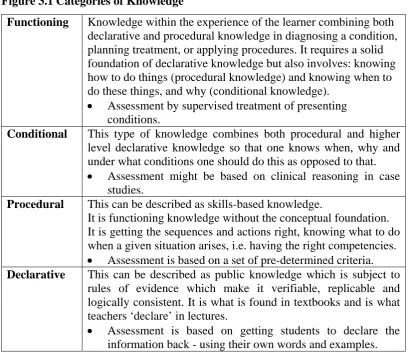
It has been argued by Biggs (2003) that knowledge can be divided into four distinct categories, which he describes as: declarative knowledge (theoretical knowledge), procedural knowledge (attainment of skills), conditional knowledge (circumstances for using these skills) and functional knowledge (combination of the previous three categories).These categories are more fully explained in Chapter 3 (Figure 3.1) and appear to provide an excellent means of ‘focusing’ on the content, delivery, and assessment of individual units when developing undergraduate learning programs such as Myotherapy.
1.5 Curriculum
Teitlebaum (2007, p. 2) estimates that there are more than 120 definitions of curriculum in the related professional literature. However, for the purpose of this research, the following selected examples have been deemed as most relevant. One of the earliest definitions of curriculum is noted by Teitebaum (2007) when he cites Bobbitt (1918, p. 42) who considered curriculum to be: “That series of things which children and youth must do and experience by way of developing abilities to do the things well that make up the affairs of adult life”. Later, a general definition cited by offered by John Kerr (1968, p. 16) who defines curriculum as: “All the learning which is planned and guided by the school, whether it is carried out in groups or individually, inside or outside the school”, (quoted by Kelly 1999). This is similar to the definition offered by Print (1993, p. 9) who defined curriculum as: “all the planned learning opportunities offered by the organization to learners and the experiences learners encounter when the curriculum is implemented”.
topics should be covered and which methods are to be used for learning, teaching and evaluation”.
Commenting on curriculum in Higher Education in the United Kingdom, Barnett and Coate (2004, p.2) argue that: “The idea of curriculum has not been seriously engaged within the higher education debate and policy formation and even in its practices. Curriculum design in Higher Education is not yet a properly reflective practice”. Tertiary education may have at one time been seen as the final component in the formal education and preparation process, but this is no longer the case. Any form of tertiary curriculum should, where possible, prepare the learner for a lifetime of continuing change - and the ability to cope with ongoing educational requirements. Smith (1996, p. 9) describes a praxis model of curriculum, which he suggests adds to the more general process model by the inclusion of collective well-being and emancipation of the human spirit. The Collins Concise English Dictionary (1991, p. 899) describes the term ‘praxis’ “as the practice of a field of study as opposed to the theory”. Macpherson (1996) also uses the term praxis when he explains and defines curriculum in the following comprehensive manner:
Curriculum is a praxis – a dynamic interplay of theoretical concepts and professional work within a critically reflective mindset. As a praxis, curriculum has no particular starting point – it is a constantly evolving and living organism made up of an interacting set of ideas, people, space, time, and resources. It is the set of learning environments to which learners have access; of learning activities which learners experience; and of learning outcomes which learners achieve, all within the immediate contexts of an individual teacher’s (or curriculum practitioner’s) and an institution’s mission/policy/vision (including its organisational arrangements) as well as the broader contexts of community and society (p. 2).
Macpherson suggests that this approach to curriculum may be carried out in a variety of ways, depending on the resources available, the dispositions of teaching staff, and the particular needs and interests of those enrolled. This curriculum would reflect the broader principles associated with adult learning, critical pedagogy and teaching in higher education institutions. In integrating curriculum theory and practice, a theoretical process was suggested by Stenhouse (1975) in the following terms:
For the purposes of this study, the term curriculum refers to: “a planned program of learning opportunities, in which the aim is to enable the individual to function in their present environment and prepare them to operate within a future environment”.
1.6 Education and Training
The term CBE/T implies a connection between the words ‘education’ and ‘training’. However, although these terms are not necessarily exclusive to each other, they do have differing implications. Although it has been customary to equate the term ‘education’ with primary or secondary schools and universities, the term ‘training’ is normally used in relation to vocational or technical instruction - with connotations of specific task-oriented skills requiring a standard of competency with limited cognitive components. Harris, Guthrie, Hobart and Lundberg (1995, p. 15) contend that prior to the implementation of CBE/T there were differing perceptions of training, citing Snook (1973) who describes ‘training’ as a narrow preparation to enable a person to perform a function or task, whereas the term ‘education’ refers to a broad preparation of a person for life skills.
For the purpose of this study, the term ‘Competency-based Education and Training’ (CBE/T) is used to describe a learning program designed and developed to meet the competency standards of a relevant industry or professional body. These standards are a compilation of the requirements considered necessary for a person to be regarded as competent in a particular occupation. Learning programs using this type of approach may be oriented to the narrow rigidity of a workplace setting, or may incorporate the expectations and values of the broader community
Almost all forms of occupational activity require the acquisition of knowledge and skills involving some measure of formal education and training. The process by which the knowledge and skills are acquired usually includes some form of evaluation or assessment to gauge whether the activity is being carried out with an acceptable degree of competence. This applies equally to the person who is being taught the skills required to lay bricks and the person who is being taught the skills required to carry out heart surgery. The difference lies in the emphasis placed on the ratio of underpinning educational or cognitive requirements of the discipline - and of course in the consequences of the activity. This is illustrated in figure 1.1.
Trade Proficiency Technical Proficiency Professional Proficiency Greater emphasis on
manual skills
________________ Less emphasis on underpinning cognitive skills
Equal emphasis on manual and
underpinning cognitive skills _________________________ Equal emphasis on manual and
underpinning cognitive skills
Greater emphasis on underpinning
cognitive skills ________________ Less emphasis on manual skill
Figure 1.1 Manual skills and underpinning cognitive skills (Tritton 2006)
The above learning of skills might be divided into practical or theoretical skills and attributes but the combination of both can provide greater mental and physical dexterity. Although the manual dexterity or skill may vary, most of us would like to think that the prosthesis engineer creating an artificial limb - or the heart surgeon about to perform an operation on our person - were as least as skilled as a highly trained violin maker.
Competency describes the ability to perform a task in a given context and comprehend the principles and concepts which underlie its application in order to transfer that knowledge and skills to new tasks and situations in both vocational and social settings. Competency-based Education and Training describes a method of instruction in which learning programs or curricula are designed and developed to meet the competency standards of a relevant industry or professional body. These competency standards are a compilation of the requirements which are considered necessary to be regarded as competent in a particular occupation. Learning programs using this type of approach may be too oriented to the narrow rigidity of a workplace setting, or they may incorporate the expectations and values of the broader community. Competency-based learning programs have been part of the Australian education system for over fifteen years, but its implementation has largely been confined to the VET sector. their incorporation into different levels has created a great deal of discussion regarding usefulness and even meaning.
Competency-based programs in the VET sector are often seen as having a large component of ‘on-the-job training’ conducted in settings associated with manufacturing, agricultural, or service-oriented industries. However, ‘on-the-job’ training is also a requirement for most professions in areas including teaching and health sciences, but is couched in discipline-specific terminology. For example, law graduates are required to complete ‘articles’, nurses are required to complete a staff-year, medical practitioners are required to complete internships, and teachers must complete a practicum. However, the practical components in these HE courses are not formally referred to as competency-based.
Within the VET sector, the current method of delivery is through the use of National Training Packages that consist of competency standards developed by the relevant industry and endorsed by the Department of Education, Science and Training (DEST) which in December 2007 DEST was incorporated Department of Education, Employment, and Workplace Relations (DEEWR).
While Training Packages offer many opportunities for a wide range of students and workers in a wider variety of vocations (and locations) than ever before in Australia, their emphasis upon workplace delivery has led many to view them as narrow, static, unlikely to develop higher order skills, and of little relevance to the learner’s personal development (p. 11).
The National Training Packages and other competency-based programs used in the VET sector include ‘Key Competencies’ developed by the Mayer Committee (1992). These are often referred to as ‘Employability Skills’, and can be described as the knowledge and skills that might be considered generic to all occupations and essential for effective participation in the workplace. These competencies may also facilitate the transfer of knowledge and skills acquired in learning programs that can be transferred to the workplace.
In addressing the question: Is there a place for a competency-based approach to be formally integrated into the procedural or task-oriented units of a HE curriculum?
this thesis makes a significant contribution to the debate on the applicability of CBE/T in higher education, whilst also providing insight into the delivery of CBE/T programs in the VET sector through the selected case study. In the course of the research, the data collected from participants, indicates a generally positive attitude to the concept of CBE/T and its applicability in certain areas of HE curricula.
The study also identified of the concept of ‘protocolic’ and ‘functional’ knowledge as a key to differentiating between the intended outcomes in the VET and HE sector curricula. Within the VET sector the focus of the intended outcome is the ability to replicate procedural tasks in differing circumstances or environments, based on sets of industry-based criteria and may be described as ‘protocolic’ knowledge. Whereas, within the HE sector the focus of the intended outcome is the capacity for analytic inquiry which is achieved by combining declarative, procedural and conditional knowledge to produce ‘functional’ knowledge (Biggs 2003), which in the area of health may be termed clinical reasoning.
This thesis uses the development of Myotherapy programs in both VET and HE as a case study to explore the intersection and applicability of CBE/T in HE. This study considers the concept of CBE/T in Australia through reviewing the attitudes and perceptions of 10 participants interviewed regarding their experience of CBE/T. In this thesis, the term ‘attitude’ is used to refer to a way of thinking, acting or feeling, and the term ‘perception’ is used to refer to the process of using one’s experiences to formulate views and opinions.
CHAPTER TWO
CONTEXT OF THE STUDY
2.1 Introduction
From the early 1990s, the emergence of competency-based programs at both state and National levels, and ten years later the introduction of National Training Packages, have caused radical changes in teaching, learning and assessment processes within the VET sector, and to a lesser extent in the HE sector. Therefore, in accordance with the aims of this thesis and in order to appreciate the sequence of events in the evolution of CBE/T in Australia, this chapter provides an overview of relevant reports, recommendations and reviews pertaining to CBE/T.
Education and training in Myotherapy commenced in the VET sector at a time when CBE/T was being formally introduced. The Advanced Diploma of Myotherapy was developed in consultation with industry representatives and based on the relevant competency standards. This early program contained seven basic units of competency, allowing for a holistic learning program with integrated content and outcomes-based units within the curriculum (see Appendix B). However, the introduction of National Training Packages in the VET sector established a system in which all units within courses were developed, delivered and assessed in a competency-based manner, regardless of whether they had a cognitive or task-based orientation. In this context, the present study investigates the suitability of the formal introduction of the concept of CBE/T into task-oriented aspects of a HE curriculum.
The term VET is used in many countries, with some variations, to describe the development and furtherance of the skills and knowledge required of an individual to be productive in a given occupation. It has been suggested by Smith and Keating (2003, p. 3) that VET programs have a number of features which help define the term including: an association with industry; association with a job or task; learning on and off the job; and skills based. However, these features are not confined to the VET sector. Many university courses are also vocational, requiring the attainment of specific levels of knowledge and skills. There are also courses such as those in Nursing and Paramedics which conduct competency-based learning programs in both the tertiary and TAFE education sectors.
2.2 Rationale for Competency-based Education and Training
One of the principal reasons for the formal introduction of CBE/T was to provide training programs with outcomes which were deemed necessary by the relevant industry representatives and professional bodies for entry into a particular occupation. These programs were primarily task-oriented or vocational in nature. In this context, the term ‘competency’ has been around for some time and is used to describe the ability of a person to perform a task in a given context, and to comprehend the principles and concepts underlying its application in order to be able to transfer such knowledge and skills to new tasks and situations in both vocational and social settings. Here, although the learning of skills might be either practical or theoretical, the combination of both can provide greater mental and physical dexterity. For example, without the ability to read we may gain theoretical and underpinning knowledge by verbal communication and we can acquire motor skills by practical application and refinement, however the ability to read allows us to attain greater knowledge in a self-directed manner with less reliance on others for information.
manner, and the method of measuring successful attainment must be fair, flexible, reliable and valid. The purpose and nature of each unit must also be transparent, with clear, definite and stated relationships between the unit and the overall program.
Competency-based training programs have been developed by government or private institutions in conjunction with relevant industries and professional bodies, and designed to meet the competency standards formulated by these organisations. Smith and Keating (2003, p. 52) state that: “Competency standards provide the basis for VET courses and qualifications, and they are the means for common recognition of knowledge and skills and of qualifications around the country”.
This concept of national portability was taken into account when the Advanced Diploma of Myotherapy was developed as a competency-based program at the MBDS University. Development and accreditation of this course took place prior to the implementation of National Training Packages, and was based on Competency Standards developed by the National Institute of Registered Myotherapists Australia (NIRMA), the professional body representing Myotherapists at that time (previously AAM). The resulting curriculum contained teaching and learning strategies, individual units containing the required content and underpinning knowledge, as well as associated discipline-specific skills, allocated participation time and assessment procedures.
2.3 Learning Process and Competency-based Programs
Harris et al. (1995, pp. 16-17) suggest that there are three major schools of educational philosophy whose theories can be considered as either supportive or unsupportive of CBE/T. These theories regarding learning and teaching styles and their relevance to CBE/T and in particular to the Myotherapy curriculum are considered below.
promote the theory that the acquisition of knowledge is aided by rewarding a correct response (positive reinforcement) rather than punishing an incorrect response (negative reinforcement). In CBE/T this can often be accomplished with immediate feedback on the completion of criteria-based tasks. This aspect of behaviourist theory is also supported in an essential element of CBE/T - public disclosure of the intended outcomes (progressive or final) prior to commencement of the task, module, or subject unit.
Secondly, there is the cognitive school of thought, which Harris et al. (1995) consider the principal proponents to be Bruner (1960), Ausubel (1963) and Gange (1965). This theory proposes that knowledge is acquired by the continuous refinement of schemata, in which, understanding formed by past experiences and new experiences are evaluated. This theory is not at odds with CBE/T in that the tasks to be performed grow progressively more complex as more information and skills are acquired.
Thirdly, there is the humanist school of thought, whose principal proponents Harris et al. (1995) consider to have been Maslow (1970) and Rogers (1983). Humanists believe that a person should be regarded as a holistic being, and emphasises the individual differences in learning processes. This theory tends to be at odds with the predetermined and prescriptive nature of CBE/T.
knowledge is gained and internalized through continued exposure to completing certain tasks, such as occurs in a competency-based learning program.
Although the behaviourist and cognitive schools of thought are of use in understanding CBE/T, the development of skills through ‘tacit knowledge’ proposed by Polanyi (1967) describes one of the most important features of Myotherapy where the development of tacit knowledge and skills is acquired in what is termed ‘palpatory literacy’. This is the development of a student’s palpatory skills to locate, identify, assess and treat musculoskeletal dysfunction. This type of skill evolves and develops in a similar fashion to the playing of a musical instrument, and improves with ongoing repetition of certain movements. It also requires unconscious knowledge which is difficult to analyse, but can certainly be described as the internalisation of underpinning theoretical knowledge combined with functional or acquired skills.
The attainment of this type of knowledge and skill can be difficult to evaluate or grade, and must be assessed from a predetermined, set criteria. Furthermore, the assessment of this type of skill must be conducted using a holistic approach, and determined by an experienced practitioner. In order to neutralise the subjectivity associated with this type of assessment in the Myotherapy degree program, two examiners assess the relevant task simultaneously.
2.4 Development of CBE/T in Australia
The concept of Competency-based Education and Training originated in the late 1980s in order to develop curricula based on the competency standards of associated industries. At this time the Myotherapy curriculum - one of the first learning programs to be developed as a competency-based curriculum prior to the advent of National Training Packages, was evolving within the VET sector of MBDS as a three-year full-time Diploma.
was the introduction of competency-based training in which curricula were to meet work-related competency standards for each major industry, and the establishment of Industry Training Advisory Boards (ITABS) with representatives from employer groups and unions assisting in the development of standards and accredited courses for each industry. In order to accomplish this, National Industry Competency Standards were introduced, with a National Training Board established in 1990 to oversee and help develop industry standards.
The second major reform stemmed from a 1991 report of the Training Costs Review Committee (Deveson, 1991) which had a considerable impact on the VET sector. The major implication of this report was the introduction of an ‘open-training’ market in which private training providers were licensed to develop and submit courses for accreditation and delivery to the relevant ITABS in competition with TAFE in the VET sector.
Standardisation of training and qualifications at a National level was also introduced in 1992 with the creation of a National Framework for the Recognition of Training (NFROT). This was to be the forerunner to the Australian Recognition Framework which became the Australian Quality Training Framework in 2002, to create standards and maintain quality control in TAFE colleges and privately Registered Training Organisations involved in teaching accredited VET courses.
The next report produced in this sequence of events was from the Australian Education Council (1991) chaired by Brian Finn. This recommended a number of targets for the participation of young people completing post-compulsory Education and Training, to be achieved by the year 2001. The Finn report also recommended the establishment of a group to develop a list of ‘Key Competencies’ for inclusion into these training programs. Accordingly, under the chairmanship of Eric Mayer in 1993, a committee produced the Mayer Report which developed seven key competencies with three levels of performance.
qualifications in secondary, vocational and higher education, which was to also serve as a precursor to the introduction of some VET programs into secondary schools. Further acceptance of nationalisation in education was confirmed with the establishment of the Australian National Training Authority (ANTA) established in 1992, which was formally commissioned in 1994 to have the major responsibility for policy in the VET sector. This ongoing period of change was to continue with the 1997 endorsement of ‘National Training Packages’ consisting of qualification rules, competency standards, and assessment guidelines which act as guidelines for curriculum development. On the 1st July 2005, the functions and responsibilities of ANTA were transferred to the Department of Education Science and Training (DEST). With the change in Federal government in December 2007 DEST was incorporated into a new department, the Department of Education, Employment, and Workplace Relations (DEEWR).
2.5 National Training Packages
qualifications, in which qualifications and/or statements of attainment issued by one RTO must be recognized by all other RTOs. This change shifted the equality of emphasis that had existed between training and assessment to that of assessment of performance relating to a set of performance criteria developed in consultation with relevant industry groups.
The introduction of National Training Packages had a major impact on the Myotherapy program in the VET sector by changing the focus of the course from a distinct program of treatment for musculoskeletal pain to a course which was primarily concerned with relaxation and remedial massage. This change was so extensive that in order to reflect the new focus of its content, the course was reaccredited as the Advanced Diploma of Remedial Massage (Myotherapy).
As previously mentioned, National Training Packages refer to the nationally endorsed competency standards, assessment guidelines and Australian Qualifications Framework (AQF) qualifications for specific industries and professional bodies. Training Packages are developed by Industry Skills Councils and endorsed by the National Training Quality Council (NTQC). A National Training Package does not constitute a curriculum, but can be considered as the guidelines from which a course of training is to be developed. National Training Packages consist of the specified ‘Units of Competency’ which constitute the learning outcomes required for a particular certification.
These Units of Competency are a compilation of a number of related tasks called ‘Elements’ or single tasks which are based on ‘Performance Criteria’. The units of competency include a ‘Range of Variables’ that advise on the scope and context of delivery, and an ‘Evidence Guide’ which identifies the critical aspects, knowledge and skills to be demonstrated. In addition to discipline-specific skills, each training package also includes specific units of competency required to integrate the key competencies (Smith & Keating, 2003, pp. 147-175).
competency (together with others which are specific to a particular course) are arranged in the form of National Training Packages. Institutions accredited to conduct units of competency are free to deliver the training in a variety of settings, and the level of associated underpinning knowledge at each institution can be diverse.
National Training Packages have resulted in a major deregulation of education and training within the VET sector, and their introduction at a time when teachers had just begun to accommodate the concepts associated with CBE/T has added another impetus for fundamental change in teaching and learning strategies within the VET sector. As with the introduction of CBE/T National Training Packages have created much controversy amongst those involved in the educational process. For example Smith and Keating (1997) contend that:
Training Packages take competency to its ‘logical extreme’ in that training is focused on the ability to competently complete a task rather than the methodology used in acquiring the skills needed to competently complete the task (p. 105).
Scollay (2000, p. 3) comments that: “The key to the successful application of Training Packages in any learning environment is the ability of the teacher /trainer to develop and customize the learning strategies within the framework of competencies and assessment that the packages provide”. This customizing of the learning strategies to develop a curriculum or syllabus from the Training Package strategies was seen by some, such as Waterhouse (2000), as an opportunity for innovative teachers to explore and create new methods of delivery. However, commentators such as Smith (2002) argue that:
Others see this reliance upon individual teacher’s or trainer’s expertise as a possible route to disaster, with smaller and/or less scrupulous providers perhaps leaving it to under-qualified teachers to struggle as best they could to teach to units of competence (p. 7).
In a similar vein, Malloch (2000, p. 22) argues that individual customizing of learning strategies is erratic, and likens training packages to: “a mail order dress; you read about it in the catalogue, read the description, order it, take delivery of it, and then you try to alter it to fit your specific circumstances”.
and provision of a ready-made framework for training in workplaces with flexibility in delivery and assessment. In the same text, Misko then lists the disadvantages as: introduced too hastily; flexibility can lead to variability in quality; teachers and workplace supervisors require advanced skills to structure learning activities, assessment pathways may be suspect in quality; underpinning knowledge is down-played; and may not be suitable for students who have no workplace experience.
However, we have yet to see the results of this fundamental alteration to vocational training in the VET sector. Training Packages should not be seen as the epitome of CBE/T, but rather as one of a variety of models by which competency-based programs might be delivered. As with CBE/T, the system of National Training Packages will have its subscribers and detractors, with some seeing the benefits outweighing the difficulties. These Training Packages will, no doubt, undergo the normal evolutionary changes, and is probably too early to pronounce judgment on their overall effectiveness.
This chapter, in discussing competency based education and training in the Australian and Victorian context, provides a basis for the study to proceed in investigating the applicability of formalising the inclusion of a CBE/T approach into those units of HE curricula which contain a strong procedural focus. In Myotherapy, the case explored in this thesis, the utilisation of a CBE/T approach would be applicable in units for clinical practice but not for areas of declarative knowledge, for example, anatomy, physiology, nutrition, biophysics and clinical diagnosis, all of which require strong content focus rather than an emphasis on outcomes. CBE/T can contribute but not be the sole focus for units of study.
CHAPTER THREE
LITERATURE REVIEW
3.1 Introduction
As indicated in the previous chapters, education and training in Myotherapy developed into a competency-based Diploma in the early 1990s, and evolved to become a content-based degree program in the HE sector in 2004. In this context, the present study conducts an evaluation of the advantages of integrating aspects of competency-based learning into the task-oriented units of the Myotherapy degree program. It draws upon literature that debates and critiques the implementation of CBE/T in post secondary education at both state and national levels in Australia, to form a basis from which questions in a descriptive survey and semi-structured interviews are derived.
CBE/T programs were introduced in Australia in 1992 to form a major component of the National Training Reform Agenda, primarily aimed at the VET sector. These programs sought to provide a highly skilled and flexible labour force to service the needs of national industries in a growing and competitive global market (Smith & Keating 2003). These programs were derived from similar systems that had been implemented in the previous decade in America, Europe and the United Kingdom. CBE/T has not been universally accepted nor is it regarded as the panacea to any perceived difficulties associated with the learning process. The work of Lundberg (1995), Anderson (1999), Angus (1999), Thomson, Mathers and Quirk (1996) and Smith and Keating (2003) offer examples of differing opinions on the concept and application of CBE/T.
3.2 Defining Competency
The meaning of competency has been the subject of much debate, and the following examples of views regarding the meaning of the term ‘competency’ indicate the difficulty in obtaining a precise and universally acceptable definition. This lack of clear definition was recognized by Hoffmann (1999) who stated that:
The term competency is multi-faceted. Some have defined the term narrowly by using a single element of human performance. Others have allowed their definition to overlap several of the elements of human performance. The shifting definition has brought with it a degree of confusion over the nature of the concept and its application (p. 275).
The meaning of competency is therefore a significant issue in the development and implementation of CBE/T. Evers, Rush, and Berdrow (1998) provide definitions of skills and competency, asserting that skills are composed of ‘related sets of actions’ performed in a particular sequence to successfully achieve a given task, and that competence in any skill might be judged by the level at which these actions are sequenced and performed. They suggest that the acquisition of skills is achieved by a learned progression from basic to advanced skills. However, others such as Norris (1991, p. 336) have argued that: “Competence appears to circumvent the issue of what people need to know, it shifts the balance of power firmly in the direction of practice and away from theory”.
An important factor in defining the term ‘competency’ is the manner in which it is used. For instance, Watson (1993) considers that much of the debate in relation to competency-based learning programs relies on whether competency is perceived from a holistic or Cartesian viewpoint. That is to say- whether a person’s competency is be judged on their overall attributes or simply on their ability to carry out a set of individual tasks relating to the workplace. This method of categorising competency as it relates to the workplace may stem from the fact that competency-based learning programs were first implemented in short, certificate level, vocational programs in which more emphasis was placed on task-oriented aspects of the program and less emphasis placed on cognitive requirements.
In America and the United Kingdom, the notion of competency tends to emanate from the holistic concept seen in Fletcher’s observation (1991) that in Australia, vocational competency reflects the expectations of employment and focuses on work-related tasks, but in the United States, vocational competence is seen to include the underlying characteristic of the person. In the United Kingdom, the Further Education Unit (1984, p. 3) defines competency as “the possession and development of sufficient skills, appropriate attitudes and experiences for successful performance in a life role”.
In Australia, the notion of competency is more vocationally focused and appears to be much more industrially oriented than it is in America or the United Kingdom. It has been suggested by Harris et al. (1995) that the tendency in Australia to focus more on the occupational aspects of competency and less on ‘life skills’, may have contributed to some of the misgivings that have accompanied competency-based programs. These programs might also be considered ‘narrow’ in that they have been employment-related with little reference to the values and attitudes advocated in graduate attributes of the HE sector. An example of this was an early Australian definition of competence provided by the Australian National Training Board (1992): The concept of competency focuses on what is expected of an employee in the workplace rather than on the learning process; and embodies the ability to transfer and apply skills and knowledge to new situations and environments (p. 29).
complete a task; Standards which focus on the quality of the observable performance; and Underlying Attributes which focus on the required underpinning knowledge, skills and generic capabilities that can be modified in response to vocational or social requirements. The first two of these constituents are suited to simple task-oriented learning programs in which the objectives are based on performance, conditions and criteria, with little need to place much emphasis on the third criteria. However, in more complex task-oriented learning programs, a much greater emphasis is required from the third constituent.
The notion of competence being linked to performance was disputed by Noddings (1984) who argues that, if we view competence as a set of observable behaviors, then the same set or list of observable behaviors should be observed by anyone deemed competent in the same field. However, this is rarely if ever the case. She uses the example of competent teachers who may be observed using a variety of individual teaching styles to demonstrate that the nexus between competence and observable behavior is not immutable. This view is shared by Smith and Keating (2003) who state that:
Competence itself is a difficult concept. In fact we cannot really assess competence from performance: we can only infer it. A person’s competence is something that lies behind what he or she can actually do. We cannot observe his or her ‘competence’. Competence has usually been described as an encompassing knowledge, skills and attitude, but the problem is how to ensure that CBT teaches and assess all three (p. 135).
3.3 Competency-based Education and Training
The intention of implementing CBE/T was to increase and improve the skills of workers for industry. However, it has been suggested that there had been very little research into the area of CBE/T prior to its implementation. Cairns (1999) states that:
There was little reported research evidence that competency-based training was able to deliver the efficacy and results touted in the many papers, reports, and calls for this needed reform. The idea was timely, the approach was grasped with almost missionary zeal by some and the focus was seen as common sense. The lack of research evidence clearly justifying the approach or demonstrating clear links to the alleged competitive improvements for individual and even national business efforts was not an issue (p.2).
This viewpoint was supported by Newman (1999, pp. 75-76), who contended that: “in the interests of everyone the principles behind competency–based training should have been subjected to critical scrutiny”. Although CBE/T was introduced in the VET sector at a national level and supported by the states and territories, its introduction has created a great deal of debate amongst all sections of educational professionals. The intrinsic changes stemming from its implementation were bound to create controversy. As argued by Smith, Lowrie, Hill, Bush and Lobegeier, (1996):
Not only have many VET teachers and trainers been opposed to the concept of CBT but also the way in which CBT was introduced into some VET organizations was not ideal. Such a major curriculum change was bound to incur opposition. Many teachers and trainers arrayed themselves into the “for” and “against” camps and in such a climate it has not always been easy or appropriate to attempt to examine the effects of CBT (p. 1).
Many opponents to the concept of CBE/T see it as reductionist, rigid, atomised, narrow, and pedagogically unsound (Chappell, 1996; Hyland 1994), whilst others view it as a ‘controlling mechanism’, restricting the professionalism of the educator, limiting a holistic approach to curricula, and stifling the expression of the student - presenting a narrow, fundamentally flawed conception of competence.
Chappell et al. (2000) consider that a narrowness of approach and definition manifests itself in a number ways due to an over-emphasis on technical task skills at the expense of general social, intellectual and emotional abilities. They suggest that competency should not be confused with performance, and that a large variety of attributes underpinning performance must be considered in a competency analysis. The Australian Chamber of Commerce and Industry (1992) regards CBE/T to be a type of training that that places the primary emphasis on what a person can do as a result of training (outcome), rather than the process involved within training (input). This suggests a rather narrow employment-related role for competency-based education and training which involves a task-specific learning process, with little reference to life-skills that relate to both employment and social environments. In the course of data collection for this study, one of the participants suggested that, in order to prevent the Myotherapy course from being too employment-related, the curriculum should be developed in conjunction with the competency standards of the relevant professional body. Many professions have produced ‘competency standards’ that can be used by curriculum developers as a guide to establishing syllabuses. It might be assumed that any professional body would expect a curriculum to be broad enough to include values relating to the community in general as well as discipline specific skills related to the workplace.
3.4 Competency-based Curriculum
Just as definitions of ‘competency’ have been many and varied, there are differences of opinion as to what constitutes a ‘Competency-based Learning Program’. Jubb and Robotham (1997, p. 171) express the view that “it still remains the case that a precise and widely accepted definition of competencies continues to elude both those researching the field and the trainers themselves”.
Competency-based programs or curriculum can be described as being task-based and outcome-oriented, as distinct from input or content-oriented. They are based on industry or professional competency standards, with assessment based on a set of established criteria. The Mayer Committee (1992) established seven ‘Key Competencies’ they considered essential for effective participation in occupational settings including: collecting, analysing and organising ideas and information; expressing ideas and information; planning and organizing activities; working with others and in teams; using mathematical ideas and techniques; and solving problems and using technology.
The Mayer Committee felt these ‘Key Competencies’ should be generic to all courses and considered that this would enable knowledge and skills acquired in the learning program to be transferred to the workplace. The Committee also considered the inclusion of ‘cultural understanding’ as an additional competency, but stated in the report that “both the principles and characteristics the committee had used to construct the set of key competencies preclude the inclusion of values and attitudes”. The inclusion in the Committee’s Report on ‘Generic and Key Competencies’ broadened the concept of employment-related competence, and commented that:
Employment-related competence should refer not only to a narrow skills based vocational content but also requires generic and key competencies, which are required for effective entry into a wide range of occupations and industries (p. ix).
The mid-1990s saw a considerable effort being given to implementation of the Mayer ‘Key Competencies’ in Australian Schools and VET programs. More recently, Australian industry re-established a focus on key competencies - otherwise referred to as generic skills. The Australian Industry Group commissioned a report into the training needs of Australian industries (Allen Consulting Group, 1999), consulting a large number of companies in the manufacturing, construction, and information technology sectors. The research from this report found that an increasing premium was being placed on generic skills including information technology, problem solving, team skills, willingness and the ability to adapt.
With regards to what constitutes a competency-based program, Smith and Keating (2003) have suggested that the majority of curriculum developers and teachers or trainers within the VET sector would accept the notion that there are a number of ‘key features’ that can be categorized as being part of competency-based learning programs. Ten of these features include: 1) based on competency standards; 2) outcome not input focused; 3) involvement with industry; 4) recognition of prior learning; 5) modularized; 6) self-paced; 7) skills-based assessment rather than knowledge-based; 8) criterion-referenced assessment not norm-referenced; 9) flexibility in delivery; and 10) competencies that are widely recognized. A more detailed reference to these features can be found in Appendix C.
Smith and Keating (2003) have suggested that some learning programs may comprise differing combinations of these features, and not every competency-based learning program will include all of these ‘key features’. However, they are of the opinion that for a learning program to be considered “competency-based”, it would require the inclusion of a substantial proportion of these features.
3.5 Curriculum in Higher Education
The HE curriculum has traditionally placed emphasis on content (information received) rather than outcome (ability to perform). Barrie (2005 p 1) suggests that since ‘Graduate Attributes’ were made a condition of government funding a few years ago, curricula in HE are expected to satisfy the following requirements. Firstly, they must prepare graduates with the discipline-specific skills to cope in a workplace environment. Secondly, they must produce graduates with the generic graduate attributes required by the institution. Thirdly, they must produce graduates who exhibit the generic capabilities required in the competency standards of the relevant, representative professional body.
Graduate Attributes have been described by Bowden, Hart, King, Trigwell and Watts (2000) as:
The qualities, skills and understandings a university community agrees its students should develop during their time with the institution. These attributes include but go beyond the disciplinary expertise or technical knowledge that has traditionally formed the core of most university courses. They are qualities that also prepare graduates as agents of social good in an unknown future (p. 3).
The term ‘Graduate Attributes’ has been used to describe generic capabilities of graduates from professional programs but tends to refer to attitudinal and dispositional qualities, that may be refined and modified by knowledge and reflection. The terminology is sometimes mixed and “generic attributes” have been defined as ‘the key outcomes of higher education as a process’ (Higher Education Council Australia 1992).
differ widely from the knowledge and skills required to build a cabinet or make an article of clothing. Although the consequences of these actions may be very different, all of these skills require a certain amount of workplace or on-the-job training. The early 1990s saw the emergence of generic skills as an important factor in the HE sector, and the Higher Education Council Report (1992) states:
These are the skills, personal attributes and values which should be acquired by all graduates regardless of their discipline, or field of study. They should represent the central achievement of Higher Education as a process (p. 20). Hager, Holland and Beckett (2002) suggest that when people use the term ‘generic skills’ they are referring to a mixed bag of skills components, attitudes, values and dispositions which differ from the discipline-specific knowledge and associated technical skills traditionally associated with HE. They also suggest that the term ‘generic skills’ has become increasingly used to describe the skills and qualities regarded as important in HE.
A major proponent in the development of generic skills has been organizations requiring their employees to possess proficiencies in a broad range of skills including communication, teamwork, problem-solving decision-making, and the ability to deal with atypical processes. The Australian Chamber of Commerce and the Industry and Business Council of Australia (2002) chose to define generic skills, capabilities and key competencies as ‘employability skills’, describing them as “Skills required not only to gain employment, but also to progress within an enterprise so as to achieve one’s potential and contribute successfully to enterprise strategic directions”.
attributes - such as ethical behaviour or tolerance and integrity. They acknowledge that although such qualities are highly desirable, it is unreasonable to expect any university to certify that its engineering graduates are not racist or that its commerce graduates are ethical. They suggest that the best any university can ensure is that their graduates have mastered certain bodies of knowledge and that they have acquired certain generic intellectual skills that satisfy entry into a profession.
However most professional bodies have expectations that their members behave within a code of ethics and act according to prescribeds standard of integrity. Those professional bodies would also expect that the content and relevance of these attributes would be included in any relevant curriculum. These types of attributes might come under the area of procedural knowledge as mentioned by Biggs (2003) who considers that the knowledge and skills required by graduates can be divided into four distinct categories as follows:
Figure 3.1Categories of Knowledge
Functioning Knowledge within the experience of the learner combining both declarative and procedural knowledge in diagnosing a condition, planning treatment, or applying procedures. It requires a solid foundation of declarative knowledge but also involves: knowing how to do things (procedural knowledge) and knowing when to do these things, and why (conditional knowledge).
• Assessment by supervised treatment of presenting conditions.
Conditional This type of knowledge combines both procedural and higher level declarative knowledge so that one knows when, why and under what conditions one should do this as opposed to that.
• Assessment might be based on clinical reasoning in case studies.
Procedural This can be described asskills-based knowledge.
It is functioning knowledge without the conceptual foundation. It is getting the sequences and actions right, knowing what to do when a given situation arises, i.e. having the right competencies.
• Assessment is based on a set of pre-determined criteria. Declarative This can be described as public knowledge which is subject to
rules of evidence which make it verifiable, replicable and logically consistent. It is what is found in textbooks and is what teachers ‘declare’ in lectures.
• Assessment is based on getting students to declare the information back - using their own words and examples.
Adapted from: Biggs, J. (2003) 2nd ed. Teaching for Quality Learning at University: Open
The type of knowledge base preferred when developing a curriculum should depend on the subject material and the level of complexity of the content. If we consider the four-year Myotherapy undergraduate degree program delivered at PHEP as an example of the above, in which we might expect the following:
The first year would emphasise the acquisition of lower-level declarative knowledge and basic procedural skills required in the areas of Anatomy and Physiology, Bioscience, Biophysics and Musculoskeletal Structure. Students would be introduced to study skills in the subject Biomedical Study Skills and subjects such as Soft Tissue Mobilisation and Myotherapy 1 & 2 introduce the student to basic procedural knowledge in preparation for studies in the following years.
In second year the emphasis on declarative knowledge continues at a higher level with subjects such as Myotherapy 3 & 4, Nutrition, Myofascial Dry-needling 1, Biomechanics and Kinesiology, Research Methods and Psychology I & 2. The more advanced procedural skills commence in this year and incorporated into the following subjects: Clinical assessment 1 & 2, Surface Anatomy, Dry-needling 2 and Trigger Point Location 1 & 2.
In third year, the emphasis would be directed to conditional knowledge with higher-level declarative knowledge would still be, very much part of the syllabus in subjects such as Pathology 1 & 2. Subjects such as Advanced Research Methods require the skills of critical analysis of scientific literature and are developed, building on the research methodology and statistics introduced in the previous year. In the subjects Pain Management 1 & 2 students are are expected to show evidence of more in-depth, sophisticated research and original thinking. Subjects requiring advanced procedural knowledge such as Skeletal Mobilisation, Corrective Exercise 1 & 2, Myotherapy 5 and Counselling 1 & 2 are dispersed throughout the year and incorporated into functional knowledge used in a clinical setting in year four.
component, which is a literature review about an aspect of Myotherapy. Students are encouraged to critically analyse, review and extend their knowledge through assignments and external clinical experience where they are exposed to a diversity of attitudes, and methodologies of practice in Myotherapy and related professions.
3.6 Competency-based Approaches and Higher Education
CBE/T in Australia has largely been confined to the VET sector where it was introduced and vigorously implemented by a Federal Labor government which also suggested its consideration in the HE sector (Bowden and Masters, 1993). However, Harris et al. (1995) record that competency-based education was making little impression in secondary school courses (traditionally associated with entry into universities) or in universities, except in a few professional programs. Educationalists such as Hager (1992), Jackson (1993) and Watson (1993), have suggested that CBE/T is too compartmentalised to provide a holistic development of graduate attributes, with not enough emphasis being placed on underpinning knowledge and values. Penington (1992, p. 70) expresses the view that “education is broader than training and that the intellectual is not one and the same as the practical even though they may often be necessarily and desirably entwined”.
The National Training Board’s competency-based approach has naturally had its critics in all sectors of education. Some of this opposition has stemmed from an inherent reluctance by the HE sector to accept any system which has its beginning in the VET sector. It has also met with opposition from those who feel it is unreasonable to use the same approach when delivering basic learning programs in which emphasis is placed on manual or motor skills. Opponents assert that delivering a complex learning program with different professional outcomes and greater emphasis on the underlying educational and cognitive components requires a different approach.