BEHAVIOURAL ANTECEDENTS COMPLEMENTING CLASSICAL
FINANCIAL MODELS FOR RATIONAL DECISION MAKING
George Obeng University of Education, Winneba College of Technology Education Kumasi, Faculty of Business Education Department of Accounting Education,Ghana.
ABSTRACT
Article History
Received: 8 August 2019 Revised: 13 September 2019 Accepted: 18 October 2019 Published: 2 December 2019
Keyword
s
Behavioral antecedents Capital structure Rational decision Information. Cognitive psychology Portfolio choice Investment failure.
Behavioral antecedents precede rational investment decision and an investor cannot achieve rationality without credence to psychological impetus. In literature choice making is rationalized and investors conform to set models and rules which theories has become fundamental and expected to be internalized in portfolio ordering. In the absence of rationality, theory postulates the possibility of financial distress, risk to equity holders, in the event of poor performance when a company geared than optimal fails to honor its debt obligations. The current school of thought suggests cognitive psychology of investors as the factor influencing investment decision disputing the rationality of decisions. Corporate and investment failure to the classical and fundamental theorist is alluded to irrational decision and to the behaviorist it is not a rationality issue but cognitive psychological filters that influence the investment decision. Information, its source and influence is out of the equation, as a stimuli. Literature is synthesized on the investment decisions from traditional and classical financial models and how independent of behavioral psychological impinges. Attention is directed to the fact that investors react differently to available information, with rationality achieved when psychological impinges complement classical models, according to investors understanding, disposition, expectations and self-interest.
Contribution/ Originality:
The paper primary contribution is finding that investors are enjoined to make use of classical financial models and information and their cognitive psychology as directed by the socio-cultural environment to make investment decision.1. INTRODUCTION
Offer of financial assets in business finance have seen varying theories as to the rationality of behavior in making investment decisions. There are theories like capital structure, pecking order, trade off, efficient market hypothesis, capital asset pricing model and others. These theories fashion the rationality of behavior to conceptualize the process of portfolio choices, to achieve desired objectives. The investment decision made and funds received by the firm establish the capital structure unique of others in consonance with information from management (Ross et al., 2002; Niu, 2008). Capital structure deviating from the optimal level associated with an industry may expose the firm to risk of financial distress, a disadvantage to equity holders. Pecking Order Theory assumes uneven of information between managers and investors; investors have less information such that common stocks would be undervalued by the market (Myers and Majluf, 1984). In the static trade-off consideration, there should be a balance between interest tax shields of debt and the costs of financial distress
International Journal of Publication and Social Studies
ISSN(e): 2520-4491
ISSN(p): 2520-4483
DOI: 10.18488/journal.135.2019.42.111.122 Vol. 4, No. 2, 111-122.
© 2019 AESS Publications. All Rights Reserved.
with the assets and investment plans remaining stable (Jensen, 1978; Myers and Majluf, 1984; Niu, 2008). The classic models of Markowitz (1952), Sharpe (1964), Fama and Miller (1971) and Merton (1972) construct the efficient frontier, and are the single testable hypothesis associated with the valuation of a firm (Roll, 1977; Livanas, 2008).
satisfy your thirst with empty hands, without paying for the service. It looks like the argument on rationality or irrationality is skewed at the success or failure of an investment decision. When the decision goes well it is rational otherwise it is irrational (Adair et al., 1994; Zahera and Bansal, 2018) Irrationality of the decision is then seen as stemming from behavioral distortion which cannot be factual. Any distortion is a matter of underlying information either qualitative or quantitative used in the investment decision not being sufficient, reliable or relevant. The cardinal point is that investment processes and methodologies are all addressing expectations because of uncertainties and we cannot achieve 100% accuracy in every domain of the processes. Secondly not every investment is taken with the objective of expecting maximum returns or cash flows but some may be for an objective to correct an ill, and to limit the incidence of deviance in society. The objective enforces and ensures conformity of policy and accepted norms and cultures. Once the objective is met rationality is settled. This should defeat the argument on distortions and biases as noise, projected by behavioral finance negatively in investment decisions. They are rather drivers that shape thought in situations of uncertainty. The problem addressed here is traditional and behavioral theories are seen as being independent in decision making. Traditional theories consider rationality as adherence and conformity to rules and principles and behavioral theory diffuses rationality but focus on cognitive psychology. Rationality of information as the underlying factor for investment is missing out in the equation of behaviorists. In situations of uncertainty credible information is key, the absence of which investor will employ cognitive psychology embedded in their socio-cultural experiences and behaviors to complement the traditional decision processes. The rest of the work is addressing; traditional models of rationality; behavioral finance and investment decision;behavioral antecedents driving investment decision,andpsychological distortions and emotions.
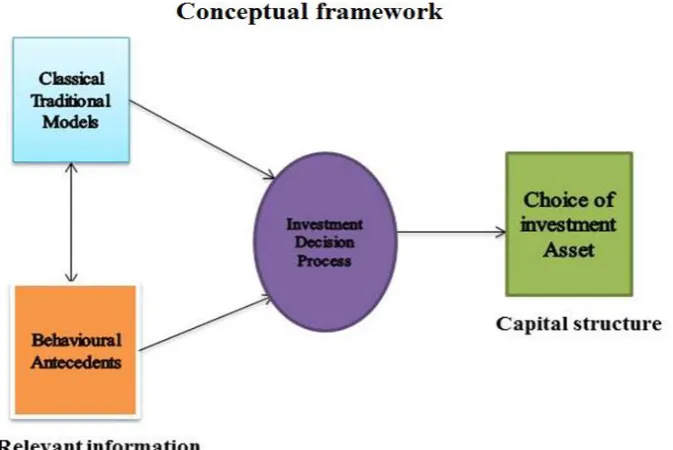
Figure-1.Traditional/ classical financial models/ complementing behavioral antecedents. Source: Researcher model.
Figure 1 is demonstrating how classical financial models complements behavioral antecedents to guide the
2. TRADITIONAL MODELS OF RATIONALITY
Different views on market behavior are expressed and theories developed to explain the movement in share prices and guide investors’ decision on share acquisition and disposal. Investors build their investment portfolio on the basis of available information. Share price behavior theory and analysis, the theme under this section, focus on how some classical theories influence investors’ preference and choice complemented by cognitive psychology
2.1. Fundamental Analysis, as Basic Theory
The value of the firm or the share price, as a quantitative information, holds the view of all future expected dividend payments on the share discounted at the shareholders cost of capital. There are two approaches for price predictions as:
a. Constant payment of dividend every year.
b. Dividend growth at constant rate (g) every year, for a given foreseeable future.
The rationality of valuation of the share is largely an implication of change in interest rate of return as against the coupon or existing rate. The market prices of shares will fall when there is rise in interest rates and when there is any decline in interest rates share prices will rise. When interest rate rises as against the existing rate on the share, investors will move elsewhere for the new opportunity therefore, the price of the share will fall for lack of attraction until the rate on the share change and moves up. Likewise if the interest rate of the market declines, as against that of the share, the price of the share will rise because more of the shares will be demanded by investors. The variables guiding the predictions of share values and prices depends on available information that shapes the behavior of the investor. How relevant is the information motivating the decision should be of concern to the investor or analyst. The data and any information there from are mostly past and historical derived from past dividend payments to predict future expectations. Models are hypothetically developed to test and predict future return and value outcomes as guides to investors. The investor then employs any of the psychological factors as overconfidence, herding, heuristic, framing and others suitable in the given culture and environment to make a decision.
2.2. Charting or Technical Analysis
Charting as a technical skill in presenting data on visual mode or graphical representation of share prices help predict direction. It is expected that the prices will follow similar pattern and repeat itself over time. It cannot be claimed with certainty that every major price movement can be predicted accurately and satisfactorily to make the correct investment decision because of lack of relevant information. Chartists are not concerned with predicting price change but primarily interested in trend reversals, which is further proof to provide information for investment decision. These are hypothetical models developed to test and predict future return outcomes and as a guide to investors. The charts on their own cannot be the final decision of investment. It is the cognitive psychology working on such data that find tune the process to make a decision influenced by socio-cultural understanding of the investor.
2.3. Random Walk Theory
This theory envisages an intrinsic prices is dependent and reflection on:
a. The fortunes of the company, that is, if the company is doing well it will reflect in the values or prices of the company.
This theory assumes the intrinsic value of the share price changes as new information becomes available. Investors will behave and react with direct response to price movement at random. With share price movement being random, it could as well be erratic, therefore investors should be cautious about the movement in making investment. There is the interplay of raw data and cognitive psychological impinges to make a deserving decision.
2.4. The Efficient Market Hypothesis (EMH)
This is major finance theory that came out of the study or work undertaken by Eugene Fredric Fama, 1965. The work posits that Market (Stock Exchanges) is efficient where;
a. Trade reflects available information and share prices change quickly according to future prospects and the market position.
b. The market is fair to all participants.
c. Transactional cost is normal, not outrageous to discourage trading.
The proponents of EMH assert investors do not earn above-average returns without risk (Bank and Brustbauer, 2014; Anspach, 2017). Any anticipation of prices movement can be predicted if:
a. An effort of the firm will be profitable and shareholders demand pushing the price up to enjoy dividend growth.
b. In the absence good fortunes shareholders will know therefore, the company’s shares will not be of demand and its prices will fall.
c. If interest rates rise, shareholders will want a higher return from their investment and therefore market prices shall decline.
The stock can be categorized into three degrees of efficiency as; weak form, semi strong form, and strong form
Weak market is a test that demonstrates price response to past information without knowledge of any mis-priced securities (Clarke et al., 2001; Rothbort, 2009). The current market has no value in anticipation of new information.
With semi strong market prices reflect;
a. Available information on past price movements. b. Knowledge available publicly on valuation of shares.
The market anticipates share price changes before new information is publicly announced and made known (Clarke et al., 2001; Rothbort, 2009; Anspach, 2017). The market should be semi-strong efficient if it is able to anticipate an idea of new acquisition. The idea should reflect in the price of the share before the announcement, so that the share price change in advance of the acquisition move is confirmed.
Strong market is a test proving prices reflecting information from; a) Past price.
b) Public knowledge. c) Insider knowledge.
These fundamental and efficient market hypotheses have been variously criticized and challenged as to its correctness (Clarke et al., 2001; Rothbort, 2009; Bank and Brustbauer, 2014; Anspach, 2017; Causi, 2017).
Investors being rational should react and behave differently and randomly, towards information made available by the firm, depending on their interest, uses and understanding of the information. Investors are influenced by available information to react and behave accordingly in making their preference ordering and investment decision that finally gives the firm its capital structure. The bottom line is the cognitive psychological impinges of the investor emanating from experience and influences of the socio-cultural environment to digest the information for rational investment decision.
3. BEHAVIOURAL FINANCE AND INVESTMENT DECISION
This section looks at behavioral finance in investment decision questioning the reliability and authenticity of traditional financial theories in investment decision in situations of risk and uncertainty (Zahera and Bansal, 2018). In complex situations saddled with high volume of unclassified information, the capacity of the human brain/mind to analyze and select the relevant information for informed decision is short changed for shortcuts, heuristic decision-making methods. Technology and sophistication is impacting on the financial market with information so complex to dissuade investors into cognitive distortions in a bid to avoid risk (Jagongo and Mutswenje, 2014). Behavioral Finance has recently captured the attention in the investment domain and the discussion on how decision is influenced by attitudes and characters on the flip side which are not featuring in the fundamental and traditional theories. It focuses on financial and investment decisions matters to establish behavioral in the psychology, sociology and anthropology disciplines (Causi, 2017). The quest for alternate strategies, as against traditional financial theories, to explain and guide investors in choosing their investment portfolio in the midst of risk and uncertainty of investors’ interest brought in behavioral finance (Shefrin, 2000). Keynes (1936) emphasized a market of wants with optimism and pessimistic tendencies beyond psychological comprehension. This limitation is motivating an inner urge to demonstrate how investors’ psychological energies can fill the gap based on emotions and sentiments in moments of uncertainties. This go against the accepted norm of rationality in the decision process which leave investors in disarray when it matters most. A revelation in the financial market is disputing the reality of rationality and market efficiency to interpret behavior (Causi, 2017). There are cases where investors decision deviates the theoretical rules of rationality (Simon, 1955; Zahera and Bansal, 2018) and the objective of optimizing returns and cash inflow but may be influenced by emotional instincts (Keynes, 1936) driving by cultural, environment and investors dispositions, risk and uncertainty (Neumann and Morgenstern, 1953; Slovic, 1969). Unstructured decision processes dealing with complex information ridicules the psychological capacity of investors. In this case the brain attempts heuristic decision-making methods to make a decision (Causi, 2017). Literature is revealing the capacity of the human mind to influence behavior when it comes to investment decision dependent on available information, prevailing circumstances and environment with no respecter to the traditional financial theories. It seems as if the psychological impinges on investment decision and that of classical models are mutually exclusive in coming out with the final portfolio choice. To assume an exclusive posture in the investment decision process portrays investment as an event having nothing to do with the environment and it cultures and publics. The behavioral and psychological impinges as qualitative drivers on one hand and traditional and classical models on the other complement each other to achieve the best of decision satisfying the investor, his/her environment and publics and other objectives in general terms.
4. BEHAVIOURAL ANTECEDENTS DRIVING INVESTMENT DECISION
1955; Slovic, 1969; Tversky and Kahneman, 1971) to select the relevant information to make an informed decision. The information under consideration may come from different sources and the investors may have different objectives, influenced by their environment and cultures, acting as drivers of psychological and emotional challenges in investment decision. The drivers and pillars on which the number, frequency and complexity of information may evolve include; the type or kind of investor, culture of the investor, environmental issues and corporate social responsibility in addition to financial and economic data (information). Informal communication in the form of interpersonal communications, word-of-mouth communications are good channels of soliciting information (Shiller and Pound, 1989; Ivković and Weisbenner, 2007). To make savings, interpersonal exchanges with trusted confidants in acquiring more information increase trading among overconfident investors (Epstein and Schneider, 2008; Abreu and Mendes, 2012). In the normal sense investors eschew information from friends and family confidants but go for specialized source of information to increase their trading activities, and accept risky assets (Abreu and Mendes, 2012). Institutional investors, accommodating professional skills and expertise, have high prevalence in depending on formal and quality source of information emanating from corporate bodies; example company’s stock characteristics, financial situation, industry and sectoral information (Abreu and Mendes, 2012; Jagongo and Mutswenje, 2014; Islam et al., 2017).
4.1. The type or Kind of Investor and their Behavioral Drivers
Investors may be classified by grouping as an individual or institutional investor, by gender as male or female, age group as youth or elderly, professional skills and expertise with different psychological and emotional influence. Institutional and individual investors may require different information and their source in their investment decision. Individual investors may be influenced by expected returns and herd behaviors (Banerjee, 1992; Welch, 1992; Warther, 1995) family composition, biological connectivity, and lifestyle to achieve rationality (Lin, 2011; Mathuraswamy and Rajendran, 2015). Economic and political facts direct institutional investors in their decisions (Menkhoff, 1998) and investment mentors to support any conclusion drawn. Behaviorists ponder of irrational and rational investors having diverse reaction to market information. Rational investors consolidate their market positions with the irrational ones kick out due to insolvency. Gender, education, age and market orientation also have influence investment decision with behavioral biases exposing less fancy individuals of their inexperience in classical decision-making (Hoffmann et al., 2015; Chavali and Mohanraj, 2016). These are testimonies that psychological impinges influence investors in choice and preference ordering to complement available information from other models where there is uncertainty or other qualitative objectives are at stake.
4.2. Culture
Culture is another diver that influences investors’ decision. Positive affirmation towards socio-cultural welfare for general good of the environment into the foreseeable future, play a role in the investment ambition and performance of investors (Howard, 2014; Li et al., 2016). Market is not always stable and predictable. Fluctuations may set in with volatility sentiments directing the returns to be offered investors, who as rational beings may be informed on their investment disposition (Howard, 2014). Personal values of honesty, comfortable life and family security on the behavioral decision-making and choices have a great impact on the investment of individual investors (Agyemang and Ansong, 2016).
an error in an investment decision with insufficient return and excessive risk exposure; collective biases from different investors whose behavior exceed a certain critical level with contagion effect; generic market inefficiencies featuring prices distortions or anomalies in return for different investment cycle (Kahneman and Tversky, 1979). Prospect theory provides a strategy to compare risk return relation of different investment opportunities and their utilities. Behavioral distortions of loss aversion, overreaction and behavioral biases have propensity to enable rationality and irrationality decision to impact negatively on the economy. However, with adaptive market hypothesis (Soufian et al., 2014) the market adapt itself to its inefficiencies and recover to function as anticipated by the participants. Investors may prefer short-term gains and losses to their own long term investments a situation of ―myopic loss aversion‖ (Benartzi and Thaler, 1995) Human subjectivity, emotions and desires, familiar influence, investment objectives, risk dimension, the feeling of guilt, rationalization, fear and anguish are forms of psychological distortions that may deviate rationalism in investment decision (Godoi et al., 2005; Kleinübing Godoi et al., 2005). The heuristic behavior by different authors are summed up in Barberis and Thaler (2003); (Causi, 2017) as:
a) Over confidence- a behavior that deals with attitudes of over estimation of investors own abilities (Lichtenstein et al., 1977; De Bondt and Thaler, 1995; Barber and Odean, 1999).
b) Anchoring Heuristic- the tendency to cling to original figures and eschew change even with new information available to take advantage (Barberis and Thaler, 2003).
c) Representativeness deals with the status quo of economic agents (Kahneman and Tversky, 1974; Slovic and Tversky, 1982; Warther, 1995).
d) Availability- Lackadaisical Phenomenon of relying on past experience in decision making (Kahneman and Tversky, 1974).
e) Loss aversion- The individual behavior is tilted towards loses more than gains under conditions of uncertainty, panic and fear of losing monetary value (Kahneman and Tversky, 1979).
f) Under reaction and over reaction- under reaction is state of prices of securities reacting to new information below expectation in the interim (Barberis et al., 1998). Over reaction is the situation prices of securities respond quickly to new information beyond expectation in the long term (De Bondt and Thaler, 1985; Barberis et al., 1998).
g) Conservatism- Judgement that follows the status quo, a resistance to change affecting the decision making of individual.
h) Heuristics behavior; preference to game of chance or bet, a comparative ignorance, depicting a situation revealing the shortcomings of the individual competencies of an event and superior expertise in another.
Disposition effect is a phenomenon explaining investors’ tendency to appreciate the gains, but refuse to realize losses (Shefrin and Statman, 1985). Investors in this position sell those funds which have made positive returns and are refuse to dispose the loss-making funds (Shapira and Venezia, 2001; Dhar and Zhu, 2006).
5.1. Herding
Herding has to do with the behavior where individuals follow the footsteps of others in making their own judgements
(2014) writing on investment sentiments in financial markets saw the need to study investors’ sentiment in investment. They opined that investors are prone to sentiments and they constantly react to information influenced by their cognitive psychology. Abdulkadir et al. (2016) noticed in Nigeria window dressing accounting information in anticipation of inviting investors to acquire shares with the intension to over-value assets and net worth.
Relying solely on traditional finance theory and accounting information to conclude on the possible outcome of investors’ decision could distort other vital factors, in behavioral terms, which motivate investors in making their preference ordering and choice. The psychological, distortions and biases seen negatively as noise in investment decisions should rather be drivers shaping and complementing classical models to optimize rationality in decision making. The outcome of the preference ordering, based on emotional response to available information is the capital structure. It can be deduced that the wrong decision based on wrong response with emotional sentiments, to wrong and complex information give birth to erratic capital structure. Therefore financial distress is not occasioned by capital structure per se but by the wrong fundamentals underlying the final investment decision giving birth to the financial structure.
6. CONCLUSION
The work looked at classical models of finance and psychological behaviors of investors that precede their investment decisions and how the two may compliment to help investors achieve their goal and objectives. The classical models are built and theorized on the basis of rationality postulating that investment decisions are made with guiding principles and rules. Investors relying on information, in the financial market, on the firm investment assets prevail on their decisions. The behavioral antecedents encompassing psychological distortions and emotions and behavioral finance as a concept laid more emphases on the number, frequency and complexity of information engage the brain to facilitate short cuts, heuristic decision-making methods, to reduce the data processing time (Causi, 2017) as well as cognitive filters (Simon, 1955; Slovic, 1969; Tversky and Kahneman, 1971) to select the relevant information to make an informed decision. The two, classical models and psychological behaviors are projected as being mutually exclusive to influence investment decision in different style. Behavioral finance dwelling on the psychological impulses investment decision is challenging the rationality of decisions made through the classical models emphasizing the presence of psychological distortions and emotions in the decision process. Literature is not in total support of this assertion from the behavioral finance. It is here established that the two work in unison in the investment process and are not independent. The behavioral finance prevails when an investment decision fails, adducing the problem to classical models as being irrational. We cannot exonerate agency from the investment failure. Every decision is made based on available information which should be relevant, reliable and adequate and the information is from the firm and its agents. The information should as well be properly communicated. There is the need of developing strategies and framework of reporting and communication of financial information to the investing public taking account of their socio-cultural background. This will expose investors to alternatives in positive and negative shades to reduce the biases in investment decision (Nenkov et al., 2009). Cunningham (2002) in a models demonstrated how prices are formed, and how investor behavior can help to analyze corporate governance compelling classical and behavioral finance complement for better decision and not against each other.
Funding: This study received no specific financial support.
REFERENCES
Abdulkadir, M., H. Abubakar and L. Danrim, 2016. The effect of financial reporting on investment decision making by banks in Nigeria. International Journal of Research in Finance and Marketing, 6(4): 21-50.
Abreu, M. and V. Mendes, 2012. Information, overconfidence and trading: Do the sources of information matter? Journal of Economic Psychology, 33(4): 868-881.Available at: https://doi.org/10.1016/j.joep.2012.04.003.
Adair, A., J. Berry and W. Mc Greal, 1994. Investment decision making. Journal of Property Finance, 5(4): 32-42.
Agyemang, O.S. and A. Ansong, 2016. Role of personal values in investment decisions: Perspectives of individual ghanaian shareholders. Management Research Review, 39(8): 940-964.
Anspach, D., 2017. The efficient market hypothesis in simple terms. Available from https://www.thebalance.com/the-efficient-market-hypothesis-in-simple-terms-2388640.
Ball, R. and P. Brown, 1968. An empirical evaluation of accounting income numbers. Journal of Accounting Research, 6(2): 159-178.Available at: https://doi.org/10.2307/2490232.
Banerjee, A.V., 1992. A simple model of herd behavior. The Quarterly Journal of Economics, 107(3): 797-817.Available at: https://doi.org/10.2307/2118364.
Bank, M. and J. Brustbauer, 2014. Investor sentiment in financial markets working paper. University of Innsbruck.
Banz, R.W., 1981. The relationship between return and market value of common stocks. Journal of Financial Economics, 9(1): 3-18.
Barber, B.M. and T. Odean, 1999. The courage of misguided convictions. Financial Analysts Journal, 55(6): 41-55.Available at: https://doi.org/10.2469/faj.v55.n6.2313.
Barberis, N., A. Shleifer and R. Vishny, 1998. A model of investor sentiment. Journal of Financial Economics, 49(3): 307-343.
Barberis, N. and R. Thaler, 2003. A survey of behavioral finance. Handbook of the Economics of Finance, 1: 1053-1128. Benartzi, S. and R.H. Thaler, 1995. Myopic loss aversion and the equity premium puzzle. The Quarterly Journal of
Economics, 110(1): 73-92.
Causi, G.L., 2017. Theories of investor behaviour: From the efficient market hypothesis to behavioural finance. Tallinn University of Technology.
Chavali, K. and M.P. Mohanraj, 2016. Impact of demographic variables and risk tolerance on investment decisions–an empirical analysis. International Journal of Economics and Financial Issues, 6(1): 169-175.
Clarke, J., T. Jandik and G. Mandelker, 2001. The efficient markets hypothesis. Expert Financial Planning: Advice from Industry Leaders. pp: 126-141.
Collard, S., 2009. Individual investment behaviour. Personal Finance Research Centre, University of Bristol.
Cunningham, L.A., 2002. Behavioral finance and investor governance. Washington & Lee Law Review, 59(32): 767-837. De Bondt, W.F. and R.H. Thaler, 1995. Financial decision-making in markets and firms: A behavioral perspective.
Handbooks in Operations Research and Management Science, 9: 385-410.Available at:
https://doi.org/10.1016/s0927-0507(05)80057-x.
De Bondt, W.F.M. and R. Thaler, 1985. Does the stock market overreact? The Journal of Finance, 40(3): 793-805. Papers and Proceedings of the Forty-Third Annual Meeting American Finance Association, Dallas, Texas, December 728-730, 1984. (Jul., 1985).
Dhar, R. and N. Zhu, 2006. Up close and personal: Investor sophistication and the disposition effect. Management Science, 52(5): 726-740.Available at: https://doi.org/10.1287/mnsc.1040.0473.
Epstein, L.G. and M. Schneider, 2008. Ambiguity, information quality, and asset pricing. The Journal of Finance, 63(1): 197-228.Available at: https://doi.org/10.1111/j.1540-6261.2008.01314.x.
Fama, E. and M. Miller, 1971. Theory of finance‖, Chapter 1, Hinsdale, Illinois: Drysden Press, pp: 11-39.
Hoffmann, A., O.I. Thomas, P. Joost and M.E. Pennings, 2015. How investor perceptions drive actual trading and
risk-taking behaviour. Journal of Behavioural Finance, 16(1): 94-103.Available at:
https://doi.org/10.1080/15427560.2015.1000332.
Howard, C.T., 2014. Behavioural portfolio management. Journal of Behavioural Finance and Economics, 3(1): 99-138. Islam, K.M.T., T. Siow-Hooi and C. Lee-Lee, 2017. Information sources and investing decisions – a path modelling
approach. Managerial Finance, 43(8): 928-947.Available at: https://doi.org/10.1108/mf-08-2016-0232.
Ivković, Z. and S. Weisbenner, 2007. Information diffusion effects in individual investors' common stock purchases: Covet thy neighbors' investment choices. The Review of Financial Studies, 20(4): 1327-1357.Available at: https://doi.org/10.1093/revfin/hhm009.
Jagongo, A. and V.S. Mutswenje, 2014. A survey of the factors influencing investment decisions: The case of individual investors at the NSE. International Journal of Humanities and Social Science, 4(4): 92-102.
Jensen, M.C., 1978. Some anomalous evidence regarding market efficiency. Journal of Financial Economics, 6(2/3): 95-101.Available at: https://doi.org/10.1016/0304-405x(78)90025-9.
Kahneman, D. and A. Tversky, 1974. Judgment under uncertainty: Heuristics and biases. Science, 185(4157): 1124-1131. Kahneman, D. and A. Tversky, 1979. Prospect theory: An analysis of decision under risk. Econometrica‖, Journal of the
Econometric Society, 47(3): 263-291.
Karlsson, A., 2007. Investment decisions and risk preferences among non-professional investors; Intellecta AB, Stockholm, Sweden.
Keynes, J.M., 1936. The general theory of employment, interest and money. London: Macmillan.
Kleinübing Godoi, C., R. Marcon and A. Barbosa daSilva, 2005. Loss aversion: A qualitative study in behavioural finance. Managerial Finance, 31(4): 46-56.Available at: https://doi.org/10.1108/03074350510769613.
Kumar, S. and N. Goyal, 2016. Evidence on rationality and behavioural biases in investment decision making. Qualitative Research in Financial Markets, 8(4): 270-287.
Li, J.J., M. Massa and H. Zhang, 2016. Culture vs. Bias: Can social trust mitigate the disposition effect? Available from https://editorialexpress.com/cgi-bin/conference/download.cgi?db_name=AFA2018&paper_id=172.
Lichtenstein, S., B. Fischhoff and L.D. Phillips, 1977. Calibration of probabilities: The State of the Art. In: Jungermann H., De Zeeuw G. (Eds) Decision making and change in human affairs. Theory and decision library (An International Series in the Philosophy and Methodology of the Social and Behavioural Sciences), Dordrecht: Springer, Vol. 16. Lin, H.-W., 2011. Elucidating rational investment decisions and behavioral biases: Evidence from the Taiwanese stock
market. African Journal of Business Management, 5(5): 1630-1641.
Livanas, J., 2008. Empirical analysis of investor utilities in investment choice; Institute of actuaries of Australia; Risk and Capital Management Research Conference 2008, Sydney, Australia.
Markowitz, H., 1952. Portfolio selection. The Journal of Finance, 7(1): 77-91.
Mathuraswamy, P. and G. Rajendran, 2015. Essence of rational investment in equity market: An empirical study. IJER Serials Publications, 12(2): 439-449.
Menkhoff, L., 1998. The noise trading approach—questionnaire evidence from foreign exchange. Journal of International Money and Finance, 17(3): 547-564.Available at: https://doi.org/10.1016/s0261-5606(98)00016-3.
Merton, R.C., 1972. An analytic derivation of the efficient portfolio frontier. Journal of Financial and Quantitative Analysis, 7(4): 1851-1872.Available at: https://doi.org/10.2307/2329621.
Myers, S.C. and N.S. Majluf, 1984. Corporate financing and investment decisions when firms have information that
investors do not have. Journal of Financial Economics, 13(2): 187-221.Available at:
https://doi.org/10.1016/0304-405x(84)90023-0.
Neumann, v.J. and O. Morgenstern, 1953. A theory of games and economic behaviour. Princeton: Princeton University Press.
Niu, X., 2008. Theoretical and practical review of capital structure and its determinants. International Journal of Business and Management, 3(3): 133-139.
Roll, R., 1977. A critique of the asset pricing theory's tests part i: On past and potential testability of the theory. Journal of Financial Economics, 4(2): 129-176.Available at: https://doi.org/10.1016/0304-405x(77)90009-5.
Ross, S.A., R.W. Westerfield and J. Jaffe, 2002. Corporate finance. 6th Edn., Boston: McGraw-Hill Irwin. Rothbort, S., 2009. Does the efficient markets hypothesis work?
Shapira, Z. and I. Venezia, 2001. Patterns of behavior of professionally managed and independent investors. Journal of Banking & Finance, 25(8): 1573-1587.Available at: https://doi.org/10.1016/s0378-4266(00)00139-4.
Sharpe, W.F., 1964. Capital asset prices: A theory of market equilibrium under conditions of risk. The Journal of Finance, 19(3): 425-442.Available at: https://doi.org/10.1111/j.1540-6261.1964.tb02865.x.
Shefrin, H., 2000. Beyond greed and fear. Boston: Harvard University Press.
Shefrin, H. and M. Statman, 1985. The disposition to sell winners too early and ride losers too long: Theory and evidence. The Journal of Finance, 40(3): 777-790.Available at: https://doi.org/10.2307/2327802.
Shiller, R.J. and J. Pound, 1989. Survey evidence on diffusion of interest and information among investors. Journal of Economic Behavior & Organization, 12(1): 47-66.Available at: https://doi.org/10.1016/0167-2681(89)90076-0. Shleifer, A., 2000. Inefficient markets. Oxford University Press. books.google.com.
Simon, H.A., 1955. A behavioral model of rational choice. The Quarterly Journal of Economics, 69(1): 99-118.Available at: https://doi.org/10.2307/1884852.
Slovic, P., 1969. Analyzing the expert judge: A descriptive study of a stockbroker's decision process. Journal of Applied Psychology, 53(4): 255-263.Available at: https://doi.org/10.1037/h0027773.
Slovic, P. and A. Tversky, 1982. Judgement under uncertainty: Heuristics and biases, New York: Cambridge University Press, pp: 359-370.
Soufian, M., W. Forbes and R. Hudson, 2014. Adapting financial rationality: Is a new paradigm emerging? Critical Perspectives on Accounting, 25(8): 724-742.Available at: https://doi.org/10.1016/j.cpa.2013.08.009.
Tversky, A. and D. Kahneman, 1971. Belief in the law of small numbers. Psychological Bulletin, 76(2): 105-110.Available at: https://doi.org/10.1037/h0031322.
Warther, V.A., 1995. Aggregate mutual fund flows and security returns. Journal of Financial Economics, 39(2-3): 209-235.Available at: https://doi.org/10.1016/0304-405x(95)00827-2.
Welch, I., 1992. Sequential sales, learning, and cascades. The Journal of Finance, 47(2): 695-732.Available at: https://doi.org/10.2307/2329120.
Zahera, S.A. and R. Bansal, 2018. Do investors exhibit behavioural biases in investment decision making? A systematic review. Qualitative Research in Financial Markets, 10(2): 210-251.