IJEDR1603044 International Journal of Engineering Development and Research (www.ijedr.org) 271
Diagnosis Report Generation Using Map Reduce
Approach.
1
Pragati S. Joshi, 2P. N. Kalavadekar
1
PG Student,2Assistant Professor
1
Computer Department, 1
Sanjivani College of Engineering, Kopargaon, Kopargaon, India
________________________________________________________________________________________________________ Abstract - It has been presented a challenging issue in processing large amount of data, especially in data redundant system. The conditional random field (CRF) model is applied in biomedical named entity recognition. The performance improvement of the CRF model is significant due to the internally sequential feature, which requires a new parallelized solution. There is classification Of disease on the basis of symptoms, cure, prevention, commonlyseen in (age). To keep these issues in mind we are implementing the solution with new virtibiLearning, MRCRF Using Fuzzy for CRF and Map Reduce technique respectively. IndexTerms- Biomedical named entity, MapReduce, Conditional Random field (CRF), Hadoop...
________________________________________________________________________________________________________
I. INTRODUCTION
It has been presented a challenging issue in processing large amount of data, especially in data redundantsystem. The conditional random field (CRF) model is applied in biomedical named entity recognition. The performanceimprovement of the CRF model is significant due to the internally sequential feature, which requires a new parallelizedsolutions. By merging and parallelizing the limited memory Broyolen-Fletcher-Goldfarb-Shanno and Viterbi algorithms.To enhance the capability of estimating parameters; the MRLB algorithm leverages the MapReduce framework. TheMRVtb algorithm deduce as if the state sequence by extending the Viterbi algorithm with another MapReduce job.
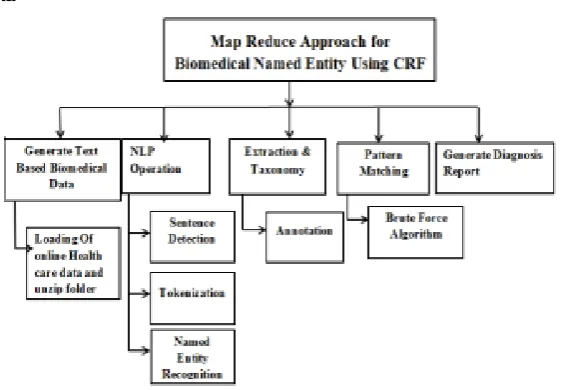
In this Map Reduce Approach for Biomedical Named Entity using CRF, we first generate text based biomedical data in which we are loading online health care data and unzip the folder. Secondly we perform NLP operation such as sentence detection, tokenization and Named entity Recognition. The next stage the extraction and taxonomy building task are performed. Pattern matching and searching in the relational database is carried. Finally diagnosis report is generated.
Problem Statement
II. LITERATURE SURVEY
1.Kenli Li, Wei Ai, Zhuo Tang, Fan Zhang, Lingang Jiang, Keqin Li, and Kai Hwang[1] proposed Hadoop Recognition of Biomedical Named Entity Using Conditional RandomFields
Advantage:
To develop the system with HDFS frameworkusing map reduce, to improve thesystem performance... Disadvantage:
Increasing copy threads causes internalcommunication delay
2.ChengjieSun,Yi Guan, Xiaolong Wang, Lei Lin [2]uses the Rich features based Conditional Random Fields for biological named entities recognition..
Advantage:
Provided an opportunity for natural language processing techniques also provides services to data mining.
Disadvantage:
Information extraction, and word sense disambiguation are particularly challenging in the biological domain with its highly complex
IJEDR1603044 International Journal of Engineering Development and Research (www.ijedr.org) 272 Advantage:
Use of both a closed dictionary from thetraining set and an open dictionary, as ituses deep knowledge resources such as the name alias phenomenon..
4. ThomasLavergne, Olivier Capp [4] proposed Practical very large scale CRFs Advantages:
Analysis demonstrates that training large scale sparse models can be done efficientlyand allows improving over the performanceof smaller models...
III. SYSTEM OVERVIEW
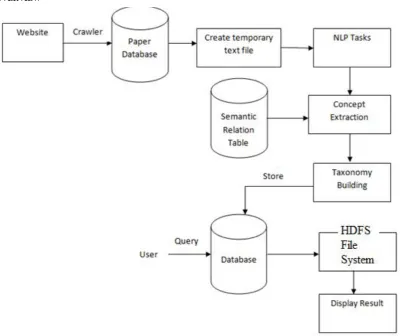
Fig .1: System Overview of Diagnosis Report generation using Map Reduce Approach.
Fig.1 Shows System Overview of Diagnosis Report generation using Map Reduce Approach. It contains Taxonomybuilding, Extraction; HDFS file System, HadoopEnvironment, display result.
Scope:
1) To challenge task for information extraction and natural language understanding.
2) A statistical machine learning approach for extracting features, modeling, and predicting biological named entities. 3) To develop the system with HDFS framework using map reduce, to improve the system performance.
4) To develop a system that will retain the quality of service and the system performance.
Objective:
1) To develop tools to analyze biomedical texts as comprehensively and as accurately as possible.
IJEDR1603044 International Journal of Engineering Development and Research (www.ijedr.org) 273 3) To mine the text by mapping all relevant words and phrases to a set of predefined categories into proteins, cell lines, and cell types and so on, found in the GENIA ontology.
IV. BREAKDOWN STRUCTURE
Fig .2: Breakdown Structures of Diagnosis Report generation using Map Reduce Approach.
1. Generate text based on biomedical data.
Loading Of online Health care data and unzip folder in this load bio medical data online in Zip folder Format. And another operation is Unzip that folder for further NLP Operation. That Loading and Unzipping can do by Admin.
2. NLP operation
The output of first module is given as input to second module, i.e. the temporary text file. This text file contains content of the medical paper. The data in this file is in unstructured form thus the next task is
to perform Natural Language Processing (NLP) operations on this data. Input of Module: Temporary text with the medical paper content.
Output of Module: Text file contains the Adjective Phrases, Adverb Phrases, Conjunction Phrase, Noun phrase, Prepositional phrases, and Verb phrase classified by labels.
Sentence Detection is first step of NLP operation. Sentence Detector can detect that a punctuation character marks the end of a sentence or not.
Tokenization is the second step in NLP operation. tokenization Convert a sentence into a sequence of tokens.Divides the text into smallest units (usually words), removing punctuation. Assign a part-of-speech
tag to each token in a sentence.
Named Entity Recognition is the third step of in NLP operation. Named entity recognition classifies tokens in text into predefined categories such as date, location, person, time.
3. Extraction and Taxonomy
In this module the Concept extraction and Taxonomy building task are performed.
Input of Module: The input for this module is the table generated by NLP tasks and the master table containing the attributes such as synonyms for disease, specialized lexicon, and semantic network.
Output Of Module: The output of this module is relational database schema containing attributes such as symptom, disease, treatment, side-effect. Identification of sentence task is to identifying sentences published in medical papers as containing information about diseases and treatments and data sets are annotated with the following information: a label indicating that the sentence is informative that is it containing disease treatment information, or a label indicating that the sentence is not informative.
Annotation is the second task, the sentences have annotation information that states if the relation that exists in a sentence between the disease and treatment is Cure, Prevent, or Side Effect, these are three semantic relation used.
4. Pattern Matching
IJEDR1603044 International Journal of Engineering Development and Research (www.ijedr.org) 274 tokens is checked for the presence of the constituents of some pattern. The resultant matched pattern is tabulated and cluster of information is formed by the pattern matching algorithm. These patterns are referred while determining the input for the next module i.e. Perceptron optimization.
Input Of Module: The input for this module will be a sentence containing either disease or symptoms. Output Of Module: The result containing symptoms, treatment, side-effects for the disease.
5. Generate Diagnosis Report.
It provides Diagnosis Report of dieses by providing treatment, symtoms, and cureetc in GUI. It uses Map reduce Technique.
V. RESULT ANALYSIS
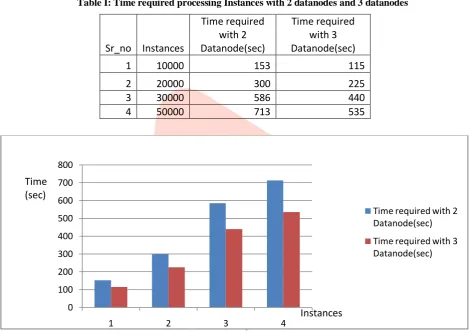
Result of Time required processing Instances.
Table I: Time required processing Instances with 2 datanodes and 3 datanodes
This Analysis tells that If we increment size of datanodes, It, decreses the time required to process instances.
Result of classify the dieses into different categories.
Table II: number of dieses classify into different categories.
Diseases Name Symptoms Prevention Cure Age
Angina Y Y Y Y
Arrhythmia N Y Y Y
Atheroseosis Y Y Y Y
Cadiomegaly Y N N N
Catidartary Y Y N Y
Congenital Heart Y N Y Y
Congenital Heart Y N N Y
0 100 200 300 400 500 600 700 800
1 2 3 4
Time required with 2 Datanode(sec)
Time required with 3 Datanode(sec)
Instances Time
(sec)
Sr_no Instances
Time required with 2 Datanode(sec)
Time required with 3 Datanode(sec)
1 10000 153 115
2 20000 300 225
3 30000 586 440
IJEDR1603044 International Journal of Engineering Development and Research (www.ijedr.org) 275
Failure
Fluid around heart N Y Y Y
Heart Attack Y Y Y Y
HypercholeStreomia Y Y Y Y
Infective enfocarditis
Y Y Y Y
Mitral value prolapse
Y Y Y Y
Peripheral artery Y Y Y Y
Above Analysis tells that, 14 number of dieses can be categoried into 4 categories as symptoms,prevention,cure,age
VI. CONCLUSION
The paper proposes a Map reduce approach for Named Entity recognition using CRF .Proposed scheme offers substantial benefits and provides an opportunity to extend Biomedical applications., I have implemented thefirst module that is Loading of health care data and extraction. In this module firstly load the health dataset into zip format, after unzipping by admin. In Extraction will get symptoms,causes of particular disease.
VII. ACKNOWLEDGMENT
“Dignosis Report Generation Using Map Reduce Approach”hasbeenawonderfulsubjecttoresearch upon, which leads ones mind to explore new heights in the field of Computer Engineering. I dedicate all my works to my esteemed guide, Prof. P. N. Kalvadekar, whose interest and guidance helped me to complete the work successfully. This experience willalways ssteermetodomyworkperfectlyandprofessionally. IalsoextendmygratitudetoProf. D. B. Kshirsagar(H.O.D. Computer Engineering Department) and Prof. P. N. Kalvadekar(P. G. Cordinator) who has provided facilities to explore the subject with more enthusiasm. I express my immense pleasure and thankfulness to all the teachers and staff of the Department of Comp. Engg., S.R.E.S COE, Kopargaon for their co-operation and support. Last but not the least, I thank all others, and especially my friends who in one way or another helped me in the successful completion of this dissertation.
REFERENCES
[1] Kenli Li, Wei Ai, Zhuo Tang, Fan Zhang, Lingang Jiang, Keqin Li, and Kai Hwang, Hadoop Recognition of Biomedical Named Entity Using Conditional Random Fields,in IEEE Transactions on Parallel and Distributed Systems, 2014.
[2] ChengjieSun,Yi Guan, Xiaolong Wang, Lei Lin , Rich features based Conditional Random Fields for biological namedentitiesrecognition,in Computers in Biology and Medicine 37 , 2007
[3] ZHOU GuoDong SU Jian, Exploring Deep Knowledge Resources in Biomedical Name Recognition,in Institute for Infocomm Research 21 HengMuiKeng Terrace Singapore,vol 99, 2014.
[4] Thomas Lavergne, Practical very large scale CRFs,in ACM Trans. Graph,vol 22, 2003.
[5] Jenny Rose Finkel, TrondGrenager, and Christopher Manning, Incorporating Nonlocal Information into Information Extraction Systems by Gibbs Sampling,in ACM Trans. Graph, 2009.
[6] T. Cohn, Efficient inference in large conditional random fields,in Machine Learning: ECML
[7] S. Della Pietra, V. Della Pietra, and J. Lafferty T. Cohn, Inducing features of random fields. Pattern Analysis and Machine Intelligence,in IEEE Transactions on,1997.
[8] J. E. Dennis, Jr and J. J. More, Quasi-newton methods, motivation and theory.in SIAM review, 1977.