Performance Analysis of Multiple-Symbol
Differential Detection for OFDM over Both
Time- and Frequency-Selective Rayleigh
Fading Channels
Akira Ishii
Department of Communications and Systems, University of Electro-Communications, 1-5-1 Chofugaoka, Chofu-shi, Tokyo 182-8585, Japan
Email:[email protected]
Hideki Ochiai
Division of Physics, Electrical and Computer Engineering, Yokohama National University, 79-1 Tokiwadai, Hodogaya-ku, Yokohama 240-8501, Japan
Email:[email protected]
Tadashi Fujino
Department of Communications and Systems, University of Electro-Communications, 1-5-1 Chofugaoka, Chofu-shi, Tokyo 182-8585, Japan
Email:[email protected]
Received 28 February 2003; Revised 8 October 2003
The performance of orthogonal frequency-division multiplexing (OFDM) system with multiple-symbol differential detection (MSDD) is analyzed over both and frequency-selective Rayleigh fading channels. The optimal decision metrics of time-domain MSDD (TD-MSDD) and frequency-time-domain MSDD (FD-MSDD) are derived by calculating the exact covariance matrix under the assumption that the guard time is longer than the delay spread, thus causing no effective intersymbol interference (ISI). Since the complexity of calculating the exact covariance matrix turns out to be substantial for FD-MSDD, we also develop a sub-optimal metric based on the simplified covariance matrix. The comparative analysis between TD-MSDD and FD-MSDD suggests that the most significant improvement is achieved by the FD-MSDD with the optimal metric and a large symbol observation interval, since the time selectiveness of the channel has a dominant effect on the bit error rate of the OFDM system.
Keywords and phrases:orthogonal frequency-division multiplexing, multiple-symbol differential detection, time- and frequency-selective channels, Rayleigh fading.
1. INTRODUCTION
In mobile communications systems, there has been a grow-ing demand for high data rate services such as video phone, high-quality digital distribution of music, and digital televi-sion terrestrial broadcasting (DTTB) [1]. In such systems, the delay spread of the channel becomes a major impair-ment to cope with, since it may cause a severe intersym-bol interference (ISI). It is well known that the orthogo-nal frequency-division multiplexing (OFDM), which trans-mits the information symbols in parallel over a number of spectrally overlapping but temporally orthogonal subchan-nels [2], is an effective technique to combat the ISI. With a guard interval longer than the maximum delay spread of
the channel, OFDM can effectively avoid the ISI with high spectral efficiency and reasonable complexity. However, the time-selective nature of the channel due to the Doppler shift also results in the loss of orthogonality among subcarriers, causing a considerable interchannel interference (ICI) [3].
(AWGN) channel. In order to reduce this gap between the co-herent detection and conventional DD, the multiple-symbol differential detection (MSDD) has been introduced forM -ary phase-shift keying (MPSK) signals over the AWGN chan-nel in [4]. Making a joint decision on a block ofNM consec-utive information symbols based on NM + 1 received sam-ples as opposed to conventional symbol-by-symbol detec-tion, MSDD can asymptotically achieve the performance of the coherent detector. Since the conventional DD or MSDD relies on the time-invariant nature of the channel impulse response over adjacent symbols, its performance will be con-siderably degraded when the channel is time selective, which results in an irreducible error floor. To cope with this time variance, MSDD has been modified in [5,6]. Its decision metric utilizes the covariance matrix conditioned on the transmitted information symbol sequence.
For OFDM, the DD can be applied over time domain, frequency domain, or both. Because of the long symbol du-ration, the performance of the time-domain DD (TD-DD) may be mostly affected by the time-selective fading. On the other hand, the performance of the frequency-domain DD (FD-DD) may also depend on the frequency-selectiveness of the channel associated with delay spread [7,8]. In [8,9,10], the bit error rate (BER) performance of TD-DD and FD-DD has been theoretically analyzed over time- and frequency-selective Rayleigh fading channels, including the effects of the ISI caused by the delay spread longer than the guard time. In [11], the performance of MSDD with coded modulation has been studied in terms of channel capacity over quasistatic Rayleigh fading channels with OFDM scenario and ideal in-terleaving.
In this paper, the performance of MSDD combined with OFDM is analyzed over time- and frequency-selective Rayleigh fading channels. Assuming the guard time is longer than the delay spread, we derive the optimal decision met-rics. Furthermore, we study the theoretical BER performance of the MSDD for OFDM by extending the result of [6]. Our approach is based on the truncated union bound, which counts only dominant terms of the pairwise error proba-bility (PEP) in the union bound. Based on these analyti-cal results, we compare TD-MSDD and FD-MSDD in terms of irreducible BER behavior for high signal-to-noise ratio (SNR).
The paper is organized as follows. After the description of the system model considered throughout the paper in
Section 2, we describe the proposed metrics of TD-MSDD and FD-MSDD inSection 3. The bit error probability based on these metrics is studied inSection 4.Section 5is devoted to a comparative study on the theoretical and simulation re-sults of the MSDD with the various decision metrics devel-oped in the paper. Finally, concluding remarks are given in
Section 6.
2. SYSTEM MODEL
2.1. OFDM with differential encoding
The discrete-time baseband equivalent model of the sys-tem under consideration is described inFigure 1.
Informa-MDPSK modulation in TD or FD
Ns-point
IFFT
Add guard interval
Time- and frequency-selective channel
+ White Gaussian
noise
Remove guard interval Ns-point
FFT Multiple-symbol
differential detector in TD or FD
Figure1: The discrete-time baseband equivalent model of OFDM with MSDD.
tion bits are Gray mapped onto MPSK and let ci(n) = exp(jθi(n)), whereθi(n) ∈ {(2πm)/M, m = 0, 1,. . .,M− 1}, denote the information symbol prior to the differential encoding, which will be assigned on thenth subcarrier of the
ith OFDM symbol withNssubcarriers. Information symbols are assumed to be independent and identically distributed (i.i.d.). For TD-(MS)DD, information symbols are diff er-entially encoded over the consecutive OFDM symbols with the same subcarrier indexn. For FD-(MS)DD, on the other hand, information symbols are differentially encoded over the adjacent subcarriers within the same OFDM symbol in-dexi. The differentially encoded symbolsi(n) in each domain can be thus expressed as
si(n)=
ci(n)si−1(n), in TD,
ci(n)si(n−1), in FD,
(1)
where si(n) ∈ {exp(j2πm/M), m = 0, 1,. . .,M−1}. The symbol transmitted on thenth subcarrier of theith OFDM symbol is given by
ai(n)=
Essi(n), n=0, 1,. . .,Ns−1, (2)
whereEsdenotes the signal energy per subcarrier symbol. The complex sequenceai(n),n=0, 1,. . .,Ns−1, is mod-ulated by the Ns-point inverse discrete Fourier transform (IDFT) to yieldNstime-domain samples corresponding to theith OFDM symbol. LetTsdenote the Nyquist interval be-tween the output samples. Thus, the OFDM symbol length without guard interval is given byNsTs. After the insertion of the guard interval, the transmitted baseband sequence of the
ith OFDM symbol can be expressed as
xig(k)= 1
Ns Ns−1
n=0
ai(n)ej(2πnk/Ns) for−G≤k≤Ns−1, (3)
where the initialGsamples ofxgi(k),k= −G,−G+ 1,. . .,−1, constitute the guard interval. Assuming thatxig(k) is zero for
is written as
2.2. Channel model and received baseband sequence
We assume that the channel is subject to a wide-sense station-ary uncorrelated scattering (WSSUS) Rayleigh fading [12] and is modeled as a time-variant tapped delay line with fixed tap spacingTs, each tap having Jakes power spectrum [13]. Provided that the maximum delay of the channel impulse re-sponseTmdoes not exceedMpTsfor some integerMp, the re-ceived baseband sequence assuming perfect synchronization can be expressed as
r(k)=
GTs, theri(k) after eliminating the initialG guard samples can be expressed as
ri(k)=
Here,Ri(l) denotes the received symbol on thelth subcarrier of theith OFDM symbol. In (7),Hi(l),Ci(l), andWi(l) are the multiplicative distortion, the ICI, and the AWGN, respec-tively, on thelth subcarrier of theith OFDM symbol. Based onRi(l), a multiple-symbol differential detector in each do-main makes a decision on the estimated information sym-bols, which is described in the next section.
3. OPTIMAL AND SUBOPTIMAL METRICS
3.1. Multiple-symbol differential detection
Following the basis on the MSDD system in [4, 5,6], we rewrite the transmitted complex sequence in (2) as
ai+d(l)=
andNMdenotes the observation interval of the information symbols. Note that with this definition of NM, the conven-tional DD corresponds to the case withNM=1. Also, appar-ently, we havezd,i(l)∈ {exp(j2πm/M),m=0, 1,. . .,M−1}. The received symbols in (7) are divided into a detection block that consists of (NM+ 1) symbols as
where, throughout the paper, the notations (·)t and (·)†
are used to denote the transpose and the Hermitian trans-pose, respectively. The column vector Ri(l) is input to a multiple-symbol differential detector implemented based on maximum-likelihood sequence estimation (MLSE). The MLSE detects the most likely estimated information symbol sequence this is accomplished by selecting the sequence ˆci(l) of which the metric
conditioned on ˆci(l). It should be noted that the complexity of MSDD increases exponentially withMNM. In the
follow-ing, we derive the covariance matrix for each case.
3.2. Covariance matrix in time-domain MSDD
The covariance ofRi(l) in (7) can be written as
where the notationE[·] and·∗are used to denote the
is expressed, by definition, as is the zeroth-order Bessel function of the first kind, fD is the maximum Doppler frequency, andδm,mis the Kronecker delta function. By normalizing the average power of each path such thatMm=p−01σm2 =1, the correlation of the multi-plicative distortion is expressed as
φt(α)≡E
Due to the assumption of the statistical independence of the information symbols, we haveEai(l)a∗i(l) theorem can be invoked and the ICI can be modeled as a complex Gaussian random process with zero mean. Then the correlation of the ICI can be obtained as
ECi(l)Ci∗+α(l)
ICIis the variance of the ICI. The correlation of the AWGN is given by
ENi(l)Ni∗+α(l)
=N0δ0,α, (18)
where N0 is the one-sided power spectral density of the AWGN process.
Recognizing that the covariance matrix of arbitraryRi(l) denoted byΦRi(l)is irrelevant to the indexl, and using (13),
is the covariance matrix of the multiplicative distortion of which the (β,γ)th element can be expressed asφt(γ−β)
de-matrix, it follows that
Φ−1
Therefore, ˆΦ−Ri1can be obtained by substituting estimated
se-quence ˆZi = diag(1, ˆz1,i,. . ., ˆzNM,i) forZiin (21). When the
channel is stationary such that all the variables Es,N0,Φt, andσICI remain constant, ˆΦ
−1
Ri need not be calculated each
time.
3.3. Covariance matrix in frequency-domain MSDD
Likewise, for FD-MSDD, by noticing that the correlation of interest is irrelevant to the OFDM symbol indexi, the covari-ance ofR(l) in (7) can be expressed as
Given the transmitted symbolsa(l), (22) can be decomposed as
The first term in (23) requires the correlation of the multi-plicative distortion, which is given by
φf(α)≡E
The second term in (23) requires the calculation of the
where we have applied (8). Using the Taylor series expansion of the Bessel functionJ0(2πx)≈1−(πx)2, which becomes
Likewise, the third term in (23) requires the following:
ξl(β,γ)
The fourth term in (23) corresponds to the ICI, which is
given by
Finally, for the AWGN term, we have
EW(l)W∗(l+α)=N0δ0,α. (31) The exact calculation of (32) requires the knowledge of both delay profile and fD. Furthermore, it requires higher compu-tational complexity resulting from (25), (26), (27), (28), and (29) and calculations of inverse matrices ˆΦ−R(1l)over all ˆZ(l). To obviate the computation of these unwieldy terms, we also introduce the following suboptimal alternative:
This approximate covariance matrix can be obtained by sim-ply substituting the covariance matrix of the multiplicative distortionΦf in FD forΦt in (20). Since this approximate covariance matrix has an analogous aspect to the covari-ance matrix in TD, the required computation can be signif-icantly reduced. The price for this simplification is its per-formance degradation caused by the time selectiveness of the channel, compared to FD-MSDD with the exact covari-ance matrix. Note that without ICI, the matrices (32) and (33) become identical. The BER performance of this subop-timal FD-MSDD is examined over both time- and frequency-selective Rayleigh fading channels inSection 5.
4. BIT ERROR PROBABILITY ANALYSIS
4.1. Pairwise error probability
The PEP of MSDD for OFDM can be derived simply by sub-stituting the covariance matrix derived inSection 3for that of PEP given in [6]. It can be shown that
ΦD(s) is the characteristic function ofD, and the summation is taken over all the residues calculated at the poles ofΦD(s)/s located on the right-hand plane. Following [6], one may have
ΦD(s)=
whereλkis thekth eigenvalue of the matrix G=ΦRi(l) This expression is the exact PEP of TD-MSDD and FD-MSDD. The PEP of the suboptimal FD-MSDD can be ob-tained simply by replacing the covariance matrix ˆΦRi(l) in
(37) with the corresponding covariance matrix in (33). The covariance matrix ΦRi(l) in (37) remains unchanged and it
corresponds to the exact covariance matrix associated with the actual received symbols.
4.2. Approximate BER
The information symbol sequenceci(l) hasNMlog2M infor-mation bits denoted byui(l). Let ˆui(l) also denote estimated information bits associated with ˆci(l). The pairwise BER as-sociated with transmitting a sequenceci(l) and detecting an erroneous sequence ˆci(l) is given by
An upper bound on the BER can be obtained by the union of all pairwise error events. The BER of TD-MSDD is independent of the OFDM symbol indexi, the subcarrier indexl, and information symbol sequencecin terms of the-oretical BER associated with the corresponding covariance matrix (20). As a result, ccan be assumed as the all-zero-phase sequence, that is,c=(1,. . ., 1). The union bound on the BER of TD-MSDD can then be written as
Pb≤
where the summation is taken over all the distinct sequences ˆ
cwhich differ from the transmitted information symbol se-quence c. On the other hand, the BER of both the optimal and suboptimal FD-MSDD is dependent on the transmitted sequencec. Since it is independent of the subcarrier indexl,
lcan be assumed to be 0. It must be averaged over all the se-quencesc. The union bound on the BER of FD-MSDD can then be obtained as
Pb≤ 1
Direct application of (39) and (40), however, does not yield a tight bound of the bit error performance for TD-MSDD and FD-TD-MSDD over time- and frequency-selective Rayleigh fading channels. As shown in [6] for single-carrier transmission over the time-selective channel, the BER can be approximated by the summation of the PEP over the set of most likely error events. These most likely error events are determined by the set {zˆ1,. . ., ˆzNM} which has the highest
NM=1
NM=2
NM=4
NM=7
NM=10
NM=1 (simulation)
NM=4 (simulation)
10 15 20 25 30 35 40 45 50 55 60 Eb/N0(dB)
10−4 10−3 10−2 10−1
BER
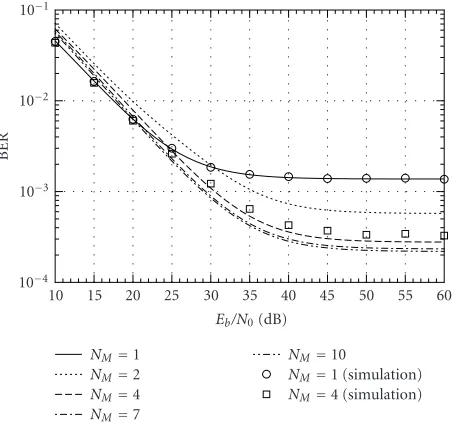
Figure2: BER performance of TD-MSDD with QDPSK over the time- and frequency-selective Rayleigh fading channel with fD = 0.01,Tm≤7/64,RG =7/64.NM =1 corresponds to conventional DD.
It is shown in [8] that for TD-DD and FD-DD (i.e.,NM=1) with QDPSK, inphase and quadrature components of the re-ceived sequence are statistically independent. Thus, in the case of TD-DD and FD-DD with QDPSK, most likely er-ror events are statistically independent, and thus the BER ob-tained by the above method results in a closed-form expres-sion.
5. NUMERICAL RESULTS
Numerical results presented in this section include Monte Carlo simulation results and theoretical results based on the approximate BER in (41). These results are investigated over a two-ray equal-power profile. As a generalization of MSDD to OFDM, we normalize the Doppler frequency and delay spread by the OFDM symbol period, defined as fD= fDNsTs andTm=MpTs/(NsTs)=Mp/Ns, respectively. For this chan-nel, the average power of the mth channel tap can be ex-pressed as
σ2 m=
1
2, form=0,Mp, 0, form=0,Mp.
(42)
5.1. Verification of analysis
Theoretical and simulation results for the BER performance of TD-MSDD with QDPSK over the time- and frequency-selective channel with fD = 0.01,Tm ≤ 7/64, guard inter-val ratio RG = 7/64 (defined asRG = G/Ns), are shown in
Conventional DD (NM=1)
Optimal FD-MSDD Suboptimal FD-MSDD
Conventional DD (NM=1, simulation)
Optimal FD-MSDD (NM=4, simulation)
Suboptimal FD-MSDD (NM=4, simulation)
NM=1
NM=2
NM=7
NM=7
NM=4
NM=4
10 15 20 25 30 35 40 45 50 55 60 Eb/N0(dB)
10−6 10−5 10−4 10−3 10−2 10−1
BER
Figure3: BER performance of FD-MSDD with QDPSK over the time- and frequency-selective Rayleigh fading channel with fD = 0.01,Tm=2/64,Ns=64,G≥2.
Figure 2. Note that the OFDM system withNs=64, a carrier frequency of 5 GHz, a bandwidth of 1 MHz, and a mobile sta-tion velocity of 34 km/h may result in fD≈0.01. In this case, since the ISI does not occur, these results are independent of the specific value ofTm(≤7/64). AlthoughRGis relevant to the correlation of the multiplicative distortion, its effect is relatively small without ISI. It is observed fromFigure 2that forNM=4, the simulation results show close agreement with the theoretical results at high SNR (above 25 dB). At lower SNR, however, the approximation appears to be slightly pes-simistic, due to the asymptotic tightness nature of the union bound. The performance degradation of TD-DD is notice-able over the time-selective channel. This is caused by both decrease in the intersymbol correlation of the multiplicative distortion and the irreducible ICI associated with the OFDM transmission. Even though increasingNMin TD-MSDD may alleviate performance degradation due to decrease in the in-tersymbol correlation, it is not capable of reducing the effect of the ICI. Thus, the error floor appears for TD-MSDD even with largeNM.
Figure 3compares theoretical and simulation results for the BER performance of FD-MSDD with QDPSK over the time- and frequency-selective channel with fD =0.01,Tm= 2/64, Ns = 64, G ≥ 2. Note that the result is irrelevant to the value ofNs. Similar to the case of TD-MSDD, good agreement between the simulation and theoretical results is observed at high SNR (above 20 dB). Even though the per-formance degradation is noticeable for FD-DD, increasing
NM=1
NM=2
NM=4
NM=7
NM=10
NM=10 (Tm=0)
10 15 20 25 30 35 40 45 50 55 60 Eb/N0(dB)
10−7 10−6 10−5 10−4 10−3 10−2 10−1
BER
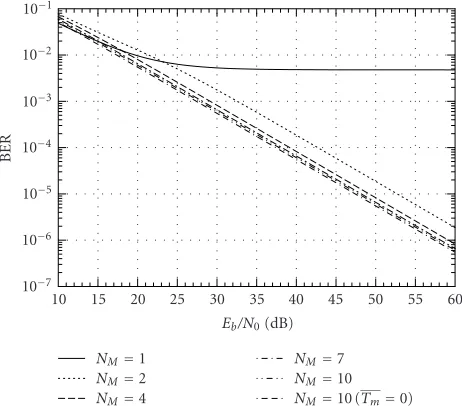
Figure4: BER performance of FD-MSDD with QDPSK over the time-nonselective (i.e., fD=0.0) frequency-selective Rayleigh fad-ing channel withTm=2/64,G≥Mp.
metric calculates the exact impact of ICI whereas the subop-timal metric only utilizes the approximation.
5.2. Asymptotic performance of FD-MSDD
Figure 4shows theoretical results for the BER performance of FD-MSDD with QDPSK over the time-nonselective (i.e.,
fD =0.0) frequency-selective channel withTm = 2/64 and
G ≥ Mp. In this case, the behavior of optimal FD-MSDD is equivalent to that of suboptimal FD-MSDD, sinceKl,Ξl,
ΦC,l in (32) are all equal to zero matrices. It is observed from Figure 4that without ICI, the irreducible error floor associated with a decrease in the inter-subcarrier correla-tion of the multiplicative distorcorrela-tion for FD-DD can be effi -ciently eliminated for FD-MSDD even withNM as small as 2. WhenNM =10, the performance degradation from that with frequency-nonselective channel is approximately 0.4 dB at a BER of 10−6. Thus, in the limit as the observation in-terval approaches infinity, the BER behavior of FD-MSDD over frequency-selective channels without ICI approaches that with the same observation interval over a static channel.
5.3. Comparison between TD-MSDD and FD-MSDD
Figure 5shows theoretical results for the BER performance of TD-DD and FD-DD with QDPSK employed in each di-mension and RG = 7/64. For the sake of comparison of the asymptotic bit error performance at error floor region,
Eb/N0 is fixed at 60 [dB]. Note that, given the system pa-rameters by Ns = 64, 5 GHz carrier frequency, and 1 MHz bandwidth, the range fD up to 0.05 corresponds to the mo-bile station velocity up to approximately 170 km/h. It is ob-served from Figure 5that the performance degradation of TD-DD is caused only by the time selectiveness and is ir-relevant to the frequency selectiveness, as long as the ISI is
TD-DD FD-DD 0
0.01 0.02
0.03 0.04
0.05 fD
0.1 0.08 0.06 0.04 0.02 0
Tm
10−6 10−5 10−4 10−3 10−2
BER
Figure5: BER performance of TD-DD and FD-DD with QDPSK in each dimension,Eb/N0=60 (dB),RG=7/64.
Optimal FD-MSDD (NM=2)
Suboptimal FD-MSDD (NM=2)
0 0.01
0.02 0.03
0.04 0.05 fD
0.1 0.08 0.06 0.04 0.02 0
Tm
10−6 10−5 10−4 10−3 10−2
BER
Figure 6: BER performance of optimal FD-MSDD and subopti-mal FD-MSDD with QDPSK in each dimension,Eb/N0 =60 (dB),
NM=2,Ns=64,G=7.
negligible. For FD-DD, the frequency selectiveness is the lim-iting factor for the BER. These results suggest the importance of appropriate selection of the DD technique matched to the channel statistics.
TD-MSDD (NM=2)
Optimal FD-MSDD (NM=2)
0 0.01
0.02 0.03
0.04 0.05 fD
0.1 0.08 0.06 0.04 0.02 0
Tm
10−6 10−5 10−4 10−3 10−2
BER
Figure7: BER performance of TD-MSDD and optimal FD-MSDD with QDPSK in each dimension,Eb/N0 =60 (dB),NM =2,Ns = 64,G=7.
TD-MSDD (NM=4)
Optimal FD-MSDD (NM=4)
0 0.01
0.02 0.03
0.04 0.05 fD
0.1 0.08 0.06 0.04 0.02 0
Tm
10−6 10−5 10−4 10−3
BER
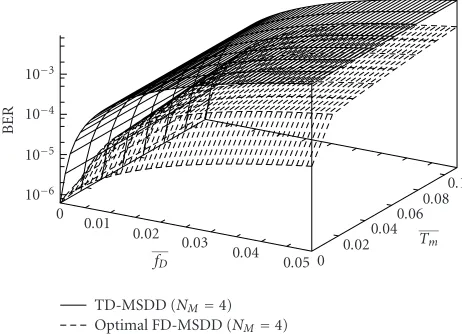
Figure8: BER performance of TD-MSDD and optimal FD-MSDD with QDPSK in each dimension,Eb/N0 =60 (dB),NM =4,Ns = 64,G=7.
Theoretical results for the BER performance of TD-MSDD and the optimal FD-TD-MSDD with the same channel and system parameters above are shown inFigure 7. It is ob-served that forNM =2, the behavior of FD-MSDD is analo-gous to that of TD-MSDD, since both are able to mitigate the performance degradation associated with the decrease in the correlation of the multiplicative distortion. WithNM = 2, however, they do not alleviate the effect of ICI.
Figure 8shows the performance of the system with the same parameters asFigure 7except now we setNM =4. It is observed that even though the optimal FD-MSDD requires higher complexity, it outperforms TD-MSDD on almost all channel statistics compared. This difference comes from the fact that the optimal FD-MSDD can also mitigate the ICI.
Finally, theoretical results for the BER performance of TD-MSDD and the suboptimal FD-MSDD with the same
TD-MSDD (NM=4)
Suboptimal FD-MSDD (NM=4)
0 0.01
0.02 0.03 0.04
0.05 fD
0.1 0.08 0.06 0.04 0.02 0
Tm
10−6 10−5 10−4 10−3
BER
Figure 9: BER performance of TD-MSDD and suboptimal FD-MSDD with QDPSK in each dimension,Eb/N0=60 (dB),NM=4, Ns=64,G=7.
conditions as Figure 8 are shown inFigure 9 , where it is observed that the behavior of the suboptimal FD-MSDD is analogous to that of TD-MSDD. Thus, forNM≥2, the diff er-ence between the BER performance of TD-MSDD and that of the suboptimal FD-MSDD may be negligible.
6. CONCLUSION
In this paper, we applied MSDD to OFDM over time- and frequency-selective Rayleigh fading channels under the as-sumption that the guard time is longer than the delay spread, thus causing no effective ISI. Optimal decision metrics of TD-MSDD and FD-MSDD have been derived based on the exact covariance matrix conditioned on transmitted infor-mation symbol sequence. The theoretical BER performance of MSDD for OFDM has been analyzed, and based on these analytical results, we have shown that when simple receiver structure is preferable, both TD-MSDD and the suboptimal FD-MSDD provide a good performance because of their robustness against the time- and frequency-selective nature of the channel. Thus, as opposed to need of careful selec-tion between TD-DD and FD-DD according to the channel statistics, the difference in BER performance between TD-MSDD and the suboptimal FD-TD-MSDD is negligible. Further-more, it has been shown that if the enhancement of compu-tational complexity at the receiver is acceptable, the optimal FD-MSDD may be a very effective strategy due to its robust-ness against the ICI over such channels.
equivalent and DF-DD can be derived from MSDD by intro-ducing decision-feedback symbols into the MSDD metrics, the metrics proposed in this paper can be also applied to DF-DD for OFDM for reduction of computational complexity. Therefore, extension of the proposed metric to DF-DD with OFDM may be a topic for future study.
REFERENCES
[1] Y. Wu and B. Caron, “Digital television terrestrial broadcast-ing,” IEEE Communications Magazine, vol. 32, no. 5, pp. 46– 52, 1994.
[2] R. van Nee and R. Prasad, OFDM for Wireless Multimedia Communications, Artech House Publishers, Boston, Mass, USA, 2000.
[3] M. Russell and G. L. Stuber, “Interchannel interference anal-ysis of OFDM in a mobile environment,” inIEEE 45th Ve-hicular Technology Conference (VTC ’95), vol. 2, pp. 820–824, Chicago, Ill, USA, July 1995.
[4] D. Divsalar and M. K. Simon, “Multiple-symbol differential detection of MPSK,”IEEE Trans. Communications, vol. 38, no. 3, pp. 300–308, 1990.
[5] P. Ho and D. Fung, “Error performance of multiple symbol differential detection of PSK signals transmitted over corre-lated Rayleigh fading channels,” inProc. IEEE International Conference on Communications (ICC ’91), vol. 2, pp. 568–574, Denver, Colo, USA, June 1991.
[6] P. Ho and D. Fung, “Error performance of multiple-symbol differential detection of PSK signals transmitted over corre-lated Rayleigh fading channels,”IEEE Trans. Communications, vol. 40, no. 10, pp. 1566–1569, 1992.
[7] H. Schubert, A. Richter, and K. Iversen, “Differential mod-ulation for OFDM in frequency vs. time domain,” inACTS Mobile Communication Summit, pp. 763–768, Aalborg, Den-mark, October 1997.
[8] M. Lott, “Comparision of frequency and time domain diff er-ential modulation in an OFDM system for wireless ATM,” in IEEE 49th Vehicular Technology Conference (VTC ’99), vol. 2, pp. 877–883, Houston, Tex, USA, May 1999.
[9] M. Lott, P. Seidenberg, and S. Mangold, “BER characteris-tic for the broadband radio channel at 5.2 GHz,” in Proc. ITG-Workshop Wellenausbreitung bei Funksystemen und Mik-rowellensystemen, pp. 53–60, Oberpfaffenhofen, Germany, May 1998.
[10] M. Okada, S. Hara, and N. Morinaga, “Bit error rate perfor-mances of orthogonal multicarrier modulation radio trans-mission systems,”IEICE Transaction on Communications, vol. E76-B, pp. 113–119, 1993.
[11] R. F. H. Fischer, L. H.-J. Lampe, and S. H. Muller-Weinfurtner, “Coded modulation for noncoherent reception with applica-tion to OFDM,”IEEE Trans. Vehicular Technology, vol. 50, no. 4, pp. 910–919, 2001.
[12] J. G. Proakis, Digital Communications, McGraw-Hill, New York, NY, USA, 4th edition, 2000.
[13] W. C. Jakes Jr., Ed.,Microwave Mobile Communications, John Wiley & Sons, New York, NY, USA, 1974.
[14] Y. H. Kim, I. Song, H. G. Kim, T. Chang, and H. M. Kim, “Per-formance analysis of a coded OFDM system in time-varying multipath Rayleigh fading channels,” IEEE Trans. Vehicular Technology, vol. 48, no. 5, pp. 1610–1615, 1999.
[15] W. C. Lee, Mobile Communications Engineering, McGraw-Hill, New York, NY, USA, 1982.
[16] F. Adachi and M. Sawahashi, “Decision feedback multiple-symbol differential detection forM-ary DPSK,” Electronics Letters, vol. 29, no. 15, pp. 1385–1387, 1993.
[17] R. Schober, W. H. Gerstacker, and J. B. Huber, “Decision-feedback differential detection of MDPSK for flat Rayleigh fading channels,” IEEE Trans. Communications, vol. 47, no. 7, pp. 1025–1035, 1999.
Akira Ishiireceived the B.E. and M.E. de-grees in communication engineering from the University of Electro-Communications, Tokyo, Japan, in 2002 and 2004, respec-tively. He has joined NTT DoCoMo, Tokyo, Japan, in 2004. His current research inter-ests include modulation and coding tech-niques in mobile communications.
Hideki Ochiaireceived the B.E. degree in communication engineering from Osaka University, Osaka, Japan, in 1996, and the M.E. and Ph.D. degrees in information and communication engineering from The Uni-versity of Tokyo, Tokyo, Japan, in 1998 and 2001, respectively. From 1994 to 1995, he was with the Department of Electrical En-gineering, University of California (UCLA), Los Angeles, under the scholarship of the
Ministry of Education, Science, and Culture. From 2001 to 2003, he was with the Department of Information and Communication Engineering, The University of Electro-Communications, Tokyo, Japan. Since April 2003, he has been with the Division of Physics, Electrical and Computer Engineering, Yokohama National Univer-sity, Yokohama, Japan, where he is an Assistant Professor. His cur-rent research interests include modulation and coding techniques in mobile communications. Dr. Ochiai was a recipient of a Student Paper Award from the Telecommunications Advancement Founda-tion in 1999 and the Ericsson Young Scientist Award in 2000.
Tadashi Fujinowas born in Osaka, Japan, on 15 July, 1945. He received his B.E. and M.E. degrees in electrical engineering and his Ph.D. degree in communication en-gineering from Osaka University in 1968, 1970, and 1985, respectively. Since April 2000, he has been Professor in wireless com-munication at the Department of Infor-mation and Communication Engineering, the University of Electro-Communications,