R E S E A R C H
Open Access
Trust evaluation model with entropy-based
weight assignment for malicious node
’
s
detection in wireless sensor networks
Xueqiang Yin
1,2*and Shining Li
1Abstract
Trust management is considered as an effective complementary mechanism to ensure the security of sensor networks. Based on historical behavior, the trust value can be evaluated and applied to estimate the reliability of the node. For the analysis of the possible attack behavior of malicious nodes, we proposed a trust evaluation model with entropy-based weight assignment for malicious node’s detection in wireless sensor networks. To mitigate the malicious attacks such as packet dropping or packet modifications, multidimensional trust indicators are derived from communication between adjacent sensor nodes, and direct and indirect trust values will be estimated based on the corresponding behaviors of those sensor nodes. In order to improve the validity of trust quantification and ensure the objectivity of evaluation, the entropy weight method is applied to determine the proper value of the weight. Finally, the indirect trust value and direct trust value are synthesized to obtain the overall trust. Experimental results show that the proposed scheme performs well in terms of the identification of malicious node.
Keywords:Trust evaluation model, Entropy, Weight assignment, Security, Wireless sensor networks
1 Introduction
Nowadays, wireless sensor networks (WSNs) have become one of the most useful technologies and attracted more and more attention from researchers [1]. Owing to the capabilities of data acquisition, processing, and transmis-sion, the sensor nodes can be deployed in many application scenarios, such as environmental monitoring, battlefield detection, industrial safety monitoring and health care, etc. However, due to the unmanned environment and the char-acteristics of energy-constrained, the sensors are vulnerable to various attacks. By capturing some normal nodes, the at-tackers can change their behavior and then insert false data or decisions to mislead the decision-making of the whole network. In addition, the sensor nodes may be problem-prone to non-malicious errors, such as inadequate residual energy and faults of wireless transceiver or components, and then, result in unreliable data generation [2]. Espe-cially, to improve the energy efficiency, data aggregation in
sensor networks is needed. Once a node is captured, the errors or forged data sent by the fault node will impact the entire fusion result. Therefore, network security of WSNs is a crucial problem to be solved [3].
In the field of network security, asymmetric cryptog-raphy is widely used to deal with external attacks in the Internet, peer-to-peer, and ad hoc networks. However, due to the complexity and demand of huge computa-tional memory, the encryption algorithm is not suitable for WSNs due to limited processing power and resource constraints [4]. In addition, the security mechanism based on encryption can only solve external security problems and cannot effectively deal with internal at-tacks. In WSNs, the particularity of nodes, different from other networks, can refuse to cooperate with service requesters to save energy, and those nodes are being called selfish nodes. Although they do not actively attack the network, a large number of selfish nodes may cause serious consequences. Obviously, the existing encryption mechanism is incapable to identify the risks caused by authenticated selfish nodes. Therefore, it is necessary to establish an effective security mechanism to solve those problems [5]. In recent years, trust management has
© The Author(s). 2019Open AccessThis article is distributed under the terms of the Creative Commons Attribution 4.0 International License (http://creativecommons.org/licenses/by/4.0/), which permits unrestricted use, distribution, and reproduction in any medium, provided you give appropriate credit to the original author(s) and the source, provide a link to the Creative Commons license, and indicate if changes were made.
* Correspondence:[email protected]
1School of Computer Science, Northwestern Polytechnical University, Xi’an 710029, People’s Republic of China
been regarded as an effective complementary mechan-ism to ensure the security of sensor networks. Based on historical behavior, the trust value of a node can be eval-uated to estimate the reliability based on the perform-ance of specific tasks. At present, many typical trust models have been proposed for WSNs, which derives from game theory [6], Bayesian estimation [7], D-S evi-dence [8], fuzzy logic [9], etc. The above models all iden-tify malicious nodes through trust evaluation to a certain extent and provide a theoretical basis for further re-search. Under the open network environment, the trust between sensor nodes will vary dynamically with time and behavior The trust value obtained by the trust model should also change with the communication be-havior between nodes, thus effectively restrain the ab-normal increase or decrease of trust value and resist the influence of flattery or slander between nodes. How to define the trust relationship in the model as well as im-prove the efficiency of the model implementation be-comes an important issue.
The rest of this paper is organized as follows: after the related works are summarized in Section 2, the trust evaluation model is presented in detail in Section 3. In Section4, we present the steps of secure communication under the proposed model. We evaluate the perform-ance of our trust evaluation model in Section 5. And finally, we conclude this paper in Section6.
2 Related work
For internal malicious node attacks, most of the effective defense measures are often built on trust model manage-ment. Trust evaluation can be abstractly referred to as the estimation of the relevant evidence affecting the trust of the subject. Generally, trust can be measured in a way similar to information or knowledge and formu-lated as degree of trust. The trust value can be defined as the combination of direct trust and indirect trust, which can be given a certain weight according to the specific application requirements [10]. Behavior-based trust evaluation models can be divided into centralized and distributed trust evaluation model. Different work-ing modes directly affect the data exchange mode be-tween participants in trust assessment, as well as the data processing, trust calculation during the phase of trust assessment.
In the centralized trust evaluation model, the center obtains global information such as exchange records be-tween sensor nodes or user’s feedback and calculates trust according to a certain rule. Ganeriwal et al. [11] proposed a reputation-based framework for high integ-rity sensor networks, and they introduced beta function to calculate reputation and trust value. In [12], Probst et al. introduced a statistical method into a trust manage-ment model. Trust value can be estimated based on the
direct and indirect experience of nodes and confidence interval is applied to identify malicious behavior. Cheng et al. [13] presented a trust model based on D-S evi-dence theory, in which the comprehensive trust value can be obtained by D-S combination rules. According to historical behavior, trust fluctuation, and recommenda-tion inconsistency in a certain period of time, Anita et al. [14] proposed a routing trust prediction model based on fuzzy theory. The model can predict the subsequent behavior of neighbor nodes, but it may lead to the loss of information. Aivaloglou et al. [15] proposed a hybrid trust and reputation management model based on the certificate-based method and behavior-based mechan-ism. The model utilizes the knowledge of network top-ology and data flow to support the highly diversified needs of node’s roles. Combining fuzzy and gray theory, Wu et al. [16] proposed a trust model with incentive mechanism to evaluate the reliability of nodes. However, because of the complexity of model calculation, it is not suitable for sensor networks with limited processing capacity of nodes. Generally, the centralized trust evalu-ation model has the characteristics of a relatively simple structure and less difficulty to implement. However, due to overwhelmingly dependent on central nodes, load bal-ancing and robustness become the bottleneck of further exploitation.
nodes detection and trusted data filtering mechanism can obtain good performance and scalability. To achieve the tradeoff between energy conservation and network secur-ity, Liao et al. [21] presented a mixed and continuous monitor-forward model based on game theory to mitigate the selective-forwarding attack, in which the monitoring node conducts a strategy continuously to determine the duration of behavior surveillance. However, the selfishness and rationality of sensor nodes are not thoroughly considered.
Taking into account of energy consumption and secure routing, many studies combine the construction of trust model with the clustering management mechanism of nodes. Shaikh et al. [22] proposed a group-based trust management mechanism and applied it to cluster-structured wireless sensor networks. The calculation of trust value is achieved by monitoring the communica-tion behavior between neighbor nodes, including mem-ber node’s trust, cluster head’s trust, cluster trust, and base station trust. The trust model can effectively resist malicious node attacks and protect malicious nodes from defamation and defamation attacks as well as keep energy-efficiency. Zhou et al. [23] proposed a trust evaluation model based on the autonomous behavior of sensor nodes. Sensor nodes acquire direct or indirect trust values by monitoring the behavior of neighbor nodes. Cluster heads calculate comprehensive trust values according to D-S evidence theory. By trust evalu-ation, malicious nodes can be effectively identified and malicious nodes can be restricted to become cluster heads. Crosby et al. [24] designed a distributed trust-based cluster head election mechanism. The trust table was constructed by monitoring the transmission process of neighbor nodes, and the trust degree was calculated. Then, the reliable cluster head was elected according to the trust degree, which ensured the reliability of data fu-sion and network security. For secured data fufu-sion, Fu et al. [25] introduced a cluster-based trust model with double cluster heads structure, in which the dissimilarity coefficient is defined to evaluate the data fusion results. If the fusion results exceed the threshold value, it dem-onstrates that the cluster head is possible to be compro-mised nodes and then to be added to the blacklist.
3 Trust model
3.1 Trust indicators
The purpose of trust evaluation is to provide support for trust decision-making to establish a reliable relationship between the entities. Combining with the implementation of security strategy, it can form a general trust manage-ment system. In WSNs, the sensor’s authentication depends not only on the historical data of the node itself, but also on the adjacent nodes with spatio-temporal cor-relation. The characteristics of node behavior often vary
with time, and the regularity has some statistical charac-teristics. Therefore, the behavior of nodes can be analyzed, and a quantitative evaluation model can be established through the history of interaction between nodes. Specific-ally, the sensor nodes in adjacent areas monitor each other and calculate their trust, which can effectively identify malicious nodes to resist network attacks.
The selection of trust factors is the premise and founda-tion of calculating node’s direct trust, and the trust ele-ments should conform to the characteristics of WSNS. Malicious attacks launched by nodes mainly include steal-ing, tampering with perceptual information, injecting a lot of error information, etc. Therefore, we can analyze the data repetition rate, the number of data packets, data cor-relation, and the volatility of data latency.
Definition 1:Data repetition rate. The data repetition rate of samples can reflect the node’s abnormal behavior owing to repeat sending packets continuously.
DRRi;jðu;v;tÞ ¼Su;v t Definition 2: Packet size abnormality. If the number of samples during the monitoring cycle is too large, it may be a denial of service attack. On the other hand, if the number is too small, the possibility of selfish behav-ior is high.
PSAðu;v;tÞ ¼jSu;vð Þt −ΔS tð Þ j Su;vð Þt
ð2Þ
where ΔS(t) denotes the expected value for the number of samples.
Definition 3: Data correlation. The data collected by neighbor nodes have certain correlation, and the differ-ence between normal nodes should be within a certain range.
DCðu;v;tÞ ¼αe−r D½ uð Þt−Dvð Þt2 ð3Þ
whereαis the attractiveness parameter, andrrepresents the distance between nodesuandsv.Du(t) andDv(t)
VTD u;ð v;tÞ ¼
where h denotes the average number of hops between
node su and sv, and RT(i,k), and ST(i,k) represents the time of receipt and delivery of samples, respectively.
3.2 Clustering objective function
Quantification of trust relationship needs to meet the dynamic requirements of the environment, and it should also show the exact emphasis according to the impact of measurement indicators [26, 27]. Generally, under the condition of multiple monitoring indicators, the weight value has certain experience and subjectivity, which is not conducive to the validity of trust quantification and evaluation [28,29].
In this paper, the trust evaluation model divides the nodes into categories of normal nodes, relay nodes, and base station in the perception layer. In the process of evaluating node behavior trust, only relay nodes generate recommended trust values among themselves, and it is assumed that the base station is fully trusted. Let s1, s2, ⋯,sndenotenadjacent relay nodes of the evaluated
tar-get. According to the index mentioned above, the obser-vation vector (ri1 ri2 ⋯ rim) is obtained at theith relay
node. The evaluation matrix Rn×m can be constructed,
in whichrijrepresents the evaluation result ofjth
indica-tor fromith relay node, 1≤i≤n, 1≤j≤m.
Generally, under the condition of multiple monitor-ing indicators, the establishment of weights has
cer-tain experience and subjectivity, which is
disadvantageous to the validity of trust quantification and evaluation [30, 31]. In this paper, the weight of monitoring index will be solved based on the method of entropy weight.
First, the membership matrixUm×nis defined, and the
matrix element uijrepresents the degree of membership
ofrijwith constraint of
Xm
j¼1
uij¼1;0≤uij≤1: ð5Þ
Next, to indicate the difference between the recommen-dation entity and the expectation caused by the objective deviation, we define the recommended deviationΔas:
Δj¼
where rj represents the average value of jth indicator, andrj¼m1
Pm i¼1rij
The objective of clustering is to find the optimal clus-tering vector so as to minimize the overall recom-mended deviation, and the objective function can be expressed as:
According to the definition of membership matrix Um×n,uijcan be regarded as the probability that theith
entity belongs to the jth monitoring index. Therefore, the information entropy of jth monitoring index for the relay nodesican be calculated as:
H¼−uijln uij ð8Þ
Accordingly, the total information entropy of the matrixUm×ncan be expressed as:
In order to minimize the clustering function and
optimize the overall information entropy, the
optimization process can be described as follows:
minf−X
whereρis the equilibrium factor of the equation. By using the Lagrange multiplier method [32,33], the constraint Pmj¼1uij¼1 can be introduced into the
La-grange multiplier λ, and the Eq. (9) can be transformed to
CRj¼rj 1−kj
represents the comprehensive recommenda-tion forjth indicator from entities.
Finally, based on recommendation trust and corre-sponding weight value, the quantitative results of direct trust evaluation between relay node k and monitored node can be estimated as:
DTrustk¼ Xm
j¼1
wjrkj ð14Þ
3.3 Indirect trust
The indirect trust can be regarded as the recommenda-tion from the third party [34]. The indirect trust value of node suto nodesvis composed of the direct trust value
of all recommendation nodes to nodesv, and the
recom-mended nodes are referred to as the common neighbor nodes of nodesu and sv. However, not all
tion nodes are trustworthy, and unreliable recommenda-tion will provide false informarecommenda-tion to evaluate the trustworthiness of the nodes, which will affect the trust of the sensor nodes that create and manipulate the data.
In order to calculate the indirect trust value accurately through recommendation nodes, it is necessary to select trusted neighbors as recommendation nodes. First, we define a specified trust threshold δ, and the nodes with direct trust higher thanδ will be selected as the recom-mended neighbors set. As multiple nodes push trust values to a single node at the same time, it may bring opportunities to malicious nodes. Malicious nodes intentionally elevate or degrade the trust of a node by sending false or conflicting recommendation trust values. Therefore, multiple recommendation trust prob-lems must be solved through trust merge rules. Suppose Ωdenote represents the set of trusted neighbor nodes of the evaluated node and relay nodesk, and |Ω| represents
the number of nodes in setΩ. Firstly, the average value of all evaluation result will be calculated as
rij¼
Next, the weight ωiof the recommendation node can
be obtained as:
Then, the indirect trust can be estimated as
ITrustk¼
Definition 5: Total trust. By synthesizing indirect trust with direct trust, the total trust can be obtained as follows:
TTrust¼θDTrustþð1−θÞITrust ð18Þ
whereθ∈[0,1] and indicate the trustworthiness degree to the trust value.
4 Secure communication
Based on the proposed trust evaluation model, the se-cure communication is introduced based on AODV protocol. In the initial stage, the identity-based cryptog-raphy mechanism is applied to verify the legitimacy of nodes and establish a trusted network environment. Then, the specific flow of its secure communication is as follows:
Step 1: Initially, all nodes broadcast their own identity
information in the network. All neighbor nodes in the communication range can calculate their shared keys according to the private keys and identification, which can be used to encrypt and decrypt exchange message between them.
Step 2: If the source nodesSprepares to communicate
with the destination nodesD, it will query the local routing table whether exists a route to the destination. If not, the route to nodesDshould be established by the following steps.
Step 3:sSbroadcasts query message RREQ to its
neighborsk, andskwill determine whether the same query information has been processed. If so, the current request message is discarded. Otherwise, the number of hops in the query message will plus 1.
Step 4: Then,sSwill retrieve the direct trust of
neighborskin its local storage module and broadcast a trust query message to its neighbor nodes. All the nodes receiving the source node trust query
Step 5: Finally, sS can obtain the comprehensive trust of the node sk. If trustworthy, it will be regarded as the next hop node and continue to forward the routing query message RREQ. Otherwise, return to execute Step 2.
Step 6: Execute Step 3 repeatedly until a trusted route
fromsSto destinationsDcan be resolved.
5 Experimental results
In order to verify the validity of the proposed trust model for wireless sensor networks, simulation experi-ments are conducted. The size of the network is 100m × 100m. One hundred sensor nodes are randomly distributed in the region, and the base station is located in the center of the monitoring area. The perception
a)
b)
radius of nodes is 20 m and the communication range is set to 40 m. In the simulation experiment, the propor-tion of malicious nodes is arranged from 0 to 40%, and they simulated by the several kinds of attacks, including selective forwarding attack, data forgery attack, DoS at-tack, and on/off attack. Each simulation time is 400 s, and the time period of trust update is equal to 10 s. The
assignment of other parameters is as m= 4, θ= 0.5 and
δ= 0.7.
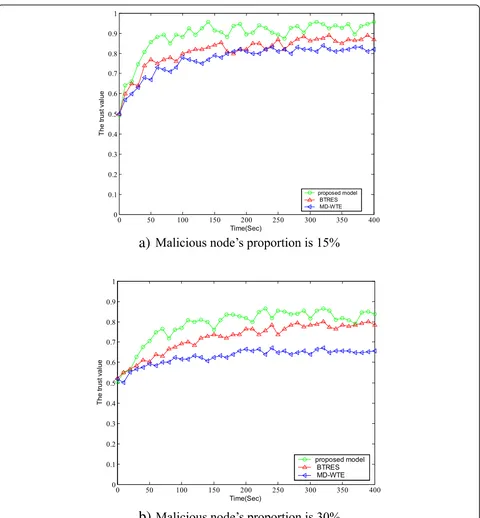
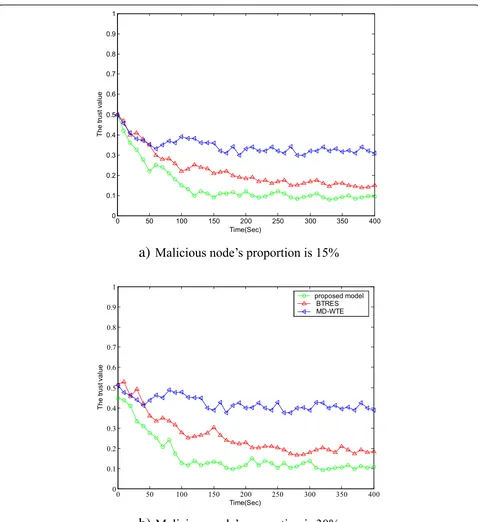
The performance of the proposed method is compared with that of MD-WTE [34] and BTRES [35]. Figures 1 and2show the trust value of the normal node and mali-cious node with time as malimali-cious node proportion is 15% and 30%, respectively. The experimental results
a)
b)
show that in MD-WTE, the average trust value of nor-mal nodes is similar, but the trust value of abnornor-mal nodes is obviously higher than that of other methods. As a result, the malicious nodes cannot be distinguished clearly. That is because only one trust value is applied in MD-WTE, and the malicious sensor nodes can hide ma-licious behavior of their sensing through trusted transfer function. The nodes can still maintain high reliability by masking malicious packet loss via trusted sensing behav-ior. In our proposed model and BTRES, the direct trust
values are closer to the object trust values compared with the integrated trust values since the integrated trust values are more or less influenced by the malicious rec-ommendations. However, they take communication be-havior into account to calculate sensor nodes’trust value and improve the accuracy of recommendation trust against the selective forwarding attack and the data for-gery attack.
As can be seen from Fig. 2, when the proportion of malicious nodes is about 30%, the trust value of normal
Fig. 3The detection rate with time as malicious node’s proportion is 15%
nodes decreases obviously; meanwhile, the trust value of malicious nodes increase. This trend also shows that when malicious nodes reach a certain proportion, the normal nodes in the network cannot effectively detect the abnormal behavior of malicious nodes. Hence, the average trust value of malicious nodes increases. Com-pared with the other methods, our proposed model can reduce the impact of malicious nodes more effectively. It illustrates that the direct trust and recommendation trust should be dynamically adjusted based on the pro-portion of malicious nodes. Once the percent of mali-cious nodes exceeds the extent, the normal behavior of nodes may be mistaken as abnormal. That will not be
conducive to the delivery of data by normal nodes in the network.
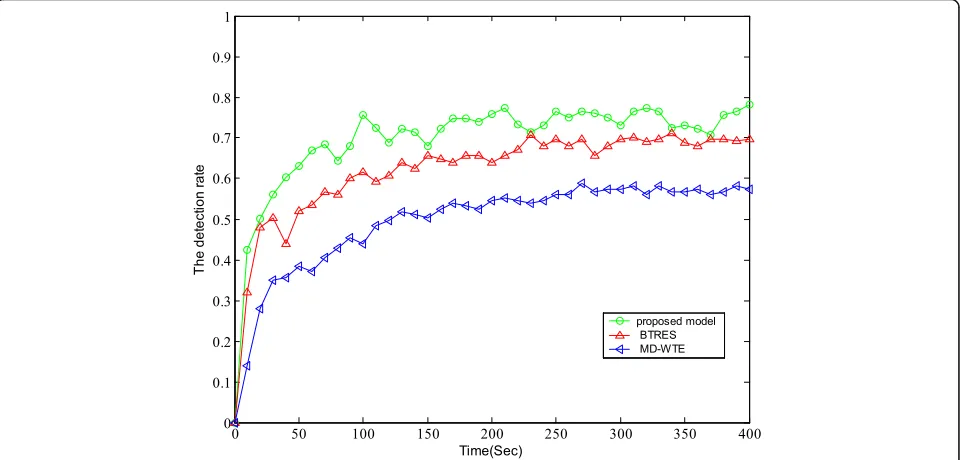
Furthermore, we evaluate the detection rate and false error rate of malicious nodes. Due to open environment and the performance of nodes being uncertain, not all nodes can be judged as trusted or untrustworthy state. Figures 3 and 4 show the differences in detection rate when malicious nodes are 15% and 30%, respectively. As can be seen from the results, our proposed model and BTRES have risen rapidly from the beginning of different scenarios and have maintained a high detection rate in the process of operation. The reason is that both of the methods can reduce the dependence on prior experience and the assumption of prior distribution, which im-proves the speed and accuracy of identifying the mali-cious nodes. Comparatively, after accumulating a certain amount of records, the detection rate in MD-WTE in-creases gradually. In our proposed model, entropy-based weight assignment improves the objectivity of trust evaluation and obtains fast convergence rate.
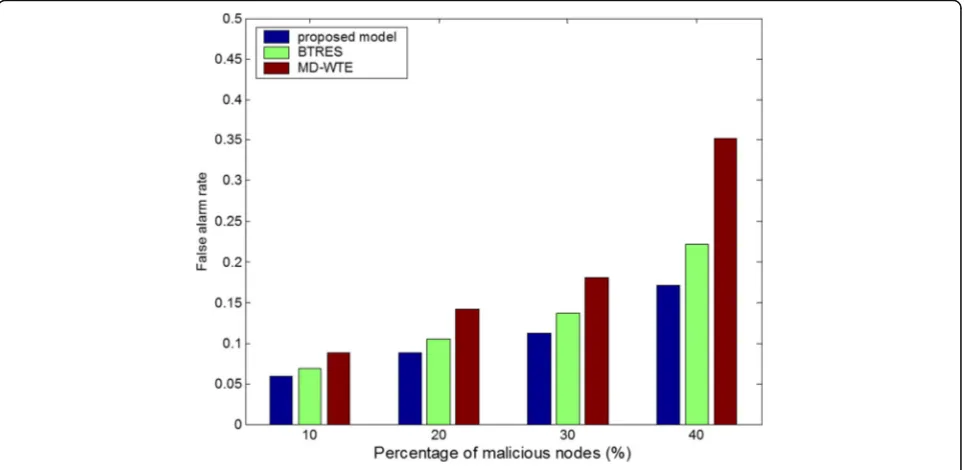
Next, we analyze and compare the detection rate and false alarm rate under different percentage of malicious nodes. As can be seen from Figs. 5and 6, our proposed model and BTRES have higher detection rate and lower false alarm rate when the proportion of malicious nodes is small. As the proportion of malicious nodes increases, the detection rate of MD-WTE decreases rapidly, and the false alarm rate also increases sharply. The detection rate of our proposed model decreases slowly and grad-ually stabilizes, and the promotion of false alarm rate is relatively small. The reason is that the fuzziness and conflict of evidence increase as the proportion of
Fig. 5The detection rate with different percentage of malicious nodes
malicious nodes increases. By means of selecting the proper value of the weight of direct trust and indirect trust, our proposed model improves the accuracy of the malicious node’s detection and robustness of trust evalu-ation model.
6 Conclusions
In this paper, we proposed a trust evaluation model with entropy-based weight assignment for malicious node’s detection in wireless sensor networks. Multidimensional trust indicators are derived from communication be-tween adjacent sensor nodes, and direct and indirect trust values will be estimated based on the correspond-ing behaviors of those sensor nodes. To improve the val-idity of trust quantification and ensure the objectivity of evaluation, the entropy weight method is applied to de-termine the proper value of the weight. In our future work, we will devote to evaluate the trust level of sensor nodes in clustered WSNs and combine the trust model with secure data fusion. Besides, some professional tech-niques, e.g., fuzzy logic or pattern recognition, will be employed and discussed to reduce the fuzziness of be-havior evidences.
Abbreviation
WSNs:Wireless sensor networks
Acknowledgements
The authors acknowledged the anonymous reviewers and editors for their efforts in valuable comments and suggestions.
Authors’contributions
XY proposed the innovation ideas and theoretical analysis, and he carried out the experiments and data analysis. SL conceived of the study, participated in its design and coordination, and helped to draft the manuscript. All authors read and approved the final manuscript.
Availability of data and materials
Data sharing is not applicable to this article as no datasets were generated or analyzed during the current study.
Competing interests
The authors declare that they have no competing interests.
Received: 29 March 2019 Accepted: 22 July 2019
References
1. G. Han, J. Jiang, L. Shu, J. Niu, J. Comput. Syst. Sci.80(3), 602–617 (2014) 2. A. Ahmed, K.A. Bakar, M.I. Channa, A.W. Khan, K. Haseeb, Peer-Peer Netw.
Appl.10(1), 216–237 (2017)
3. B. Wu, X. Yan, Y. Wang, C. Guedes Soares, Risk Anal.37(10), 1936–1957 (2017) 4. M.A. Simplício, P. Barreto, C.B. Margi, Comput. Netw.54(1), 2591–2612 (2010) 5. Y.M. Huang, M.Y. Hsieh, H.C. Chao, IEEE J. Sel. Areas Commun.24(7),
400–411 (2009)
6. J. Duan, D. Gao, D. Yang, C.H. Foh, IEEE Internet Things J.1(1), 58–69 (2014) 7. M.K. Denko, T. Sun, I. Woungang, Comput. Commun.34(3), 398–406 (2011) 8. W. Zhang, S. Zhu, J. Tang, J. Supercomput.74, 1779–1801 (2018) 9. B. Wu, L. Zong, X. Yan, C. Guedes Soares, Ocean Eng.164, 590–603 (2018) 10. D. He, S. Zeadally, N. Kumar, J.H. Lee, IEEE Syst. J.11(4), 2590–2601 (2016) 11. S. Ganeriwal, M. Srivastava,Proceedings of the 2nd ACM Workshop on Security
of Ad-Hoc and Sensor Networks Washington DC(2004), pp. 66–77 12. M.J. Probst, S.K. Kasera,Proceedings of 2007 International Conference on
Parallel and Distributed Systems(2007), pp. 1–8
13. R. Feng, S. Che, X. Wang, Int. J. Distrib. Sens. Netw.9(6), 1–9 (2013) 14. X. Anita, M.A. Bhagyaveni, J. Manickam, Sci. World J.8(1), 341–356 (2014) 15. E. Aivaloglou, S. Gritzalis, Wirel. Netw16(5), 1493–1510 (2010) 16. G. Wu, Z. Du, Y. Hu, et al., Soft. Comput.18(9), 1829–1840 (2014)
22. R.A. Shaikh, H. Jameel, B.J. D’Auriol, et al., IEEE Trans. Parallel Distrib. Syst.
20(11), 1698–1712 (2008)
23. J.M. Zhou, F. Liu, Q.Y. Lu, J. Sensors68(9), 907–913 (2014)
24. G.V. Crosby, N. Pissinou, J. Gadze,Proceedings of Second IEEE Workshop on Dependability and Security in Sensor Networks and Systems(IEEE, Columbia, 2006), pp. 13–22
25. J.S. Fu, Y. Liu, Sensors15(1), 2021–2040 (2015)
26. A. Boukerch, L. Xu, K. El-Khatib, Comput. Commun.30(12), 2413–2427 (2007) 27. M. Al Ameen, J. Liu, K. Kwak, J. Med. Syst.36(1), 93–101 (2012)
34. I.M. Atakli, H. Hu, Y. Chen, et al.,Proceedings of the International Symposium on Simulation of Systems Security(2008), pp. 836–843
35. W. Fang, C. Zhang, Z. Shi, J. Netw. Comput. Appl.59, 88–94 (2016) Publisher’s Note