R E S E A R C H
Open Access
An integrated diversity and fusion framework
for binary consensus over fading channels
Mehrzad Malmirchegini
*and Yasamin Mostofi
Abstract
In this paper, we consider a cooperative network that is trying to reach consensus on the occurrence of an event by communicating over not fully connected and time-invariant network topologies with fading channels. We first discuss the fusion and diversity decision-making strategies over time-invariant network topologies and shed light on the underlying trade-offs. We then propose an integrated diversity and fusion framework. Our approach properly takes advantage of both fusion to enable information flow and diversity to increase robustness to link errors. We mathematically analyze the proposed framework and show how the network achieves accurate consensus
asymptotically. To show an example, we then utilize the proposed framework over regular ring lattice networks. Our theoretical and simulation results indicate that the proposed technique improves the consensus performance considerably.
1 Introduction
Cooperative decision-making over sensor networks has gotten considerable interest in recent years. These net-works have a variety of applications such as environmental monitoring, target tracking, and surveillance. Consider the scenario where a network of nodes, distributed in a harsh environment, aims to cooperatively accomplish a task. Each node has limited local capabilities and can therefore only accomplish the task in a cooperative man-ner. In this paper, we are interested in group agreement problem, where a group of agents need to reach consensus on the value of a parameter of interest. The consen-sus problems can be categorized into two main groups:
estimation consensusanddetection consensus. Estimation consensus refers to problems in which each agent has an estimate of the parameter of interest, where the param-eter of interest can take values over an infinite set or an unknown finite set. For instance, it may be of interest that all the mobile agents that started in different direc-tions reach an agreement on their asymptotic headings in a cooperative multi-agent network [1]. Recently, there has been considerable interest in estimation consensus problems from the signal processing and communication
*Correspondence: [email protected]
Electrical and Computer Engineering Department, University of California, Santa Barbara, CA, USA
community, with more emphasis on link uncertainties [2-4].
Detection consensus, on the other hand, refers to prob-lems in which the parameter of interest takes values from a finite known set. Then the update protocol, which each agent will utilize, becomes nonlinear. Bybinary consensus
[5], we refer to a subset of detection consensus problems where the network is trying to reach consensus over a binary parameter. For instance, in a cooperative fire detec-tion scenario, each node has an initial opinion as to if there is a fire or not. However, as a network, they may act based only on the majority vote. Therefore, the goal of the net-work is for each node to reach consensus over the majority of initial votes. Another application of binary consensus is in cooperative spectrum sensing in cognitive radio net-works. In this scenario, the secondary users communicate with each other in order to reach consensus on busy or idle status of the primary user, which is a binary value [6].
1.1 Related work and our contribution
While there exists a rich literature on estimation consen-sus, detection consensus problems only recently started to receive attention. In [7], the authors consider convergence in a detection consensus setup over perfect channels with repeated sensing and known probabilistic sensing mod-els. In [8], the authors consider a distributed hypothesis testing problem over perfect communication channels to
which they refer to as belief consensus. They consider the case where each node transmits its belief (conditional probability) to other nodes. As a result, their problem immediately takes the form of the traditional average estimation consensus for which a rich literature exists.
In [5,9], the binary consensus scenario is considered. In this scenario, each node in the network has an opinion regarding the occurrence of an event. The nodes will then communicate over the network topology. The goal for every node is to reach the majority of the initial votes with-out any prior knowledge on the sensing qualities. Authors in [9] characterized phase transition of such a binary con-sensus problem in the presence of a uniformly distributed communication noise. In most applications, however, the agents will communicate their values wirelessly and will experience Gaussian receiver noise as opposed to a uni-formly distributed noise. In [5], we considered reaching binary consensus over regular network topologies (all nodes have the same number of neighbors) with addi-tive white Gaussian noise channels. We characterized the transient behavior of the network probabilistically. We showed that in the presence of noise, the network state is asymptoticallymemoryless, i.e., independent of the initial state. This is undesirable since the group agreement is not related to the initial state of the system and is merely a function of channel errors.
In [10], we studied the binary consensus over a fully connected network topology with fading channels. We proposed a novel consensus-seeking protocol that utilizes information of link qualities. We showed that by incorpo-rating the information of link qualities, the network will be in consensus with a higher probability but still holds the undesirable asymptotic behavior. In [11], we considered binary consensus over rapidly changing network topolo-gies with fading channels. We mathematically character-ized the impact of fading, noise, network connectivity and time-varying topology on consensus performance.
In this paper, we consider the binary consensus prob-lem over the general time-invariant network topologies (not necessarily fully connected) with fading channels. We study two decision-making strategies that differ in terms of using the available transmissions: fusion and diver-sity. In the first strategy, the given resources are used to increase the flow of information in the network, whereas the second strategy aims to increase robustness to link error by channel coding [11]. We characterize the under-lying trade-offs between these two strategies for binary consensus over anot fully connected andtime-invariant
network topology. In particular, we show that fusion-based scheme results in an asymptotic memoryless behav-ior, which is not desirable. Furthermore, diversity-based scheme only outperforms fusion-based scheme, when the main bottleneck is link quality and the network has a good connectivity. Themain contributionof this paper is
to propose a framework that keeps the benefits of both fusion and diversity strategies, in terms of the network information flow and link error robustness, for binary consensus over time-invariant network topologies with fading channels. We mathematically analyze the proposed framework and show that it achieves accurate consensus asymptotically. The proposed framework solves the unde-sirable memoryless behavior of the network consensus and results in a drastic performance improvement.
2 Binary consensus problem over time-invariant topologies with ideal communication links
In this section, we introduce the binary consensus prob-lem over not fully connected and time-invariant network topologies. Furthermore, we assume ideal communication links. Studying this case allows us to focus solely on the impact of information flow in the network and character-ize a benchmark for the performance of binary consensus algorithms over non-ideal communication links.
Consider a cooperative network of Mnodesa that are trying to reach consensus over the occurrence of an event. Each node has its own initial decision, based on its one-time sensing. The goal of the network is for each node to reach a decision that is equal to the majority of the initial votes. For instance, in a cooperative fire detection sce-nario, each node has an initial opinion as to if there is a fire or not. However, as a network, they may act based only on the majority vote. Therefore, it is desirable that every node reaches the majority of the initial votes without a group leader. As it may happen in realistic scenarios, the nodes may not have any information on their own or the others’ sensing quality. Therefore, the main goal is that each node reaches the majority of the initial votes. Considering sens-ing quality of the nodes is among possible extensions of this work.
In order to achieve this, each node will transmit its current decision to other nodes.b We model the under-lying network as an undirected graph G(V,E), where
and updates its vote based on the majority of its neighbors’ votes.
Letb˜ui denote theith node’s vote afterufusion steps over ideal communication links. We have,
˜
bui =ϒideal
⎛
⎝ 1
1+ |Ni| ⎡ ⎣b˜u−1
i +
j∈Ni ˜
buj−1
⎤ ⎦,b˜ui−1
⎞ ⎠
(1)
whereNi denotes the neighbor set of theith node, and the decision-making function for the binary consensus over ideal communication links,ϒideal(., .), is defined as
follows:
ϒideal(x,ξ )
⎧ ⎨ ⎩
1 x>0.5 ξ x=0.5 0 x<0.5
. (2)
Figure 1 shows a network ofM=17 nodes trying to reach consensus over a 6-regular ring lattice.c In this topology, each node receives information from its neighbors over ideal communication links. As can be seen, all the nodes reach the majority of initial votes at the second level of fusion. LetDu= {˜bu1,b˜u2,. . .,b˜uM}denote the network state afterufusion steps. Define
uG(D0)min{u|Duis an accurate consensus state}.
For instance, for the example of Figure 1, we haveD0= {1, 0, 0, 1, 0, 1, 0, 1, 1, 1, 0, 0, 0, 1, 1, 0, 1} and uG(D0) = 2. We then define DG {D0| uG(D0) < ∞} and uG = maxD0∈DGuG(D0).uGis only a function of graph connec-tivity and represents the maximum number of required fusion levels in order to achieve accurate consensus if
D0 ∈DG. For instance, for the fully connected graph, i.e.,
each node is connected to all the nodes in the network, we have uG = 1. In the next section, we consider the binary consensus problem over non-ideal communication links. We discuss different strategies in terms of informa-tion flow and robustness to link error and characterize the underlying trade-offs.
3 The underlying trade-offs between information flow and link error robustness
In a realistic scenario, each node transmits its decision to other nodes over non-ideal communication links. The transmissions occur over fading channels and are further-more corrupted by the receiver noise. Letrj,i(k)represent the fading coefficient of the link from nodejto nodeiat timek. Similarly,nj,i(k)denotes the receiver noise at the
kth time step in the transmission from the jth node to the ith one.nj,i(k) is zero-mean Gaussian with the vari-ance ofσj2,i. We take the receiver noise of the receptions of different nodes to be uncorrelated. Let bj,i(k) repre-sent the reception of theith node from the transmission of thejth one at thekth time step. We have the follow-ing if there exists a link from thejth node to theith one:d
bj,i(k) = rj,i(k)bj(k)+nj,i(k), wherebj(k)denotes thejth node’s vote at timek. We assume that each receiver can learn the fading coefficient of each of its receptions and utilize it in the decision-making process. Furthermore, we consider the case where the fading coefficients are uncor-related among different nodes and in different time steps. Each agent will then update its assessment based on the received information. We next discuss fusion and diversity decision-making strategies for binary consensus prob-lem over not fully connected and time-invariant network topologies and characterize the underlying trade-offs.
3.1 Fusion case
In this case, each node fuses its received information in every time step to form its new opinion, which it will then
send to other nodes. In this manner, each node helps to propagate the information of other nodes in the network. This strategy is suitable, in particular when the graph con-nectivity is low, as it creates virtual links between nodes. In [10], we proposed a fusion-based protocol that utilizes information of link qualities and noise variance. In this approach, each node tries to estimate the majority of its neighbors’ votes based on the best affine estimation (BAE) of the sum of its neighbors’ votes. Letψi(k)=j∈N
ibj(k) represent the sum of the votes of theith node’s neighbors. Then the ith node estimatesψi(k) using the best affine unbiased function of the received information: ψˆi(k) =
j∈Niαj,i(k)bj,i(k)+βj,i(k)where
αj,i(k)=
rj,i(k)
rj2,i(k)+ σ
2
j,i qj(k)(1−qj(k))
and
βj,i(k)=1−αj,i(k)rj,i(k)
qj(k),
(3)
andqj(k)=E[bj(k)] (readers are referred to [10] for more information). Theith node will then update its decision as follows:
bi(k+1)=ϒfading,|Ni|+1 ⎛
⎝ 1
1+ |Ni|
× ⎡ ⎣bi(k)+
j∈Ni
αj,i(k)bj,i(k)+βj,i(k) ⎤ ⎦,bi(k)
⎞ ⎠,
(4)
wherebi(0) = ˜b0i for 1 ≤ i ≤ M. The decision-making function for the binary consensus over fading communi-cation links,ϒfading,M(., .), is defined as follows:
ϒfading,M=2j
x,ξ ⎧ ⎨ ⎩
1 x> 12+21M ξ |x−12| 21M
0 x< 12−21M and
ϒfading,M=2j+1x,ξ
1 x 12
0 x< 12
(5)
It can be seen that Equation 3 assumes that the knowl-edge of qj(k) is available at the receiver. If theith node does not have an estimate of qj(k), it will assume that
qj(k)=0.5. We refer to this case as basic BAE.
In section III-B of [11], we mathematically analyzed the asymptotic behavior of the basic BAE for binary consen-sus over fully connected network topology. We showed
that the network loses its memory of the initial state asymptotically due to the impact of link errors, which is undesirable. The same analysis can also be extended to the case of not fully connected network topologies. Therefore, the fusion approach for binary consensus over not fully connected and time-invariant network topol-ogy and in the presence of noise and fading suffers from asymptotic memoryless behavior. Next, we discuss the diversity-based scheme, which is more robust to the link error.
3.2 Diversity case
In this part, we consider another strategy in which each node uses its transmissions to repeat its initial vote. Con-sider the case where the network is givenK + 1 trans-missions to reach an agreement. Each node can use all of its transmissions to repeat its initial vote and only fuses the received information afterward. This strategy can, in particular, be useful in reducing the impact of link errors. LetZj,i(K) =[bj,i(0),. . .,bj,i(K)]T denote the receptions ofith node from thejth node inK+1 transmis-sions. DefineRj,i(K) =[rj,i(0),. . .,rj,i(K)]T andNj,i(K) = [nj,i(0),. . .,nj,i(K)]T. For the diversity case, all nodes use their transmissions to repeat their initial votes, i.e.,bj(k)=
˜
b0j for 0 ≤ k ≤ K. Then we have the following, consid-ering all the receptions of theith node from thejth node:
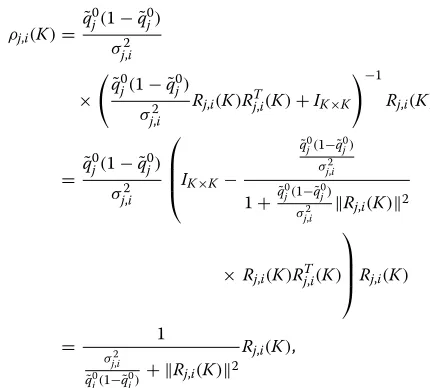
Zj,i(K)= ˜b0jRj,i(K)+Nj,i(K). Theith node can then esti-mateb˜0j by using the best affine unbiased function of the received information:bˆ0j(K)=ρjT,i(K)Zj,i(K)+ηj,i(K). To ensure an unbiased estimator, we should have,Ebˆ0j(K)]=
Eb˜0j ⇒ ηj,i(K) = ˜q0j
1−ρjT,i(K)Rj,i(K)
, where q˜0j =
Eb˜0i. Let ζj,i(K) = E[ ˆ
b0j(K) − ˜b0j2] denote the cor-responding estimation error variance. We then have the following optimization problem:
ρj,i(K)=arg min ζj,i(K),
subject toηj,i(K)= ˜q0j
1−ρjT,i(K)Rj,i(K)
. (6)
We have
ζj,i(K)=E
(bˆ0j(K)− ˜b0j)2
=Eb˜0j − ˜q0jρTj,i(K)Rj,i(K)−
bj(0)− ˜q0j
+ρj,iTNj,i(K)
2
=ρj,iT(K)q˜0j(1− ˜q0j)Rj,i(K)RTj,i(K)+σj,i2IK×K
ρj,i(K)
−2q˜0j(1− ˜q0j)ρj,iT(K)Rj,i(K)+ ˜qj0(1− ˜q0j).
By noting that Equation 7 is a convex function ofρj,i(K), the following for the estimation error variance after
K + 1 transmissions: ζj,i(K) = σ
the channel-to-noise ratio for the link from nodejto node
iat timek. We then have the following decision-making function:
Lemma 1. Consider binary consensus over a not fully con-nected network topology. Under the assumption of i.i.d. Rayleigh fading channels, CNRj,i(k) are independent and
identically distributed (i.i.d.) exponential random vari-ables with CNR = ECNRj,i(k). Then the dynamical
system, based on the decision-making function of 8, will asymptotically reach D1= {˜b11,b˜12,. . .,b˜1M}, where D1 rep-resents the network state after one level of fusion over ideal communication links.
Proof.It can be easily confirmed that if b
where in the last line we are using Chebyshev’s inequality. Furthermore, we have, i.i.d. exponential random variables with the mean of CNR, γj,i(K)has Gamma distribution with the following param-eters:γj,i(K)∼Gamma(K+1, CNR). As a result,γj−1,i (K) is an inverse Gamma random variable. We then have, limK→∞E
100 101 102 103 0
0.2 0.4 0.6 0.8 1
time step (k) in log scale
average probability of accurate consensus
diversity, L=6, average CNRj,i=6dB
fusion, L=6, average CNRj,i=6dB
100 101 102 103
0 0.1 0.2 0.3 0.4 0.5 0.6 0.7 0.8 0.9 1
time step (k) in log scale
average probability of accurate consensus
diversity, L=16, average CNRj,i=−6dB
fusion, L=16, average CNRj,i=−6dB
Figure 2Performance comparison of fusion and diversity approaches for binary consensus over regular ring lattice topology.TheM=17 nodes with fading channels and different graph connectivities: (left)L=16 and CNR= −6 dB, (right)L=6 and CNR=6 dB (averaging is done over several runs).
better transient behavior. This is due to the fact that by fusing the received information, it helps in propagat-ing the information over the network. However, it lacks asymptotic accurate consensus and suffers from asymp-totic memoryless behavior. As the network connectivity decreases, the fusion strategy outperforms the diversity. For instance, Figure 2 (right) compares the performance of both approaches for 6-regular ring topology and CNR = 6 dB. Since the main bottleneck is the network connec-tivity, the fusion approach outperforms the diversity one drastically. In summary, the fusion strategy is more suit-able when the graph connectivity is low, while the diversity technique is a better candidate if poor link quality is the main bottleneck. The analysis and simulation of this part show the underlying trade-offs between fusion and diver-sity strategies. In the next section, we propose a novel framework that keeps the benefits of both fusion and diversity approaches.
4 An integrated diversity-fusion framework for binary consensus over fading channels
In this section, we propose our diversity-fusion frame-work for binary consensus over fading channels. In this strategy, each agent sends a vector to its neighbors. This vector consists of the estimations of the votes correspond-ing to the different fusion levels. Throughout the repeated communications (diversity), each node tries to refine its assessments of different fusion levels in order to reach consensus.
Let Bi(k) =[b0i(k),b1i(k),. . .,b lG(k)
i (k)]T represent the vector that nodeiwill send to all its neighbors over fad-ing channels at time k,e where bui(k) represents the ith node’s estimate ofb˜ui at timekandlG(k)=min{k,uG−1}. Note thatb˜ui is defined in Section 2 as the value of nodei
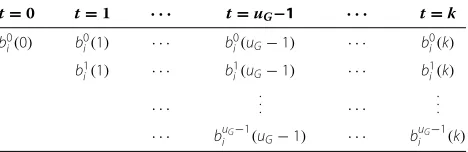
afterufusion levels for the case where there is no noise. Table 1 shows the time progression of the transmitted
vector by nodei to all its neighbors. As can be seen, at time t = 0, node i only transmits its initial vote to its neighbors. It also receives its neighbors’ initial votes over fading channels. Next, in time stept = 1, nodeifuses all its receptions in order to come up with an estimate of
˜
b1i. It then transmits its initial vote together with the esti-mate of b˜1i to all its neighbors. This process will go on for a while, and each agent sends its estimate of differ-ent fusion levels to it neighbors. As can be seen, theith node’s estimate ofb˜ui will not be available tillk=u. There-fore, fork<uG−1,Bi(k)=[b0i(k),b1i(k),. . .,bki(k)]Tand
lG(k)=k. However, fort≥uG−1, the length of the trans-mitted vector becomes fixed and equal touG.fIt is worth noting that except for the first row, the columns of other rows have different values. This is due to the fact that sim-ilar transmissions can undergo different noise and fading values.
Letruj,i(k)andnuj,i(k)represent the fading coefficient and the receiver noise of the link, which transmitsbuj(k)from node j to node i, respectively. nuj,i(k) is the zero-mean Gaussian with the variance of σj2,i,u. We take the fading coefficient and the receiver noise of all the receptions to be uncorrelated. Letbuj,i(k)represent the reception of the
ith node from the transmission ofbuj(k)at timek. We have the following,buj,i(k) = rju,i(k)buj(k)+nuj,i(k)for 1 ≤ i ≤ Mandj ∈Ni. LetZju,i(k)=[buj,i(u),. . .,buj,i(k)]T represent all the receptions of nodeifrom nodejcorresponding to
Table 1 Time progression of transmitted vector by nodei
t=0 t=1 · · · t=uG−1 · · · t=k b0
i(0) b0i(1) · · · bi0(uG−1) · · · b0i(k) b1
i(1) · · · b1i(uG−1) · · · b1i(k)
· · · ... · · ·
. . .
· · · buG−1
theuth level of fusion till timek. Nodeiwill then update its estimate ofbui+1at timek+1 based onbui(k)and all theuth level votes of its neighbors until timek.
bui+1(k+1)=Fbui(k),Zuj,i(k)∀j∈Ni
, (11)
where F represents a decision-making function.
The redundancy in vector Zju,i(k) tries to improve the link qualities. We next show how to design this function. We define the following variables:
ˆ diag(.) is a diagonal matrix with the elements of the argument on its main diagonal. Therefore, we have
Zju,i(k) = Hju,i(k)Bˆju(k)+Nju,i(k)fork ≥ u. Theith node will then try to estimate b˜uj, based on all receptions from jth node, i.e., Zu
j,i(k). In order to characterize the best affine estimation of b˜uj, the second-order statistic of Bˆuj(k) is required. However, finding a closed-form expression for the second-order statistics of this vari-able is challenging. The vector Bˆuj(k) contains different temporal assessments of thejth node aboutb˜uj. To sim-plify the mathematical derivation, we consider the case, where the uth level of fusion is in its steady state, i.e.,
ˆ
Buj(k) = ˜bju1k−u+1 ∀j. Under this assumption, the BAE estimation can be derived similar to Equation 6 as fol-lows: bˆuj(k) = ρju,iT(k)Zuj,i(k) + ηuj,i(k), where ρju,i(k) = tor is suboptimal. However, in Theorem 1, we will show that limk→∞buj(k) = ˜buj for 1 ≤ j ≤ M. Therefore, the proposed suboptimal estimator is asymptotically optimal. Theith node will then update its(u+1)th level decision as
bui+1(k+1)=ϒfading,|Ni|+1 ∀i,k. Next we show that the decision-making function of Equation 12 achieves accurate consensus asymptotically and overcomes the asymptotic memoryless behavior of the traditional fusion approaches.
Theorem 1. Consider binary consensus over a time-invariant network topology with i.i.d. Rayleigh fad-ing channels. Then, the decision-makfad-ing function of Equation 12 asymptotically converges (in probability) to accurate consensus if D0∈D
G.
Proof.We prove the theorem by induction. Define
ωui(k)prob
ωiu+1(k+1)
for the last term in the third line, we are using the prop-erty that ifis a zero-mean Gaussian variable with the variance ofσ2, then E{√} =
0. By substituting these values in Equation 13, it can be easily confirmed that limk→∞ωiu+1(k +1) = 0. Using is an accurate consensus state with the probability of one, which proves the theorem.
Remark 1. The decision-making function of Equation 12 uses information of σj,i,us. If such information is not
available, then theith node can estimateb˜uj using best
lin-ear unbiased estimation: bˆuj(k) = Ru1 j,i(k)2R
u
j,iT(k)Zuj,i(k), assuming that theuth level of fusion is in its steady state. Each node will then update its(u+1)th level decision as follows: This receiver can be considered as a special case of the decision-making function of Equation 12, whereσj,i,u=0. We can similarly show that it achieves accurate asymp-totic consensus. Furthermore, we have limk→∞ρju,i(k) ≈
In the subsequent sections, we utilize the integrated framework for a special class of undirected graphs and show the performance of the proposed framework.
5 Integrated framework over regular ring lattice topologies
networks, we have uG = 1. In general, uG is a func-tion of network topology and independent of communi-cation quality. This parameter needs to be determined before running the algorithm. In this section, we mainly focus onL-regular ring lattice topologies with ideal com-munication links in order to characterize uG. Let V = {1, 2,. . .,M}denote the vertex set. Without loss of gener-ality, we assume that the vertices are ordered clockwise on the ring (see Figure 1). Furthermore, we assume thatMis odd. Under the above assumptions, the adjacency matrix of anL-regular ring lattice, i.e.,AL, can be represented by a circulant matrix with the first row of [ 0,1TL
2
,0TM−L−1,1TL
2
]. For this class of graphs, L is a notion of connectivity. Therefore, we try to show howuGchanges as a function of
L. We then have the following lemma, which will be used in Theorem 2.
Lemma 2. For an L-regular ring lattice, if L = M−1, then ∩Mi=1Ni∪ {i} =M. Moreover, if L≤M−3, then ∩p
n=1
Nin∪ {in} ≤L+2−p. The equality is achieved
if and only if{i1,. . .,ip} ⊂ Vdenotes a set of consecutive
nodes on the corresponding ring.
Proof.The proof is straightforward and we skip it.
Letmu = min M
j=1b˜uj,M−
M
j=1b˜uj
. We then have the following theorem.
Theorem 2. Consider binary consensus over an L-regular ring lattice. We then have the following properties:
1. AssumeV=!ci=1Vi, such thatVirepresents a set of consecutive nodes on the ring that vote the same and |Vi| ≥ L2+1. Then the corresponding network state is an absorbing state.
2. Form0≤ L2, the accurate consensus is achievable after one level of fusion.
3. Form0= L2+1andD0∈DG, accurate consensus is achievable at most after two fusion steps.
Proof.LetVi = {oi1,. . .,oi|Vi|} denote theith partition, whereoijrepresents the index ofjth node in theith
parti-tion. Therefore, we have, Noi j ∪ {o
i j}
)
Vi ≥ L2 +1 for all 1≤j≤ |Vi|. Since all the nodes inVivote the same, we haveb˜u+1
oij = ˜
bu
oij
for 1≤i≤cand 1≤j≤ |Vi|.
We next prove the second part. Consider the case where the majority of the initial votes is 1. Ifm0 ≤ L2, we then
have b˜
0
i+
j∈Nib˜
0
j
L+1 ≥ L+1−m 0
L+1 > 12 ∀ i, which results in ˜
b1i =1. For the case where the majority of the initial votes
is 0, we have b˜
0
i+
j∈Nib˜
0
j L+1 ≤ m
0
L+1 < 12 ∀ i, which results
inb˜1i = 0. Therefore, form0 ≤ L2 accurate consensus is achievable in one iteration.
Next, we show the third statement. First we show that form0 = L
2 +1 and D0 ∈ DG, we havem1 ≤ L2. Let
i01,i02,. . .,i0m0
denote an ordered set of the nodes, which vote to the minority of the initial votes. Lemma 2 says that at mostL+2−m0 = L2+1 nodes can have{i01,. . .,i0m0}
in their neighbor set if and only if i01,i02,. . .,i0m0 is a set of consecutive vertices. Therefore, m1 = L2 + 1 is achievable if and only if the initial state is an absorbing state (see Theorem 2-1). Therefore, if D0 ∈ DG, then
m1≤ L2, which reaches accurate consensus inu =2 (see Theorem 2-2).
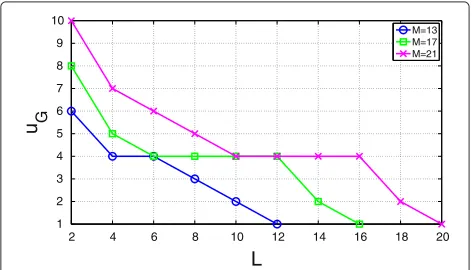
In Theorem 2, we showed that the number of fusion levels, required to achieve accurate consensus is a func-tion of graph connectivity (L) and initial state (D0). For instance, for a fixed connectivity, if m0 ≤ L2, accurate consensus is achievable after one level of fusion. How-ever, if m0 increases to L2 + 1, then the network may require two fusion steps to reach consensus. In order to understand the impact of the connectivity on the required fusion steps, Figure 3 characterizesuGas a function ofL over a regular ring lattice topology for different number of nodes. As can be seen, as Lincreases, uG decreases. For instance, for L = 16, i.e., a fully connected graph, the network requires only one level of fusion to reach accurate consensus. It can also be seen thatuG is only a function of the graph topology. Figure 3 also comparesuG for different number of nodes. As can be seen, uG is a non-decreasing function ofMfor a fixedL. However, the mathematical derivations are challenging. Intuitively, as
Mincreases, the network requires more number of fusion levels, i.e., ‘a higher’uG, in order to achieve consensus. For instance, consider anL-regular ring lattice network ofM1
nodes, whereL=M1−1 andM1is an odd number. Since
we always havem0 ≤ L
2 =
M1−1
2 , therefore the network
achieves accurate consensus only in one iteration. Next,
2 4 6 8 10 12 14 16 18 20
1 2 3 4 5 6 7 8 9 10
L
u G
M=13 M=17 M=21
consider an L-regular ring lattice network ofM2 nodes,
whereL=M1−1,M2>M1andM2is an odd number. It
is easy to confirm thatuG≥2 in this case.
6 Simulation and comparison
Figure 4 shows the performance of the proposed frame-work over a regular ring lattice topology of M = 17 nodes. In order to show the impact of network connec-tivity on the performance of the proposed algorithm, we consider a regular graph topology with different values of L. For each L, the number of required fusion levels, i.e.,uG, can be found from Figure 3. Each node will then send a binary vector of lengthuGto all its neighbors over communication channels. Moreover, we assume all chan-nels experience the same noise variance (σj,i,u =1.5) and the average power of fading coefficients is equal to one (Eruj,i2(k)= 1). In order to make a fair comparison (the proposed integrated approaches send more bits per iter-ation), we compare all the approaches under the same number of transmitted bits. Therefore, in Figure 4, we show the probability of accurate consensus as a function of number of transmitted bits per node.
Figure 4 shows the performance of the proposed frame-work for L = 8, 10, and 14. For these simulations, we assume that node i does not have the knowledge of quj for j ∈ Ni. So it simply assumes quj = 0.5 in the decision-making function of Equation 12. As can be seen, the the integrated approach, independent of network connectivity, achieves accurate consensus asymptotically. Therefore, the proposed approach overcomes the mem-oryless asymptotic behavior of traditional binary con-sensus approaches. Furthermore, networks with higher connectivity, i.e., larger values of L, reach their steady state in fewer transmissions. For the case of L = 8, the performance of both fusion and diversity approaches of Section 3 are also shown for comparison. As can be seen,
100 101 102 103
0 0.1 0.2 0.3 0.4 0.5 0.6 0.7 0.8 0.9 1
number of transmitted bits per node
average probability of accurate consensus
fusion (basic BAE) (L=8) diversity (L=8)
integrated, known σj,i,u (L=8)
integrated, unknown σj,i,u (L=8)
integrated, known σj,i,u (L=10)
integrated, known σj,i,u (L=14)
Figure 4Average probability of accurate consensus over regular ring lattice of 17 nodes where CNR= −3.5dB.
the proposed approach keeps the benefits of both fusion and diversity in terms of the transient and asymptotic behaviors respectively. Furthermore, the performance of the integrated approach for the case where L = 8 and knowledge of σj,i,u is not available (Remark 1) is also shown in Figure 4. As can be seen, the integrated approach with known link quality slightly outperforms the case of unknown link quality. However, both cases provide a sim-ilar performance asymptotically as mentioned earlier in Remark 1.
7 Conclusions
In this paper we considered a cooperative network that is trying to reach binary consensus over not fully con-nected and time-invariant network topologies with fading channels. We first characterized the underlying trade-offs between fusion and diversity strategies. We then proposed a framework that keeps the benefits of both strategies. We mathematically analyzed the proposed algorithm and showed how it achieves accurate consensus asymptoti-cally. Our results indicated that the proposed technique improves the consensus performance considerably and solves the undesirable memoryless asymptotic behavior of the original problem.
Endnotes
a We also use the term ‘agent’ to refer to each node.
b Note that in a binary consensus scenario, each node
only exchanges 1 bit of information with its neighbors in each time step.
c AnL-regular ring lattice is anL-regular graph withM
vertices in a ring in which each vertex is connected to its
Lneighbors (L2on each side for an even value ofL). d Note that without loss of generality, we assumed that
the modulation is on-off keying.
e We assume an FDMA- or TDMA-based MAC
approach. For instance, in FDMA-base approach, to each node we assign different frequency subbands,
corresponding to different fusion levels. f Note that we choseu
Gas the maximum length based on the fact that, in the case of no noise, this is the number of fusion levels needed for convergence. However, in this case that we have noise, this may not be the optimum length and choosing longer lengths can possibly result in a better performance.
Competing interests
The authors declare that they have no competing interests.
Received: 22 April 2012 Accepted: 19 June 2013 Published: 4 September 2013
References
2. TC Aysal, ME Yildiz, AD Sarwate, A Scaglione, Broadcast gossip algorithms for consensus. IEEE Trans. Signal Process.57, 2748–2761 (2009) 3. S Kar, J Moura, Distributed consensus algorithms in sensor networks with
imperfect communication: Link failures and channel noise. IEEE Trans. Signal Process.57, 355–369 (2009)
4. G Scutari, S Barbarossa, Distributed consensus over wireless sensor networks affected by multipath fading. IEEE Trans. Signal Process.
56, 4100–4106 (2008)
5. Y Mostofi, Binary consensus with Gaussian communication noise: a probabilistic approach, inProceedings of the 46th IEEE Conference on Decision and Control (CDC). Hilton New Orleans Riverside, New Orleans, 12–14, Dec 2007
6. S Ashrafi, M Malmirchegini, Y Mostofi, Binary consensus for cooperative spectrum sensing in cognitive radio networks. IEEE GLOBECOM, Houston, 5–9 Dec 2011 (IEEE, Piscataway, 2011)
7. Y Hong, A Scaglione, P Varshney, A communication architecture for reaching the consensus in decision for a large network. IEEE Statistical Signal Processing Workshop, SSP2005, Bordeaux, 17–20 July 2005 (IEEE, Piscataway, 2005), pp. 17–22
8. R Olfati-Saber, E Franco, E Frazzoli, JS Shamma, Belief consensus and distributed hypothesis testing in sensor networks. Network Embedded Sensing Control.331, 169–182 (2006)
9. J Liu, V Yadav, H Sehgal, J Olson, H Liu, N Elia, Phase transitions on fixed connected graphs and random graphs in the presence of noise. Proceedings of the 44th IEEE Conference on Decision and Control, Orlando, 12–15 Dec 2005 (IEEE, Piscataway, 2005), pp. 2996–3000 10. M Malmirchegini, Y Ruan, Y Mostofi, Binary consensus over fading
channels: a best affine estimation approach. IEEE Global
Telecommunications Conference, New Orleans, 30 Nov–4 Dec 2008 (IEEE, Piscataway, 2008)
11. Y Mostofi, M Malmirchegini, Binary consensus over fading channels. IEEE Trans. Signal Process.58, 6340–6354 (2010)
doi:10.1186/1687-6180-2013-144
Cite this article as:Malmirchegini and Mostofi:An integrated diversity
and fusion framework for binary consensus over fading channels.EURASIP
Journal on Advances in Signal Processing20132013:144.
Submit your manuscript to a
journal and benefi t from:
7Convenient online submission
7Rigorous peer review
7Immediate publication on acceptance
7Open access: articles freely available online
7High visibility within the fi eld
7Retaining the copyright to your article