Parametric Weighting of Parallel Data for Statistical Machine Translation
Kashif Shah, Lo¨ıc Barrault, Holger Schwenk
LIUM, University of Le Mans Le Mans, France.
Abstract
During the last years there is increas-ing interest in methods that perform some kind of weighting of heterogeneous paral-lel training data when building a statistical machine translation system. It was for in-stance observed that training data that is close to the period of the test data is more valuable than older data (Hardt and Elm-ing, 2010; Levenberg et al., 2010). In this paper we obtain such a weighting by resampling alignments using weights that decrease with the temporal distance of bi-texts to the test set. By these means, we can use all the available bitexts and still put an emphasis on the most recent one. The main idea of our approach is to use a parametric form or meta-weights for the weighting of the different parts of the bi-texts. This ensures that our approach has only few parameters to optimize. We re-port experimental results on the Europarl corpus, translating from French to En-glish and further verified it on the official WMT’11 task, translating from English to French. Our method achieves improve-ments of about 0.6 points BLEU on the test set with respect to a system trained on data without any weighting.
1 Introduction
Statistical machine translation (SMT) systems are based on two types of resources: monolingual data to build a language model (LM) and bilingual data – also called bitexts – to train the translation model (TM). The parallel data often comes from differ-ent sources,e.g. Europarl, UN, in-domain data in limited amounts, data crawled from the Internet or even bitexts automatically extracted from compa-rable corpora. It seems obvious that the appropri-ateness and the usefulness of this parallel data for
a particular translation task may vary quite a lot. Nevertheless, the standard procedure is to concate-nate all available parallel data, to perform word alignment using GIZA++ (Och and Ney, 2000) and to extract and score the phrase pairs by sim-ple relative frequency. Doing this, the parallel data is (wrongly) considered as one homogeneous pool of knowledge. We argue that the parallel data is quite inhomogeneous in many practical applica-tions with respect to several factors:
• the data may come from different sources that are more or less relevant to the translation task (in-domain versus out-of-domain data).
• more generally, the topic or genre of the data may be more or less relevant.
• the data may be of different quality (carefully performed human translations versus auto-matically crawled and aligned data).
• the recency of the data with respect to the task may have an influence. This is of interest in the news domain where named entities, etc change over time.
There have been several attempts in the liter-ature to address some of these problems. Mat-soukas et al. (2009) proposed to weight each sen-tence in the training bitexts by optimizing a dis-criminative function on a tuning set. Sentence-level features are extracted to estimate the weights that are relevant to the given task. Foster et al. (2010) proposed an extended approach by an in-stant weighting scheme which learns weights on individual phrase pairs instead of sentences and incorporated the instance-weighting model into a linear combination of feature functions.
The technique presented in this paper is related to these previous works as it concerns the weight-ing of corpora or sentences. However, it does not
1996 1997 ... 2009 2010 Alignments obtained from time-stamped training parallel text
1
1997
1996 ... 2009 2010 0.05 0.09 ... 0.17 0.20
Normalized weights
Resampling with replacement
Resampled alignments used to build Phrase Table
!t
e
−λ.∆t0.4
0.8
0.9
[image:2.595.144.461.63.252.2]0.45
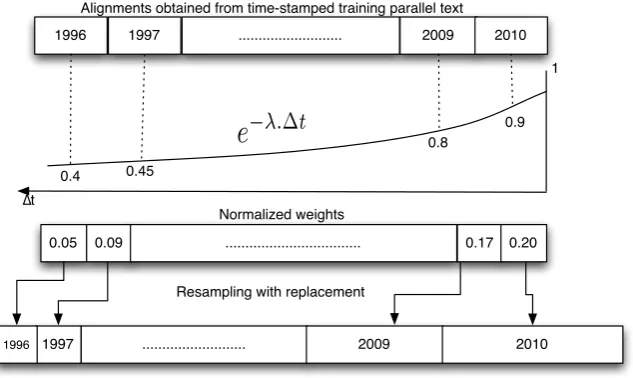
Figure 1: Overview of the weighting scheme. The alignments are weighted by an exponential decay function, parameterized byλ. Resampling with replacement is used to create a new corpus (parts with higher weight will appear more often). The phrase table is built from this corpus using the standard procedure.
require the calculation of additional sentence-level features.
In our previous work Shah et al. (2010) we pro-posed a technique to weight heterogeneous data by weighted resampling of the alignments. The weights were numerically optimized on develop-ment data.
Hardt and Elming (2010) has shown recency ef-fect in terms of file-context and concluded that the data within the same file is of greater importance than the rest. Levenberg et al. (2010) proposed an incremental training procedure to deal with a con-tinuous stream of parallel text. Word alignment was performed by the stepwise online EM algo-rithm and the phrase table was represented with suffix arrays. The authors showed that it is better to use parallel data close to the test data than all the available data.
The research presented in this paper is the ex-tension of our previous work Shah et al. (2010) to weight corpora by resampling and is inspired by the work of Levenberg et al. (2010) to consider the recency of the training data. In fact, we could split the training data into several parts over time scale and use our previous resampling approach Shah et al. (2010) to automatically optimize the weights of each time period. However, this approach does not seem to scale very well when the number of indi-vidual corpora increases. Numerical optimization of more than ten corpus weights would probably
need a large number of iterations, each one con-sisting in the creation of a complete phrase table and its evaluation on the development data.
The main idea of our work is to consider some kind of meta-weights for each part of the train-ing data. Instead of numerically optimiztrain-ing all the weights, these meta-weights only depend on few parameters that need to be optimized. Con-cretely, in this work we study the exponential de-crease of the importance of parallel data in func-tion of its temporal distance to the development and test data. The weighting of the parts is still done by resampling the alignments. However, our general approach is not limited to weighting the training data with respect to recency to the devel-opment and test data. Any other criterion could be used as long as it can be calculated by a parametric function,i.e.to measure the topic appropriateness.
2 Weighting Scheme
important than older one, we apply an exponential decay function:
e−λ·∆t (1)
where λ is the decay factor and ∆t is the dis-cretized time distance (0 for most recent part, 1 for the next one, etc.). Therefore, our weighting scheme has only one parameter to be optimized.
Following our previous work Shah et al. (2010), we resample the alignments in order to obtain a weighting of the bitexts according to their recency. The weight of each part of the bitexts is normal-ized (sum to one). The normalnormal-ized weights rep-resent the percentage of final aligned corpus that is originated from each part of the source corpus: word alignments corresponding to bitexts that are close to the test period will appear more often than the older ones in the final corpus.
In addition, we considered the quality of the alignments during resampling, as described in our previous work (Shah et al., 2010). Alignments produced by GIZA++ have alignment scores as-sociated with each sentence pair in both direction,
i.e. source to target and target to source. Align-ment scores have a very large dynamic range and are concentrated around very low values, conse-quently the following logarithmic mapping is ap-plied in order to flatten the distribution:
log(α·(ntrg
√a
src trg+ nsrc√atrg src)
2 ) (2)
where a is the alignment score, n the size of a sentence and α a smoothing coefficient to opti-mize. We used these normalized alignment scores as confidence measurement for each sentence pair.
3 Description of the algorithm
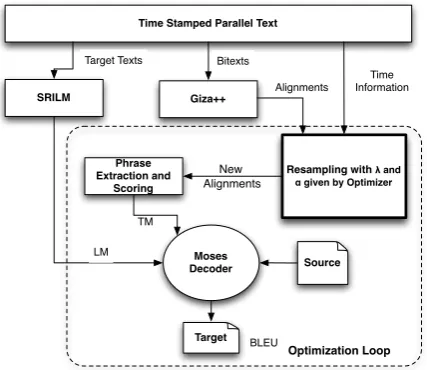
The architecture is presented in Figure 2. The starting point is a parallel corpus. We performed word alignment in both directions using GIZA++. The corpus is then separated into several parts on the basis of a given time span. We performed ex-periments with different span sizes, namely year, month, week and day. The decaying function is scaled so that the range does not change when us-ing different span sizes. A weightus-ing coefficient obtained with the exponential decay function is then associated to each part.
1required size depends upon the number of times we
re-sample - see section 5.
Alignments
Time Stamped Parallel Text
Giza++
Resampling with ! and
" given by Optimizer Phrase
Extraction and Scoring
Moses
Decoder Source
Target
Optimization Loop
New Alignments
Time Information
SRILM
TM
Target Texts Bitexts
LM
[image:3.595.310.524.64.249.2]BLEU
Figure 2: Architecture of SMT Weighting System.
Algorithm 1Weighting with Exponential Decay function using resampling
1: Determine word to word alignment with GIZA++ on concatenated bitexts.
2: Initializeλandαwith equal weights. 3: whilenot Optimizeddo
4: Computetime-spansweights by eq. 1 5: Normalize weights
6: fori= 0to#time-spando
7: proportion ← required size1∗weights[i]
8: j = 0
9: whilej < proportiondo 10: Al ← Random alignment
11: Alscore ← normalized score ofAl
12: FlattenAlscorewithα
13: T hreshold←rand[0, 1]
14: ifAlscore > T hresholdthen
15: keep it
16: j=j+ 1
17: end if 18: end while 19: end for
20: Create new resampled alignment file. 21: Extract phrases and build the phrase table. 22: Decode
23: Calculate the BLEU score on Dev 24: Updateλandα
25: end while
gen-erated and compared to the alignment score. The alignment is kept only if its score is above the threshold. This ensures that all alignments have a chance to be selected, but this chance is propor-tional to its alignment score.
Note that some alignments may appear several times, but this is exactly what is expected as it will increase the probability of certain phrase pairs which are supposed to be more related to the test data (in terms of recency) and of better quality. The smoothing and decay factors,αandλ respec-tively, are optimized with a numerical optimizer called CONDOR (Berghen and Bersini, 2005). The procedure and steps involved in our weight-ing scheme are shown in algorithm 1.
4 Experimental evaluation
Our first experiments are based on the French-English portion of the freely available time-stamped Europarl data (Koehn, 2005) from April 1996 to December 2010. We have built sev-eral phrase-based systems using the Moses toolkit (Koehn et al., 2007), though our approach is equally applicable to any other approach based on alignments and could be used for any language pairs. In our system, fourteen feature functions are used. These feature functions include phrase and lexical translation probabilities in both directions, seven features for the lexicalized distortion model, a word and phrase penalty, and the target language model. The coefficients of these feature functions are optimized by minimum error training.
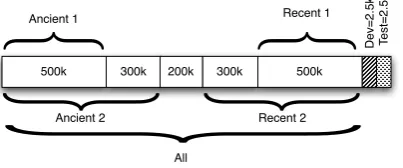
In the first experiments, the whole Europarl cor-pus was split into train, development and test as shown in Figure 3. The most recent 5K sentences are split into two sets of equal size, one for devel-opment and the other for testing. The remaining data was used as training bitexts to build the dif-ferent systems.
500k 300k
Ancient 2
{
Ancient 1{
{
Dev=2.5k Test=2.5k{
500k 300k
200k
Recent 2 Recent 1
{
[image:4.595.77.279.628.712.2]All
Figure 3: Data used to build the different systems (# sentences)
Since we want to focus on the impact of the weighting scheme of the bitexts, we used the same language model for all systems. It has been trained with the SRILM toolkit (Stolcke, 2002) on the tar-get side of all the training data. In addition, the weights of the feature functions were tuned once for the system that uses all the training data and then kept constant for all the subsequent exper-iments, i.e. no tuning of the feature functions weights is done during the optimization of the weighting coefficientsλandα.
Table 1 presents the results of the systems trained on various parts of the available bitexts without using the proposed weighting scheme. The best performance is obtained when using all the data (55M words, BLEU=30.48), but almost the same BLEU score is obtained by using only the most recent part of the data (24M words, part
Recent 2). However, if we use the same amount of data that is further away from the time period of the test data (25M words, part Ancient 2), we observe a significant loss in performance. These results are in agreement with the observations al-ready described in (Levenberg et al., 2010). Us-ing less data, but still close to the evaluation pe-riod (15M words, partRecent 1) results in a small loss in the BLEU score. The goal of the proposed weighting scheme is to be able to take advantage of all the data while giving more weight to recent data than to older one. By these means we are not obliged to disregard older parts of the data that may contain additional useful translations. If the weighting scheme does work correctly, we can-not perform worse than using all the data. Of course, we expect to achieve better results by find-ing the optimal weightfind-ing between recent and an-cient data.
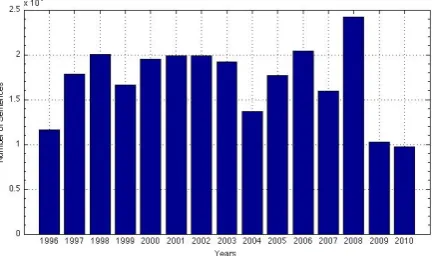
The amount of data per year in the Europarl data can vary substantially in function of time period since it depends on the frequency and length of the sessions of the European Parliament. As an example Figure 4 shows the histogram of the data per year.
Europarl Ancient data Recent data
Ancient 1 Ancient 2 Recent 1 Recent 2 All # of sentences/words 500K/15M 800K/25M 500K/15M 800K/24M 1800K/55M
BLEU (on dev) 29.84 30.08 30.80 31.09 31.34
[image:5.595.92.502.62.135.2]BLEU (on test) 29.30 29.43 30.32 30.44 30.48
Table 1: BLEU scores obtained with systems trained on data coming from different time spans.
Europarl Weighting + alignment selection Best+retune Time span Days Weeks Months Years Years Optimizedλ 0.0099 0.0109 0.0110 0.0130 0.0130 BLEU (on dev) 31.73 31.82 31.75 31.80 31.92
[image:5.595.137.458.180.255.2]BLEU (on test) 30.94 30.97 30.92 30.98 31.09
Table 2: Results in BLEU score after weighting.
size of each span. The results are shown in Table 2. It is observed that all four systems obtained very similar results, which indicates that the size of the spans is not very important. One surprising ob-servation is that the optimized decay factor for all time span sizes are really close to each other. The reason to this could be the scaling of the exponen-tial decaying function based on the time span size. In fact scaled values ensure that the oldest data point get roughly the same value independent of using years, months or days as time span. Look-ing at the optimized values ofλin Table 2, we can observe that the relative difference between recent and ancient data is rather small, i.e. the ancient data is still somehow important and cannot be ne-glected.
By using years as time span, we obtain an improvement of +0.50 BLEU score on the test
Figure 4: Amount of data available in the Europarl corpus for each year
Figure 5: Distribution of data after weighting
set compared to using all data without weighting (30.48 → 30.98). It is clear that recency has a
positive impact on system performance, however, weighting properly the different parts gives bet-ter performance than using the most recent or all available data.
Finally, the best system is retuned (feature func-tions weights) and an overall improvement of +0.61 in the BLEU score is observed on test set.
5 Discussion
[image:5.595.311.515.311.429.2] [image:5.595.76.293.579.707.2]Europarl Resampling only Weighting only alignment selection only
BLEU (on dev) 31.36 31.69 31.45
[image:6.595.115.485.62.107.2]BLEU (on test) 30.51 30.84 30.64
Table 3: Results in BLEU score with different settings.
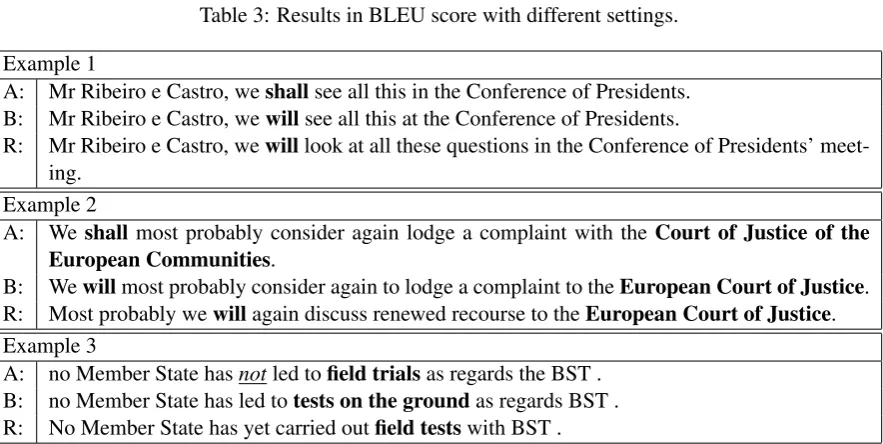
Example 1
A: Mr Ribeiro e Castro, weshallsee all this in the Conference of Presidents. B: Mr Ribeiro e Castro, wewillsee all this at the Conference of Presidents.
R: Mr Ribeiro e Castro, wewilllook at all these questions in the Conference of Presidents’ meet-ing.
Example 2
A: Weshallmost probably consider again lodge a complaint with the Court of Justice of the European Communities.
B: Wewillmost probably consider again to lodge a complaint to theEuropean Court of Justice. R: Most probably wewillagain discuss renewed recourse to theEuropean Court of Justice. Example 3
A: no Member State hasnotled tofield trialsas regards the BST . B: no Member State has led totests on the groundas regards BST . R: No Member State has yet carried outfield testswith BST .
Table 4: Example translations produced by systemsAll(A) andBest+retune(B) versus reference (R)
When comparing to Figure 4, the overall propor-tion of data coming from recent years is clearly bigger when using our resampling approach. This leads to different word choices while decoding.
Note that resampling is performed several times to estimate and select the samples which better represent the target data set. The more often we resample, the closer we get to the true probabil-ity distribution. The required-sizein algorithm 1 depends upon the number of times we resample. We resampled ten times in our experiments. It is also worth to note that, we keep the original training data along with resampled one. It en-sures that no information is lost and the set of ex-tracted phrase pairs remain the same - only the cor-responding probability distributions in the phrase table are changed.
In order to get more insight in our method, we separately performed the different techniques:
• resampling the training data without weight-ing;
• resampling the training data using weighting
only (with respect to recency);
• resampling the training data using alignment selection.
These results are summarized in Table 3.
Note that the first case does not correspond to duplicating the training data a certain amount of time (which would of course produce exactly the same phrase-table). Since we perform resampling with replacement, this procedure introduces some randomness which could be beneficial. Accord-ing to our results, this is not the case: we ob-tained exactly the same BLEU scores on the dev and test data than with the standard training proce-dure. Weighting with respect to recency or align-ment quality both slightly improve the BLEU, but not as much as both techniques together. The per-formance increase seems actually to be comple-mentary.
Some comparative examples between the trans-lations produced by systems AllandBest+retune
[image:6.595.79.521.128.350.2]pro-WMT Task Baseline Receny weighting Recency weighting + alignment selection + alignment selection + relative importance
BLEU (on dev) 26.08 26.51 26.60
[image:7.595.83.516.62.122.2]BLEU (on test) 28.16 28.59 28.69
Table 5: Results in BLEU score after weighting on English to French WMT Task.
duced correct translation. Actually, it was found that the word “will” is 10% more frequent in recent data (Recent 1) than in ancient data ( An-cient 1) while the word “shall” is 2% less fre-quent.
Another interesting example is Example 2, in which the correct name for theEuropean Court of Justiceis proposed by the adapted system unlike the systemAllwhich proposedCourt of Justice of the European Communities. Actually, it appears that theCourt of Justice of the European Commu-nities is the former name of the European Court of Justiceprior to December 2009. The use of re-cent data allows to correctly translate the named entities which can change over time. The correct translation proposed by SystemBest+retunecould be observed in Example 3 because of alignment selection procedure.
In our experiments, we assume that the test data is in present time (the usual case in a news trans-lation system), and consequently we decrease the weight of the bitexts towards the past. This princi-ple could be of course adapted to other scenarios.
An alternative approach could be to directly use the time decay function as the count for each extracted phrase. However, resampling the alignments and changing the counts of extracted phrases is not exactly the same. Same phrase pairs could be extracted from different parallel sen-tences coming from different time spans. Further-more, weighting the alignments with their scores has shown improvements in the BLEU score as presented in Table 3, but considering the align-ment score at the phrase level is not straight for-ward.
6 Experiments on the WMT task
To further verify whether our results are robust be-yond the narrow experimental conditions, we con-sidered a task where the development and test data do not come from the same source than the bitexts. We took the official test sets of the 2011 WMT translation tasks as dev and test sets (Schwenk
et al., 2011) i.e news-test09 and news-test10 re-spectively. We built English-French systems by using the Europarl and News-Commentary (NC) corpora, both contain news data over a long time period.
For this set-up, there are three coefficients to op-timize: the decay factor for Europarlλ1, the decay
factor for the news-commentary textsλ2and a
co-efficient for the alignmentsα. The Europarl cor-pus was divided into time span according to years and NC corpus was assumed to be sorted over time since time-stamp information was not avail-able for the NC corpus. Remaining settings are kept same as mentioned in previous experiments to build the system Best+retune. The results are shown in Table 5. Finally, we considered the rel-ative importance of the Europarl andNCcorpora. For this, a weight is attached to each corpus which represents the percentage of the final aligned cor-pus that comes from each source corcor-pus. These weights are also optimized on the development data using the same technique as proposed in our previous work (Shah et al., 2010). Using all these methods, we have achieved an overall improve-ment of approximately +0.5 BLEU on the devel-opment and test data, as shown in Table 5.
7 Conclusion and future work
BLEU score on the test data was observed in com-parison to using all the data or only the most recent one. We argue that weighting the training data with respect to its temporal closeness should be quite important for translating news material since word choice in this domain is rapidly changing.
An interesting continuation of this work is to consider other criteria for weighting the corpora than the temporal distance. It is clear that recency is a relevant information and this could be associ-ated with other features,e.g. thematic or linguis-tic distance. Also, this work can be included into a stream-based framework where new data is in-corporated in an existing system by exponential growth function and making use of online retrain-ing procedure as discussed in (Levenberg et al., 2010).
Acknowledgments
This work has been partially funded by the Euro-pean Commission under the project Euromatrix-Plus, the French government under the project Cosmat and by an Overseas scholarship of Higher Education Pakistan. We would like to thank the unknown reviewers for their valuable comments.
References
Frank Vanden Berghen and Hugues Bersini. 2005. CONDOR, a new parallel, constrained extension of Powell’s UOBYQA algorithm: Experimental results and comparison with the DFO algorithm. Journal of Computational and Applied Mathematics, 181:157–175, Septem-ber.
George Foster, Cyril Goutte, and Roland Kuhn. 2010. Discriminative instance weighting for domain adaptation in statistical machine trans-lation. In Proceedings of the 2010 Confer-ence on Empirical Methods in Natural Lan-guage Processing, EMNLP ’10, pages 451– 459, Stroudsburg, PA, USA. Association for Computational Linguistics.
Daniel Hardt and Jakob Elming. 2010. Incre-mental re-training for post-editing smt. InThe Ninth Conference of the Association for Ma-chine Translation in the Americas 2010.
Philipp Koehn, Hieu Hoang, Alexandra Birch, Chris Callison-Burch, Marcello Federico, Nicola Bertoldi, Brooke Cowan, Wade Shen,
Christine Moran, Richard Zens, Chris Dyer, Ondˇrej Bojar, Alexandra Constantin, and Evan Herbst. 2007. Moses: open source toolkit for statistical machine translation. InProceedings of the 45th Annual Meeting of the ACL on Interactive Poster and Demonstration Ses-sions, ACL ’07, pages 177–180, Stroudsburg, PA, USA. Association for Computational Linguistics.
Philipp Koehn. 2005. Europarl: A Parallel Cor-pus for Statistical Machine Translation. In Con-ference Proceedings: the tenth Machine Trans-lation Summit, pages 79–86, Phuket, Thailand. AAMT.
Abby Levenberg, Chris Callison-Burch, and Miles Osborne. 2010. Stream-based translation models for statistical machine translation. In
Human Language Technologies: The 2010 An-nual Conference of the North American Chap-ter of the Association for Computational Lin-guistics, HLT ’10, pages 394–402, Stroudsburg, PA, USA. Association for Computational Lin-guistics.
Spyros Matsoukas, Antti-Veikko I. Rosti, and Bing Zhang. 2009. Discriminative corpus weight estimation for machine translation. In
Proceedings of the 2009 Conference on Empir-ical Methods in Natural Language Processing, pages 708–717.
Franz Josef Och and Hermann Ney. 2000. Im-proved statistical alignment models. In Pro-ceedings of the 38th Annual Meeting on Associ-ation for ComputAssoci-ational Linguistics, ACL ’00, pages 440–447, Stroudsburg, PA, USA. Asso-ciation for Computational Linguistics.
Holger Schwenk, Patrik Lambert, Lo¨ıc Bar-rault, Christophe Servan, Sadaf Abdul-Rauf, Haithem Afli, and Kashif Shah. 2011. Lium’s smt machine translation systems for wmt 2011. In Proceedings of the Sixth Workshop on Sta-tistical Machine Translation, pages 464–469, Edinburgh, Scotland. Association for Compu-tational Linguistics.
Stroudsburg, PA, USA. Association for Com-putational Linguistics.