Improving Neural Machine Translation
through Phrase-based Forced Decoding
Jingyi Zhang1,2, Masao Utiyama1, Eiichro Sumita1Graham Neubig3,2, Satoshi Nakamura2
1National Institute of Information and Communications Technology, Japan
2Graduate School of Information Science, Nara Institute of Science and Technology, Japan 3Language Technologies Institute, Carnegie Mellon University, USA
jingyizhang/mutiyama/[email protected] [email protected], [email protected]
Abstract
Compared to traditional statistical ma-chine translation (SMT), neural mama-chine translation (NMT) often sacrifices ade-quacy for the sake of fluency. We propose a method to combine the advantages of tra-ditional SMT and NMT by exploiting an existing phrase-based SMT model to com-pute the phrase-based decoding cost for an NMT output and then using this cost to rerank then-best NMT outputs. The main challenge in implementing this approach is that NMT outputs may not be in the search space of the standard phrase-based decoding algorithm, because the search space of phrase-based SMT is limited by the phrase-based translation rule table. We propose a soft forced decoding algorithm, which can always successfully find a de-coding path for any NMT output. We show that using the forced decoding cost to rerank the NMT outputs can success-fully improve translation quality on four different language pairs.
1 Introduction
Neural machine translation (NMT), which uses a single large neural network to model the entire translation process, has recently been shown to outperform traditional statistical machine tion (SMT) such as phrase-based machine transla-tion (PBMT) on several translatransla-tion tasks (Koehn et al.,2003;Bahdanau et al.,2015;Sennrich et al.,
2016a). Compared to traditional SMT, NMT gen-erally produces more fluent translations, but of-ten sacrifices adequacy, such as translating source words into completely unrelated target words, over-translation or under-translation (Koehn and Knowles,2017).
There are a number of methods that combine the two paradigms to address their respective weak-nesses. For example, it is possible to incorpo-rate neural features into traditional SMT models to disambiguate hypotheses (Neubig et al.,2015;
Stahlberg et al.,2016). However, the search space of traditional SMT is usually limited by transla-tion rule tables, reducing the ability of these mod-els to generate hypotheses on the same level of fluency as NMT, even after reranking. There are also methods that incorporate knowledge from tra-ditional SMT into NMT, such as lexical translation probabilities (Arthur et al.,2016;He et al.,2016), phrase memory (Tang et al., 2016;Zhang et al.,
2017), and n-gram posterior probabilities based on traditional SMT translation lattices (Stahlberg et al.,2017). These improve the adequacy of NMT outputs, but do not impose hard alignment con-straints like traditional SMT systems and there-fore cannot effectively solve all over-translation or under-translation problems.
In this paper, we propose a method that ex-ploits an existing phrase-based translation model to compute the phrase-based decoding cost for a given NMT translation.1 That is, we force a phrase-based translation system to take in the source sentence and generate an NMT translation. Then we use the cost of this phrase-based forced decoding to rerank the NMT outputs. The phrase-based decoding cost will heavily punish com-pletely unrelated translations, over-translations, and under-translations, as they will not be able to be found in the translation phrase table.
One challenge in implementing this method is that the NMT output may not be in the search space of the phrase-based translation model, which is limited by the phrase-based translation
1In fact, our method can take in the output of any up-stream system, but we experiment exclusively with using it to rerank NMT output.
rule table. To solve this problem, we propose a soft forced decoding algorithm, which is based on the standard phrase-based decoding algorithm and integrates new types of translation rules (deleting a source word or inserting a target word). The proposed forced decoding algorithm can always successfully find a decoding path and compute a phrase-based decoding cost for any NMT output. Another challenge is that we need a diverse NMT
n-best list for reranking. Because beam search for NMT often lacks diversity in the beam – candi-dates only have slight differences, with most of the words overlapping – we use a random sampling method to obtain a more diversen-best list.
We test the proposed method on English-to-Chinese, English-to-Japanese, English-to-German and English-to-French translation tasks, obtaining large improvements over a strong NMT baseline that already incorporates discrete lexicon features.
2 Attentional NMT
Our baseline NMT model is similar to the atten-tional model of Bahdanau et al. (2015), which includes an encoder, a decoder and an atten-tion (alignment) model. Given a source sentence
F = {f1, ..., fJ}, the encoder learns an
annota-for fj using a bi-directional recurrent neural network.
The decoder generates the target translation from left to right. The probability of generating next wordeiis,2
siis a source representation for timei, calculated as,
whereαi,jscores how well the inputs around posi-tionjand the output at positionimatch, computed as,
As we can see, NMT only learns an atten-tion (alignment) distribuatten-tion for each target word over all source words and does not provides ex-act mutually-exclusive word or phrase level align-ments. As a result, it is known that attentional NMT systems make mistakes in over- or under-translation (Cohn et al.,2016;Mi et al.,2016).
3 Phrase-based Forced Decoding for NMT
3.1 Phrase-based SMT
In phrase-based SMT (Koehn et al., 2003), a phrase-based translation ruler includes a source phrase, a target phrase and a translation score
S(r). Phrase-based translation rules can be ex-tracted from the word-aligned training set and then used to translate new sentences. Word alignments for the training set can be obtained by IBM models (Brown et al.,1993).
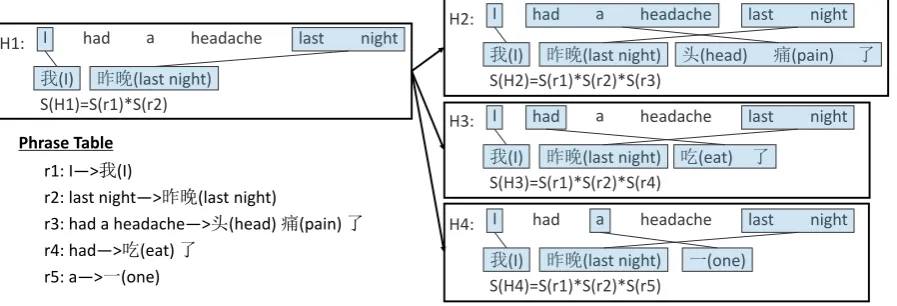
Phrase-based decoding uses a list of translation rules to translate source phrases in the input sen-tence and generate target phrases from left to right. A basic concept in phrase-based decoding is hy-potheses. As shown in Figure 1, the hypothesis
H1 consists of two rulesr1 andr2. The score of
a hypothesisS(H)can be calculated as the prod-uct of the scores of all applied rules.3 An existing hypothesis can be expanded into a new hypothesis by applying a new rule. As shown in Figure1,H1
can be expanded intoH2,H3 andH4. H2 cannot
be further expanded, because it covers all source words, whileH3andH4can (and must) be further expanded. The decoder starts with an initial empty hypothesisH0and selects the hypothesis with the
highest score from all completed hypotheses. During decoding, hypotheses are stored in stacks. For a source sentence withJwords, the de-coder buildsJ stacks. The hypotheses that cover
j source words are stored in stack sj. The de-coder expands hypotheses ins1, s2, ..., sJ in turn as shown in Algorithm 1. Here, EXPAND(H) is
expanding H to get new hypotheses and putting the new hypotheses into corresponding stacks. For each stack, a beam of the bestnhypotheses is kept to speed up the decoding process.
night r2: last night—>昨晚(last night)
H1:
Figure 1: An example of phrase-based decoding.
Algorithm 1Standard phrase-based decoding. Require: Source sentenceF with lengthJ
Ensure: TranslationE and decoding pathD
initializeH0 ands1, s2, ..., sJ EXPAND(H0)
forj= 1toJ−1do
foreach hypothesisHjk insj do EXPAND(Hjk)
select best hypothesis insJ
3.2 Forced Decoding for NMT
As stated in the introduction, our goal is not to generate new hypotheses with phrase-based SMT, but instead use the phrase-based model to calcu-late scores for NMT output. In order to do so, we can performforced decoding, which is very sim-ilar to the algorithm in the previous section but discards all partial hypotheses that do not match the NMT output. However, the NMT output is not limited by the phrase-based rule table, so there may be no decoding path that completely matches the NMT output when using only the phrase-based rules.
To remedy this problem, inspired by previous work in forced decoding for training phrase-based SMT systems (Wuebker et al., 2010, 2012) we propose a soft forced decoding algorithm that can always successfully find a decoding path for a source sentenceF and an NMT translationE.
First, we introduce two new types of rules R1
and R2.
R1 A source wordf can be translated into a
spe-cial wordnull. This corresponds to deleting f
during translation. The score of deletingf is
cal-culated as,
s(f →null) = unalign|T |(f) (5)
where unalign(f) is how many times f is un-aligned in the word-un-aligned training setT and|T |
is the number of sentence pairs inT.
R2 A target wordecan be translated from a
spe-cial wordnull, which corresponds to insertinge
during translation. The score of insertingeis cal-culated as,
s(null→e) = unalign|T |(e) (6)
where unalign(e) is how many times e is un-aligned inT.
One motivation for Equations 5 and 6 is that function words usually have high frequencies, but do not have as clear a correspondence with a word in the other language as content words. As a re-sult, in the training set function words are more often unaligned than content words. As an exam-ple, Table 1 and Table 2 show how many times different words occur and how many times they are unaligned in the word-aligned training set of English-to-Chinese and English-to-French tasks in our experiments. As we can see, generally there are less unaligned words in the English-to-French task, however, function words are more likely to be unaligned in both tasks. Based on Equation5
and Equation6, the scores of deleting or inserting “of” and “a” will be higher.
Words of a practice water
Occur 1.3M 1.0M 2.2K 29K
Unaligned 0.51M 0.41M 0.25K 3.5K
Table 1: The number of times that words occur in the English-to-Chinese training corpus and the number of times that they are unaligned.
Words of a practice water
Occur 1.7M 0.83M 8.8K 7.4K Unaligned 0.16M 0.12M 0.38K 0.19K Table 2: The number of times that words occur in the English-to-French training corpus and the number of times that they are unaligned.
the scale of the scores for R1 and R2 match the
other phrase (which are the product of two prob-abilities), we use the square of the score in Equa-tion5/6as the rule score for R1/R2.
Algorithm 2 shows the forced decoding algo-rithm that integrates the new rules. Because the translationE is given for the forced decoding al-gorithm, the proposed forced decoding algorithm keeps I stacks, where I is the length of E. In other words, the stack size is corresponding to the target word size during forced decoding while the stack size is corresponding to the source word size during standard phrase-based decoding. The stack s0
i in Algorithm 2 contains all hypotheses in which the first i target words have been gen-erated. We expand hypotheses ins0
1, s02, ..., s0I in turn. When expanding a hypothesis Hold in s0i, besides expanding it using the original rule table EXPAND(Hold),4 we also expand Hold by
insert-ing the next target wordei+1 at the end ofHoldto get an additional hypothesisHnew and putHnew intos0
i+1. For a final hypothesis in stacks0I, it may not cover all source words. We update its score by translating uncovered words intonull.
Because different decoding paths can generate the same final translation, there can be different decoding paths that fit the NMT translation E. We use the score of the single decoding path with the highest decoding score as the forced decoding score forE.
4The new introduced word inserting/deleting rules are not used when performing EXPAND(Hold).
Algorithm 2Forced phrase-based decoding. Require: Source sentence F with length J and
translationE with lengthI
Ensure: Decoding pathD
initializeH0ands01, s02, ..., s0I EXPAND(H0)
expandH0with rulenull→e1
fori= 1toI −1do
foreach hypothesisHikins0i do EXPAND(Hik)
expandHikwith rulenull→ei+1
foreach hypothesisHIkins0I do
updateS(HIk)for uncovered source words select best hypothesis ins0
I
4 Reranking NMT Outputs with Phrase-based Decoding Score
We rerank the n-best NMT outputs using the phrase-based forced decoding score according to Equation7.
logP(E|F) =w1·logPn(E|F)+w2·logSd(E|F) (7)
where Pn(E|F) is the original NMT translation probability as calculated by Equation1;
Pn(E|F) =YI
i=1
PNMT
ei|ei−1 1 , F
(8)
Sd(E|F) is the forced decoding score, which is the score of the decoding pathDˆ with the highest decoding score as described above;
Sd(E|F) =Y
r∈DˆS(r) (9) w1 andw2 are weights that can be tuned on the
n-best list of the development set.
The easiest way to get an n-best list for NMT is by using the n-best translations from beam search, which is the standard decoding algorithm for NMT. While beam search is likely to find the highest-scoring hypothesis, it often lacks diversity in the beam: candidates only have slight differ-ences, with most of the words overlapping. In or-der to obtain a more diverse list of hypotheses for reranking, we additionally augment the 1-best hy-pothesis discovered by beam search with transla-tions sampled from the NMT conditional proba-bility distribution.
PNMT ei|ei1−1, F
(Shen et al.,2016). This will make a diverse list of hypotheses, but may reduce the probability of selecting a highly scoring hy-pothesis, and the whole n-best list may not con-tain any candidate with better translation quality than the standard beam search output.
Instead, we take an alternative approach that proved empirically better in our experiments: at each time step i, we use sampling to randomly select the next word from e0 ande00 according to
Equation 10. Here, e0 and e00 are the two target
words with the highest probability according to Equation1. The sampling process ends whenh/si is selected as the next word.
We repeat the decoding process1,000times to sample 1,000 outputs for each source sentence. We additionally add the 1-best output of standard beam search, making the size of the list used for reranking to be1,001.
5 Experiments 5.1 Settings
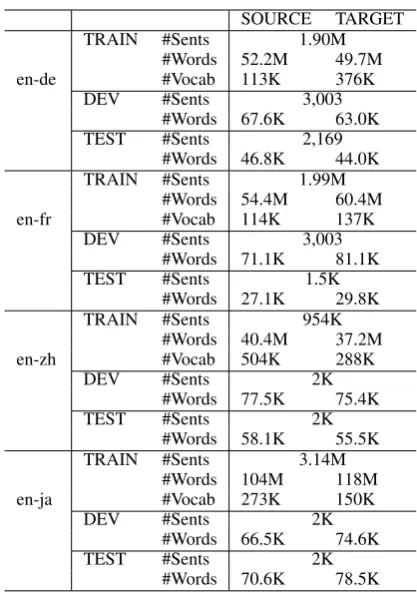
We evaluated the proposed approach for English-to-Chinese (en-zh), English-to-Japanese (en-ja), English-to-German (en-de) and English-to-French (fr) translation tasks. For the zh and en-ja tasks, we used datasets provided for the patent machine translation task at NTCIR-9 (Goto et al.,
2011).5 For the en-de and en-fr tasks, we used version 7 of the Europarl corpus as training data, WMT 2014 test sets as our development sets and WMT 2015 test sets as our test sets. The detailed statistics for training, development and test sets are given in Table3. The word segmentation was done by BaseSeg (Zhao et al., 2006) for Chinese and Mecab6for Japanese.
We built attentional NMT systems with Lam-tram7. Word embedding size and hidden layer size
5Note that NTCIR-9 only contained a Chinese-to-English translation task, we used English as the source language in our experiments. In NTCIR-9, the development and test sets were both provided for the zh-en task while only the test set was provided for the en-ja task. We used the sentences from the NTCIR-8 en-ja and ja-en test sets as the development set in our experiments.
Table 3: Data sets.
are both 512. We used Byte-pair encoding (BPE) (Sennrich et al.,2016b) and set the vocabulary size to be 50K. We used the Adam algorithm for opti-mization.
To obtain a phrase-based translation rule ta-ble for our forced decoding algorithm, we used GIZA++ (Och and Ney, 2003) and grow-diag-final-and heuristic to obtain symmetric word alignments for the training set. Then we extracted the rule table using Moses (Koehn et al.,2007).
5.2 Results and Analysis
Table 4 shows results of the phrase-based SMT system8, the baseline NMT system, the lexicon integration method (Arthur et al., 2016) and the proposed reranking method. We tested three fea-tures for reranking: the NMT scorePn, the forced decoding scoreSd and a word penalty (WP) fea-ture, which is the length of the translation. The best NMT system and the systems that have no significant difference from the best NMT system at thep < 0.05level using bootstrap resampling (Koehn,2004) are shown in bold font.
As we can see, integrating lexical translation probabilities improved the baseline NMT system
en-zh en-ja en-de en-fr
dev test dev test dev test dev test
PBMT 30.73 27.72 35.67 33.46 12.37 13.95 25.96 27.50
NMT 34.60 32.71 41.67 39.00 12.52 14.05 23.63 23.99
NMT+lex 36.06 34.80 44.47 41.09 13.36 15.60 24.00 24.91
NMT+lex+rerank(Pn) 34.38 33.23 38.92 34.18 12.34 13.59 23.13 23.61 NMT+lex+rerank(Sd) 36.17 34.09 42.91 40.16 13.08 15.29 24.28 25.71 NMT+lex+rerank(Pn+Sd) 37.94 35.59 45.34 41.75 14.56 16.61 25.96 27.12 NMT+lex+rerank(Pn+WP) 37.44 34.93 45.81 41.90 13.75 15.46 24.47 25.09 NMT+lex+rerank(Sd+WP) 36.44 33.73 43.52 40.49 13.39 15.71 24.74 26.25 NMT+lex+rerank(Pn+Sd+WP) 38.69 35.75 46.92 43.17 14.61 16.65 25.98 27.15
Table 4: Translation results (BLEU). NMT+lex: (Arthur et al.,2016); NMT+lex+rerank: we rerank the
n-best outputs of NMT+lex using different features (Pn,Sdand WP).
en-zh en-ja en-de en-fr
METEOR chrF METEOR chrF METEOR chrF METEOR chrF
PBMT 34.70 37.87 35.22 39.45 26.66 50.02 32.33 56.36
NMT 34.51 39.91 35.07 42.02 24.91 44.50 29.58 49.99
NMT+lex 35.56 42.22 36.48 44.34 25.49 45.67 30.10 50.89
NMT+lex+rerank(Pn) 34.56 40.80 32.63 38.57 23.57 40.35 29.15 48.64
NMT+lex+rerank(Sd) 36.02 42.65 36.87 44.85 26.48 48.73 31.56 54.42
NMT+lex+rerank(Pn+Sd) 36.40 43.73 37.22 45.69 26.26 47.27 31.62 53.99
NMT+lex+rerank(Pn+WP) 36.04 42.86 36.90 44.93 25.03 44.05 30.21 50.78
NMT+lex+rerank(Sd+WP) 36.34 42.78 37.05 45.03 26.16 47.82 31.32 53.75
NMT+lex+rerank(Pn+Sd+WP) 36.88 44.09 37.94 46.66 26.20 47.12 31.61 53.98
Table 5: METEOR and chrF scores on the test sets for different system outputs in Table4.
en-zh en-ja en-de en-fr
dev test dev test dev test dev test
PBMT 1.008 1.018 1.005 0.998 1.077 1.069 0.986 1.004
NMT 0.953 0.954 0.960 0.961 1.059 1.038 0.985 0.977
NMT+lex 0.936 0.966 0.955 0.963 1.054 1.019 1.030 0.977
NMT+lex+rerank(Pn) 0.875 0.898 0.814 0.775 0.874 0.854 0.904 0.900 NMT+lex+rerank(Sd) 0.973 0.989 0.985 0.981 1.062 1.060 1.030 1.031 NMT+lex+rerank(Pn+Sd) 0.949 0.965 0.945 0.936 1.000 0.992 0.999 0.992 NMT+lex+rerank(Pn+WP) 0.996 1.019 0.999 0.983 1.000 0.975 0.998 1.001 NMT+lex+rerank(Sd+WP) 1.000 1.024 1.001 1.001 1.011 1.007 0.999 0.989 NMT+lex+rerank(Pn+Sd+WP) 0.990 1.014 1.000 0.986 1.000 0.989 1.000 0.992
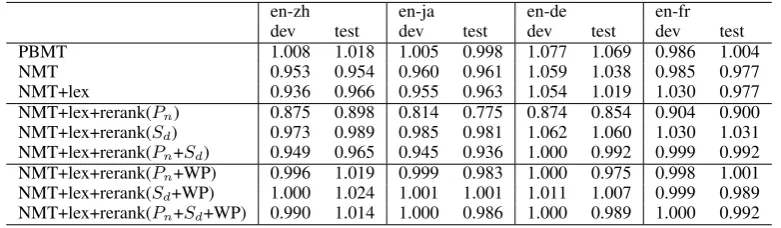
Table 6: Ratio of translation length to reference length for different system outputs in Table4.
and reranking with the three features all together achieved further improvements for all four lan-guage pairs. Even on English-to-Chinese and English-to-Japanese tasks, where the NMT system outperformed the phrase-based SMT system by 7-8 BLEU scores, using the forced decoding score for reranking NMT outputs can still achieve sig-nificant improvements. With or without the word penalty feature, using bothPn andSdfor rerank-ing gave better results than only usrerank-ing Pn or Sd alone. We also show METEOR and chrF scores on the test sets in Table5. Our reranking method improved both METEOR and chrF significantly.
The Word Penalty Feature The word penalty feature generally improved the reranking results, especially when only the NMT scorePnwas used for reranking. As we can see, using only Pn for reranking decreased the translation quality
com-pared to the standard beam search result of NMT. Because the search spaces of beam search and ran-dom sampling are quite different, the best beam search output does not necessarily have the high-est NMT score compared to random sampling out-puts. Therefore, even thePnreranking results do have higher NMT scores, but have lower BLEU scores according to Table4. To explain why this happened, we show the ratio of translation length to reference length in Table6. As we can see, the
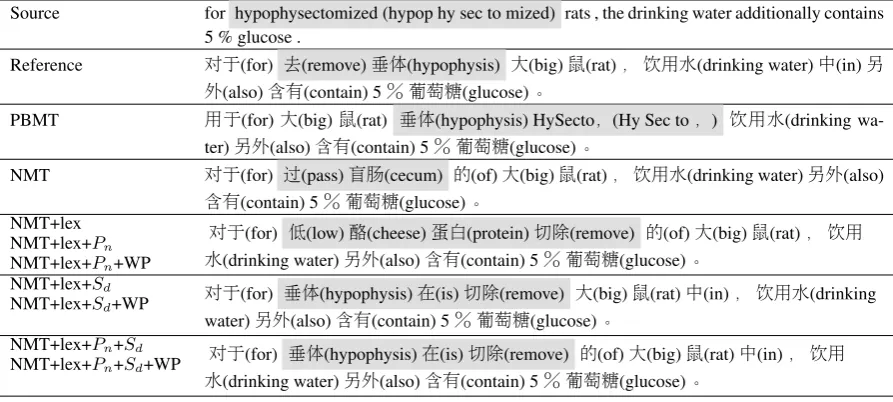
Source for hypophysectomized (hypop hy sec to mized) rats , the drinking water additionally contains 5 % glucose .
Reference 对于(for) 去(remove)垂体(hypophysis) 大(big)鼠(rat),饮用水(drinking water)中(in)另 外(also)含有(contain) 5%葡萄糖(glucose)。
PBMT 用于(for)大(big)鼠(rat) 垂体(hypophysis) HySecto,(Hy Sec to,) 饮用水(drinking wa-ter)另外(also)含有(contain) 5%葡萄糖(glucose)。
NMT 对于(for) 过(pass)盲肠(cecum) 的(of)大(big)鼠(rat),饮用水(drinking water)另外(also)
含有(contain) 5%葡萄糖(glucose)。
NMT+lex 对于(for) 低(low)酪(cheese)蛋白(protein)切除(remove) 的(of)大(big)鼠(rat),饮用 水(drinking water)另外(also)含有(contain) 5%葡萄糖(glucose)。
NMT+lex+Pn NMT+lex+Pn+WP
NMT+lex+Sd 对于(for) 垂体(hypophysis)在(is)切除(remove) 大(big)鼠(rat)中(in),饮用水(drinking water)另外(also)含有(contain) 5%葡萄糖(glucose)。
NMT+lex+Sd+WP
NMT+lex+Pn+Sd 对于(for) 垂体(hypophysis)在(is)切除(remove) 的(of)大(big)鼠(rat)中(in),饮用 水(drinking water)另外(also)含有(contain) 5%葡萄糖(glucose)。
NMT+lex+Pn+Sd+WP
Table 7: An example of improving inaccurate rare word translation by usingSdfor reranking.
feature became less helpful. When bothPnandSd were used for reranking, the word penalty feature only achieved further significant improvement on the English-to-Japanese task.
T1(NMT+lex):
for→对于(for) -3.04 ra: hy→低(low) -12.19
rb:null→酪(cheese) -21.99
rc:null→蛋白(protein) -13.83
to mized→切除(remove) -6.22
null→的(of) -1.53
rats→大(big)鼠(rat) -1.52
, the drinking water→,饮用水(drinking water) -1.38 additionally contains→另外(also)含有(contain) -3.68
5 %→5% -0.51
glucose .→葡萄糖(glucose)。 -0.60
rd: hypop→null -25.33
sec→null -20.66
T2(NMT+lex+Pn+Sd):
for→对于(for) -3.04
hypop hy→垂体(hypophysis) -5.09
the→在(is) -5.32
to mized→切除(remove) -6.22
null→的(of) -1.53
rats→大(big)鼠(rat) -1.52
,→中(in), -4.11 drinking water→饮用水(drinking water) -1.03 additionally contains→另外(also)含有(contain) -3.68
5 %→5% -0.51
glucose .→葡萄糖(glucose)。 -0.60
sec→null -20.66
Table 9: Forced decoding paths for T1 and T2:
used rules and log scores. The translation rules with shade are used only for T1or T2.
Table 7 gives translation examples of our reranking method from the English-to-Chinese task. The source English word “hypophysec-tomized” is an unknown word which does not oc-cur in the training set. By employing BPE, this word is split into “hypop”, “hy”, “sec”, “to” and “mized”. The correct translation for “hypophy-sectomized” is “去(remove) 垂体(hypophysis)” as shown in the reference sentence. The orig-inal attentional NMT translated it into incor-rect translation “过(pass) 盲肠(cecum)”. Af-ter integrating lexicons, the NMT system trans-lated it into “低(low)酪(cheese)蛋白(protein)切 除(remove)”. The last word “切除(remove)” is correct, but the rest of the translation is still wrong. Only by using the forced decoding score Sd for reranking, we get the more accurate translation “垂体(hypophysis)在(is)切除(remove)”.
To further demonstrate how the reranking method works, Table9shows translation rules and their log-scores contained in the forced decoding paths found for T1, the NMT translation
with-out reranking and T2, the NMT translation using
both Pn and Sd for reranking. As we can see, the four rules ra, rb, rc andrd used for T1 have
low scores. ra is an unlikely translation. In rb,
rcandrd, “酪(cheese)”, “蛋白(protein)” and “hy-pop” are content words, which are unlikely to be deleted or inserted during translation. Table9also shows that the translation of function words is very flexible. The score of inserting a function word “的(of)” is very high. The translation rule “the
→在(is)” used for T2 is incorrect, but its score is
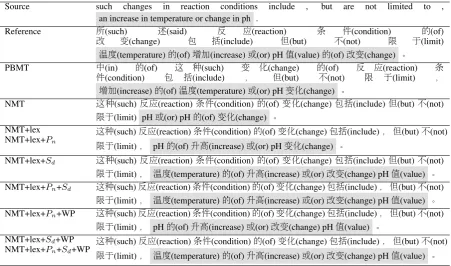
Source such changes in reaction conditions include , but are not limited to , an increase in temperature or change in ph .
Reference 所(such) 述(said) 反 应(reaction) 条 件(condition) 的(of)
改 变(change) 包 括(include) 但(but) 不(not) 限 于(limit)
温度(temperature)的(of)增加(increase)或(or) pH值(value)的(of)改变(change) 。
PBMT 中(in) 的(of) 这 种(such) 变 化(change) 的(of) 反 应(reaction) 条 件(condition) 包 括(include) , 但(but) 不(not) 限 于(limit) ,
增加(increase)的(of)温度(temperature)或(or) pH变化(change) 。
NMT 这种(such)反应(reaction)条件(condition)的(of)变化(change)包括(include)但(but)不(not)
限于(limit) pH或(or) pH的(of)变化(change) 。
NMT+lex 这种(such)反应(reaction)条件(condition)的(of)变化(change)包括(include),但(but)不(not)
限于(limit), pH的(of)升高(increase)或(or) pH变化(change) 。
NMT+lex+Pn
NMT+lex+Sd 这种(such)反应(reaction)条件(condition)的(of)变化(change)包括(include)但(but)不(not)
限于(limit), 温度(temperature)的(of)升高(increase)或(or)改变(change) pH值(value) 。
NMT+lex+Pn+Sd 这种(such)反应(reaction)条件(condition)的(of)变化(change)包括(include),但(but)不(not)
限于(limit), 温度(temperature)的(of)升高(increase)或(or)改变(change) pH值(value) 。
NMT+lex+Pn+WP 这种(such)反应(reaction)条件(condition)的(of)变化(change)包括(include),但(but)不(not)
限于(limit), pH的(of)升高(increase)或(or)改变(change) pH值(value) 。
NMT+lex+Sd+WP 这种(such)反应(reaction)条件(condition)的(of)变化(change)包括(include),但(but)不(not)
限于(limit), 温度(temperature)的(of)升高(increase)或(or)改变(change) pH值(value) 。
NMT+lex+Pn+Sd+WP
Table 8: An example of improving under-translation and over-translation by usingSdfor reranking.
incorrectly aligned in the training set. The rea-son why function words are more likely to be in-correctly aligned to each other is that they usually have high frequencies and do not have clear corre-spondences between different languages.
In T1, “hypophysectomized (hypop hy sec to
mized)” is incorrectly translated into “低(low) 酪(cheese) 蛋白(protein) 切除(remove)”. How-ever, from Table 9, we can see that the forced decoding algorithm learns it as un-likely translation (hy→低(low)), over-translation (null→酪(cheese), null→蛋白(protein)) and under-translation (hypop→null, sec→null), because there is no translation rule between “hy-pop” “sec” and “酪(cheese)” “蛋白(protein)”. Be-cause content words are unlikely to be deleted or inserted during translation, they have low forced decoding scores. So using the forced decoding score for reranking NMT outputs can naturally improve over-translation or under-translation as shown in Table 8. As we can see, without using
Sdfor reranking, NMT under-translated “temper-ature” and over-translated “ph” twice, which will be assigned low scores by forced decoding. By usingSdfor reranking, the correct translation was selected.
We did human evaluation on 100 sentences ran-domly selected from the English-to-Chinese test set to test the effectiveness of our forced decoding
method. We compared the outputs of two systems:
• NMT+lex+rerank(Pn+WP)
• NMT+lex+rerank(Pn+Sd+WP)
For each source sentence, we compared the two system outputs. Table 10 shows the numbers of sentences that our forced decoding feature helped to reduce completely unrelated transla-tion, over-translation and under-translation. The last line of Table 10 means that for 73 source sentences, our forced decoding feature neither reduced nor caused more unrelated/over/under translation. That is our forced decoding feature never caused more unrelated/over/under transla-tion for the sampled 100 sentences, which shows that our method is very robust for improving unre-lated/over/under translation.
Reduce
both under- and over- translation 2
under-translation 11
over-translation 10
unrelated translation 4
No difference 73
Table 10: Human evaluation results.
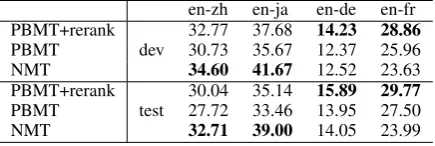
in Table 11. We also copy results of baseline PBMT and NMT from Table 4 for direct com-parison. As we can see, using NMT to rerank PBMT outputs achieved improvements over the baseline PBMT system. However, when the base-line NMT system is significantly better than the baseline PBMT system (en-zh, en-ja), even using NMT to rerank PBMT outputs still achieved lower translation quality compared to the baseline NMT system.
en-zh en-ja en-de en-fr PBMT+rerank 32.77 37.68 14.23 28.86
PBMT dev 30.73 35.67 12.37 25.96
NMT 34.60 41.67 12.52 23.63 PBMT+rerank 30.04 35.14 15.89 29.77
PBMT test 27.72 33.46 13.95 27.50
NMT 32.71 39.00 14.05 23.99
Table 11: Results of using NMT for reranking PBMT outputs.
6 Related Work
Wuebker et al.(2010,2012) applied forced decod-ing on the traindecod-ing set to improve the traindecod-ing pro-cess of based SMT and prune the phrase-based rule table. They also used word insertions and deletions for forced decoding, but they used a high penalty for all insertions and deletions. In contrast, our soft forced decoding algorithm for NMT outputs uses a small penalty for function words and a high penalty for content words, be-cause function words are usually translated very flexibly and more likely to be inserted or deleted compared to content words. For example, the under-translation of a content word can hurt the adequacy of the translation heavily. But function words may naturally disappear during translation (e.g. the English word “the” disappears in Chi-nese). By assigning a high penalty to words that should not be deleted or inserted during transla-tion, our soft forced decoding method aims to im-prove the adequacy of NMT, which is very differ-ent from previous forced decoding methods that are used to improve general SMT training (Yu et al.,2013;Xiao et al.,2016).
A major difference of traditional SMT and NMT is that the alignment model in traditional SMT provides exact word or phrase level align-ments between the source and target sentences while the attention model in NMT only computes an alignment probability distribution for each tar-get word over all source words, which is the main
reason why NMT is more likely to produce com-pletely unrelated translations, over-translation or under-translation compared to traditional SMT. To relieve NMT of these problems, there are meth-ods that modify the NMT neural network structure (Tu et al.,2016;Meng et al.,2016;Alkhouli et al.,
2016) while we rerank NMT outputs by exploiting knowledge from traditional SMT.
There are also existing methods that rerank NMT outputs by using target-bidirectional NMT models (Liu et al., 2016;Sennrich et al., 2016a). Their reranking method aims to overcome the is-sue of unbalanced accuracy in NMT outputs while our reranking method aims to solve the inade-quacy problem of NMT.
7 Conclusion
In this paper, we propose to exploit an existing based SMT model to compute the phrase-based decoding cost for NMT outputs and then use the phrase-based decoding cost to rerank the n -best NMT outputs, so we can combine the advan-tages of both PBMT and NMT. Because an NMT output may not be in the search space of standard phrase-based SMT, we propose a forced decod-ing algorithm, which can always successfully find a decoding path for any NMT output by deleting source words and inserting target words. Results show that using the forced decoding cost to rerank NMT outputs improved translation accuracy on four different language pairs.
References
Tamer Alkhouli, Gabriel Bretschner, Jan-Thorsten Pe-ter, Mohammed Hethnawi, Andreas Guta, and Her-mann Ney. 2016. Alignment-based neural machine translation. InProceedings of the First Conference on Machine Translation, pages 54–65.
Philip Arthur, Graham Neubig, and Satoshi Nakamura. 2016. Incorporating discrete translation lexicons into neural machine translation. In Proceedings of the 2016 Conference on Empirical Methods in Nat-ural Language Processing, pages 1557–1567.
Dzmitry Bahdanau, Kyunghyun Cho, and Yoshua Ben-gio. 2015. Neural machine translation by jointly learning to align and translate. InInternational Con-ference on Learning Representations.
Trevor Cohn, Cong Duy Vu Hoang, Ekaterina Vy-molova, Kaisheng Yao, Chris Dyer, and Gholamreza Haffari. 2016. Incorporating structural alignment biases into an attentional neural translation model. InProceedings of the 2016 Conference of the North American Chapter of the Association for Computa-tional Linguistics: Human Language Technologies, pages 876–885.
Isao Goto, Bin Lu, Ka Po Chow, Eiichiro Sumita, and Benjamin K Tsou. 2011. Overview of the patent ma-chine translation task at the NTCIR-9 workshop. In
Proc. NTCIR-9, pages 559–578.
Wei He, Zhongjun He, Hua Wu, and Haifeng Wang. 2016. Improved neural machine translation with SMT features. InThirtieth AAAI conference on ar-tificial intelligence.
Philipp Koehn. 2004. Statistical significance tests for machine translation evaluation. In Proceedings of the 2004 Conference on Empirical Methods in Nat-ural Language Processing, pages 388–395.
Philipp Koehn, Hieu Hoang, Alexandra Birch, Chris Callison-Burch, Marcello Federico, Nicola Bertoldi, Brooke Cowan, Wade Shen, Christine Moran, Richard Zens, Chris Dyer, Ondrej Bojar, Alexandra Constantin, and Evan Herbst. 2007. Moses: Open source toolkit for statistical machine translation. In
Proceedings of the 45th Annual Meeting of the As-sociation for Computational Linguistics Companion Volume Proceedings of the Demo and Poster Ses-sions, pages 177–180.
Philipp Koehn and Rebecca Knowles. 2017. Six chal-lenges for neural machine translation. In Pro-ceedings of the First Workshop on Neural Machine Translation, pages 28–39.
Philipp Koehn, Franz Josef Och, and Daniel Marcu. 2003. Statistical phrase-based translation. In
Proceedings of the 2003 Conference of the North American Chapter of the Association for Computa-tional Linguistics on Human Language Technology-Volume 1, pages 48–54.
Lemao Liu, Masao Utiyama, Andrew Finch, and Eiichiro Sumita. 2016. Agreement on target-bidirectional neural machine translation. In Pro-ceedings of the 2016 Conference of the North Amer-ican Chapter of the Association for Computational Linguistics: Human Language Technologies, pages 411–416.
Fandong Meng, Zhengdong Lu, Hang Li, and Qun Liu. 2016. Interactive attention for neural ma-chine translation. InProceedings of COLING 2016, the 26th International Conference on Computational Linguistics: Technical Papers, pages 2174–2185. Haitao Mi, Baskaran Sankaran, Zhiguo Wang, and Abe
Ittycheriah. 2016. Coverage embedding models for neural machine translation. In Proceedings of the 2016 Conference on Empirical Methods in Natural Language Processing, pages 955–960.
Graham Neubig, Makoto Morishita, and Satoshi Naka-mura. 2015. Neural reranking improves subjective quality of machine translation: NAIST at WAT2015. InProceedings of the 2nd Workshop on Asian Trans-lation (WAT2015).
Franz Josef Och and Hermann Ney. 2003. A systematic comparison of various statistical alignment models.
Computational Linguistics, 29(1):19–51.
Rico Sennrich, Barry Haddow, and Alexandra Birch. 2016a. Edinburgh neural machine translation sys-tems for WMT 16. InProceedings of the First Con-ference on Machine Translation, pages 371–376. Rico Sennrich, Barry Haddow, and Alexandra Birch.
2016b. Neural machine translation of rare words with subword units. InProceedings of the 54th An-nual Meeting of the Association for Computational Linguistics (Volume 1: Long Papers), pages 1715– 1725.
Shiqi Shen, Yong Cheng, Zhongjun He, Wei He, Hua Wu, Maosong Sun, and Yang Liu. 2016. Minimum risk training for neural machine translation. In Pro-ceedings of the 54th Annual Meeting of the Associa-tion for ComputaAssocia-tional Linguistics (Volume 1: Long Papers), pages 1683–1692.
Felix Stahlberg, Adri`a de Gispert, Eva Hasler, and Bill Byrne. 2017. Neural machine translation by minimising the Bayes-risk with respect to syntactic translation lattices. InProceedings of the 15th Con-ference of the European Chapter of the Association for Computational Linguistics: Volume 2, Short Pa-pers, pages 362–368.
Felix Stahlberg, Eva Hasler, Aurelien Waite, and Bill Byrne. 2016. Syntactically guided neural machine translation. InProceedings of the 54th Annual Meet-ing of the Association for Computational LMeet-inguistics (Volume 2: Short Papers), pages 299–305.
Yaohua Tang, Fandong Meng, Zhengdong Lu, Hang Li, and Philip LH Yu. 2016. Neural machine transla-tion with external phrase memory. arXiv preprint arXiv:1606.01792.
Zhaopeng Tu, Zhengdong Lu, Yang Liu, Xiaohua Liu, and Hang Li. 2016. Modeling coverage for neural machine translation. InProceedings of the 54th An-nual Meeting of the Association for Computational Linguistics (Volume 1: Long Papers), pages 76–85. Joern Wuebker, Mei-Yuh Hwang, and Chris Quirk.
2012. Leave-one-out phrase model training for large-scale deployment. InProceedings of the Sev-enth Workshop on Statistical Machine Translation, pages 460–467.
Tong Xiao, Derek F Wong, and Jingbo Zhu. 2016. A loss-augmented approach to training syntactic ma-chine translation systems. IEEE/ACM Transac-tions on Audio, Speech, and Language Processing, 24(11):2069–2083.
Heng Yu, Liang Huang, Haitao Mi, and Kai Zhao. 2013. Max-violation perceptron and forced decod-ing for scalable MT traindecod-ing. InProceedings of the 2013 Conference on Empirical Methods in Natural Language Processing, pages 1112–1123.
Jiacheng Zhang, Yang Liu, Huanbo Luan, Jingfang Xu, and Maosong Sun. 2017. Prior knowledge inte-gration for neural machine translation using poste-rior regularization. InProceedings of the 55th An-nual Meeting of the Association for Computational Linguistics (Volume 1: Long Papers), pages 1514– 1523.