A Study of Applying BTM Model on the Chinese Chunk Bracketing
Jia-Lin Tsai
Tung Nan Institute of Technology, Department of Information Management
Taipei 222, Taiwan, R.O.C.
[email protected]
Abstract
The purpose of this paper is to auto-matically generate Chinese chunk bracketing by a bottom-to-top map-ping (BTM) model with a BTM data-set. The BTM model is designed as a supporting model with parsers. We de-fine a word-layer matrix to generate the BTM dataset from Chinese Tree-bank. Our model matches auto-learned patterns and templates against seg-mented and POS-tagged Chinese sen-tences. A sentence that can be matched with some patterns or templates is called a matching sentence. The ex-perimental results have shown that the chunk bracketing of the BTM model on the matching sentences is high and stable. By applying the BTM model to the matching sentences and the N-gram model to the non-matching sen-tences, the experiment results show the F-measure of an N-gram model can be improved.
1
Introduction
The definition of chunk, which has been repre-sented as groups of words between square brackets, was first raised by (Abney, 1991). A chunker is to divide sentences into non-overlapping phrases by starting with finding cor-related chunks of words. Text chunking has been shown a useful pre-processing step for language parsing (Sang and Buchholz, 2000). Among the chunk types, NP chunking is the first to receive the attention (Ramshaw and Marcus, 1995), than other chunk types, such as VP and PP chunking (Veenstra, 1999). For English (Sang and
Buchholz, 2000) and Chinese (Li et al., 2004) languages, the top 3 most frequent chunk types are NP, VP and PP chunks. Meanwhile, the three chunk types cover about 80% of chunking prob-lems. In many natural language processing (NLP) applications, such as information retrieval, knowledge discovery, example-based machine translation (EBMT) and text summarization, can benefit with chunks (Le et al., 2003; Munoz et al., 1999; Oliver, 2001; Zhou and Su, 2003).
As per the reports (Menzel, 1995; Sang and Buchholz, 2000; Basili and Zanzotto, 2002; Knutsson et al., 2003; Li et al., 2004; Xu et al., 2004; Johnny et al., 2005), there are three im-portant trends in the study of Chinese text chunking and parsing. These important trends are: (1) Treebank-Derived Approaches for auto-constructing useful patterns and templates from Treebank (TB) as rules combined with statistical language models (SLM), such as N-gram mod-els and support vector machines (SVMs), etc.; (2) Robust Chunkers against Treebank sparseness and perfect/actual input. Here the perfect input means the word-segmentation and Part-of-Speech (POS) tags all are correct. The actual input means the word-segmentation and POS tags all are generated by a selected segmenter and a POS tagger; and (3) High Performance Chunk Bracketing has been reported that the key issue of Chinese parsing (Li et al., 2004). To sum up these trends, one of critical issues for developing a high performance Chinese chunker is to find methods to achieve high performance of chunk bracketing against training size, perfect and actual input.
Following these trends of Chinese chunking and parsing, the goals of this paper are:
(CTB) as rules for chunking;
(2) Develop a BTM model with the BTM data-set to identify the chunks (i.e. phrase bounda-ries) for a given segmented and POS-tagged Chinese sentence;
(3) Show the chunk bracketing performance of the BTM model is high and stable against training corpus size, perfect and actual input; (4) Show the BTM model can improve the per-formance (F-measure) of N-gram models on chunk bracketing.
The remainder of this paper is arranged as follows. In Section 2, we present the BTM model for identifying chunks for each seg-mented and POS-tagged Chinese sentence. Ex-perimental results and analyses of the BTM model are presented in Section 3. Finally, in Section 4, we present our conclusions and dis-cuss the direction of future research.
2
Development of the BTM model
2.1
Introduction of Chinese TreebankA Chinese Treebank (CTB) is a segmented, POS-tagged and fully bracketed Chinese corpus with morphological, syntactic, semantic and dis-course structures. The CKIP (Chinese Knowl-edge Information Processing) Chinese-Treebank (CCTB) and the Penn Chinese Treebank (PCTB) are two of most important Chinese Treebank resources for Treebank-derived NLP tasks in Chinese (CKIP, 1995; Xia et al., 2000; Xu et al., 2000; Li et al., 2004). The brief introductions of the CCTB and the PCTB are given as below (Table 1 is a brief comparison between the CCTB and the PCTB):
(1) CCTB: the CCTB is developed in traditional Chinese texts (BIG5 encoded) taken from the Academia Sinica Balanced Corpus 3.0 (ASBC3) at the Academia Sinica, Taiwan (Chen et al., 1996; Chen et al., 1999; Huang et al., 2000, Chen et al., 2003; Chen et al., 2004). The CCTB uses Information-based Case Grammar (ICG) as the language framework to express both syntac-tic and semansyntac-tic descriptions (Chen and Huang, 1996). The structural frame of CCTB is based on the Head-Driven Principle: it means a sen-tence or phrase is composed of a core Head and its arguments, or adjuncts (Chen and Hsieh, 2004). The Head defines its phrasal category and relations with other constituents. The pre-sent version CCTB2.1 (CCTB Version 2.1)
in-cludes 54,902 sentences (i.e. trees) and 290,144 words that are bracketed and post-edited by hu-mans, based on the computer parsed results (CKIP, 1995). There are 1,000 CCTB trees open to the public for researchers to download on the CCTB portal. The details of supplementary principles, symbol illustrations, semantic roles, phrasal structures and applications of the CCTB can be found in (CCTB portal; Chen et al., 2003; Chen and Hsieh, 2004; You and Chen, 2004). Table 1. A brief comparison between CCTB2.1 and PCTB4 (The number in () is the word frequency and the English word in [] is the English Translation for the corresponding Chinese word)
CCTB2.1 PCTB4
Developer CKIP UPenn
Content type Balanced Newswire corpus sources Language framework ICG HPSG Word standard Taiwan China
(CKIP, 1996) (Liu et al.,1993)
POS-tagging system type hierarchical non- (5 layer) hierarchical
Structure frame Head-driven Head-driven
Code BIG5 GB
No. of sentences 54,902 15,162 No. of distinct POS tags 302 47 No. of words in CTB 290,144 404,156 Top 3 one-char words ⊛(19,212) ⱘ(15,080)
[of] [of]
ᤚ(4,608) (4,055) [is/are] [at] (4,235) ᰃ(2,965) [at] [is/are] Top 3 two-char words ᚒ(1,057) Ё(2,097)
[we] [China] ৻(675) 㒣⌢(1,015) [a/an/one] [Economy]
ઁ(564) ӕϮ(989) [they] [business]
Xue and Palmer, 2005). The present version PCTB5 (PCTB Version 5), contains 18,782 sen-tences, 507,222 words, 824,983 Hanzi and 890 data files. The PCTB was created by two pass approach. The first pass was done by one anno-tator, and the resulting files were checked by a second annotator (the second pass). The details and applications of PCTB can be found in (PCTB portal; Xia et al, 2000; Chiou et al, 2001; Xue et al, 2002; Xue et al, 2005).
Overall, from Table 1, the four major differ-ences between the CCTB and the PCTB are con-tent type, language framework, word standard and POS-tagging system type. The CCTB is natural to be a balanced CTB because its content is taken from the Academia Sinica Balanced Corpus (CKIP, 1995). On the other hand, since the content type of PCTB is newswire sources, it is natural to be a newswire-based CTB and not a balanced CTB.
2.2
Generating the BTM DatasetFirstly, we use CCTB2.1 as an example to de-scribe how to generate a BTM dataset from the CCTB with the word-layer matrix. Then, we define two types of conditional probabilities used in this study for constructing the BTM model. Finally, the algorithm of our BTM model is given in Section 2.3.
Figure 1. The tree structure of CCTB2.1 for the Chinese sentence “㔚ᓇ(movie)⊛(of)⇠㕙(picture)↢േ (colorful)⿰(interesting)” (Note that the content of
the nodes between the root and the words is [The-matic role : Syntactic category])
(1) Generation of BTM dataset from CCTB2.1: Figure 1 shows the tree structure of CCTB2.1 for the Chinese sentence “㔚ᓇ(movie)⊛(of)⇠
㕙(picture)↢ േ(colorful) ⿰(interesting).” The content of the nodes between the root layer and the words layer (leaves) is comprised of matic roles and syntactic categories. The the-matic roles can be annotated as a Theme, Property, etc., while the syntactic categories can be annotated as a POS-tag (such as Nac) or a phrasal category (such as NP). The details of CCTB syntactic and thematic annotations can be found in (Chen et al., 2003).
Table 2. The word-layer matrix extracted from CCTB2.1 for the Chinese sentence “㔚ᓇ(movie)⊛ (of)⇠㕙(picture)↢േ(colorful)⿰(interesting)”
Word 1st layer
(Top) 2nd layer
3rd layer (Bottom)
㔚ᓇ Head:Nac
⊛ Property:NP.⊛ Head:DE
⇠㕙
Theme:NP
Head:Nac Head:Nac
↢േ Head:H11
⿰ Head:VH11 Head:VH11 Head:H11
Table 3. The BTM dataset for the CCTB2.1 tree of the Chinese sentence “㔚 ᓇ(movie)⊛(of)⇠ 㕙 (picture)↢േ(colorful)⿰(interesting)”
Type Content
BL Word pattern <㔚ᓇ\⊛\⇠㕙\↢േ\⿰> TL Word pattern <㔚ᓇ:⊛:⇠㕙+↢േ:⿰>
BL POS pattern <Nac\DE\Nac\VH11\VH11> TL POS pattern <Nac:DE:Nac+VH11:VH11> TL POS template <Na%Na+VH11:VH11> PC pattern <NP+VH11>
POS pattern, we also generate its corresponding TL POS template (with POS tags) and phrasal category (PC) pattern (with POS tags and phrasal categories).
In the Table 3:
BL stands for the bottom layer (the last layer of a word-layer matrix);
TL stands for the top layer (the first layer of a word-layer matrix);
PC stands for the phrasal category in a TL; “\” indicates the word boundary in a BL; “+” indicates word/phrase boundaries in a TL; “:” indicates next to; for example,
“Nac:DE” means “Nac” next to “DE”; “%” indicates near by; for example,
“Nac%Nac” means “Nac”near by “Nac”; “<” indicates the begin of a sentence; and “>” indicates the end of a sentence.
The CKIP POS tagging is a hierarchical system. The first layer of CKIP POS tagging include eight main syntactic categories, i.e. N (noun), V (verb), D (adverb), A (adjective), C (conjunc-tion), I (interjec(conjunc-tion), T (particles) and P (prepo-sition). As per the CKIP technical reports (CKIP, 1995; CKIP, 1996), the maximum layer number of CKIP POS tagging is 5. Take the CKIP POS tag “Ndabe” as an example, we define its POS tags with POS layer numbers 1, 2, 3, 4 and 5 as “N”, “Nd”, “Nda”, “Ndab” and “Ndabe”, re-spectively. Thus, if the POS layer of BTM model is set to 2 (called 2 POS-layer mode), the BL POS pattern “<Nac\DE\Nac\VH11\VH11>” in Table 3 will become “<Na\DE\Na\VH\VH>”, and so forth.
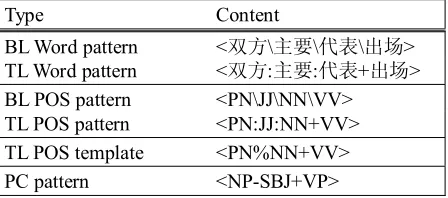
Table 4. The BTM dataset for the PCTB4 tree of the Chinese sentence “ঠ ᮍ(both)Џ 㽕(major)ҷ 㸼 (agent)ߎഎ(appear)”
Type Content
BL Word pattern <ঠᮍ\Џ㽕\ҷ㸼\ߎഎ> TL Word pattern <ঠᮍ:Џ㽕:ҷ㸼+ߎഎ>
BL POS pattern <PN\JJ\NN\VV> TL POS pattern <PN:JJ:NN+VV>
TL POS template <PN%NN+VV> PC pattern <NP-SBJ+VP>
By the word-layer matrix, the BTM dataset of PCTB can also be generated. Table 4 shows an example BTM dataset for the PCTB4 tree of the
Chinese sentence “ঠᮍ(both)Џ㽕(major)ҷ㸼 (agent)ߎഎ(appear).” Since the POS tagging of PCTB is not a hierarchical system, there is no POS layer mode can be set to the BTM dataset of PCTB.
(2) Definitions of Two Types of Probabilities: In this study, two conditional probabilities were used in the BTM model. The Type I conditional probability is used to perform full TL POS pat-tern matching. The Type II conditional prob-ability is used to perform full TL POS template matching. Details of these probabilities are given below.
Type I. Pr(a given TL POS pattern | the BL POS pattern of the given TL POS pattern) =
(# of the given TL POS pattern found in the training BTM dataset) /
(# of the BL POS patterns of the given TL POS pattern found in the training BTM dataset).
Take the BL POS pattern “Cb\Nc\DE\Na” as an example. There are:
one TL POS pattern “Cb+Nc:DE:Na” four TL POS pattern “Cb+Nc:DE+Na” and five BL POS pattern “Cb\Nc\DE\Na” in the CCTB2.1 BTM dataset. Thus,
the Pr(Cb+Nc:DE:Na|Cb+Nc+DE+Na) = 1/5 = 0.2; and
the Pr(Cb+Nc:DE+Na|Cb+Nc+DE+Na) = 4/5 = 0.8.
Table 5a. Top 5 most frequent TL POS patterns whose number of POS tags is 5 for 2 POS-layer mo-de (training size is 45,000 CCTB2.1 trees)
TL POS pattern (Type I pro.)
V_+DM:VH:DE:Na (19/19 = 100%)
(Eg. 㗗[is]+ᶨ ᾳ[a]:⮷ ⮷[small]:䘬[of]:㛹 ⫸ [village])
Nb:A:Na:Nb+VE (11/11 = 100%)
(Eg. 㲘 㸸[taiyuan]:㈽ 栏[inference reader]:䴻 䎮
[manager]:檀⫸傥[gao-zi-neng]+㊯↢[point out]) Nc:Nb+VH+Nc:Nb (10/10 = 100%)
(Eg. 屣❶[Philadelphia]:ᶫℕṢ昲[76-people team]+
⊅[win]+厗䚃枻[Washington]:⫸⻰昲[bullet team])) VC+Di+Na:DE:Na (9/9 = 100%)
(Eg. ㏕[attach]+崟[to]+⍳ 婤:䘬:㧳 㦹[bridge of friendship])
Nh+VA+P2:Na:Nc (8/8 = 100%)
Table 5a gives the Top 5 most frequent TL POS patterns whose number of POS tags is 5 while the POS layer number is 2.
Type II. Pr(matching patterns | a given TL POS template) =
(# of matching TL POS patterns of the given TL POS template found in the training BTM dataset) / (# of matching BL POS pattern of the given TL POS template found in the training BTM dataset).
Take the TL POS template “P3%Na+VA” as an example. In the CCTB2.1 BTM dataset, there are four matching BL POS patterns and two matching TL POS pattern for the template “P3%Na+VA”, namely: (Note that “%” means “near by”)
“P3\Dd\VA\DE\Na\VA”
“P3:Dd:VA:DE:Na+VA”(matching) “P3\Na\P2\VC\Nb\Nc\DE\Na\VA”
“P3:Na+P2:VC:Nb:Nc:DE:Na+VA”(no matching) “P3\Na\VA”
“P3:Na+VA”(matching) “P3\Na\VC\Na\VA”
“P3:Na+VC+Na+VA”(no matching)
Thus, the Pr(matching pattern|P3%Na+VA) = 2/4 = 0.5.
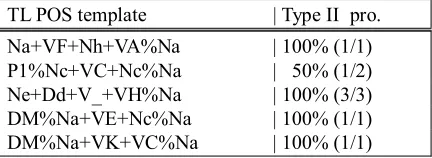
Table 5b gives 5 randomly selected TL POS templates where their POS number is 5 while the POS layer number is 2.
Table 5b. Five randomly selected TL POS templates where their POS number is 5 for 2 POS-layer mode (training size = 45,000)
TL POS template | Type II pro.
Na+VF+Nh+VA%Na | 100% (1/1) P1%Nc+VC+Nc%Na | 50% (1/2) Ne+Dd+V_+VH%Na | 100% (3/3) DM%Na+VE+Nc%Na | 100% (1/1) DM%Na+VK+VC%Na | 100% (1/1)
2.3
Algorithm of the BTM ModelFollowing is the algorithm of our BTM model uses Types I (full TL POS pattern matching) and Type II (full TL POS template matching) condi-tional probabilities to determine the chunks for a given segmented and POS-tagged Chinese sen-tence. We use BTM (value1, value2, value3) to
express the function of our BTM model, where
value1 is the BTM threshold value, value2 is the POS layer number and value3 is the BTM train-ing size. Table 6 is a step by step example to demonstrate the detailed processes and outputs of our BTM model.
Table 6. A step by step example of the application of BTM (0.5; 2; 45,000) for the given BL POS pattern “Na\Na\DE\Nb(ዋᐕ[boy]\ᤨઍ[age]\⊛[of]\ผᙿື [schweitzer])”
Step Output
1 Na\Na\DE\Nb (ዋᐕ[boy]\ᤨઍ[age]\⊛[of]\ผᙿື[schweitzer])
2 NULL; Goto Step 4
3 -
4 Pr(Na%DE+Nb) = 66.7% (Type II); and use the selected TL POS template “Na%De+Nb” to translate “Na\Na\DE\Nb” into “Na:Na:DE+Nb”
5 TL POS pattern = Na:Na:DE+Nb, and Matching sentence = ዋᐕ:ᤨઍ:⊛+ผᙿື
Chunks = “ዋᐕᤨઍ⊛” and “ผᙿື”
Step 1. Give the value1 (BTM threshold value),
value2 (POS layer number) and value3
(training size), as well as the segmented and POS-tagged sentence. In the follow-ing steps, the POS taggfollow-ing sequence of the given sentence is called the BL POS pattern, such as the “Na\Na\DE\Nb” in Table 6.
Step 2. According to the BL POS pattern in Step 1, find all matched TL POS patterns whose corresponding Type I probabili-ties are greater than or equal to the BTM threshold value. If the number of matched TL POS patterns is zero, then go to Step 4.
Step 3. Using the matched TL POS patterns from Step 2, select the TL POS pattern that has the maximum Type I probabil-ity as the output. If there are two or more TL POS patterns with the same maximum Type I probability, randomly select one as the output. Go to Step 5.
probabil-ity to generate the output (see Table 6, Step 4). If there are two or more TL POS templates with the same maximum Type II probability, randomly select one to generate the output. If the number of matched TL POS patterns is zero, then a NULL output will be given. Step 5. Stop. If a NULL TL POS pattern output
is given, this input sentence is a non-matching sentence. Otherwise, it is a matching sentence.
3
Experiment Results
To conduct the following experiments in ten-folds, we randomly select 50,000 trees of CCTB2.1 and separate them into the following two sets:
(1) Training Set consists of 45,000 CCTB2.1 trees; and
(2) Open Testing Set consists of the other 5,000 CCTB2.1 trees.
In our computation, 66% of CCTB2.1 BL POS patterns in the open testing set are not found in the training set. This means the ratio of unseen CCTB2.1 BL POS patterns in the open testing set is 66%. The PCTB4 BTM dataset was not used in this study by two reasons: the first one is that the PCTB is not a balanced CTB; the sec-ond one is that the POS tagging system of PCTB is not a hierarchical system.
We conducted four experiments in this study. The first three experiments are designed to show the relationships between the chunk bracketing performance of the BTM model on the matching sentences and the three BTM parameters: POS layer number; BTM threshold value; and BTM training size. To avoid the error propagation of word segmentation and POS tagging, the first three experiments only consider open testing sentences with correct word segmentations and POS tags provided in CCTB2.1 as perfect input. The fourth experiment is to show the BTM model is able to improve the performance (F-measure) of N-gram models on Chinese chunk bracketing for both perfect input and actual in-put. Here, the actual input means the word segmentations and POS tags of the testing sen-tences were all generated by a forward maxi-mum matching (FMM) segmenter and a bigram-based POS tagger, respectively.
To evaluate the performance of our BTM model, we use recall (R), precision (P), and F-measure (F) (Manning and Schuetze, 1999), which are defined as follows:
Recall (R) = (# of correctly identified chunk brackets) / ( # of chunk brackets) (1)
Precision (P) = (# of correctly identified chunk brackets) / ( # of identified chunk brackets) (2)
F-measure (F) = (2 × recall × precision) /
(re-call + precision) (3)
In addition, we use coverage ratio (CR) to repre-sent the size of matching repre-sentences (or say, matching set) of our BTM model. The CR is defined as:
Coverage Ratio (CR) = (# of not NULL output sentences) / (# of total testing sentences) (4)
3.1
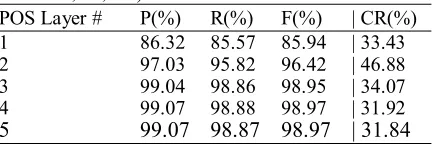
Relationship between POS layer number and BTM performanceIn the 1st experiment, the BTM threshold value is set to 1 and the BTM training size is set to 45,000. Table 7 is the first experimental results of BTM performance (P, R, F) and CR for the POS layer numbers are 1, 2, 3, 4 or 5. From Ta-ble 7, it shows the POS layer number is posi-tively related to the F-measure. Since the BTM model with POS layer number 2 is able to achieve more than 96% F-measure, we use POS layer number 2 to conduct the following ex-periments. This experimental result seems to indicate that the CCTB2.1 dataset with POS layer number 2 (including 57 distinct POS tags) can provide sufficient information for the BTM model to achieve an F-measure of more than 96% and a maximum CR of 46.88%.
Table 7. The first experimental results of BTM (1; 1/2/3/4/5; 45,000)
POS Layer # P(%) R(%) F(%) | CR(%) 1 86.32 85.57 85.94 | 33.43 2 97.03 95.82 96.42 | 46.88 3 99.04 98.86 98.95 | 34.07 4 99.07 98.88 98.97 | 31.92
5 99.07 98.87 98.97 | 31.84
3.2
Relationship between BTM threshold value and BTM performance45,000. Table 8 is the second experimental re-sults of BTM performance and CR when the BTM threshold value is 1.0, 0.9, 0.8, 0.7, 0.6 or 0.5. From Table 8, it shows the BTM threshold value is positively related to the F-measure. Be-sides, the F-measure difference between thresh-old values 1.0 and 0.5 is only 1.37%. This result indicates that the BTM model can robustly maintain an F-measure of more than 95% and a CR of more than 46% while the POS layer num-ber is set to 2, BTM training size is set to 45,000 and the BTM threshold value is t 0.5.
Table 8. The second experimental results of BTM (1/0.9/0.8/0.7/0.6/0.5; 2; 45,000)
Threshold
Value P(%) R(%) F(%) | CR(%) 1.0 97.03 95.82 96.42 | 46.88 0.9 96.99 95.71 96.35 | 47.84 0.8 96.95 95.54 96.24 | 49.42 0.7 96.94 95.49 96.21 | 50.66 0.6 96.86 95.26 96.05 | 51.92 0.5 96.34 93.80 95.05 | 53.72
3.3
Relationship between BTM training size and BTM performanceIn the 3rd experiment, the BTM threshold value is set to 0.5 and POS layer number is set to 2. Table 9 is the third experimental results of BTM performance and CR when the BTM training size is 5000, 10000, 15000, 20000, 25000, 30000, 35000, 40000 or 45000. From Table 9, it seems to indicate that the F-measure of the BTM model is independent of the training size be-cause the maximum difference between these respective F-measures is only 0.88%.
Table 9. The third experimental results of BTM (0.5, 2, 5,000/ 10,000/ 15,000/ 20,000/ 25,000 /30,000 /35,000 / 40,000/ 45,000)
Training size P(%) R(%) F(%) | CR(%) 5,000 95.82 91.33 94.61 | 30.23 10,000 96.28 92.16 94.64 | 35.13 15,000 96.29 92.48 94.54 | 40.32 20,000 96.07 92.59 94.44 | 43.73 25,000 96.19 92.74 94.43 | 46.70 30,000 96.17 92.78 94.30 | 48.46 35,000 96.22 92.92 94.35 | 50.51 40,000 96.28 93.06 94.17 | 52.29 45,000 96.34 93.80 95.05 | 53.72
To sum up the above three experimental results (Tables 7-9), it shows that the F-measure
(over-all performance) of our BTM model with POS layer number (t 2) is apparently not sensitive to BTM threshold value (t 0.5) and BTM training size (t 5,000) on the matching set with perfect input. Since the CR of our BTM model is posi-tively related to BTM training size, it indicates our BTM model should be able to maintain the high performance chunk bracketing (more than 95% F-measure on the matching set with perfect input) and increase the CR only by enlarging the BTM training size.
3.4
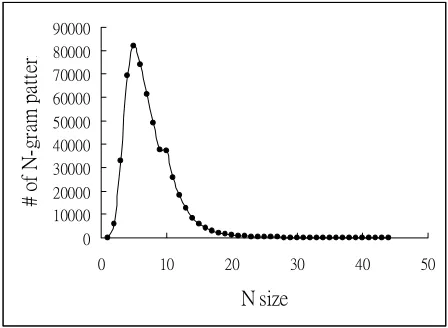
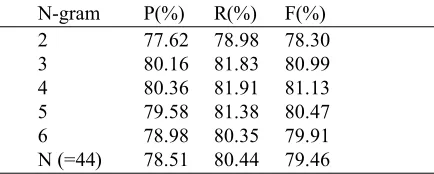
Comparative study of the N-gram model and the BTM model on perfect/actual inputTo conduct the 4th experiment, we develop N-gram models (NGM) by the SRILM (Stanford Research Institute Language Modeling) toolkit (Stolcke, 2002) as the baseline model. SRILM is a freely available collection of C++ libraries, executable programs, and helper scripts de-signed to allow both production of, and experi-mentation with, statistical language models for speech recognition and other NLP applications (Stolcke, 2002). In this experiment, the TL POS patterns (such as “<Na:DE:Na+VH:VH>”) of training set were used as the data for SIRLM to build N-gram models. Then, use these N-gram models to determine the chunks for each BL POS pattern in the testing set. Note that these N-gram models were trained by the TL POS pat-terns only, not by each layer’s POS patpat-terns. Figure 2 shows the distribution of n-gram pat-terns of N-gram models (N is from 2 to 44) trained by the training set.
ı IJıııı ijıııı Ĵıııı ĵıııı Ķıııı ķıııı ĸıııı Ĺıııı ĺıııı
ı IJı ijı Ĵı ĵı Ķı
ŏġŴŪŻŦ
Ĥġ
Űŧ
ġŏ
ĮŨ
ųŢ
Ů
ġű
Ţŵ
ŵŦ
ųů
Fig.2 The n-gram distribution of N-gram models (N is 2 to 44) trained by the 45,000 CCTB2.1 TL POS
Tables 10, 11, 12 13 and 14 are the results of the fourth experiment. The explanations of the five tables are given below.
Table 10. The fourth experimental results of NGM (2/3/4/5/6/N; 45,000) for perfect input
N-gram P(%) R(%) F(%) 2 77.62 78.98 78.30 3 80.16 81.83 80.99 4 80.36 81.91 81.13 5 79.58 81.38 80.47 6 78.98 80.35 79.91 N (=44) 78.51 80.44 79.46
Table 11. The comparative experimental results of P/R/F and CR between BTM (0.5, 2, 45,000) and a 4-gram model for perfect input
Set BTM(0.5, 2, 45k) 4-gram | CR(%) matching 96.3/93.8/95.1 89.3/89.7/89.5 | 53.6 no matching - 73.5/75.7/74.6 | 46.4
Table 12. The comparative experimental results of P/R/F and CR between BTM (0.5, 2, 45,000) and a 4-gram model for actual input
Set BTM(0.5, 2, 45k) 4-gram | CR(%) matching 97.4/97.3/97.3 95.1/96.7/95.9 | 19.2 no matching - 69.1/68.8/68.9 | 80.8
Table 13. The comparative experimental results of P/R/F of a 4-gram model and a 4-gram with BTM (0.5, 2, 45,000) model for perfect input and actual input
Model Perfect(P/R/F) Actual(P/R/F)
4-gram 80.4/81.9/81.1 72.63/72.23/72.43 BTM+4-gram 83.8/83.4/83.6 74.70/73.03/73.42
From Table 10, it shows the maximum preci-sion, recall and F-measure of N-gram models all occur at the 4-gram model for perfect input. Thus, we use the 4-gram model as the baseline model in this experiment. Tables 11 and 12 are the comparative experimental results of the baseline model and the BTM model on the matching sets of perfect input and actual input, respectively. From Table 11, it shows the per-formance (95.1% F-measure) of a BTM (0.5, 2, 45,000) is 5.6% greater than that of a 4-gram model (89.5% F-measure) for the matching set with perfect input. From Table 12, it shows the performance (97.3% F-measure) of a BTM (0.5, 2, 45,000) is 1.4% greater than that of a 4-gram model (95.9% F-measure) for the matching set with actual input. Table 13 is the experimental
results of applying the BTM model to the matching set and the 4-gram model to the non-matching set. From Table 13, it shows the F-measure of a 4-gram model can be improved by the BTM model for both perfect input (2.5% increasing) and actual input (1% increasing).
According to all the four experimental results, we have: (1) the BTM model can achieve better F-measure performance than N-gram models on the matching sets for both perfect input and ac-tual input; and (2) the chunk bracketing per-formance of the BTM model for the matching sets should be high and stable against training size, perfect and actual input while POS layer number t 2 and BTM threshold value t 0.5.
4
Conclusion and Future Directions
In this paper, we define a word-layer matrix that can be used to translate the CKIP Treebank and the Penn Chinese Treebank into corresponding BTM datasets. By the BTM dataset, we devel-oped a BTM model, adopting two types of con-ditional probabilities and using full TL POS pattern matching and full TL POS template matching to identify the chunks for each seg-mented and POS-tagged Chinese sentence.
Our experiment results show that the BTM model can effectively achieve precision and re-call optimization on the matching sets for both perfect input and actual input. The experimental results also demonstrate that:
(1) The BTM threshold value is positively re-lated to the BTM F-measure;
(2) The POS layer number is positively related to the BTM F-measure;
(3) The F-measure of our BTM model for the matching set should be not sensitive to two BTM parameters: BTM threshold value and BTM training size;
(4) The chunk bracketing of our BTM model on the matching set should be high and stable (or say, robust) against training size, perfect and actual input while POS layer number is t 2 and BTM threshold value is t 0.5;
overcome corpus sparseness problem (Manning et al., 1999; Gao et al., 2002; Le et al., 2003). Furthermore, it is difficult for them to identify their “matching set” with high and stable per-formance, whereas our BTM model has the abil-ity to support chunkers and parsers for improving chunking performance. According to the fourth experiment results, when applying a BTM (0.5, 2, 45,000) model on the matching set and a 4-gram model on the non-matching set, the combined system can improve the F-measure of 4-gram model 2.5% for perfect input and 1.0% for actual input. Among the chunking and parsing models, Cascaded Markov Models should be the first one to construct the parse tree layer by layer with each layer’s Markov Model. As per (Brants, 1999), each layer’s chunk brack-eting of Cascaded Markov Models is dependent because the output of a lower layer is passed as input to the next higher layer. On the contrast, our BTM model can independently generate the chunks for top layer without the results of lower layer chunk bracketing; and
(6) Since the F-measures of the BTM model for the matching sets of perfect and actual input both are greater than 95%, we believe our BTM model can be used not only to improve the F-measure of existing shallow parsing or chunking systems, but also to help select valuable sen-tences from the non-matching set for effectively extending the CR of our BTM model.
In the future, we shall study how to combine our BTM model with more conventional statisti-cal approaches, such as Bayesian Networks, Maximum Entropy and Cascaded Markov Mod-els, etc. Meanwhile, we will also apply our BTM model to the Penn English Treebank as a com-parative study.
Acknowledgement
Some work of this paper was done while the author was a visitor at the Institute of Informa-tion Science (Academia Sinica in Taiwan). We thank Prof. Wei-Lian Hsu and Cheng-Wei Shih for their kind help. We also thank the Chinese Knowledge Information Processing group in Taiwan for providing us the CKIP Treebank.
References
Abney, S. Parsing by chunks. In Principle-Based
Parsing. Kluwer Academic Publishers,
Dordrecht: pp.257–278. 1991.
Basili, R. and Zanzotto, F. M. Parsing engineering and empirical robustness. Natural Language Engineering, 8(2–3):pp.97–120. 2002.
Brants, T. Cascaded Markov Models. Proceedings of EACL '99. pp.118 – 125. 1999.
Chen, K.-J. and Huang C.-R. Information-based Case Grammar: A Unification-based Formalism for Parsing Chinese. In Huang et al. (Eds.): pp.23-46. 1996.
Chen, K.-J., Huang C.-R., Chang, L.-P. and Hsu, H.-L. Sinica Corpus: Design Methodology for Bal-anced Corpra.” Proceedings of the 11th Pacific Asia Conference on Language, Information, and Computation (PACLIC II), SeoulKorea, pp.167-176. 1996.
Chen, K.-J., Luo, C.-C., Gao, Z.-M., Chang, M.-C., Chen, F.-Y., and Chen, C.-J. The CKIP Chinese Treebank. In Journ ees ATALA sur les Corpus annot es pour la syntaxe, Talana, Paris VII: pp.85-96. 1999.
Chen, K.-J. et al. Building and Using Parsed Corpora. (Anne Abeillé ed. s) KLUWER, Dordrecht. 2003.
Chen, K.-J and Hsieh Y.-M. Chinese Treebanks and Grammar Extraction. Proceedings of IJCNLP-2004: pp.560-565. 2004.
Chiou, F.-D., Chiang, D. and Palmer, M. Facilitating Treebank Annotation with a Statistical Parser. Proceedings of the Human Language Technol-ogy Conference (HLT 2001), San Diego, Cali-fornia, 2001.
CKIP portal.
http://rocling.iis.sinica.edu.tw/CKIP/treebank.ht m
CKIP (Chinese Knowledge Information Processing Group). Technical Report no. 95-02, the content and illustration of Sinica corpus of Academia Sinica. Institute of Information Science, Aca-demia Sinica. 1995.
CKIP (Chinese Knowledge Information Processing Group). A study of Chinese Word Boundaries and Segmentation Standard for Information processing (in Chinese). Technical Report, Tai-wan, Taipei, Academia Sinica. 1996.
Huang, Chu-Ren, Chen, K.-J., Chen, F.-Y., Gao, Z.-M. and Chen, K.-Y. Sinica Treebank: Design Criteria, Annotation Guidelines, and On-line In-terface. Proceedings of 2nd Chinese Language Processing Workshop (Held in conjunction with the 38th Annual Meeting of the Association for Computational Linguistics, ACL-2000). Octo-ber 7, 2000, Hong Kong: pp.29-37. 2000. Johnny Bigert, Jonas Sjöbergh, Ola Knutsson and
Magnus Sahlgren. Unsupervised Evaluation of Parser Robustness. In Proc. of CICLing 2005. Mexico City, Mexico. 2005.
Knutsson, O., Bigert, J. and Kann, V. A Robust Shal-low Parser for Swedish. In: Proc. of Nodalida'03. Reykavik, Iceland. 2003.
Le, Zhang, Lu X.ue-qiang, Shen Yan-na and Yao Tian-shun. A Statistical Approach to Extract Chinese Chunk candidates from Large Corpora. In: Proc. of ICCPOL-2003. ShengYang: pp.109-117. 2003.
Li, Hongqiao, Huang, C.-N., Gao, Jianfeng and Fan, Xiaozhong. Chinese chunking with another type of spec. In SIGHAN-2004. Barcelona: pp. 41-48
.
2004.Liu Y., Q. Tan, and X. Shen. Segmentation Standard for Modern Chinese Information Processing and Automatic Segmentation Methodology. 1993.
Jorn Veenstra. Memory-Based Text Chunking. In: Nikos Fakotakis (ed), Machine learning in hu-man language technology, workshop at ACAI 99. Chania, Greece. 1999.
Lance A. Ramshaw and Mitchell P. Marcus. Text Chunking Using Transformation-Based Learn-ing. In: Proc. of the Third ACL Workshop on Very Large Corpora. Cambridge MA, USA: pp.82-94. 1995.
Manning, C. D. and Schuetze, H. Fundations of Sta-tistical Natural Language Processing, MIT Press: pp.191-220., 1999.
Menzel, W. Robust processing of natural language. In Proc. 19th Annual German Conference on Arti-ficial Intelligence, Berlin. Springer: pp.19–34. 1995.
Munoz, M., V. Punyakanok, D. Roth, and D. Zimak. A learning approach to shallow parsing. Tech-nical Report UIUCDCS-R-99-2087, UIUC Computer Science Department. 1999.
Oliver Streiter. Memory-based Parsing: Enhancing Recursive Top-down Fuzzy Match with Bot-tom-up Chunking. ICCPOL 2001, Seoul. 2001. PCTB portal.
http://www.cis.upenn.edu/~chinese/ctb.html Ruifeng Xu, Qin Lu, Yin Li and Wanyin Li. The
Construction of a Chinese Shallow Treebank. In:
Proc. of 3rd ACL SIGHAN Workshop. Barce-lona: pp.94-101. 2004.
Sang, Erik F. Tjong Kim and Buchholz, Sabine. In-troduction to the CoNLL-2000 Shared Task: Chunking. In: Proc. of CoNLL-2000 and LLL-2000. Lisbon, Portugal: pp.127-132. LLL-2000. Stolcke, A. SRILM - An Extensible Lan-guage
Mod-eling Toolkit, in Proc. Intl. Conf. Spoken Lan-guage Processing, Denver, Colorado. 2003. Xia, Fei, Palmer, M., Xue, N., Okurowski, M.E.,
Kovarik, J., Chiou, F.-D., Huang, S., Kroch, T. and Marcus, M. Developing Guidelines and En-suring Consistency for Chinese Text Annotation. In: Proc. of LREC-2000. Greece. 2000.
Xue, N., Chiou, F. and M. Palmer. Building a Large-Scale Annotated Chinese Corpus, In: Proc. of COLING-2002. Taipei, Taiwan. 2002.
Xue, N. and Palmer, M. Annotating Propositions in the Penn Chinese Treebank, In Proceedings of the 2nd SIGHAN Workshop on Chinese Lan-guage Processing, in conjunction with ACL'03. Sapporo, Japan. 2003.
Xue., N. and M. Palmer. Automatic Semantic Role Labeling for Chinese Verbs, in Proceedings of the 19th International Joint Conference on Arti-ficial Intelligence. Edinburgh, Scotland. 2005 Xue, N., Xia, F., Chiou F.-D. and M. Palmer. The
Penn Chinese TreeBank: Phrase Structure An-notation of a Large Corpus. Natural Language Engineering, 11(2)-207. 2005.
You Jia-Ming and Chen, K.-J. Automatic Semantic Role Assignment for a Tree Structure. Proceed-ings of SIGHAN workshop. pp.109-115. 2004. Zhou, G.-D. and Su, J. A Chinese Efficient Analyser
![Table 1. A brief comparison between CCTB2.1 and PCTB4 (The number in () is the word frequency and the English word in [] is the English Translation for the corresponding Chinese word)](https://thumb-us.123doks.com/thumbv2/123dok_us/806268.1095194/2.595.305.525.258.549/table-comparison-frequency-english-english-translation-corresponding-chinese.webp)
![Figure 1. The tree structure of CCTB2.1 for the Chinese sentence “��(movie)�(of)��(picture)��(colorful)��(interesting)” (Note that the content of the nodes between the root and the words is [The-matic role : Syntactic category])](https://thumb-us.123doks.com/thumbv2/123dok_us/806268.1095194/3.595.62.285.454.627/figure-structure-chinese-sentence-colorful-interesting-syntactic-category.webp)