Parallel Homomorphic Encryption
Seny Kamara Microsoft Research [email protected]
Mariana Raykova ∗ Columbia University [email protected]
Abstract
In the problem of private outsourced computation, a client wishes to delegate the evaluation of a functionf on a private inputxto an untrusted worker without the latter learning anything aboutxand f(x). This problem occurs in many applications and, most notably, in the setting of cloud computing.
In this work, we consider the problem of privately outsourcing computation to acluster of machines, which typically happens when the computation is to be performed over massive datasets, e.g., to analyze large social networks or train machine learning algorithms on large corpora. At such scales, computation is beyond the capabilities of any single machine so it is performed by large-scale clusters of workers.
We address this problem by introducing the notion of parallel homomorphic encryption (PHE) schemes, which are encryption schemes that support computation over encrypted data via evaluation algorithms that can be efficiently executed in parallel. We also considerdelegated PHE schemes which, in addition, can hide the function being evaluated. More concretely, we focus on the MapReduce model of parallel computation and show how to construct PHE schemes that can support various MapReduce operations on encrypted datasets including element testing and keyword search. More generally, we con-struct schemes that can support the evaluation of functions inNC0 with locality 1 andm=polylog(k) (wherekis the security parameter).
Underlying our PHE schemes are two new constructions of (local) randomized reductions (Beaver and Feigenbaum, STACS 090) for univariate and multivariate polynomials. Unlike previous constructions, our reductions are not based on secret sharing and arefully-hiding in the sense that the privacy of the input is guaranteed even if the adversary seesall the client’s queries.
Our randomized reduction for univariate polynomials is information-theoretically secure and is based on permutation polynomials, whereas our reduction for multivariate polynomials is computationally-secure under the multi-dimensional noisy curve reconstruction assumption (Ishai, Kushilevitz, Ostrovsky, Sahai,FOCS ’06).
1
Introduction
In the problem of private outsourced computation, a client wishes to delegate the evaluation of a function
f on a private input x to an untrusted worker without the latter learning anything about x and f(x). This problem occurs in many applications and, most notably, in the setting of cloud computing, where a provider makes its computational resources available to clients “as a service”.
One approach to this problem is via the use of homomorphic encryption (HE). An encryption scheme is homomorphic if it supports computation on encrypted data, i.e., in addition to the standard encryption
∗
and decryption algorithms it also has an evaluation algorithm that takes as input an encryption of some messagexand a functionf and returns an encryption off(x). HE schemes can be roughly categorized into two types. The first are arithmetic HE schemes which, in addition to the standard encrypt and decrypt operations, have an add or multiply operation that take as inputs encryptions of messages x1 and x2 and
returns encryptions ofx1+x2 andx1·x2, respectively. If an arithmetic HE scheme supports both addition
and multiplication, then it can evaluate any arithmetic circuit over encrypted data and we say that it is a fully homomorphic encryption (FHE) scheme. We refer to the second type of HE schemes as non-arithmetic since they do not provide (at least explicitly) addition or multiplication operations.
The problem of outsourced computation occurs in various forms. For instance, in addition to the simple client/worker setting described above, clients often wish to outsource their computation toclusters of workers. This typically occurs when the computation is to be performed over massive datasets, e.g., to analyze large social networks or train machine learning algorithms on large corpora. At such scales, computation is beyond the capabilities of any single machine so it is performed on clusters of machines, i.e., large-scale distributed systems often composed of low-cost unreliable commodity hardware. For our purposes, we will view such a cluster as a system composed of w workers and one controller. Given some input, the controller generates n jobs (where typically n w) which it distributes to the workers. Each worker executes its job in parallel and returns some value to the controller who then decides whether to continue the computation or halt.
In this work, we consider the problem of privately outsourcing computation to acluster of machines. To address this, we introduceparallel homomorphic encryption (PHE) schemes, which are encryption schemes that support computation over encrypted data through the use of an evaluation algorithm that can be efficiently executed in parallel. Using a PHE scheme, a client can outsource the evaluation of a function
f on some private input x to a cluster of w machines as follows. The client encrypts x and sends the ciphertext andf to the controller. Using the ciphertext, the controller generatesnjobs that it distributes to the workers and, as above, the workers execute their jobs in parallel. When the entire computation is finished, the client receives a ciphertext which it decrypts to recoverf(x). To handle cases where even the functionf must be hidden, we introduce a second variant of PHE which we refer to asdelegated PHE. This variant includes an additional token generation algorithm that takes as inputf and outputs a tokenτ that reveals no information aboutf but that, nonetheless, can be used by the evaluation algorithm (instead of
f) to return an encryption off(x).
Parallel computation. Most computations are not completely parallelizable and require some amount of communication between machines. The specifics of how the computation and communication between processors are organized leads to particular architectures, each having unique characteristics in terms of computational and communication complexity. This has motivated the design of several architecture-independent models of parallel computation, includingNCcircuits [16], the parallel RAM (PRAM) [25,40],
Valiant’s bulk synchronous parallel (BSP) model [51], LogP [20] and, more recently, the MapReduce [23] and Dryad models [33]. It follows that an important consideration in the design of PHE schemes is the parallel model in which the function will be evaluated. In this work, we focus on the MapReduce model (which we describe below) but note that our choice is due mainly to practical considerations (e.g., the emergence of cloud-based MapReduce services such as Amazon’s Elastic MapReduce [1]) and that PHE can also be considered with respect to other models of parallel computation. As an example, note that any arithmetic FHE scheme yields anNC-parallel HE scheme for any function f inNC.
Applications to cloud-based cluster-computing. Due to its simplicity and generality, the MapRe-duce model has quickly become the standard for working with massive datasets. In fact, it is arguably the most successful and widely used model of parallel computation. In 2008 it was reported that Google processed over 20 petabytes of data a day using MapReduce [24] and that Yahoo! deployed a 10,000 core MapReduce cluster [4]. A MapReduce algorithm is run by an execution framework that handles the details of distributing work among the machines in the cluster, balancing the workload so as to optimize perfor-mance and recovering from failures. The most popular framework is Hadoop [3] which is open source and used by hundreds of large organizations including Amazon, Ebay, Facebook, Yahoo!, Twitter and IBM.
Building and maintaining large-scale clusters requires a considerable amount of effort and resources, so a recent trend in cluster-computing has been to make use of cloud infrastructures. Examples include Amazon’s Elastic MapReduce [1], Cloudera’s Hadoop distribution [2] (which can run over several cloud infrastructures) and the recently announced Microsoft Azure Hadoop service. With such services, a client can run a MapReduce algorithm on massive datasets “in the cloud”. While these services allow clients to take advantage of all the benefits of cloud computing, they require the client to trust the provider with its data. For many potential clients (e.g., hospitals or government agencies) this presents an unacceptable risk.
Using an MR-parallel HE scheme a client can maintain the confidentiality of its data while utilizing the processing power of a third-party MapReduce cluster such as Amazon’s Elastic MapReduce service. Of course, the client must bear the costs of encryption and decryption which, for massive datasets, can represent a non-trivial amount of work. But, as discussed above, in certain settings this cost is dominated by the amount of work that is outsourced. This occurs, for example, if the function being evaluated is very complex or if the client wishes to evaluate many different functions over its data (i.e., the offline/online setting). We also note that for all of our constructions, encryption can be performed in a streaming manner. This means that even if the data is very large, it can still be encrypted by a “weak” client (i.e., with a small amount of memory) albeit rather slowly.
1.1 Overview of Techniques
Designing PHE schemes. Our approach to designing PHE schemes combines randomized reductions (RR) [12, 13] and homomorphic encryption. Roughly speaking, a RR from a function f to a function
g transforms an input x in the domain of f to a set of n inputs S = (s1, . . . , sn) in the domain of g
information aboutxorf(x) can be recovered from any subset oft≤nelements ofS. A natural approach to constructing a PHE (ignoring the particualr model of parallel computatin) is therefore to “encrypt” x
by using a RR to transform it into a set (s1, . . . , sn) and have each workerievaluategonsiindependently.
The results can then be sent back to the client who can recoverf(x) using the reduction’s recover algorithm. As long as at most tworkers collude, the RR will guarantee the confidentiality ofx and f(x).
Unfortunately, there are two problems with this approach. First, as far as we know, the best hiding threshold achieved by any RR is t≤(n−1)/q [12,13]. In the context of cloud computing, however, this is not a reasonable assumption as the cloud provider owns all the machines in the cluster 1. Another limitation is that the client has to run the RR’s recovery algorithm which can represent a non-trivial amount of work depending on the particular scheme and the parameters used.
We address these limitations in the following way. First, we show how to construct fully-hiding RRs, i.e., reductions with a hiding threshold of t = n. Our first construction is for the class of univariate polynomials while the second is for multivariate polynomials with a “small” (i.e., poly-logarithmic in the security parameter) number of variables. As far as we know, these are the first RRs to achieve a threshold of t = n. Towards handling the second limitation, we observe that if the recovery algorithm of the RR can be evaluated homomorphically, then the recovery step can also be outsourced to the workers. Clearly, using FHE any recovery algorithm can be outsourced, but our goal here is to avoid the use of FHE so as to have practical schemes. Our approach therefore will be to design RRs with recovery algorithms that are either (1) simple enough to be evaluated using partially-homomorphic encryption; or (2) efficient enough to be run by the client.
Designing fully-hiding RRs. The best known RRs for polynomials [12,13] work roughly as follows. LetQbe the polynomial of degreeqthat we wish to evaluate andx∈Fmbe the input. First, each element
of xis shared into q·t+ 1 shares using Shamir secret sharing with a sharing polynomial of degree t(i.e., the hiding threshold). This yields m sets of shares (s1, . . . ,sm), where si = (si[1], . . . ,si[q·t+ 1]). Each
workerj∈[q·t+ 1] is then given (s1[j], . . . ,sm[j]) and evaluatesQ on his shares. Given the results of all
these evaluations, the client interpolates at 0 to recover Q(x). This approach yields a hiding threshold of up to t= (n−1)/q. Note that this construction works equally as well for m = 1. As shown in [12, 13], this can be improved to t=n·clog(m)/mfor any constantc >0 andm >1.
Due to their reliance on secret sharing, it is not clear how to extend the techniques from [12, 13] to achieve t = n and (informally) it seems hard to imagine using any technique based on secret sharing to achieve full hiding. Instead, we introduce two new techniques for designing RRs. The first works for univariate polynomials and makes use of permutation polynomials over finite fields (i.e., bijective families of polynomials). The resulting RR is information-theoretically secure and very efficient. Our second approach is only computationally-secure but works for multivariate polynomials. The security of the reduction is based on the multi-dimensional noisy curve reconstruction assumption [36,45].
1.2 Our Contributions
While (sequential) homomorphic encryption constitutes an important step towards private outsourced computation, an increasing fraction of the computations performed “in the cloud” is on massive datasets and therefore requires the computation to be performed on clusters of machines. To address this, we make the following contributions:
1
1. We initiate the study of PHE and delegated PHE (which also hides the function being evaluated). In particular, we consider the MapReduce model of parallel computation and formalize MapReduce-parallel HE schemes. Given the practical importance of the MapReduce model and the emergence of cloud-based MapReduce clusters, we believe the study of MapReduce-parallel HE to be important and well motivated.
2. We construct new RRs for univariate and multivariate polynomials with a small number of vari-ables (i.e., polylogarithmic in the security parameter). Our reduction for univariate polynomials is information theoretically secure while our reduction for multivariate polynomials is secure based on the multi-dimensional noisy curve reconstruction assumption [36]. Both our constructions achieve a hiding threshold of t=n and are, as far as we know, the first constructions to do so.
3. We give a general transformation from any RR to a MR-parallel HE scheme given any public-key HE scheme that can evaluate the reductions’ recovery algorithm. If the RR works for any function within a class C, then the resulting MR-parallel scheme isC-homomorphic.
4. We show how to construct a delegated MR-parallel HE scheme for any function whose output values can be computed by evaluating a (single) univariate polynomial over the input values. Our construc-tion is based on our RR for univariate polynomials and makes black-box use of a 2DNF-HE scheme (i.e., a HE scheme that can handle a single multiplication and any number of additions) such as [15,31].
5. We show how to construct a MR-parallel HE scheme for any function in NC0m which consists of all
functions whose outputs depend on at most minput elements. We note that the construction is not delegated. The scheme makes use of our RR for multivariate polynomials and makes black-box use of additively HE.
6. Finally, we show how our MR-parallel HE schemes can be used to evaluate various database queries on encrypted datasets including keyword search and set membership testing.
2
Related Work
We already mentioned previous work on parallel computation so we restrict the following discussion to work closer to our own.
Randomized reductions & encodings. Private outsourced computation is also known as instance hiding and was first considered by Abadi, Feigenbaum and Kilian [5]. Abadi et al. show that if a function
f is NP-hard then it cannot be privately outsourced (even using interaction) unless the polynomial hierarchy collapses. This negative result motivated Beaver and Feigenbaum [11] to consider a setting where the client outsources to multiple servers that are not allowed to communicate. Under these constraints, the authors show that every functionf can be privately outsourced by constructing a RR for multi-variate polynomials that achieves a hiding threshold oft= 1 (i.e., without any resistance to collusion). Following [11], Beaver, Feigenbaum, Killian and Rogaway showed how to achievet= (n−1)/q for anym-variate polynomial with
m≥1 and t=n·clog(m)/mforc, m >1 [12,13].
cryptographic primitives (e.g., pseudo-random generators, commitment schemes, public-key encryption) with efficient parallel complexity [7,6,8,9]. While REs imply RRs the converse is not known to be true [10].
Homomorphic encryption. As mentioned in section1, the problem of private outsourced computation can be addressed non-interactively using HE. Of course, several semantically secure arithmetic HE schemes are known [32, 27, 14, 46, 44, 47, 21, 15, 31], including Gentry’s breakthrough FHE scheme [29] and its variants [52,50]. Several non-arithmetic HE schemes are also known including [49,17,37,30].
MapReduce. MapReduce was introduced by Dean and Ghemawat in [23]. In this work, they describe the design and implementation of the MapReduce framework for processing massive datasets on large-scale systems of loosely coupled machines. MapReduce offers a simple interface to design and implement parallel algorithms and an execution framework that handles the details of distributing work among the machines in the cluster, balancing the workload so as to optimize performance and recovering from failures. Due to the simplicity and generality of the MapReduce model, it has quickly become the standard for working with massive datasets
The MapReduce model of computation has been formalized and studied in recent work by Karloff, Suri and Vassilvitskii [39]. This work introduces a new complexity class that captures the power of the model and relates it to known models of parallel computation, including PRAMs and NC circuits. The
authors also present new MapReduce algorithms for frequency counts, undirected s-t connectivity and for computing the minimum spanning tree of a dense graph.
Other MapReduce algorithms have been proposed for a multitude of tasks, including for indexing the Web and computing PageRank [23], clustering high-dimensional data [22], processing large-scale graphs [38,18,43,39], machine learning [19] and natural language processing [48].
3
Preliminaries and Notation
Notation. We writex←χto represent an element xbeing sampled from a distribution χ, and x←$ X
to represent an element x being sampled uniformly from a set X. The output x of an algorithm A is denoted by x ← A. We refer to the ith element of a vector v as either vi or v[i]. Throughout k will
refer to the security parameter. A function ν : N→ N is negligible in k if for every polynomial p(·) and
sufficiently large k, ν(k) <1/p(k). Let poly(k) and negl(k) denote unspecified polynomial and negligible functions ink, respectively. We writef(k) =poly(k) to mean that there exists a polynomialp(·) such that for all sufficiently largek,f(k)≤p(k), andf(k) =negl(k) to mean that there exists a negligible function
ν(·) such that for all sufficiently large k,f(k)≤ ν(k). The statistical distance between two distributions
χ1 and χ2 over the same spaceX is defined as SD(χ1, χ2) = maxS⊂X|Pr [χ1 ∈S]−Pr [χ2 ∈S]|.
Polynomials. If p is a univariate polynomial of degree d over a field F, then it can be written as p(x) = P
α∈Sp(α)· Lα(x), where S is an arbitrary subset of F of size d+ 1 and Lα is the Lagrangian
coefficient defined asLα(x) =Q
i∈S,i6=α(x−i)/(α−i).A permutation polynomialp∈F[x] is a bijection over
F. One class of permutation polynomials which will make use of in this work are the Dickson polynomials
polynomial Dd,β defined as
Dd,β(x) def
= Dd(x, β) = bd/2c
X
λ=0 d d−λ·
d−λ λ
·(−β)λxd−2λ,
is a permutation overF. Ford= 2 and any β6= 0, we haveD2,β(x) =x2−2β which is a permutation over
any Fsuch that |F|2−1 is odd.
Locality and degree. Here, we follow closely the notation and definitions of [7]. We view a function
f :F∗ →F∗ as a function family{fn}n∈Nwherefnis the restriction off to inputs of lengthn. Throughout
this work we will represent a functionfn:Fn→Fw as a vector of polynomials (Q1, . . . ,Qw) such that the ith output offn can be computed using Qi. We assume thatf can be computed in polynomial time in n
and that its vector representation can be found in polynomial time.
We say that f is`-local if all its output elements depend on at most` input elements and that it has degree dif each polynomial in its vector representation has degree at mostd. The (arithmetic) class NC0`
includes all `-local functions that are computable and constructible in polynomial time (throughout this work all complexity classes will be uniform). Furthermore, we denote byNC0`,eq the class of functions that are`-local and whose vector representation is such thatQ1 =· · ·=Qw.
Homomorphic encryption. Let F be a family of of n-ary functions. A F-homomorphic encryption scheme is a set of four polynomial-time algorithmsHE= (Gen,Enc,Eval,Dec) such thatGenis a probabilistic algorithm that takes as input a security parameter k and outputs a secret key K; Enc is a probabilistic algorithm that takes as input a keyKand ann-bit messagemand outputs a ciphertextc;Evalis a (possibly probabilistic) algorithm that takes as input a function f ∈ F and n encryptions (c1, . . . , cn) of messages
(m1, . . . , mn) and outputs an encryptioncoff(m1, . . . , mn); andDec is a deterministic algorithm takes as
input a keyKand a ciphertextcand outputs a messagem. In this work, we make use of 2DNF-HE schemes which support an arbitrary number of additions and a single multiplication. Concrete instantiations of such schemes include [15] and [31]. Informally, a HE scheme is secure against chosen-plaintext attacks (CPA) if the ciphertexts it outputs do not leak any useful information about the plaintext even to an adversary that (in the case of a private-key scheme) can adaptively query an encryption oracle. As discussed in [28] (cf., section 2.2.), the formal definition of CPA-security for standard encryption schemes can be used for HE schemes.
4
MapReduce-Parallel Homomorphic Encryption
In this section, we first give an overview of the MapReduce model of computation together with an example of a simple MapReduce algorithm. We refer the reader to [42] for a more detailed exposition. After formalizing the MapReduce model, we define MapReduce-parallel HE schemes and present our security definitions for standard and delegated MR-parallel HE schemes.
4.1 The MapReduce Model of Computation
of “reducers”. All pairs with the same label are routed to the same reducer which is then tasked with applying a reduce operation that combines the values into a single value for that label.
More precisely, a MapReduce algorithm is divided into five (possibly probabilistic) algorithms: parse, map, partition, reduce and merge. The parse algorithm takes an n-bit input x and outputs a set of label/value pairs {(`i, vi)}i. The map algorithm takes a single input pair (`i, vi) and outputs a set of
intermediate pairs {(λj, γj)}j, where λj is from some label space Λ. Note that the intermediate pairs do
not have to be from the same space as the input pairs. The partition algorithm takes as input a set of intermediate pairs and partitions it into the sets {Pl}l. The reduce algorithm takes as input a labelλand
a partitionPl and returns a string z. Finally, the merge algorithm takes a set of strings{zr}r and returns
an output y. For the algorithm to work properly, it is crucial that the map and reduce algorithms be stateless.
Definition 4.1 (MapReduce algorithm). A MapReduce algorithm for a function family F is a tuple of five polynomial-time algorithms Π = (Parse,Map,Part,Red,Merge) such that:
(`i, vi)i←Parse(f, x): is a deterministic algorithm that takes as input a functionf ∈ F and a string x, and that returns a sequence of input pairs.
(λj, γj)j ← Map(`, v): is a (possibly probabilistic) algorithm that takes an input pair (`, v) and that
returns a sequence of intermediate pairs.
h←Part(λ, γ): is a (possibly probabilistic) algorithm that takes as input an intermediate pair (λ, γ) and that returns a value h in some space H.
(λ, z)←Red(λ, P): is a (possibly probabilistic) algorithm that takes as input a labelλand a setP of intermediate values and returns an output pair (λ, z).
y←Merge (λt, zt)t
: is a deterministic algorithm that takes as input a set of output pairs and returns a string y.
We will sometimes denote the execution of a MapReduce algorithm Π on a function f and input x as
y←Π(f, x).
We add that all implementations of the MapReduce framework offer a defaultPartalgorithm that maps all the intermediate pairs with the same label to the same partition. This algorithm is usually referred to as theShufflealgorithm.
Executing a MapReduce Algorithm. A MapReduce algorithm Π = (Parse,Map,Part,Red,Merge) is executed on a cluster of w workers and one controller as follows (we refer the reader to [23] for a more detailed description). The client provides a function f and an input x to the controller who runs Parse
on (f, x), resulting in a sequence of input pairs (`i, vi)i. Each pair is then assigned by the controller to
a worker that evaluates Map on it. Note that since the Map algorithm is stateless, it can be executed in parallel. Typically the number of input pairs is much larger than the number of workers so this stage may require several rounds. When all the input pairs have been processed, the Part algorithm is executed on the set of intermediate pairs. This results in a partition of the intermediate pairs and each element of the partition is then assigned to a worker that runs the Red algorithm. Again, since Red is stateless it can be executed in parallel (though it can be sequential on its own partition). The outputs of all these Red
An example. Perhaps the simplest example of a MapReduce algorithm is to determine frequency counts, i.e., the number times a keyword occurs in a document collection. The parse algorithm takes the document collection (D1, . . . , Dn) as input and outputs a set of input pairs (i, Di)i. Each mapper receives an input pair
(i, Di) and outputs a set of intermediate pairs (wj,1)j for each wordwj found inDi. All the intermediate
pairs are then partitioned by the partition operation into sets{Pl}, wherePlconsists of all the intermediate
pairs with label wl. The reducers receive a set Pl of intermediate pairs and sum the values of each pair.
The result is a count of the number of times the word wl occurs in the document collection. The merge
algorithm then concatenates all these counts and returns the result.
4.2 Syntax and Security Definitions
A MR-parallel HE scheme is a HE whose evaluation operation can be computed using a MapReduce algorithm. We formalize this in the following definition.
Definition 4.2 (MR-parallel HE). A private-key MR-parallel F-homomorphic encryption scheme is a tuple of polynomial-time algorithmsPHE= (Gen,Enc,Eval,Dec), where(Gen,Enc,Dec) are as in a private-key encryption scheme andEval= (Parse,Map,Part,Red,Merge) is a MapReduce algorithm. More precisely we have:
K ←Gen(1k): is a probabilistic algorithm that takes as input a security parameterkand that returns a key K.
c ← Enc(K, x): is a probabilistic algorithm that takes as input a key K and an input x from some message space X, and that returns a ciphertext c. We sometimes write this as c←EncK(x).
(`i, vi)i ← Parse(f, c): is a deterministic algorithm that takes as input a function f ∈ F and a
ciphertextc, and that returns a sequence of input pairs.
(λj, γj)j ← Map(`, v): is a (possibly probabilistic) algorithm that takes an input pair (`, v) and that
returns a sequence of intermediate pairs.
h←Part(λ, γ): is a (possibly probabilistic) algorithm that takes as input an intermediate pair (λ, γ) and that returns a value h in some space H.
(λ, z) ← Red(λ, P): is a (possibly probabilistic) algorithm that takes a label λ and a partition P of intermediate values and returns an output pair (λ, z).
c0 ← Merge (λt, zt)t
: is a deterministic algorithm that takes as input a set of output pairs and returns a ciphertext c0.
y←Dec(K, c0): is a deterministic algorithm that takes a key K and a ciphertextc0 and that returns an outputy. We sometimes write this as y←DecK(c0).
We say that PHEis correct if for all k∈N, for all f ∈ Fk, for all K output by Gen(1k), for all x∈X, for
allc output by EncK(x),DecK Eval(f, c)
=f(x).
opposed that of secure communication, the cost of generating a new key per input is negligible. As such, our security definitions only guarantee security for a single input (which could be, e.g., a massive dataset). Another issue to consider in the context of HE is the possibility side-channels during the evaluation. Such leakage can occur if some aspect of the evaluation of f is data-dependent (e.g., the amount of space used or the time needed to complete) so some care has to be taken to make the evaluation “leakage-resilient”. In the case of arithmetic FHE, side-channels are not a concern since evaluation is done by executing a circuit which is a data-oblivious operation. This is not the case for MR-parallel HE, however, since many “natural” MapReduce algorithms appear to be very data-dependent. Consider, for instance, the simple frequency count algorithm described above. The number of intermediate pairs immediately reveals the number of words in a document and the sizes of the partition elements reveal the counts for all the words.
Definition 4.3(CPA1-security). Let PHE= (Gen,Enc,Token,Map,Part,Red,Merge,Dec)be a MR-parallel
F-homomorphic encryption scheme and consider the following probabilistic experiments where A is an adversary and S is a simulator:
RealPHE,A(k): the challenger begins by running Gen(1k) to generate a key K. A outputs an input x
and receives a ciphertext c← EncK(x) from the challenger. A returns a bit b that is output by the
experiment.
IdealPHE,A,S(k): Aoutputs an inputx. Given|x|,S generates and returns a ciphertextctoA. Areturns
a bit b that is output by the experiment.
We say that PHE is secure against a single-message chosen-plaintext attack if for all ppt adversaries A,
there exists a ppt simulator S such that
|Pr [RealPHE,A(k) = 1 ]−Pr [IdealPHE,A,S(k) = 1 ]| ≤negl(k),
where the probabilities are over the coins of Enc, A and S.
A delegated PHE scheme is a PHE scheme that supports computation on encrypted data in such a way that the function being computed is hidden. We provide a formal definition below.
Definition 4.4(Delegated MR-parallel HE). A delegated MR-parallelF-homomorphic encryption scheme is a tuple of nine polynomial-time algorithms PHE = (Gen,Enc,Token,Parse,Map,Part,Red,Merge,Dec) such that (Gen,Enc,Map,Part,Red,Merge,Dec) are as in Definition 4.2 and that Token and Parse are as follows:
τ ←Token(K, f): is a probabilistic algorithm that takes as input a key K and a functionf and that returns a tokenτ. We can write this as τ ←TokenK(f).
(`i, vi)i ←Parse(τ, c): is a deterministic algorithm that takes as input a token τ and a ciphertext c,
and that returns a sequence of input pairs.
We say that PHE is correct if for all k ∈ N, for all f ∈ Fk, for all K output by Gen(1k), for all x ∈ X,
for all c output by EncK(x), for all tokens τ output by Token(K, f), DecK Π(τ, c)
= f(x), where Π = (Parse,Map,Part,Red,Merge).
Definition 4.5 (CPFA1-security). Let PHE= (Gen,Enc,Token,Map,Part,Red,Merge,Dec) be a delegated MR-parallelF-homomorphic encryption scheme and consider the following probabilistic experiments where
A is an adversary and S is a simulator:
Real?PHE,A(k): the challenger begins by running Gen(1k) to generate a key K. A outputs an input x and
receives a ciphertext c←EncK(x) from the challenger. The adversary chooses a polynomial number
of functions f ∈ F and, for each f, receives a token τ ← TokenK(f) from the challenger. Note that
each choice of f is done adaptively, i.e., as a function of c, the previously chosen functions and the previously received tokens. Finally, A returns a bit b that is output by the experiment.
Ideal?PHE,A,S(k): A outputs an input x. Given |x|, S generates and returns a ciphertext c to A. The adversary chooses a polynomial number of functionsf ∈ F and, for each functionf, the simulator is given deg(f). The simulator returns a token τ. Again, A chooses the functions adaptively. Finally,
A returns a bitb that is output by the experiment.
We say that PHE is secure against a single-message chosen-plaintext and function attacks if for all ppt
adversaries A, there exists a ppt simulatorS such that
Pr
Real?PHE,A(k) = 1−PrIdeal?PHE,A,S(k) = 1≤negl(k),
where the probabilities are over the coins of Enc, Token, A and S.
5
Randomized Reductions for Polynomials
In this section, we formally define randomized reductions [11, 12, 13] and then present our fully-hiding constructions for univariate and multivariate polynomials. Our definitions follow closely the ones given by Beaver, Feigenbaum, Killian and Rogaway [13].
Let t, n∈ N such that t ≤ n. A function f :X → Y is (t, n)-locally random reducible to a function
g : Xe → Ye if there exists two polynomial-time algorithms RR = (Scatter,Recon) that work as follows.
Scatter is a probabilistic algorithm that takes as input an element x ∈ X and a parameter n ∈ N, and returns a sequence s ∈Xen and some state information st. Recon is a deterministic algorithm that takes as input some statestand a sequencey∈Yen and returns an elementy∈Y. In addition, we require that
RR satisfy the following properties:
• (Correctness) for allx∈X,
PrRecon st, g(s1), . . . , g(sn)
=f(x) : (s, st)←Scatter(x, n)≥3/4,
where the probability is over the coins ofScatter. We depart slightly from the original definition [13] in that hereRecondoes not need to take x as input.
• (t-hiding) for all I ⊆[n] such that |I|=t, and all x1 andx2 inX such that|x1|=|x2|,
hsiii∈I: (s, st)←Scatter(x1, n)
≈
hsiii∈I : (s, st)←Scatter(x2, n)
Ifg=f, thenRRis arandomized self reduction (RSR). Furthermore, if there exists a pair of algorithms
RSR= (Scatter,Recon), such that for every functionf in some classC,RSRis a random self reduction for
f, then we say thatRSRis auniversal random self reduction overC. All of our constructions are universal.
5.1 A Perfect Randomized Self Reduction for Univariate Polynomials
In this section, we present a fully-hiding randomized reduction for univariate polynomials. As far as we know, the best hiding threshold previously achieved by any RR for univariate polynomials of degree q is
t≤(n−1)/q which is achieved by the construction of Beaver, Feigenbaum, Killian and Rogaway [12,13]. Like the construction presented in [12,13], our randomized reduction isuniversal and self-reducing.
Let Qbe a degree q univariate polynomial over a finite field Fsuch that|F| ≥2q+ 1 and |F|2−1≡1
(mod 2), and let δ[Fn] def= v ∈ Fn : vi 6= vj for alli, j ∈ [n] . Consider the random self reduction Poly1q= (Scatterq,Reconq) defined as follows:
• Scatterq(x): letn= 2q+ 1 and sample a vector α uniformly at random from δ[Fn]. For all i∈[n],
computesi :=D2(αi,−x/2) =α2i +x. Output (s1, . . . , sn) and st=α. • Reconq(st, y1, . . . , yn): output y=Pni=1yi· Lαi(0).
Theorem 5.1. Polyq1 is a perfect and fully-hiding randomized self reduction. Proof. Towards showing correctness, letQb(α)
def
= Q D2(α,−x/2)
(for somex∈F) and note that Qb(0) =
Q(x). We therefore have:
y=
2q+1
X
i=1
yi· Lαi(0) = 2q+1
X
i=1
Q D2(αi,−x/2)
· Lαi(0) = 2q+1
X
i=1
b
Q(αi)· Lαi(0) =Qb(0) =Q(x),
since deg(Qb) = 2q. We now consider perfect hiding. Let n = 2q+ 1 and note that for fixed q ∈N and
x∈F,Scatter evaluates the vector-valued functionfx,q :δ[Fn]→δ[Fn] defined as
fx,q(α) =
D2 α1,−x/2
, ...,D2 αn,−x/2
,
for a randomα. Note that fx,q is a permutation overδ[Fn] sinceD2(α, β) is a permutation over Ffor any β (this follows from the fact that |F|2−1≡1 (mod 2)). Let U be the uniform distribution over δ[
Fn]. In
the following, for visual clarity we drop the subscriptq and denotefx,q by fx. For all x1 and x2 inF,
SD fx1(U), fx2(U)
= max
S⊂δ[Fn]
|Pr [fx1(U)∈S]−Pr [fx2(U)∈S]|
= max
S⊂δ[Fn]
Pr
U ∈fx−11(S)−PrU ∈fx−21(S)
≤ max
V,V0⊂δ[Fn] |V|=|V0|
Pr [U ∈V ]−Pr
U ∈V0
= 0
where the last equality follows from the fact thatfx1 andfx2 are permutations over δ[F
5.2 A Computational Randomized Self Reduction for Multivariate Polynomials
We now present a fully-hiding RSR for multi-variate polynomials. The best known hiding threshold previously achieved is from a construction of [12,13] which achievest≤n·clog(m)/mforcand mgreater than 1. Our construction is universal and self-reducing.
LetQbe am-variate degreeq polynomial over a finite fieldFsuch that|F| ≥n+ 1, forn∈N. Consider
the randomized self reduction Polymq = (Scatterq,Reconq) defined as follows:
• Scatterq(x): let n = 2q + 1 and sample m univariate polynomials (p1, . . . , pm) of degree 2 such
that pi(0) = xi for all i ∈ [m]. Let N = ω(n·(n/q)m) and α $
← δ[Fn]. For all j ∈ [n], set
zj := p1(αj), . . . , pm(αj)
and for all j ∈ [n+N] set zj $
← Fm. Let S = (s1, . . . ,sn+N) be the
sequence that results from permuting the elements ofZ= (z1, . . . ,zn+N) at random and let Γ be the
locations in S of the elements inZthat were chosen at random in Fm. OutputS and st= (α,Γ).
• Reconm,q(st, y1, . . . , yn+N): parsestas (α,Γ) and outputy =Pi6∈Γyi· Lαi(0).
The security of our randomized reduction is based on the multi-dimensional noisy curve reconstruction assumption from Ishai, Kushilevitz, Ostrovsky and Sahai [36], which extends the polynomial reconstruction (PR) assumption from Naor and Pinkas [45].
Assumption 5.2 (Multi-dimensional noisy curve reconstruction [36, 45]). The multi-dimensional noisy curve reconstruction (CR) assumption is defined in terms of the following experiment where x is a m -dimensional vector over a finite field F, d >1, andt=t(k) andz=z(k) are functions of k:
CurveRec(k,x, d, n, N, m): sample a vector α ←$ Fn and a random subset of N indices Γ chosen from
[n+N]. Choose m random univariate polynomials (p1, . . . , pm) such that each pi is of degree at
most d and that pi(0) = xi. For all j ∈ [n], set zj = (p1(αj), . . . , pm(αj)) and for all j ∈ [n+N]
set zj ←$ Fm. Let S = (s1, . . . ,sn+N) be the sequence that results from permuting the elements of
Z= (z1, . . . ,zn+N) uniformly at random. The output of the experiment is(s1, . . . ,sn+N).
We say that the CR assumption holds over F with parameters (d, n, N, m) if for all x1 and x2 in Fm,
CurveRec(k,x1, d, n, N, m)
c ≈
CurveRec(k,x2, d, n, N, m)
We note that the CR assumption is believed to hold when N isω(n·(n/d)m) and|F|=N [36].
Remark. Setting n and N to be polynomial in k, the CR assumption is believed to hold as long as
m=polylog(k). We note, however, that the parameters provided in [36] and used in this work are for the stronger “augmented CR” assumption which outputs, in addition to the vectors (s1, . . . ,sn+N), the
evalu-ation points (α1, . . . , αn) together withN random values. It is therefore plausible that the CR assumption
could hold for a wider range of parameters and, in particular, for m=poly(k).
In the following theorem, we show that Polymq is a fully-hiding and universal RSR for the class of multi-variate polynomials with a poly-logarithmic number of variables.
Proof. Since the fully-hiding property follows directly from the CR assumption we only show correctness.
LetQb(α)
def
= Q p1(α), . . . , pm(α)
and note thatQb(0) =Q(x1, . . . , xm). We therefore have
y=X
i6∈Γ
yi· Lαi(0) =
X
i6∈Γ
Q p1(αi), . . . , pm(αi)
· Lαi(0) =X
i6∈Γ
b
Q(αi)· Lαi(0) =Qb(0) =Q(x1, . . . , xm),
since deg(Qb) = 2q and |[n+N]\Γ|= 2q+ 1.
6
MR-Parallel HE from Randomized Reductions
We now show how to construct a MR-parallel HE scheme from anyF-homomorphic encryption scheme and any fully-hiding RR between functions f and g whose reconstruction algorithm is in F. At a high-level, the construction works as follows.
The RR’s scatter algorithm is applied to each element xi of the input x. This results in a sequence si
and a state sti. The latter is encrypted using the F-homomorphic encryption scheme and each mapper
receives a pair composed of a label`=iand a valuev of the form (si[j], ei) for some i∈[#x] andj ∈[n]
and where ei is a F-homomorphic encryption of sti. The mapper evaluates g on si[j] and returns an
intermediate pair with label λ=i and value γ = g(si[j]), ei
. After the shuffle operation, each reducer receives a pair composed of a labeliand a partition
P =
yi,j, ei
, . . . , yi,n, ei
,
where yi,j = g(si[j]) for j ∈ [n]. Since Recon is in F, the reducer can evaluate Recon(ei, yi,1, . . . , yi,n)
homomorphically which results in an encryption off(xi).
Note that this approach yields a function-private MR-parallel HE scheme so it can be used in the context of private function evaluation. To be useful for server-aided computation, however, the running time of the reduction’s scatter algorithm and of the HE scheme’s decryption algorithm must be less than the fastest known algorithm for computing f. If the reduction is C-universal, however, the client can evaluatemultiple functions on the same encrypted input if we include a description of the function in the input value. We describe this variant in Figure 1.
Theorem 6.1. If HE is CPA-secure and ifRR is fully-hiding, thenPHE as described in Figure 1is secure against single-message chosen-plaintext attacks.
Proof sketch: Consider the simulator S that simulates ciphertexts in an Ideal(k) experiment as follows. Given #x it generates (pk0, sk0) ← Gen(1k) and, for all i ∈ [#x], it computes (s0i, st0i) ← Scatter(0) and e0i ← HE.Encpk0(st0
i). It outputs c0 = (pk0,s01, . . . ,s0#x, e01, . . . , e0#x). The fully-hiding property of RR
guarantees that the s0i’s are indistinguishable from thesi’s generated in aReal(k) experiment. Similarly,
the CPA-security ofHEguarantees that thee0i’s are indistinguishable from theei’s generated in aReal(k)
experiment.
7
An Efficient Delegated MR-Parallel HE Scheme for NC
01,eqLetHE= (Gen,Enc,Eval,Dec) be a public-keyF-homomorphic encryption scheme and letRR= (Scatter,Recon) be a C-universal (t, n)-local randomized reduction from f to g such that Recon ∈ F. Consider the multi-use MR-parallel C-homomorphic encryption scheme PHE = (Gen,Enc,Eval,Dec), where PHE.Eval = (Parse,Map,Part,Red,Merge), defined as follows:
• Gen(1k): compute (pk, sk)←HE.Gen(1k). OutputK= (sk, pk).
• Enc(K,x): for all i ∈ [#x], compute (si, sti) ← Scatter(xi) and ei ← HE.Encpk(sti). Output c = (pk,s1, . . . ,s#x, e1, . . . , e#x).
• Parse(f,c): for alli∈[#x] andj ∈[n], set`i,j:=iandvi,j := (f, pk,si[j], ei). Output (`i,j, vi,j)i,j.
• Map(`, v): parsevas (f, s, e) and computea←HE.Encpk(g(s)). Outputλ:=`andγ:= (a, e).
• Red(λ, P): parseP as (ar, er)r and computez←HE.Eval(Recon, er,(ar)r). Output (λ, z).
• Merge (λt, zt)t: outputc0:= (zt)t.
• Dec(K,c0): for alli∈[#c0], computeyi:=HE.Decsk(zi). Outputy= (y1, . . . , y#c0).
Figure 1: MR-parallel HE from RR and HE
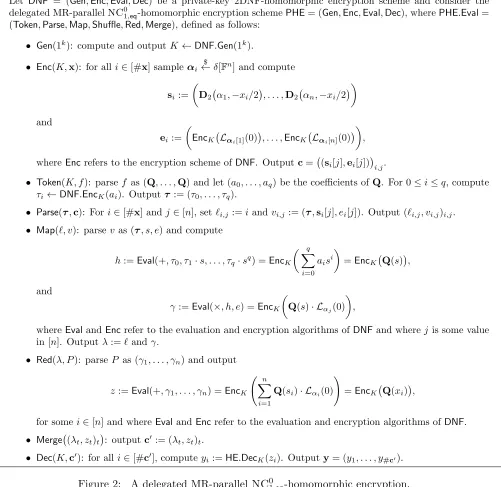
multi-use MR-parallel HE scheme for functions in NC01,eq since all functions f ∈NC01,eq can be computed by evaluating a single univariate polynomial. In addition, the resulting construction can be made delegated by encrypting the coefficients of the polynomial using the FHE scheme and having the mappers perform their computations homomorphically.
Current FHE constructions, however, are not yet practical enough for our purposes so we present a direct construction based only on 2DNF-HE. The direct construction also has the advantage that the input values sent to the mappers are smaller than what would result from our general construction. We describe our scheme in detail in Figure2but, at a high level, it works as follows. First, recall thatPoly1qscatters an input xby using it to choose a polynomial D from a family of permutation polynomials of degree 2. This polynomial is then evaluated atn= 2q+ 1 distinct locationsα= (α1, . . . , αn) chosen uniformly at random.
This results in a sequences= (s1, . . . , sn) which, together withα, are the output of the scatter operation.
Reconstruction consists recoveringQ(x) fromy= Q(s1), . . . ,Q(sn)
andαusing interpolation. The main difficulty in using the general approach is that it is unclear how to evaluate the reconstruction algorithm (i.e., interpolation ofQ(x) from yand α) homomorphically without making use of FHE.
Our approach, therefore, will be to have the client perform some additional work in order to make the reconstruction algorithm simpler and computable using a weaker HE scheme. In particular, the client will itself compute the Lagrangians needed for the interpolation and include them (encrypted) as part of the ci-phertext. Notice that givenyand a sequence of encrypted Lagrangians EncK(Lα1(0)), . . . ,EncK(Lαn(0))
, the valueQ(x) can be interpolated homomorphically using only scalar multiplication and addition since
Q(x) =X
i
yi· Lαi(0).
To make the scheme delegated, however, we would also like to encrypt the coefficients ofQ in such a way thatyi =Q(si) =Pnj=0aj·sji can be evaluated homomorphically. These two constraints essentially require
that we be able to perform one multiplication (between an encrypted yi and an encrypted Lagrangians)
and multiple additions homomorphically which we can do relatively efficiently using a 2DNF-HE scheme.
Let DNF = (Gen,Enc,Eval,Dec) be a private-key 2DNF-homomorphic encryption scheme and consider the delegated MR-parallelNC01,eq-homomorphic encryption schemePHE= (Gen,Enc,Eval,Dec), wherePHE.Eval= (Token,Parse,Map,Shuffle,Red,Merge), defined as follows:
• Gen(1k): compute and output K←DNF.Gen(1k).
• Enc(K,x): for alli∈[#x] sampleαi←$ δ[Fn] and compute
si:=
D2 α1,−xi/2
, . . . ,D2 αn,−xi/2
and
ei:=
EncK Lαi[1](0)
, . . . ,EncK Lαi[n](0)
,
where Encrefers to the encryption scheme ofDNF. Outputc= (si[j],ei[j])i,j.
• Token(K, f): parsef as (Q, . . . ,Q) and let (a0, . . . , aq) be the coefficients ofQ. For 0≤i≤q, compute τi←DNF.EncK(ai). Outputτ := (τ0, . . . , τq).
• Parse(τ,c): Fori∈[#x] andj ∈[n], set`i,j:=iandvi,j:= (τ,si[j], ei[j]). Output (`i,j, vi,j)i,j.
• Map(`, v): parsevas (τ, s, e) and compute
h:=Eval(+, τ0, τ1·s, . . . , τq·sq) =EncK
q X
i=0 aisi
=EncK Q(s),
and
γ:=Eval(×, h, e) =EncK
Q(s)· Lαj(0)
,
whereEvalandEncrefer to the evaluation and encryption algorithms ofDNFand wherej is some value in [n]. Outputλ:=`andγ.
• Red(λ, P): parseP as (γ1, . . . , γn) and output
z:=Eval(+, γ1, . . . , γn) =EncK n
X
i=1
Q(si)· Lαi(0) !
=EncK Q(xi)
,
for some i∈[n] and where EvalandEnc refer to the evaluation and encryption algorithms ofDNF.
• Merge (λt, zt)t: outputc0:= (λt, zt)t.
• Dec(K,c0): for alli∈[#c0], computeyi:=HE.DecK(zi). Outputy= (y1, . . . , y#c0).
Figure 2: A delegated MR-parallelNC01,eq-homomorphic encryption.
Theorem 7.1. If DNF is CPA-secure, then PHE as described in Figure 2 is secure against single-input chosen-plaintext and function attacks.
(s0i,α0i)←Poly1q.Scatter(0) and
e0i:=
EncK Lα0i[1](0)
, . . . ,EncK0 Lα0
i[n](0)
.
It then returns c0 = (s0i[j],e0i[j])i,j. Givenq, it returns τ0 = (τ10, . . . , τq0), whereτi0 =EncK0(0). The fully-hiding property of Poly1
q guarantees that the s0i,j’s are indistinguishable from the si,j’s
gen-erated in aReal? experiment. Similarly, the CPA-security of DNF guarantees that the e0i,j’s are indistin-guishable from theei,j’s in aReal?(k) experiment. Finally, the CPA-security of DNFalso guarantees that
each τ0 is indistinguishable from theτ generated in a Real?(k) experiment.
Efficiency. The most efficient approach for evaluating a polynomial on multiple points using the Fast Fourier Transform (FFT) takes time O(qlogq) for the evaluation of a degree q polynomial on q points. Thus, the costs to evaluate a univariate polynomialQof degreeq over a sequencexusing our construction areO(#x·logq) for encryption, O(q) for token generation andO(#x) for decryption.
Therefore, in the setting of server-aided computation, our scheme can reduce the client’s work from
O(w·#x·logq) toO(#x·logq+w·(q+ #x)) when evaluatingf = (Q1, . . . ,Qw) inNC01,eq and #xq.
8
A MR-Parallel HE Scheme for NC
0mSimilarly to the case of NC01,eq functions, our general construction yields a multi-use MR-parallel HE scheme for functions in NC0m if we instantiate its RR and HE scheme with a fully-hiding RR for
multi-variate polynomials (as our construction in section5.2) and a FHE scheme.
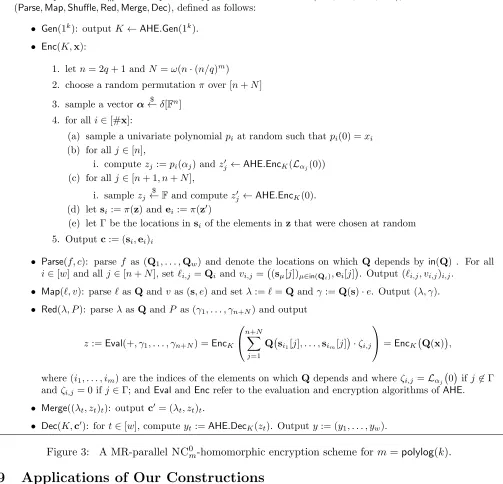
To avoid the use of FHE, we present a direct construction that only makes use of additively HE. The high-level approach is similar to our direct construction forNC01,eq functions: we make the client compute the Lagrangians in order to simplify the computation that has to be performed homomorphically by the reducers. Our construction is described in detail in Figure 3.
Theorem 8.1. If AHE is CPA-secure and if the multi-dimensional noisy curve reconstruction assumption holds, then PHE as described in Figure 3 is secure against single-message chosen-plaintext attacks.
Proof sketch: Consider the simulator S that simulates ciphertexts in an Ideal(k) experiment as follows. Given #x and q, it starts by generating a key K0 ← AHE.Gen(1k). Then, for all i ∈ [#x] it (1) generates s0i by running a CurveRec(k,0,2, n, N, m) experiment (where 0 ∈ Fm); and (2) computes e0i := EncK0(0), . . . ,EncK0(n+N), where Enc refers to the encryption algorithm of AHE. Finally, S outputs the ciphertextc0 := (s0i,e0i)i.
The CR assumption and the CPA-security ofAHE guarantee that the s0i’s ande0i’s generated by S are indistinguishable from thesi’s andei’s in aReal(k) experiment.
Efficiency. The costs to evaluate a functionf ∈NC0
m of degreeq and such thatf = (Q1, . . . ,Qw) using
Let AHE = (Gen,Enc,Eval,Dec) be a private-key additively homomorphic encryption scheme and consider the MR-parallel NC0m-homomorphic encryption scheme PHE = (Gen,Enc,Eval,Dec), where PHE.Eval = (Parse,Map,Shuffle,Red,Merge,Dec), defined as follows:
• Gen(1k): outputK←AHE.Gen(1k).
• Enc(K,x):
1. letn= 2q+ 1 andN =ω(n·(n/q)m)
2. choose a random permutationπover [n+N]
3. sample a vectorα←$ δ[Fn]
4. for alli∈[#x]:
(a) sample a univariate polynomialpi at random such thatpi(0) =xi (b) for allj∈[n],
i. computezj :=pi(αj) andz0j←AHE.EncK(Lαj(0))
(c) for allj∈[n+ 1, n+N],
i. sample zj←$ Fand computezj0 ←AHE.EncK(0). (d) letsi:=π(z) andei:=π(z0)
(e) let Γ be the locations insi of the elements inzthat were chosen at random
5. Outputc:= (si,ei)i
• Parse(f, c): parsef as (Q1, . . . ,Qw) and denote the locations on whichQ depends by in(Q) . For all i∈[w] and allj∈[n+N], set`i,j=Qi andvi,j = (sµ[j])µ∈in(Qi),ei[j]
. Output (`i,j, vi,j)i,j.
• Map(`, v): parse`asQandv as (s, e) and set λ:=`=Qandγ:=Q(s)·e. Output (λ, γ).
• Red(λ, P): parseλasQandP as (γ1, . . . , γn+N) and output
z:=Eval(+, γ1, . . . , γn+N) =EncK
n+N
X
j=1
Q si1[j], . . . ,sim[j]
·ζi,j
=EncK Q(x)
,
where (i1, . . . , im) are the indices of the elements on whichQdepends and where ζi,j =Lαj 0
ifj6∈Γ andζi,j= 0 ifj∈Γ; andEvaland Encrefer to the evaluation and encryption algorithms ofAHE.
• Merge((λt, zt)t): outputc0= (λt, zt)t.
• Dec(K,c0): fort∈[w], computeyt:=AHE.DecK(zt). Outputy:= (y1, . . . , yw).
Figure 3: A MR-parallelNC0m-homomorphic encryption scheme form=polylog(k).
9
Applications of Our Constructions
In this section we discuss applications of our MR-parallel HE schemes. These applications do not depend on any particular feature of our construction but can be achieved using any MR-parallel HE scheme for
NC01,eq and NC0m. We show how to perform various queries over a n-element databasex∈Fn.
Simple database queries. The simplest query we can support is for set membership. More precisely, if
the set S could encode a numerical range or a list of keywords. Our approach here is similar to that of Kissner and Song for the purpose of secure two-party set intersection [41]. Using ourNC01,eq-HE scheme, it suffices to evaluate the functionf = (Q1, . . . ,Qn) onx, whereQ1 =...=Qn is a univariate polynomial
whose roots are the values in S. Correctness follows from the fact that if xi ∈S thenQi(xi) = 0 and if xi 6∈S thenQi(xi)6= 0.
A slightly more complex query isOR(x, i1, . . . , im, w1, . . . xm) which outputs
xi1 =w1
^
· · ·^xim =wm
.
The ORquery can be computed using ourNC0m-HE scheme by evaluating the function Q(xi1, . . . , xim) =
(w1−xi1)× · · · ×(wm−xim). Correctness follows from the fact thatQ(xi1, . . . , xim) = 0 if xij =wj for
somej and Q(xi1, . . . , xim)6= 0 otherwise.
Keyword search. A more complex query that can also be performed using ourNC0m construction with m = 2 is keyword search. Here, let x = (w1, v1), . . . ,(wn, vn)
be a dataset where wi and vi are in F.
The query KS(x, w) outputs a sequence (z1, . . . , zn) such that zi = vi if wi = w and such that zi = 0 if wi 6=w. TheKS query can be handled using the approach of [26] which for every pair (wi, vi) computes
the polynomial Qw,r(wi, vi) =p1(vi) +r·p2(wi), where r $
←F,p1(v) returnsv||0k and p2(w) = 0.
Acknowledgements
The authors are grateful to Yuval Ishai and Payman Mohassel for useful comments and suggestions.
References
[1] Amazon elastic mapreduce. See http://aws.amazon.com/elasticmapreduce.
[2] Cloudera. See http://cloudera.com.
[3] Powered by hadoop. See http://wiki.apache.org/hadoop/PoweredBy.
[4] Yahoo! launches world’s largest haddoop production application. See http://developer.yahoo.
net/blogs/hadoop/2008/02/yahoo-worlds-largest-production-hadoop.html, 2008.
[5] M. Abadi, J. Feingenbaum, and J. Killian. On hiding information from an oracle. InACM Symposium on Theory of Computing (STOC 1987), pages 195–203, 1987.
[6] B. Applebaum, Y. Ishai, and E. Kushilevitz. Computationally private randomizing polynomials and their applications. Journal of Computational Complexity, 15(2), 2006.
[7] B. Applebaum, Y. Ishai, and E. Kushilevitz. Cryptography in NC0. SIAM Journal of Computation, 36(4):845–888, December 2006.
[9] B. Applebaum, Y. Ishai, and E. Kushilevitz. On pseudorandom generators with linear stretch in nc0. Journal of Computational Complexity, 17(1):38–69, 2008.
[10] B. Applebaum, Y. Ishai, and E. Kushilevitz. From secrecy to soundness: Efficient verification via secure computation. InInternational Colloquium on Automata, Languages and Programming (ICALP ’10), pages 152–163, 2010.
[11] D. Beaver and J. Feigenbaum. Hiding instances in multioracle queries. In Symposium on Theoretical aspects of Computer Science (STACS ’90), pages 37–48. Springer, 1990.
[12] D. Beaver, J. Feigenbaum, J. Kilian, and P. Rogaway. Security with low communication overhead. In Advances in Cryptology - CRYPTO ’90, pages 62–76. Springer-Verlag, 1991.
[13] D. Beaver, J. Feigenbaum, J. Kilian, and P. Rogaway. Locally random reductions: Improvements and applications. Journal of Cryptology, 10(1):17–36, 1997.
[14] J. Benaloh. Verifiable secret-ballot elections. PhD thesis, Yale University, 1987.
[15] D. Boneh, E.-J. Goh, and K. Nissim. Evaluating 2-dnf formulas on ciphertexts. In Theory of Cryp-tography Conference (TCC ’05), volume 3378 ofLecture Notes in Computer Science, pages 325–342. Springer, 2005.
[16] A. Borodin. On relating time and space to size and depth. SIAM Journal of Computation, 6(4):733– 744, 1977.
[17] C. Cachin, J. Camenisch, J. Kilian, and J. M¨uller. One-round secure computation and secure au-tonomous mobile agents. In International Colloquium on Automata, Languages and Programming (ICALP ’00), volume 1853 ofLecture Notes in Computer Science, pages 512–523. Springer, 2000.
[18] F. Chierichetti, R. Kumar, and A. Tomkins. Max-cover in map-reduce. InConference on World Wide Web, pages 231–240, New York, NY, USA, 2010. ACM.
[19] C.-T. Chu, S. K. Kim, Y.-A. Lin, Y. Yu, G. Bradski, A. Ng, and K. Olukotun. Map-reduce for machine learning on multicore. In Conference on Neural Information Processing Systems (NIPS ’06), pages 281–288. MIT Press, 2006.
[20] D. Culler, R. Karp, D. Patterson, A. Sahay, E. Santos, K. Schauser, R. Subramonian, and T. von Eicken. Logp: a practical model of parallel computation. Communications of the ACM, 39(11):78–85, 1996.
[21] I. Damgard and M. Jurik. A generalisation, a simplification and some applications of paillier’s prob-abilistic public-key system. In International Workshop on Practice and Theory in Public Key Cryp-tography (PKC ’01), pages 119–136. Springer-Verlag, 2001.
[22] A. Das, M. Datar, A. Garg, and S. Rajaram. Google news personalization: scalable online collaborative filtering. InConference on World Wide Web (WWW ’07), pages 271–280, New York, NY, USA, 2007. ACM.
[24] J. Dean and S. Ghemawat. Mapreduce: simplified data processing on large clusters. Communications of the ACM, 51(1):107–113, 2008.
[25] S. Fortune and J. Wyllie. Parallelism in random access machines. In ACM Symposium on Theory of
Computing (STOC ’78), pages 114–118, New York, NY, USA, 1978. ACM.
[26] M. Freedman, Y. Ishai, B. Pinkas, and O. Reingold. Keyword search and obliviosu pseudorandom functions. InTheory of Cryptography Conference (TCC ’05). Springer, 2005.
[27] T. El Gamal. A public key cryptosystem and a signature scheme based on discrete logarithms. In Advances in Cryptology - CRYPTO 1984, Lecture Notes in Computer Science, pages 10–18. Springer, 1985.
[28] C. Gentry. A fully homomorphic encryption scheme. PhD thesis, Stanford University, 2009.
[29] C. Gentry. Fully homomorphic encryption using ideal lattices. In ACM Symposium on Theory of Computing (STOC ’09), pages 169–178. ACM Press, 2009.
[30] C. Gentry, S. Halevi, and V. Vaikuntanathan. i-hop homomorphic encryption and rerandomizable yao circuits. InAdvances in Cryptology - CRYPTO ’10, volume 6223 of Lecture Notes in Computer Science, pages 155–172. Springer, 2010.
[31] C. Gentry, S. Halevi, and V. Vaikuntanathan. A simple bgn-type cryptosystem from lwe. InAdvances in Cryptology - EUROCRYPT ’10, pages 506–522. Springer, 2010.
[32] S. Goldwasser and S. Micali. Probabilistic encryption. Journal of Computer and System Sciences, 28(2):270–299, April 1984.
[33] M. Isard, M. Budiu, Y. Yu, A. Birrell, and D. Fetterly. Dryad: distributed data-parallel programs from sequential building blocks. In ACM SIGOPS/EuroSys European Conference on Computer Systems (EuroSys ’07), pages 59–72, New York, NY, USA, 2007. ACM.
[34] Y. Ishai and E. Kushilevitz. Randomizing polynomials: A new representation with applications to round-efficient secure computation. InIEEE Symposium on Foundations of Computer Science (FOCS ’00), pages 294–304. IEEE Press, 2000.
[35] Y. Ishai and E. Kushilevitz. Perfect constant-round secure computation via perfect randomizing polynomials. InInternational Colloquium on Automata, Languages and Programming (ICALP ’02), pages 244–256. Springer, 2002.
[36] Y. Ishai, E. Kushilevitz, R. Ostrovsky, and A. Sahai. Cryptography from anonymity. In IEEE Symposium on Foundations of Computer Science (FOCS ’06). IEEE Computer Society, 2006.
[37] Y. Ishai and A. Paskin. Evaluating branching programs on encrypted data. InTheory of Cryptography Conference (TCC ’07), volume 4392 ofLecture Notes in Computer Science, pages 575–594. Springer, 2007.
[39] H. Karloff, S. Suri, and S. Vassilvitskii. A model of computation for mapreduce. In Symposium on Discrete Algorithms (SODA ’10), pages 938–948. SIAM, 2010.
[40] R. M. Karp and V. Ramachandran. Parallel algorithms for shared-memory machines. pages 869–941, 1990.
[41] L. Kissner and D. Song. Privacy-preserving set operations. In Advances in Cryptology - CRYPTO ’05, volume 3621 of Lecture Notes in Computer Science, pages 241–257, 2005.
[42] J. Lin and C. Dyer. Data-Intensive Text Processing with MapReduce. Morgan & Claypool, 2010.
[43] J. Lin and M. Schatz. Design patterns for efficient graph algorithms in mapreduce. InWorkshop on Mining and Learning with Graphs, pages 78–85, New York, NY, USA, 2010. ACM.
[44] D. Naccache and J. Stern. A new public key cryptosystem based on higher residues. In ACM Con-ference on Computer and Communications Security (CCS ’98), pages 59–66. ACM Press, 1998.
[45] M. Naor and B. Pinkas. Oblivious polynomial evaluation. SIAM Journal of Computation, 35(5):1254– 1281, 2006.
[46] T. Okamoto and S. Uchiyama. A new public-key cryptosystem as secure as factoring. InAdvances in Cryptology - EUROCRYPT 1998, volume 1403 ofLecture Notes in Computer Science, pages 308–318. Springer, 1998.
[47] Pascal Paillier. Public-key cryptosystems based on composite degree residuosity classes. InAdvances in Cryptology – Eurocrypt ’99, volume 1592 of Lecture Notes in Computer Science, pages 223–238. Springer-Verlag, 1999.
[48] D. Rao and D. Yarowsky. Ranking and semi-supervised classification on large scale graphs using map-reduce. In Workshop on Graph-based Methods for Natural Language Processing, pages 58–65, Morristown, NJ, USA, 2009. Association for Computational Linguistics.
[49] T. Sander, A. Young, and M. Yung. Non-interactive cryptocomputing for nc1. In IEEE Symposium on Foundations of Computer Science (FOCS ’99), page 554. IEEE Computer Society, 1999.
[50] N. Smart and F. Vercauteren. Fully homomorphic encryption with relatively small key and ciphertext sizes. In International Conference on Practice and Theory in Public Key Cryptography (PKC ’10), volume 6056 ofLecture Notes in Computer Science, pages 420–443. Springer, 2010.
[51] L. Valiant. A bridging model for parallel computation. Communications of the ACM, 33(8):103–111, 1990.