Two-factor Authentication attribute-based Access
Control System for Cloud Server
Akula Sreeja & G.Srinivasa Rao
1
PG Scholar, Department of CSE, PACE Institute of Technology and Sciences,Vallur, Prakasam,,
Andhrapradesh, India
2
Associate Professor, Department of CSE, PACE Institute of Technology and Sciences,Vallur,
Prakasam, Andhrapradesh, India
Abstract:
A New fine-grained two-factor authentication (2FA) access control system for web-based cloud computing services. Specifically, in my proposed 2FA access control system, an attribute-based access control mechanism is implemented with the necessity of both a user secret key and a lightweight security device. As a user cannot access the system if they do not hold both, the mechanism can enhance the security of the system, especially in those scenarios where many users share the same computer for web-based cloud services. In addition, attribute-web-based control in the system also enables the cloud server to restrict the access to those users with the same set of attributes while preserving user privacy, i.e., the cloud server only knows that the user fulfills the required predicate, but has no idea on the exact identity of the user. Finally, I also carry out a simulation to demonstrate the practicability of my Implemented 2FA system..
Index Terms—Fine-grained, two-factor, access control, Web services.
1.Introduction
Cloud Computing is a Networked system that enables enterprises to buy, lease, sell, or distribute software and other digital resources over the internet as an on demand service. It no longer depends on a server or a number of machines that physically exist, as it is a virtual system. There are many applications of cloud computing, such as data sharing [22], [30], data storage [15]big data management [4], medical information system etc. End users access cloud-based applications through a webbrowser, thin client or mobile app while the business software and user’s data are stored on servers at a remote location. The benefits of web-based cloud computing services are huge, which include the ease of accessibility, reduced costs and capital expenditures, increased operational efficiencies, scalability, flexibility and immediate time to market. Though the new paradigm of cloud computing provides great advantages, there are meanwhile also concerns about security and privacy especially for web-based
cloud services. As sensitive data may be stored in the cloud for sharing purpose or convenient access; and eligible users may also access the cloud system for various applications and services, user authentication has become a critical component for any cloud system. A user is required to login before using the cloud services or accessing the sensitive data stored in the cloud. There are two problems for the traditional account/password based system. First, the traditional account/password-based authentication is not privacy-preserving. However, it is well acknowledged that privacy is an essential feature that must be considered in cloud computing systems. Second, it is common to share a computer among different people. It maybe easy for hackers to install some spyware to learn the login password from the web-browser. A recently proposed access control model called attribute-based access control is a good candidate to tackle the first problem. It not only provides anonymous authentication but also further defines access control policies based on different attributes of the requester, environment, or the data object. In an attribute-based access control system,1 each user has a user secret key issued by the authority. In practice, the user secret key is stored inside the personal computer. When we consider the above mentioned second problem on web-based services, it is common that computers may be shared by many users especially in some large enterprises or organizations. For example, let us consider the following two scenarios:
In a hospital, computers are shared by different staff. Dr. Alice uses the computer in room A when she is on duty in the daytime, while Dr. Bob uses the same computer in the same room when he is on duty at night.
In a university, computers in the undergraduate lab are usually shared by different students.
A more secure way is to use two-factor authentication (2FA). 2FA is very common among web-based e-banking services. In addition to a username/password, the user is also required to have a device to display a one-time password. Some systems may require the user to have a mobile phone while the one-time password will be sent to the mobile phone through SMS during the login process. By using 2FA, users will have more confidence to use shared computers to login for web-based e-banking services. For the same reason, it will be better to have a 2FA system for users in the web-based cloud services in order to increase the security level in the system.
A. Our Contribution
In this paper, we propose a fine-grained two-factor access control protocol for web-based cloud computing services, using a lightweight security device. The device has the following properties: (1) it can compute some lightweight algorithms, e.g. hashing and exponentiation; and (2) it is tamper resistant, i.e., it is assumed that no one can break into it to get the secret information stored inside.
With this device, our protocol provides a 2FA security. First the user secret key (which is usually stored inside the computer) is required. In addition, the security device should be also connected to the computer (e.g. through USB) in order to authenticate the user for accessing the cloud. The user can be granted access only if he has both items. Furthermore, the user cannot use his secret key with another device belonging to others for the access. Our protocol supports fine-grained attribute-based access which provides a great flexibility for the system to set different access policies according to different scenarios.
At the same time, the privacy of the user is also preserved. The cloud system only knows that the user possesses some required attribute, but not the real identity of the user. To show the practicality of our system, we simulate the prototype of the protocol. In the next section, we will review some related works that are related to our concept.
II. RELATED WORKS
We review some related works including attribute-based cryptosystems and access control with security device in this section. A. Attribute-Based Cryptosystem
Attribute-based encryption (ABE) [20] is the cornerstone of attribute-based cryptosystem. ABE enables fine-grained access control over encrypted data using access policies and associates attributes with private keys and ciphertexts. Within this context, ciphertext-policy ABE (CP-ABE) [6] allows a scalable way of data encryption such that the encryptor defines the access policy that the decryptor
(and his/her attributes set) needs to satisfy to decrypt the ciphertext. Thus, different users are allowed to decrypt different pieces of data with respect to the pre-defined policy.
This can eliminate the trust on the storage server to prevent unauthorised data access. Besides dealing with authenticated access on encrypted data in cloud storage service [21], [23], [24] ABE can also be used for access control to cloud computing service, in a similar way as an encryption scheme can be used for authentication purpose: The cloud server may encrypt a random message using the access policy and ask the user to decrypt. If the user can successfully decrypt the ciphertext (which means the user’s attributes set satisfies the prescribed policy), then it is allowed to access the cloud computing service.
In addition to ABE, another cryptographic primitive in based cryptosystem is attribute-based signature (ABS) .An ABS scheme enables a user to sign a message with fine-grained control over identifying information. Specifically, in an ABS scheme, users obtain their attribute private keys from an attribute authority. Then they can later sign messages for any predicate satisfied by their attributes. A verifier will be convinced of the fact that the signer’s attributes satisfy the signing predicate if the signature is valid. At the same time, the identity of signer remains hidden. Thus it can achieve anonymous attribute based access control efficiently. Recently, Yuen et al. proposed an attribute-based access control mechanism which can be regarded as the interactive form of ABS.
Note that SMC is different from our concept. The main purpose of SMC is to solve the revocation problem. Thus the SME is controlled by the authority. In other words, the authority needs to be
online for every signature signing and ciphertext decryption. The user is not anonymous in SMC. While in our system, the security device is controlled by the user. Anonymity is also preserved.
2) Key-Insulated Cryptosystem: The paradigm of keyinsulated cryptography was introduced in [17]. The general idea of key-insulated security was to store long-term keys in a physically-secure but computationally-limited device. Short-term secret keys are kept by users on a powerful but insecure device where cryptographic computations take place. Short term secrets are then refreshed at discrete time periods via interaction between the user and the base while the public key remains unchanged throughout the lifetime of the system. At the beginning of each time period, the user obtains a partial secret key from the device. By combining this partial secret key with the secret key for the previous period, the user renews the secret key for the current time period. Different from our concept, key-insulated cryptosystem requires all users to update their keys in every time period. The key update process requires the security device. Once the key has been updated, the signing or decryption algorithm does
not require the device anymore within the same time period. While our concept does require the security device every time the user tries to access the system. Furthermore, there is no key updating required in our system.
III. OVERVIEW OF PROPOSED SYSTEM
A. Intuition
A naive thinking to achieve our goal is to use a normal ABS and simply split the user secret key into two parts. One part is kept by the user (stored in the computer) while another part is initialized into the security device. Special care must be taken in the process since normal ABS does not guarantee that the leakage of part of the secret key does not affect the security of the scheme while in two 2FA, the attacker could have compromised one of the factors. Besides, the splitting should be done in such a way that most of the computation load should be with the user’s computer since the security device is not supposed to be powerful. We specifically design our system in another manner. We do not split the secret key into two parts. Instead, we introduce some additional unique information stored in the security device. The authentication process requires this piece of information together with the user secret key. It is guaranteed that missing either part cannot let the
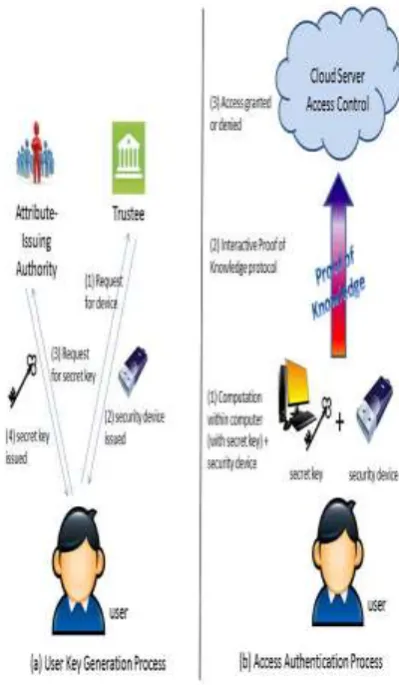
authentication pass. There is also a linking relationship between the user’s device and the secret key so that the user cannot use another user’s device for the authentication. The communication overhead is minimal and the computation required in the device is just some lightweight algorithms such as hashing or exponentiation over group GT .2 All the heavy computations such as pairing are done on the computer. The idea of our system is illustrated in Figure 1.
Fig:1 Overview of our idea system
B. Entities
Our system consists of the following entities: • Trustee: It is responsible for generating all system parameters and initialise the security device. • Attribute-issuing Authority: It is responsible to generate user secret key for each user according to their attributes.
• User: It is the player that makes authentication with the cloud server. Each user has a secret key issued by the attribute-issuing authority and a security device initialized by the trustee.
anonymous authorised users. It interacts with the user during the authentication process.
C. Assumptions
The focus of this paper is on preventing private information leakage at the phase of access authentication. Thus we make some assumptions on system setup and communication channels. We assume each user communicates with the cloud service provider through an anonymous channel [26], or uses IP-hiding technology. We also assume that trustee generates the security parameters according to the algorithm prescribed. Other potential attacks, such as IP hijacking, distributed denial-of-service attack, man-in-the-middle attack, etc., are out of the scope of this paper.
D. Threat Model
In this paper, we consider the following threats: 1) Authentication: The adversary tries to access the system beyond its privileges. For example, a user with attributes {Student, Physics} may try to access the system with policy “Staff” AND “Physics”. To do so, he may collude with other users. 2) Access without Security Device: The adversary tries to access the system (within its privileges) without the security device, or using another security device belonging to others.
3) Access without Secret Key: The adversary tries to access the system (within its privileges) without any secret key. It can have its own security device. 4) Privacy: The adversary acts as the role of the cloud server and tries to find out the identity of the user it is interacting with.
IV ADVANTAGES OF PROPOSED SYSTEM A. Specification of the Security Device We assume the security device employed in our system satisfies the following requirements. 1) Tamper-resistance. The content stored inside the security device is not accessible nor modifiable once it is initialized. In addition, it will always follow the
algorithm specification.
2) Capability. It is capable of evaluation of a hash function. In addition, it can generate random numbers and compute exponentiations of a cyclic group defined over a finite field.
B. Construction
1) System Setup: The system setup process consists of two parts. The first part TSet is run by a trustee to generate public parameters. The second part A Set is run by the attribute-issuing authority to generate its master secret key and public key.
2) User Key Generation: The user key generation process consists of three parts. First, the user generates his secret and public key in USet. Then the security device is initialized by the trustee in Device
Initialization. Finally the attributeissuing authority generates the user attribute secret key according to the user’s attribute in AttrGen.
3) Access Authentication:The access authentication process is an interactive protocol between the user and the cloud service provider. It requires the user to have his partial secret key, attribute secret key3 and the security device.
V. CONCLUSION
In this paper, we have presented a new 2FA (including both user secret key and a lightweight security device) access control system for web-based cloud computing services. Based on the attribute-based access control mechanism, the proposed 2FA access control system has been identified to not only enable the cloud server to restrict the access to those users with the same set of attributes but also preserve user privacy. Detailed security analysis shows that the proposed 2FA access control system achieves the desired security requirements. Through performance evaluation, we demonstrated that the construction is “feasible”. We leave as future work to further improve the efficiency while keeping all nice features of the system.
REFERENCES
[1] M. H. Au and A. Kapadia, “PERM: Practical reputation-based blacklisting without TTPS,” in
Proc. ACM Conf. Comput. Commun. Secur. (CCS), Raleigh, NC, USA, Oct. 2012, pp. 929–940.
[2] M. H. Au, A. Kapadia, and W. Susilo, “BLACR: TTP-free blacklistable anonymous credentials with reputation,” in Proc. 19th NDSS, 2012, pp. 1–17.
[3] M. H. Au, W. Susilo, and Y. Mu, “Constant-size dynamic k-TAA,” in Proc. 5th Int. Conf. SCN, 2006, pp. 111–125.
[4] J. Baek, Q. H. Vu, J. K. Liu, X. Huang, and Y. Xiang, “A secure cloud computing based framework for big data information management of smart grid,”
IEEE Trans. Cloud Comput., vol. 3, no. 2, pp. 233– 244, Apr./Jun. 2015.
[5] M. Bellare and O. Goldreich, “On defining proofs of knowledge,” in Proc. 12th Annu. Int. CRYPTO, 1992, pp. 390–420.
[6] J. Bethencourt, A. Sahai, and B. Waters, “Ciphertext-policy attributebased encryption,” in
Proc. IEEE Symp. Secur. Privacy, May 2007, pp. 321–334.
[8] D. Boneh, X. Ding, and G. Tsudik, “Fine-grained control of security capabilities,” ACM Trans. Internet Technol., vol. 4, no. 1, pp. 60–82, 2004.
[9] J. Camenisch, “Group signature schemes and payment systems based on the discrete logarithm problem,” Ph.D. dissertation, ETH Zurich, Zürich, Switzerland, 1998.
[10] J. Camenisch, M. Dubovitskaya, and G. Neven, “Oblivious transfer with access control,” in Proc. 16th ACM Conf. Comput. Commun. Secur. (CCS), Chicago, IL, USA, Nov. 2009, pp. 131–140.
[11] J. Camenisch and A. Lysyanskaya, “A signature scheme with efficient protocols,” in Proc. 3rd Int. Conf. Secur. Commun. Netw. (SCN), Amalfi, Italy, Sep. 2002, pp. 268–289.
[12] J. Camenisch and A. Lysyanskaya, “Signature schemes and anonymous credentials from bilinear maps,” in Advances in Cryptology. Berlin, Germany: Springer-Verlag, 2004, pp. 56–72.
[13] Y. Chen, Z. L. Jiang, S. M. Yiu, J. K. Liu, M. H. Au, and X. Wang, “Fully secure ciphertext-policy attribute based encryption with security mediator,” in
Proc. ICICS, 2014, pp. 274–289.
[14] S. S. M. Chow, C. Boyd, and J. M. G. Nieto, “Security-mediated certificateless cryptography,” in
Public Key Cryptography (Lecture Notes in Computer Science), vol. 3958. Berlin, Germany: Springer-Verlag, 2006, pp. 508–524.
[15] C.-K. Chu, W.-T. Zhu, J. Han, J.-K. Liu, J. Xu, and J. Zhou, “Security concerns in popular cloud storage services,” IEEE Pervasive Comput., vol. 12, no. 4, pp. 50–57, Oct./Dec. 2013.
[16] R. Cramer, I. Damgård, and P. D. MacKenzie, “Efficient zero-knowledge proofs of knowledge without intractability assumptions,” in Public Key Cryptography (Lecture Notes in Computer Science), vol. 1751, H. Imai and Y. Zheng, Eds. Berlin, Germany: Springer-Verlag, 2000, pp. 354–373.
[17] Y. Dodis, J. Katz, S. Xu, and M. Yung, “Key-insulated public key cryptosystems,” in Proc. EUROCRYPT, 2002, pp. 65–82.
[18] Y. Dodis and A. Yampolskiy, “A verifiable random function with short proofs and keys,” in
Public Key Cryptography (Lecture Notes in Computer Science), vol. 3386, S. Vaudenay, Ed.
Berlin, Germany: Springer-Verlag, 2005, pp. 416– 431.
[19] M. K. Franklin, in Proc. 24th Annu. Int. Cryptol. Conf., Santa Barbara, CA, USA, Aug. 2004.
[20] V. Goyal, O. Pandey, A. Sahai, and B. Waters, “Attribute-based encryption for fine-grained access control of encrypted data,” in Proc. 13th ACM Conf. Comput. Commun. Secur., 2006, pp. 89– 98.
[21] J. Han, W. Susilo, Y. Mu, and J. Yan, “Privacy-preserving decentralized key-policy attribute-based encryption,” IEEE Trans. Parallel Distrib. Syst., vol. 23, no. 11, pp. 2150–2162, Nov. 2012.
[22] X. Huang et al., “Cost-effective authentic and
anonymous data sharing with forward security,”
IEEE Trans. Comput., vol. 64, no. 4, pp. 971–983, Apr. 2015.
[23] J. Hur, “Attribute-based secure data sharing
with hidden policies in smart
grid,” IEEE Trans. Parallel Distrib. Syst., vol. 24, no. 11, pp. 2171–2180,Nov. 2013.
[24] J. Hur, “Improving security and efficiency in attribute-based data sharing,” IEEE Trans. Knowl. Data Eng., vol. 25, no. 10, pp. 2271–2282, Oct. 2013.
[25] T. Jiang, X. Chen, J. Li, D. S. Wong, J. Ma, and J. Liu, “TIMER: Secure and reliable cloud storage against data re-outsourcing,” in Proc. 10th Int. Conf. ISPEC, 2014, pp. 346–358.
[26] A. Juels, D. Catalano, and M. Jakobsson, “Coercion-resistant electronic elections,” in Proc. WPES, 2005, pp. 61–70.
[27] J. Lai, R. H. Deng, C. Guan, and J. Weng, “Attribute-based encryption with verifiable outsourced decryption,” IEEE Trans. Inf. Forensics Security, vol. 8, no. 8, pp. 1343–1354, Aug. 2013.
[28] M. Li, X. Huang, J. K. Liu, and L. Xu, “GO-ABE: Grouporiented attribute-based encryption,” in
Proc. 8th Int. Conf. NSS, 2014, pp. 260–270.
[29] M. Li, S. Yu, Y. Zheng, K. Ren, and W. Lou, “Scalable and secure sharing of personal health records in cloud computing using attributebased encryption,” IEEE Trans. Parallel Distrib. Syst., vol. 24, no. 1, pp. 131–143, Jan. 2013.
[30] K. Liang et al., “A DFA-based functional proxy
sharing,” IEEE Trans. Inf. Forensics Security, vol. 9, no. 10, pp. 1667–1680, Oct. 2014.
[31] K. Liang, J. K. Liu, D. S. Wong, and W. Susilo, “An efficient cloud-based revocable identity-based proxy re-encryption scheme for public clouds data sharing,” in Proc. 19th ESORICS, 2014, pp. 257– 272.
[32] K. Liang, W. Susilo, and J. K. Liu, “Privacy-preserving ciphertext multisharing control for big data storage,” IEEE Trans. Inf. Forensics Security, vol. 10, no. 8, pp. 1578–1589, Aug. 2015. [33] J. K. Liu, M. H. Au, W. Susilo, K. Liang, R. Lu, and B. Srinivasan,“Secure sharing and searching for real-time video data in mobile cloud,”
IEEE Netw., vol. 29, no. 2, pp. 46–50, Mar./Apr. 2015.
[34] J. K. Liu, M. H. Au, W. Susilo, and J. Zhou,
“Enhancing location privacy
for electric vehicles (at the right time),” in Proc. 17th Eur. Symp. Res.Comput. Secur., Pisa, Italy, Sep. 2012, pp. 397–414.
[35] H. K. Maji, M. Prabhakaran, and M. Rosulek, “Attribute-based signatures,” in Topics in Cryptology, vol. 6558. Berlin, Germany: Springer-Verlag, 2011, pp. 376–392.
A
uthor’s Profile
Ms. Akula Sreeja pursuing M. Tech in Computer Science and Engineering from PACE Institute Of Technology and
Sciences affiliated to the
Jawaharlal Nehru technological University,Kakinada.
Mr.G.Srinivasa Rao
has received his B.Tech and M.Tech PG. He is pursuing his Ph.D
from JNTU
Ananthapuram.He is
Dedicated to Teaching Field from the last 10 Years. He has Guided 20 P.G Students and 30 U.G Students. At Present He is Working as Assoc.Professor in PACE Institute Of Technology and Sciences, Vallur, Prakasam(Dt), AP, India.He is Highly Passionate and Enthusiastic about his Teaching and Believes that Inspiring Students to