?
Jan Camenisch1, Maria Dubovitskaya1,2, Robert R. Enderlein1,2, and Gregory Neven1
1
IBM Research – Zurich, S¨aumerstrasse 4, CH-8803 R¨uschlikon, Switzerland
2
Department of Computer Science, Swiss Federal Institute of Technology (ETH Z¨urich), CH-8092 Z¨urich, Switzerland
Abstract. The notion of oblivious transfer with hidden access control policies (HACOT) was recently proposed by Ca-menisch et al. (Public-Key Cryptography 2011). This primitive allows a user to anonymously query a database where each record is protected by a hidden attribute-based access control policy. At each query, the user either learns the value of a single record if the attributes in his key satisfy the policy, or the mere fact that his attributes do not satisfy the policy. The database, even when colluding with the key issuer, learns nothing about the identity of the user, the index or the access policy of the record, or whether access was granted or denied. At the same time, the database can keep an eye on the overall access frequency to prevent the data from being “crawled”.
In this paper, we present a new HACOT scheme which is more efficient and offers more expressive policies than the scheme presented by Camenisch et al. We construct our HACOT protocol based on a hidden ciphertext-policy attribute-based en-cryption (HP-ABE) scheme by Nishide et al.: users are issued HACOT deen-cryption keys based on HP-ABE attributes and HACOT records are encrypted under HP-ABE policies. However, as we will see, this simple approach does not work and we need to extend the Nishide et al. scheme as follows. First, we add protocols that allows users to verify that the public key of the issuer and ciphertexts are correctly formed. Second, we reserve one attribute and give the corresponding decryption key only to the database. Thereby users can no longer decrypt records by themselves but require the help of the database. Third, we provide a joint decryption protocol between the user and the database, so that the database does not learn which ciphertext is decrypted. The latter will also allow one to optionally add revocation of the users’ access. We prove our con-struction secure by a reduction to the security of Nishide et al.’s scheme, the Symmetric External Diffie-Hellman (SXDH) and Simultaneous Flexible Pairing (SFP) assumptions.
Keywords:Privacy, Oblivious Transfer, Attribute-Based Encryption.
?
1 Introduction
Consider a medical database containing patients’ medical records. Clearly, proper encryption and access control mechanisms need to be in place to protect such sensitive data. Different access control policies may apply to different records, ensuring for example that only relevant specialists and the treating medical staff have access to a patient’s record. Given the frequent changes in medical personnel at hospitals, a role-based or attribute-based approach seems a natural solution.
Mere access control may not be enough, however. First, the access control policy by itself may leak sensitive information about a patient’s illness. For example, the nature of a patient’s health problem is pretty clear if an oncologist, a psychiatrist, or a plastic surgeon has access to his or her record. The treating medical staff may also have an interest in hiding the access control policies, e.g., to avoid being approached by the press when treating celebrities. Second, the query pattern for a particular record may reveal considerable information about the seriousness of the patient’s condition or the phase of treatment. It is therefore desirable that the database can be queried anonymously, so that the database administrator remains oblivious as to who accesses which record at which time. Third, the database owner may want to prevent its users from abusing their anonymity to “crawl” the database and re-create a copy outside the owner’s control. The database must therefore be able to detect unusual query activity to throttle requests, e.g., by inserting time delays or by presenting CAPTCHAs.
Narayan et al. [NGSN10] proposed a privacy-preserving Electronic Health Records (EHR) system that allows one to share patient data among healthcare providers in the cloud, using attribute-based encryption. However, the cloud provider still learns which files get downloaded (the scheme does not provide oblivious access to the data), the access control policy of records is not hidden, and revocation only works when all data is deleted from the user’s device after each query.
A full-fledged solution is given by Camenisch et al. [CDNZ11], who combine adaptive oblivious transfer (OT), anonymous credentials, and zero-knowledge proofs to build a primitive called Oblivious Transfer with Hidden Access Control Policies (HACOT).
As observed by Camenisch et al. [CDNZ11], attribute-based encryption with hidden ciphertext policies (HP-ABE) [KSW08,NYO08,LOS+10] is a similar primitive: a user’s decryption key is associated with a list of attributes, while a ciphertext is associated with a hidden access control policy so that it can only be decrypted by users whose attributes satisfy the policy. Thus one could attempt to apply anHP-ABEscheme in the scenario above: issuing decryption keys to the medical personnel, encrypting each patient’s record under the appropriate policy, and sending all ciphertexts to all users, all mentioned security requirements are met. However, this approach does not offer all the necessary security features, as we will discuss in detail in this paper. For example, it allows users to crawl the database and “bulk-decrypt” all records to which they have access offline. Also, it is not possible to revoke access, an indispensable feature in a changing environment such as a hospital’s workforce. Revocation is notoriously difficult to implement in identity-based and attribute-based encryption systems, with most practical solutions requiring a painful trade-off to be made between security and frequency of key updates and database re-encryptions. Finally, as we will explain in more detail later, aHP-ABEscheme does not exclude that a single ciphertext decrypts to different plaintexts for different users, leading to anonymity problems. So, a plain application ofHP-ABEis not satisfactory and, indeed, the construction of anHACOTscheme based onHP-ABEwas left as an open problem by Camenisch et al. [CDNZ11].
We also address a deficiency in the definition and protocol by Camenisch et al. [CDNZ11]: in their ideal functionality, users are returned⊥if they do not have the necessary access rights, but in their protocol, they receive a random message in this case. We address this as follows: we define the ideal functionality 1) to handle only encryption keys that can then be used to derive keys for a symmetric encryption scheme and 2) in case a user has no access, the functionality will return a random key to the user.
Our construction relies on interactive zero-knowledge proofs of knowledge [CDM00], Groth-Sahai non-in-teractive proofs [GS08], the privacy-friendly signature scheme by Abe et al. [AFG+10] and anHP-ABEscheme that allows transformations described in Section 4. OurHACOT protocol offers several advantages over that of Camenisch et al. [CDNZ11]. First, access control policies in our protocol are specified as vectors of subsets of polynomial-size attribute universes, which is more expressive than the boolean attributes of their scheme. Commu-nication and computation by the database in the decryption protocol is independent of the number of attributes in our scheme, versus linear in theirs. Indeed, already for 3 attributes all operations are more efficient in our scheme except the key generation where ours is costly (using realistic security parameters for both schemes).
We prove our construction secure in the common reference string (CRS) model under the Symmetric eXternal Diffie-Hellman (SXDH) assumption, the Simultaneous Flexible Pairing (SFP) [AFG+10] assumption, and the se-curity of the underlying HP-ABEscheme (in the case of Nishide et al.’s scheme: generic bilinear group model). We also implemented a prototype of our protocol and provide a theoretical efficiency analysis and experimental performance results. Notice that database updates are also supported in our scheme, and records can be added to the database without having to re-encrypt the whole database. The database provider just distributes an update containing the ciphertexts of the new records.
Related Work. All attribute-based [SW05,BSW07,NYO08,LOS+10] and predicate [KSW08,LOS+10] encryp-tion schemes allow for offline decrypencryp-tion, and can therefore not be used as such for the scenario we envisage. Some of these schemes [KSW08,NYO08,LOS+10] arepolicy-hiding, meaning that users cannot deduce anything about the policy of a ciphertext except whether their key satisfies it. The schemes of Katz et al. and Lewko et al. [KSW08,LOS+10] allow for conjunctions and disjunctions in the policy, but require composite-order bilinear groups. The scheme of Nishide et al. [NYO08] allows for slightly less powerful policies but works in a prime-order group setting. The scheme of Lewko et al. [LOS+10] and the second construction of Nishide et al. [NYO08] are fully secure in the generic group model [Nis08], whereas the other schemes are only selectively secure.
There is an extensive body of literature on the subject of oblivious transfer [Rab81]. In this paper we use the adaptive k-out-of-n variant [NP99,CNS07], where a user may query for up tok records from a database of n records. The user does not learn anything about the(n−k)records he did not query, while the database does not learn which records were queried. The goal is to “amortize” communication costs so that the encrypted database of size linear innis transmitted once, but each transfer afterwards has communication cost independent ofn. Several extensions to adaptive k-out-of-n OT have been proposed, including pricing [CDN10] and access control with known [CDN09,CGH09] and hidden [CDNZ11] policies. Our protocol is an alternative instantiation of the latter primitive.
Zhang et al. [ZAW+10] have proposed a scheme that combines the OT protocol of Camenisch el al. [CNS07] with the attribute based encryption scheme of Lewko et al. [LOS+10] and achieves oblivious transfer with access control functionality, but their scheme does not cover the hidden policy case and does not provide revocation of users. We also show in Section 4 that this scheme cannot be extended to a hidden policy while preserving our
HACOTsecurity properties.
Green et al. [GHW11] propose a way to outsource the main computation for decrypting ABE ciphertexts to a (possibly passively malicious) proxy, however their approach does not fit well with our real-world/ideal-world security notions since it is not clear what guarantees the user has if the proxy maliciously deviates from its specifi-cations.
2 Definitions
rights to the database by setting access policies; andusers, who anonymously fetch records that they are entitled to access. LetIdenote the issuer,DBthe set of all databases,DB%the database with index%,Uthe set of all users,
Uϕthe user with indexϕ.
2.1 Syntax and Basic Terminology
ByN we denote the set of natural numbers, byNn the set of all natural numbers between 0 and(n−1). ByZp we denote the ring of integers modulop. We useN∗n andZ∗p to denoteNn\ {0}andZp \ {0}, respectively. By
e :G1×G27→GTwe denote a bilinear map. Ifκ∈N, then1κdenotes the string consisting ofκones.
IfAis a set, thena←$ Ameans we setato a random element of that set. IfAis a Probabilistic Polynomial-Time (PPT) algorithm or interactive machine, then y ← A$ (x)means we assign y to the output ofAwhen run with fresh random coins on inputx. IfAandBare two interactive machines, then let(InA||InB)→(OutA||OutB)
denote the sets of inputs and outputs ofAandBduring the interaction between these two machines.
2.2 Record Policies and User Attributes
OurHACOTscheme uses the same policy framework as theHP-ABEscheme by Nishide et al. [NYO08]. We recall the notation below for convenience.
All records in the database are encrypted. The database DB% can specify an access policy for an encrypted recordC%,ψ, which is called a ciphertext policy (W%,ψ). The issuer givesUϕa secret decryption key corresponding to the set of access attributes(Lϕ)granted to the user.
We denote languages for the attributes and policies asLLandLW respectively. We writeL|=W to mean that W is satisfied byL, andL6|=W if not (i.e., a user key corresponding toL, respectively can and cannot decrypt a ciphertext with policyW).
We now describe the structure of attributes and policies in more detail. The keys issued to users are associated with a list of attributesL = (L1, . . . , Ln)fromndifferent categories. Letni ∈ N be the (finite and polynomial) number of possible attribute values in thei-th category. Without loss of generality, we can encode theniattributes of categoryias elements ofNni, so thatLi ∈Nni. For example, in a hospital scenario, then= 3categories could
be (Job Title, Department, Gender), where Job Title can take any of then1 = 5attributes{student, nurse, doctor, surgeon, administration}, Department can take any of the n2 = 4attributes {cardiology, maternity, neurology, oncology}, and Gender can be any of then3= 2attributes{male, female}.
Each record in the database has an access control policy associated with it. A policyW = (W1, . . . , Wn)is expressed as a list ofnsubsets of attributesWi ⊆ Nni. A key endowed with the attribute list Lis authorized to
access a record if and only if all attributes in the key are also in the ciphertext policy, i.e.,L|=W ⇔ ∀i∈N∗
n+1: Li ∈ Wi. For example, Alice may be a surgeon in the oncology department, so that her key is associated with (surgeon, oncology, female), while Bob, who is an administrative assistant in the maternity department, has key (administration, maternity, male). If a patient’s medical record is protected by a policyW =({doctor, surgeon},
{cardiology, oncology},{male, female}), then Alice can access the record, but Bob cannot.
One could view the ciphertext policy as implementing a limited version of conjunctive normal form: within a category, the policy specifies an OR condition on the attribute the user key has for that category; and all attributes of the key have to be in the access structure, basically an AND condition. Note that the access structure is hidden from the user, meaning that he cannot recover it from the ciphertext alone.
2.3 Definition ofHACOTwithout Revocation
AHACOTscheme is a tuple of the following eight PPT algorithms and protocols:
• IssuerSetup(LL,LW) →$ (pkI,skI). This algorithm generates the system-wide issuer public keypkI and
• VerifyIssuerKey (pkI)||(pkI,skI)
$
→ (b||ε). Upon receiving the public key of the issuer, each user and each database runs this protocol with the issuer, so that the latter can prove that the issuer keys are correctly formed. The common input is the issuer’s public key, the issuer’s private input is his secret key. The output is a bit bindicating whether the user or database accepts the issuer’s key.
• DBSetup(pkI)
$
→(pkDB%,skDB%). The database with index%runs this algorithm to generate its public key
pkDB%and corresponding private keyskDB%.
• VerifyDBKey (pkI,pkDB%)||(pkI,pkDB%,skDB%)
$
→(b||ε). Upon receiving the public key ofDB%, each user runs this protocol with the databaseDB%, so that the latter can prove in zero-knowledge that it knows the secret key corresponding to its public key. The common input consists of the issuer’s and the database’s public keys. The database’s private input is its secret key. The output is a bitbindicating whether the public keypkDB%is accepted.
• IssueRecord(pkI,pkDB%,skDB%, K%,ψ, W%,ψ) $
→ C%,ψ. The databaseDB% runs this algorithm to publish a new record with indexψ. The input are the database’s key pair, the issuer’s public key, the plaintextK%,ψ ∈GT, and the ciphertext policyW%,ψ ∈ LW. The output is the ciphertextC%,ψ.
• CheckRecord(pkI,pkDB%,C%,ψ) $
→b. Upon receiving a ciphertextC%,ψ, each user performs a check to test whether it is correctly formed. The output bitbindicates the result of that check.
• Escrow(skI,pkI,pkDB%,C%,ψ) $
→(K%,ψ, W%,ψ). With this algorithm,Ican efficiently recover the plaintext and the policy of the ciphertextC%,ψ without interacting withDB%. This algorithm models the fact that in most
HP-ABEsystems, the issuer can recover a great deal of information from all ciphertexts by using his private key.
• IssueUserKey (pkI, ϕ,Lϕ)||(pkI,skI, ϕ,Lϕ)
$
→ (skUϕ||ε). The user with index ϕ and the issuer run this interactive protocol to generate a new secret key skUϕ for Uϕ. We assume that the protocol is run over an authenticated channel. Common inputs areϕ, attributesLϕ ∈ LL, and the public key of the issuer. The issuer has his secret key as private input. Only the user receives output from this protocol, namely his secret keyskUϕ.
• Query (skUϕ,pkI,pkDB%,C%,ψ)||(pkI,pkDB%,skDB%)
$
→ (K0||ε). The user Uϕ queries databaseDB% to attempt to decrypt recordψ. The common input contains the public keys of the issuer and database. The user’s private input is his secret key and the ciphertextC%,ψ. (A more general definition would include the entire encrypted database in the user’s input, but the most efficient schemes should not need this.) The database’s secret input is its private key. Only the user receives output from this protocol, namely the recovered plaintext K0. If decryption was successful, thenK0 = K%,ψ, otherwiseK0 is a random element ofGT. Queries take place over anonymous channels so that the database does not know with which user it interacts.
We assume that the CRS and system parameters are generated according to the appropriate distributions and are made available to all participants.
This definition is similar to the definition of HACOT in [CDNZ11]. The differences are as follows: 1) our definition allows for more expressive policies; 2) records can be added individually instead of setting them up all at once at system startup; 3) our system allows for multiple independent databases; and 4) we explicitly model the level of access that the issuer has in our system though the Escrow functionality. With respect to the last point, our scheme is at a disadvantage compared to [CDNZ11]: while the issuer in [CDNZ11] can always generate for himself a user key that decrypts all records, he must interact with the database to recover the plaintext of a record; to recover the policy, one interaction with the database per attribute is necessary.
2.4 Security Definitions
To define the security of our protocol we take an approach from [CNS07,CDNZ11] which is inspired by universal composability [Can00] and reactive systems [PW00,PW01]. Namely, we prove aHACOTprotocol secure through an indistinguishability argument between the instantiation ofHACOTin the real worldRHACOT, where players run the set of cryptographic protocols, and an ideal world functionalityFHACOT, which applies the functionality the cryptographic protocols are supposed to realize.
In the real world after receiving a message from the environment E all parties run the corresponding crypto-graphic algorithms or engage in the protocols described in Section 2.3.
We briefly describe the FHACOTfunctionality below and provide a formal ideal world definition in Appendix
Ideal World (sketch). In the ideal world,FHACOTperforms all actions only after relaying all received messages to the simulatorSand getting an approval fromS. After receiving a first message from the issuer,FHACOT fixes the set of possible attributes and policies. It further relays all messages between users, databases and issuer during the Issuer and Database Setup phases and creates a list of all databases and users. Note that after Setup is completed, it is not possible to add users or databases. Later, during Record Issuance,FHACOTstores records and their policies upon request from the database. This can be repeated any number of times, meaning that the records can be added at any time. When receiving a key request from a user,FHACOT stores an entry with the set of attributes for that user’s key. Finally, during a Query,FHACOT removes the user and record identifier from the user’s request before forwarding it toSand to the corresponding database. After the database replies with a bitb,FHACOTchecks whether
the set of user’s attributes satisfies the policy of the requested record; ifb= 0, then it sends⊥to the user; ifb= 1
and the policy is satisfied, it sends the stored record back to the user, otherwise, it sends back a random group element.
Discussion of Security Properties. Informally, the specification of the ideal functionality FHACOT is such that the following security properties are trivially satisfied. Hence, any real-world implementation of the scheme must satisfy the same properties.
Database security. Users need to contact the database for each record that they want to access, so the database can keep an eye on the overall access frequency and throttle too-frequent requests. Users cannot determine whether their key satisfies the access policy of the record before the interaction. They cannot deduce anything about the contents of a record if they did not query it with a valid key that satisfies the policy. After a successful interaction, users cannot deduce anything about the policy except whether their key satisfies it or not. Cheating and colluding users cannot query any records that one of them could not have queried individually. In particular, they cannot “combine” or “rearrange” attributes in their keys.
User security. The only information that the database sees during a query is the mere fact that a query takes place. In particular, it cannot determine which user queries which record, which policy is associated to the record, which attributes the user has, and whether access to the record was granted or not. User security is valid even if the database colludes with the issuer and other users. If the query protocol completes successfully, honest users are guaranteed that 1) if access was granted, then their key satisfies the policy of the record and 2) if access was denied, then their key does not satisfy the policy of the record.
3 Preliminaries
In this section we describe the security assumptions and building blocks used in our scheme.
3.1 Assumptions
Decisional Diffie-Hellman (DDH) Assumption. LetGbe eitherG1,G2 orGT (and letgbe the corresponding generator of the group, viz.g1,g2,gT). Leta, b, z
$
←Zp. DDH is hard inGif for every PPT algorithmA:
AdvDDHG =def
Pr
h
A(g, ga, gb, gab)= 1$? i
−Pr h
A(g, ga, gb, gz)= 1$? i
=negl. (1)
`-Simultaneous Flexible Pairing (SFP) Assumption. LetA, B ←$ G1,A,˜ B˜ ←$ G2 andgZ, fZ, gR, fU $
← G∗
1. Forj∈N∗
`+1letPj =def Zj, Rj, Sj, Tj, Uj, Vj, Wj
that satisfies:
e(A,A˜) = e(gZ, Zj) e(gR, Rj) e(Sj, Tj)∧
e(B,B˜) = e(fZ, Zj) e(fU, Uj) e(Vj, Wj) . (2)
We say that the`-SFP assumptions holds inG1if for all PPT algorithmsA(3) is satisfied [AFG+10,AHO10], whereP`+1satisfies (2) andZ`+1 6= 1∧ ∀i∈N∗`+1:Z`+16=Zi.
Adv`−SFP
G1 def
= Pr h
AgZ, fZ, gR, fU, A, B,A,˜ B, Pj˜ `j=1
$?
=P`+1
i
=negl. (3)
We define`-SFP inG2analogously by exchanging the groupsG1 andG2above.
This assumption is parameterized by`(unlike the other assumptions which are static), where a larger`means a stronger assumption. This assumption was proven to hold in the generic bilinear group model [AHO10], as long as`√p(quadratic bound).
3.2 Zero-Knowledge Proofs
ZKPK denotes an interactive zero-knowledge proof (or argument) of knowledge [CDM00], whileNIZK denotes a non-interactive zero-knowledge proof [GS08]. We will use the Camenisch-Stadler notation [CS97] to describe what is being proven, for example:ZKPK{(α, β) : y = gα∧z = gβhα}. Variables in parenthesis denote the elements knowledge is proven about, such that the formula after the colon is true. Further details can be found in Appendix A.1 and A.2.
3.3 Hidden-Policy Attribute-Based Encryption
AHP-ABEscheme is a tuple of the following four PPT algorithms:
• IssuerSetup(1κ,LL,LW)→$ (pkhI,skhI). UsingLL,LW, and a security parameter as input, this algorithm outputs the public and secret keys ofI.
• IssueUserKey(skhI,pkhI, L)
$
→ skhU. Given a permissible set of attributesL ∈ LL and the issuer’s key pair, this generates a new user keyskhU endowed withL.
• Encrypt(pkhI, K, W)
$
→C. Given a plaintextK ∈GT, a permissible ciphertext policyW ∈ LW, and the issuer’s public keypkhI, this algorithm generates a corresponding ciphertextC.
• Decrypt(skhU,pkhI,C)→K0. Given a ciphertextC, the user’s secret keyskhU, and the issuer’s public key
pkhI, this algorithm decrypts the ciphertext with the user’s secret key. If the key satisfies the policy (L|=W), then
the correct plaintext is recovered (K0=K). If the key does not satisfy the policy thenK0 6=Kwith overwhelming probability.
Security of HP-ABE. Informally, anHP-ABEscheme is secure if an adversary, who can adaptively get as many keys issued as he wants, cannot tell if a given challenge ciphertext decrypts to some plaintextM0under policyW0 or to some other plaintextM1 underW1 of his choosing (modulo the trivial cases). A precise definition is given in Appendix A.5. Note that someHP-ABEschemes are onlyselectivelysecure (meaning the adversary must fix the challenge plaintexts and policies before he receives the issuer’s key), but this is not sufficient for our scheme.
We use the second construction of Nishide et al.’sHP-ABE[NYO08] scheme. It is proven secure in the generic bilinear group setting [Nis08], and requires Type-3 pairings. It allows the issuer to add attributes and categories after system setup. In their scheme the issuer is assumed to be trusted, unlike ourHACOTscheme.
3.4 Structure-Preserving Signatures
a set of group elements, we use the basic signature scheme by Abe et al. [AFG+10] for signing group elements. This scheme does not require the signer to know the discrete logarithm of the group elements he is signing. It is existentially unforgeable against adaptive chosen message attacks if the Simultaneous Flexible Pairing assumption [AFG+10] holds.
This signature schemeSigallows the user to re-randomize (blind) the signature and prove in zero-knowledge that this is still a correct signature. The user’s anonymity is thus preserved, and the database has the guaran-tee that it is not helping the user to decrypt invalid ciphertexts. The scheme consists of a key generation algo-rithmSig.KeyGen; a signing algorithmSig.Sign; a verification algorithmSig.Verify; a re-randomization algorithm
Sig.Rerand, that takes as input a signatureσ of a messagemand outputs a re-randomized signatureσ0, which is also a valid signature onm; and two algorithmsSig.KeyProveandSig.Provefor proving in zero-knowledge the validity of the key and the signature respectively. See Appendix A.3 for more details.
4 AchievingHACOTfromHP-ABE
Let us give some intuition and a high-level description of our scheme, in particular how to extend a HP-ABE
scheme into an oblivious access control system with hidden policies. In our protocol we use a concreteHP-ABE
scheme by Nishide et al. [NYO08], but one can apply a similar trick to other HP-ABEschemes. Recall that in
HP-ABE, a user’s decryption key is associated with a list of attributes, while a ciphertext is associated with a hidden access control policy. A user can decrypt a ciphertext offline only if the attributes from his key satisfy the cipertext policy. Assume a database would just employ anHP-ABEscheme to encrypt all records and then publish these encryptions. Users would be issued the HP-ABE decryption keys corresponding to their attributes. In this approach, the access control policies would indeed be hidden and also users would only be able to access the records for which their attributes match the access control policies. Unfortunately, this solution does not provide all the properties thatHACOTrequires:
• First, somewhat counterintuitively, anonymity of the users is not guaranteed: in case the database and the issuer are malicious, they could deviate from the key issuance and encryption procedures so that if two users with the same attributes decrypt a record their result will still be different; hence, the scheme would not satisfy our ideal world definition. In a higher-level protocol, the two users might be distinguishable.
• Second, users can immediately decrypt all the records for which they have the necessary attributes. This will allow colluding users to derive information about the policies. Furthermore, the database has no control over the access frequency of records and cannot revoke access rights.
To address the first issue, we make the operations by the issuer and the database verifiable. We add an ad-ditional protocol (VerifyIssuerKey) in which the issuer proves that its keys were generated correctly, we turn the
IssueUserKeyalgorithm that generates users’ decryption keys into a two-party computation between the issuer and the user, and we provide a protocol VerifyEncryption allowing users to check that the ciphertexts are correctly formed.
Addressing the second issue is a bit trickier. A first idea to ensure that users cannot decrypt without the help of the database could be to combine a standard OT protocol to encrypt records twice, first under the OT protocol and then under the appropriate policies using theHP-ABEscheme. (Zhang et al. [ZAW+10] used a similar approach to obtain an OT protocol with public access control policies.) This does not suffice, however, as users can perform the outerHP-ABEdecryption step without interacting with the database and learn information about the access policies by observing whether decryption succeeds. Encrypting first under theHP-ABEscheme does not work either, since colluding users could start by doing a single OT query, and then attempt decrypting the innerHP-ABEciphertext without oversight. Besides violating our ideal world definition, such a scheme excludes any interactive revocation scheme.
On a high level, our approach is the following. We create a dedicated “zeroth” attribute category of theHP-ABE
scheme so that the issuer only issues decryption keys for one particular attribute WI in this zeroth category, but
each database encrypts records under policies that require a different attributeWDB% for the zeroth category. The
database has a “transformation key” that allows it to convert a ciphertext encrypted forWDB% into one forWI.
1. Generate HP-ABE key: w, β←$ Z∗p; Y←gTw; B←g
β 1 ;
{{ai,t←$ Z∗p; Ai,t←g ai,t
1 } ni−1
t=0 }ni=0;
skhI← {ai,t}, w, β
; pkhI← {Ai,t}, Y, B
. 2. Generate signing keys:
(sgkI,vkI)
$
←Sig.KeyGen(1κ) ;
OutputskI←(skhI,sgkI) ;
pkI←(pkhI,vkI).
Fig. 1.IssuerSetupalgorithm.
1. Generate HP-ABE keys for the DB-specific attribute:
k% $
←Zp;
A0,%←Ak0,0% =g1a0,0k%;
skhDB%←k%; pkhDB%←A0,%. 2. Generate signing keys:
(sgkDB%,vkDB%) $
←Sig.KeyGen(1κ) ;
OutputskDB%←(skhDB%,sgkDB%) ;
pkDB%←(pkhDB%,vkDB%).
Fig. 2.DBSetupalgorithm.
the database to obtain a transformed ciphertext forWI. To make sure that the user blinded a ciphertext that was
previously published by the database, the database signs all of its ciphertexts. During the decryption protocol, the user proves knowledge of a valid signature for her blinded ciphertext—without revealing the signature, of course.
Now that the database is involved in the decryption process of the user, it becomes much easier to add revoca-tion. Users are issued an anonymous credential and the database will only run the joint decryption protocol if the user’s credential has not been revoked. There are a number of possible schemes to employ here and we will follow the choice by Camenisch et al. for theirHACOTscheme [CDNZ11].
5 Our Construction Without Revocation
In this section we describe in detail how to construct ourHACOTprotocol (without the optional revocation mech-anism) when instantiated with the second HP-ABEscheme by Nishide et al. [NYO08]. The description of the construction will be followed by a discussion about asymptotic complexity. The changes needed to handle revoca-tion are described in Appendix C.
5.1 Detailed Construction
We now present the realizations of all algorithms and protocols of our scheme listed in Section 2.3 in detail.
System Parameters. We assume that the following parameters are generated by a trusted third party (or alter-natively generated jointly via a multiparty computation) and are an extra (implicit) input to all algorithms and protocols. Concretely, all primitives we use require a common bilinear map setting:(p,G1,G2,GT, g1 ∈G1, g2 ∈ G2,e)←Gen(1κ).We denotegT def= e(g1, g2). For the Groth-Sahai proofs we also need a common reference string CRS←{U1,2←g2a,U2,1←g2t,U2,2←gat2}, wherea,t
$
←Z∗p.
Issuer Key Generation and Verification. In addition to thenregular categories, the issuer creates an additional zeroth category, and creates one attribute WI in that category. Let A0,0 = g
a0,0
1 be the public key component associated to that attribute (a0,0 is the private key component). All the users’ keys he issues will contain thisWI
attribute (that isL0 = 0). The key generation algorithmIssuerSetupis depicted in Figure 1, and takes as input the number of categoriesnand the number of attributes possible per category{ni}ni=1;n0 = 1.
Each party who receives the issuer’s public key checks that the latter’s key was generated correctly by running the VerifyIssuerKey protocol, which consists of checking that Y 6= 1, B 6= 1, Ai,t 6= 1, and running the fol-lowing proof of knowledge with the issuer:ZKPK1 def= ZKPK
sgkI, w, β,{{ai,t}}
: Y = gw
T ∧B = g
β 1 ∧
Vn
i=0(
Vni−1
t=0 (Ai,t =g ai,t
1. Encrypt the record with respect to the policy with the HP-ABE scheme:
ˆ
C, C0, C0,1, C0,%,2,{{Ci,t}ni−1
t=0 }ni=1
$
←Encrypt(pkhI, K%,ψ, W%,ψ), that is:
Choose{ri ←$ Z∗p}ni=0; {i,t $
←Z∗pfor allt∈(Nni\Wi)}
n i=1. Setr =Pn
i=0rimodp; {i,t←0for allt∈Wi}ni=1; ˆC←KYr; C0←Br; C0,%,2←Ar00,%; {Ci,1←gri
1 }ni=0; {{Ci,t,2←A ri
i,tg i,t
1 } ni−1
t=0 }ni=1. 2. Generate a Groth-Sahai proofπ=NIZK3to assert correctness of the encryption:
π=def NIZK{({ri}n i=0) :
Vn
i=0(Ci,1 =g ri
1 )∧C0=
Qn
i=0Bri∧C0,%,2 =A r0 0,%}. 3. Sign the ciphertext componentC0,%,2:σ0 ←$ Sig.SignsgkDB
%(C0,%,2). OutputC%,ψ← π, σ0,C, C0, C0,1, C0,%,2,ˆ {{Ci,t}ni−1
t=0 }ni=1
.
Fig. 3.IssueRecordalgorithm.
Database Key Generation and Verification. Recall that%is the implicit database identifier. Each databaseDB% that joins the system extends the zeroth category with a new attribute,WDB%. The public key component associated
to that attribute isA0,% = Ak%
0,0, where k% is part of the database’s private key. The valueA0,% = g a0,0k%
1 can be considered as part of the public key of the “related”HP-ABEscheme, i.e., the secret key component corresponding toWDB%thereby implicitly becomesa0,% =a0,0k% (modp).
The database setup consists of an algorithmDBSetupshown in Figure 2 to generate the database’s key pair. Each user receiving pkDB% checks that the database’s public was generated correctly with the protocol
VerifyDBKey, which consists of first checking thatA0,% 6= 1, and then running the following proof of knowledge with the database:ZKPK2
def
=ZKPK
sgkDB%, k%
:A0,% =A k%
0,0∧Sig.KeyProve(sgkDB%,vkDB%) .
Verifiable Encryption of Records. To encrypt a record with (implicit) indexψ, containing the plaintextK ∈GT
and the hidden ciphertext policy W%,ψ = [W0, . . . , Wn], where∀i : Wi ⊆ Nni, the database runs IssueRecord
as shown in Figure 3. If one wants to use messages M ∈ {0,1}∗ instead, one can use an authenticated encryp-tion [BN08] algorithmAuthEncthat uses elements fromGTas symmetric keys to encryptM using the keyK.
For the zeroth category, only the ciphertext componentC0,%,2for theWDB%attribute is published and notC0,0,2
for the WI attribute. For the latter the users will have the decryption key but not for the former. However, as
C0,0,2 = (C0,%,2)k%−1, users can decrypt a record if (and only if) the database helps them.
Users need to verify all ciphertexts by runningCheckRecord, which for each record verifies correctness of the GS proofπand the signatureσ0 onC0,%,2.
Issuing Decryption Keys to Users. Let(L1, . . . , Ln), Li ∈ Nni, be the attributes of the user. We add to these
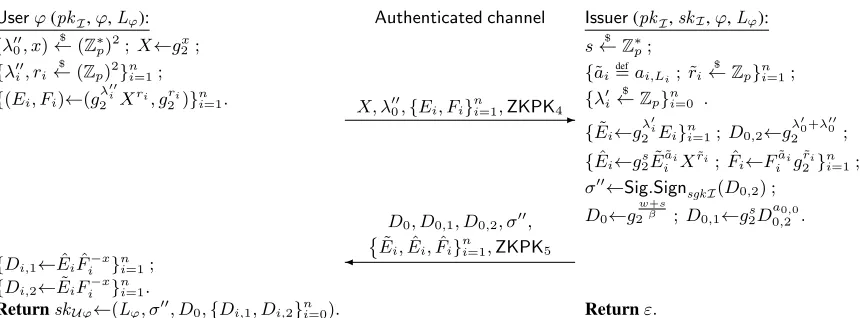
L0 = 0(corresponding toWI) and setLϕ = (L0, L1, . . . Ln). The protocol depicted in Figure 4 ensures that the keys are generated in an honest way, i.e., that theDi,j’s are computed correctly with respect toLi and contain a randomλi. To this end, the user chooses an ephemeral ElGamal key pair and a random λ00i and sends the issuer
encryptions ofgλ
00
i
2 . As discussed in Section 4, this will ensure the anonymity for the user during decryption. The issuer then chooses his own values ofλ0i and then computes the encryptions of the HP-ABEkeys by modifying the received encryptions so thatλi ≡ λ0i+λ00i (modp)will hold. For this to work, the user and the issuer have to prove to each other that they did their computation correctly with the following two proof protocols. With the first protocol ZKPK4 def= ZKPK{(x,{λ00i, ri}ni=1) : X = gx2 ∧(
Vn
i=1(Ei = g λ00i
2 Xri ∧Fi = g2ri))} the user proves to the issuer that (Ei, Fi) is a valid encryption of the value g
λ00i
2 . With the second proof of knowledge
ZKPK5 def= ZKPK{(w, β, s,{λ0i,˜ai}i=0n ,{r˜i}ni=1) : Y = gTw∧B = g
β
1 ∧1 = g2wgs2(D
−1
0 )β ∧D0,2 = g λ000 2 g
λ00 2 ∧ D0,1 =g2sD
˜ a0 0,2∧(
Vn
i=0(Ai,Li =g
˜ ai
1 ))∧(
Vn
i=1( ˜Ei =g λ0i
2 Ei∧Eˆi =gs2E˜ ˜ ai
i Xr˜i∧Fˆi =Fi˜aig r5,i
Userϕ(pkI,ϕ,Lϕ): Authenticated channel Issuer(pkI,skI,ϕ,Lϕ):
(λ000, x)
$
←(Z∗p)2; X←gx2; {λ00i, ri
$
←(Zp)2}ni=1; {(Ei, Fi)←(g
λ00i
2 X
ri, gri
2 )}
n i=1.
s←$ Z∗p;
{˜ai=defai,Li; ˜ri $
←Zp}ni=1; {λ0i
$
←Zp}ni=0 .
X, λ000,{Ei, Fi}ni=1,ZKPK4
-{E˜i←gλ0i
2 Ei}ni=1;D0,2←g
λ00+λ000
2 ;
{Eˆi←gs
2E˜ia˜iX
˜
ri; ˆF
i←Fia˜ig
˜
ri
2 }
n i=1;
σ00←Sig.SignsgkI(D0,2) ;
D0←g2
w+s
β ;D0,1←gs
2D
a0,0
0,2 .
D0, D0,1, D0,2, σ00,
˜
Ei,Eˆi,Fˆi}ni=1,ZKPK5
{Di,1←EˆiFˆi−x} n i=1; {Di,2←E˜iFi−x}
n i=1.
ReturnskUϕ←(Lϕ, σ00, D0,{Di,1, Di,2}ni=0). Returnε.
Fig. 4.Interactive issuing of a user’s decryption keys. The proofsZKPK4andZKPK5are defined in the text.
Userϕ(skUϕ,pkI,pkDB%,C%,ψ): Anonymous channel Database%(pkI,pkDB%,skDB%) : BlindC0,%,2of recordψandD0,2of userϕ:
kc, kd
$
←Z∗p; C
0
←Ckc
0,%,2;D
00
←Dkd
0,2.
Re-randomize sigantures: ˜
σ0←$ Sig.Rerand(σ0) ; ˜σ00←$ Sig.Rerand(σ00). C0
, D00,ZKPK6
-Transform input:P0←e(C0, D00)k%−.1 P0,ZKPK7
UnblindP0:P←P0k−c1k−d1.
ReturnK0← CˆQni=0e(Ci,1,Di,1)
Pe(C0,D0)Qn
i=1e(Ci,Li,2,Di,2). Returnε.
Fig. 5.TheQueryprotocol. The proofsZKPK6andZKPK7are defined in the text.
key. Finally, the issuer signs the valueD0,2 using the Abe et al. signature scheme, such that the user can prove to the database that he uses the correct input in the Query protocol.
Decryption of a Record. Assume a user wants to decrypt a record;HP-ABEdecryption would work as in Equation 4 assuming the user’s key satisfies the ciphertext policy (cf. [NYO08]).
K0← Cˆ
Qn
i=0e(Ci,1, Di,1)
e(C0, D0)Qn
i=0e(Ci,Li,2, Di,2)
(4)
Intuitively, each key componentDi,2allows the user to decrypt a ciphertext componentCi,Li,2ifDi,2corresponds
to attributeLi. However, in our scheme, even if the attributes(L1, . . . Ln)in the user’s key all satisfy the policy, he could by construction not decrypt the ciphertext componentC0,%,2, because all users lack the key component for
this zeroth attribute. Indeed, the key for this would beDk
−1
%
0,2 , wherek%is the database’s secret. Thus, to decrypt, the user has to run theQueryprotocol with the database to compute P def= e(C0,%,2, Dk
−1
%
0,2 ) = e(C0,%,2, D0,2)k
−1
%
and then run the HP-ABE decryption. This protocol is given in Figure 5. It is of course important that 1) the database cannot learnC0,%,2norD0,2because otherwise it would learn which record a user attempts to decrypt and 2) the database is nevertheless ensured that the user indeed wants to compute this expression on valid inputs. The latter is achieved by having the user prove that he knows signatures onC0,%,2 andD0,2 from the database and the issuer, and the former is ensured by proper blinding of these two inputs. Note that if the user does not possess the necessary decryption keys, decryption will result in a random symmetric keyK0to be recovered (which will make the authenticated decryption algorithmAuthDecreturn⊥).
The user proves possession of signatures onC0,%,2andD0,2, specific to the recordψand userϕrespectively, by
the proof protocolZKPK6def=ZKPK{(kc−1, k
−1 d ,σ˜
0,σ˜00) :Sig.Prove(vk
DB%, C0k
−1
c ,σ˜0)∧Sig.Prove(vk I, D00k
−1
d ,σ˜00)}.
Real-world escrow. The issuer can recover the plaintext from a given ciphertext C with the help of skI:
K0←Cˆe(C0, g2)−wβ
−1
= KgwrT e(gβr1 , g2)−wβ
−1
= K. The issuer now checks if the authenticated ciphertext can be decrypted withAuthDecwith key K. IfAuthDec succeeded, the issuer can recover the ciphertext policy thus:{Wi←{t ∈ Nni|C
ai,t
i,1 = Ci,t,2}}ni=1. Fori = 0, the perfect soundness of theNIZK3 proof guarantees that C0,%,2 is well-formed and thatr = Pri, thereforeW0←{%}. IfAuthDec failed, the issuer simply setsW1 = ∅ (the message can never be decrypted).
5.2 Protocol Complexity
A significant amount of work is done during setup and record issuing phases. LetNusers, Nrecords, andV denote
the number of users, records, and attributes respectively. The players have to perform computations in time linear either toNusers·V, or toNrecords·V, but never linear to the product of the threeNusers·Nrecords·V, similarly to
[CDNZ11].
For each query, the user has to do work linear inn(number of categories), while the database has to do only a constant1amount of work (in contrast, in [CDNZ11] both the user and the database have to do work linear inn). In the worst case, each user will query each ciphertext, so it is very important to ensure a fast query protocol for the database, which has to bear most of the work.
Adding revocation does not have a big influence on the complexity analysis: the complexity of the query phase remains the same. The public key of the issuer however will increase linearly in size toNusers.
6 Security Analysis
Theorem 1 If theHP-ABEscheme by Nishide et al. is secure, the SXDH assumption holds, and themax(Nusers, Nrecords)-SFP assumption holds in the chosen bilinear group, then our scheme presented in Section 5.1 securely
implements theHACOTfunctionality described in Section 2.
Corollary 2 OurHACOTscheme is secure in the generic bilinear group model.
The corollary trivially follows from security of the Nishide et al. scheme in the generic group model [Nis08]. We prove the theorem by demonstrating indistinguishability between adversarial actions in the real protocol and the ideal world for static corruptions: for every real-world adversaryA, we show how to construct an ideal-world adversaryS, such that for every environmentE:E cannot distinguish whether it is interacting withA in the real world or withSin the ideal world, i.e.,
∀A:∃S:∀E: AdvHACOTE,A def
=
Pr
h
Exec(E,A,RHACOT)= 1$? i
−Pr h
Exec(E,S,FHACOT)= 1$? i
=negl. ,
(5)
whereExec(E,A,RHACOT)denotes the binary random variable given by the output ofEwhen interacting withA
andRHACOTin the real world; and analogously forExec(E,S,FHACOT)in the ideal world.
Proof sketch. Due to space constraints we only sketch the proof here; details are given in Appendix D. In case all parties are honest, the real and ideal worlds are indistinguishable by construction. To handle the case where some parties misbehave, we need to show how to construct a simulatorS. The construction ofSis mostly straightforward:
S extracts the witnesses from all interactive zero-knowledge proofs so that S can extract blinding factors and signature forgeries fromAin the query protocol.S also simulates all interactive zero-knowledge proofs and GS proofs, which gives it the “wiggle room” to encrypt bogus plaintexts instead of the real records, and later manipulate the query protocol so that honest users still recover the correct record. We show that dishonest users cannot detect the deception based on the security of theHP-ABEscheme plus the SXDH assumption, where the latter is needed because of our tweaks in the “zeroth category” of theHP-ABEscheme. Another delicate point in the proof is that a dishonest issuer should not be able to issue to an honest user a malformed key that permits correct decryption even if access should be denied. We prove that the joint randomness in the issuance protocol prevents this under the SXDH assumption.
1
7 Implementation
We implemented the scheme presented in Section 5 in C++ using the PBC Library [Lyn07]. Our implementation uses “D”-type curves [Lyn07], on which the SDXH assumption is believed to hold. Keys and records are stored as files on disk. Records can be files of arbitrary size. We use the NIST standard AES-256-CGM as the authenticated encryption scheme.
Our program currently does not support revocation.
We have observed run times of around 0.5–3 seconds for most algorithms/protocols when run with groups of order≈2158and 5 categories and 22 attributes, except theIssueUserKeyprotocol, which took around 11.5 seconds. Overall, the measured run times confirm our theoretical predictions.
8 Comparison with HACOT by Camenisch et al. at PKC 2011
In this section, we will compare the scheme presented by Camenisch et al. at PKC 2011 [CDNZ11] (CDNZ) with our scheme (without revocation). We first show that the class of expressible policies in both schemes is the same, and that there is an efficient transformation from CDNZ-policies to our policies (the transformation from our policies to CDNZ-polices is inefficient, as it may require an exponential number of categories. We omit it due to space constraints). We then compare the communications and runtime costs of both schemes in “steady state” (after setup) when they are used with CDNZ-policies, and show that our scheme is faster and needs less bandwidth.
Explanation of CDNZ-policies. In CDNZ, the keys issued to users are associated with a list of bits of length`:
d = (d0, . . . , d`−1)anddi ∈ N2. Each record in the database has an access control policy associated with it. A policyc = (c0, . . . , c`−1)is also expressed as a list of`bits (ci ∈ N2). The index of a bit in that list is called its “category”. A key is authorized to access a record if and only ifP`−1
i=0cidi =
P`−1
i=0ci.
Expressing CDNZ Policies in our Scheme. It is easy to emulate CDNZ-policies in our scheme: simply set the same number of categories (n←`), and create two attributes per category∀i ∈ N∗
n+1 : ni = 2. Users’ keys are endowed with the following attributes, and policies are formed thus:∀i∈N∗n+1:Li←di;ifci = 0 :Wi←{0,1}; elseWi←{1}.We will use this transformation as the basis for comparing the two schemes.
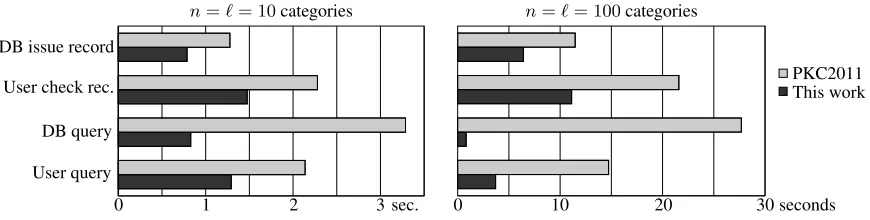
Efficiency comparison. Tables 1, 2, and Figure 12 (in Appendix E) show that the scheme presented in this paper has lower communication and computation costs than CDNZ in “steady state” (after setup). Assuming we use our scheme to express CDNZ-policies (n = `,V = 2`), our records are (asymptotically) 1.6 times smaller, the database can generate them (asympotically) 1.8 times faster, and users can check them (asymptotically) twice as fast. The communication costs in the query protocol are constant in our scheme, versus linear in CDNZ. The user’s computational costs during the query protocol are (asymptotically) five times lower in our scheme; and the database’s computational costs are constant-time in our scheme (versus linear in CDNZ).
Our scheme becomes faster and requires less bandwidth than CDNZ when there are three categories or more. It must be said however, that our scheme trades more efficient “steady state” communication, storage, and computational costs with more expensive setup costs: for example, it takes about 18 seconds (forn= 10) to issue a user’s key in our scheme, while this operation is nearly instantaneous in CDNZ.
9 Conclusions and Future Work
We created a scheme that allows a database to publish records that are protected by a hidden access control policy, and that users can access without revealing their identity or choice of record. Extensions to our scheme allow the key issuer to revoke the user’s keys. We have proved our scheme secure in the generic bilinear group model.
Timing results of a prototype implementation show that the scheme is scalable and sufficiently performant to be used in practical settings.
Recently, Okamoto and Takashima [OT12] have proposed an HP-ABE scheme that is secure under the decision linear assumption. It seems that one could extend their scheme into a HACOT scheme similarly as we have done it for the Nishide el al. scheme, i.e., by splitting the attribute keys between the database and the users. As this approach does not use the HP-ABE scheme as a block box, the security of such an extension of the Okamoto and Takashima scheme will have to be proven from scratch. We leave this as future work.
Other future work is investigating how to remove the unfettered access the issuer has over the published records.
Acknowledgements. The research leading to these results has received funding from the European Community’s Seventh Framework Programme (FP7/2007-2013) as part of the “ICT Trust and Security Research”, under grant agreements n◦257782 for the project ABC4Trust and n◦216676 for the project Ecrypt II.
References
[AFG+10] Masayuki Abe, Georg Fuchsbauer, Jens Groth, Kristiyan Haralambiev, and Miyako Ohkubo. Structure-Preserving Signatures and Commitments to Group Elements. In Tal Rabin, editor,CRYPTO, volume 6223 ofLecture Notes in Computer Science, pages 209–236. Springer, 2010.
[AHO10] Masayuki Abe, Kristiyan Haralambiev, and Miyako Ohkubo. Signing on Elements in Bilinear Groups for Modular Protocol Design.IACR Cryptology ePrint Archive, 2010:133, 2010.
[ASM06] Man Au, Willy Susilo, and Yi Mu. Constant-size dynamic k-taa. In Roberto De Prisco and Moti Yung, editors,Security and Cryptography for Networks, volume 4116 ofLecture Notes in Computer Science, pages 111–125. Springer Berlin / Heidelberg, 2006.
[BB08] Dan Boneh and Xavier Boyen. Short signatures without random oracles and the sdh assumption in bilinear groups.Journal of Cryptology, 21:149–177, 2008.
[BBS04] Dan Boneh, Xavier Boyen, and Hovav Shacham. Short group signatures. In Matt Franklin, editor,Advances in Cryptology – CRYPTO 2004, volume 3152 ofLecture Notes in Computer Science, pages 227–242. Springer Berlin / Heidelberg, 2004. [BN08] Mihir Bellare and Chanathip Namprempre. Authenticated Encryption: Relations among Notions and Analysis of the Generic
Composition Paradigm.J. Cryptology, 21(4):469–491, 2008.
[BSW07] John Bethencourt, Amit Sahai, and Brent Waters. Ciphertext-Policy Attribute-Based Encryption. In IEEE Symposium on Security and Privacy, pages 321–334. IEEE Computer Society, 2007.
[Can00] Ran Canetti. Universally Composable Security: A New Paradigm for Cryptographic Protocols.IACR Cryptology ePrint Archive, 2000:67, 2000.
[CCS08] Jan Camenisch, Rafik Chaabouni, and Abhi Shelat. Efficient protocols for set membership and range proofs. In Josef Pieprzyk, editor,Advances in Cryptology - ASIACRYPT 2008, volume 5350 of Lecture Notes in Computer Science, pages 234–252. Springer Berlin / Heidelberg, 2008.
[CDM00] Ronald Cramer, Ivan Damg˚ard, and Philip D. MacKenzie. Efficient Zero-Knowledge Proofs of Knowledge Without Intractability Assumptions. In Hideki Imai and Yuliang Zheng, editors,Public Key Cryptography, volume 1751 ofLNCS, pages 354–373. Springer, 2000.
[CDN09] Jan Camenisch, Maria Dubovitskaya, and Gregory Neven. Oblivious Transfer with Access Control. In Ehab Al-Shaer, Somesh Jha, and Angelos D. Keromytis, editors,ACM Conference on Computer and Communications Security, pages 131–140. ACM, 2009.
[CDN10] Jan Camenisch, Maria Dubovitskaya, and Gregory Neven. Unlinkable Priced Oblivious Transfer with Rechargeable Wallets. In Radu Sion, editor,Financial Cryptography, volume 6052 ofLNCS, pages 66–81. Springer, 2010.
[CDNZ11] Jan Camenisch, Maria Dubovitskaya, Gregory Neven, and Gregory M. Zaverucha. Oblivious Transfer with Hidden Access Control Policies. In Dario Catalano, Nelly Fazio, Rosario Gennaro, and Antonio Nicolosi, editors,Public Key Cryptography, volume 6571 ofLNCS, pages 192–209. Springer, 2011.
[CGH09] Scott E. Coull, Matthew Green, and Susan Hohenberger. Controlling Access to an Oblivious Database Using Stateful Anony-mous Credentials. In Stanislaw Jarecki and Gene Tsudik, editors,Public Key Cryptography, volume 5443 ofLNCS, pages 501–520. Springer, 2009.
[CNS07] Jan Camenisch, Gregory Neven, and Abhi Shelat. Simulatable Adaptive Oblivious Transfer. In Moni Naor, editor,EUROCRYPT, volume 4515 ofLNCS, pages 573–590. Springer, 2007.
[CS97] Jan Camenisch and Markus Stadler. Efficient Group Signature Schemes for Large Groups. In Burton S. Kaliski Jr., editor, CRYPTO, volume 1294 ofLNCS, pages 410–424. Springer, 1997.
[GHW11] Matthew Green, Susan Hohenberger, and Brent Waters. Outsourcing the Decryption of ABE Ciphertexts. InUSENIX Security Symposium. USENIX Association, 2011.
[GS08] Jens Groth and Amit Sahai. Efficient Non-interactive Proof Systems for Bilinear Groups. In Nigel P. Smart, editor, EURO-CRYPT, volume 4965 ofLNCS, pages 415–432. Springer, 2008.
[GSW10] Essam Ghadafi, Nigel. Smart, and Bogdan Warinschi. Groth-Sahai proofs revisited. In Phong Nguyen and David Pointcheval, editors,Public Key Cryptography – PKC 2010, volume 6056 ofLecture Notes in Computer Science, pages 177–192. Springer Berlin / Heidelberg, 2010.
[KSW08] Jonathan Katz, Amit Sahai, and Brent Waters. Predicate Encryption Supporting Disjunctions, Polynomial Equations, and Inner Products. In Nigel P. Smart, editor,EUROCRYPT, volume 4965 ofLNCS, pages 146–162. Springer, 2008.
[LOS+10] Allison B. Lewko, Tatsuaki Okamoto, Amit Sahai, Katsuyuki Takashima, and Brent Waters. Fully Secure Functional
Encryp-tion: Attribute-Based Encryption and (Hierarchical) Inner Product Encryption. In Henri Gilbert, editor,EUROCRYPT, volume 6110 ofLNCS, pages 62–91. Springer, 2010.
[Lyn07] Ben Lynn.On the Implementation of Pairing-Based Cryptography. PhD thesis, Stanford University, 2007. PBC library available athttp://crypto.stanford.edu/pbc/.
[NFHF09] Toru Nakanishi, Hiroki Fujii, Yuta Hira, and Nobuo Funabiki. Revocable group signature schemes with constant costs for signing and verifying. In Stanislaw Jarecki and Gene Tsudik, editors,Public Key Cryptography – PKC 2009, volume 5443 of Lecture Notes in Computer Science, pages 463–480. Springer Berlin / Heidelberg, 2009.
[NGSN10] Shivaramakrishnan Narayan, Martin Gagn´e, and Reihaneh Safavi-Naini. Privacy Preserving EHR System Using Attribute-based Infrastructure. In Adrian Perrig and Radu Sion, editors,CCSW, pages 47–52. ACM, 2010.
[Nis08] Takashi Nishide. Cryptographic Schemes with Minimum Disclosure of Private Information in Attribute-Based Encryption and Multiparty Computation. PhD thesis, University of Electro-Communications, 2008.
[NP99] Moni Naor and Benny Pinkas. Oblivious Transfer with Adaptive Queries. In Michael J. Wiener, editor,CRYPTO, volume 1666 ofLNCS, pages 573–590. Springer, 1999.
[NYO08] Takashi Nishide, Kazuki Yoneyama, and Kazuo Ohta. Attribute-Based Encryption with Partially Hidden Encryptor-Specified Access Structures. In Steven M. Bellovin, Rosario Gennaro, Angelos D. Keromytis, and Moti Yung, editors,ACNS, volume 5037 ofLNCS, pages 111–129, 2008.
[OT12] Tatsuaki Okamoto and Katsuyuki Takashima. Adaptively Attribute-Hiding (Hierarchical) Inner Product Encryption. In David Pointcheval and Thomas Johansson, editors,EUROCRYPT, volume 7237 ofLNCS, pages 591–608. Springer, 2012.
[PW00] Birgit Pfitzmann and Michael Waidner. Composition and Integrity Preservation of Secure Reactive Systems. In Dimitris Gritzalis, Sushil Jajodia, and Pierangela Samarati, editors,ACM Conference on Computer and Communications Security, pages 245–254. ACM, 2000.
[PW01] Birgit Pfitzmann and Michael Waidner. A Model for Asynchronous Reactive Systems and its Application to Secure Message Transmission. InIEEE Symposium on Security and Privacy, pages 184–, 2001.
[Rab81] Michael O. Rabin. How to Exchange Secrets by Oblivious Transfer. Technical Report TR-81, Harvard Aiken Computation Laboratory, 1981.
[Sho04] Victor Shoup. Sequences of games: a tool for taming complexity in security proofs. Cryptology ePrint Archive, Report 2004/332, 2004.http://eprint.iacr.org/.
[SW05] Amit Sahai and Brent Waters. Fuzzy Identity-Based Encryption. In Ronald Cramer, editor,EUROCRYPT, volume 3494 of LNCS, pages 457–473. Springer, 2005.
[ZAW+10] Ye Zhang, Man Ho Au, Duncan S. Wong, Qiong Huang, Nikos Mamoulis, David W. Cheung, and Siu-Ming Yiu. Oblivious Transfer with Access Control : Realizing Disjunction without Duplication. In Marc Joye, Atsuko Miyaji, and Akira Otsuka, editors,Pairing, volume 6487 ofLNCS, pages 96–115. Springer, 2010.
A Preliminaries
A.1 Perfect Zero-knowledge Proofs of Knowledge
A zero-knowledge proof of knowledge (ZKPK) [CDM00] is a protocol in which a proverPcan convince a verifier
Qthat he knows a secret — for instance, the discrete logarithm of a certain element, the discrete-logarithm–based representation of a certain element to certain bases, a pre-image of a bilinear pairing — without disclosing these to the verifier.
We will use the notation introduced by Camenisch and Stadler[CS97] when we need to perform aZKPKin a protocol. For example:
ZKPK{(α, β) :y =gα∧z=gβhα}
WithZKPKprotocols it is possible to work with statements of the form:
ZKPK
xi∈Zp
ux
i=0, γi ∈G1
ug
i=0, ηi ∈G2
uh i=0 : ng ^ i=0
Gi = n1,i
Y
j=0 gxν1,i,j
1,i,j (6) nh ^ i=0 Hi = n2,i Y j=0 hx2,i,jν2,i,j
^nt
i=0 Ti= n3,i Y j=0 tx3,i,jν3,i,j
n4,i
Y
j=0
e(g4,i,j, ην4,i,j)
n5,i
Y
j=0
e(γν5,i,j, h5,i,j)
wheret3,i,j, Ti ∈GT,g1,i,j, g4,i,j, Gi ∈G1,h2,i,j, h5,i,j, Hi ∈G2andν1,i,j, ν2,i,j, ν3,i,j ∈Nux+1,ν4,i,j ∈Nug+1,
ν5,i,j ∈Nuh+1andux, ug, uh, ng, nh, nt, nk,i
5
k=1∈Nare known to both parties.
A.2 Non-interactive Zero-knowledge Proofs
A non-interactive zero-knowledge (NIZK) proof allows a prover P to certify that a certain statement is satisfi-able, without revealing a satisfiable assignment in the proof (howeverP usually needs to know such a satisfiable assignment to be able to compute the proof). The proof he issues can be checked offline by a verifierQ.
Groth-Sahai Proofs In our construction, we will work with a subset of Groth-Sahai (GS) proofs [GS08,GSW10] which allows us to prove the satisfiability of the following classes of statements:
NIZK
xi ∈Zp u i=0 : n ^ i=0
Gi = ni
Y
j=0 gi,jxνi,j
whereGi, gi,j ∈G1 andνi,j ∈ Nu+1andu, n, ni ∈Nare known to bothP andQ. GS proofs require the SXDH assumption to hold.
GS proofs are not proofs of knowledge, since it is possible to combine several GS proofs to construct a GS proof of a related statement (as used in [CDNZ11]).
A.3 Structure-Preserving Signatures
A structure-preserving signature scheme is a tuple of algorithms (Sig.KeyGen,Sig.Sign,Sig.Verify,Sig.Rerand,
Sig.Prove,Sig.KeyProve). The subset of the signature scheme by Abe et al. [AFG+10] shown below allows the message to be either an element ofG1or ofG2(it is also possible to sign a tuple of group elements, see [AFG+10]). We will show how the signature works for signing messages inG2. For messages inG1, simply switchG1andG2 in everything below.
Figure 6 shows how to generate a signing and verification key pair, and Figure 7 shows how perform a proof of knowledge of the signing key. Figure 8 show how to sign a message m ∈ G2, and Figure 9 shows how to re-randomize a signature. Figure 10 show how to check a signature.
To prove possession of a signatureσfor a messagemwithout revealingσnorm, one would proceed as follows: first, the signature is re-randomized:σ˜←Sig.Rerand(σ); second the message is blinded:km←$ Zp; ˜m←mkm; and finally the proof of knowledge shown in Figure 11 is performed.
A.4 Authenticated Encryption
An authenticated encryption algorithmAuthEncand corresponding decryption algorithmAuthDecis integrity-of-ciphertext secure [BN08] if no adversaryAcan, with non-negligible probability, when given access to an encryption oracleAuthEncK(·)for a random keyK
$
gR, fU ←$ G∗1;γZ, δZ, δM, γM, α, β←$ Z∗p;
A←e(gR, gα2) ; B←e(fU, gβ2) ;
gZ←gγZ
R ; fZ←f δZ
U ; fM←f δM
U ; gM←g γM R ;
sgk←(α, β, γZ, δZ, γM, δM) ; vk←(gZ, fZ, gR, fU, gM, fM, A, B) ;
Output(sgk,vk).
Fig. 6.Key generation algorithm (Sig.KeyGen).
Sig.KeyProve(sgk,vk)def=
ZKPK{(γZ, δZ, δM, γM, α, β) :
A= e(gR, g2)α∧B = e(fU, g2)β∧
gZ=gγZ
R ∧fZ =f δZ
U ∧fM =f δM
U ∧gM =g γM R }.
Fig. 7.Proof of knowledge of signing key.
To sign a messagem∈G2 :
ζ, ρ, τ, ϕ, ω←$ Z∗p; Z←g2ζ;
R←gρ−γZζ
2 m
−γM ; S←gτ
R; T←g
(α−ρ)τ−1
2 ;
U←gϕ−δZζ
2 m−δM ; V←fUω; W←g
(β−ϕ)ω−1
2 ;
Outputσ←(Z, R, S, T, U, V, W).
Fig. 8.Signing algorithm (Sig.Sign).
ρ, γ, τ, ω←$ Z∗
p;
˜
R←RTρ; ˜S←(SgR−ρ)γ; ˜T←Tγ−1 ; ˜
U←U Wτ; ˜V←(V fU−τ)ω; ˜W←Wω−1 ;
Outputσ˜←(Z,R,˜ S,˜ T ,˜ U ,˜ V ,˜ W˜).
Fig. 9.Re-randomization algorithm (Sig.Rerand).
Check that:
A= e(gZ, Z) e(gR, R) e(S, T) e(gM, m)∧
B = e(fZ, Z) e(fU, U) e(V, W) e(fM, m).
Fig. 10.Verification algorithm (Sig.Verify).
Sig.Prove(˜σ,m, k˜ m) def
=ZKPK{(km−1, Z,R,˜ U˜) :
A= e(gZ, Z) e(gR,R˜) e( ˜S,T˜) e(gM,m˜)k−m1∧
B = e(fZ, Z) e(fU,U˜) e( ˜V ,W˜) e(fM,m˜)k−m1}. Fig. 11.Proof of possession of a signature.
A.5 Security Game for Hidden–ciphertext-policy Attribute-based Encryption
We say that a key with list attributesLϕisadmissiblefor anHP-ABEchallenge tuple(K0, K1, W0, W1)if:
• IfK0 6=K1, thenLϕ6|=W0∧Lϕ 6|=W1.
• Else ifK0=K1, then(Lϕ 6|=W0∧Lϕ 6|=W1)∨(Lϕ |=W0∧Lϕ|=W1)
A HP-ABE scheme is (non-selectively) secure if no PPT adversary A has non-negligible advantage in the following game [Nis08]2:
Setup. The challenger generates an issuer key and gives the public key toA.
Phase 1. Asubmits a list of attributesLϕ ∈ LLto the challenger. The latter then generates a user key with these attributes and gives it toA. This phase may be repeated polynomially many times (with differentϕ).
Challenge. Asubmits two plaintextsK0andK1and two ciphertext policiesW0 ∈ LW andW1∈ LW to the chal-lenger, such that all the keys issued so far are admissible with respect to the challenge tuple(K0, K1, W0, W1). The challenger then flips a random bitb, runs the encryption algorithm withKbas message andWbas ciphertext policy, and givesAthe resulting ciphertext.
Phase 2. Phase 1 is repeated, with the restriction that the key must be admissible. Like phase 1, Amay ask for polynomially many admissible keys.
Guess. The adversary outputs a guessb0 ofb.
The advantage ofAis defined as beingPr[b0 =b]− 1 2
where the probability is taken over the random coins
used by the challenger and the adversary.
2
B Formal Ideal-World Definition
Messages exchanged between the players andFHACOTare formatted ashstr,arg1,arg2,arg3i, wherestris a string identifying the type of message, and arg1, arg2, arg3,. . .are the payload.
Unless noted otherwise, all channels in the ideal world are authenticated, secure and integer.
(1 – Issuer setup)FHACOTwaits for a messagehinit:i,LL,LWifromI, fixing the set of attributesLLkeys can be endowed with, and the set of ciphertext policiesLW.FHACOTrelays the message toS.
For each userUϕin the system:FHACOTwaits for a messagehproof:i:i:ϕifromI, and relays it toS.FHACOTwaits for a messagehproof:i:u:ϕifromUϕ, and relays it toS.FHACOTwaits for a messagehproof:i:i:ϕ:okifromS, and relays it toI.FHACOTwaits for a messagehproof:i:u:ϕ:okifromS, and relays it toUϕ. For each databaseDB%in the system:FHACOTproceeds similarly (simply replace “u” with ”d” andϕwith%in the above).
Note that after step (1) has completed, it is not possible to add users or databases.
(2 – Database setup)For every databaseDB%in the system: FHACOT waits for a message hinit:d:%i fromDB%.
FHACOTthen relays the message toS.
For each userUϕin the system:FHACOTwaits for a messagehproof:d:d:%:ϕifromDB%, and relays it toS.FHACOT
waits for a messagehproof:d:u:%:ϕifromUϕ, and relays it toS.FHACOT waits for a messagehproof:d:d:%:ϕ:oki
fromS, and relays it toDB%.FHACOTwaits for a messagehproof:d:u:%:ϕ:okifromS, and relays it toUϕ.FHACOT
proceeds similarly for the issuer (simply replace “u” with ”i” removeϕin the above).
The steps (3) to (5) may now be run in any order, any number of times. It means that in the real world, records may be added to the database at any point of time without having to re-encrypt the whole database. The database provider just distributes an update containing the ciphertexts of the new records. The scheme of [CDNZ11] can easily be transformed to achieve this functionality as well.
(3 – Record issuance)Upon receivinghrec:%:ψ, K%,ψ, W%,ψifromDB%, whereFHACOThas not yet stored an entry
%, ψ forK;K%,ψ ∈GTandW%,ψ ∈ LW;FHACOT storesK%,ψ andW%,ψ and sendshrec:%:ψ, `(K%,ψ), `(W%,ψ)i
toS. (ψis the record identifier, and`is a leakage function.)FHACOTwaits forhrec:%:ψ:okifromS.FHACOT then broadcastshrec:%:ψ:doneito all users.FHACOTalso sendshrec:%:ψ:escrow, K%,ψ, W%,ψitoI.
(4 – User key issuance)Upon receivinghkey:u:ϕ, LϕifromUϕ, whereFHACOThas not yet stored an entryϕforL;
Lϕ ∈ LL;FHACOTrelays the message toS.FHACOTnow waits forhkey:i:ϕ, LϕifromI, and relays it toS.FHACOT
now waits forhkey:i:ϕ:okifromS, and relays it toI.FHACOTnow waits forhkey:u:ϕ:okifromS, and relays it to
Uϕ. Finally,FHACOTstoresLϕ.
(5 – Query) FHACOT prepares a counter α←0 for this step. Upon receiving hquery:u:ϕ:%:ψi fromUϕ, where
FHACOThas storedLϕandK%,ψ,FHACOTincrementsαand sendshquery:u:%:αitoS.FHACOTwaits forhquery:d:%:α,
bifromDB%, wherebis a bit, and relays the message toS.FHACOT now waits forhquery:d:%:α:okifromSand
relays it toDB%. If it is the first time thatUϕqueried for the recordψ,FHACOTselectsK%,ψ,ϕ0 $
←GT.FHACOTnow
waits forhquery:u:%:α:okifromSand sends: (a) ifb= 0:hquery:u:ϕ:%:ψ, b,⊥i; (b) else ifb= 1andLϕ|=W%,ψ:
hquery:u:ϕ:%:ψ, b, K%,ψi; (c) else ifb= 1andLϕ6|=W%,ψ:hquery:u:ϕ:%:ψ, b, K%,ψ,ϕ0 i.3
C Revocation of users
In this section, we show how to add a privacy-friendly mechanism to revoke users to ourHACOT scheme. We will first provide a high-level overview of the revocation mechanism. We then update the definition of theHACOT
scheme and adapt the security definition. Next, we describe additional building blocks needed for the construction. And finally, we present the construction.
C.1 High-level Idea
The issuer generates a key revocation list (KRL) each time the set of revoked users changes, and publishes it. In the query phase, users then have to prove to the database in zero-knowledge that their key has not been revoked.
3