GENERALIZED JACOBIAN CRYPTOSYSTEMS
ISABELLE DÉCHÈNE
Abstract. Generalized Jacobians are natural candidates to use in discrete logarithm (DL) based cryptography since they include the multiplicative group of …nite …elds, algebraic tori, elliptic curves as well as all Jacobians of curves. This thus led to the study of the simplest nontrivial generalized Jacobians of an elliptic curve, for which an e¢ cient group law algorithm was recently obtained. With these explicit equations at hand, it is now possible to concretely study the corresponding discrete logarithm problem (DLP); this is what we undertake in this paper. In short, our results highlight the close links between the DLP in these generalized Jacobians and the ones in the underlying elliptic curve and …nite …eld.
1. Introduction
Throughout this past year, cryptographers proudly celebrated three decades of public-key cryptography. In a word, concrete public-key cryptosystems existbecause
we know computational problems which, despite our greatest joint e¤orts, remain very hard to solve. We could thus say that Di¢ e and Hellman [4] taught us how to be optimistic by turning our incapacity of solving these problems into an amazingly elegant and powerful technique.
In addition of being the …rst such problem to be used in public-key cryptography, the discrete logarithm problem (DLP) remains without a doubt one of the most popular choices used nowadays to design cryptographic protocols.
De…nition 1. LetGbe a …nite group and g be an element ofG. Givenh2 hgi, the smallest non-negative integerksuch thatgk =his called thediscrete logarithm of h(to the baseg) and is denotedloggh.
Generalized Jacobians are a good source of groups where this problem seems in-tractable. Indeed, recall that the ElGamal, Elliptic and Hyperelliptic Curve Cryp-tosystems as well as XTR, LUC and CEILIDH can all be understood in terms of generalized Jacobians [11, 3]. So from a cryptographic point of view, two remarkable subfamilies of generalized Jacobians are algebraic tori and usual Jacobians.
In order toexplicitlystudy the cryptographic properties of a family of generalized Jacobians that are neither Jacobians nor tori, the simplest nontrivial generalized Ja-cobians of an elliptic curve was recently put forward [3]. In particular, it was shown
Date: First submitted on September 29, 2006 and revised on March 24, 2007. 2000Mathematics Subject Classi…cation. Primary 14L35, 94A60; Secondary 68Q17.
Key words and phrases. Public-key cryptography, discrete logarithm problem, generalized Ja-cobians, semi-abelian varieties, elliptic curves, …nite …elds, pairing-friendly curves.
The research for this paper was done while the author was a Ph.D. student at McGill University under the supervision of Henri Darmon and Claude Crépeau and was supported by the Bell University Laboratories (BUL).
in this article how to obtain a compact representation of the elements, e¢ ciently compute the group law and readily determine the cardinality of these groups.
The present article is the natural continuation of this work. Indeed, using com-pletely elementary techniques, we here investigate the corresponding discrete loga-rithm problem. From the point of view of algebraic geometry, these speci…c gener-alized Jacobians are extensions of an elliptic curve by the multiplicative groupGm. We thus expect that this study will involve discrete logarithms in three di¤erent groups, namely, the generalized Jacobian, an elliptic curve and the multiplicative group of a …nite …eld.
Thus the overall goal of this paper is to gain further insight on the precise relationships between these three problems. We emphasize that the objective of this work is not to claim nor demonstrate anypractical advantages over previously proposed groups.
This article is based on Section 5.5 of our doctoral dissertation [2]. We …rst show that extracting a DL in these generalized Jacobians can always be performed bysequentially solving an instance of the DLP in the underlying elliptic curveE
followed by one in the chosen …nite …eldF. On the other hand, we demonstrate that the DLP in such cyclic generalized Jacobians is at least as hard as the DLP in E and at least as hard as the DLP in F. As a result, extracting a DL in those generalized Jacobians is polynomial-time equivalent to solving a DL inEand a DL inF.
Galbraith and Smith [6] recently made similar observations by working with ex-tensions of algebraic groups “presented by a cocycle”. Although this more general setting extends some of the results of this paper, we believe that our explicit ap-proach has the advantage of being more insightful. For instance, these techniques enabled us to highlight an apparent distinct behaviour of generalized Jacobians of pairing-friendly curves (see Section 6 for more details).
This paper is organized as follows. In the next section, we review the construction of generalized Jacobians and recall the group law for the explicit family we consider. In Section 3, we obtain a closed expression involving three di¤erent DLPs, from which follows a natural solution to the DLP in these generalized Jacobians. Two reductions among discrete logarithm problems are then obtained in Section 4. In the following two sections, we apply the ideas of Pohlig and Hellman, both to curves used in classical ECC as well as to pairing-friendly curves. Lastly, an outlook is presented in Section 7.
2. Generalized Jacobians of an Elliptic Curve
The goal of this section is to present a minimalist aide-mémoire of the construc-tion of generalized Jacobians as well as of the explicit group law for the family we are studying. For a complete treatment, please refer to the classical texts by Maxwell Rosenlicht [9, 10] and Jean-Pierre Serre [12, 13]. Although the underlying theory truly sheds some light on the intrinsic structure of these groups, the utterly simple equations for the group operation is all that will be needed for the sequel.
Let C be a smooth algebraic curve de…ned over an algebraically closed …eld
K and m = PP2CmP(P) 2 Div(C) be an e¤ective divisor1, thereafter called a modulus. Two divisors D and D0 of disjoint support with m are said to be m -equivalent, and we write D m D0, if there exists an f in the function …eld of
1That is, eachm
C such that div(f) = D D0 and ord
P(1 f) mP for each P in the support
of m. Let Pic0m(C) be the group of m-equivalence classes of degree zero divisors having disjoint support withm. Then, there exists a commutative algebraic group
Jm, called thegeneralized Jacobian ofC with respect tom, which is isomorphic to
Pic0m(C).
The explicit family of generalized Jacobians we consider can now be described as follows. LetE be a smooth elliptic curve de…ned over the …nite …eldFq with q
elements and let B2E(Fq)be a point of prime orderl. Let alsom= (M) + (N)
be aB-unrelated modulus withM andN distinct points ofE(Fqr), wherer 1is a chosen integer (to …x ideas, r can be picked to be relatively small, sayr 50). Recall that a modulusm= (M) + (N)is said to beB-unrelated ifM,N =2 hBi[3, De…nition 3].
For the purpose of constructing the corresponding generalized JacobianJm, we
view E as being de…ned over Fq. This algebraic group Jm is then a semi-abelian
variety, which is an extension of algebraic groups ofE by the multiplicative group
Gm. Background material on extensions of algebraic groups can be found in [13, Chapter VII].
Remark 1. Recall that a commutative algebraic groupS is called a semi-abelian variety if there exists a short exact sequence of algebraic groups
1!T !S!A!1,
whereT is an algebraic torus andAis an abelian variety.
In order to obtain a compact and convenient representation for the elements of
Jmand a group law algorithm using this representation, the …rst step followed in [3]
was to obtain an explicit bijection of sets betweenPic0m(E)andGm E. Thus in this particular case, an element ofJm can be viewed as a pair(k; P), wherek2Gm andP 2E. The known addition onPic0m(E)could then be used to endow, via ,
the setGm Ewith the desired group structure.
More explicitly, let (k1; P1) and (k2; P2) be elements of Jm such that P1, P2,
(P1+P2)2 f= M; Ng. Then,
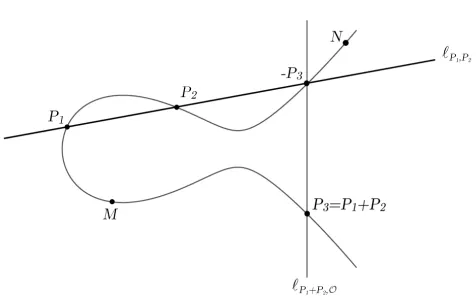
(2.1) (k1; P1) + (k2; P2) = (k1k2 cm(P1; P2); P1+P2),
wherecm:E E !Gm is the 2-cocycle given by
cm(P1; P2) =
`P1;P2(M) `P1+P2;O(M)
`P1+P2;O(N) `P1;P2(N)
,
and`P;Qdenotes the equation of the straight line passing throughPandQ(tangent at the curve ifP=Q) [3, Theorem 5].
Several basic properties can be easily derived from these explicit equations [3, Section 5]. In particular, the set
Fqr hBi= (k; P) k2Fqr; P 2 hBi ,
together with the group law (2.1), is a subgroup ofJm with identity (1;O). Also,
for all(k1;O);(k2; P)2Fqr hBi, we have that
(2.2) (k1;O) + (k2; P) = (k1k2; P).
Figure 1. Group law in the generalized Jacobian
Next we make some useful remarks on the order of the elements in Fqr hBi. So let(k; P)2Fqr hBibe given such thatP 6=O. We are then looking for the smallest positive integerm such that m(k; P) = (1;O). Since m(k; P) = ( ; mP), we must have mP =O, from which we get that m is a multiple of l = ord (P). There is then a positive integernsuch thatm=n l. Hence,
(1;O) =m(k; P) =n l(k; P) =n( ;O) = ( n;O),
where 2Fqr satis…esl(k; P) = ( ;O). It thus follows that n = 1, for which the least solution isn= ord( ). As a result,
(2.3) The order of (k; P)equals ord( ) l.
So in particular,
(2.4) (k; P)generates Fqr hBi if and only if generates Fqr.
This last property can also be used to show, using an elementary counting ar-gument, thatFqr hBiis a cyclic group as soon as l -(qr 1) [2, Section 5.4.4]. Moreover, Balasubramanian and Koblitz showed that for a random primeqand a randomEde…ned overFq such that#E(Fq) =l, the caselj(qr 1)was very
un-likely to arise [1, Theorem 2]. Thus in practice, it is easy to generate a generalized JacobianFqr hBiwhich is a cyclic group.
To sum up, Fqr hBi together with the induced group law (2.1) is a …nite subgroup ofJmof order(qr 1) lfor which the elements are compactly represented
and the group law is e¢ ciently computable. That being said, we are now ready to study the discrete logarithm problem inFqr hBi.
3. A Natural Solution
The purpose of this section is to present a natural method to extract discrete logarithms inFqr hBi. To do so, the …rst step will be to take a closer look at the scalar multiplication in this group.
So given(k; P)2Fqr hBiand a non-negative integern, we are here looking for an e¢ cient way to compute the scalar multiplen(k; P). First remark that a repeated application of the group law yieldsn(k; P) = ( ; nP). Thus if we setn0=nmodl,
use of the value of n0(k; P). Indeed, if we let n1 = bn=lc, then n = n1l+n0
and so n(k; P) = n1l(k; P) +n0(k; P). Therefore, if we let l(k; P) = ( ;O) and n0(k; P) = ( n0; n0P), we obtain
n(k; P) =n1l(k; P) +n0(k; P)
(3.1)
=n1( ;O) + ( n0; n0P)
= ( n1;
O) + ( n0; n0P)
= ( n0
n1; n 0P)
by repeated applications of (2.2). Hence, evaluating n(k; P) using this method essentially requires to compute , n1 and n0(k; P). Of course, if several scalar
multiples of thesameelement(k; P)need to be performed, then the value of may be precomputed in order to speed up the computations. We have therefore shown:
Lemma 2. LetE be a smooth elliptic curve de…ned overFq,B2E(Fq)be a point of prime order l andm = (M) + (N)be a B-unrelated modulus, where M andN are distinct points ofE(Fqr). For(k; P)2Fqr hBiand a non-negative integern,
letn0=nmodl,n1=bn=lc,l(k; P) = ( ;O)andn0(k; P) = ( n0; n0P). Then,
n(k; P) = ( n0
n1; n0P).
Notice that this simple equality in fact relates three instances of the discrete logarithm problem in three di¤erent groups, namely a generalized Jacobian, an elliptic curve and a …nite …eld. Next we see how this observation provides a natural solution to compute discrete logarithms in Fqr hBi. The goal of this exercise is to give an upper bound on the overall complexity of this problem.
So given(k; P)2Fqr hBiand an element(j; Q)in the subgroup generated by (k; P), we need to determine the least non-negative integern such thatn(k; P) = (j; Q). Using the above notations, …rst notice that knowing n is equivalent to knowing bothn0andn1(sincelis public andn=n1l+n0), where0 n <ord( )l, 0 n0< l and0 n1<ord( ). Lemma 2 then yields
(j; Q) =n(k; P) = ( n0
n1; n 0P).
Thus, given the values of
j = n0
n1 andQ=n 0P,
our task is to recovern. Observe thatQis independent of n1 while j depends on
bothn0 andn1.
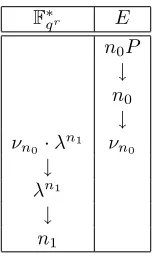
The obvious strategy is then to start by solving an instance of the discrete logarithm problem in E in order to recovern0 fromQ=n0P. Oncen0 is known, the value of n0 can be easily computed, as n0(k; P) = ( n0; n0P). Next derive
the value of n1 by computing2 1
n0 j. Then recovern1by extracting the discrete
logarithm of n1 to the base . At last, setn=n1l+n0. Figure 2 illustrates this
sequence of computations while the following proposition summarizes the result just obtained.
Proposition 1. LetE be a smooth elliptic curve de…ned overFq,B2E(Fq)be a point of prime orderl andm= (M) + (N)be aB-unrelated modulus, whereM and N are distinct points ofE(Fqr). Then, the discrete logarithm problem in any cyclic
2Notice that
subgroup ofFqr hBiis no harder than sequentiallysolving a discrete logarithm
inE followed by one inFqr.
Fqr E
n0P
#
n0
#
n0 n1
n0
#
n1
#
n1
Figure 2. Natural solution to a DLP in the generalized Jacobian
Informally speaking, the next step is to ask whether it is possible to …nd a quicker way to solve this DLP. In particular,
If we know how to solve the DLP in Fqr hBi, do we necessarily know how
to solve it in E?
If we know how to solve the DLP in Fqr hBi, do we necessarily know how
to solve it in Fqr?
Is it possible to solve a DLP in Fqr hBiby solving one in E and one in
Fqr inparallel?
Can some precomputations be made in order to speed up the extraction of a DL in Fqr hBi?
The remainder of this paper focuses on the …rst three questions, while a discus-sion around the last question can be found in [2, Section 5.5.3].
4. Reductions among Discrete Logarithm Problems
To ease the exposition, we will assume throughout this section thatFqr hBiis a cyclic subgroup ofJm generated by(k; P). In short, the goal is now to show that
any given algorithm that solves DLPs in Fqr hBi may be used as a subroutine to solve DLPs inE as well as in Fqr. In other words, if anyone ever discovers an
e¢ cient way to solve DLPs inFqr hBi, he or she could use it to e¢ ciently solve instances of the DLP inE and inFqr.
Since we are concerned in this section with lower bounds on the di¢ culty of solving the DLP in Fqr hBi, the proofs we provide here are written formally in order to be as rigorous as possible. For completeness, a review of fundamental properties of discrete logarithms needed to prove these results is included in the appendix.
Proposition 2. Let E be a smooth elliptic curve over Fq,B 2 E(Fq) be a point of prime order l,m = (M) + (N) be a B-unrelated modulus, where M and N are distinct points ofE(Fqr)such thatFqr hBiis a cyclic subgroup ofJm. Then, the
discrete logarithm problem inFqr hBiis at least as hard as the discrete logarithm
Proof. LetAJm be an algorithm having a non-negligible probability of solving
dis-crete logarithms in Fqr hBi to the base (k; P), where (k; P) is a generator of
Fqr hBi. We wish to show that there is an algorithmAEhaving a non-negligible
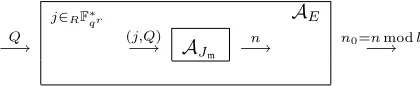
probability of solving discrete logarithms inhBito the baseP. So letQ=n0P be
an instance of the discrete logarithm problem in hBi, where 0 n0 < l. By the
random self-reducible property of discrete logarithms3, we can assume without loss of generality that givenanyelement ofFqr hBi, its discrete logarithm (to the base (k; P)) has a non-negligible probability of being obtained with AJm. Now, for a
randomly chosen elementj2Fqr, invokeAJm on input(j; Q). With non-negligible probability, a non-negative integer n such thatn(k; P) = (j; Q)will be obtained, yieldingn0=nmodl.
j2RFqr AE
Q
! (j;Q)! AJm n
! n0=nmodl
!
Figure 3. Converting an instance of the DLP in hBiinto one in
Fqr hBi
Next we show a similar reduction from the discrete logarithm problem inFqr to the one inFqr hBi.
Proposition 3. Let E be a smooth elliptic curve over Fq,B 2 E(Fq) be a point of prime order l,m = (M) + (N) be a B-unrelated modulus, where M and N are distinct points ofE(Fqr)such thatF
qr hBiis a cyclic subgroup ofJm. Then, the
discrete logarithm problem inFqr hBiis at least as hard as the discrete logarithm
problem inFqr.
Proof. LetAJm be an algorithm having a non-negligible probability of solving
dis-crete logarithms in Fqr hBi to the base (k; P), where (k; P) is a generator of
Fqr hBi. We want to show the existence of an algorithm AFqr having a non-negligible probability of solving discrete logarithms in Fqr to the base , where
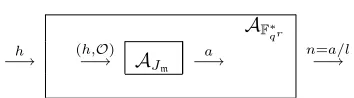
l(k; P) = ( ;O). Recall that by (2.4), must generate all ofFqrsince(k; P)is a gen-erator ofFqr hBi. Thus leth= nbe an instance of the discrete logarithm problem in Fqr, with0 n < qr 1. As usual, thanks to the random self-reducible prop-erty, we can assume without loss of generality that givenany element ofFqr hBi, its discrete logarithm (to the base(k; P)) has a non-negligible probability of being obtained with AJm. Invoking AJm on input (h;O) will yield with non-negligible
probability an integer a satisfying (h;O) = a(k; P) and 0 a < (qr 1)l. We
have in particular thataP=O, which implies thatamust be divisible byl. There is thus an integerbsuch that a=b land0 b <(qr 1). As a result,
( n;O) = (h;O) =a(k; P) =bl(k; P) =b( ;O) = ( b;O),
which yieldsn=b.
As a result, the two propositions of this section imply that even though general-ized Jacobians are newcomers in cryptography, we already know that solving their
AFqr
h
! (h;!O) AJm a
! n=a=l!
Figure 4. Converting an instance of the DLP inFqr into one in
Fqr hBi
DLP cannot be easier than solving discrete logarithms in two of the most studied groups used in DL-based cryptography today.
5. A Parallel Solution à la Pohlig-Hellman
Now that we have strong evidences that the discrete logarithm problem in the generalized Jacobians we consider is a computationally di¢ cult problem, we further investigate the natural solution proposed in Section 3. Recall that Proposition 1 showed that an instance of the DLP inFqr hBican be solved by sequentially ex-tracting a discrete logarithm inEfollowed by one inFqr. We next try to determine under which circumstances the DLP inFqr hBicould be performed any faster.
For simplicity, we will also assume here that Fqr hBiis a cyclic subgroup of
Jm generated by (k; P). As usual, let(j; Q) =n(k; P) be an instance of the DLP
inFqr hBito be solved, where0 n <(qr 1)l. By Lemma 2, we know that
(5.1) (j; Q) =n(k; P) = ( n0
n1; n0P),
where we keep the notationn=n1l+n0,0 n0 < l, 0 n1 < qr 1 as well as l(k; P) = ( ;O)andn0(k; P) = ( n0; n0P). Notice that the sequential solution of
Section 3 performs computations involvingj= n0
n1 only once
n0 is known, as
depicted in Figure 2.
We could instead attempt to extract a discrete logarithm inFqr inparallel with the one in the elliptic curve. On one hand, using (5.1), one can start to solve
Q=n0P forn0by extracting a discrete logarithm inE. In the meantime, we could also start to extract a discrete logarithm in the …nite …eld as follows. This time, let
n2=nmod (qr 1).
Then computel(j; Q)which will equal, say,(j0;O). We now have:
(j0;O) =l(j; Q) =l n(k; P) =n l(k; P) =n( ;O) = ( n;O) = ( n2;
O). Sincej0 and are known, we can then solve the following DLP in F
qr in order to getn2:
j0= n2.
Remark that this can be done inparallel with the computation ofn0.
Finally, try to combinen0andn2using the Chinese remainder theorem in order to recovern. However, wemust havegcd (l; qr 1) = 1to fully recovernwith this
method. We summarize this observation below.
Proposition 4. Let E be a smooth elliptic curve over Fq, B 2 E(Fq) be a point of prime order l andm = (M) + (N)be a B-unrelated modulus, where M andN are distinct points of E(Fqr). If l - (qr 1), then the discrete logarithm problem
inFqr hBiis no harder than solving a discrete logarithm inE and one inFqr in
Remark 2. Notice that in this proposition, there is no need to add the hypothesis that Fqr hBi must be a cyclic group. Indeed, as mentioned in Section 2, the conditionl-(qr 1)already ensures thatF
qr hBiwill be cyclic.
6. Generalized Jacobians of Pairing-friendly Curves
We now turn our attention to the caselj(qr 1), and thus to pairing-friendly
curves. Recall that we now know several techniques allowing to e¢ ciently gener-ate suitable curves for various values of r of cryptographic interest. A thorough classi…cation of these methods was recently made by Freeman, Scott and Teske [5].
An interesting case arises when we work in a cyclic subgroup h(k; P)i Fqr hBi of order d l , where 2 and l - d. Indeed, we will see here that the natural solution of Section 3 is then still faster than a straightforward application of the ideas of Pohlig and Hellman. It therefore seems that the DLP in generalized Jacobians of pairing-friendly curves can behave distinctly.
Remark 3. Recall that the MOV attack [7] allows in this case to reduce the DLP in hBi E(Fq)to the DLP inFqr, thanks to the Weil pairing. Thus for pairing-based applications, the embedding degree r is usually chosen such that these two DLPs are (roughly) of equal di¢ culty. We shall assume that this also holds here, so that there is no practical advantage of transforming an instance of the DLP in the elliptic curve into one in the …nite …eld.
Just as before, let(j; Q) =n(k; P)be the instance of the DLP we wish to solve. In order to use the Chinese remainder theorem to recovern, we now compute
n :=nmodl nd:=nmodd .
This can be achieved as follows.
(1) We here want to compute nd. To do so, …rst evaluatel (j; Q), which will
equal, say,(j0;O). Now,
(j0;O) =l (j; Q) =l n(k; P) =nl 1 l(k; P)
=nl 1( ;O) = l 1 n;O = l 1 nd;O ,
which means that
j0= l 1 nd,
where j0 and l 1
are known. It thus su¢ ces to solve a DLP in Fqr in order to recovernd.
(2) While performing Step 1, we can also start to determine n in parallel. (a) First letn0=nmodl(=n modl). Since(j; Q) =n(k; P) = ( ; nP) =
( ; n0P), we haveQ=n0P. The value ofn0 can thus be obtained by
solving a DLP in the elliptic curve4. (b) Next we compute
n1=n n0
l modl.
4Notice that we have now retrievedallthe information aboutnthatQcontained. That is, we
To do so, writenasn0+n1l+ml2for some (unknown) integermand
computedl 2(j; Q)to get, say, j00; dl 2Q . Then,
j00; dl 2Q =dl 2(j; Q) =dl 2 n(k; P)
=dl 2 n0+n1l+ml2 (k; P)
=dl 2n0(k; P) +n1dl 2 l(k; P) +m dl (k; P)
=dl 2( n0; n0P) +n1dl 2( ;
O) +m(1;O)
= ( n0) dl 2
; dl 2Q + dl 2 n1;O
= ( n0)
dl 2 dl 2 n1
; dl 2Q ,
where is simply the product of the 2-cocycles from repeated applica-tions of the group law. Notice that can be computed directly from
Qanddl 2. It therefore follows that
j00
( n0) dl 2 =
dl 2 n1
,
where the only unknown isn1. Thus,n1 can be obtained by solving a DLP inFqr.
(c) If = 2, then we are done sincen =n0+n1l. Otherwise, proceed to
computen2 such that
n2=
n n0 n1l
l2 modl,
and repeat this process for n3, n4, ..., n 1. Finally, get n =n0+ n1l+n2l2+:::+n 1l 1.
(3) Combine nd andn using the Chinese remainder theorem to get n.
The remarkable property of this method5 is that the value of n0 is used to compute n1. This thus suggests that the value ofn0, obtained by solving a DLP in
E, should be known prior to the computation of n1. In other words, to compute
n , the discrete logarithm in the elliptic curve should be performed …rst, and be followed by discrete logarithm(s) inFqr.
Therefore, the natural solution of Section 3 is still preferable to the above method
à laPohlig-Hellman in the case of pairing-friendly curves. In particular, we are left with the following open question.
Question. LetEbe a smooth elliptic curve de…ned overFq,B 2E(Fq)be a point
of prime orderl and m= (M) + (N)be a B-unrelated modulus, whereM andN
are distinct points of E(Fqr) such that Fqr hBi is a cyclic subgroup of Jm. If
l jqr 1, is it possible to solve a DLP inFqr hBisigni…cantly faster than with the sequential solution of Section 3?
7. Outlook
This paper was devoted to the study of the DLP in the simplest nontrivial generalized Jacobians of an elliptic curve. Thanks to the explicit equations for this group law from [3], it was not only possible to give an upper bound on the di¢ culty
5To the best of our knowledge, there is no version of the above process that allows to retrieve
of this problem, but most importantly, to show that whenFqr hBiis cyclic, it is at least as hard as two well-studied computational problems, namely the DLP in elliptic curves and in …nite …elds.
As a result, the abelian group Fqr hBi in principle ful…lls the four basic re-quirements for a group to be suitable for DL-based cryptography, as its elements are easily represented in a compact form, its group law is e¢ ciently computable, its order is readily determined and its DLP is believed to be intractable.
This therefore shows that the family of generalized Jacobians that are suitable for cryptographic applicationsstrictly contains algebraic tori and Jacobians of curves.
Acknowledgments. I would like to thank my thesis co-supervisors Henri Dar-mon and Claude Crépeau for their guidance and advices. I am also grateful to Edlyn Teske and Alfred Menezes, who always …nd time for me in their busy schedules.
References
[1] R. Balasubramanian and Neal Koblitz. The improbability that an elliptic curve has subex-ponential discrete log problem under the Menezes-Okamoto-Vanstone algorithm.Journal of Cryptology, 10(11):141–145, 1998.
[2] Isabelle Déchène. Generalized Jacobians in Cryptography. PhD thesis, McGill University, 2005.
[3] Isabelle Déchène. Arithmetic of Generalized Jacobians. InAlgorithmic Number Theory Sym-posium - ANTS VII, volume 4076 ofLecture Notes in Computer Science, pages 421–435. Springer-Verlag, 2006.
[4] Whit…eld Di¢ e and Martin E. Hellman. New directions in cryptography.IEEE Transactions on Information Theory, 22(6):644–654, November 1976.
[5] David Freeman, Michael Scott, and Edlyn Teske. A taxonomy of pairing-friendly elliptic curves. Cryptology ePrint Archive, Report 2006/372, 2006.http://eprint.iacr.org/. [6] S. D. Galbraith and B. A. Smith. Discrete logarithms in generalized jacobians. Cryptology
ePrint Archive, Report 2006/333, 2006.http://eprint.iacr.org/.
[7] Alfred J. Menezes, Tatsuaki Okamoto, and Scott A. Vanstone. Reducing elliptic curve loga-rithms to logaloga-rithms in a …nite …eld.IEEE Transactions on Information Theory, 39(5):1639– 1646, 1993.
[8] Alfred J. Menezes, Paul C. van Oorschot, and Scott A. Vanstone.Handbook of Applied Cryp-tography. CRC Press series on discrete mathematics and its applications. CRC Press, Boca Raton, 1996.
[9] Maxwell Rosenlicht. Equivalence relations on algebraic curves. Annals of Mathematics, 56:169–191, July 1952.
[10] Maxwell Rosenlicht. Generalized Jacobian varieties.Annals of Mathematics, 59:505–530, May 1954.
[11] Karl Rubin and Alice Silverberg. Torus-based cryptography. In Dan Boneh, editor,Advances in Cryptology— CRYPTO ’03, volume 2729 of Lecture Notes in Computer Science, pages 349–365. Springer-Verlag, 2003.
[12] Jean-Pierre Serre.Groupes algébriques et corps de classes. Hermann, Paris, 1975.
Appendix: Properties of Discrete Logarithms
We here review fundamental properties of discrete logarithms in an arbitrary (multiplicatively written) cyclic groupGof order ngenerated by an elementg.
We begin with therandom self-reducible property of discrete logarithms, which is based on the equality
(7.1) ga gr=ga+r.
We say that an algorithm Ahas anon-negligible probability of solving the DLP in G(to the baseg) if for an inputhuniformly chosen at random inG, there is a non-negligible probability6 that Aoutputsloggh. But in practice, it is often desirable
to learn the discrete logarithm of aspeci…c elements of the group. It is however possible that the probability thatAyieldsa= loggson inputsequals zero7. The strategy is then todisguisesusing (7.1). Indeed, if we uniformly pick an integerr
inf0;1; : : : ; n 1g, then
s gr=ga gr=ga+r.
Then notice that if r is uniformly selected, then so is a+r. So on input s gr,
there is now a non-negligible probability that Ayields the value of (a+r) modn. If so, thenacan be recovered since ris known. Thus,Aimplies the existence of a randomized algorithm A0 such that for any inputs2G, there is a non-negligible
probability thatA0 outputsloggs.
r2Rf0;1;:::;n 1g A0
s
! s g
r
! A (a+r) mod! n a!
Figure 5. ConstructingA0 fromA
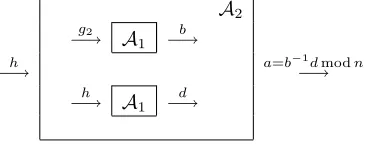
The second property concerns the choice of the generator of the group. Namely, if g1 and g2 are distinct generators of G, then any algorithm A1 that has a
non-negligible probability of solving discrete logarithms inGto the baseg1can readily be turned into an algorithmA2having non-negligible probability of solving discrete
logarithms inGto the baseg2. Indeed, leth=ga
2 be an instance of the DLP inGto be solved. By the random
self-reducible property of discrete logarithms, we can assume without loss of gen-erality that for anys2G,A1has a non-negligible probability of producinglogg1s.
So …rst invoke A1 on input g2 in order to get, with non-negligible probability, an
integer b such that g2 =g1b and0 < b < n. Since g1 and g2 are both generators,
it follows that gcd (n; b) = 1, and so b is an invertible element of Z/nZ. Then compute an integerc such thatbc 1 (modn) and0 < c < nusing, for instance, the extended Euclidean algorithm [8, Algorithm 2.107]. Then,
g2c= gb1 c=g1bc=g1.
6That is, there is a polynomialpsuch that this probability is greater than1=p(logn). 7For instance, the algorithm could solve all instances for which the discrete logarithm is even,
Next, we can obtain with non-negligible probability an integer dsuch thath=gd 1
and0 d < nby invokingA1on inputh. Finally,
h=gd1 = (g2c)d=gcd2 ,
and soa=cdmodn, which completes the argument.
A2 g2
! A1 b! h
! a=b
1dmodn
!
h
! A1 d
!
Figure 6. ConstructingA2from A1
Department of Combinatorics and Optimization, University of Waterloo, Waterloo, Ontario, Canada N2L 3G1