Concurrent Non-Malleable Zero Knowledge
Boaz Barak
Department of Computer Science Princeton University
Manoj Prabhakaran
Department of Computer Science University of Illinois at Urbana-Champaign
Amit Sahai∗
Department of Computer Science University of California Los Angeles
October 21, 2006
Abstract
We provide the first construction of a concurrent and non-malleable zero knowledge argument for every language inNP. We stress that our construction is in the plain model with no common random string, trusted parties, or super-polynomial simulation. That is, we construct a zero knowledge protocol
Πsuch that for every polynomial-time adversary that can adaptively and concurrently schedule polyno-mially many executions ofΠ, and corrupt some of the verifiers and some of the provers in these sessions, there is a polynomial-time simulator that can simulate a transcript of the entire execution, along with the witnesses for all statements proven by a corrupt prover to an honest verifier.
Our security model is the traditional model for concurrent zero knowledge, where the statements to be proven by the honest provers are fixed in advance and do not depend on the previous history (but can be correlated with each other); corrupted provers, of course, can chose the statements adaptively. We also prove that there exists some functionalityF(a combination of zero knowledge and oblivious transfer) such that it is impossible to obtain a concurrent non-malleable protocol forF in this model. Previous impossibility results for composable protocols ruled out existence of protocols for a wider class of functionalities (including zero knowledge!) but only if these protocols were required to remain secure when executed concurrently with arbitrarily chosen different protocols (Lindell, FOCS 2003) or if these protocols were required to remain secure when the honest parties’ inputs in each execution are chosen adaptively based on the results of previous executions (Lindell, TCC 2004).
We obtain anO˜(n)-round protocol under the assumption that one-to-one one-way functions exist. This can be improved toO˜(klogn)rounds under the assumption that there existk-round statistically hiding commitment schemes. Our protocol is a black-box zero knowledge protocol.
Keywords: Non-malleable protocols, concurrent composition, concurrent zero knowledge, non-malleable zero knowledge
∗
Contents
1 Introduction 1
1.1 Our Results . . . 1
1.2 Previous works. . . 3
1.3 Preliminaries. . . 4
2 A concurrent non-malleable zero knowledge protocol 5 2.1 UC-like definition of CNMZK . . . 6
2.2 Result from [PRS02] . . . 6
2.3 Non-Malleable Commitment . . . 8
2.3.1 Available Non-Malleable Commitment Protocols . . . 9
2.4 Other Ingredients . . . 11
2.5 Our Protocol . . . 11
2.5.1 Proof of Claim 2.6 . . . 14
2.5.2 Relaxing the requirement onComNM . . . 18
3 Impossibility result for concurrent non-malleable general functionalities. 18 3.1 Proof of Theorem 3.1: First stage. . . 21
3.2 Proof of Theorem 3.1: Second stage. . . 22
1
Introduction
In the two decades since their introduction [GMR85], zero-knowledge proofs have played a central role in the
study of cryptographic protocols. Intuitively speaking, a zero-knowledge proof is an interactive protocol that allows one party (a “prover”) to convince another party (a “verifier”) that some statement is true, without revealing anything else to the verifier. The zero knowledge property was formalized in [GMR85] by requiring
that the verifier can efficiently simulate its view of an interaction with the prover, when given only the statement as input – i.e., without any knowledge of why the statement is true.
In many settings, however, the above security guarantee is not sufficient. Consider a situation in which Alice is giving a zero-knowledge proof of the statement X to Bob, and at the same time Bob is trying to give a zero-knowledge proof of some other statement X’ to Charlie. Our intuitive definition of zero-knowledge tells us that Bob should not get any “help” in proving X’ to Charlie by means of the zero-knowledge proof that Bob is getting from Alice – i.e. Bob should only be able to prove X’ to Charlie if he could have done it on his own, without any help from Alice. This property is called non-malleability [DDN91] for
zero-knowledge proofs. It turns out that the standard simulation definition of zero zero-knowledge does not imply non-malleability, and in fact, many known zero-knowledge proofs are susceptible to this kind of attack. We note that we can describe non-malleability as security in the following scenario: there are two executions of zero-knowledge proofs, with the adversary corrupting the verifier in one execution and the prover in the other.
Another setting considered in the literature is the following: Suppose there are many verifiers, all of which are receiving zero-knowledge proofs from various provers at the same time. We would like to guar-antee that even if many of these verifiers collude, they still can’t learn anything nontrivial from the provers – i.e., that it is possible to efficiently simulate the view of all the colluding verifiers interacting with the provers, given only the statements being proven by the provers. This property is called concurrent zero
knowledge [DNS98,RK99], and here too, the standard definition of zero knowledge does not imply concurrent
zero knowledge.
1.1 Our Results
In this work, we present the first protocol that is provably simultaneously non-malleable and concurrent zero knowledge in the “plain” cryptographic model without any setup assumptions. Our protocol allows provers to prove anyNPstatement and is based on standard cryptographic assumptions – namely, the ex-istence of collision-resistant hash functions. The assumptions that we use is the exex-istence of statistically hiding commitment schemes. Such schemes can be constructed withO(n)rounds under one-way permu-tations [NOVY98] and and even regular (and in particular one-to-one) one-way functions [HHK+05] and in
constant rounds under claw-free permutations [GMR84] or collision-resistent hash functions [DPP97,HM96].
Simultaneous non-malleability and concurrency means that in the setting where there are many verifiers and provers all interacting concurrently, with scheduling decided by the adversary as well, security is preserved even if the adversary corrupts an arbitrary subset of both the provers and the verifiers. The definition of security is that for any such adversary there exists a polynomial-time simulator that, given only the state-ments proven by the honest parties (and not the witnesses), simulates the entire execution, and outputs along with the simulated transcript a list of witnesses corresponding to all statements successfully proven in this transcript by corrupted provers to honest verifiers. This definition is the natural combination of non-malleable zero knowledge [DDN91] and concurrent zero knowledge [DNS98, RK99], and is also similar
to the analogous definitions for non-malleable and concurrent commitments [DDN91,PR05A]. We note that
non-malleability [RK99, KP01, PRS02], (2) achieved non-malleability but only with a bounded number of
parties present [DDN91,BAR02, PR05B], (3) made use of global setup assumptions like a common reference
strings [CLOS02] or time-delayed messages [KLP05], or (4) used different security frameworks like
super-polynomial simulation [PS04,BS05,MMY06].
As in previous works on concurrent zero knowledge and non-malleable zero knowledge, our model assumes that the vector of inputs (statements and witnesses) to all parties is fixed according to some pre-determined distribution (although corrupted parties of course do not have to use their given inputs and can choose their inputs and messages adaptively). However, our security proof does not extend to the case of adaptively chosen honest inputs; this is with good reason, as it was shown by Lindell that there is no concurrent non-malleable zero knowledge protocol for honest adaptive inputs [LIN04]. Indeed, Lindell’s
argument also ruled out many other functionalities, including oblivious transfer (OT), in the setting where the inputs for honest parties can be chosen adaptively based on outputs of previous protocols.
This leads to a natural question: Can we generalize our positive result on concurrent non-malleable zero knowledge to obtain a result for any polynomial-time functionality – as long as the inputs to honest parties are fixed in advance? We answer this question negatively by exhibiting a simple and natural functionality that is impossible to realize, even in the setting where all honest inputs are fixed in advance. Our negative result is also somewhat surprising since in many other settings (i.e., UC security in the common reference string model [CLOS02], bounded-concurrent security [LIN03A,PR03,PAS04], super-polynomial simulation [PS04, BS05,MMY06], and composition in timing model [KLP05]) obtaining composable zero-knowledge protocols
was the key step to obtaining protocols for all functionalities1.
Our techniques. Perhaps surprisingly, our protocol does not use non-black-box techniques, but rather only uses black-box concurrent zero knowledge and non-malleable commitments; both tools that have been around for several years by now [RK99,DDN91] (although we do require some tweaking of these protocols,
see below and Section 2). We see our main novelty in our proof of security.
Essentially all known techniques for achieving concurrent zero knowledge simulation and non-malleability in the plain model have relied crucially on proof techniques based on complex “rewinding” arguments2. A critical component to many results (e.g. [DDN91,PRS02,PR05A,BS05]) has been the development of new proof
techniques to tame the complexity introduced by rewinding, often through new kinds of hybrid arguments. At a technical level, we continue in this line and develop new techniques for dealing with complex rewinding in security proofs.
Our protocol uses the Prabhakaran-Rosen-Sahai (PRS) [PRS02] concurrent zero knowledge protocol and
simulation strategy. We also want to make use of non-malleable commitment constructions (e.g. [DDN91, PR05A]) to obtain non-malleability. This gives rise to two main obstacles: (1) We need to guarantee that the
non-malleability properties of these commitment schemes remain even in the presence of our rewinding. Note that in general, this should not be true – an adversary for a plain-model non-malleable commitment scheme such as [DDN91,PR05A] that can rewind honest parties would always be able to cheat. We develop
a new hybrid argument that shows that we can guarantee non-malleability by making specific use of the properties of the PRS rewinding strategy and a statistical zero knowledge variant of the PRS protocol. (2) The other major obstacle is that the techniques for non-malleability necessarily involve rewinding of their
1
We do believe that the pattern will still hold true here – that our concurrent non-malleable zero-knowledge protocol will lead to protocols for all or large classes of functionalities, but just not according to the same definition of security. In the conclusions section, we mention some possible directions.
2We note that all known non-black-box techniques [B
own (for extraction). We develop a new proof technique to show that the extraction methods we need can work “on top of” the PRS rewinding strategy.
For our impossibility result ruling out concurrent non-malleable realizations of more general functions, even when honest party input distributions are fixed, we work as follows: we start by taking one of the counterexamples showing that very strongly composable protocols (e.g., UC security [CAN01] or security
against “chosen-protocol attack” [KSW97,LIN03B]) for, say, zero knowledge, do not exist in the plain model
(where there are no trusted parties or common reference strings). This basically implies that for every supposedly composable zero-knowledge argumentΠ, there exists a protocolΠ0, depending onΠ, such that their concurrent execution is not secure. The main novelty in our work is that in order to get the kind of result we want, we use a variant of Yao’s garbled circuit technique [YAO86] to “compile” the protocolΠ0 into
a protocol using the oblivious transfer functionality. Thus, we create a scenario where for every protocol
Π implementing the combined zero knowledge and oblivious transfer functionality (or equivalently, for every pair of protocolsΠZK andΠOT each implementing these two functionalities), there’s an adversary
launching a concurrent attack that manages to learn a secret with probability close to1in the real world, but no adversary would be able to learn the secret with non-negligible probability in the ideal model. Note that, unlike its typical use, we’re using Yao’s technique here to get a negative result. (This is somewhat similar in spirit to [BGI+01].)
1.2 Previous works.
Concurrent zero knowledge. Concurrent zero knowledge (where the adversary corrupts either only provers or only verifiers) was defined by Dwork, Naor and Sahai [DNS98] and the first construction in the standard
model was given by Richardson and Kilian [RK99]. The number of rounds was improved to O˜(logn) by
[KP01,PRS02] which is optimal for black-box simulation [CKPR01]. (A constant round protocol for
bounded-concurrent zero knowledge was given in [BAR01] using non-black-box simulation.)
Non-malleable zero knowledge. Non-malleable zero knowledge was first defined and constructed by Dolev, Dwork and Naor [DDN91]. Constant round protocols were given in [BAR02,PR05B]. These latter works
also introduced some more convenient definitions (which we follow) than the [DDN91] definition (inspired
by definitions of non-malleable non-interactive zero knowledge [SAH99]).
Non-malleable and concurrent commitments. By a simple hybrid argument, every commitment scheme remains secure under concurrent composition if the adversary can corrupt either only senders or only re-ceivers. As in the case of zero knowledge, stand-alone non-malleable commitments were defined by [DDN91]
and constant-round protocols were given in [BAR02,PR05B]. Pass and Rosen [PR05A] showed that the
commit-ment scheme from [PR05B] is actually concurrently non-malleable thus giving anO(1)round concurrent
non-malleable commitment scheme. Note: In many previous works, progress in commitment schemes and zero-knowledge went hand in hand, where one could obtain a ZK protocol satisfying security notionXby plug-ging a commitment scheme satisfying X to a standard standalone protocol [DDN91,CF01, CLOS02, LIN03A].
Thus, one might hope that one could obtain in this way a concurrent non-malleable ZK protocol from the [PR05A] scheme. However, an important limitation of [PR05A] is that security is guaranteed only under
the condition that only the commit protocol and not the reveal protocol is executed concurrently. For this reason, such commitment schemes do not automatically imply concurrent non-malleable zero knowledge proofs. In particular, we do not know that if we plug in [PR05A]’s commitments in one of the well known
In fact, that would be quite surprising since in particular it will yield the first constant round concurrent
zero knowledge protocol. We note that our work here does not work in this way, and indeed, we can make
use of “non-concurrent” non-malleable commitment protocols like the original protocol of [DDN91], thus
avoiding non-black-box techniques altogether, and reducing our assumptions to just regular one-way func-tions. We also don’t know whether it’s possible make the proof simpler by using concurrently non-malleable commitments.
Universally composable (UC) security, general and self composition. In [CAN01], Canetti introduced the
notion of universally composable or UC security for cryptographic protocols. This is a very strong notion of security and in particular a UC secure zero-knowledge protocol will be concurrently non-malleable and in fact will compose with an environment that contains executions of arbitrary other protocols as well (see also [LIN03B]). However, this notion, that essentially implies black-box straightline simulation, is in some sense
“too strong”, and it was shown that in the “plain” model, without trusted parties, honest majority or setup, it is impossible to achieve UC-secure zero knowledge and in fact a very wide range of functionalities including commitment schemes [CAN01,CF01,CKL03]. (See [BOGW88,CAN01,CLOS02,BCNP04] for constructions in other
models.)
Self-composition. As mentioned above, Lindell [LIN04] showed that for the case of message passing
func-tionalities (funcfunc-tionalities allowing to transmit a bit, in particular including zero knowledge), security for
concurrent composition of the same protocol under adaptive input selection essentially implies UC security and hence it is impossible to obtain a zero knowledge protocol satisfying this notion of self-composition in the plain model. Adaptive input selection is defined by having the inputs supplied by an environment as in the UC model, but unlike the UC definition, this environment is not allowed to look at the actual
communi-cation of the executions but only at the outputs of these executions. In contrast, in our security model the
inputs may be chosen from some distribution but are supplied in advance to all parties, and so, while we can’t control the corrupted parties’ behavior, the honest parties do not choose their inputs adaptively based on previous executions.
Super-polynomial-time simulation. Another sequence of works considered a setting where the ideal model simulator is allowed to run in super-polynomial time [PS04,BS05,MMY06]. This allows to bypass the
UC impossibility results and yield protocols for any functionality that seem to supply adequate security for many applications. However, the definition is not as intuitive and mathematically clean as polynomial-time simulation, and the current constructions do suffer from drawbacks such as requiring stronger complexity assumptions, and a tradeoff between the time of simulation and the standalone soundness of the protocol.
Security for independent inputs. Garay and MacKenzie [GM00] show a protocol for oblivious transfer
that is concurrently secure if the inputs to the parties in each execution is chosen independently and at random from a known distribution such as the uniform distribution. We note that in this paper we consider the more standard setting where the inputs are arbitrarily chosen and in particular may be correlated.
1.3 Preliminaries.
We consider only two party protocols in this paper. Our model is ofmpartiesP1, . . . , Pm (not necessarily
can assume that each party participates in at most one interaction ofΠ). We assume an adversaryAdvthat chooses initially to corrupt a set of parties{Pi:i∈C}, and receives the inputs for that set, and completely
controls these parties. The adversary can also schedule concurrently and adaptively all the messages in the network. We assume that all parties in the network have unique identities and authenticated communication (following [DDN91] this can be relaxed somewhat for the positive result). We say thatΠsecurely implements
an ideal functionalityF with two inputs and two outputs if for any suchAdvcorrupting a setC there’s a simulatorSimthat receives the inputsxifori∈C, and for every pair(i, j)that interacts viaΠwithi∈C
andj 6∈ C,Simgets one access to the first output of the function x 7→ F(x, xj) (we have an analogous
definition if the corrupted party is the second in the pair). The outputs ofSimand the second output should be computationally indistinguishable from the outputs ofAdvand the outputs of the honest parties in the real execution. It can be shown that Π is concurrent non-malleable zero knowledge for an NP-relation R if and only if it secure implements the ZKPOK functionalityF defined as follows: F(x◦w) = x iff
(x, w)∈RandF(x◦w) =⊥otherwise (this functionality only uses one of its inputs).
2
A concurrent non-malleable zero knowledge protocol
Definition 2.1. A protocol is a Concurrent Non-Malleable Zero Knowledge (CNMZK) argument of
knowl-edge for membership in anNPlanguageLwith witness relationR (that is,y ∈Liff there existswsuch thatR(y, w) = 1), if it is an interactive proof system between a prover and a verifier such that
Completeness: if both the prover and the verifier are honest, then for every(y, w)such thatR(y, w) = 1, the verifier will accept the proof, and
Soundness, Zero-Knowledge and Non-Malleability: for every (non-uniform PPT) adversaryA interact-ing with proversP1, . . . , PmLinmL“left sessions” and verifiersV1, . . . , VmR inmR“right sessions” of the protocol (withAcontrolling the scheduling of all the sessions), there exists a simulatorSsuch that for every set of “left inputs”y1, . . . , ymL, we haveS(y1, . . . , ymL) = (ν, z1, . . . , zmR), such that
1. ν is a simulated view ofA: i.e.,ν is distributed indistinguishably from the view ofA(for any set of witnesses(w1, . . . , wmL)thatP1, . . . , PmLare provided with).
3
2. For alli∈ {1, . . . , mR}, if in thei-th right hand side session inνthe common input isxiand the
verifierViaccepts the proof, thenziis a valid witness to the membership ofxiin the language,
except with negligible probability (zi =⊥ifVidoes not accept.)
Further, we call the protocol a black-box CNMZK if there exists a universal simulatorSBBsuch that for any adversaryA, it is the case thatS =SBBA satisfies the above requirements.
Note that the above security property subsumes both zero-knowledge and proof-of-knowledge proper-ties. In particular, the second condition reduces to regular (stand-alone) zero knowledge property when mL = 1andmR = 0, and implies regular (stand-alone) proof-of-knowledge property whenmL = 0and
mR= 1. Furthermore, this condition reduces to concurrent zero knowledge [DNS98,RK99] whenmL=poly
andmR= 0; it reduces to basic (“non-concurrent”) non-malleability [DDN91] whenmL=mR= 1.
This definition resembles the notion of simulation-extractablity used in [PR05A] for concurrent
non-malleable commitments.
2.1 UC-like definition of CNMZK
We can also write this definition in the language of the UC-framework, to further illustrate the level of security and composition it gives. We do not get into the details of modeling the Network, but instead keep our description at an informal level. For more details of modeling see [CAN05,PRA05].
The functionality in question isFR
ZK, the natural zero-knowledge functionality for membership inL: it
accepts a pair(y, w)fromP and sends(y, R(y, w))toV, which it outputs.
The nature of the security is essentially described by the kind of environments allowed in the security definition. We call a PPT environmentZa “CNM environment” if it behaves as follows:
• Zinteracts arbitrarily with the adversary, and selects many pairs of parties(P, V). For each of these pairs,Zpicks(y, w)such thatR(y, w) = 1. It handsyto bothP andV, andwtoP.
• ThenZ initiates each pair to interact with an instance ofFR
ZK. After this point the environment does
not send any messages to the parties or to the adversary (but it continues to receive messages from the adversary).4
• FinallyZ outputs a bit.
Note that since there will be no automatic composition theorem available, the environment already invokes multiple instances of the functionality. Also note that there are no other protocols or functionalities being invoked, emphasising the fact that we are dealing only with self-composition.
In the “ideal” execution, when initiated with input, the parties interact withFR
ZK. In the “real” execution
the parties use the protocol in question. All scheduling is controlled adversarially.
Then the definition of security is that there exists a simulator SBB such that for all adversariesAand
any CNM environmentZ, the output ofZ in the real execution is indistinguishable from that in the ideal execution.
2.2 Result from [PRS02]
We adapt the main argument from [PRS02] for use in our protocol. Consider the following protocol segment:5
1. PRS Commitment: The verifier picks a (sufficiently long) random string σ, and preparesk·t(k)
(wheret(k) is anyω(logk)function) pairs of secret shares(α0ij, αij1)for1 ≤i ≤k, 1 ≤j ≤t(k)
such that for all(i, j)we haveα0ij⊕α1ij =σ. Then it commits toσand(α0ij, αij1)ijusing a statistically
binding commitment schemeComPRS.
2. PRS Challenge-Response: This is followed byt(k)rounds of randomk-bit challenges by the prover. In response, for each (i, j), if thei-th bit in thej-th challenge rij = bthen the verifier opens the
commitment toαbij in that round.
3. On reaching this point the prover considers the preamble to have “concluded.”
4
The environment not communicating with honest parties after initiating the protocol execution corresponds to the restriction that the inputs to the honest parties are non-adaptive. Also the restriction that there is no information the adversary receives other than its initial auxiliary inputs and the protocol messages is captured by restricting the environment from sending messages to the adversary after the protocols commence. Technically, such a restricted environment allows a simulation that involves “rewinding,” as in our case.
5
4. PRS Opening: The verifier opens all the commitments made in the PRS Commitment step, and the prover verifies consistency of the revealed values (i.e., that for all (i, j), α0
ij ⊕α1ij evaluates to the
same value).
5. On reaching this point the prover “accepts” the preamble.
There can be other messages in between, as long as the challengesrij are picked randomly independent
of previous messages. In particular, as in our case, there can be messages in the protocol between the prover concluding the preamble and the verifier opening the commitments.
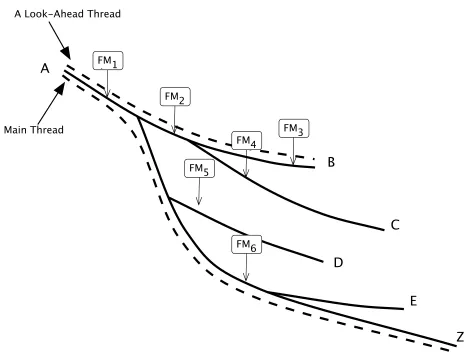
The PRS simulator (for our purposes) is the following program which “simulates” multiple (polyno-mially many in the security parameter) concurrent sessions of the protocol between honest provers and a combined adversarial verifier, APRS. The simulator gets inputs of all the parties in all the sessions, and it runs the honest provers and the adversarial verifier internally.6 In the end it produces an ordered list of “threads of execution.” A thread of execution consists of views of all the parties, such that the following hold.
• Each thread of execution is a perfect simulation of a prefix of an actual execution.
• The last thread, called the main thread, is a perfect simulation of a complete execution (i.e., until all the parties terminate); all other threads are called look-ahead threads.
• Each thread shares a (possibly empty) prefix with the previous thread, and is derived by running the honest parties with fresh randomness after that point.
The aim of the PRS simulator is, for each PRS commitment that it comes across in any session in any thread, to extract the committed valueσ(referred to as the “PRS secret”) before the preamble of the session is concluded in that thread. The extraction is achieved by observing the adversary’s messages in multiple previous threads. If it fails to extract the PRS secret in any session in a thread, and the execution goes on to accept the preamble of that session in that thread, then the simulation is said to “get stuck.” [PRS02]
guarantees that the probability of the PRS simulation getting stuck is negligible.
Lemma 2.2. (Adapted from [PRS02]) Consider proversP1, . . . , Pmand an adversarial verifierAPRSrunning m sessions of a protocol with the PRS preamble as described above, where m is any polynomial in the security parameterk. Then except with negligible probability, in every thread of execution output by the PRS simulator, if the simulation reaches a point where the proverPi accepts the PRS preamble withσas
the secret in the preamble, then at the point when the preamble was concluded, the simulator would have already recorded the valueσ.7
In fact [PRS02] prove a further refinement of this lemma (that we will need): instead of the simulator
running each thread exactly as in the original execution, if each thread (individually) is executed in an indistinguishable way,8 the lemma still holds. (This is what allows [PRS02] to show that indistinguishable
6
Note that the “simulator” as described here is given all the inputs to all the parties. Later, after introducing this simulator into the sequence of hybrids in our proof, we shall show how to get rid of these inputs.
7
Unlike in [PRS02], in our preamble, the PRS commitment is statistically binding. So, except with negligible probability, ifPi
accepts the preamble, there is a well-defined valueσin the PRS commitment, and it is this value that the prover accepted as the secret in the preamble. We point out that our case is slightly simpler than the original analysis in [PRS02] in that we are interested in arguments (not proofs), and hence the commitment by the verifier can be statistically binding.
8
simulation is possible.). It is important that here we require the indistinguishability requirement only on a
per thread basis. In particular the joint distribution of the threads in the latter simulation is allowed to be
distinguishable from the joint distribution of the threads in the original simulation.
We shall adapt the PRS simulator to our setting in which an adversaryAis engaged in concurrent left hand side sessions as the verifier, while concurrently playing the prover in multiple right hand sessions. We could build a preliminary simulator (which is provided with inputs of all the parties) for this situation by considering all the right hand verifiers also as part of an adversaryAPRSbefore invoking the PRS simulator. However there is a minor technicality that needs to be taken into account. In [PRS02], since the adversary is
arbitrary, it may very well be assumed to read its entire random tape up front. Thus in all the threads (all of which may share a common non-empty prefix) the PRS simulator in [PRS02] uses the same random tape
for the adversary. But it is easy to see that the analysis in [PRS02] works even with probabilistic adversaries
which do not read their entire random tapes initially, and in that case the PRS simulator can use fresh randomness for the unread parts of the random tape when simulating a new thread. This is important for us because in our simulation we will need to use fresh randomness for the right hand side verifiers in different threads (except during the shared prefixes). So in our use of the PRS simulator only the random tape of the original (arbitrary) adversaryAis fixed across all the threads while the rest ofAPRS(i.e., the right hand side verifiers) is given fresh randomness in different threads.
Another equivalent (and in some sense a more natural) way to formulate this is to consider the right hand side verifiers as part of the honest prover and, as in the original PRS simulator, to fix the random tape of the adversary across all threads. Later in our proof, we will have chance to refer to this formulation.
2.3 Non-Malleable Commitment
The other ingredient we need is a statistically binding non-malleable commitment (not necessarily concur-rent non-malleable) with an “extractability” property. More precisely, we require an interactive commitment protocolComNM, between a “sender” (whose input it wants to commit to) and a “receiver” (with no input)
satisfying the following properties.
1. Statistical Binding: The protocol has a determining message from the sender to the receiver (typically the first message from the sender) which is the first message containing information about the value to be committed. If either the sender or the receiver is honest, the determining message is information theoretically binding except with negligible probability.
For clarity in presentation we shall require that the first message in the protocol is itself the determin-ing message. (However see Section 2.5.2.)
2. (Non-concurrent) Non-Malleability: Consider the following two experiments in which an adversary M participates in one “left session” of the protocol as the receiver, and in one “right session” as the sender. M picks a valuew and gives it to the left senderP. In the first experimentP commits to w while in the second experiment it commits to the all-zeroes string. We define the value of the experiment as(τ, α), whereτ is the output ofMandαis the value in the determining message of the right-hand-side commitment. (We sayα=⊥if the right-hand-side commitment was not accepted, or if the determining message did not uniquely determine the committed value).
The non-malleability property is that the values of the two experiments are distributed computationally indistinguishably.
in a right hand execution. Instead, after receiving the commitment fromP, M produces an output, which is the value of the experiment. Then the hiding property requires that the values of the two experiments are computationally indistinguishably distributed.
3. (Stand-alone) Extractability: The extractability requirement is that there is an efficient extractor such that given an adversary and its view from a random execution of the protocol with an honest receiver, then, except with negligible probability – the probability being over the coins of the adversary and the verifier in the view, as well as that of the extractor, if it is randomized – the extractor outputs the value in the commitment, if according to the view the receiver accepts the commitment.
In fact, we require a slight extension to this by requiring that the extraction can work on a prefix of the protocol where the verifier is public-coin. More formally, there is a message from the sender in the protocol called the “knowledge-determining message” (KDM), such that given an adversary and its view during a random execution of the protocol till (and including) the KDM, the extractor will output the committed value, if according to the view the verifier was still accepting (i.e., it did not abort). We require that prior to receiving the KDM the receiver does not have any private coins.
2.3.1 Available Non-Malleable Commitment Protocols
For simplicity, first we consider a model in which all parties have distinct identities9, and all communication is over authenticated channels.
Pass-Rosen Commitment: In [PR05A] give a statistically binding commitment protocol, and show that
their protocol satisfies the non-malleability property we require (and more).
Though [PR05A] states their definition without an extraction requirement, in their proof they show how
to do extraction as well. But in fact we observe that another simple extractor (so that the protocol is clearly public coin until the knowledge-determining message) can be derived by slightly modifying their proto-col. Their protocol has the following structure: first the sender commits to its input using any statistically binding commitment scheme; then it gives a proof of knowledge of the input and randomness used in this commitment, using a non-malleable ZK protocolnmZKID, whereIDis the identity of the prover. Consider
modifying this protocol by replacing the first message – namely the statistically binding commitment – by an
interactive statistically binding commitment, which consists of a regular non-interactive statistically binding
commitment (which can be based on any 1-1 one-way function) followed by a ZK proof of knowledge that it knows the contents of the commitment. Using a ZKPOK of super-constant rounds we can obtain a deter-ministic polynomial time extractor. This can be done, for instance, by having aω(logk)-round sequential copies of the basic Hamiltonicity protocol [BLU87]. (see e.g. [GOL01]).
This commitment protocol satisfies all our requirements.
DDN Commitment: Surprisingly, though we are in a concurrent setting, our requirement of non-malleability on the commitment schemeComNM is in the plain non-malleability setting (i.e., one execution each on the
left hand and right hand sides). We show that the original non-malleable commitment scheme by Dolev, Dwork and Naor [DDN91] satisfies our requirements, when the initial (statistically binding, non-interactive)
9
commitment phase of their protocol is augmented to have a ZKPOK, as above. As we mentioned above this modification takes care of the extraction requirement, while retaining the non-malleability property proven there.
Next we claim that the non-malleability property of the DDN protocol implies the non-malleability property that we require. First we adapt the definition from [DDN91] as follows:
Definition 2.3. (DDN Non-Malleable Commitment. Adapted from [DDN91].) A statistically binding
commitment protocol is said to be DDN-non-malleable if for every (non-uniform PPT) adversaryADDN,
there exists a simulatorSDDN such that for all (non-uniform) PPT machinesR that take three inputs and
outputs a single bit, the outputs of the following two experiments are indistinguishable from each other.
DDN-Experiment 1: ADDN first outputs a stringw. Thenais set to bewor the all-zeros string, chosen unifromly at random. An honest sender P commits to ato ADDN. MeanwhileADDN commits to some
stringαto an honest receiverV. (αis well-defined, possibly as⊥, because the commitment is statistically binding). Also at the endADDNoutputs a plain-textτDDN. The output of the experiment isR(a, α, τDDN).
DDN-Experiment 2: SDDNoutputs a stringwandais set to bewor the all-zeros string, chosen unifromly
at random. ThenSDDNcommits to some stringαto an honest receiverV and outputs a plain-textτDDN. The
output of the experiment isR(a, α, τDDN).
Here we have simplified the DDN definition by replacing a general distribution by a uniform distribution over a stringwand the all-zeros string. Without loss of generality we assume thatwis chosen determinis-tically (but non-uniformly). Also, we have slightly strengthened the definition to include a plain-text output τ produced by the adversary as input toR. To see that the protocol in [DDN91] does satisfy this
strength-ened requirement, note that the proof there first uses a “knowledge extractor” to extractα, which could be modified to output(τ, α)instead.
Now suppose a commitment protocol did not satisfy the non-malleability we require. Then, there is an adversaryA who gives a valuew, accepts a commitment on the left to either wor the all-zero string, and makes a commitment on the right to computationally distinguishable values on the right, and outputs a stringτ. Let the value committed to on the right beα. Denote these as(τ(w), α(w))in the first experiment (when commitment on the left is tow), and as (τ(0), α(0)) in the second experiment (when commitment on the left is to0). We have a PPT distinguisherDwhich outputs a single bit such thatD(τ(w), α(w)) 6≡C D(τ(0), α(0)). In other words,|πw−π0|is not negligible, whereπwandπ0stand forPr[D(τ(w), α(w)) = 1]
andPr[D(τ(0), α(0)) = 1]respectively. Note that this can be true only ifwis not the all-zeros string. Now defineADDNto be the same asA, but withτDDN= (τ, w). Define
R(a, α,(τ, w)) = (
D(α, τ) ifa=w 1−D(α, τ) otherwise.
Then the probability of the output of DDN-Experiment 1 being 1 is 12(πw+ (1−π0)) = 21 +12(πw−π0),
where as the probability of DDN-Experiment 2 producing 1 is 12 (since a = w with probability 12; here we use the fact thatwis not the all-zeros string). Since|πw−π0|is not negligible, the outputs of the two
2.4 Other Ingredients
The other ingredients we use are
1. A statistically (or perfectly) hiding commitment schemeComSH.
2. A statistical (or perfect) ZK argument of knowledgesZKAOK, for proving knowledge of witness for membership in anyNPlanguage.
The statistically hiding commitment schemeComSHcan be achieved in a constant-round protocol using
collision-resistant hash functions or claw-free permutations or, at the expense of havingO(k)rounds, using one-way permutations [NOVY98] (see also Section 4.8 of [GOL01]), and even using only regular one-way
functions by the recent result of Haitner et al.[HHK+05]. Given such a commitment scheme, we getsZKAOK
as required with a factor ω(logk)blow up in the number of rounds, in same manner as our construction of a ZKPOK above, usingω(logk)sequential copies of the Hamiltonicity protocol, but where the prover’s commitments in the Hamiltonicity protocol are made using the statistically hiding commitment scheme
ComSH. ThissZKAOKenjoys a strict polynomial-time extraction procedure with negligible probability of
failure.
We note that all our ingredients are realizable under the assumption that regular one-way functions exist (and in particular under the assumptions that one-to-one one-way functions exist).
2.5 Our Protocol
Consider an NP-complete language L with a witness relationship R. The prover and verifier receive a common input y and the prover receives a witness w such that R(y, w) = 1. The protocol CNMZKis described below.
Phase I: PRS preamble from Section 2.2 up to the point where the prover concludes the preamble.
Phase II: Prover commits to the all-zero string usingComSH. Then it usessZKAOKto prove the knowledge
of the randomness and inputs to this execution ofComSH.
Phase III: Continue the PRS preamble until the prover accepts the preamble. Let the secret in the preamble
(as revealed by the verifier) beσ.
Phase IV: Prover commits to the witnesswusingComNM.
Phase V: Prover proves the following statement usingsZKAOK: either
• the value committed to in Phase IV iswsuch thatR(y, w) = 1, or
• the value committed to in Phase II isσ.
It uses the witness corresponding to the first part of the statement.
Proof. It is easy to see that the protocol satisifies the completeness condition. Below we shall build a
simulator-extractor, which outputs a simulated view of the adversary’s view along with witnesses for all the successful right hand side proofs in the simulated view, as required by the second condition in Defintion 2.1. We build the simulator S in stages, via intermediate simulators Hi, fori = 1, . . . ,4. Hi outputs a simulated view ν(i). (S will in addition output a list of witnesses.) We define 2mR random variables
{b(i)` , α(i)` }mR
`=1, whereb (i)
` is a bit denoting whether according toν(i),V` accepted the proof from the
ad-versary or not, andα(i)` is the value contained in the Phase IV commitment ComNM received by V` (as
determined by the determining message; if there is no unique value, then it is defined to be⊥).
Stage 1: H1 gets all the inputs to P1, . . . , PmL as well as the inputs toA. It internally runs the (honest) programs ofP1, . . . , PmL, as well the honest program for the verifiersV1, . . . , VmR, to generateA’s view ν(1). The simulation is perfect.
Also one can show that due to the knowledge soundness of the sZKAOK scheme used in Phase II and Phase V, if V` accepts the proof in the`-th right hand session in the simulated viewν, then, except
with negligible probability, the Phase IV commitment (which is statistically binding) in that session indeed contains a valid witnessz`to the statementx`. (This follows from a hybrid argument for themRright hand
side sessions.) This is stated in the claim below; a detailed proof follows.
Claim 2.5.
∀` b(1)` = 1 =⇒ R(x`, α (1) ` ) = 1
(1)
except with negligible probability.
Proof. Fix ` ∈ {1, . . . , mR}. First, from H1, construct a standalone proverP∗ which interacts with V`
alone. This is done by including everything simulated byH1exceptV` as part ofP∗, so that an interaction
ofP∗ with an honest verifierV` is identical to the execution of H1. We need to argue that ifV` accepts
the proof byP∗, then except with negligible probability, the Phase IV commitment made byP∗ is a valid witness z` to the statementx`. We consider the following experiment. Engage P∗ in an execution with
an honest verifierV` which uses a random PRS secretσ. Then, ifV`accepts the proof fromP∗ build two
standalone proversP1∗ andP2∗ as follows. P1∗ is a copy ofP∗ at the point where it began thesZKAOKin Phase II.P2∗ is a copy ofP∗ at the point where it began the sZKAOKin Phase V. Now run the extractor forsZKAOKonP1∗ andP2∗. First we observe that from the hiding property ofComPRSit follows that the
probability of the extractor onP1∗ returning (an opening or explanation ofComSH as a commitment to)σ
is negligible. Secondly we observe that the computational binding ofComSHimplies that the probability of
extractor onP1∗returning an opening to something other thanσand the extractor onP2∗returning an opening toσis negligible: this is because, otherwise we obtain two different ways to openComSH. Finally by the
knowledge extractability property ofsZKAOKwe observe that the probability of (V`accepting and)P1∗not
returning some opening ofComSHis negligible; also that ofP2∗returning neither an opening ofComSHtoσ
nor an opening of the Phase IVComNM commitment to a valid witness forx` is negligible. Together these
imply that the probability ofV` accepting the proof and the Phase IVComNM being not to a valid witness
forx`is negligible.
Stage 2: H2 works just likeH1, but it also does the PRS look-aheads and records the PRS secrets. Recall
that this means that the simulator runs many perfect simulations of the execution with shared prefixes (but using fresh randomness in the unshared parts), and records the PRS secrets for each preamble concluded in any thread. H2 aborts if the PRS simulation gets stuck. Otherwise it outputs the view of the adversary in
generated is identically distributed as in the simulation byH1. By Lemma 2.2 we know that the probability of aborting is negligible. Hence, we have
ν(1)≡Cν
(2)
∀` (b(1)` , α(1)` , y`)≡C(b
(2) ` , α
(2) ` , y`).
Stage 3: H3 works likeH2, except that in all the simulated left hand side sessions, the prover commits
to the PRS secrets in the Phase II ComSH, and follows up with an honest execution of sZKAOK for this
commitment. Since ComSH is a statistically hiding commitment scheme, andsZKAOK is statistical zero
knowledge we get
ν(2)≡Cν(3)
∀` (b(2)` , α(2)` , y`)≡C(b
(3) ` , α
(3) ` , y`).
Stage 4:H4works likeH3, except that in all the simulated left hand side sessions, the prover
• commits to the all zeros string in the Phase IVComNM, and
• uses theComSHcommitment as the witness in the Phase VsZKAOKinstead of the witnessesw`.
Claim 2.6.
ν(3)≡Cν (4)
∀` (b(3)` , α(3)` , y`)≡C(b (4) ` , α
(4) ` , y`).
Here ν(4) and {b(4)` , α(4)` }mR
`=1 are defined analogously to the case of H1. We shall prove this claim
shortly, using a carefully designed series of hybrids. It is in this part of the proof that we shall require the non-malleability property of the commitment schemeComNM.
Stage 5: Finally we describe the simulator-extractorS. First it runsH4 to produce a view of the adversary, ν(4). Then it extracts the valuesα(4)` , for`= 1, . . . , mR.
For this we take the view that in the PRS simulator all the honest parties includingV` are considered
part of the prover. Then, for each`,Swill considerH4 as a standalone adversaryA∗
` making a single
com-mitment to a receiver. The adversaryA∗` will contain the adversary and all of the honest parties simulated by H4, except the part of V` in the main thread which receives the Phase IV commitmentComNM. A∗`
terminates execution after sending the knowledge-determining message (KDM) to the external verifier. Note that some of the PRS look-ahead threads simulated byH4will share a prefix with the main thread.
Thus the interaction ofA∗` with the external receiver (which forms part of the main thread) may define parts of these look-ahead threads as well. If the KDM toV`in the main thread does not occur in the shared prefix
with a look-ahead thread, thenH4would have created this thread before reaching the KDM. HenceA∗` also
needs to create this thread before terminating. For simulating such a look-ahead thread which shares some prefix with the interaction with the external receiver,A∗
` should be able to internally continue a prefix of the
interaction with an external receiver where the prefix does not extend to the KDM. This is possible because of our requirement that prior to the KDM the receiver inComNMdoes not use any private coins. So at the
pointA∗
` needs to continue this prefix as a look-ahead, there is no secret state of the receiver that it needs
S constructs the view ofA∗
` (by having kept track of the internals in the run ofH4) and invokes the
extractor for ComNM, withA∗` and this view. The final output ofS is(ν, β1, . . . , βmR) whereβ` are the extracted values. By the extraction guarantee, if according toν, V` accepted the proof, and in particular
accepted the Phase IV commitment, thenβ` =α(4)` except with negligible probability.
Note that from above displayed relations,ν(4) ≡C ν(1), where the former is the view generated bySand the latter is identical to that of the adversaryAin an actual execution. Further, we have
∀` b(4)` = 1 =⇒ R(x`, α (4) ` ) = 1
except with negligible probability. This follows from Equation 1, the fact that(b(4)` , α(4)` )≡C (b(1)` , α(1)` )as
implied by the above displayed relations, and the fact that the condition
b(`·)= 1 =⇒ R(x`, α(
·) ` ) = 1
can be efficiently checked.
This completes the proof except for the proof of Claim 2.6.
2.5.1 Proof of Claim 2.6
This is the most delicate part of the proof, which reduces the concurrent non-malleability of our zero-knowledge protocol to (non-concurrent) non-malleability of the commitment schemeComNM. The goal is to
show that in moving from the hybridH3, which uses the real left hand side witnesses in the simulation, toH4
which uses the alternate PRS witnesses and commits to all-zeros strings instead of the witnesses, the values committed to by the adversary do not change adversely. Conceptually the difficulty is in separating the effect of the modifications in the left sessions from those in the right sessions. The technical difficulties stem from the somewhat intricate nature of PRS simulation which causes change at some point in the simulation to propagate in subtle ways.
Before proceeding we point out, intuitively, why we do not require concurrent non-malleability for
ComNM: all we require is that, in H4, for each right hand session, the commitment made using ComNM
continues to be a witness, if it used to be a witness inH3; we do not require that the entire set of committed
values remain indistinguishable jointly.
We move from H3 to H4 using a carefully designed series of hybrid simulators. To describe these hybrids, first we introduce some notation. In the PRS simulation consider numbering (in order) all the occurrences of first message (FM) in the Phase IVComNMin the left hand side sessions. Note that in a full
PRS execution, due to the look-aheads, we may have multiple FMs being sent by the same left hand side prover (though only one in each thread). Further, in the simulation, for anyi, the left hand prover sending FMi is a random variable with support on allmL provers: this is because in each thread, the adversary
dynamically schedules the protocol sessions based on the history of messages in the thread (and its random
tape, which we have fixed). We shall denote the index of the left hand prover sending FMibyp(i).
Consider a FM and all threads passing through it (i.e., all threads which share a prefix containing this FM). Suppose this FM belongs to a left hand session with proverPj. In each of the threads, the session with
Pj may go on to reach Phase VsZKAOK. We will refer to these instances of sZKAOKas “belonging” to
this particular FM.
Now we can describe our intermediate hybridsH˜i:1 andH˜i:2. We defineH˜0:2 to beH3 and letH4 be
˜
HN:2, whereNis an upperbound on the number of FMs in the PRS schedule (N =O((mLt(k))2)suffices).
Fori= 1, . . . , N, the simulatorsH˜i:1andH˜i:2are as follows:
˜
Hi:1: Exactly likeH˜i−1:2, except that for all thesZKAOKbelonging to FMi, the prover will use the
Main Thread
A Look-Ahead Thread
FM1
FM2
FM3 FM4
FM5
FM6
A
B
C
D
Z
E
Figure 1: A schematic representation of the threads in a PRS simulation. Here the segment AB represents the first thread and AZ the last or main thread (highlighted with dotted lines). AB, AC, AD, AE are all look-ahead threads. Also marked are points where the FMs (first messages of Phase IVComNM fromAto
the simulator fails10.
˜
Hi:2: Exactly likeH˜i:1, except that in FMi the prover commits to the all-zeros string (instead ofwp(i)) and
continues the execution accordingly.
Fori= 1, . . . , Nwe define random variablesν˜(i:1)and{b˜(i:1)` ,α˜(i:1)` }mR
`=1andν˜(i:2)and{˜b (i:2) ` ,α˜ (i:2) ` } mR `=1
analogous toν(1)and{b(1) ` , α
(1) ` }
mR
`=1. Note that we need to show that
˜
ν(0:2)≡Cν˜(N:2)
∀` (˜b(0:2)` ,α˜(0:2)` , y`)≡C(˜b
(N:2) ` ,α˜
(N:2) ` , y`).
We do this via the following sequence:
˜
ν(i−1:2) ≡Cν˜(i:1) (2)
˜
ν(i:1)≡Cν˜(i:2) (3)
∀` (˜b(i`−1:2),α˜`(i−1:2), y`)≡C(˜b
(i:1) ` ,α˜
(i:1)
` , y`) (4)
∀` (˜b(i:1)` ,α˜(i:1)` , y`)≡C(˜b
(i:2) ` ,α˜
(i:2)
` , y`) (5)
Proving Equations (2) and (4): These follow from the fact that the Phase VsZKAOK remains statisti-cally indistinguishable when the alternate witness is used. However note that in the PRS simulation, indis-tinguishability does not hold when multiple threads are considered together. But the only way a thread can affect subsequent threads is through the availability of the PRS secrets at the right points in the simulation. Recall the refinement mentioned after Lemma 2.2: as the change introduced in each thread is undetectable, it will still hold that the PRS secrets will be available as required except with negligible probability. Other than the availability of the PRS secret, each thread is independent of other threads. Thus each individual thread, and in particular the main thread, continues to be statistically indistinguishable in the simulation by
˜
Hi−1:2andH˜i:1. This in turn implies both equations (2) and (4).
Proving Equations (3) and (5): Equation (3) follows from the hiding property ofComNM. To see this we
create a standalone machineM which is identical toH˜i:1, except that on reaching FMiit starts interacting
with an external senderP. First it sendswp(i)toP, and then receives a commitment fromP which it uses
to interact withA, instead of an honest commitment towp(i)asH˜i:1does. However ifP makes an honest
commitment towp(i)then the(M, P)system is identical toH˜i:1. However, ifP makes a commitment to the
all-zeros string, then the(M, P)system is identical toH˜i:2. By the hiding property ofComNMthe output of
M must be indistinguishable in the two cases, establishing equation (3).
However to prove equation (5), this is not enough, because only the right hand side commitments appear in the simulated view and not the committed values themselves (which can be distinguishable even when the commitments themselves are indistinguishable). So now we build a machineM` which will “expose” the
incoming left hand side commitment fromPp(i)and the outgoing right hand side commitment toV`. That
is,M`will interact with an external sender and an external receiver for these commitments, while internally
simulating the rest. Then we shall use the non-malleability property ofComNM to argue that the values
committed to byM`in two experiments – one in whichPp(i)commits towp(i)and another in which to the
all-zeros string – are indistinguishable, and hence so will be the values committed toV`byH˜i:1andH˜i:2.
10
The precise argument is slightly more involved. Consider generating the pair of random variables
(˜b(i:1)` ,α˜(i:1)` ) and (˜b(i:2)` ,α˜(i:2)` ) as follows: note that H˜i:1 and H˜i:2 are described identically until FMi.
Let us call this machineH˜i, which we run until reaching FMi. At this point there are three possibilities:
1 Both(˜b(i:1)` ,α˜(i:1)` ) and (˜b(i:2)` ,α˜(i:2)` ) are defined – i.e. the `’th right-hand-side interaction already terminated before we reached FMi. In this case they have identical values.
2 Both α˜(i:1)` and α˜(i:2)` are defined and they have the same value, α˜`(i). ˜b(i:1)` and ˜b(i:2)` are not yet defined.
3 All of(˜b(i:1)` ,α˜(i:1)` )and(˜b(i:2)` ,α˜(i:2)` )are undefined.
In the latter two cases we continue the execution ofH˜i:1 andH˜i:2 separately to fully define the random
variables. It is sufficient to argue that the pairs of random variables obtained in these two sub-processes are indistinguishably distributed.
In the second case this follows from the indistinguishability ofComNM. To see this consider a machine
M`initialized toH˜i, at the point of FMi. It starts off by sendingwp(i)to an external senderP and receives
a commitment to either wp(i) or to the all zeros string, and uses this commitment instead of the honest commitment; then it outputs a bit indicating whether V` accepted the simulated proof or not, along with
the committed valueα˜(i)` , which is provided toM` non-uniformily (as it was already fixed). Depending on
the choice made byP, the output is either(˜b(i:1)` ,α˜(i:1)` )or(˜b(i:2)` ,α˜`(i:2)). SinceM is a (non-uniform) PPT machine, the hiding property ofComNMimplies that these two outputs must be indistinguishable.
In the third case we consider two sub-cases, depending on whether FMi is in the main thread or not. If
FMiis not in the main thread, then the statistical difference in the main thread is negligible. This is because,
as described in the proof of equations (2) and (4), the only way previous threads affect the main thread is on account of whether all the requisite PRS secrets are available on time during the simulation; but, again as pointed out above, the refinement of Lemma 2.2 guarantees that the probability of the simulation getting stuck for want of a PRS secret will remain negligible in bothH˜i:1andH˜i:2.
Dealing with the remaining sub-case, when FMiappears in the main thread, requires the non-malleability
property ofComNM. Note that at FMithe first message of the right handComNMphase withV`has not yet
started. Then, like before, we construct a machineM`0, again initialized toH˜i at the point of FMi, which
starts off by sendingwp(i) to an external senderP and receives a commitment to eitherwp(i)or to the all zeros string, and uses this commitment instead of the honest commitment. HoweverM`0 differs fromM`in
the following ways:
• It does not run any look-ahead threads. (For instance, in Figure 1, fori= 1,M`0will not run any look-ahead threads; fori = 6, M`0 will run all the look-ahead threads except AE.) Note that at the point FMi, we have thatH˜iwould have recorded the PRS secret for all the left hand side preambles which
were already concluded and could go on to be accepted. As for the preambles which are concluded after the point FMi, if their sessions go on to reach Phase IVComNM, then they will be numbered
FMjforj ≥i. So for those sessionsH˜i:1andH˜i:2do not require the PRS secret to execute the thread.
So there is no need to run any further look-ahead threads.
• The ComNM commitment to V` is “exposed.” That is, the part of V` which receives the ComNM
commitment is not internalized; insteadM`0expects this to be an outside party.
• For convenience, we will haveM`0 output a bit indicating whether in the internal simulationV`
WhenP chooses to commit to the string sent byM`0, the entire execution, with an honest external receiver for the exposed commitment is a statistical simulation of the main thread execution ofH˜i:1, and whenP chooses to commit to the all-zeros string it is a statistical simulation of the main thread execution ofH˜i:2.
(The only reason for the simulations being not perfect is that inM`0, the negligible probability that the PRS simulation may fail beyond FMiis no longer present, whereas it is present inH˜i:1andH˜i:2.) Further, in the
first case the output byM`0 is˜b`(i:1)and in the latter˜b(i:2)` . Now, the non-malleability condition onComNM
implies equation (5).
2.5.2 Relaxing the requirement onComNM
We remark that the (natural) requirement we used, that the first message in ComNM be the determining
message, can in fact be removed. This will provide the flexibility of using a protocol based on alternate sta-tistical binding commitment schemes (like Naor’s scheme [NAO89] in which the first message in the protocol
is a random string from the receiver to the sender, and it is the second message which is the determining message).
Not having the first message as the determining messageg affects our proof at exactly one point:11at the very last case analysis in the proof of Claim 2.6, in constructing the adversaryM`0 we assumed that it can be initialized to the point at which FMioccurs in the main thread ofH˜i, and only subsequently does it start
interacting with the external receiver, in the exposed session (i.e.,ComNMsession withV`). However, if the
first message ofComNMis not the determining message, the case analyzed should include the possibility that
the commitment to be exposed has already started before FMi occurs, but has not reached its determining
message yet. Then we modify M`0 to be initialized to the point where either theComNM session withV`
starts or where FMioccurs in the main thread, whichever occurs first. If the former occurs first,M`0 needs
to carry out the execution of the look-ahead threads until it reaches FMi. However since it cannot rewind
the external receiver, in the look-ahead threads it must internally simulate the receiver. This is similar to the situation faced in creating the standalone adversary for extraction in the final stage of buildingS. Indeed, the condition we used there, namely that the receiver has no private coin until the knowledge-determining message, implies that the receiver has no private coins until the point where the simulation reaches FMi
(because it occurs before the determining message, which in turn occurs before the KDM). HenceM`0 can carry out the simulation of the look-ahead threads internally until it reaches FMi.
3
Impossibility result for concurrent non-malleable general functionalities.
In this section we show that it is impossible to extend the result we achieved for zero knowledge for general functionalities. Specifically, we will show that there is some polynomial-time function F, such that for every protocol implementingF, there’s a concurrent attack that can be carried in the real model and cannot be carried in the ideal mode, even in the case where all honest parties’ inputs are chosen according to some (correlated) distribution and fixed in advance.
The functionF. The functionFwill be a combination of 21string oblivious transfer and zero knowledge for a particular language. This is a two-party functionality where only one party (which we call the receiver) gets any output. Formally, it is defined as follows:
11
There is also a notational difference: we definedp(i)to be the index of the prover sending FMi. Now, depending on whether
The functionality will be parameterized with a security parametern. Letf : {0,1}n → {0,1}nbe a
one-way function, define
FZK(w◦x, x) = (
1 x=f(w) 0 otherwise
Forx, w∈ {0,1}n, and where◦denotes concatenation. That isF
ZK is the ideal zero knowledge
function-ality for theNP-relationRf ={(x, w) :x=f(w)}.
We defineFOT as follows
FOT(x0◦x1, b) =xb
For x0, x1 ∈ {0,1}n andb ∈ {0,1}. That is, FOT is the functionality for 21
string oblivious transfer, where the sender has two strings as inputsx0, x1 ∈ {0,1}n, the receiver one bitb ∈ {0,1}, the receiver
learnsxbbut notx1−band the sender learns nothing aboutb.
We define F to be the function that allows to compute bothFZK andFOT. Formally, it is defined as follows:
F(i◦x◦w◦x0◦x1, i0◦x◦b) =
FZK(x◦w, x) i=i0 = 0
FOT(x0◦x1, b) i=i0 = 1
⊥ otherwise(i6=i0)
(where⊥is a value denoting failure).
LetΠbe a two-party protocol, where we call one party the sender and the other the receiver. We say that
ΠcomputesF if when both parties follow the protocol’s instructions with inputss andrrespectively, the receiver outputsF(s,r). (To simplify notations, we assume that the valuenis used as the security parameter of the protocolΠas well as the input size parameter of the functionality.) We prove the following theorem:
Theorem 3.1. Assume that f is a one-way function f and let F be defined as above. Let Π be any polynomial-time two party protocol computing F. Then, there’s a polynomial t(·) such that for any n
there exists a distribution DΠ ont = t(n) input pairs forΠ, a setting of one party in each oft pairs as
corrupt, and a polynomial functionSECRETthat maps the inputs into{0,1}n, so that the following hold.
• There exists a polynomial-time adversaryAwhich controls the corrupt parties (including the schedule and contents of those parties’ messages) such that in a concurrent execution oftcopies ofΠ, with the parties receiving inputs chosen from the distribution DΠ, the adversaryAoutputs the value of
SECRETon the inputs with probability1.
• For any polynomial-time adversaryAˆwhich controls the corrupt parties in an ideal model execution wherein the parties get access totcopies of the ideal functionalityF, and receive inputs chosen from the distributionDΠ, the probability thatAˆoutputs the value ofSECRET on the inputs is negligible,
the probability taken overDΠand the coins ofAˆ.
This is the first result ruling out composable protocols in the plain model for general (possibly non-black-box) simulation, honest inputs fixed in advance, and without requiring composability also with other arbitrary protocols.
This result is somewhat surprising since in many previous settings, (UC-security [CLOS02], bounded
composition [LIN03A,PAS04], timing [KLP05], super-polynomial simulation [PS04,BS05]) obtaining a
and in that application the receiver proves a statement that is independent of any messages sent to it by the prover (and hence can be thought of as secret input that is fixed in advance). Thus, it may seem that com-bining this protocol with the zero knowledge argument of Section 2 would yield an implementation ofF. In fact, it may seem that by combining Naor-Pinkas OT with our zero knowledge and Yao’s garbled circuit protocol [YAO86], we might get a protocol for computing any deterministic function assuming that the inputs
are fixed in advance, this is because the compiler to ensure security against malicious adversaries, no party ever needs to use zero knowledge to prove statements that depend on the messages sent by the other party. Thus, it may seem that we don’t need zero knowledge for adaptively chosen inputs in this case.
However, it turns out this is not the case. The problem in proving the security of this particular protocol is that when performing the simulation and rewinding the zero-knowledge protocol, we may also rewind other executions of the OT protocol, which is problematic in the case of an honest sender (as the security of the OT requires that the receiver will only learn one of the sender’s inputs). Indeed, by the results of Lindell [LIN04], no black-box simulator can work in this case. Nonetheless, when general composition with
arbitrary protocols is not required, the fact that the straightforward black-box simulation does not work does not mean that there’s no other more clever simulation to prove the security of this protocol. The results of this section will rule out this possibility as well.
The proof of Theorem 3.1 will proceed in two stages:
1 First, (as warm-up) we will prove that for every protocolΠZK for the zero knowledge functionality
(for the relationRf above), there exists an ideal two-party non-interactive deterministic functionality
FΠ (that depends on the protocol ΠZK) such that a single instance ofΠZK executed concurrently
with several ideal calls to copies ofFΠwill not be secure. (In the same sense as Theorem 3.1, that for
inputs chosen from some distribution and fixed in advance, an adversary can learn a secret that she cannot learn ifΠZK was replaced with the ideal zero knowledge functionality.)
Note that the inputs toFΠare not adaptively chosen. For the second stage we would requireFΠto be
non-interactive (i.e., not reactive). IfFΠwere allowed to be a reactive functionality or use adaptively
chosen inputs, then this would be the same setting as the results for impossibility of protocols that are secure under general composition or the “chosen protocol attack.” That is, the results of [LIN03B]
(and in fact implicitly earlier works such as [CAN01, CF01, CKL03,KSW97]) imply that for every zero
knowledge protocol ΠZK, we can find a protocolP (depending onΠZK) such that the concurrent
execution ofΠZK andP is insecure in the above sense. Our main tool in transformingP into a
non-interactive functionalityFΠis to use Message Authentication Codes (MACs) to force the adversary
to make calls toFΠin a certain order, imitating an interactive protocol.
The reason we’re not finished is not just becauseFΠis a “less natural” functionality thanF, but also
– and more importantly – because the functionFΠ can (and will) depend onΠZK in its definition,
its complexity and its input size. To get the negative result that we want, we need to go further and exhibit a functionalityF that cannot be implemented by anyΠ.
2 The second conceptual stage is to take this scenario of the protocolΠZK and functionalityFΠand