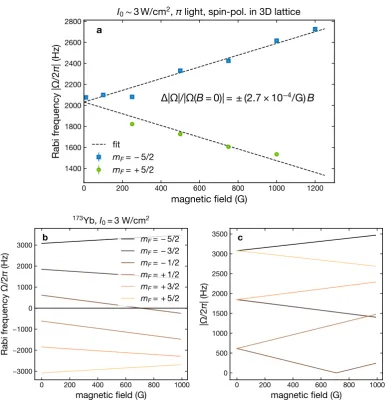
state-dependent optical lattice
Luis Riegger
state-dependent optical lattice
Dissertation an der Fakultät für Physik
Ludwig-Maximilians-Universität München
vorgelegt von
Luis Riegger
aus Karlsruhe
Erstgutachter: Prof. Immanuel Bloch
Zweitgutachter: Prof. Ulrich Schollwöck
Diese Arbeit beschreibt die Realisierung eines zustandsabhängigen optischen Gitters für Ytter-bium-Quantengase mit zwei elektronischen Orbitalen sowie die Beobachtung einer einstellba-ren interorbitalen Spinaustauschkopplung zwischen mobilen und lokalisierten magnetischen Momenten. Ultrakalte Gase erdalkaliartiger Atome wie Ytterbium in derartigen optischen Git-tern eignen sich als vielfältige Modellsysteme zur Simulation von Phänomenen und Aggre-gatzuständen aus der Festkörperphysik, welche durch einen orbitalen Freiheitsgrad bestimmt sind. Beispiele hierfür sind die Physik schwerer Fermionen, Kondo-Spinabschirmung sowie der kolossale magnetoresistive Effekt in Kondo-artigen Modellen.
This thesis reports on the creation of a state-dependent optical lattice for two-orbital ytterbium quantum gases and the observation of a tunable interorbital spin-exchange coupling between itinerant and localized magnetic moments. Ultracold gases of earth-alkaline-like atoms, such as ytterbium, in state-dependent optical lattices have recently been suggested for the simula-tion of a large variety of paradigmatic orbital models and phenomena. These include Kondo-and Anderson-type models featuring heavy-fermion physics, Kondo spin screening, or colossal magnetoresistance. In analogy to electrons in distinct orbitals of solid-state systems, fermionic ytterbium atoms in the electronic ground state and the metastable exited clock state exhibit different mobility in the optical lattice. A strong decoupling of the nuclear spin and the elec-tronic angular momentum results in SU(N)-symmetric interactions and the emergence of a natural spin-exchange coupling through two interorbital scattering channels.
Introduction 1
1 Ytterbium – a two-orbital atom 7
1.1 Atomic properties, level structure and transitions . . . 8
1.2 Zeeman and hyperfine coupling . . . 10
1.2.1 Coupling in (nsnp) two-electron systems . . . 11
1.3 Ytterbium coupling with light . . . 17
1.3.1 Atom-light coupling . . . 18
1.3.2 Dipole potentials and radiative forces . . . 18
1.3.3 Dipole polarizability . . . 20
1.3.4 Ytterbium light shifts from transition data . . . 23
1.3.5 Relative optical transition strengths . . . 28
1.3.6 Coherent coupling . . . 30
1.3.7 Decoherence and saturation . . . 33
1.4 The metastable orbital and the clock transition . . . 33
1.5 Interaction properties . . . 39
1.5.1 Low-energy scattering . . . 39
1.5.2 Inelastic scattering . . . 41
1.5.3 Large-spin systems and SU(N)-symmetric interactions . . . 42
1.5.4 Two interorbital scattering channels . . . 46
1.5.5 A magnetic Feshbach resonance for interorbital interactions . . . 49
2 An orbital state-dependent optical lattice 53 2.1 Optical lattices . . . 53
2.1.1 Band structure and mobility . . . 55
2.1.2 Harmonic and quartic on-site approximation . . . 57
2.1.3 Wannier functions and the tight-binding regime . . . 58
2.1.4 Simulation of Hubbard models . . . 61
2.2 Orbital state-dependent mobility . . . 62
2.2.1 The magic wavelength . . . 62
2.2.2 Anti-magic and tune-out wavelengths . . . 64
2.2.3 A state-dependent lattice for orbital lattice models . . . 65
2.3 Mixed anisotropic confinement . . . 67
2.4 Lattice-depth and polarizability calibration . . . 69
2.5 Clock spectroscopy in the state-dependent lattice . . . 72
2.5.2 Differential light shifts . . . 74
2.6 Single-particle lifetime in the SDL . . . 76
2.7 Limiting excited-state losses . . . 79
2.7.1 Excited-state losses in a 3D lattice . . . 79
2.7.2 Measurement results . . . 82
2.8 Multiorbital physics in the state-dependent lattice . . . 87
2.8.1 The two-orbital Fermi-Hubbard model . . . 87
2.8.2 The Kondo impurity model . . . 89
2.8.3 The Kondo lattice model . . . 93
3 Experimental setup and techniques 99 3.1 A setup overview . . . 99
3.2 Magnetic fields and Zeeman shifts . . . 101
3.2.1 Calibration of magnetic fields . . . 102
3.2.2 Measurement of the differential clock state Zeeman shift . . . 104
3.3 Cooling spin mixtures to degeneracy . . . 106
3.3.1 Zeeman slower and magneto-optical trap . . . 106
3.3.2 Evaporation in the dipole traps . . . 107
3.3.3 Preparation of ground-state spin mixtures . . . 107
3.3.4 Measuring temperatures . . . 108
3.4 Optical lattices . . . 110
3.4.1 Laser sources and lattice geometry . . . 110
3.4.2 Trap depths and frequencies . . . 111
3.4.3 Lattice loading . . . 112
3.5 Addressing the second orbital . . . 113
3.5.1 The clock laser . . . 113
3.5.2 Orbital state preparation in the state-dependent lattice . . . 114
3.5.3 A repumper for the clock state . . . 116
3.6 State detection . . . 117
3.6.1 Absorption imaging . . . 118
3.6.2 Optical Stern-Gerlach detection . . . 121
4 Interorbital interactions in mixed confinement 123 4.1 Interactions in mixed anisotropic confinement . . . 123
4.1.1 The on-site interaction model . . . 124
4.1.2 A solution to the uncoupled problem . . . 127
4.1.3 On-site relative and center-of-mass motion coupling . . . 130
4.1.4 Regularized Hubbard interaction parameters . . . 134
4.2 Multi-channel mixing in anisotropic traps . . . 135
5 Tunable spin exchange in an orbital state-dependent lattice 145
5.1 Experimental setting . . . 145
5.2 Probing spin-equilibration dynamics . . . 147
5.3 Tunable exchange coupling . . . 151
5.3.1 Resonant bound-state coupling . . . 152
5.3.2 Anisotropy of the perpendicular confinement . . . 155
5.3.3 Tunable two-channel exchange coupling in a state-dependent double well . . . 156
5.4 Dissipative dynamics . . . 162
6 Mobility in hybridized lattice bands 165 6.1 Combined lattice and harmonic potential . . . 166
6.2 Ground-state mobility measurements . . . 168
6.3 Optical hybridization of lattice orbitals . . . 172
Conclusions and outlook 179 A Hyperfine and Zeeman coupling in two-electron systems 183 B Light shifts in ytterbium-173 189 B.1 Branching ratios in the LS coupling scheme . . . 189
B.2 Nuclear Zeeman state-selective potentials . . . 191
C Non-interacting Fermi gases in harmonic confinement 193
D Measurement data collection 197
References 201
Free electrons are characterized by their elementary electric charge and their intrinsic angu-lar momentum, the spin. In contrast, electrons in solid materials typically carry a third key property: the orbital which characterizes their localization on an atomic site. The interplay of these three degrees of freedom and the Coulomb interaction between the electrons leads to a wealth of quantum many-body phenomena. Strong correlations can develop which underly the emergence of magnetism, metal-insulator transitions and high-temperature superconduc-tivity.
In certain materials, the orbital degree of freedom and its strong coupling with the spin and lattice dynamics plays a decisive role. A prominent example is the Kondo effect which occurs in electronic solid-state systems featuring localized magnetic moments. It describes the strong singlet spin screening of these localized moments by the conduction electrons. The discovery of the Kondo effect was in the context of the well-known low-temperature resistivity anomaly in dilute magnetic alloys[1–3]. Extensive theoretical and experimental studies have led to a good understanding of the underlying Kondo impurity model, dominated by antiferromagnetic (AFM) spin-exchange coupling[4].
In more recent years, a new family of strongly correlated materials, so-called heavy-fermion (HF) compounds have become a focus of interest. This was fueled mainly by the discovery of unconventional superconductivity in these compounds[5–7]. They contain a dense matrix of rare-earth or actinide ions, acting as localized magnetic moments immersed in a quantum sea of itinerant conduction electrons[8–12]. The strongly enhanced quasiparticle mass in these materials is attributed to a lattice version of the Kondo effect, again leading to the formation of Kondo singlets[13–16]. Quantum fluctuations of the electronic and magnetic degrees of free-dom are strongly coupled, and the emergence of non-Fermi liquid behavior close to a quantum critical point between HF and magnetic phases is of particular interest[8, 11, 16, 17].
Other “orbital materials” that recently have attracted a lot of interest are manganite and other transition-metal oxides with perovskite structure. So-called colossal magnetoresistance is observed upon the application of external magnetic fields, mediated by a ferromagnetic (FM) Hund’s coupling between spin and orbital degrees of freedom[18–21].
Reaching a deeper understanding of the orbital phenomena in these materials is both a challenge and a goal in modern condensed matter physics. It could lead to the development of new classes of materials featuring unconventional high-temperature superconductivity, colos-sal magnetoresistance or multiferroic properties for spintronics[14, 22].
development of fundamentally new techniques, including analytic and numerical renormal-ization group methods, Bethe ansatz, large-N expansions and dynamical mean-field theory [4, 23] (and references therein). Yet, many open questions remain, particularly regarding the non-Fermi liquid effects around the quantum critical point in HF compounds[17]. More-over, current theoretical efforts to understand the physics of out-of-equilibrium systems with spin-orbital coupling have been motivated by recent transport measurements in mesoscopic quantum dot systems and spectroscopic studies of the electromagnetic response of correlated materials [24–29]. The formation dynamics of the Kondo singlet screening cloud has been studied for varying Kondo coupling anisotropies[30–34], extending previous studies of the equilibrium properties[32].
In order to describe the observations in these strongly correlated electronic systems on a microscopic level, seemingly simple model Hamiltonians have been formulated. Hubbard models constitute a prominent example used for the description of crystalline materials. They capture the transport properties of metals as well as the magnetic phenomena arising from strong interactions between the electrons[35]. Despite their formal simplicity, featuring only nearest-neighbor tunnel mobility and on-site interactions, Hubbard models serve as a proto-type model for many strongly correlated phases observed in condensed matter systems. No-tably, the doped Mott insulating phase of the Fermi-Hubbard model is assumed to capture high-temperature superconducting properties[36].
Coupling to additional orbital degrees of freedom can easily be included in these Hubbard-type models, which enables the description of localized magnetic moments. In particular, the periodic Anderson model [2] and the Kondo lattice model (KLM) [13] have been found to provide a good description of the orbital physics in intermetallic compounds, capturing the competition between magnetic order and HF properties[14]. A FM version of the KLM has been shown to host colossal magnetoresistance[20, 21], and the Kugel-Khomskii model is used to describe spin-orbital interactions of Mott insulating states in manganites or other transition-metal oxides with perovskite structure[18, 19, 37].
A direct validation of these microscopic models in condensed matter systems is often hin-dered by experimental inaccessibility or their intrinsic complexity, and depending on the pa-rameter regime, a theoretical treatment can be very demanding or impossible. In the last two decades, ultracold gases of neutral atoms have proven themselves as a viable and powerful tool for the simulation of such models, and thus, of solid state materials[38, 39]. Despite their rel-atively low densities, advanced laser cooling technologies can be used to reach temperatures in the nanokelvin range, where both bosonic and fermionic gases enter a quantum degenerate regime. Experimental techniques are available that offer a great degree of control over the state preparation and detection. For example, the interaction strength can be widely tuned via Feshbach resonances for many atomic species[40]. In that way, strongly correlated states of matter have been realized and systematically probed, as demonstrated by the realization of the crossover between the Bardeen-Cooper-Schrieffer state and a molecular Bose-Einstein condensate in Fermi gases[41].
solid state systems, the lattice depth, and thereby the mobility and transport properties, as well as the on-site interactions can easily and dynamically be varied. Notably, the interaction-driven Mott insulating phase has been realized in a single-band Hubbard model[45, 46]. Access to the band structure, quasimomentum distribution and even spin correlations can be gained from the density distributions after expansion from the trap[47, 48]. Moreover, direct in-situ observation reveals the density distribution in the trap[49], and with the advent of quantum gas microscopes, detection and manipulation of charge and spin on a single-site level has been made possible[44, 50–52]. In fermionic systems, low-temperature phases of the single-band FHM have been accessed, exhibiting magnetic spin correlations, and even long-range AFM order[44](and references therein). Controlled spin imbalances can be prepared to investigate the effect of impurity doping on the magnetic order[53].
Most quantum simulation experiments with ultracold atoms have employed alkali met-als. In contrast, alkaline-earth(-like) atoms (AEA) possess two valence electrons. As a conse-quence, a more complex, Helium-type level structure emerges where the metastable state3P0 in the electronic spin-triplet manifold is connected to the ground state1S0via an ultranarrow optical transition. This so-called clock transition has made AEA ideal for the realization of highly accurate and stable atomic clocks[54–57].
Ytterbium and strontium are the most commonly used AEA species and quantum degener-ate atomic gases of most fermionic and bosonic isotopes have been realized. In the context of quantum simulation, their (meta-)stable clock states can serve as an additional orbital degree of freedom, along with an independent spin degree of freedom that is provided by the nuclear spin of the fermionic isotopes. Due to the closed outer shell in both clock states, with zero total electronic angular momentum, the hyperfine coupling vanishes and the orbital degree of freedom is highly decoupled from the nuclear spin I. In fact, the low-energy intra- and interorbital interactions obey an SU(N = 2I+1) symmetry [58]. For 173Yb (I = 5/2) and 87Sr (I=9/2), an enhanced SU(N>2) symmetry compared to electronic condensed matter systems emerges, which has been verified experimentally[59–61].
At the level of single-orbital physics, this SU(N) symmetric nature of the interactions pro-vides access to high-symmetry analogs of electronic spin-1/2 models and the emergence of novel, exotic phases of matter, such as valence bond and Abelian chiral spin liquid states, has been predicted[62–66]. Recent experimental manifestations of the enhanced symmetry are in the creation of a large-N spin liquid in one-dimensional systems [67], the realization of SU(6)-symmetric Mott insulators[68, 69], and the observation of AFM correlations in SU(4) samples in an optical dimerized cubic lattice[70], all realized with173Yb.
The earliest proposals which involved both the orbital degree of freedom as well as the SU(N) symmetry in the spin sector have studied fermionic AEA as a promising platform for quantum computation[64, 71–75], as well as for the implementation of artificial gauge fields [76]. The increased SU(N) symmetry could even enable the realization of non-Abelian gauge potentials and spin-orbit Hamiltonians with a close connection to the gauge interactions in quantum chromodynamics[77, 78].
gases of AEA with their orbital and nuclear-spin degree of freedom have recently been pro-posed as model systems for the simulation of both orbital magnetism as well as Kondo physics, including heavy-fermion states[58, 66, 79–81]. Two-orbital SU(N)-symmetric Hamiltonians can be modelled that capture the interplay between spin, charge and orbital degree of free-dom. In particular, Kondo impurity and lattice models with both FM and AFM coupling should be accessible[34, 58, 79–84]. These rely on two main ingredients: the strong localization of one orbital and the presence of spin-exchanging interactions between the localized and mo-bile magnetic moments. Compared to previous proposals for alkali atoms[85–87], both can be realized simultaneously and naturally with fermionic AEA.
The spin-exchange interactions arise directly from the interplay of two available interor-bital scattering channels, associated with spin-singlet and triplet superposition states[58]. By monitoring the equilibration dynamics of a spin imbalance between the population in different orbitals, as well as by spectroscopic techniques, the interorbital interactions have been quan-tified in previous experiments. A natural FM exchange coupling was measured for173Yb and 87Sr[59–61], in contrast to an AFM coupling in171Yb[88]. For173Yb, the exchange coupling
was found to be exceptionally large due to the large s-wave scattering length in the spin-singlet scattering channel[59, 60]. Beyond that, the associated shallow bound state leads to the emergence of a magnetically tunable interorbital Feshbach resonance which has recently been observed at accessible magnetic fields [89–91]. The orbital state-dependent mobility of the magnetic moments is straightforward to accomplish using AEA in optical lattices with electronic state-dependent ac Stark shifts [73, 74, 92]. The orbital degree is then encoded in the clock states which belong to different electronic manifolds. This represents a signifi-cant advantage over approaches with alkali atoms which rely on the use of different atomic species[86, 93]or excited bands of an optical lattice[85, 94]– lacking a direct spin-exchange coupling or suffering from reduced stability in higher lattice bands, respectively.
This thesis
The main subject of this thesis is the experimental implementation of an orbital state-dependent optical lattice (SDL) for ytterbium and the study of the interorbital interactions of fermionic 173Yb in this setup. The atomic ground state1S
0 and the metastable excited clock state3P0 take the role of the mobile and localized lattice orbitals, and different nuclear spin compo-nents act as a pseudo-spin. We demonstrate how a static and monochromatic optical lattice potential can be devised to realize the necessary state-dependent confinement for the real-ization of Kondo models. The spin-independent nature of the atom-light coupling preserves the SU(N) symmetry of the interactions and direct collisional losses between the excited-state atoms[59, 95, 96]are avoided by their strong localization.
by a molecular bound state of spin-singlet nature. By monitoring the out-of-equilibrium spin relaxation dynamics of localized magnetic moments interacting with mobile “bath” atoms on separate lattice sites, we can directly access the strength of the spin-exchange coupling in the SDL. We demonstrate how the effective Kondo-type coupling strength can be tuned resonantly with the external confinement via coupling to spin-singlet bound states. This first realization of interorbital spin-exchanging interactions with orbital state-dependent mobility in a gas of ultracold fermions lays the groundwork for using AEA as a testbed for orbital lattice models.
Outline of this thesis
This thesis is structured as follows.
In Chapter 1, we review the atomic properties of ytterbium. The consequences of its AEA level structure are discussed with regard to atom-light and Zeeman coupling, as well as its interatomic interactions. We focus on the optical and magnetic properties of the two clock states. In particular, their differential dipole polarizability is predicted over a large range of wavelengths which enables the realization of orbital state-dependent and independent opti-cal potentials. Furthermore, known properties of the intra- and interorbital interactions are reviewed, illustrating the origin of the spin-exchanging interactions in fermionic ytterbium.
Chapter 2 discusses the implementation of our orbital SDL. The orbital state-dependent band structure is discussed on a single-particle level and we introduce the notion of mixed on-site confinement in the tight-binding approximation. The wavelength-dependent differential polarizability, leading to the localization of the excited clock state orbital, is quantified via clock line spectroscopy and parametric heating techniques. We characterize the atomic lifetime limits in the SDL setup, imposed by collisional losses between atoms in the excited clock state. Finally, we review existing proposals and ideas on the simulation of multiorbital lattice models using fermionic AEA in a SDL. It is shown how the two-orbital SU(N) Fermi-Hubbard model is naturally realized and how it connects to the SU(N) generalized version of the KLM. The accessibility of interesting many-body phases in different experimental parameter regimes is discussed.
In Chapter 3, an overview over the experimental apparatus and techniques is presented. The laser beam geometry of the optical trapping potentials, defining the confinement for the ytterbium atoms is illustrated. We introduce the available techniques for state manipulation and detection, including the coherent control of the electronic orbital via coupling to the clock transition and nuclear-spin-resolved imaging.
Chapter 5 presents the experimental observation of out-of-equilibrium magnetization dy-namics in two-orbital spin mixtures. We directly observe the spin-exchange dydy-namics in the SDL and find that the process is well described by an effective exchange coupling arising from the state-dependent mobility and the two repulsive on-site interaction channels. Notably, we observe a resonant tunability of the exchange rate via the external confinement. The tuning mechanism is explained by finite coupling to on-site singlet bound states, holding the potential to invert the sign of the Kondo coupling in an effective low-energy model.
In Chapter 6, we characterize the collective mobility in the SDL, with the potential real-ization of heavy fermion phases and the associated mass enhancement in mind. The effective mass is probed via center-of-mass dipole oscillations of fermionic and bosonic samples in an additional harmonic confinement. In particular, we investigate the energy dependence and the effect of the finite Fermi pressure on the oscillation dynamics. Finally, we artificially introduce a controllable hybridization of the lattice orbitals by means of adiabatic clock “light dressing”, in analogy to the exchange coupling in the KLM.
Publications
The main experiments and results obtained during the work on this thesis are presented in the following publications:
• L. Riegger, N. Darkwah Oppong, M. Höfer, D. R. Fernandes, I. Bloch and S. Fölling. Localized magnetic moments with tunable spin exchange in a gas of ultracold fermions. Phys. Rev. Lett. 120, 143601 (2018)
• C. Hofrichter, L. Riegger, F. Scazza, M. Höfer, D. R. Fernandes, I. Bloch, and S. Fölling. Direct probing of the Mott crossover in the SU(N ) Fermi-Hubbard model. Phys. Rev. X 6, 021030 (2016)
• M. Höfer, L. Riegger, F. Scazza, C. Hofrichter, D. R. Fernandes, M. M. Parish, J. Levinsen, I. Bloch and S. Fölling. Observation of an orbital interaction-induced Feshbach resonance in173Yb. Phys. Rev. Lett. 115, 265302 (2015)
The following article has also been published in the course of this PhD:
Ytterbium – a two-orbital atom
Ytterbium an alkaline-earth-like atom (AEA). The designation is justified by the nature of its electron shell, featuring a set of complete internal shells, as well as two valence electrons in an outers-shell. This structure is found only for group-two elements, namely the alkaline-earth metals Be, Mg, Ca, Sr, Ba and Ra, as well as transition metals from thed-block (Zn, Cd, Hg) and f-block (Yb, No) of the periodic table. AEA possess a peculiar level structure, similar to the one of Helium, where the electronic states can be separated into a spin singlet and triplet manifold. Optical dipole transitions between the manifolds are inhibited which entails the presence of metastable states and ultranarrow transitions. Moreover, the total electronic angular momentum of the lowest electronic states, the clock states, vanishes, leading to a decoupling from the nuclear spin. For fermionic AEA, this does not only imply a strongly reduced sensitivity to external magnetic fields, but it also causes the emergence of SU(N) symmetric interactions.
These properties radically distinguish them from alkali atoms with one valence electron and have led to a large variety of experimental applications and theoretical interest. This in-cludes the realization of highly precise and accurate optical atomic clocks[57]. In the context of quantum simulation with ultracold neutral atoms, the decoupling of the electronic angu-lar momentum from the nuclear spin can be exploited to realize strongly correlated states of matter involving orbital magnetism and Kondo-type spin-exchange coupling[58, 80, 81]. The ground state1S0 and metastable excited clock state3P0 then act as the orbital degree of freedom, along with the spin degree of freedom provided by the nuclear spinIof fermionic iso-topes (see Fig. 1.1). Two interaction channels between the clock states lead to the emergence
clock transition (I = 5/2)
of a natural exchange interaction between the orbitals.
In this Chapter, we review the essential atomic properties of ytterbium concerning the re-alization of such orbital lattice models. We discuss off-resonant atom-light coupling which enables the realization of orbital state-dependent lattices, based on the differential dipole po-larizability of the clock states. Taking known optical transition properties into account, we estimate the polarizability of the lowest-lying electronic states over a large wavelength range and compare to existing theory. Coherent light coupling in AEA is discussed, with a focus on the clock transition which is relevant both for state preparation and detection of orbital mix-tures. In this context, we also investigate the effect of Zeeman and hyperfine coupling which strongly influences the atom-light coupling strength and causes spectroscopic shifts.
Furthermore, a review of the low-energy scattering properties of AEA is presented. The emergence of the extended SU(N) symmetry and the interorbital spin-exchange interactions are discussed.
1.1
Atomic properties, level structure and transitions
Ytterbium, as a lanthanide with atomic number Z=70, is a rare-earth element with an elec-tronic structure (Xe)4f146s2(1S0) in the ground state. Conveniently, many stable isotopes exists. The bosonic isotopes are 168Yb, 170Yb, 172Yb,174Yb and176Yb; the fermionic isotopes are173Yb and 171Yb. Thanks to a relatively large natural abundance of all isotopes, enrich-ment processes are rendered unnecessary for the production of ultracold atomic gases. Also, multi-isotope mixtures can easily be created[100]. The experiments described in Chapters 4 to 6 of this thesis employ fermionic173Yb, as well as bosonic174Yb in Chapter 6. With regard to future applications of171Yb, exhibiting an inverted sign of the interorbital exchange inter-actions[88], we specifically compare to the properties of this isotope in the next sections. The bosonic isotopes all carry an even number of protons and neutrons in a so-called even-even nucleus with I =0. In contrast, the nucleus of the fermionic isotopes 173Yb (I = 5/2) and 171Yb (I=1/2) is characterized by a half integer nuclear spin.
The electronic properties of AEA are largely determined by the two valence electrons in the outer s-shell. Most higher-lying eigenstates are in the so-called intermediate coupling regime, influenced by spin-orbit coupling and electrostatic interactions [101]. However, in good approximation, the electronic levels can be labeled by the Russell-Saunders (RS) sym-bols, suggesting bare, LS coupling eigenstates2S+1L0J, where the orbital angular momentum L, the electronic spinSand the total electronic angular momentumJ are good quantum num-bers [102]. To lowest order, the optical transition strengths between the states are then de-termined by the standard dipole selection rules. State-mixing induced by different coupling mechanisms can cause a violation of the selection rules leading to small but finite transition strengths. Possible coupling mechanisms are discussed in Section 1.2.
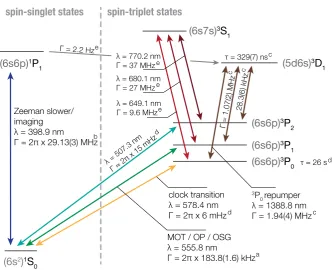
As depicted in Fig. 1.2, the level spectrum is split into an electronic spin-singlet and triplet manifold, characterized by their total electronic spinS=0 orS=1. The atomic ground state 1S
(6s2)1S 0
(6s6p)1P 1
(6s7s)3S 1
(6s6p)3P 0
(6s6p)3P 1
(6s6p)3P 2
(5d6s)3D 1 spin-triplet states
spin-singlet states
Zeeman slower/ imaging λ = 398.9 nm Γ = 2π x 29.13(3) MHz
λ = 649.1 nm Γ = 9.6 MHz
3P
0 repumper
λ = 1388.8 nm Γ = 1.94(4) MHz Γ = 1.07(2) MHz
Γ = 2.2 Hz
28.3(6) kHz
τ = 329(7) ns
τ ≈ 26 s
clock transition λ = 578.4 nm Γ = 2π x 6 mHz MOT / OP / OSG λ = 555.8 nm
Γ = 2π x 183.8(1.6) kHz λ = 507.3 nm
Γ ≈ 2π x 15 mHz
λ = 680.1 nm Γ = 27 MHz λ = 770.2 nm Γ = 37 MHz
a c c e e e e b d d d c c
Figure 1.2– Partial term diagram for173Ybatomic levels and transitions relevant to this work. Optical tran-sitions are denoted with arrows and associated wavelengthsλand decay ratesΓ. Atomic levels are labeled with their associated bare LS eigenstates2S+1LJ and lifetimeτ. The hyperfine structure is not shown. The values are taken from references indicated by the superscriptsa[103],b[104],c[105],d[106] ande[107].
The blue imaging and cooling transition Within an electronic spin manifold, strong dipole-allowed transitions can be found. A prominent example is the broad 398.9 nm transition1S0→
(6s6p)1P1with a natural linewidth ofΓblue=2π×29.13 MHz, obtained from photoassociation spectroscopy [104]. The transition frequency isν174blue = 751.526 533 49(33)THz [108] for 174Yb. Experimentally determined hyperfine and isotope shifts for the fermionic isotopes can
be found in the references provided in Fig. 1.2. The transition is nearly closed and the large linewidth and photon scattering rate make it suitable for both Zeeman slowing and absorption imaging of the ground-state atoms.
In contrast, the electrons of the three lowest-lying excited states3P0,3P1,3P2 are in a 6s6p spin-triplet configuration. The transitions connecting these states to the ground state1S0 are typically designated as intercombination lines. Generally, these transitions between the spin manifolds are forbidden by the dipole selection rule∆S=0, and therefore relatively weak.
a reasonable capture velocity[59]. Note that for the fermionic isotopes withI >0, a hyper-fine and magnetic substructure emerges for the states with J 6=0 which strongly influences the atom-light and Zeeman coupling. This is discussed in detail in Section 1.2. As a result, light coupling to the1S0→3P1 transition can be used in the preparation of nuclear spin state (mF) mixtures via optical pumping (OP), or for anmF-selective optical Stern Gerlach (OSG) technique (see Chapter 3).
The clock transition Because the metastable excited state3P0 has zero angular momentum J = 0, like the ground-state, the transition1S0→3P0 violates an additional dipole selection rule, namely∆J6→J=0. Therefore it is denoted as doubly forbidden and its extremely small linewidth on the 10-milihertz scale is only enabled for fermionic isotopes through hyperfine coupling with1P1 and3P1. For the bosonic isotopes a finite atom-light coupling strength can only be induced by “quenching” the transition via a strong external magnetic field, that leads to Zeeman cross coupling with other states of the triplet manifold. A detailed discussion of the properties of the metastable clock state and the clock transition to the ground state is provided in Section 1.4. Coherent, nuclear-spin-resolved manipulation of the clock transition, and thereby the population of3P0, can be achieved using a narrow-linewidth laser at finite magnetic fields (see Section 3.5.2).
Further transitions which are relevant to this work lie within the spin-triplet manifold and connect the 6s6p states with the higher-lying states (6s7s)3S1 and (5d6s)3D1. In particular, our implementation of a state-dependent optical lattice for the two clock states relies on a laser frequency close to the transition3P0→3S1, inducing a significant light shift for the3P0 atoms (see Chapter 2). Resonant coupling to the transition3P0→3D1 is employed for repumping metastable3P0 atoms to the ground state where they can be imaged (see Section 3.5.3).
1.2
Zeeman and hyperfine coupling
In this section, we want to discuss the effect of Zeeman, hyperfine and other coupling mech-anisms on the lowest-energy states of ytterbium. Above, we have labeled the atomic levels of ytterbium by their RS symbols, denoting LS coupling eigenstates2S+1L0J. However, in AEA, like ytterbium or strontium, this is assumption is broken by several coupling mechanisms. The bare RS states are mixed my spin-orbit coupling and electrostatic interaction between the two electrons. Also, one needs to consider inter-state Zeeman coupling in the case of external magnetic fields, and for fermionic isotopes with I >0, there is additional hyperfine mixing of the lowest-lying states. First, this leads to a violation of certain dipole selection rules and, consequently, a finite linewidth of the intercombination and clock transition. Second, the state mixing leads to a modification of the Zeeman shift. This particularly affects the clock states 1S
mixing mechanisms induce finite differential magnetic shifts between the clock states, even for the bosonic isotope.
1.2.1
Coupling in (nsnp) two-electron systems
To understand the effect of the different coupling mechanisms, we follow the approach by Lurio et al. [101]for the simultaneous treatment of Zeeman, hyperfine and spin-orbit coupling be-tween the states of an (nsnl) state manifold in a two-electron system. Their approach is based on the relativistic Breit-Wills model for the hyperfine interactions[109, 110]and neglects con-figuration interaction that can become important in heavy many-electron systems. Yet, it has been successfully employed in the case of87Sr[111] and other species[112, 113]to derive quantitatively correct values for the differential Zeeman splitting of the clock states as well as an estimated3P0 lifetime compatible with an ab-initio calculation including the configuration interaction[106]. A numerical diagonalization of the total Hamiltonian including spin-orbit coupling, hyperfine and Zeeman interactions allows us to determine the eigenspectrum for the lowest-lying excited states for large range of magnetic fields.
Intermediate coupling
In the case of ytterbium, we consider the excited states of the (6s6p) manifold,1P1, 3P0,3P1 and3P2. In the absence of hyperfine and Zeeman coupling, the states of highest and lowest angular momentumJ are uncoupled and remain the bare RS states: |3P0〉=|3P00〉and|3P2〉= |3P0
2〉. The states withJ=1 however are subject to finite spin-orbit coupling and electrostatic interaction and are transformed into[101, 111]
|3P1〉 |1P1〉
=U
|3P10〉 |1P10〉
with U=
α β
−β α
. (1.1)
This is called the regime of intermediate coupling and one can switch between the two basis sets using the unitary transformU that contains the mixing anglesβandα=p1−β2.
It turns out that the mixing angles can be determined experimentally, assuming the lifetime of the bare RS state3P10is indeed zero and the measured finite decay rateΓ3P
1of
3P
1is entirely caused by the spin-orbit coupling with1P1. Then, using Eq. (1.33), which relates the decay rate to the transition frequency and the reduced dipole matrix element, for both bare RS states leads to[101, 111]
β2
α2 =
Γ3P 1
Γ1P 1
ν3(1P
1−1S0)
ν3(3P
1−1S0)
. (1.2)
For ytterbium and the experimentally determined transition linewidths and frequencies (see Fig. 1.2), we obtain a mixing angle1
β=−0.1295(6) (α=0.99157(8)), (1.3)
1The sign ofβ can be inferred from the derivation of the intermediate coupling coefficients in[109]. The
nearly an order of magnitude larger than in87Sr[111]. A matrix representation of the trans-formation in the bare RS state basis is shown in Fig. 1.3(b).
Zeeman coupling
The total Zeeman HamiltonianHZ =µ0gSS·B+µ0gLL·B−µ0gII·Bcouples the electronic spinSand angular momentumLas well as the nuclear spinIwith the external magnetic field. The electronic Landé factors are the universal values gS ≈2.00232[114] and gL = 1. The
nuclear Landé factor is given by the ratio of the nuclear magnetic momentµI and the Bohr magnetonµ0:
gI= µI
µ0I
. (1.4)
µI is typically of the order of the nuclear magnetonµN ≈µ0/1836.15[114] and there-fore strongly reduced compared to the electronic moments. For the two fermionic ytterbium isotopes, it has been determined by means of mF-resolved optical pumping experiments2
[118, 120]:
µI(173Yb) =−0.67989(3)µN,
µI(171Yb) = +0.49367(1)µN.
(1.5)
In the basis of bare RS states, Lurio et al.[101]provide the full expression for the Zeeman Hamiltonian within an (nsnl) manifold (l=p=1 in our case):
〈S0LJ0F0m0F|Hz0|S LJ F mF〉=δSS0δmFm0F(−1)
F0−m0F
F0 1 F −mF 0 mF
Æ
(2F0+1)(2F+1)
×
δJ J0(−1)I+J+F+1
I F0 J F I 1
〈I|Hzn|I〉
+(−1)I+J+F0+1
J0 F0 I F J 1
〈J0|Hze|J〉
(1.6)
2The given values include the correction for diamagnetic shielding by the electron cloud. Another value for
the nuclear moment, that is frequently cited, isµI(173Yb) =−0.67755(3)µN, measured by Olschewski and Otten
[115]in a “precursor” experiment, and listed in[116, 117]. In contrast to the more recent study[118], it does not take light shift corrections into account.
In an independent NMR measurement, Gossard et al. obtainµI(173Yb) =0.68002(3)µN [119], consistent with
with the nuclear and electronic reduced matrix elements3
〈I|Hzn|I〉=−gIÆI(I+1)(2I+1)µ0B 〈J0|Hze|J〉=Æ(2J+1)(2J0+1)µ0B
gL(−1)L+S+J 0+1
L J0 S J L 1
Æ
l(l+1)(2l+1)
+gS(−1)L+S+J+1
S J0 L J S 1
Æ
S(S+1)(2S+1)
.
(1.7)
Here,(·)and{·}indicate Wigner-3j and Wigner-6j symbols, respectively. A matrix representa-tion of the bare Zeeman Hamiltonian for173Yb is shown in Fig. 1.3(a).
Low-field Zeeman shifts On the diagonal ofHz0, one recovers the linear Zeeman shift term
∆(1)
z =gFmFµ0B (1.8)
with the standard definition of the Landé factors
gF =gJ
F(F+1) +J(J+1)−I(I+1) 2F(F+1) −gI
F(F+1) +I(I+1)−J(J+1) 2F(F+1) and gJ =gLJ(J+1) +L(L+1)−S(J+1)
2J(J+1) +gS
J(J+1) +S(S+1)−L(L+1) 2J(J+1) .
(1.9)
To account for finite spin-orbit coupling, we can transform the bare Zeeman Hamiltonian to the intermediate coupling regime viaHz=U†H UwithU from Eq. (1.1)[see Fig. 1.3(c)]. One finds that Eq. (1.8) still holds, except that the orbital Landé factorsgJ for the twoJ=1 states are modified by the state mixing to[101]:
g0J 3P1
=α2g
J 3P10
+β2g
J 1P10
gJ0 1P1=α2gJ 1P10+β2gJ 3P10. (1.10) The experimentally determined mixing angles in Eq. (1.2) for ytterbium result in a modifi-cation of the linear Zeeman shift on the percent level. The resulting linear shift is a good approximation for the states3P1 and1P1 if the Zeeman energy is much smaller than the hy-perfine splitting and if hyhy-perfine and Zeeman cross-coupling between the (6s6p) states are neglected. We have evaluated the linear Zeeman shift∆(z1)for a collection of experimentally relevant states in Figs. A.2 to A.5.
Ground-state Zeeman shift The ground state withJ=0 andgJ=0 is not subject to
inter-state coupling and Eq. (1.8) is actually an exact expression for the Zeeman shift for near-arbitrary magnetic fields. From the measuredµI in Eq. (1.5), we infer the following nuclear Landé factors for the fermionic isotopes:
gFg(173Yb) =−gI(173Yb) = +207.30(1)hHz/Gµ0, gFg(171Yb) =−gI(171Yb) =−752.61(2)hHz/Gµ0.
(1.11)
3Note the inverted sign for the nuclear reduced matrix element compared to[101]to account for the selected
0 20 40 60 i 0 20 40 60 j
1
P
0 13
P
003
P
0 13
P
0 2a
HZ020 10 0 10 20
0 20 40 60
i 0 20 40 60 j
1
P
0 13
P
003
P
0 13
P
0 2b
spin-orbit transformation U1.00 0.75 0.50 0.25 0.00 0.25 0.50 0.75 1.00
0 20 40 60
i 0 20 40 60 j
1
P
13
P
0 03
P
13
P
02c
HZ= U H0ZU (after s.o. trafo.)20 10 0 10 20
0 20 40 60
i 0 20 40 60 j
1
P
13
P
0 03
P
13
P
02d
HHFS 60 40 20 0 20 40 600 20 40 60
i 0 20 40 60 j
1
P
13
P
0 03
P
13
P
02e
Htot75 50 25 0 25 50 75
0 20 40 60
i 0 20 40 60 j
1
P
13
P
0 03
P
13
P
02f
eigenvectors (a.u.)0.75 0.50 0.25 0.00 0.25 0.50 0.75
Figure 1.3– Hyperfine and Zeeman Hamiltonians including spin-orbit, hyperfine and Zeeman cross coupling
in the (6s6p) state manifold of173Yb(see Section 1.2). The Hamiltonians are in the basis of the bare RS states (superscript zero) or in the intermediate coupling basis (no superscript). They are sorted by descending F and by descendingmF for everyF. The matrix elements are in a.u. and for better contrast, we plot the
square root of the amplitude. (a) Zeeman Hamiltonian (B = 200G) in the bare RS basis. (b) Transformation U from bare RS basis into the intermediate coupling regime (mixing angleβ = −0.1295(6)). (c) Zeeman Hamiltonian after basis transformationHz = U†Hz0U. (d) Hyperfine couplingHHFSup to quadrupole order
In Figure 1.11, the Zeeman shift of the ground state is compared to the one of the clock state3P0 in173Yb which is of similar magnitude, carrying only a small differential shift (see Section 1.4). The weak magnetic sensitivity of the J =0 clock states limits the application of many state preparation and detection techniques that are available for alkali atoms in the ground state and which are relying on strong Zeeman splitting or magnetic field gradients. However, it is beneficial for the realization of optical clock experiments, reducing the necessary amount of magnetic field stabilization[57].
Zeeman cross coupling The Zeeman Hamiltonian in Eq. (1.6) for bare RS states is diagonal in the magnetic quantum numbermF and the spinS. Consequently, magnetic fields can only
couple states within the spin-triplet manifold. In particular, one finds a non-vanishing coupling between the clock state3P0 and3P10, as well as between 3P2 and3P10 [see Fig. 1.3(a)]. It is responsible for the small quadratic Zeeman shift of the clock state, independent of the atomic isotope (see Section 1.4).
Again, we have to account for spin-orbit and electrostatic coupling between1P10 and3P10 by applying the transformationHz = U†H U [see Fig. 1.3(c)]. The state mixing leads to the intermediate-strength E1 decay channel of 3P1 to the ground state, inherited from 1P1, the so-called intercombination line. Effectively, the state mixing then also induces a small Zeeman coupling of the clock state with1P1contributing to an enhanced strength of the clock transition at finite magnetic fields (see Section 1.4).
Hyperfine coupling
For bosonic isotopes of AEA, the inter-state coupling is entirely determined by spin-orbit and Zeeman coupling. Fermionic isotopes additionally possess a nuclear spin I > 0 and finite nuclear magnetic moment which can couple to the electron angular momentumJ. This leads to a hyperfine structure on the GHz scale as well as hyperfine cross coupling between the states of a two-electron (nsnl) state manifold.
Up to quadrupole order, the hyperfine interaction Hamiltonian is given by[121]
HHFS=A
I·J
ħ h2 +B
3
ħ
h2(I·J)
2+ 3
2ħh(I·J)−I(I+1)J(J+1)
2I(2I−1)J(2J−1) , (1.12) where Aspecifies the strength of the magnetic-dipole coupling and B of the electric-dipole coupling. This follows from a multipole expansion of the relativistic hyperfine interaction Hamiltonian in the field potentials[101, 110]. The octopole term or higher coupling terms vanish for I,J ≤ 1 and therefore for all states of 173Yb that we use in the experiment. For 171Yb, only the dipole term remains, since the quadrupole term is zero forI,J
≤1/2.
The hyperfine coupling Hamiltonian is diagonal in the quantum numbers F andmF asso-ciated with the total angular momentumF=I+J. Considering only first order coupling of the electron magnetic moment with the nucleus, we obtain the diagonal elements of the hyperfine Hamiltonian:
∆HFS=A K 2 +B
3
2K(K+1)−2I(I+1)J(J+1)
withK=F(F+1)−I(I+1)−J(J+1). This is a good approximation for the hyperfine structure (HFS) energy shift. The dipole and quadrupole coupling constantsAandBcan be determined spectroscopically and a collection of known values for experimentally relevant states in173Yb and 171Yb is provided in Table A.1. The evaluated hyperfine shifts for all available F are indicated in Figs. A.2 to A.5.
Hyperfine cross coupling As with the Zeeman coupling, there can be finite (second-order) hyperfine coupling between the states of the two-electron (6s6p) manifold in ytterbium, mix-ing states of equalFandmF(see Fig. 1.3(d) and Eq. (A.1) for the definition of the off-diagonal matrix elements). The consequences of the hyperfine cross-coupling are most dramatic for the clock state3P0. To first order, it leads to a state mixing of the clock state with the intermediate coupling representations of1P1and3P1, and with3P20[111, 122]:
|3P0〉=|3P00〉+α0|3P1〉+β0|1P1〉+γ0|3P2〉 (1.14) Once more, the state mixing withJ =1 states contributes to an enhanced Zeeman shift and decay rate of the clock state. As demonstrated in[101, 111, 112, 122], we can approximately relate the hyperfine coupling constantsα0, β0 andγ0 to experimentally measured hyperfine splittings in the singlet and triplet manifold using the Breit-Wills theory for the two-electron wave functions (see Appendix A). For173Yb, we find that, the dipole couplingα0 with3P1 is nearly two orders of magnitude larger thanβ0andγ0, very similar to Strontium[111].
This allows us to extract a rather precise value of the 3P1 mixing angleα0 ≈1.45×10⁻⁴ as well as a corse estimate of β0 ≈ −6.4×10⁻⁶ from the experimentally determined linear differential Zeeman shift of the clock transition and the theoretically predicted lifetime, via Eq. (1.47) and Eq. (1.45) in Section 1.4.
All couplings combined
To predict energy shifts for the (6s6p) states over a large range of magnetic fields, we diago-nalize the total coupling Hamiltonian, that is, the sumHtot=HHFS+U†H0ZU of the hyperfine and Zeeman Hamiltonian in the intermediate coupling basis[see Fig. 1.3(e-f)]. The coupling constantsα, β,α0, AandBtake the values specified above, whereasβ0andγ0 are expected to be strongly suppressed and set to zero.
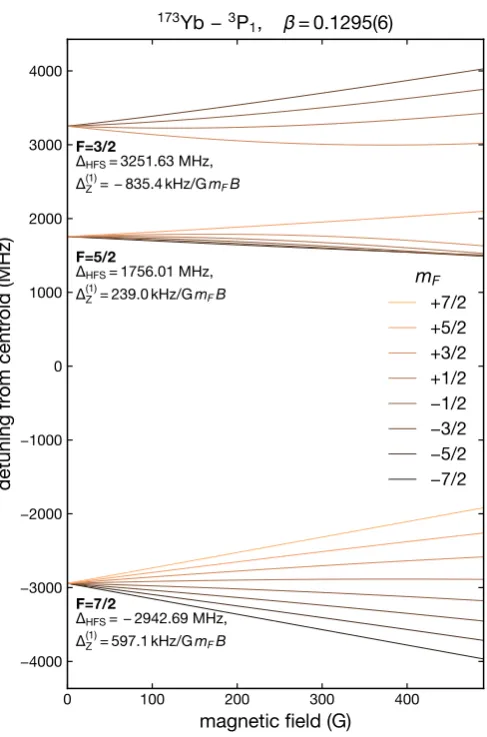
The resulting spectrum for theJ >0 state3P1 is shown in Fig. 1.4, for magnetic fields up to 500 G. The eigenenergies display the typical Breit-Rabi like behavior where the low-field linear Zeeman shift is governed by the hyperfine states which transform into fine-structure eigenstates at high fields. We also calculate the magnetic field and hyperfine splitting (Figs. A.2 to A.5) for 1P1 and 3P2, for (5d6s)3D1 used in the repumping transition, and for (6s7s)3S1 which provides the largest contribution to the ac polarizability of the clock state3P0 in our state-dependent lattice at 670 nm (see Section 1.3.4).
Figure 1.4– Hyperfine structure and magnetic sensitivity of173Yb(6s6p)3P1. All frequency shifts are relative to the1S0→3P1transition centroid. Underlying hyperfine coupling constants are from [103]. Eigenspectrum from diagonalization of full coupling Hamiltonian for (6s6p) manifold with experimentally determined mixing angleβ=−0.1295(6)(see Section 1.2). The low-field linear Zeeman shift∆(1)Z is calculated from Eq. (1.8).
quantitatively correct theoretical description is required, like for the calibration of the experi-mental magnetic field using the intercombination transition1S0→3P1in Section 3.2.1. Also, the Zeeman and hyperfine cross-couplings cause a qualitatively different behavior for the clock state3P0when compared to the uncoupled system or to the ground state, as explained in sec-tion Secsec-tion 1.4.
1.3
Ytterbium coupling with light
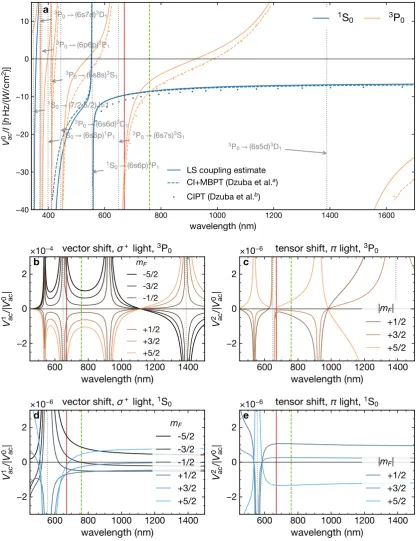
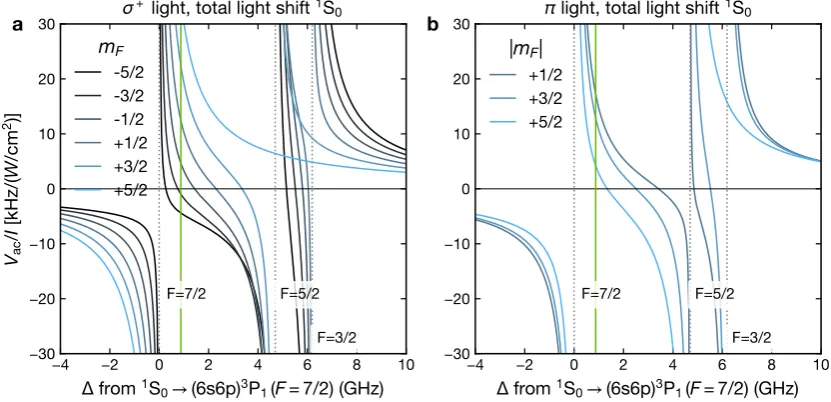
and therefore only exhibit very weak dependence on external magnetic fields (Section 1.2). One can distinguish between two different regimes of atom-light interaction, the resonant or near-resonant and the far-detuned case. For example, we use near-resonant light for clock-line spectroscopy and spin-resolved absorption imaging. Far-off-resonant light is employed for creating optical traps for the degenerate Fermi gas, in particular, the orbital state-dependent lattice potential. An extensive treatment of the physics of atom light interactions is given in [121] and we follow the notation there. In the following section, we review the relevant concepts in view of the aforementioned applications. We derive expressions for the light-induced dipole shifts and scattering rates, taking into account the hyperfine structure of the transitions in fermionic ytterbium. We estimate not only the scalar, but also vectorial and tensorial light shifts for a broad range of wavelengths from a manifold of contributing atomic transitions. This allows us to make suitable wavelength selections for state-dependent dipole potentials that are selective either on the nuclear-spin Zeeman state or the electronic orbital.
1.3.1
Atom-light coupling
For our applications, the atom-light interactions can be treated on a semiclassical level where multiple quantized atomic levels are considered but the light is treated as a classical electric field. Assuming the dipole approximation where the wavelength λis much larger than the size of the atom, the propagation direction of the light does not need to be considered and the electric field at the position of the atom can be written as
E(t) =E0cos(ωt+φ) =E(+)e−iωt+E(−)e+iωt=2ℜ(E(+)e−iωt) (1.15) withE0along the light polarization vector and whereE(±)=E0e∓iφ/2 are the conjugate com-ponents of the field in complex notation with positive (negative) frequencyω(−ω).
1.3.2
Dipole potentials and radiative forces
When the incident light field frequencyωis far detuned from an atomic transition frequency
ω0, the atom-light interactions are dominated by a second-order, dispersive effect, theac Stark shiftor dynamic light shift. This is the case when the light detuning∆ = ω−ω0 becomes large compared to the transition rate Γ = 2πγ, with γ the natural linewidth for a closed transition. The external, oscillating light field induces an oscillating dipole moment d(t) =
d(+)e−iωt+d(−)e+iωtin the atom which in turn interacts with the electric field via[121] Vac(t) =−d(t)·E(t)/2 . (1.16) The dynamic polarizabilityα(ω)around an atomic transition is frequency dependent and de-scribes the strength of the induced dipole for a given external field throughd(+)=α(ω)E(+).
The ac Stark shift can then be written as
Vac(t) =−
In calculating the time-averaged interaction energyVac=〈Vac(t)〉as a function of laser inten-sityI=2ε0c|E(+)|2=ε0c|E|2/2, we neglect the physically irrelevant terms oscillating at twice the optical frequency and obtain
Vac=−ℜ[α(ω)]|E(+)|2=− 1
2ε0cℜ[α(ω)]I. (1.18) Thus, the generated light shift for an atomic state is proportional to the real part of the dynamic polarizability and the light intensity.
Dipole forces
If the light intensity, and thereby the light shift, is varied spatially, one can create a conservative force proportional to the gradient of the intensity:
F(r) =∇Vac(r) = 1
2ε0cℜ[α(ω)]∇I. (1.19) This force can restore a particle position to points of maximum or minimum intensity, depend-ing on the sign of the polarizabilityα(see Fig. 1.5). It provides the trapping mechanism for optical dipole traps and lattices[123].
Light scattering
In addition to the conservative dipole force, there is a dissipative part of the dipole atom-light interaction that is tied to dipole oscillations out of phase with the incident light. This leads to a light power[123]
Psc=〈˙d(t)E(t)〉=
ω ε0c
ℑ[α(ω)]I (1.20)
being absorbed by the atom and spontaneously reemitted into the light field. Considering an incoming stream of photons with energyħhω, the resulting scattering rate is given by
Γsc= Psc ħ hω =
1
ħ hε0cℑ
[α(ω)]I. (1.21)
Compared to the dipole force in Eq. (1.19), the radiation pressure is still proportional to the light intensity but scales with the imaginary part of the polarizability.
Through scattering of photons, the atom can pick up quantized recoil momenta prec=ħhk and associated recoil energy
Erec= ħh 2k2
2m (1.22)
1.3.3
Dipole polarizability
While Eqs. (1.18) and (1.21) for the light shift and scattering rate in terms of the polarizability are general for any detuning and saturation of an atomic transition, the dynamic polarizability
α(ω)of an atomic state depends on the specific electronic state structure.
Far-detuned dipole potentials
If the light frequencyωis close to a atomic transition of frequencyωf ibetween states|i〉and |f〉, the generated light shifts and scattering properties for the connected states are dominated by this transition. Effectively, the system can then be described as a simplified two-level system. Furthermore, typical optical dipole traps and lattices operate in the limit of large detuning compared to the linewidth (∆fi=ω−ωf iΓfi) and low saturation of the transition. The real and imaginary part of the polarizability of state|i〉are then given by[121, 123]
ℜ[αf i(ω)] =
2ωf i
ħ
h(ω2f i−ω2)|〈i|εˆ·d|f〉| 2
ℑ[αf i(ω)] =
2ω2f iω3
3πc3ħh2ε
0(ω2f i−ω2)2
|〈i|εˆ·d|f〉|4
(1.23)
where 〈i|εˆ·d|f〉 is the dipole matrix element connecting the initial and final state through light of polarization ˆε. In practice, the dipole matrix element is often easiest inferred from an experimentally determined transition strengthΓfiby means of[121]
Γf i=
ω3
f i
3πε0ħhc3|〈i| ˆ
ε·d|f〉|2. (1.24)
Finally, evaluating the light shift in Eq. (1.18) and the scattering rate in Eq. (1.21) as a function of detuning and transition strength leads to the well-known expressions
Vacf i=−3πc 2
2ω3f i
Γ
f i
∆f i
+ Γf i
ωf i+ω
I and
Γf i
sc = 3πc2 2ħhω3f i
ω ωf i
3Γ
f i
∆f i
+ Γf i
ωf i+ω
2
I.
(1.25)
For detunings ∆f i ωf i (rotating-wave approximation), only the terms Vac ∝1/∆f i and
Γsc∝1/∆2f i remain. Consequently, red-detuned light with∆f i <0 will lead to an attractive
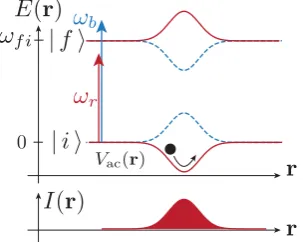
potential for the energetically lower-lying state while the energetically higher-lying state sees the inverse, repulsive potential, and vice versa for blue detuned light with∆f i>0.
The simple scaling relation between dipole and radiative force
Vac
Γsc
=ħh∆
Γ (1.26)
Figure 1.5– Schematic of spatially dependent light shifts in a two-level system. Red-detuned (blue-detuned) lightωr (ωb) induces attractive (repulsive) potential for the lower lying state and vice versa for the excited
state. The intensity distributionI(r)has a Gaussian profile and traps the|iistate in the intensity maximum for red-detuned light.
the relative strength of the conservative dipole force increases with the detuning. So, at least for a two-level atom, the ultimate performance of a dipole trap is only limited by the available laser power.
Multi-level systems
In “real” atomic systems, the two-level picture can be a good approximation in the vicinity of a strong dipole-allowed resonance. However, to obtain the polarizability for an arbitrary laser wavelength and state|i〉, optical transitions to all final states|f〉with a significant coupling strength have to be considered. This is especially important for many-electron systems like AEA with a large number of available transitions and a resolvable hyperfine substructure of the transitions for near-resonant detunings. In the following, we will focus on the light shift, and the real part ofαonly. In general, the estimation of scattering rates in a multi-level atom requires the use of rate or master equations to account for optical pumping between different levels of the magnetic substructure. Also, one needs to account for interference between the fields radiated on the different transitions[121, 124].
As a result of second-order time-independent perturbation theory in the atom field inter-action, the resulting energy shift of a state|i〉is just a sum over the ac Stark shift contributions from all available transitionsVac=Pf6=iVacf i. This state sum can be incorporated into the total polarizability of a multi-level system asα(ω) =Pf6=iαf i(ω)[121].
Hyperfine structure and angular-momentum degeneracy
In order to treat the angular momentum degeneracy and the non-spherical nature of the mF sublevels in the hyperfine structure, the scalar polarizability α(ω) needs to be generalized to a tensorαµν(ω). The light polarization is still included in the field vector Eµ(+) while the anisotropy of the atomic angular momentum states is captured in the tensorαµν. This tensor can couple field and atom anisotropically such that the induced dipole vector becomes
dµ(+)=αµν(ω)Eν(+) and the light shift can be calculated as[121]
Vac=−dµ(+)Eµ(−)/2−dµ(−)Eµ(+)/2=−ℜ[αµν]Eµ(−)Eν(+) (1.27) with the real part of the polarizability tensor
ℜ[αµν(ω)] =
X
f6=i
2ωf i
ħ
h(ω2f i−ω2)〈i|dµ|f〉〈f|dν|i〉. (1.28) In the case of hyperfine states, we put |i〉= |F mF〉and|f〉= |F0m0F〉 and the index f runs over theF0andm0F quantum numbers. We choose the magnetic quantization axis along thez axis (ˆz). Finally, one can split the rank-2 polarizability tensor into its irreducible scalar, vector and tensor components and carry out the summation4 in Eq. (1.27) for the total light shift to arrive at:
Vac(F,mF,ω) =−α(0)(F,ω)|E(+)|2
−α(1)(F,ω) (iE(−)×E(+))z mF
F −α(2)(F,ω)(3|E
(+) z |
2
− |E(+)|2) 2
3m2F−F(F+1) F(2F−1)
(1.29)
where the scalar, vector and tensor polarizabilities are defined independent ofmF as[121]:
α(0)(F,ω) =X
F0
2 3
ωF0F ħh(ω2F0F−ω2)
〈F|d|F0〉
2
α(1)(F,ω) =X
F0
(−1)F0+F+1
v
t6F(2F+1)
F+1
1 1 1
F F F0
ωF0F ħh(ω2F0F−ω2)
〈F|d|F0〉
2
α(2)(F,ω) =X
F0
(−1)F0+F
v
t40F(2F+1)(2F−1)
3(F+1)(2F+3)
1 1 2
F F F0
ωF0F
ħ
h(ω2F0F−ω2)
〈F|d|F0〉
2 .
(1.30)
Here, 〈F|d|F0〉 are the reduced matrix elements and ωF0F are the transition frequencies
be-tween|F〉and|F0〉.

![Figure 1.8 – Light shifts of 3P1 (F=7/2) (green) and 1S0 (blue). (a) Scalar light shift V 0ac in units of laser intensityfrom the LS coupling estimate (solid lines) and from an ab-initio CI+MBPT calculation b[128] (circles)](https://thumb-us.123doks.com/thumbv2/123dok_us/1792067.1232169/41.595.86.504.139.600/figure-light-scalar-intensityfrom-coupling-estimate-calculation-circles.webp)