Comments on two multi-server authentication protocols
*Yalin Chen1, Chun-Hui Huang2, Jue-Sam Chou3
1Institute of information systems and applications, National Tsing Hua University
*: corresponding author [email protected]
2Department of Information Management, Nanhua University Chiayi 622 Taiwan, R.O.C
3Department of Information Management, Nanhua University Chiayi 622 Taiwan, R.O.C
[email protected] Tel: 886+ (0)5+272-1001 ext.56226
Abstract
Recently, Tsai and Liaoet al.each proposed a multi-server authentication protocol. They claimed their protocols are secure and can withstand various attacks. But we found some security loopholes in each protocol. We will show the attacks on their schemes.
Keywords:multi-server, password authentication protocol, server spoofing attack, parallel session attack
1. Introduction
For password-based authentication protocols using smart cards are widely used in an open network. A two-party password authentication protocol for client-server architecture is therefore not sufficient as networks getting larger and larger. Consequently, several multi-server protocols were proposed [1-13].
known attacks. Yet, after our analysis, we found that it is vulnerable to the server spoofing attack.Recently, in 2009, Liao and Wang [2] proposed a secure dynamic ID scheme for multi-server environment. They claim that their protocol is secure. However, we found their scheme suffers from both the server spoofing attack and the parallel session attack. In this paper, we will show the attacks on [1] and [2], respectively.
The remainder of this paper is organized as follows: In Section 2, we review both Tsai’sand Liao-Wang’sprotocols. In Section 3, we demonstrate the vulnerabilities in their schemes, respectively. Finally, a conclusion is given in Section 4.
2. Review of Tsai’sand Liao-Wang’sprotocols
In this section, we review Tsai’sprotocolin Section 2.1 and Liao-Wang’sprotocol
in Section 2.2, respectively. Before that, the notations used throughout this paper are first defined as follows.
RC : the registration center Uu : a legal user u
Sj : a legal server j
E(P) : an attacker E who masquerades as a peer P. SIDj : the identity of Sj
IDu : the identity of Uu
PWu : the password of Uu
x,y : RC’s two secret keys p : a large prime number
g : the primitive element in a Galois field GF(p) H( ) : a collision-resistant one-way hash function
(a,b) : a string denotes that stringais concatenated with stringb.
⊕ : a bitwise Xor operator
△T : a tolerant time delay for messages transmission over network => : a secure channel
→ : a common channel
2.1 Review of Tsai’sprotocol
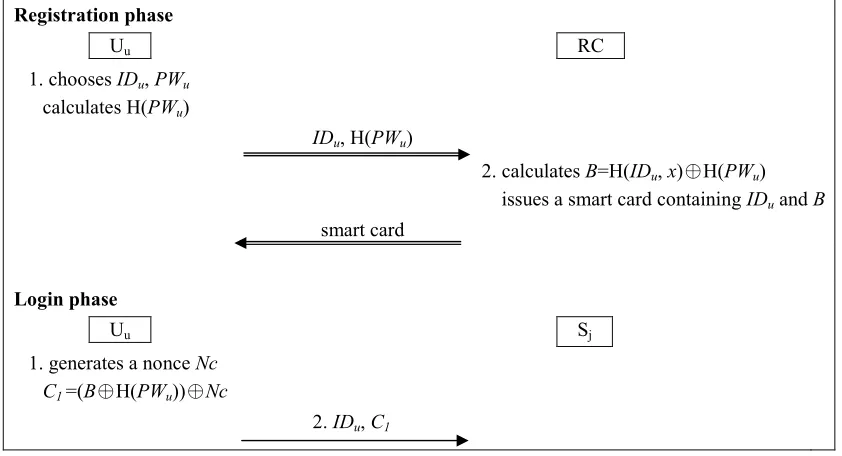
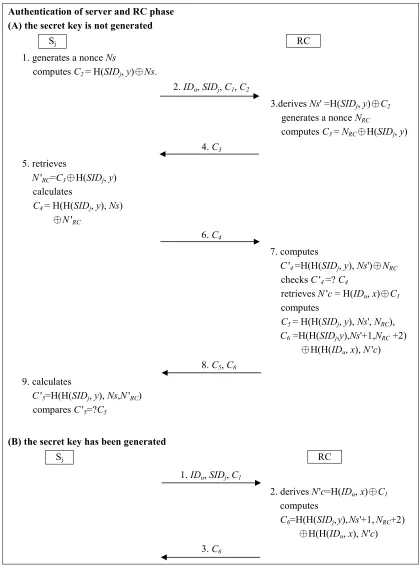
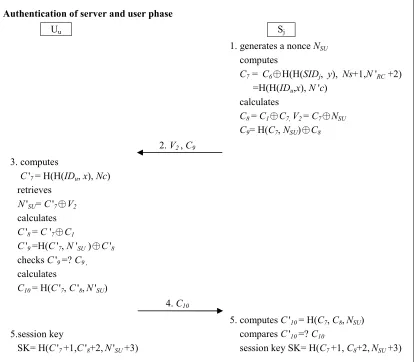
Tsai’sprotocolcontains four phases. They are: (1)user registration phase, (2)login phase, (3)authentication of server and RC phase, and (4)authentication of server and user phase. We describe the protocol as follows and also depict phases (1), (2) in Figure 1, phase (3) in Figure 2, and phase (4) in Figure 3.
Registration phase
Uu RC
1. choosesIDu,PWu
calculates H(PWu)
IDu, H(PWu)
2. calculatesB=H(IDu,x)⊕H(PWu)
issues a smart card containingIDuandB
smart card
Login phase
Uu Sj
1. generates a nonceNc C1=(B⊕H(PWu))⊕Nc
2.IDu,C1
Fig. 1. Registration phase and login phase of Tsai’s protocol
2.1.1 Registration phase
In this phase, Uuperforms the following steps for obtaining a smart card from RC.
1. Uu freely chooses his IDu and PWu and calculates H(PWu). He then sends {IDu,
H(PWu)} to RC through a secure channel.
2. RC calculates B=H(IDu, x)⊕H(PWu) and issues Uu a smart card containing IDu
andBthrough a secure channel.
2.1.2 Login phase
When Uuwants to login to Sj, he inserts his smart card and performs the following
steps.
1. Uukeys his IDuandPWuand generates a random nonceNc. He then computesC1
=(B⊕H(PWu))⊕Nc= H(IDu,x)⊕Nc. 2. Uusends {IDu,C1} to Sj.
2.1.3 Authentication of server and RC phase
In this phase, when receiving message {IDu,C1} from Uu, Sjwill run the following
steps to let himself be authenticated by RC, verify Uu’s legitimacy, and negotiate the
session key with Uu. Let the secret key shared between Sj and RC be H(H(SIDj, y),
Ns+1, NRC +2), where Ns and NRC are Sj’s and RC’s randomly chosen nonces
Authentication of server and RC phase (A) the secret key is not generated
Sj RC
1. generates a nonceNs
computesC2= H(SIDj,y)⊕Ns.
2.IDu,SIDj,C1,C2
3.derivesNs' =H(SIDj,y)⊕C2
generates a nonceNRC
computesC3=NRC⊕H(SIDj,y)
4.C3
5. retrieves
N'RC=C3⊕H(SIDj,y)
calculates
C4= H(H(SIDj,y),Ns)
⊕N'RC
6.C4
7. computes
C'4=H(H(SIDj,y),Ns')⊕NRC
checksC'4=?C4
retrievesN'c= H(IDu,x)⊕C1
computes
C5= H(H(SIDj,y),Ns',NRC),
C6=H(H(SIDj,y),Ns'+1,NRC+2)
⊕H(H(IDu,x),N'c)
8.C5,C6
9. calculates
C'5=H(H(SIDj,y),Ns,N'RC)
comparesC'5=?C5
(B) the secret key has been generated
Sj RC
1.IDu,SIDj,C1
2. derivesN'c=H(IDu,x)⊕C1
computes
C6=H(H(SIDj,y),Ns'+1,NRC+2)
⊕H(H(IDu,x),N'c)
3.C6
Fig. 2. Authentication of server and RC phase of Tsai’sprotocol
(A) the secret key is not generated.
1. Sjgenerates a random nonceNsand computesC2= H(SIDj,y)⊕Ns.
2. Sjsends {IDu,SIDj,C1,C2} to RC.
4. RC sends {C3} to Sj.
5. After receiving the message from RC, Sjretrieves N'RC = C3⊕H(SIDj, y) and
calculatesC4= H(H(SIDj,y),Ns)⊕N'RC. 6. Sjsends {C4} to RC.
7. RC computes C'4= H(H(SIDj, y), Ns')⊕NRC and checks to see if C'4 is equal to the received C4. If so, Sj is authentic. He then retrieves N'c=H(IDu, x)⊕C1 and
computes C5 = H(H(SIDj, y), Ns', NRC), C6 = H(H(SIDj, y), Ns'+1, NRC +2)⊕
H(H(IDu,x),N'c). 8. RC sends {C5,C6} to Sj.
9. After receiving the message from RC, Sj calculates C'5= H(H(SIDj,y), Ns,N'RC)
and compares to see ifC'5is equal to the received C5. If so, RC is authentic. Both Sj and RC will store the common secret key AuthS-RC=H(H(SIDj,y), Ns+1, N'RC
+2) for next execution of server and RC authentication to reduce the computational cost.
(B) the secret key has been generated.
1. Sjsends {IDu,SIDj,C1} to RC.
2. RC derives N'c=H(IDu, x)⊕C1and uses his AuthS-RC to computeC6= H(H(SIDj, y),Ns'+1,NRC+2)⊕H(H(IDu,x),N'c).
3. RC sends {C6} to Sj.
2.1.4 Authentication of server and user phase
After the authentication of server and RC phase, Sj and Uu perform the following
steps for mutual authentication.
1. Sj generates a random nonce NSU and uses his AuthS-RC to compute C7= C6⊕
H(H(SIDj,y), Ns+1,N'RC+2)=H(H(IDu,x), N'c). He then calculatesC8= C1⊕C7, V2=C7⊕NSU, andC9= H(C7,NSU)⊕C8.
2. Sjsends {V2,C9} to Uu.
3. After receiving the message, Uu computesC'7= H(H(IDu,x), Nc), retrievesN'SU=
C'7⊕V2, and calculates C'8= C'7⊕C1, C'9= H(C'7, N'SU)⊕C'8. He then checks to see if the newly computedC'9is equal to the receivedC9. If so, Sjis authentic.
Uucontinues to calculateC10= H(C'7,C'8,N'SU).
4. Uusends {C10} to Sj.
5. After receiving {C10}, Sj computesC'10= H(C7,C8,NSU) and compares to see if
C'10is equal to the received C10. If so, Uu is authentic. They then have the same
Authentication of server and user phase
Uu Sj
1. generates a nonceNSU
computes
C7= C6⊕H(H(SIDj, y), Ns+1,N'RC+2)
=H(H(IDu,x),N'c)
calculates
C8=C1⊕C7,V2=C7⊕NSU
C9= H(C7,NSU)⊕C8
2.V2,C9
3. computes
C'7= H(H(IDu,x),Nc)
retrieves
N'SU=C'7⊕V2
calculates
C'8=C'7⊕C1
C'9=H(C'7,N'SU)⊕C'8
checksC'9=?C9 ,
calculates
C10= H(C'7,C'8,N'SU)
4.C10
5.session key
SK= H(C'7+1,C'8+2,N'SU+3)
5. computesC'10= H(C7,C8,NSU)
comparesC'10=?C10
session key SK= H(C7+1,C8+2,NSU+3)
Fig. 3. Authentication of server and user phase of Tsai’sprotocol
2.2 Review of Liao-Wang’sprotocol
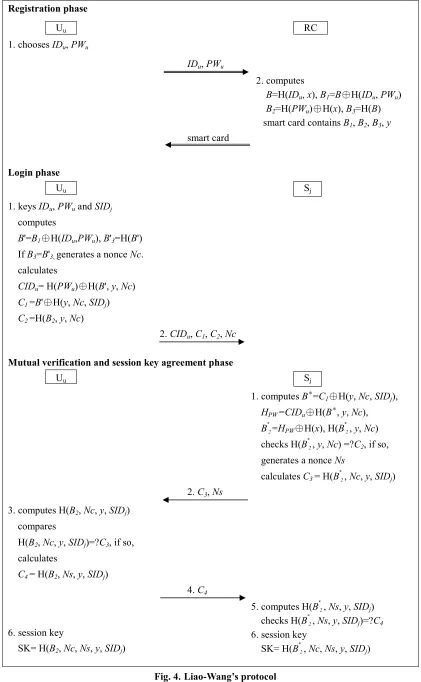
In this section, we review Liao-Wang’sprotocol. Their protocol consists of four phases: (1) registration phase, (2) login phase, (3) mutual verification and session key agreement phase, and (4) password change phase. In their protocol, y is a secret number shared among RC and all servers. We describe their protocol as follows and also depict it in Figure 4.
2.2.1 Registration phase
In this phase, Uu performs the following steps to register at RC for obtaining a
smart card so that he can access the resources of all servers.
1. Chooses hisIDu,PWuand sends {IDu,PWu} to RC through a secure channel.
2. RC computes B=H(IDu, x), B1=B⊕H(IDu, PWu), B2=H(PWu)⊕H(x), and B3=H(B). He then issues Uu a smart card containing B1,B2,B3, and y through a
Registration phase
Uu RC
1. choosesIDu,PWu
IDu,PWu
2. computes
B=H(IDu,x),B1=B⊕H(IDu,PWu)
B2=H(PWu)⊕H(x),B3=H(B)
smart card containsB1,B2,B3,y
smart card
Login phase
Uu Sj
1. keysIDu,PWuandSIDj
computes
B'=B1⊕H(IDu,PWu),B'3=H(B')
IfB3=B'3,generates a nonceNc.
calculates
CIDu= H(PWu)⊕H(B',y,Nc)
C1=B'⊕H(y,Nc,SIDj)
C2=H(B2,y,Nc)
2.CIDu,C1,C2,Nc
Mutual verification and session key agreement phase
Uu Sj
1. computesB*
=C1⊕H(y,Nc,SIDj),
HPW=CIDu⊕H(B*,y,Nc),
B*2=HPW⊕H(x), H(B
* 2,y,Nc)
checks H(B*2,y,Nc) =?C2, if so,
generates a nonceNs
calculatesC3= H(B
*
2,Nc,y,SIDj)
2.C3,Ns
3. computes H(B2,Nc,y,SIDj)
compares
H(B2,Nc,y,SIDj)=?C3, if so,
calculates
C4= H(B2,Ns,y,SIDj)
4.C4
6. session key
SK= H(B2,Nc,Ns,y,SIDj)
5. computes H(B*
2,Ns,y,SIDj)
checks H(B*
2,Ns,y,SIDj)=?C4
6. session key SK= H(B*
2,Nc,Ns,y,SIDj)
2.2.2 Login phase
1. Uukeys hisIDu,PWuandSIDj to the smart card. The smart card computesB'=B1 ⊕H(IDu, PWu), B'3=H(B'), and compares to see if B3 stored is equal to the computedB'3. If so, smart card knows Uuis the real card holder. It then generates
a random nonceNcand calculatesCIDu=H(PWu)⊕H(B',y,Nc),C1=B'⊕H(y,Nc, SIDj), andC2=H(B2,y,Nc).
2. Uusends {CIDu,C1,C2,Nc} to Sj.
2.2.3 Mutual verification and session key agreement phase
After receiving the login message from Uu, Sjexecutes the following steps together
with Uuto authenticate each other and compute a common session key.
1. Sj computes B*=C1⊕H(y,Nc, SIDj), HPW=CIDu⊕H(B*, y, Nc), and B*2=HPW⊕
H(x). He then computes H(B*
2, y, Nc) and checks to see if it is equal to the
receivedC2. If so, Sjthen generates a random nonceNs and calculatesC3= H(B*2,
Nc,y,SIDj).
2. Sjsends {C3,Ns} to Uu.
3. Uucomputes H(B2,Nc,y,SIDj) and compares to see if it is equal to the received
C3. If it is, Sjis authentic. Uuthen calculatesC4= H(B2,Ns,y,SIDj).
4. Uusends {C4} to Sj.
5. After receiving the message from Uu, Sj computes H(B*2,Ns,y,SIDj) and checks
to see if it is equal to the receivedC4. If so, Uuis authentic.
6. After finishing mutual authentication, Uuand Sjcan compute the common session
key SK= H(B2,Nc,Ns,y,SIDj) = H(B*
2,Nc,Ns,y,SIDj), respectively.
2.2.4 Password change phase
When Uu wants to change his password from PWu to PWunew, he executes the
following steps.
1. Keys hisIDu,PWu.
2. The smart card computesB'=B1⊕H(IDu,PWu), B'3=H(B') and compares to see if B3in the smart card is equal to the computedB'3. If so, Uuis the real card holder.
3. The smart card allows Uuto submit a new passwordPWunew.
4. The smart card computes B1new=B'⊕H(IDu, PWunew), B2new= B2⊕H(PWu)⊕
H(PWunew) and replacesB1,B2withB1new,B2new, respectively.
3. Security loopholes in Tsai’sand Liao-Wang’sprotocols
attack. In this section, we will show the security loopholes in Section 3.1 and Section 3.2, respectively.
3.1 Server spoofing attack by an insider server on Tsai’sprotocol
Assume that Si is a legal server registered at RC. He also has his H(SIDi, y) and
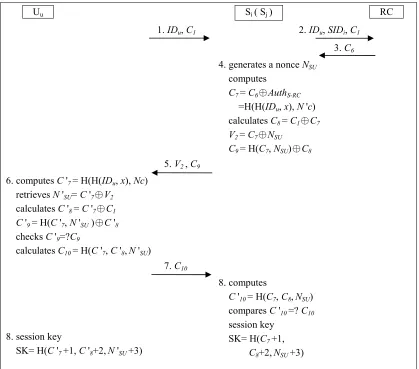
keeps it secret. He can then masquerade as a legal server to cheat a remote user on Tsai’s protocol. It is because in the authentication of server and user phase, a user doesn’t examine if the message is indeed sent from the correct server. In the following, we present server spoofing attacks on the two mentioned scenarios, (A) and (B), and also illustrate them in Figure 5 and 6, respectively.
(A) the secret key is not generated.
1. When Uuwants to communicate with Sj, he starts the protocol and sends {IDu,C1}
to Siwho masquerades as Sj.
2. Si generates a nonceNs, computesC2= H(SIDi,y)⊕Ns, and sends {IDu,SIDi,C1,
C2} to RC. For the subsequent messages C3, C4, C5 and C6, except C6, sent between RC and Si to authenticate each other are independent on Uu’s secrecy
H(H(IDu, x), Nc) as depicted in scenario (A) of Figure 2. RC and Si will thus
achieve mutual authentication successfully.
3. RC and Si then negotiate to establish the common secret keyAuthS-RC=H(H(SIDi,
y), Ns+1, N'RC+2)=H(H(SIDi, y), Ns'+1, NRC+2) in the phase of server and RC authentication. After that, Si and Uu will perform the following steps for the
authentication of server and user phase.
4. Si generates a random nonce NSU and uses his AuthS-RC to compute C7= C6⊕
AuthS-RC =H(H(IDu, x), N'c). He then calculates C8= C1⊕C7,V2= C7⊕NSU, and C9= H(C7,NSU)⊕C8.
5. Sisends {V2,C9} to Uu.
6. After receiving the message, Uu computesC'7= H(H(IDu,x), Nc), retrievesN'SU=
C'7⊕V2, and calculates C'8= C'7⊕C1, C'9= H(C'7, N'SU)⊕C'8. He then checks to see if C'9 is equal to the received C9. If so, Uu confirms that the message is
from the sender who had received hisC1in the login phase. Si disguising as Sjis
thus regarded as authentic. Uucontinues to calculateC10= H(C'7,C'8,N'SU).
7. Uusends {C10} to Si.
8. Si computes C'10= H(C7, C8,NSU) and compares to see if C'10is equal to his
receivedC10. If so, Uu is authentic. They then compute the common session key
SK= H(C'7+1,C'8+2,N'SU+3) = H(C7+1,C8+2,NSU+3).
Uu Si( Sj) RC
1.IDu,C1 2.IDu,SIDi,C1,C2
3. establishesAuthS-RC
4. generates a nonceNSU
computes
C7=C6⊕AuthS-RC
=H(H(IDu,x),N'c)
C8=C1⊕C7
V2=C7⊕NSU
C9= H(C7,NSU)⊕C8
3. establishes
AuthS-RC
5.V2,C9
6. computes
C'7= H(H(IDu,x),Nc)
retrievesN'SU=C'7⊕V2
calculatesC'8=C'7⊕C1
C'9= H(C'7,N'SU)⊕C'8
checksC'9=?C9
calculates
C10= H(C'7,C'8,N'SU)
7.C10
8. session key
SK= H(C'7+1,C'8+2,N'SU+3)
8. computes
C'10= H(C7,C8,NSU)
comparesC'10=?C10
session key
SK= H(C7+1,C8+2,NSU+3)
Fig.5. Server spoofing attack by an insider server on Tsai’sprotocol:(A) the secret key is not generated.
(B) the secret key has been generated.
For this case, we describe the attack as follows and also illustrate it in Figure 6.
1.Uustarts the protocol and sends {IDu,C1} to Siwho masquerades as Sj.
2. When Si runs the authentication of server and RC phase, he simply sends {IDu,
SIDi,C1} to RC. RC deducesN'c=H(IDu,x)⊕C1and computesC6= H(H(SIDi,y), Ns'+1,NRC+2)⊕H(H(IDu,x),N'c).
3. RC sends {C6} to Si as depicted in scenario (B) of Figure 2. Sithen proceeds the
following steps with Uufor the authentication of server and user phase.
4. Si generates a random nonce NSU and uses the generated common secret key
AuthS-RC to computeC7= C6⊕AuthS-RC =H(H(IDu,x), N'c). He then calculatesC8 =C1⊕C7,V2=C7⊕NSU, andC9= H(C7,NSU)⊕C8.
5. Sisends {V2,C9} to Uu.
6. After receiving the message, Uu computesC'7= H(H(IDu,x), Nc), retrievesN'SU=
Uu Si( Sj) RC
1.IDu,C1 2.IDu,SIDi,C1
3.C6
4. generates a nonceNSU
computes
C7=C6⊕AuthS-RC
=H(H(IDu,x),N'c)
calculatesC8=C1⊕C7
V2=C7⊕NSU
C9= H(C7,NSU)⊕C8
5.V2,C9
6. computesC'7= H(H(IDu,x),Nc)
retrievesN'SU=C'7⊕V2
calculatesC'8=C'7⊕C1
C'9= H(C'7,N'SU)⊕C'8
checksC'9=?C9
calculatesC10= H(C'7,C'8,N'SU)
7.C10
8. session key
SK= H(C'7+1,C'8+2,N'SU+3)
8. computes
C'10= H(C7,C8,NSU)
comparesC'10=?C10
session key SK= H(C7+1,
C8+2,NSU+3)
Fig. 6. Server spoofing attack by an insider server on Tsai’sprotocol:(B) the secret key has been generated.
from the sender who has received hisC1in the login phase; and Sidisguising as Sj
is therefore regarded as authentic. Uu then proceeds to calculateC10= H(C'7,C'8,
N'SU).
7. Uusends {C10} to Si.
8. After obtaining the message, Si computes C'10= H(C7,C8,NSU) and compares to
see if C'10 is equal to his received C10. If so, Uu is authentic. They then can
compute the common session key SK= H(C'7+1, C'8+2,N'SU+3) = H(C7+1, C8+2,NSU+3).
From the above-mentioned steps, we can see that a server spoofing attack launched by insider attacker Sihas been successfully accomplished.
3.2 Attack on Liao-Wang’sprotocol
with RC,PW' is his guessing password, and H(x) is shared by all legal servers in their protocol and also can be derived by all legal users by computing H(x) =B2⊕H(PW), whereB2is the value stored in the smart card andPWis the user’s password.
In addition, it also can be seen that anyone who has got Uu’s smart card can launch
a password guessing attack by comparing B3with his computation B1⊕H(IDu,PW'), where B3, B1 are the values stored in Uu’s smart card and PW' is his guessing
password.
Besides, in this section, we will show two server spoofing attacks on Liao-Wang’s
protocol in section 3.2.1 and section 3.2.2, respectively. Then, we also show a parallel session attack on their scheme in section 3.2.3.
3.2.1 Server spoofing attack by an insider server
Assume that Si is a legal server who has registered at RC. He also has his secrets
H(x), y to authenticate users. We will show that Si can masquerade as any server
( Here, we assume Sj. ) to cheat a remote user. It is because each server has the same
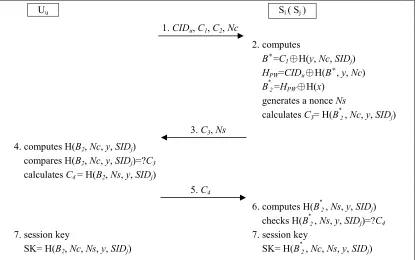
secret data, H(x) and y, for faking messages to cheat users. We describe the server spoofing attack below and also depict it in Figure 7.
1. Uustarts the protocol and sends {CIDu,C1,C2,Nc} to Si, whereC1=B'⊕H(y,Nc,
SIDj), as in the login phase of Figure 4.
2. After receiving the message {CIDu, C1, C2, Nc} from Uu, Si runs the mutual
verification and session key agreement phase with Uu. He uses his secret data,
H(x) and y, and the public parameter SIDj to compute B*
=C1⊕H(y, Nc, SIDj), HPW=CIDu⊕H(B*
, y, Nc), and B*
2=HPW⊕H(x). He then generates a random
nonceNsand calculatesC3= H(B*
2,Nc,y,SIDj).
3. Sisends {C3,Ns} to Uu.
4. Uucomputes H(B2,Nc,y,SIDj) and compares to see if it is equal to the received
C3. If so, Uu confirms that Si is authentic. Uu then calculates C4= H(B2, Ns, y,
SIDj).
5. Uusends {C4} to Si.
6. After obtaining the message, Sicomputes H(B*2,Ns,y,SIDj) and checks to see if
it is equal to the receivedC4. If so, Uuis authentic.
7. After finishing the mutual authentication, Uu and Si can compute the common
session key SK= H(B2,Nc,Ns,y,SIDj) = H(B*
2,Nc,Ns,y,SIDj).
From the above-mentioned steps, we can see that the server spoofing attack has been successfully launched by Siwho masquerades as Sj.
3.2.2 Server spoofing attack by an insider user
Uu Si( Sj)
1.CIDu,C1,C2,Nc
2. computes
B*=C
1⊕H(y,Nc,SIDj)
HPW=CIDu⊕H(B*,y,Nc)
B*2=HPW⊕H(x)
generates a nonceNs
calculatesC3= H(B*2,Nc,y,SIDj)
3.C3,Ns
4. computes H(B2,Nc,y,SIDj)
compares H(B2,Nc,y,SIDj)=?C3
calculatesC4= H(B2,Ns,y,SIDj)
5.C4
6. computes H(B*2,Ns,y,SIDj)
checks H(B*2,Ns,y,SIDj)=?C4
7. session key
SK= H(B2,Nc,Ns,y,SIDj)
7. session key
SK= H(B*2,Nc,Ns,y,SIDj)
Fig. 7. Server spoofing attack by an insider server on Liao-Wang’sprotocol
to access servers’resources. We will show that he can use hisB2'andyboth stored in the smart card to masquerade as any server to cheat a remote user. It is because Uncan
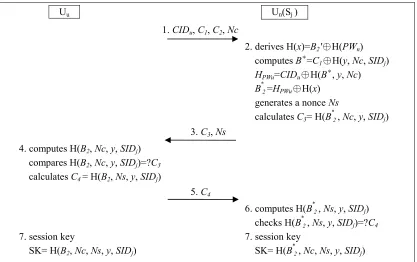
first usesB2'and his passwordPWnto computeB2'⊕H(PWn), obtaining H(x). Then he uses H(x) and y to fake desired messages to cheat the remote user. We describe this attack by using the following steps and also depict it in Figure 8.
1. Uustarts the protocol and sends {CIDu,C1,C2,Nc} to Unwho impersonates Sj.
2. Un uses his PWn and B2' in his smart card to derive the value of H(x) by
computingB2'⊕H(PWn). He then uses {CIDu,C1,C2,Nc}, H(x),y, and the public parameter SIDj to compute B*
=C1⊕H(y, Nc, SIDj), HPWu=CIDu⊕H(B*
, y, Nc) and B*
2=HPWu⊕H(x). In addition, he also generates a random nonce Ns and
calculatesC3= H(B*
2,Nc,y,SIDj).
3. Unsends {C3,Ns} to Uu.
4. After receiving the message, Uuuses his storedB2 to compute H(B2,Nc,y,SIDj)
and compares to see if it is equal to the receivedC3. If it is, Uuauthenticates Unas
Sjunconsciously. He then calculatesC4= H(B2,Ns,y,SIDj).
5. Uusends {C4} to Un.
6. After obtaining the message, Uncomputes H(B*2,Ns,y,SIDj) and checks to see if
it is equal to the receivedC4. If so, Uuis authentic.
7. After finishing the mutual authentication, Uu and Un can compute the common
session key SK= H(B2,Nc,Ns,y,SIDj) = H(B*
2,Nc,Ns,y,SIDj).
Uu Un(Sj)
1.CIDu,C1,C2,Nc
2. derives H(x)=B2'⊕H(PWn)
computesB*=C
1⊕H(y,Nc,SIDj)
HPWu=CIDu⊕H(B*,y,Nc)
B*2=HPWu⊕H(x)
generates a nonceNs
calculatesC3= H(B*2,Nc,y,SIDj)
3.C3,Ns
4. computes H(B2,Nc,y,SIDj)
compares H(B2,Nc,y,SIDj)=?C3
calculatesC4= H(B2,Ns,y,SIDj)
5.C4
6. computes H(B*2,Ns,y,SIDj)
checks H(B*2,Ns,y,SIDj)=?C4
7. session key
SK= H(B2,Nc,Ns,y,SIDj)
7. session key
SK= H(B*2,Nc,Ns,y,SIDj)
Fig. 8. Server spoofing attack by an insider user on Liao-Wang’sprotocol
3.2.3 Parallel session attack by an insider user
Assume that Un is a legal user. He also has his smart card containingB2'. We will
show that he can masquerade as any other user to cheat a remote server on Liao-Wang’s protocol. It is because the remote server doesn’t examine if the message is indeed sent from the correct user. Un can thus use his B2' and y to masquerade as
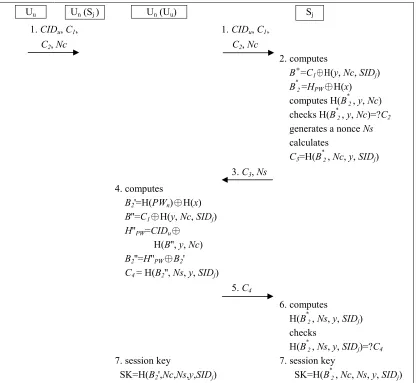
any valid user. We demonstrate this attack by using the following steps and also depict it in Figure 9.
1. Uustarts the protocol and sends {CIDu,C1,C2,Nc} to Unwho masquerades as Sj.
After receiving the message, Unnow masquerades as Uu to start another protocol
with real Sjby sending him {CIDu,C1,C2,Nc}.
2. Sj runs the mutual verification and session key agreement phase with Un and
computesB*
=C1⊕H(y,Nc,SIDj),B*
2=HPW⊕H(x). He then computes H(B *
2,y,Nc)
and checks to see if it is equal to the received C2. If so, Sj generates a random
nonceNsand calculatesC3= H(B*
2,Nc,y,SIDj).
3. Sjsends {C3,Ns} to Un.
4. Uncomputes B2'=H(PWn)⊕H(x), B''=C1⊕H(y, Nc, SIDj), H''PW=CIDu⊕H(B'', y,
Nc),B2''=H''PW⊕B2', andC4= H(B2'',Ns,y,SIDj). 5. Unsends {C4} to Sj.
6. After receiving the message, Sjcomputes H(B*2,Ns,y,SIDj) and checks to see if it
is equal to the received C4. If so, Sj confirms that Un is authentic and therefore
Uu Un(Sj) Un(Uu) Sj
1.CIDu,C1,
C2,Nc
1.CIDu,C1,
C2,Nc
2. computes
B*=C
1⊕H(y,Nc,SIDj)
B*2=HPW⊕H(x)
computes H(B*2,y,Nc)
checks H(B*2,y,Nc)=?C2
generates a nonceNs
calculates
C3=H(B*2,Nc,y,SIDj)
3.C3,Ns
4. computes
B2'=H(PWn)⊕H(x)
B''=C1⊕H(y,Nc,SIDj)
H''PW=CIDu⊕
H(B'',y,Nc)
B2''=H''PW⊕B2'
C4= H(B2'',Ns,y,SIDj)
5.C4
7. session key
SK=H(B2',Nc,Ns,y,SIDj)
6. computes
H(B*2,Ns,y,SIDj)
checks
H(B*2,Ns,y,SIDj)=?C4
7. session key
SK=H(B*2,Nc,Ns,y,SIDj)
Fig. 9. Parallel session attack by an insider user on Liao-Wang’sprotocol
7. After finishing mutual authentication, Unand Sjhave the common session key
SK= H(B2',Nc,Ns,y,SIDj) = H(B*
2,Nc,Ns,y,SIDj).
From the above-mentioned steps, we can see that the insider user Un has
successfully launched a parallel session attack.
4. Conclusion
We have analyzed the security of Tsai’sand Liao-Wang’sprotocols. Although, they claim their protocols can resist against various attacks, we have showed that their protocols are indeed insecure against some attack that we have described in this article.
References
[2]Y.P. Liao, S.S. Wang, “A secure dynamic ID based remote user authentication scheme for multi-server environment”,Computer Standards & Interfaces, Vol. 31, No. 1, pp. 24-29, January 2009.
[3]W.J. Tsaur, C.C. Wu, W.B. Lee, “An enhanced userauthentication schemefor
multi-serverInternetservices”,Applied Mathematics and Computation, Vol. 170, No. 1-1, pp. 258-266, November 2005.
[4]W.J. Tsaur, C.C. Wu, W.B. Lee,“A smartcard-based remote scheme for password authentication in multi-server Internet services”, Computer Standards & Interfaces, Vol. 27, No. 1, pp. 39-51, November 2004.
[5]I.C. Lin, M.S. Hwang, L.H. Li, “A new remoteuserauthentication schemefor
multi-serverarchitecture”,Future Generation Computer Systems, Vol. 19, No. 1, pp. 13-22, January 2003.
[6]J. H. Lee, D. H. Lee,“Efficientand SecureRemoteAuthenticated Key Agreement
Scheme for Multi-serverUsing MobileEquipment”,Proceedings of International Conference on Consumer Electronics, pp. 1-2, January 2008.
[7]L. Hu, X. Niu, Y. Yang, “An EfficientMulti-server Password Authenticated Key
Agreement Scheme Using Smart Cards”, Proceedings of International Conference on Multimedia and Ubiquitous Engineering, pp. 903-907, April 2007. [8]X. Cao, S. Zhong, “Breaking a remote user authentication scheme for multi
-serverarchitecture”,IEEE Communications Letters, Vol. 10, No. 8, pp. 580-581, August 2006.
[9]Z.F. Cao, D.Z. Sun, “Cryptanalysis and Improvement of User Authentication
Scheme using Smart Cards for Multi-Server Environments”, Proceedings of International Conference on Machine Learning and Cybernetics, pp. 2818-2822, August 2006.
[10]C.C. Chang, J.Y. Kuo, “An efficient multi-server password authenticated key agreement scheme using smart cards with access control”, Proceedings of International Conference on Advanced Information Networking and Applications, Vol. 2, No. 28-30, pp. 257-260, March 2005.
[11]R.J. Hwang, S.H. Shiau, “Password authenticated key agreement protocol for
multi-servers architecture”,Proceedings of International Conference on Wireless Networks, Vol. 1, No. 13-16, pp. 279-284, June 2005.
[12]C.C. Chang, J.S. Lee, “An efficient and secure multi-server password
authentication scheme using smart cards”, Proceedings of International Conference on Cyberworlds, No. 18-20, pp. 417-422, November 2004.
[13]W.S. Juang, “Efficientmulti-server password authenticated key agreement using