TABLE OF CONTENTS:
Vol. 41, No. 5, September 1988
ARTICLES Scientific Writing 362
364 365 366 367 368
Writing for the reader by Richard H. Hart Writing for your audience by James A. Young
Reader expectations: How important to meet? by David A. Fischbach Peer review of technical manuscripts by Gary W. Frasier
What do researchers like to read? by Henry A. Wright
Obligations and expectations of your peers: manuscript review at the Journul of Range Management by N.T. Hobbs
Viewpoint: Who are those Smiths? by Alan A. Beetle 370
Rehabilitation
372 Plant community development on petroleum drill sites in northwestern Wyoming by P.W. Smith, E.J. Depuit, and B.Z. Richardson
Plont Physiology 378
383 387
Root excision and dehydration effects on water uptake in four range species by M. Bassiri, A.M. Wilson, and R. Grami
Dehydration effects on seedling development of four range species by M. Bassiri, A.M. Wilson, and B. Grami
Water and nitrogen effects on growth and allocation patterns of creosotebush in the northern Chihuahuan Desert by F.M. Fisher, J.C. Zak, G.L. Cunningham, and W.G. Whitford
391 395 399 401
Variability within a native stand of blue grama by W.J. McGinnies, W.A. Laycock, T. Tsuchiya, C.M. Yonker, and D.A. Edmunds
Use of UV absorption for identifying subspecies ofdrtemisio tridentatu by George G. Spomer and Douglass M. Henderson
Toxicological investigations on Ruby Valley pointvetch by M. Coburn Williams and Russell J. Molyneux
Comparative chemical composition of armed saitbush and fourwing saitbush by Andres Garza, Jr., and Timothy E. Fulbright
Plant Ecology
404 Effects of burning on germinabiiity of Lehmann lovegrass by G.B. Ruyle, B.A. Roundy, and J.R. Cox
407 Fire effects on tobosagrass and weeping lovegrass by Fred H. Roberts, Carlton M. B&ton, David B. Wester, and Robert G. Clark
Published bimonthly-January, March, Improvements
May, July, September, November 413 Economic comparison of aerial and ground Ignition for rangeland
prescribed fires Copyright 1988 by the Society for Range by G. Allen Rasmussen, Guy R. McPherson, and Henry A. Wright
Management 416 Atrazlne dissipation and off-plot movement in a Nebraska sandhills subirrigated
INDIVIDUALSUBSCRIPTION is bymembershipin meadow by J.J. Brejda, P.J. Shea, L.E. Moser, and S.S. Waller the Society for Range Management.
LIBRARY or other INSTITUTIONAL SUBSCRIP- Meawrement TIONS on a calendar year basis are $56.00 for the
United States postpaid and $66.00 for other coun- 421 tries, postpaid. Payment from outside the United States should be remitted in US dollars by interna- 426 tional money order or draft on a New York bank.
BUSlNESSCORRESPONDENCE,concerningsub- 430 scriptions. advertising, reprints, back issues, and related matters, should be addressed to the Manag- ing Editor, 1839 York Street, Denver, Colorado
80206. Animal Ecology
435 Optimal stocking rate for cow-calfenterprises on native range and complementary improved pastures by R.H. Hart, J.W. Waggoner, Jr., T.G. Dunn, C.C. Kalten- bath, and L.D. Adams
441 Simulation and management implications of feral horse grazing on Cumberland Island, Georgia by Monica Goigel Turner
EDITORIALCORRESPONDENCE. concerning manu- scripts or other editorial matters, should be addressed to the Editor, 1839 York Street, Denver, Colorado 80206.
INSTRUCTIONS FOR AUTHORS appear on the inside back cover of most issues. A Style Manual is also available from the Society for Range Manage mentat theaboveaddress@$2,00forsinglecopies; $1.25 each for 2 or more.
THE JOURNAL OF RANGE MANAGEMENT (ISSN 0022-409X) is published six times yearly for $56.00 per year by the Society for Range Management. 1839 York Street, Denver, Colorado 80206. SECOND CLASS POSTAGE paid at Denver, Colorado. POSTMASTER: Return entlre Journal with address change-RETURN POSTAGE GUARANTEED-to Society for Range Management, 1839 York Street, Denver, Colorado 80206.
The Journal 01 Range Management serves as a forum for the presentation and discussion of facts, ideas, and philosophies pertaining to the study, management, and use of rangelands and their several resources. Accordingly, all material published herein is signed and reflects the individ- ual views of the authors and is not necessarily an official position of the Society. Manuscripts from any source-nonmembers as well as members-are welcome and will be given every consideration by the editors. Submissions need not be of a technical nature, but should be germane to the broad field of range management. Editorial comment by an indi- vidual is also welcome and, subject to acceptance by the editor, will be published as a “Viewpoint.”
Managlng Editor PETER V. JACKSON III
1839 York Street Denver, Colorado 80206 Edltor
PATRICIA G. SMITH
Society for Range Management 1839 York Street
Denver, Colorado 80206 (303) 355-7070
Estimation of pbytomass for ungrazed crested wheatgrass plants using allometric equations by Patricia S. Johnson, Craig L. Johnson, and Neil E. West
Methods of ytterbium analysis for predicting fecal output and flow rate constants in cattle by K.P. Coffey, E.E. Pickett, J.A. Paterson, C.W. Hunt, and S.J. Miller The use of comparative yield and dry-weight-rank techniques for monitoring arid rangeland by M.H. Friedel, V.H. Chewings, and G.N. Bastin
BOOK REVIEWS
447 Livestock and Wildlife Management During Drought, 1985. Robert D. Brown (Ed.); Colorado Flora: Western Slope. 1987. William A. Weber;‘Ecological Siiula- tion Primer. 1987. Gordon L. Swartzman and Stephen P. Kaluzny.
ASSOCIATE EDITORS WILL BLACKBURN
N.W. Watershed Res. Center 270 South Orchard Boise, Idaho 83705 CARLTON BRITTON
Range &Wildlife Mgmt Texas Tech University Lubbock, Texas 79409 THOMAS A. HANLEY Book Revbw Edltor Forestry Sciences Lab.
GRANT A. HARRIS Box 20909
Forestry and Range Management Juneau, Alaska 99802 Washington State University
Pullman, Washington 99164-6410 RICHARD H. HART USDA-ARS 8408 Hildreth Rd. Cheyenne, Wyoming 82009
RODNEY HEITSCHMIDT Box 1658
Vernon, Texas 76384 N. THOMPSON HOBBS
Colorado Div. of Wildlife 317 W. Prospect
Fort Collins, Colorado 80526 PETE W. JACOBY, JR.
P.O. Box 1658 Vernon, Texas 76384 HOWARD MORTON
2ooO E. Allen Road Tucson, Arizona 85719
BRUCE ROUNDY 325 Biological Sciences East Building, Univ. Arizona Tucson, Arizona 85721 PAUL TUELLER
Range Wildlife 8 Forestry UNR 1000 Valley Road Reno. Nevada 89512 RICHARD S. WHITE
KSU Extension Center Colby, Kansas 67701 STEVE WHISENANT
Writing for the reader
RICHARD II. HART
“Yeah. Streetstyle is happening. It’s raw. Aggressive. Fluid. And the key word is STREET-so if there ever are street contests they should be held on the natural environment-the street. Let’s keep it OUTSIDE. Rip it up.-A.J.” (Jenkins 1986).
Now THAT is writing for the reader. That’s my son-in-law A.J., writing for the typical reader of Freestylin’ magazine, who is a M-year-old who has gone over the handlebars once too often without a hehnet.
This paper is about “Writing for the Reader,” from Bernard DeVoto’s advice to his students: “Write for the reader, never for youmeU”(Stegner 1974). And I might add, not for JRMor Range- la& but for the reader of JRM or Rangelands.
The next question: What is the appropriate style for readers of JRM or Rangelands? The easy answer is “the way we’ve always
written.”
When
Don Quixote told Sancho Panza to get on with the story without so many diversions, Panza replied, “The way I’m telling it is the way all stories are told in my country. It isn’t fair for your worship to ask me to get new habits” (quoted in Zimmerman & Clark 1987).The way “stories are told in out country” was established in the 17th century (Wallsgrove 1987). Scientists had to distinguish them- selves from politicians, poets, philosophers, and theologians; they had to prove they were telling the truth about the material world, long before they had any impact on it. They wrote in the first person, what “I” did, to indicate they were reporting personal experience, not what Aristotle or some other ancient had said. They reported what happened when they performed an experi- ment; convinced readers that it had happened; and convinced readers they should care what happened. Those are still the essen- tials; everything else is style.
Everything Else Is Style
And style changes. Look at Charles Darwin’s description of what happens when grazing is excluded:
. ..the land having been enclosed, so that cattle could not enter . ..self- sown firs are now springing up in multitudes...In one square yard...1 counted thirty-two little trees; and one of them, with twenty-six rings of growth, had during many years tried to raise its head above the stems of the heath, and had failed. No wonder that, as soon as the land was enclosed, it became thickly clothed with vigorously growing young firs. (Darwin 1958).
Now look at a modern example:
The relict site (RM) had significantly more hcrbaccous vegetation than all the other sites (Table 1), which were not significantly different from one another. The reduced cover of Indian riccgrass [OrJzop& hyme- noides (R. & S.) Ricker]. a very palatable grass, was the primary reason for this difference. The cover of galleta grass [H&aria jumesii (Torr.) Iknth.], a grass tolerant to grazing, was not significantly different between sites, but as the total herbaccous vegetation cover decreased, the relative percent cover of this species increased. (Jeffries & Klopatek
1987)
The scientist has disappeared (no more “I counted”). Scientific names, complete with authority, reassure the reader that the writer really knows his plants, and data have been relegated to a table and subjected to statistical analysis. All this interferes with narrative flow; we think we need it to reassure the reader that we know what we’re talking about, but it might better be in appendices.
Day (1979) denies the existence of style; he says “...the prepara- tion of a scientific paper has almost nothing to do with writing....A
Corpus Cbristi. Texas, 10 February 1988.
scientific paper is not ‘literature.‘...if the ingredients are properly organized, the paper will virtually write itself.“That last statement alone casts considerable doubt on Day as an authority.
In contrast, Knoll (1988) in his review of the book The Young Earth applauds the author’s style, and reminisces of an era when the term “scientific literature” was not a contradiction in terms- like “quiet Texan. ”
So style exists, else why the proliferation of “Style Manuals7 And why the proliferation of styles? For example, the pontifical: Being a new approach altogether to the range deterioration problem it should not bc surprising that SGM is totally different from any of the approaches that were in usc. The diffemnccs am too many to list here but two which have caused the greatest unrest in the range profession are the facts that:
1. No matter how bad the range deterioration there is never a need to reduce stock numbers to start the reclamation process. As a general rule, the conventional or government-prescribed stocking rates can safely be doubled in the first year of operation as long as adequate time control is brought into the grazing handling. Furthermore this doubling of government or conventional rates can be done regardless of how poor the range condition is at the time. (Savorv 1983)
The author is absolutely certain of hi position (“altogether”, “totally”, “no matter”, “regardless”) and cites no data or references.
The conventional:
The stocking rate recommended by the Soil Conservation Service (SCS 1986) is 36.0 steer-days/ha. Net profit at 1986 prices and the SCS- recommended rate q S20.90 per ha (Fig. 5). Increasing to the optimum stocking rate of 57.6 steerdays/ha (a 60% increase) produced a 16% increase in net profit. Thus stocking rates recommended by SCS might be increased prolitably, at least in the short term; but this is possible with all systems, not just with shortduration rotation systems. Poten- tial short-term increases in livestock gain must be weighed against potential long-term decreases in range condition and productivity (Hart et al. 1988).
Note the flat style and the absence of “absolute” words; data, calculations, and references are expected to speak for themselves.
The popular:
Claims for range improvement in southern Africa through intensive SDG at double conventional stocking rates are not founded in fact. To the contrary, evidence in literature from Zimbabwe. and elsewhere in southern Africa indicates that it is impossible to have both heavy stocking and improvement in range condition. In fact, studies of SDG involving 12-16 units at only medium rates of stocking have shown no greater range improvement than conventional systems. Momover, there are numerous cases where double stocking (with cartwheel systems) on a long-term basis has led to severe degradation. (Skovli 1987). Supporting evidence and data are cited, but not explicitly; lan- guage is less formal; and transition words move the narrative along.
And finally, the barn-burner:
A modern equivalent of Wovoka has appeared to show besieged ranchers the way. His name is Allan Savory, a man who teaches the rancher that he can bring back the grass by doubling his cattle num- bers....Morc than any other reason, Savory owes his success thus far to the utter failure of today’s range management establiihment....Thc allegiance of the range management professionals to the cow and to the maintenance. of the rancher in hi traditional position of dominance on the nubtiC lands now threatens to make the entire archaic structure coipse. (Carr 1986)
Lots of fun to write. and to read if
you
already agree with it, but not likely to convince anyone; the writer is writingfor herself, not the reader. No data are given, the language is inflammatory, and the author is completely and utterly convinced that she is right, just as in the pontifical style.What, Then, Is The Appropriate Style?
What, then, is the appropriate style? Irmscher (1976) says style should be based on the four writer-reader relationships: the special- ist talking to the specialist, the specialist to the generalist, the generalist to the specialist, and the generalist to the generalist. He omits the most common of all: the specialist talking to himself.
A more useful classification, also by Irmscher, identifies six styles:
1. Legal & technical 4. Popular discourse 2. Popular reporting 5. Public address 3. Learned discourse 6. Private discourse
Range writers are most likely to be concerned with 1, legal & technical writing; 3, learned discourse; and 4, popular discourse. Here is an example (Zimmerman and Clark 1987) of the same material in these three styles:
Techniccll report (legal & technical writing): Standard measurements of length of six newborn swift foxes (Vu&es veloxjtaken in the study area were 15.5 cm, 14.7 cm, 16.5 cm, 14.9 cm, 15.0 cm and 16.2 cm (Smith 1965).
Scriptfor wildrife biologists (learned discourse): Newborn swift fox in the study area averaged 15 and a half centimeters in length.
Script for television audience (popular discourse): Newborn swift fox pups would fit in the palm of your hand.
Legal and technical writing for JRM and other journals uses a specialized vocabulary, which permits a highly compressed style. The writer is a specialist writing for specialists and can assume that explanations of terms are unnecessary because the reader knows what he’s talking about. On the other hand the writer is expected to give detailed accounts of materials, methods, and measurements; as in the 17th century, the writer must convince the reader that he writes from evidence, not hearsay.
Learned discourse for Rangelandr and similar publications uses a more general vocabulary and a less compressed style. The special- ist is writing for specialists in other fields as well as his own. There is less concern for detailed descriptions of methods and more concern for helping the reader to follow a train of thought. Transitional words and phrases like “on the other hand” and “therefore” are used; examples are given; sentence structure and length are varied.
Popular discourse for farm and other magazines lets the writer’s presence show through. First person, personal experiences, narra- tive style, uncomplicated sentences, figures of speech and other rhetorical devices are used. Some of us are uncomfortable with figures of speech; ask us “What’s a metaphor?“and we’re likely to answer “To keep cows in.”
Points of Interest
I’m not going to discuss many specifics of style; that’s what style manuals are for. But I’m not going to miss an opportunity to bring up a few style points that interest or irritate me (note the personal touch; that is popular discourse).
His, Hers, Its
Consider gender bias, sexist language, et al. I like the approach of van Leunen (1979):
My expository style relies heavily on the exemplary singular, and the construction ‘everybody...his’ therefore comes up frequently. This ‘his’ is generic, not gendered. ‘His or her’ becomes clumsy with repetition and suggests that ‘his’alone elsewhere is masculine, which it isn’t. ‘Her’ alone draws attention to itself and distracts from the topic at hand. ‘Their’solvcs the probkm neatly but substitutes another. ‘Ter’is bolder than I am ready for. ‘One’s’ defeats the purpose of the construction, which is meant to be vivid and particular. ‘Its’is too harsh a joke. Rather than play hob with the language, we feminists might adopt the position of pitying men for being forced to share their pronouns around. Thii may be too cavalier an approach, but you can perhaps move too far in the other direction; Zimmerman and Clark (1987) pres- ent a Zpage table of rules for avoiding gender bias. But they offer some good suggestions:
1. If you know the gender of the person, use the appropriate pronoun. 2. Use titles instead of pronouns. Use gender-neutral titles when good ones are available; avoid awkward ones such as “cowperson.” 3. Replace possessives with articles or use plurals: not “Every branch chief should submit his report” but “Every branch chief should submit a report” or “Branch chiefs should submit their reports”, but not “Every branch chief should submit their report.”
“I did it!”
It is not, repeat not “unscientific” to use first person and active voice. Both were used for centuries in scientific writing, but lately all research has been done by disembodied spirits: “Plots were clipped,” LL It was concluded,” etc. “We clipped plots,” “I con- cluded” are far superior.
Can’t Stand Alone
Do not make statements unsupported by data or references. A recent article in JRM (Ethridge et al. 1987) stated, without either, “The rotation system was assumed to increase stocking capaci- ty...by 30%,” proceeded to build a complex economic analysis on this assumption, and concluded that “Several range improvement practices were shown to be generally proiitable...These include a rotation grazing system...“.
On the other hand, do not hang unnecessary references on statements that are common knowledge. A reviewer recently asked me for a reference to support the statement that “milk provided most of (nursing calves? nutritional needs”; the editor of the jour- nal suggested I refer the reviewer to “Dial-a-Cow.”
Play It Again
This suggests that reviewers’comments should not be swallowed whole, at least not without a grain of salt. But revision is a neces- sary part of writing; few of us can rip out perfect manuscripts on the first try. Hemingway said: “Easy writing makes hard reading”; and DeVoto often advised his students: “Just mn it through the typewriter again” (Stegner 1974).
Style manuals can help you write better: Day (1979), van Leunen (1979), and the ever- reliable Strunk & White (1979). But the best way to learn good writing is to read good writing, designed for the same readers you’re trying to reach. “You11 never be Leo Tolstoy!” Lucy jeered at Snoopy. And we shouldn’t try to be. But we might try to be Charles Darwin, Carl Sagan, or Alan Moorhead.
And finally, learn by doing: write, write, write. Ill close with another quote from son-in-law A.J. (Jenkins 1986). A hotdog wrote to the magazine that he was going to be the raddest, most aggro free-styler around; he had bought “the hottest scoot in town” and now what should he do? And A.J. replied, “Ride.”
Bibliography
Cm, A. 1986. Holistic range management is unsavory. Earth First! 23 Sep. 1986~23.
Danvin, C. 1958. The origin of species (Mentor cd.) New American Library, New York.
Day. R.A. 1979. How to write and publish a scientific paper. IS1 Press, &iladelphia.
Ethridge, D.E., R.D. Pettit, R.C. Suddcrth, 8: A.L. Stoecker. 1987.
Outimal economic timina of range imnrovement alternatives: Southern H&h Plains. J. Range Manage. &:555-559.
Hart, R.H., M.J. Samuel, P.S. Tent, 10 M.A. Smith. 19M). Cattle, vegeta- tion and economic responses to grazing systems and grazing pressure. J. Range Manage. 41:(282-286).
Irmacber, W.F. 1976. The Holt guide to English (2nd ed.) Holt, Rinehart C - Winston, N.Y.
Jeffriu, D.L., and J.M. Klopatek. 1987. Effects of grazing on the vegeta- tion of the blackbrush association. J. Range Manage. 40~390-392.
Jenkins. A. 1986. Street talk. Freestvlin’ 3(10:10. 101, 113.
Knoll, A.H. 1988. Review of The Young l&h. &ien& 239: 199-200. Savory, A. 1983. The Savory Grazing Method or Holistic Resource Man-
agement. Rangelands 5:155-159.
Skovlln, J. Southern Africa’s experience with intensive short duration grazing. Rangelands 9:162-167.
Stegner, W. 1974. The uneasy chair: a biography of Bernard DeVoto. Doubleday & Co., Garden City, N.Y.
Strunk, W. Jr., & E.G. White. 1979. The elements of style (3rd cd.) Wa&sgrovc, R. 19117. Selling science in the 17th century. New Scien.
MacMillan, New York. 24(51):55-58.
vao Leuacn, M.-C. 1979. A handbook for scholars. Alfred A. Knopf, New Zimmerman, D.E., and D.G. Clark. 1987. Guide to technical and scientific
Strunk, W. Jr., & E.G. White. 1979. The elements of style (3rd cd.) MacMillan, New York.
WalLgrove, R. 1987. Selling science in the 17th century. New Scien. 24(51):55-58.
van Leanen, M.-C. 1979. A handbook for scholars. Alfred A. Knopf, New Zimmerman, D.E., and D.G. Clark. 1987. Guide to technical and scientific
York. communication. Random House, New York.
Writing for your audience
JAMES A. YOUNG
It would appear that for a portion of the membership of the Society for Range Management there is a considerable crisis in communication. This is illustrated by the proposal that not all members be required to subscribe to the Journal of Range Man- agement because the contents of the society’s journal do not apply or are too difficult for a portion of the membership to understand. At the same time, I have been told rather haughtily by scientists that they do not read Rangelands because it contains nothing of interest. This would seem to be a society that is tearing itself apart for lack of communication.
The Measure of Success
I
propose that a measure of the success of a society dedicated to the art and science of range management is which portion of its membership contributes to the publications of the society. The publications can only be as good as the sum of the contributors. Who should contribute to society publications? Only those who have something to say is the only logical answer to this question. Stop and think about the alternative of having nothing to say. Where does this answer leave you professionally, and as a member of society in general? Members of any organization always seem to have complaints about the organization that can be heard in the halls and bars at meetings, but seem never to make it into print. At the same time a great number of practitioners of the science and art of range management that truly make outstanding contributions never seem to get a word of praise in print. Many of the issues that face range managers are highly controversial. Management of free-roaming horses, revegetation of mine spoils, design of grazing experiments, pseudo-replications are only the start of list of topics that must raise some desire to communicate.How?
How do you communicate in writing in the Society for Range Management? This is the easy part. The society has everything you want to know about writing for society publications and were afraid to ask, written down in instructions to the authors for each society publication. These exhaustive, ironclad instructions are seldom followed or interpreted twice in the same manner, but it is like herding chickens-if you get most of them going in the same direction do not tight it. The society only has one editor because editors belong to an expensive guild that dates from medieval times. The secret methods of editing are passed during the dark of the night from one generation to the next. The editor delegates authority for approving material for publication to editorial boards who are composed of society members. The purpose of these boards should be to foster communications within the society, and among other individuals interested in the environment we define as rangelands. Any time these editorial boards lose sight of this goal, they are defeating their purpose.
T!x author is range scientist, Agricultural Research Service, U.S. Department of Agnculture, Rcno, Nevada. This paper was presented at the symposium “You and SRM Publications” at the Annual Meeting of the Society for Range Management, Corpus Christi, Texas, 10 February 1988.
Everyone can write so the story can be understood. Admittedly, writing comes easier for some than others, and certainly some have more experience than others, but everyone is able to communicate in writing. There was the extreme case of the brilliant Nevada soils scientist who made a detailed study of range sites, ecological sites, and habitat types and probably understood these concepts in environmental classification better than anyone else in the society. When asked why he did not submit this material for publication, he maintained that he tried once, but the editor took out all his swear words and he had nothing left to communicate with.
Wonder at the Masters
This brings us to the point of this discourse-writing for the audience. There is one thing in communication that is more impor- tant than just writing the material down: it is getting someone to read your creation. Highly stylized scientific writing is seldom interesting. The more it is edited, the less interesting the articles often become. The reason for this is the need to communicate very precisely in scientific writing. If you go through the collection of a major library and skim through scientific journal articles, you will soon realize that there are a few, really good scientific writers that have the gift of communicating, no matter how basic the subject. Try articles by G. Ledyard Stebbins, Daniel Axelrod, or Israel Cook Russell and wonder at the masters at work. Stebbins has a biting, but brilliant, sense of humor. Axlerod is always positive and direct, while ignoring the maybe and might have been. Russell wrote in the 19th century with a pen that could capture the deserts of the American West and educate the American public to the wonders of glaciers, rivers, and landforms.
We’ve Got Color
The transfer of technical information allows the writer greater freedom to exercise individuality. The Society for Range Man- agement is alive with color and steeped in history. There are endless opportunities to use the color and pageantry of rangeland envi- ronments and the culture of the herdsman to enhance interest in our communications. Range management enhances the color in individuals. There is something about clipping willows for browse estimates on the Copper River Delta of Alaska, or feeding hay to hungry cows on the North Fork of the Humboldt River, or work- ing for the BLM in Battle Mountain that tends to separate one from the yuppie clones of the metropolis. It does not matter that you are currently a bureaucrat tilling out forms on the banks of the Potomac-you once saw the sunset on the Red Desert. At the next society annual meeting, sit in the hotel lobby or bar and watch the delegates. If you do not see at least one person that could pass for Porter Wagoner’s brother the wagon train ran over, I would be very surprised. Of course, some of the rancher members dress like Harvard lawyers because they got the habit while attending Har- vard graduate school for their MBA.
If you think the society lacks color, stand back and observe the participants in the various student contests at an annual meeting. From the haunt of the cadets to the pride of the teams from
Mexico, you can draw upon a wealth of emotions. Many range managers have the opportunity to benefit from association with herdsmen whose fathers’ fathers have observed the cycles of new grass, calving, and drought on prairie, veld, pampas, or steppe. Tbii is the real stuff. The point is that you can use the color, history, and pageantry of range managers and range environments to help sell your communication by making it attractive and interesting to read.
Look at some of the highly successful slide shows that have been, prepared on rangelands. Package the same approach in your writ- ing. Borrow from journalists and hook your readers with a good lead sentence. Borrow from popular writers and have the hero treed by a bear and then rescue him with good range management. Hide your point in the story and keep referring to it subtly. Get your readers to believe they thought of it themselves. Many issues in range management have audiences highly polarized. If you jump in with a title or lead sentence that strongly supports or opposes one point of view, you automatically lose half your audience. Stop and think about the consequences of such an approach. Did you
really want to communicate with the audience that already agrees with you or did you want to influence the non-believers?
Remember our friend, the soil scientist, who could argue the concepts of vegetation classification in bars from Vya to Wild Horse but suffered from an edited vocabulary? Would you like to try to communicate these concepts in classification to the general membershp of the society? You could introduce the subject with, “habit types are abstractions that only occur in the minds of ecologists and are represented by concrete examples that only reflect a portion of the normal distribution of variability.” An alternative approach might be, “Graduates in natural resources from Utah State University date events from the morning when Dr. West got the shock from the overhead project while lecturing on concepts in vegetation classification--“.
Reader expectations:
How
important to meet?
DAVID A. FISCHBACH
As an International professional society, we have two predomi- nant modes of communicating with others in our society and our profession: our annual convention and our two regular publica- tions. With as diverse a membership as our organization has in experience, education, interest, and occupation, is it realistic to think that two publications can meet the expectations of everyone we intend to reach, or is it even important? The answer to both of these questions must be a unqualified YES! That is not to say that we only read what we agree with or already know about. We learn by reading or hearing things with which we either DISAGREE OR ARE UNAWARE OF-something unexpected!
The Mission
If the mission of our publication is to inform and educate we must first get the attention of the prospective reader. Boy, did that color photo of branding calves on the cover of the February 1987 issue of Rangelan& get my attention, as well as the color photos in two articles in the December issue. These were totally unexpected, and they were effective and added to the readability and enthusi- asm of the article. Colored photos are now expected. Enthusiasm has been described as when, on your wedding night, you turn off the lightswitch on the wall and get into bed before the room is dark! It is neither impressive nor effective to make statements like, “We procured a geotome with which to architect an aperture into the Bs”, when you could simply say, “We used a spade to check the soil profile.”
The subject of reader expectations goes much deeper than just, “What do the publications have to offer?” What our publications offer is the culmination of years of experience, education, exper- tise, and derived opinions on the many-faced subject of range. Our success in expanding upon and spreading this knowledge can not be achieved by sitting back and asking, “What do the society or the publications have to offer me?“, but rather by asking ourselves as individuals and as a society, “What do we have to offer the world?” The author is a rancher in Faith, S. Dak. This paper was presented in the sympo- sium “You and SRM Publications” at the annual meeting of the Society for Range Management in Corpus Christi, Texas, February 1988.
JOURNAL OF RANGE MANAGEMENT 41(5), September 1988
Minding our own business and remaining anonymous achieves little and contributes nothing.
Everybody’s Job
The offering of our efforts and knowledge includes not only having articles or research papers published, but also taking an active part in the society and in what is going on in range research and management on a world-wide scale. It is good to see that after many years of being afraid to become involved in any political aspects of range we have, in the past few years, finally begun making some public statements: not so much taking sides on issues, but rather as being an “expert witness” in instances where such witness is appropriate and essential. While being an expert witness on political issues may seem to diverge from the topic of Reader Expectations, it would be impossible for the Society to be a credi- ble witness without having the material in JRMand Rangelands to back our claim to being professionals and experts in this highly scientific and technical field.
Prospective authors must constantly ask themselves, ‘To whom will the proposed article appeal and how can I get it to appeal to more people?“A basic fundamental of this can be learned from the example set by the late C.M. Russell in his career as a western artist. His paintings seem to come to life before your eyes, and this is caused in part by the fact that he lived the life of a Montana cowboy for eleven years before he painted commercially. The point here is that sooner or later, what is learned from research and articles must be able to be
understood
and evaluated by those of us educated in”‘the school of all outdoors.“That is not to say the user will agree with or can use the information, but he must be able to understand it well enough to determine what might apply to his needs. The success or failure of the endeavors of the society and its publications is determined in the end by the user and his under- standing and application of information.A good article, like a good talk, is not measured by its length but by its content. A priest friend once said, “I’ve never heard a bad five-minute sermon”.
A story is told of an elderly organist in a European cathedral. He
had reached the age of retirement and was to be replaced by a much younger man. One day the younger man approached the elderly man while he was practicing his beloved organ for the last time. The elderly man turned off the organ, slid the key into his pocket and began to leave the church. The younger man stopped him and said, “Sir, the key, please.” The elderly man put his hand into his pocket, pulled out the key and placed it in the hand of the younger man. The younger man then began playing music such as the world had never heard, for that young man was Johann Sebastian Bach.
The older man said later, “Just suppose I had not given the master the key”.
Peer review of technical manuscripts
GARYW.FRASIER
“Peer Review,” the downfall of many papers and the heartbreak of authors, is the most difficult component of publishing for researchers to accept. What is peer review? Peer review is the analysis of a paper by someone with sufficient knowledge of the subject to be able to make a judgement as to the merit of the paper.
Why Review?
Why
do we need to review papers? In the early history of scien- tific investigations, the researcher kept detailed notes and logs of the observations, procedures, and results. Many early studies were conducted to satisfy the researcher’s personal curiosity. The note- books were a method of keeping track of information. These notebooks provided the written record of the investigations but were relatively inaccessible. There are several instances where duplicate research was conducted at several locations because the information was not available in common media. This problem led to the establishment of technical journals for the publication of scientific research results.The early journal articles were frequently quite long and detailed with extensive tables and figures of the actual data. From these detailed reports, a reader could make a judgement decision as to the validity of the study. With time, the articles become shorter with condensed summaries of the actual data. These shorter arti- cles created problems for readers. An author is very familiar with the procedures and actual data. A statement that is very clear to the author may lack an important component to make it understand- able to others. Peer reviews insure that a knowledgeable reader can understand how the information is collected and make a judge- ment decision as to the validity of the results.
Kinds of Review
Peer reviews may be relatively informal or a highly structured process. There are several degrees of peer review. While they are not completely unbiased, co-authors are the first level of peer review. The author’s co-workers are another level of peer review. Many institutions, agencies, and organizations have a formal review process as part of their publication policy. Most technical journals employ a peer review process, with refereed journals usually utilizing some form of anonymous review.
Peer reviews by co-authors and co-workers can be of great benefit in the early stages of manuscript preparation by giving the author guidance in maintaining a coherent logic. These peer Author is Editor of Range&w&and a past Associate Editor of the Joumolof Range Mo?tagemmt.
333
reviews however, can also be misleading. Co-workers may have some knowledge of the studies which they inadvertently use to interpret the results, although that information is not clearly stated in the paper. These reviews also are usually done at the author’s request and there is a tendency to be forgiving of errors. Some reviewers do not like to be overly critical of a co-worker’s material for fear of appearing to be jealous or petty. In some instances co-workers will be lenient, using the justification that someone else in the peer review process will point out the problems that need to be corrected.
Some agencies and groups employ technical editors to work with the authors. These editors provide a valuable service by offering assistance in the writing structure. Unfortunately, these technical editors do not have the technical training to provide the necessary evaluation of the scientific merit of a paper that is required for a good peer review.
In most instances, the best peer review is obtained when the identity of the reviewer remains anonymous. Reviewers tend to be more critical when they are assured that the author does not know the source of the comments. Then too, even in science there are instances, fortunately rare, where an author has deliberately made misleading or erroneous statements or conclusions. Anonymous peer review is one mechanism for detecting this practice.
Critical Comments
The most important contributions from anonymous peer review are the comments to clarify the paper. These comments are fre- quently needed to better understand the procedures used, such as the experimental design and data analysis. A good scientific paper must be written so that someone else can duplicate the study and end up with the same results.
Authors are frequently quite upset with peer reviewer’s com- ments. In many instances they state “...the reviewer did not under- stand what was being said.” What the author failed to understand was that the reviewers were reading and interpreting in their own minds what was written. Their interpretation was different from what the author had in mind during the writing. The author had failed to clearly state what was being done. The author had not prepared a good paper.
Most people take the peer review of a paper as a serious task. If the reviewer can understand the paper, the author will receive a “good” review. If the paper is poorly written and not clearly stated, the reviewer must then try to interpret what the author was trying to say. This is when the reviews become more and more “unsatis- factory.” There will be a point where the reviewer feels that time is being wasted and the author will receive a “reject” recommendation.
Journals usually have subjects and standards which the author ing. The peer review process gives the author the guidance to must meet. A well-written paper on the wrong subject or in the present the information in a forum that can be used by others. A wrong format may be rejected by the peer reviewers of one journal peer review that does not make suggestions for improvement prob- and accepted by the peer reviewers of another. Journal editors use ably means that the reviewer did not read the paper or did not the peer reviewers to maintain the quality of papers that are understand what was being said, and did not have the courtesy to published. admit it. A good peer review can be worth its weight in gold. Don’t
What do researchers like to read?
HENRY A. WRIGHT
I like to read papers that answer why questions, not the what bappencd questions: science proceeds most rapidly when cxpla~- tion is coupled with description. The sooner we know when and why a plant will be susceptible to a chemical, the sooner research on type of chemical and rate of application will be informative. Similarly, resistance or susceptibility to fire of a plant varies with season. Once we know our objective (kill or keep a plant), we can prescribe a bum to achieve our objective. A paper should expand our knowledge base and add to management information. Remem- ber, thii is the Journal of Range Management.
Moreover, I like to read papers that determine thresholds. When will firebrands give us problems and when will they not? Why? When will logs bum up and when will they not. Why? When are plants susceptible to rootkill and when are they not? Why? When will fires bum safely and when will they not? What are the upper and lower limits of weather conditions for permissible burns?
Papers that resolve field problems through basic and applied research are preferred reading. Laboratory work, special field testing, and, ultimately, application are usually involved. Also, this research might incorporate basic information from other disciplines.
As a scientist, I do not like to get papers rejected for the wrong reasons. Associate editors should set the standard for our journal and should take their job seriously to serve the members of the society. They should have the fortitude to make final decisions on acceptance or rejection of papers. I do not like to hear an editor say, “I rejected your paper because my reviewers rejected it, and I need to honor their judgement. Otherwise, they may not review papers for me in the future.”
There are harsh reviewers and there are lax reviewers. I can get negative comments on any paper by sending it to certain people for review. Similarly, I can guarantee acceptance from other review- ers. Thus, the editor needs to be rational and fair, and must exercise good judgment if we are to have a quality journal, regardless of reviewer comments. This is necessary if we want good research papers to continue to come to the Journal of Range Management. I am not impressed with editors who say, “We reject 50% of our Author ia Horn Professor and Chairman, Department of Range and Wildlife Management, Texas Tech University. The pa
Publications and You” Symposium at the S r
r was presented as part of the “SRM M Annual Meeting, Corpus Christi, Texas, February 1988.
manuscripts.” That is like telling a class of students that “50% of you will flunk this course, regardless of your level of performance.” Ecology used to send me papers to review. They prefaced their cover letter by saying that “We reject 50% of all manuscripts.” I returned their requests for review and said, “I review papers for content, not to make sure that 50% get rejected.” In my judgment, editors should accept papers because there is something good in this paper. It should be a contribution that will enable us to better understand ecosystems or manage our lands.
A paper should be scientifically sound. Some of our editors and reviewers are pseudo-statisticians who often reject papers ‘because of improper design.” I had a paper in which we studied the relation- ship between forage yield and percent cover of brush on a grazed and ungraxed area. The paper was rejected because of “used pseudo-replications.” What is wrong with comparing regression lines between two areas?
Some of our editors have made bad decisions based on poor reviews, and they are accepting straightforward what studies in place of good wby research. This is dangerous and embarrassing to our profession. Editors are encouraging scientists to do nothing. If you do not do anything, you cannot be accused of doing anything wrong.
Statistics should be a tool for researchers to evaluate their research. Randomization and replication should be incorporated in all studies to the greatest degree possible. After researchers have analyzed their data, they should set statistical analyses aside and “tell their story.”
When associate editors are chosen, there should be some min- imum criteria. They should have a good publication record in several journals. Some people have been scientists for 20 to 30 years and only published 2 or 3 papers. These people do not make good editors because they are too critical of themselves. Neverthe- less, they generally are some of our best reviewers if their review comments are handled by a rational editor. Lastly, associate edi- tors should preferably be senior scientists, but not necessarily.
All of us need to remember that our goal is to serve our profes- sion so that ultimately we can do a superior job of managing our natural resources. If we use the why approach in our research and get reasonable and fair treatment from associate editors, we will be doing what is best for our profession.
Obligations and expectations of your peers: manuscript
review at the
Journal of Range Management
N.T. HOBBS
It has been said that the principal virtue of the peer review system is that it assures your paper will be read by at least 2 people. However, we have all occasionally wished that 1 particular reader had been otherwise engaged. Let me paraphrase a review I once received. The referee told me, in essence, that my paper showed a unique capability for turning a sow’s ear into a sow’s nose. If that wasn’t enough, he went on to say that never before had he seen a young man who could transform a valuable commodity like paper into something thoroughly worthless merely by adding ink. It would seem that scientific publishing is not for the faint of heart.
Why do we put ourselves through this painful, time consuming business? We do it because we want to be believed. Credibility ultimately determines the effectiveness of a scientist, particularly the effectiveness of an applied scientiest who must answer to practi- tioners as well as to other researchers. To the extent that we value our trustworthiness, we will invest in enhancing and protecting the credibility of our profession. Peer review is one such investment. What we gain from it collectively is worth some individual inconvenience.
An effective system of peer review should avoid 2 classes of errors. Errors of commission are the ones that come to mind first:
Author is wildlife researcher, Colorado Division of Wildlife, 317 W. Prospect Rd., Fort Collins, Coloz 80526. The paper was presented as part of thc”SRM Publications ;;r&You” Symposmm at the SRM Annual Mectmg, Corpus Chnsti, Texas, February
we wish to avoid publishing unsound information. The conse- quence of that mistake, if it is made frequently enough, is the erosion of the credibility of range scientists. On the other hand, we don’t want to mistakenly exclude worthwhile papers. The conse- quences of errors of omission include a loss of innovation in research and its application, as well as a general unraveling of the peer review process, a process that fundamentally requires a per- ception of fair treatment by its participants. So, we need a equit- able system that assures a high level of quality.
The Current System
Our current system includes editor-in-chief Pat Smith, 12 asso-
ciate editors, and many referees (usually 200+ each year). Associate editors are nominated by the membership of the Society for Range Management, are elected to the editorial board by a vote of the board’s current members, are recommended by the editor-in-chief, and are appointed by the president of the Society. They are chosen to represent several subject areas including plant and animal phys- iology, grazing systems, plant and animal ecology, soils, hydrol- ogy, economics, wildlife management, and range improvements. Once selected, associate editors serve a 2-year term with a possible renewal for 2 additional years.
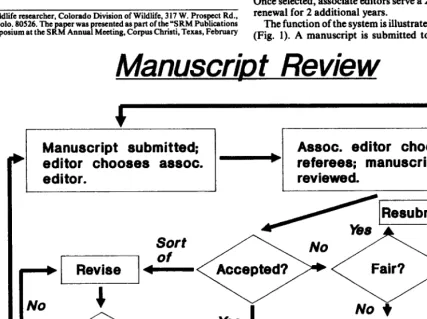
The function of the system is illustrated in the following example (Fig. 1). A manuscript is submitted to the editor-inxhief, who
Manuscr@t Review
L ( Manuscript submitted;
editor chooses assoc.
editor.
1-1
re43=_
manuscript
1
Sort
Fig. 1. Flow d&gram of peer review at the Journal of Range Management.
chooses an associate editor with expertise appropriate for its topic. editors who will persist in requiring a change that an author can Upon receiving the paper, the associate editor selects 2 or 3 referees refute in a well-documented rebuttal. After all, the editors and to review it, usually allowing them 2 weeks to a month to get the job reviewers are, by definition, your peers, not your superiors. In the done. Most referees are persons whose work the associate editor end it is your paper, and within reason, should reflect your values knows, although citations in the paper, suggestions of colleagues, and interpretations. Finally, you can expect a review that is as or recommendations of the author may also point out appropriate expedient as is consistent with thoroughness and reliability. reviewers.
When the reviews are returned, the associate editor decides the Everyone’s Share fate of the manuscript based on the comments of the referees and
his or her own evaluation. If the referees are thorough, then most associate editors will simply pass their recommendations on to the author, adding only minor comments as needed. However, if 1 or both of the reviews are weak, then the opinions of the associate editor take on greater weight. If the reviews are inadequate, the associate editor may seek others.
When the paper is returned to the author, he or she has several choices. If the paper is accepted without revision, then it is simply a matter of choosing the correct champagne. (Given the salaries of scientists, it is perhaps fortunate that this occurs rarely.) If revi- sions are required, then the author can choose to make the changes as asked, or can provide a detailed rebuttal explaining why they should not be made. The associate editor will evaluate the revisions and rebuttal, and at that point may proceed with publication, may ask for additional changes, or, in some cases, may require further review. Finally, if the paper is rejected, the author can decide to submit it elsewhere, can revise and resubmit it to JRM, or can appeal the decision of the associate editor. In the case of resubmis- sions, the process starts over. In the case of appeals, the paper will be reviewed by a different associate editor and different referees. On appeal, the second editor considers all reviews, rebuttals, and correspondence, and arrives at a final decision on publishing the paper. About half of appealed decisions are decided in favor of the author. On average, the review process requires 7.5 months from submission to acceptance; accepted papers are usually published within 5 months.
What Can You Expect?
As an author, what can you expect from the process of peer review at the Journal of Range Management? You can anticipate a rigorous evaluation of the quality of your product. Your manu- script must treat a topic that is appropriate and interesting, and in so doing, must offer original, reliable information, clearly pre- sented. Roughly half of the papers submitted meet these criteria. Papers are rejected most frequently because referees and the asso- ciate editor believe they fail to meet standards for reliability, par- ticularly in experimental design and execution. These problems frequently include inadequate replication of experimental mater- ial, confounding of treatments, and inappropriate procedures for measuring responses. Topics are judged uninteresting if they merely echo a well-established literature, if they are excessively parochial, or if they are largely irrelevant to important issues in range management.
Opaque writing rarely causes outright rejection, but often leads to major revisions. Although some editors and referees are willing to polish dull prose, authors are ultimately responsible for the clarity of their work. If good writing demands inordinate effort, get professional help-1 am often surprised that scientists who actively seek statistical guidance in designing and analyzing their experi- ments wouldn’t think of obtaining help in reporting them. If you believe working to improve your writing isn’t a worthwhile invest- ment, consider that most referees are far more forgiving of flaws in a clear paper than in a murky one.
In addition to rigor, you can expect fairness. You are entitled to a review that is unbiased, that evaluates your work solely on its merit. You are due a review that responds to your perception of the message implicit in your paper. For example, if you think the editor and referees have asked for a revision that is uncalled for or misleading, then you have every right to tell them so. I know of no
As a professional, what are you obliged to contribute to peer review? If you want to publish in refereed journals, you then are obliged to actively participate in the peer review process by provid- ing a reasonable number of critiques of manuscripts. Your obliga- tions are not limited to triage; you should strive to improve the quality of manuscripts, not merely sort them according to their quality. To that end, your comments need to be thorough, scho- larly, and constructive. Even when rejecting a paper, you must clearly explain your objections, and suggest approaches that might remedy them. If nothing else, rejected authors should learn some- thing from the reviewers. Finally, I emphasize that you must be prompt. If you are unduly burdened with requests for reviews, or have occasional scheduling conflicts, there is nothing wrong with begging-off and returning a manuscript to the associate editor. However, there is no excuse for a tardy failure to review. If you commit to reviewing by not promptly returning the paper, then get with it. As one of my colleagues said, it won’t take any less time next week than this one.
The process of peer review belongs to all of us, and as such, should respond to individuals who believe that it isn’t working properly. Evaluation of manuscripts at the JRMhas drawn tire for several reasons, but the complaint I hear most frequently is that the process is inconsistent; that standards for acceptance vary among editors, and this variation leads to widely varying rates of accep tance. All of this is true. However, I think it comes with the territory of a diverse endeavor like range science and a subjective, pluralistic process like peer review. Any system that relies on many opinions to achieve judgments will be somewhat inconsistent in its outcomes. The only way to assure homogeneity of standards is to reduce the number of people making decisions, thereby distilling the variety of opinion they represent. Alternatively, rules for accep tance or rejection can be imposed from above. In the end, I think such efforts will lead to elitism, inflexibility, and the loss of a sense of collective responsibility for peer review. It is true that consis- tency is not far removed from fairness, but the appeal system should assure equitable treatment of authors who believe their work has been held up to unfairly inconsistent standards.
Honors for Review
This is not to say the system is perfect. However, I believe that the quality of the review system, as measured by its fairness, as measured by the quality of products that appear in the Journal of Range Munugement, is more or less directly proportional to the time and imagination that referees are willing to invest in their reviews. If we wish to improve the peer review system, if we wish to improve our Journal, if we wish to enhance the credibility of our profession, then we can do so by rewarding high quality participa- tion in peer review. I think these objectives are sufficiently valuable to require that evidence of high quality reviewing become one of the criteria for promotion of range scientists. Such evidence should not be limited to a list of the journals one has reviewed for, but should include an evaluation of the thoroughness and scholarship of the reviews themselves. Promotion folders should contain reprints. They should also contain contributions to peer review.
Peer review at the Journal of Range Management is a system for enhancing the credibility of our profession by assuring that our products meet standards for quality. In this process, we should be able to expect fair and thorough treatment. We are professionally obliged to provide it.