Copyright 0 1986 by the Genetics Society of America
THE
MU
TRANSPOSABLE ELEMENTS OF MAIZE:
EVIDENCE FOR TRANSPOSITION AND COPY NUMBER
REGULATION DURING DEVELOPMENT
MARY ALLEMAN' AND MICHAEL FREELING'
Department of Genetics, University of California, Berkeley, California 94720
Manuscript received April 12, 1985 Revised copy accepted September 23, 1985
ABSTRACT
T h e Mu transposw of maize exists in a highly mutagenic strain called Rob- ertson's Mutator. Plants of this strain contain 10-50 copies of the Mu element, whereas most maize strains and other plants have none. When Mutator plants are crossed to plants of the inbred line 1S2P, which does not have copies of
Mu, the progeny plants have approximately the same number of Mu sequences as did their Mutator parent. Approximately one-half of these copies have seg- regated from their parent and one-half have arisen by transposition and are integrated into new positions in the genome. This maintenance of copy number can be accounted for by an extremely high rate of transposition of the Mu
elements ( 1 0-1 5 transpositions per gamete per generation). When Mutator plants are self-pollinated, the progeny double their Mu copy number in the first generation, but maintain a constant number of Mu sequences with subsequent self-pollinations. Transposition of Mu and the events that lead to copy number maintenance occur very late in the development of the germ cells but before fertilization. A larger version of the Mu element transposes but is not necessary for transposition of the Mu sequences. T h e progeny of crosses with a Mutator plant occasionally lack Mutator activity; these strains retain copies of the Mu
element, but these elements no longer transpose.
N 1978, ROBERTSON described a maize stock that generated 50-100 times
I
the expected frequency of recessive mutations as assessed by scoring for kernel and seedling mutants in progeny of self-pollinated plants (ROBERTSON1978). About 40% of these newly induced mutations were genetically unstable, suggesting that they were the result of insertions (GREEN 1977). ROBERTSON
has characterized the mutator quality of this stock and named it Mutator
(ROBERTSON 1978, 1980, 1981a,b). He showed that the mutagenic activity that defines Mutator stocks was transmitted as a dominant phenotype in crosses to non-Mutator stocks. When a Mutator plant was used as either the male or female parent approximately 90% of the progeny inherited Mutator activity
(ROBERTSON 1978). Further, fate maps of mutant sectors in the ear suggested that new mutants are induced primarily late in plant development (ROBERTSON
' Present address: Department of Genetics, University of Wisconsin, Madison, Wisconsin 53706.
'
To whom reprint requests should be addressed.108 M. ALLEMAN AND M. FREELING
1980, 1981b). Thus, Mutator appears to be dissimilar to the bipartite control- ling elements in maize described by MCCLINTOCK (1 950), RHOADES (1 938),
PETERSON (1 960) and others, in which autonomous and nonautonomous com- ponents segregate in a Mendelian fashion as discrete genetic units (for reviews, see FEDOROFF 1983; FREELING 1984).
Molecular analysis of the Mutator system began with the selection of an unstable mutant allele of the alcohol dehydrogenase-I ( A d h l ) gene from a Mu- tator background (FREELING 1984; FREELING, CHENC and ALLEMAN 1982). This mutant and its progenitor were analyzed by genomic blots (STROMMER et al. 1982), cloned (BENNETZEN et al. 1984) and sequenced (BARKER et al. 1984;
DENNIS et al. 1984). T h e mutant allele contains a 1.4 kilobase pairs (kbp) insertion, called M u l . T h e sequence of M u 1 is similar to other transposons in that it has inverted repeats 230 base pairs (bp) in length and is flanked by direct repeats of host DNA. In addition, M u 1 has internal direct repeats of approximately 100 bp and also has symmetry about a central A T rich region. Three long, open reading frames of unknown function have been deduced from sequence analysis (BARKER et aE. 1984).
DNA gel blot analyses (performed under stringent hybridization conditions using an internal M u 1 fragment as a probe) show a unique correlation: Mutator stocks have between 10 and 50 intact and dispersed M u sequences of two distinct size classes, whereas non-Mutator stocks have none (BENNETZEN 1984). This correlation suggests that the
Mu
element is involved in the Mutator phenomenon, but does not prove that it is solely responsible for Robertson’s Mutator activity. There is evidence, however, that the M u element is a major component of Mutator activity. First, all mutations that have been induced in Mutator lines and analyzed at the molecular level containMu
insertions. These mutations include three other mutants of A d h l (~OHNS, ALLEMAN and FREEL-INC 1983; J. N. STROMMER and M. A. JOHNS, unpublished results; C.-H. CHEN, K. OISHI and M. FREELING, unpublished results), a shrunken endosperm mu- tant allele, shl-mu9626, (D. S. ROBERTSON, B. BURR and M. FREELING, personal communication) and a mutant in anthocyanin biosynthesis, al-Mum2 (O’REILLY
et al. 1985). Second, a Mutator background does not act as a general activator of transposable elements; mutant alleles involving the Ds/Ac, Z/En, al-m/Dt and
r-cu/Fcu systems do not become unstable in a Mutator background (ROBERTSON
and MASCIA 1981).
Our studies pertain to the molecular basis of Robertson’s Mutator activity. In this report we show that (1) M u 1 elements transpose and demonstrate copy number maintenance; (2)
Mu
transposition occurs at an extremely high fre- quency before fertilization in germinal cells; (3) a larger 1.7-kbp version is an active element, but is not a “master”; and (4) plants that lose Mutator activity still have copies of M u , but these elements no longer transpose.MATERIALS AND METHODS
MU TRANSPOSABLE ELEMENTS OF MAIZE (1S2P; Mutator)X 1S2P
109
I
1-4
1 S X - l l S - - 8 2 - x 1 s - 1J 2 i
h
2 T 2 9 1 2 - x3-1 2 3 3-4 5 6 7 8 9 10 11 12 13 U 15 16 l8 20 21 3-22 232425
lSx-8 I I I
3-1 2 3 3-4 5 6 2-x 7 8 9 10 11 12 13 U 15
1
16h z T
igl
2-xl8 20 21 3-22 232425
lS2PX347 349XlS2P
LTJY
4-1 2 3 4
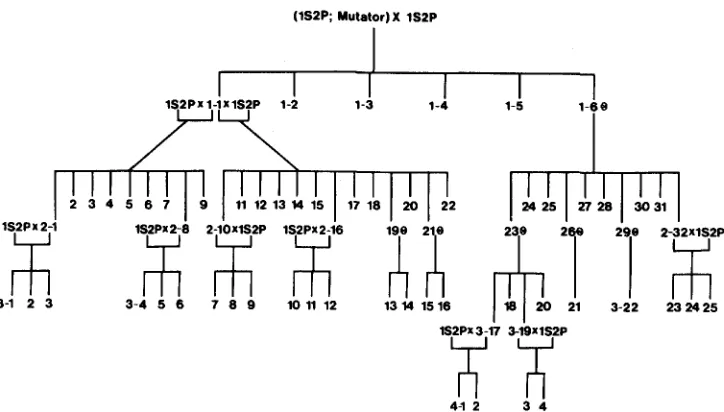
FIGURE I.-Family tree of the 1S2P;Mutator lineage used in these experiments. Individuals are numbered with respect to the generation they occupy (1-4) and the position within their genera- tion (from left to right). The 1SPP;Mutator stock was the result of five generations of crosses of Mutator from the initial stock DR 74-2031-6 X 1028-8 into the inbred line 1S2P. 1S2P has no detectable copies of Mu elements (Figure 3). The female parent is on the left in the crosses. @
denotes a self-pollination.
show an increased frequency of new mutants relative t o other inbred lines (M. FREEL-
ING, unpublished data). T h e result of this backcrossing was a line that was largely 1S2P
in genetic background a n d retained Mutator activity. W e designate this stock lS2P;Mutator. T h e subsequent lineage of lS2P;Mutator includes a n u m b e r of self- pollinations a n d backcrosses t o 1S2P (Figure 1). Mutator was also incorporated into another stock (d708a) by crossing it t o lS2P;Mutator and then backcrossing a n d self- pollinating. T h e d708a stock was obtained from M. G. NEUFFER (University of Mis- souri). Some stocks in which Mutator activity was lost were provided by ROBERTSON; these included DR77-2071-6N X 1070-8 a n d its descendants, which were outcrossed to non-Mu lines. In this paper, we use the term “Mutator” for plants of the Mutator genetic background that have the ability to produce new mutations at a high frequency. T h e term Mu refers t o t h e genetic elements, M u 1 a n d Mu2; these elements are asso- ciated with active Mutator stocks a n d with a n u m b e r of mutations that have been induced in these stocks.
DNA isolation and DNA gel blot analysis: Mature maize leaves (5-10 g of tissue, wet weight) were quick frozen in liquid N B a n d were powdered with dry ice in a n electric coffee grinder. DNA was isolated by the procedure of MURRAY a n d THOMPSON (1980).
Aliquots of DNA (15 pg) were digested with restriction enzyme for 3 h r using six units of enzyme per pg of DNA for t h e enzyme T t h l l l - I , o r three units of enzyme per pg of DNA for other enzymes. Restriction enzymes were purchased from New England Biolabs, Inc.; buffer conditions for the enzymes were as suggested by the manufacturer. Gel electrophoresis through 0.8- 1 .O% agarose, DNA gel blotting a n d filter hybridiza- tion were performed as described (JOHNS, STROMMER a n d FREELINC 1983). Gene Screen (New England Nuclear, Du Pont) was used as the blotting matrix.
110 M. ALLEMAN AND M. FREELING
c---l 100 bp
FIGURE 2.-Restriction map of a portion of the Adhl-IS3034 genomic clone containing the M u 1 transposable element of maize. M u 1 was isolated from the unstable Mutator-induced mutant of
the A d h l gene (AdhI-IS3034) (BENNETZEN et al. 1984). Position of restriction sites and direct and inverted repeats are based on the DNA sequence analysis of BARKER et al. (1984). The dashed line denotes the portion of the cloned D N A that is A d h l sequence.
b p of the surrounding Adhl sequence. Figure 2 is a restriction map of the Mu1 element showing the region included by this Mul-containing subclone. An Adhl unique sequence p r o b e was also used for these experiments; this probe was a 1.5-kbp Sac11 fragment gel purified from pB428 that includes the Adhl-IS allele (BENNETZEN et al. 1984).
Mul-containing plasmid DNA or Adhl DNA was nick-translated to a specific activity of at least 10' cpm/pg DNA with CY-'~P deoxynucleotides (RIGBY et al. 1977). T h e dried filters were hybridized in a solution containing Denhardt's solution (0.02% Ficoll, 0 . 0 2 % polyvinylpyrrolidone, 0.02% bovine serum albumin), 1.0 M NaCl, 0.05 M sodium phos- phate, p H 7.4, 1 mM E D T A (ethylenediaminetetraacetic acid), 0.2% SDS (sodium lauryl sulfate), 0.15 mg/ml denatured salmon sperm DNA and 5 0 Pg/ml polyadenylic acid. Hybridization was carried out a t a temperature of 6 8 " for 30-48 hr. Blots were washed at 65" for 2-3 h r with 0.2X SSC a n d 0.1% SDS. Autoradiography was carried o u t using Kodak X A R 5 film with a n intensifying screen. After the film was developed, a Transidyne General 2 9 7 0 scanning densitometer was used in the quantification of band intensity. All exposures were in the linear range of the film.
RESULTS
Estimation of Mutator copy number: To estimate the number of Mu se- quences in Mutator plants relative to the number in their progeny, it was first necessary to establish rigorous controls for the quantification of
Mu
copy num- ber using DNA gel blot analysis.Genomic DNA was digested with the restriction enzyme, T t h l l l - I , which cuts Mu2 within the terminal inverted repeats to produce a fragment of 1.0 kbp. T h e large Mu element, Mu2, is also cut by enzymes that recognize se- quences in the terminal repeats of Mul; these enzymes ( H i d and T t h l l l - I , for example) produce a Mu2 restriction fragment that is consistently 0.4-kbp larger than the Mu1 fragment (BENNETZEN 1984). DNA gel blot analysis of Tth 1 1 1 -I-digested genomic DNA, probed with pMuED2, produced two bands at 1.0 and 1.4 kbp accounting for all Mu elements in the genome (Figure 3, lanes 1-7). Because the entire Mul-containing plasmid, pMuED2, was used as a hybridization probe, plasmid contamination and, therefore, the possibility of Mul-plasmid contamination of our genomic DNA samples could be detected by the presence of additional (pBR322) bands on the DNA gel blots. Any lane that showed plasmid contamination was eliminated from the analyses.
112 M. ALLEMAN AND M. FREELING
number controls were normalized against each other on DNA gel blots. They were also compared with the genomic single copy Mu standards: the Mu- containing bands that appear on DNA gel blots when genomic DNA from a Mutator plant is digested with an enzyme that does not cut within either Mu element. In this case, fragments are distributed over a large range of molecular weights and represent single Mu elements at unique sites in the genome. Copy number standards were diluted to yield genomic equivalents of 1-50 copies of Mu per diploid genome; they were aliquotted for use on all DNA gel blots performed in these experiments. Non-Mutator 1S2P DNA that had been di- gested with the enzyme EcoRI was mixed with copy number standards to avoid blotting artifacts resulting from differences in DNA concentrations. DNA from 1S2P plants also served as a negative control for each DNA gel blot; no Mu sequences were detected in these plants (BENNETZEN 1984). Under high strin- gency wash conditions, 1S2P DNA showed no detectible hybridization to the Mu1 probe (Figure 3, lane l l ) , but did to the Adhl probe. All blots were probed twice: first with the Mu1 probe and then with the Adhl probe to control for variation in the amount of DNA loaded per lane.
Mutator copy number in outcrossed individuals: These experiments were performed in order to assess change in the number of Mu elements when a Mutator plant was crossed to a plant with no Mu elements, or when these plants were self-pollinated. Our study incorporated 35 individuals from the 1 S2P;Mutator lineage in direct parent-to-offspring comparisons of Mutator plants and their progeny produced by backcrossing to the non-Mu inbred line 1S2P. Among these were five plants (individuals 1-1, 2-1, 2-8, 2-10 and 2-16; Figure 1) that were compared with 34 progeny by DNA gel blot analysis. In parent-to-offspring comparisons of copy number, analyses were always from the same DNA gel blot.
After densitometer tracings were performed for each individual and con- trols, an estimate of the Mu content of each individual was expressed as the number of densitometer deflection units caused by the Mu1 band plus the number of densitometer deflection units caused by the Mu2 band; this value was normalized for variation in the amount of DNA loaded in each lane using the percent of the Adhl-specific densitometer deflection for individuals on the same DNA gel blot (when it was probed with radiolabeled Adhl). Densitometer data could then be expressed as a copy number estimate by comparison with copy nu'mber standards, or as an arbitrary value of densitometer units. Because we were interested in how the Mu copy number changed in the progeny generation relative to the parental generation when a Mutator plant was crossed to a plant without Mu elements, copy number changes were expressed
MU TRANSPOSABLE ELEMENTS OF MAIZE 113
loss. T h e 1 S2P;Mutator lineage maintained approximately 20-30 copies of Mu that include 20-30 copies of the 1.4-kbp Mu1 element and 1-10 copies of the 1.7-kbp Mu2 element. Lanes 1-4 of Figure 3 show representative
D N A
gel blot profiles of three generations in a direct parent-to-offspring lineage.Mutator copy number after self-pollination: T h e results for Mu copy num- ber following self-pollination of Mutator lines are strikingly different from those observed for crosses.
D N A
gel blots from individuals 1-6, 2-19 and 2-21 and their 14 progeny produced by self-pollination were performed, and den- sitometer tracings were compared. T h e densitometer deflection unit value for each progeny was expressed as a ratio compared to its parent. In all 14 parent- to-progeny comparisons, the progeny had 2.2*
0.21 times the Mu sequences as did their parents. In order to determine the effect of subsequent self- pollination on the Mu copy number, we compared plants 2-23, -26 and -29 with their six progeny. T h e second generation of self-pollination did not fur- ther increase the number of Mu sequences in the genome. T h e progeny had 0.95 f 0.15 times the Mu sequences as did their parent. Lanes 5-7 of Figure 3 show representativeD N A
gel blot profiles of three generations of continuous self-pollination in a direct parent-to-offspring lineage.Analysis of individual
Mu
elements by SacZ digestion: WhenD N A
from a Mutator plant is digested with a restriction enzyme that does not cut within either the 1.4-kbp or the 1.7-kbp Mu element, for example S a d , and the resultingD N A
gel blot is probed with pMuED2, a ladder of readily discernible bands appears. These bands are Mu-containing restriction fragments that rep- resent Mu elements at unique genomic locations. We analyzed two Mutator plants (individuals 1-1 and 2-8) and 25 of their progeny by this method. Lanes 1-4 of Figure 4 sh0w.a representativeD N A
gel blot that compares a Mutator parent and its progeny after crosses with non-Mu 1S2P. When progeny were compared with their Mutator parent, an apparent conservation in band number was observed. Of these Mu-containingD N A
fragments, approximately one-half were the same size as fragments in the parent, and one-half were at molecular weight positions not seen in the parent. This suggests transposition of Mu elements to new sites in the genome.A large
Mu
element transposes but is not a “master”: Transposition of the 1.7-kbp Mu element (Mu2) was shown by comparison ofD N A
gel blot profiles of lS2P;Mutator and d708a;Mutator. T h e strain d708a;Mutator was generated by crossing lS2P;Mutator to the non-Mu d708a stock, followed by backcrossing to 1S2P. T h e lS2P;Mutator plants had 1-3 copies of Mu2, whereas d708a; Mutator had 15-20 copies of Mu2. T h e Mu1 copy number in lS2P;Mutator is approximately 20; only about 5 copies of M u l , however, are in d708a; Mutator. T h e observed increase in Mu2 copy number can only be explained by Mu2 transposition.A D N A
gel blot profile ofD N A
from two siblings of the d708a;Mutator stock is shown in Figure 3, lanes 13 and 14.1 2 3 4 5 6 7 M w
(KBP)
416.7
4
8.7
B
114
MU TRANSPOSABLE ELEMENTS OF MAIZE 115
striping (FREELING 1984) and the induction of new mutants, occurred in this lineage. Copy number maintenance and mutagenesis in this stock indicate that
M u 2 is not necessary for Mutator activity or for transposition of M u l . Lane 12 of Figure 3 shows a DNA gel blot profile of DNA from an active Mutator plant containing no M u 2 elements.
Mu
sequences in stocks that have lost Mutator activity: ROBERTSON (1 978)observed that, following crosses of Mutator by non-Mutator plants, approximately1 0% of the progeny d o not inherit Mutator activity from their parent; these Mutator-loss plants do not regain Mutator activity following sub- sequent crosses to non-Mutator stocks. We analyzed several individuals that had lost Mutator activity. One of these stocks includes DR77-2071-6N X 1070-
8 and eight generations of outcrosses to non-Mu stocks; others are individuals 2-4 and 2-16 (Figure 1) and their progeny. These stocks lose M u copies at a rate of one-half each generation. DNA from these stocks was digested with a restriction enzyme that does not cut within the M u elements. Individual 2-16 had 12 copies of M u , approximately one-half of the number detected in its parent. This rate of loss is consistent with segregation of M u elements in the absence of transposition. Figure 4, lanes 5-7 show DNA gel blots of DNA from three related plants in a lineage following Mutator loss.
DISCUSSION
These experimental results provide a molecular explanation for a set of characteristics observed for the Robertson’s Mutator line of maize. These char- acteristics include an extremely high mutation frequency (ROBERTSON 1978, 1985), somatic leaf striping (FREELING 1984), chromosome breakage (M. ALLE-
MAN, unpublished results) and the loss of Mutator activity by 10% of outcrossed progeny (ROBERTSON 1978). All of these phenotypes can be explained by the behavior of transposable elements. One family of elements, the M u transpo- sons, has been identified; these are probably the only transposable elements active in Mutator lines. Our studies are directed toward the relationship be- tween the M u transposons and the Robertson’s Mutator phenomenon.
T h e data presented above show that, in the lS2P;Mutator lineage, approx- imately 10-1 5 new M u insertions are detected per generation during sequential outcrossing of Mutator lines. This is equivalent to approximately one trans-
FIGURE 4.-The distribution of Mu elements in Mutator plants and plants that have lost Mutator activity. Maize DNA from mature leaves (15 rg/lane) was digested with the restriction enzymes Sac1 (lanes 1-4) or BamHI (lanes 5-7). DNA gel blots of 0.8% agarose gels were probed with the nick-translated Mul-containing plasmid, pMuED2. Lanes 1-4 compare the distribution of Mu sequences in Sad-digested DNA of a Mutator plant and its progeny following outcrossing to non-Mu 1S2P. The Mutator plant, individual 1-1, was outcrossed as a male and as a female (see Figure 1). Lanes 1 and 4: Parent plant 1-1. Lanes 2 and 3: Progeny plants 2-10 and 2-11. Lanes 5-7 show DNA gel blot profiles of Mu elements in plants that have lost Mutator activity during outcrossing. Lane 5: Second generation of outcrossing Mutator loss line to the non-Mu hybrid
116 M. ALLEMAN AND M. FREELING
position event per M u element per generation. The presence of newly trans- posed M u elements is indicated by total copy number conservation and by the appearance of new Mu-containing restriction fragments in the progeny of out- crossed Mutator plants. We equate these new restriction fragments with trans- position events for the following reason. Parental Mu-containing restriction fragments segregate in a Mendelian fashion to progeny. Segregation should decrease copy number by one-half each generation when crosses are made to non-Mu lines, such as 1S2P. Instead of the predicted reduction, copy number is maintained at 20-25 copies during sequential outcrossing to plants with no
M u elements. T h e observed M u copy numbers and the stability of copy number from generation to generation may reflect the near-isogenic nature of the line used (1 S2P;Mutator crossed to 1 S2P without Mutator). Other Mutator lines have other M u copy number values (BENNETZEN 1984).
We interpret our results to indicate that M u elements transpose at an ex- tremely high rate and by a replicative mechanism. Copies of M u segregate with expected ratios to progeny, whereas newly transposed copies appear at a rate of about 10-15 new M u copies per genome per generation; M u elements do not leave their previous site as an obligatory part of the transposition process. This suggests that transposition occurs by a replicative mechanism (SHAPIRO, ADHYA and BUKHARI 1977) as opposed to a lambda-like excision-transposition model (CAMPBELL 1983). According to a replicative transposition model, new
M u copies would arise via replication of old copies that do not leave their chromosomal position (SHAPIRO 1979). It is not possible to show whether an excision-transposition mechanism occurs at all. However, excision of M u 1 from the first intron of Adhl in the mutant Adhl-IS3034 would create revertants or mutant Adhl derivatives ( i . e . , M u 1 leaves the Adhl locus, but produces a deletion with a resulting change of phenotype). Reversion of the Mu-bearing mutant allele, A d h l - l S 3 0 3 4 , occurs at a frequency of approximately IO-' rev- ertants per pollen grain (FREELING, CHENG and ALLEMAN 1982). Derivative alleles of S3034 also occur rarely, and none of them appear to have lost the
M u 1 element (STROMMER et al. 1982; TAYLOR and WALBOT 1985; M. ALLE- MAN and M. FREELING, unpublished results).
M U TRANSPOSABLE ELEMENTS OF MAIZE 117 SON’S published mutation frequencies for genes in Mutator stocks agree closely.
We have shown that the number of Mu elements per genome does not change when Mutator lines are crossed to non-Mu lines, but does increase in the first generation of self-pollination. Copy number stabilizes during subse- quent self-pollination, and the transposition frequency of Mu elements is greatly decreased. Assuming that mutagenesis is a reflection of transposition of Mu elements, there is agreement between these molecular data and the genetic results. Mutagenesis in Mutator lines is highest during outcrossing, but decreases during inbreeding of Mutator lines (ROBERTSON 1983).
Genetic analysis has determined that the timing of mutational activity in Mutator lines is very late in the development of the germ line or immediately after fertilization (ROBERTSON 1980, 198 1 b). Our results for Mu transposition suggest that most transpositions of Mu elements probably occur during the gametophyte stage and before fertilization. Our reasoning is as follows: copy number control of Mu transposition would act to maintain the number of Mu elements in continuously self-pollinated Mutator stocks, although the Mu copy number doubles in the first generation of self-pollination. Postmeiotic trans- position of Mu elements would increase the copy number to the approximate value that existed before the meiotic reductive division. Progeny of an outcross to a non-Mu line would then have the same copy number as did their parent and the progeny generated from a self-pollination would contain twice as many Mu elements as did the parent. T h e reduction in copy number per cell that follows meiosis might activate transposition and result in the maintenance of copy number.
On the other hand, if control of copy number and transposition occurred after fertilization or early in the development of the sporophyte, we would expect the following: After meiosis and fertilization in a plant with 20 Mu elements (for example), an outcross would generate zygotes with 10 Mu ele- ments. T h e zygotes, following a self-pollination, would have 20 copies of Mu. A copy number control mechanism that maintained 20 Mu copies would rectify the number to 20 in the progeny of outcrossed Mutator plants. There would be no increase in Mu copy number observed in the progeny of self-pollinated plants. Our results are clearly consistent with transposition and copy number control before fertilization.
T h e observed regulation of copy number that we report here may be due to interactions among factors involved in the transposition process, including putative transposase(s) and repressor(s) of transposition. These interactions would determine both the frequency and the timing of transposition. Copy number control has been observed for the T n 5 transposon of E. coli; a decrease in the frequency of transposition in strains with many T n 5 elements is partially due to the increased concentration of the Tn5-encoded transposition repressor (JOHNSON and REZNIKOFF 1984). Such a model has also been proposed for the
Ac and the E n elements in maize, based on the genetic evidence that specific deletions in these elements remove the autonomous transposition capability
118 M. ALLEMAN AND M. FREELING
result from a transposase and/or a transposition repressor specific to
Mu
being encoded by the Mutator line, but not necessarily by the M u elements them- selves.We thank JOHN DOCTOR for helpful criticism of this manuscript and JUDITH N. STROMMER for instruction in blot hybridizations. We also thank ELLEN DANIELL for the M u subclone, pMuED2. Supported by a National Institutes of Health grant (GM27134) to M.F. M.A. was a recipient of a Public Health Services Genetics training grant and was an ARC0 Plant Cell Research Institute fellow.
LITERATURE CITED
BARKER, R. F., D. V. THOMPSON, D. R. TALBOT, J. A. SWANSON and J. L. BENNETZEN, Nucleotide sequence of the maize transposable element M u l . Nucleic Acids Res. 12:
1984 5955-5967.
BENNETZEN, J., 1984
BENNETZEN, J., J. SWANSON, W. C . TAYLOR and M. FREELING, 1984
Transposable element Mu1 is found in multiple copies only in Robertson’s Mutator maize lines. J. Mol. Appl. Genet. 2: 519-524.
DNA insertion in the first intron of maize A d h l affects message levels: cloning of progenitor and mutant Adhl alleles. Proc. Natl. Acad. Sci. USA. 81: 4125-4128.
CAMPBELL, A., 1983 Bacteriophage lambda. pp. 65-103. In: Mobile Genetic Elements, Edited by
DENNIS, E. S., W. L. GERLACH, A. J. PRYOR, J. L. BENNETZEN, A. INGLIS, D. LLEWELLYN, M. M. T h e Adhl gene of maize. Nucleic Acids Res.
FEDOROFF, N. V., 1983 Controlling elements in maize, pp. 1-63. In: Mobile Genetic Elements,
FEDOROFF, N. V., S. WESSLER and M. SHURE, 1983 Isolation of the transposable maize controlling
FREELING, M., 1984 Plant transposable elements and insertion sequences. Annu. Rev. Plant Phys-
Mutant alleles that are altered in quan-
T h e case for DNA insertion mutants in Drosophila. pp. 437-445. In: DNA Insertion Elements, Plasmids, and Episomes, Edited by A. I. BUKHARI, J. A. SHAPIRO and S. L. ADHYA. Cold Spring Harbor Laboratory, Cold Spring Harbor, New York.
Differential regulation of the Adhl gene in maize: facts and theories. pp. 61-79. In: Genetic Engineering ofPlants, Edited by T . KOSUGE, C. MEREDITH and A. HOLLAENDER. Plenum Press, New York.
Exceptionally high levels of restriction site polymorphism in DNA near the maize Adhl gene. Genetics 105: 733-743.
Copy number control of Tn5 transposition. Genetics 107: 9-18.
The origin and behavior of mutable loci in maize. Proc. Natl. Acad. Sci.
MURRAY, M. G. and W. F. THOMPSON, 1980 Rapid isolation of high molecular weight plant
O’REILLY, C . , N. S. SHEPHERD, A. PEREIRA, Z. SCHWARZ-SOMMER, I. BERTRAM, D. S. ROBERTSON, Molecular cloning of the a1 locus of Zea mays using
J. SHAPRIO. Academic Press, New York.
SACHS, R. J. FERL and W. J. PEACOCK, 1984
12: 3983-4000.
Edited by J. SHAPIRO. Academic Press, New York.
elements Ac and Ds. Cell 35: 235-242.
iol. 35: 277-298.
FREELING, M., D. S.-K. CHENC and M. ALLEMAN, 1982
GREEN, M. M . , 1977
titative, organ-specific behavior. Dev. Genet. 3: 179-196.
JOHNS, M. A., M. ALLEMAN and M. FREELING, 1983
JOHNS, M. A., J. N., STROMMER and M. FREELING, 1983
JOHNSON, R. C. and W. S. REZNIKOFF, 1984
MCCLINTOCK, B., 1950
USA 36: 344-355.
DNA. Nulcleic Acids Res. 8: 4321-4325.
P. A. PETERSON and H. SAEDLER, 1985
MU TRANSPOSABLE ELEMENTS OF MAIZE 119
PEREIRA, A., Z. SCHWARZ-SOMMER, A. GIERL, I. BERTRAM, P. A. PETERSON and H. SAEDLER, Genetic and molecular analysis of the enhancer ( E n ) transposable element system of 1985
Zea mays. EMBO J. 4: 17-23.
PETERSON, P. A., 1960
RHOADES, M. M., 1938
The pale green mutable locus in maize. Genetics 45: 115-133.
Effect of the Dt gene on the mutability of the a 1 allele in maize. Genetics
Labeling deoxyribonucleic acid to
Characterization of a mutator system in maize. Mutat. Res. 51: 21-28.
The timing of Mu activity in maize. Genetics 94: 969-978. 23: 377-397.
RIGBY, P. W., M. DIECKMANN, C. RHODES and P. BERG, 1977
ROBERTSON, D. S., 1978
ROBERTSON, D. S., 1980
ROBERTSON, D. S., 1981a 213: 1515-1517.
ROBERTSON, D. S., 1981b
high specific activity in vitro by nick translation. J. Mol. Biol. 113: 237-251.
Mutator activity in maize: timing of its activation in ontogeny. Science
Tests of two models for the transmission of the (Mu) Mutator in maize.
A possible dose dependent inactivation of Mutator (Mu) in maize. Mol.
Differential activity of the maize Mutator (Mu) at different loci and in different cel lineages. Mol. Gen. Genet. 200: 9-13.
Tests of four controlling element systems of maize for Mutator activity and their interaction with (Mu) Mutator. Mutat. Res. 84: 283-289.
Molecular model for the transposition and replication of bacteriophage Mu and other transposable elements. Proc. Natl. Acad. Sci. USA 76: 1933-1937.
Introduction: new pathways in the evolution of chromosome structure. pp. 3-1 2. In: DNA Insertion Elements, Plasmids, and E f t - somes, Edited by A. H. BUKHARI, J. A. SHAPIRO and S. L. ADHYA. Cold Spring Harbor Laboratory, Cold Spring Harbor, New York.
STROMMER, J. N., S. HAKE, J. BENNETZEN, W. C. TAYLOR and M. FREELING, 1982 Regulatory mutants of the maize Adhl gene caused by DNA insertions. Nature 300: 542-544.
TAYLOR, L. P. and V. WALBOT, 1985 A deletion adjacent to the maize transposable element Mu1 accompanies loss of Adhl expression. EMBO J. 4: 869-876.
Communicating editor: W. F. SHERIDAN
Mol. Gen. Genet. 183: 51-53.
ROBERTSON, D. S., 1983 Gen. Genet. 191: 86-90.
ROBERTSON, D. S., 1985
ROBERTSON, D. S. and P. N. MASCIA, 1981
SHAPIRO, J. A., 1979