A shortened version of this paper appears under a slightly different title
in the proceedings ofACISP 2005 (Colin Boyd and Juan Gonzalez, eds.), LNCS, Springer-Verlag.
Solving Systems of Differential Equations of Addition
and
Cryptanalysis of the Helix Cipher
∗Souradyuti Paul Bart Preneel
Katholieke Universiteit Leuven, Dept. ESAT/COSIC, Kasteelpark Arenberg 10,
B–3001, Leuven-Heverlee, Belgium
{Souradyuti.Paul, Bart.Preneel}@esat.kuleuven.ac.be
Abstract
Mixing addition modulo 2n(+) and exclusive-or (⊕) has a host of applications in symmetric
cryptography as the operations are fast and nonlinear over GF(2). We deal with a frequently encountered equation (x+y)⊕((x⊕α) + (y⊕β)) =γ. The difficulty of solving an arbitrary system of such equations – named differential equations of addition (DEA) – is an important consideration in the evaluation of the security of many ciphers againstdifferential attacks. This paper shows that the satisfiability of an arbitrary set of DEA – which has so far been assumed hard for largen – is in the complexity class P. We also design an efficient algorithm to obtain all solutions to an arbitrary system of DEA with running time linear in the number of solutions. Our second contribution is solving DEA in anadaptive query modelwhere an equation is formed by a query (α, β) and oracle output γ. The challenge is to optimize the number of queries to solve (x+y)⊕((x⊕α) + (y⊕β)) =γ. Our algorithm solves this equation with only 3 queries in the worst case. Another algorithm solves the equation (x+y)⊕(x+ (y⊕β)) =γwith (n−t−1) queries in the worst case (tis the position of the least significant ‘1’ ofx), and thus, outperforms the previous best known algorithm by Muller – presented at FSE ’04 – which required 3(n−1) queries. Most importantly, we show that the upper bounds, for our algorithms, on the number of queries match worst case lower bounds. This, essentially, closes further research in this direction as our lower bounds areoptimal.
We used our results to cryptanalyze a recently proposed cipher Helix, which was a candidate for consideration in the 802.11i standard. We are successful in reducing the data complexity of a DC attack on the cipher by a factor of 3 in the worst case (a factor of 46.5 in the best case).
Keywords. Differential Cryptanalysis, Helix cipher, P, NP.
∗This work was supported in part by the Concerted Research Action (GOA) Mefisto 2000/06 and Ambiorix
Contents
Page
1 Introduction 3
1.1 Notation and Model of Computation . . . 4
2 Solving an Arbitrary System of DEA 5 2.1 Computing the Character Set and theUseful Set . . . 5
2.2 Precomputation . . . 6
2.3 Computation of ParametersGi,Si,0 andSi,1 from the Useful Set A˜ . . . 6
2.4 Satisfiability of DEA is in P . . . 7
2.5 Computing All the Solutions to a System of DEA . . . 8
3 Solving DEA in the Adaptive Query Model 8 3.1 The Power of the Adversary . . . 9
3.2 The Task . . . 9
3.3 Number of Solutions . . . 10
3.4 Worst Case Lower Bounds on the Number of Queries . . . 11
3.5 Optimal Algorithms . . . 13
4 Cryptographic Applications: Attacking the Helix Cipher 15 5 Conclusion and Further Research 17 6 Acknowledgments 17 A Appendix 19 A.1 Proofs of Lemma 1 and 2 . . . 19
A.2 Proof of Lemma 3 . . . 19
A.3 Construction ofM from the Li’s . . . 20
1
Introduction
Addition modulo 2n. Mixing addition modulo 2n (+) with other Boolean operations such as
exclusive-or (⊕), or (∨) and/or and (∧) is extensively used in symmetric cryptography. The main motivation for includingaddition mod 2n in cryptographic primitives is that it is a nonlinear transformation over GF(2) and the operation is extremely fast on all present day architectures. Nonlinear transformations are of paramount importance in the design of ciphers as they make functions hard to invert. Helix [FW+03], IDEA [LM+91], Mars [BC+98], RC6 [RR+99], and Twofish [SK+99] which mix modular addition with exclusive-or are a few examples of the application of
addition. Very recently Klimov and Shamir also used an update function for internal state, known as aT-function, whereaddition is mixed with multiplication and or in a certain fashion to achieve many useful properties of a secure stream cipher [KS04, KS03].
Keeping with the trend of widespread use of addition in symmetric ciphers, there is a large body of literature that studies equations involvingaddition from many different angles. Staffelbach and Meier investigated the probability distribution of the carry for integer addition [SM90]. Wall´en explained the linear approximations of modular addition [Wal03]. Lipmaa and Moriai [LM02] in-vestigated the equation (x+y)⊕((x⊕α) + (y⊕β)) =γ, whereα,β are the input differences and
γ is the output difference, to compute many differential properties. The dual of the above equation (x⊕y)+((x+α)⊕(y+β)) =γwas investigated for differential properties by Lipmaaet al.[LW+04].
Differential Cryptanalysis (DC). Differential Cryptanalysis, introduced by Biham and Shamir [BS91], is one of the most powerful attacks against symmetric ciphers. There are broadly two lines of attacks based on DC. One is guessing input or output differences of a cipher with nontrivial probability. In a cipher that is secure against DC, input and output differences should behave ‘pseudorandomly’, so that none of them can be guessed from any known values with a nontrivial probability. This line of attack usually results in distinguishing attacks [YB+04]. A second line of attack is much stronger but more difficult to implement than the other. It recovers secret infor-mation from known input and output differences, akin to the algebraic attacks [Mul04]. Note that this second line of attack implies the first but the converse is not true. Therefore, provable security against DC – introduced by Lai et al. [LM+91] and first implemented by Nyberg and Knudsen [NK91] – remained a key factor in the evaluation of the security of a cipher. However, security of many complex modern ciphers against DC is hard to evaluate because of lack of theory to evaluate the security of its components. Our target is to mount a second line of attack (i.e., to recover secret information) on the much used symmetric cipher componentaddition modulo 2n.
Results of the Paper. There are two basic addition equations under DC where differences of inputs and outputs are expressed asexclusive-or.
(x+y)⊕(x+ (y⊕β)) = γ , (1) (x+y)⊕((x⊕α) + (y⊕β)) = γ . (2) These equations are nameddifferential equations addition(DEA). While engaged in cryptanalysis of MD5, Berson noted in 1992 that, for largen, it ishard to analyze modular addition when differences are expressed as XOR [Ber92]. This may have motivated the use of addition in conjunction with XOR in many symmetric ciphers to increase resistance against DC.
of equations has a natural appeal to many areas such as computational complexity, combinatorics, circuit optimization and computer algebra (remember the most famous NP-Complete satisfiability problem: Boolean formula satisfiability [CL+90]). For example, if a large system of DEA is NOT satisfiable then the whole circuit representing the system of DEA can be safely removed to optimize the circuit complexity. Going beyond the satisfiability problem, we also give an efficient algorithm to compute all the solutions to a randomly generated system of DEA with running time linear in the number of solutions. Another subtle but a noteworthy aspect of our work is the departure from the traditional technique for solving multivariate polynomial equations over GF(2) [AL95]. We heavily benefit from certain properties of DEA and solve such systems combinatorially.
Next, we extend our work to solve DEA in a crypto-friendly adaptive query model. The aim is to minimize the search space for the secret (x, y) using a minimum number of adaptive queries (α, β). Such an optimization problem – typically used to reduce data complexity of chosen plaintext attacks – for (1) has already been tackled by Muller [Mul04]. But an optimal solution has been elusive until now. We achieve optimal solutions for both of the equations. We show that a worst case lower bound on the number of queries (0, β) to solve (1) is (n−t−1) where (n−t)>1 with
t being the bit-position of the least significant ‘1’ of x. A worst case lower bound on the number of queries (α, β) to solve (2) is 3 for n > 2. Most importantly, for solving the above equations we also design algorithms whose upper bounds on the number of queries match worst case lower bounds. Note that our algorithm outperforms the previous best known algorithm by Muller to solve (1) – presented at FSE ’04 – which required 3(n−1) queries [Mul04]. Over and above, our results essentially close further investigation in this particular direction as the equations are solved with an optimal number of queries in the worst case. It is particularly interesting to note that, for (2), although the number of all queries grows exponentially with the input size n, an optimal lower bound to solve (2) is 3 for all n >2, i.e., constant asymptotically.
Our results onmodular addition have the potential to be used either directly in the cryptanalysis of ciphers that include this special component or to facilitate cryptanalysis of several modern ciphers (e.g., mixing addition with multiplication). We show that, with a maximum of only 3 adaptively chosen queries, the search space of the secret of modular addition against DC can be reduced from 22n to only 4 for alln ≥1. We used our results to cryptanalyze a recently proposed cipher Helix [FW+03] which was a candidate for consideration in the 802.11i standard. We are successful in
reducing the data complexity of a DC attack on the cipher by a factor of 3 in the worst case (a factor of 46.5 in the best case) [Mul04]. In addition, using our algorithm to solve DEA, as discussed above we are able to compute all thedifferential properties of addition by investigating a single equation (note that the differential properties of addition have been independently found by Lipmaa and Moriai using a different technique [LM02]).
1.1 Notation and Model of Computation
The purpose of the paper is to solve (1) and (2) for (x, y) using triples (α, β, γ) wherex, y, α, β, γ∈
Zn2. The ith bit of an n-bit integer l is denoted by li (l0 denotes the least significant bit or the
0th bit of l). The operation addition modulo 2n over Z2n can be viewed as a binary operation
over Zn2 (we denote this operation by ‘+’) using the bijection that maps (ln−1, · · · , l0) ∈ Zn2 to
ln−12n−1+· · ·+l020 ∈Z2n. Therefore ‘+’ is a function ‘+’:Zn
2×Zn2 →Zn2. The symbols ‘⊕’ and ‘∧’
denote the operationsbit-wise exclusive-or and bit-wise and of twon-bit integers respectively. We will denote a∧b byab. Throughout the paper, [p, q] denotes a set containing all integers between the integers pand q including both of them. Unless otherwise stated, ndenotes a positive integer. The size of a setS is denoted by|S|.
addressing (direct and indirect) and branching, each of which is a constant time operation. How-ever, the choice of RAM instructions is relatively less important because algorithms based on two reasonable sets of instructions will have the same asymptotic complexity. A detailed analysis of
RAM can be found in [AH+, FB]. It can be shown that a polynomial-time solvable problem on a
RAM is also polynomial-time solvable on a Turing Machine and vice versa.
2
Solving an Arbitrary System of DEA
Our aim is to solve for (x, y) from the following set of differential equations of addition over Zn2,
(x+y)⊕((x⊕α[k]) + (y⊕β[k])) =γ[k], k= 1,2· · ·m . (3) We observe that theith bit ofγ[k] can be written as
γ[k]i =xi⊕yi⊕ci⊕x˜i⊕y˜i⊕c˜i, i∈[0, n−1], (4)
where ˜xi=xi⊕α[k]i and ˜yi =yi⊕β[k]i and ci, ˜ci are computed from the following recursion,
c0= ˜c0= 0, cj+1=xjyj ⊕xjcj⊕yjcj,˜cj+1= ˜xjy˜j⊕x˜jc˜j⊕y˜jc˜j, j∈[0, n−2]. (5)
Thus we see thatγ[k]i is a function of the least (i+ 1) bits of x,y,α[k] and β[k]. More formally,
γ[k]i =Fi(x0,· · ·, xi, y0,· · · , yi, α[k]0,· · ·, α[k]i, β[k]0,· · ·, β[k]i). (6)
Therefore, from a system of m differential equations of addition, a total of mn multivariate poly-nomial equations over GF(2) can be formed by ranging (k, i) through all values in (6).
Plenty of research has been undertaken to design efficient ways to solve randomly generated multivariate polynomial equations. The classical Buchberger’s Algorithm for generating Gr¨obner bases [AL95] and its variants [Fau99] are some of them. This problem is NP-complete (NPC) over GF(2). Many other techniques such as relinearization [KS99] have been proposed to solve a special case of overdefined systems of multivariate polynomial equations. Note that, in our case, the number of unknowns and equations are 2n and mn respectively (if m > 2 then the system of equations is overdefined). However, taking full advantage of the specific nature of the
differential equations of addition, we shall use a combinatorial technique to prove that, although the satisfiability of an arbitrary multivariate polynomial equation over GF(2) is NP-complete, this special cryptographically important subclass of equations is in the complexity class P (see [CL+90], [HM+04] for definitions of NP, P, NPC). Finally, we also derive all the solutions to a system of such equations.
2.1 Computing the Character Set and the Useful Set
From (3) we construct A = {(α[k], β[k], γ[k])|k ∈ [1, m]} assuming (α[k], β[k], γ[k])’s are all distinct.1 We call A the character set. Our first step is to transform the system of equations defined in (3) into a new set of equations over Zn2 as defined below,
(x+y)⊕((x⊕α[k]) + (y⊕β[k]))⊕α[k]⊕β[k] = ˜γ[k], k= 1,2· · ·m; (7) where ˜γ[k] =γ[k]⊕α[k]⊕β[k]. Now, we construct ˜A,
˜
A={(α, β, ˜γ =α⊕β⊕γ)|(α, β, γ)∈A}. (8)
We call ˜A theuseful set. Let all the solutions for (3) and (7) be contained in the setsA-satisfiable and ˜A-consistent respectively. It is trivial to show that
A-satisfiable = ˜A-consistent. (9)
Our aim is to compute A˜-consistent fromA˜.
1
2.2 Precomputation
Take an arbitrary element (α, β, γ˜)∈A˜(n >1). Observe that ˜γi+1 can be computed usingxi, yi,
ci, αi, βi,γ˜i,∀i∈[0, n−2], from the following three equations
˜
γi+1 =ci+1⊕c˜i+1, ci+1 =xiyi⊕xici⊕yici,c˜i+1= ˜xiy˜i⊕x˜ic˜i⊕y˜ic˜i
where ci is the carry at the ith position of (x+y), ˜xi = xi⊕αi, ˜yi = yi⊕βi and ˜ci = ci ⊕γ˜i.
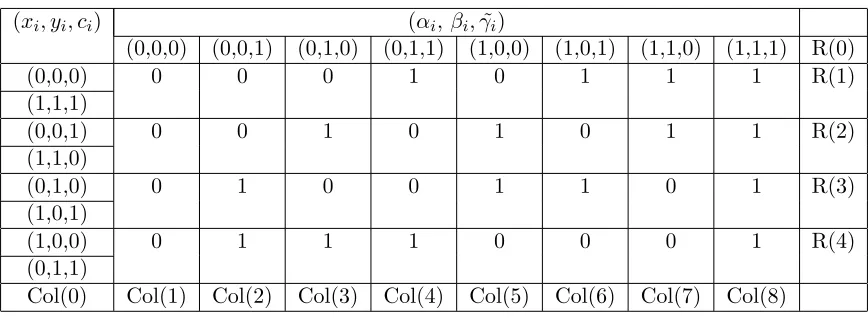
Table 1 lists the values of ˜γi+1 as computed from all values of xi, yi, ci, αi, βi,γ˜i.
Table 1: The values of ˜γi+1 corresponding to the values ofxi, yi, ci, αi, βi,γ˜i. A row and a column
are denoted by R(l) and Col(k)
(xi, yi, ci) (αi, βi,γ˜i)
(0,0,0) (0,0,1) (0,1,0) (0,1,1) (1,0,0) (1,0,1) (1,1,0) (1,1,1) R(0)
(0,0,0) 0 0 0 1 0 1 1 1 R(1)
(1,1,1)
(0,0,1) 0 0 1 0 1 0 1 1 R(2)
(1,1,0)
(0,1,0) 0 1 0 0 1 1 0 1 R(3)
(1,0,1)
(1,0,0) 0 1 1 1 0 0 0 1 R(4)
(0,1,1)
Col(0) Col(1) Col(2) Col(3) Col(4) Col(5) Col(6) Col(7) Col(8)
2.3 Computation of Parameters Gi, Si,0 and Si,1 from the Useful Set A˜
We now determine an important quantity, denoted by Gi, for a nonemptyuseful set A˜. In Gi, we
store theith and (i+ 1)th bits of ˜γ and theith bit ofα andβ for all (α, β,γ˜)∈A˜. We callGi the
ith core of theuseful set A˜. More formally (supposen >1),
Gi ={(αi, βi,γ˜i,γ˜i+1)|(α, β,γ˜)∈A˜}, i∈[0, n−2]. (10)
In the subsequent discussion we will often use the expression “Gi ⇒ (xi, yi, ci)”. Let |Gi| = g.
Take an element (αi, βi,˜γi,γ˜i+1) ∈Gi. In Table 1, find the row(s) of the fourth coordinate ˜γi+1
in the column specified by the first three coordinates (αi, βi,˜γi) in R(0) and put them in set
Fi1. Find Fi1,· · ·Fig for all g elements of Gi. Let Fi = TjFij and R(x)∈ Fi. If (xi, yi, ci) is in
Col(0)×R(x) then we say Gi ⇒(xi, yi, ci). IfFi =φthen no such (xi, yi, ci) exists. We compute
Si, j ={(xi, yi)|Gi⇒(xi, yi, ci =j)}.
Example. (Gi,Si,0,Si,1) Let n = 3 and the useful set A˜ = {((0,1,0),(1,0,1) ,(0, 0,0)),
((0,0,0),(1,1, 1),(1,0,0)), ((0, 0,1), (0,1, 1), (1,1,0))}. Therefore, G0 = {(0,1,0,0),
(1,1,0,1)}, G1 = {(1,0,0,0), (0, 1, 0,1), (0,1,1,1)} (see (10)). Now, from Table 1, F01 =
{R(1), R(3)}, F02 ={R(1), R(2)}, F11 ={R(1), R(4)}, F12 ={R(2), R(4)}, F13 ={R(1), R(4)}.
Therefore, F0 = F01∩F02 = {R(1)} and F1 = F11∩F12∩F13 = {R(4)}. Now G0 ⇒ (0,0,0),
G0 ⇒(1,1,1) as (0,0,0), (1,1,1) are in Col(0)×R(1). Similarly,G1 ⇒(1,0,0), G1 ⇒(0,1,1).
Thus,S0,0 ={(0,0)},S0,1 ={(1,1)},S1,0={(1,0)},S1,1 ={(0,1)}.
We assume m =|A˜| = O(nl) for some nonnegative integer l. Then the time and memory to compute all Gi’s and Si, j’s are O(nk) each because the size of Table 1 and |Gi| are O(1) each
(k = l+ 1). Now, we show a relation between Si,0 and Si,1 that will be used to obtain several
Proposition 1 For all nonempty useful set A˜ and all n >1, |Si,0|=|Si,1| ∀i∈[0, n−2].
We set,
|Si,0|=|Si,1|=Si ∀i∈[0, n−2]. (11)
2.4 Satisfiability of DEA is in P
In this section, we deal with a decision problem: does there exist a solution for an arbitrary set of differential equations of addition, i.e., is a system of DEA satisfiable?
We have already seen how to compute thecharacter set A, the useful set A˜, the core Gi’s and
Si’s from a system of DEA in O(nk) (see Sect. 2.3). Now, we prove an important theorem that
characterizes the membership in ˜A-consistent which is, in fact, the solution set.
Theorem 1 Let the useful setA˜6=φ and n >1. The following two statements are equivalent. 1. (x, y)∈Zn2 ×Zn2 is such that Gi ⇒(xi, yi, ci),∀i∈[0, n−2].
2. (x, y)∈A˜-consistent.
Proof. From the construction of Gi, it can be shown that 1⇔2.
Armed with the above theorem, we now formulate|A˜-consistent|(i.e., the number of solutions) in the following proposition which will later answer our satisfiability question.
Proposition 2 Let the useful set A˜6=φ and S denote |A˜-consistent|. Then,
S =
0 if ˜γ0 = 1 for some (α, β,γ˜)∈A,˜
4·Qn−2
i=0 Si if ˜γ0 = 0,∀(α, β,γ˜)∈A˜and n >1,
4 if ˜γ0 = 0,∀(α, β,γ˜)∈A˜and n= 1.
TheSi’s are defined in (11).
Proof. We prove this result by considering all cases individually.
Case 1 If ˜γ0 = 1 for some (α, β, γ˜)∈A˜ thenc0 = 1 which is impossible.
Case 2 If ˜γ0 = 0,∀(α, β, γ˜) ∈ A˜ and n > 1. From Theorem 1 of Sect. 2.5, S is the number of
solutions (x, y)∈Zn
2×Zn2 such thatGi⇒(xi, yi, ci),∀i∈[0, n−2]. LetMkdenote the number of
solutions for ((xk, · · ·, x0),(yk,· · · , y0)) such thatGi⇒(xi, yi, ci),∀i∈[0, k] wherek∈[0, n−2].
Note thatGk depends only on the least (k+ 1) bits of x,y,α,β. We consider two subcases. Case 2(a): n >2 . We determine |A˜-consistent|recursively. LetMl =Ml,0+Ml,1 such thatMl,0
solutions produce cl+1= 0 and Ml,1 solutions produce cl+1= 1. Therefore,∀l∈[0, n−3]
Ml+1 = Ml,0· |Sl+1,0|+Ml,1· |Sl+1,1|
= Sl+1·Ml. (12)
as|Si,0|=|Si,1|=Si,∀i∈[0, n−2] (see Proposition 1). It is easy to show (a proof is by
contra-diction) thatMl+1, so calculated, gives the number of solutions for ((xl+1, · · · , x0),(yl+1,· · · , y0))
such thatGi ⇒(xi, yi, ci),∀i∈[0, l+ 1]. From (12),
Mn−2 =
n−2 Y
i=0
Si (13)
asM0 =S0. Note that, for all (α, β,γ˜)∈A˜, ˜γ is independent of (xn−1, yn−1). Therefore,
S = 4·Mn−2= 4·
n−2 Y
i=0
Si ifn >2. (14)
Case 3 If ˜γ0= 0,∀(α, β,γ˜)∈A˜and n= 1 . It is trivial to show that S= 4 if n= 1 since for all
(α, β, γ˜)∈A˜, ˜γ is independent of (xn−1, yn−1) .
Using Proposition 2, we now answer the question of satisfiability of DEA in the following claim.
Claim. (i) If γ˜0 = 1 for some (α, β, ˜γ) ∈ A˜, then the set of DEA is NOT satisfiable. (ii) If ˜γ0 = 0,∀(α, β, ˜γ) ∈ A˜ and n > 1, then the set of DEA is satisfiable if and only if Si 6= 0
∀i∈[0, n−2]. (iii) If γ˜0 = 0,∀(α, β, ˜γ)∈A˜ andn= 1, then the set of DEA is satisfiable.
Verification of(i),(ii) and (iii) take timeO(1), Θ(n) andO(1) respectively. Therefore, the overall time to decide whether a system of DEA is satisfiable is O(nk) +O(1) + Θ(n) +O(1) = O(nk). Thus the satisfiability of DEA is in P.
2.5 Computing All the Solutions to a System of DEA
Now the only part left unanswered is how to actually compute ˜A-consistent, i.e., to extract all the solutions of a system of DEA which is satisfiable. Note, if n= 1 then ˜A-consistent comprises all 4 values of (x, y). TheGi’s can be computed from theuseful set A˜inO(nk) (see Sect. 2.3). Now we
compute an intermediate parameterLi={(xi, yi, ci)|Gi ⇒(xi, yi, ci)} for alli∈[0, n−2] (note
thatLi is different from Fi which has been computed in Sect. 2.3). Computation of theLi’s takes
time and memory each Θ(n). We callLi the ith bit solution. Algorithm 1 computes ˜A-consistent
from the Li’s (n >1).
Algorithm 1 Compute all the solutions to a system of satisfiable DEA
Require: Li,∀i∈[0, n−2]
Ensure: A˜-consistent
1: Compute M ={((xn−1, xn−2,· · · , x0),(yn−1, yn−2,· · · , y0))|(xn−1, yn−1)∈Z22,
(xi, yi, ci)∈Li, i∈[0, n−2], c0 = 0, ci+1=xiyi⊕xici⊕yici}. 2: Return (M).
The idea of the algorithm is to collect inM all (x, y)∈Zn
2×Zn2 such thatGi ⇒(xi, yi, ci),∀i∈
[0, n−2]. Theorem 1 is the heart of the argument to prove thatM is essentially ˜A-consistent.
Time and Memory. Algorithm 1 takes time Θ(S) and memory Θ(n·S) whereS is the number of solutions (an explicit construction ofM from theLi’s and its complexity analysis are shown in
Appendix A.3).
3
Solving DEA in the Adaptive Query Model
In this section, we solve the equations
(x+y)⊕((x⊕α) + (y⊕β)) =γ, (15) (x+y)⊕(x+ (y⊕β)) =γ (16)
separately in an adaptive query model. Solving (15) in adaptive query model means solving a set of 22n equations generated by ranging (α, β) with the corresponding γ. The number of solutions satisfying 22n equations is less than that of any subset of the equations. Therefore, solving these 22nequations reduces the search space of the secret (x, y) to the minimum. This fact is the major
problem can be asked of (16) where the number of equations is 2n. Such an optimization problem for (16) has already been tackled by Muller [Mul04] in cryptanalysis of the Helix cipher but an optimal solution has still been elusive. We reach optimal solutions for both equations.
3.1 The Power of the Adversary
The power of an adversary that solves (15) is defined as follows.
1. An adversary has unrestricted computational power and an infinite amount of memory.
2. An adversary canonly submit queries (α, β)∈Zn
2×Zn2 to an honest oracle2 which computes
γ using fixed unknown (x, y)∈Zn
2 ×Zn2 in (15) and returns the value to the adversary. We
will often refer to that fixed (x, y) as theseed of the oracle.
Such an oracle with seed (x, y) is viewed as a mapping Oxy :Zn2 ×Zn2 →Zn2 and defined by
Oxy ={(α, β, γ)|(α, β)∈Zn2 ×Zn2, γ = (x+y)⊕((x⊕α) + (y⊕β))}. (17)
An adversarial model, similar to the one described above for (15), can be constructed for (16) by setting (α, β)∈ {0}n×
Zn2 and the mappingOxy : {0}n×Zn2 →Zn2.
The model described above represents a practical adaptively chosen message attack scenario where the adversary makes adaptive queries to an oracle. Based on the replies from the oracle, the adversary computes one or more unknown parameters.
3.2 The Task
Oxy, defined in (17), generates a family of mappings F ={Oxy |(x, y) ∈Zn2 ×Zn2}. Note that, if
D∈ F then|D|= 22nfor (15). Therefore,D∈ F is thecharacter setwith the number of equations
m= 22n(see Sect. 2.1). Our aim is to find all (x, y) satisfying these 22nequations, i.e., to compute
D-satisfiable from a subset of thecharacter set D. If we deal with (16) then |D|= 2n.
An Equivalent Task. From the character set D one can compute the useful set D˜ using (8). Therefore, the task is equivalent to the determination of ˜D-consistent from a subset of theuseful set
˜
D. We callD and ˜Dthetotal character set and thetotal useful set as their sizes are maximal and they are generated from a satisfiable set 22n DEA (because we assumed the oracle to be honest). Note that there is a bijection between Dand ˜D.
Adjusting the Oracle Output. If the oracle outputs γ on query (α, β), we shall consider the oracle output to be ˜γ =α⊕β⊕γ for the sake of simplicity in the subsequent discussions.
Rules of the Game. Now we lay down the rules followed by the adversary to determine the set ˜D-consistent that, in turn, gives the essence of the whole problem.
1. The adversary starts with no information aboutx and y except their sizen.
2. The adversary settles on a strategy (i.e., a deterministic algorithm) which is publicly known. Using the strategy, the adversary computes queries adaptively, i.e., based on the previous queries and the corresponding oracle outputs the next query is determined.
3. The game stops the moment the adversary constructs ˜D-consistent. The adversary fails if she is unable to compute ˜D-consistent for some (x, y)∈Zn
2 ×Zn2. 2
We search for an algorithm that determines D˜-consistent for all (x, y)∈ Zn
2 ×Zn2. Furthermore, there is an additional requirement that, in the worst case of (x, y), the number of queries required by the algorithm is the minimum . We shall elaborate on the meaning of worst case in Sect. 3.4 which focuses on worst case lower bounds on the number of queries.
3.3 Number of Solutions
In this section we are interested to determine the number of solutions of (15) and (16) in the adaptive query model. We have already developed a framework where the set of all solutions in the adaptive query model is denoted by ˜D-consistent where ˜D is the total useful set. Therefore, formally, our effort will be directed to formulate|D˜-consistent|. We will see in Theorem 5 that, for (16), |D˜-consistent| depends on the least significant ‘1’ of x. However, for (15), |D˜-consistent|= 4,∀(x, y)∈Zn
2 ×Zn2. We shall use these results in Theorem 5 and 6 of Sect. 3.4, to obtain lower
bounds on the number of queries to compute ˜D-consistent and in Sect. 3.5, to prove the correctness of our optimal algorithms.
Theorem 2 Let the position of the least significant ‘1’ of x in the equation
(x+y)⊕(x+ (y⊕β)) =γ
be t and x, y, β, γ∈Zn
2. Let the total useful set ˜Dbe given. Then |D˜-consistent| is (i) 2t+3 if n−2≥t≥0,
(ii) 2n+1 otherwise. Proof.
(i) n−2≥t≥0. Using the procedure described in Sect. 2.3, we construct the ith core Gi, ∀i∈
[0, n−2], from thetotal useful set D˜. We derive that
Gi = {(0,0,0, ai),(0,1,0, bi)}, ∀i∈[0, t] (18)
Gi = {(0,0,0, ci),(0,0,1, di) (0,1,0, ei),(0,1,1, fi)}, ∀i∈[t+ 1, n−2]. (19)
In the above equations, ai, bi, ci, di, ei, fi ∈ [0,1]. Note that only (18) is relevant if t = n−2.
The fact that we are able to extract only the first three coordinates of the elements of Gi,∀i ∈
[0, n−2], can be proved using the following two auxiliary lemmas, the proofs of which are given in Appendix A.1.
Lemma 1 For all (0, β,γ˜)∈D˜, γ˜i = 0, ∀i∈[0, t].
Lemma 2 For all i∈[t+ 1, n−1] there exists (0, β,γ˜)∈D˜ withγ˜i= 1.
However, only the first three coordinates of the elements of the Gi’s are sufficient to determine
the Si’s (Si is defined in Sect. 2.3). It is easy to verify from Table 1 that Si = 2,∀i∈ [0, t] and
Si = 1,∀i∈[t+ 1, n−2]. From Proposition 2
|D˜-consistent|=S= 4·
n−2 Y
i=0
Si = 4· 1·1· · ·1
| {z } (n−t−2) times
·2·2· · ·2
| {z } (t+1) times
= 2t+3.
(ii) The proof is similar to the above one using Proposition 2.
Theorem 3 Let the total useful set ˜D be given for the equation
(x+y)⊕((x⊕α) + (y⊕β)) =γ
Proof. Our approach is same as that of Theorem 2.
Case 1: n≥2. Corresponding to the total useful set D˜ we determine Gi,∀i∈[0, n−2].
G0 = {(0,0,0, a0),(0,1,0, b0),(1,0,0, c0),(1,1,0, d0)}, (20)
Gi = {(0,0,0, ei),(0,0,1, fi),(0,1,0, gi),(0,1,1, hi),
(1,0,0, mi),(1,0,1, ni),(1,1,0, pi),(1,1,1, qi)},∀i∈[1, n−2]. (21)
In the equations a0, b0, c0, d0, ei, fi, gi, hi, mi, ni, pi, qi ∈[0,1]. From Table 1 we see that Si =
1,∀i∈[0, n−2] (see Sect. 2.3 to compute Si from Gi). Therefore, from Proposition 2
|D˜-consistent|=S= 4·
n−2 Y
i=0
Si = 4· 1·1· · ·1
| {z } (n−1) times
= 4.
Case 2: n= 1. Ifn= 1 then|D˜-consistent|= 4. The proof is trivial using Proposition 2.
3.4 Worst Case Lower Bounds on the Number of Queries
Our target is to design an algorithm (for (15) or (16)) which computes ˜D-consistent for all seeds
(x, y)∈Zn
2×Zn2 with adaptive queries. For such an algorithm, the number of required queries may
vary with the choice of (x, y). In this section we concentrate on a lower bound on the number of queries in the worst case of (x, y) under the “rules of the game” stated in Sect. 3.2. The significance of the lower bound is that there exists no algorithm that requires less queries in the worst case than the obtained lower bound.
We already noticed that more queries tend to reduce the search space of the secret (x, y). In our formal framework, if A ⊆ B ⊆ D˜ then ˜D-consistent ⊆ B-consistent ⊆ A-consistent. This implies that |D˜-consistent| ≤ |B-consistent| ≤ |A-consistent|. Note that our algorithm constructs
A ⊆D,˜ ∀(x, y) ∈Zn2 ×Zn2, using the submitted queries and the corresponding outputs such that
|D˜-consistent| = |A-consistent|. The algorithm fails if |D˜-consistent| < |A-consistent|, for some (x, y) ∈ Zn
2 ×Zn2. We will use the condition – |A-consistent| cannot be strictly greater than |D˜
-consistent|– to compute a lower bound on the number of queries in the worst case. In Theorem 4 we identify a property ofA, in terms of theith core Gi, where the above condition is violated. In
Theorem 5, we use this fact to obtain a lower bound.
Theorem 4 We consider the equation
(x+y)⊕(x+ (y⊕β)) =γ ,
where the position of the least significant ‘1’ of x is t with n−3 ≥ t ≥ 0. Let φ ⊂ A ⊆ D˜
and D˜ be the total useful set of the equation. Let the (n−3)th core Gn−3 contain no element
(0, βn−3,γ˜n−3,˜γn−2) with ˜γn−2= 1.3 Then |A-consistent|= 2t+3+k for some k >0.
Proof. If Gn−3 contains no element (0, βn−3,γ˜n−3,γ˜n−2) with ˜γn−2 = 1 then Gn−2 contains no
element (0, βn−2,γ˜n−2,γ˜n−1) with ˜γn−2 = 1 . Therefore, Gn−2 is of one of the following forms,
Gn−2={(0,0,0, a)} or{(0,0,0, a),(0,1,0, b)}.
Now, from Table 1, Sn−2 = 2l for either of the cases, where l > 0. Similarly, using Theorem 2,
Si ≥2,∀i∈[0, t]. AlsoSi ≥1,∀i∈[t+ 1, n−3] (whenn−4≥t). Therefore, from Proposition 2,
|A-consistent|= 2t+3+k for somek >0.
In the following theorem, we partition the entire seed space Zn2×Zn2 and compute a worst case
lower bound for each partition. Note that a lower bound (say, l) for any partition shows that, for any algorithm that computes ˜D-consistent ∀(x, y)∈Zn
2 ×Zn2, there exists at least one seed in that
particular partition which requires at leastl queries.
3
Theorem 5 A lower bound on the number of queries(0, β) to solve
(x+y)⊕(x+ (y⊕β)) =γ
in the worst case of (x, y) is (i) 0 ifn= 1,
(ii) 1 ifx= 0 andn >1, (iii) 1 ifn= 1 +t with t >0, (iv) (n−t−1)if n−2≥t≥0,
where n is the bit-length of x, y and t is the position of the least significant ‘1’ of x.
Proof. For (i),(ii) and (iii) the lower bounds are trivial.
(iv) n−2≥t≥0. Note that the submission of queries, generation of theuseful set Aand thecore
Gi are the parts of an evolving process (i.e., with every submitted query (0, β),A,Gi change). At
any time, from the already submitted queries and the outputs, we can always constructA⊆D˜ and theith core Gi,∀i∈[0, n−2] where ˜Dis the total useful set. Note that A-consistent contains all
the solutions of the equations derived from the already submitted queries. We first divide the case into four disjoint subcases.
Case 1: n−5≥t≥0. By Theorem 4, anecessary condition is that∃(0, βn−3,˜γn−3,˜γn−2 = 1)
∈Gn−3 otherwise |A-consistent|= 2t+3+c>|D˜-consistent|= 2t+3 (invoke Theorem 2).
We now define a quantity Vn, t which denotes the set of all (x, y) ∈ Zn2 ×Zn2 such that the
position of the least significant ‘1’ of x is t (Vn, t is a partition). We now define another quantity
l(n, t)(k) for all k∈[t+ 1, n−2]. Letl(n, t)(k) denote a lower bound on the number of adaptively chosen queries to have (0, βi,γ˜i,γ˜i+1 = 1) ∈ Gi for some i ∈ [k, n−2] in the worst case of
(x, y)∈Vn, t. In other words, a worst case lower bound l(n, t)(k) means that, for any algorithmA
there exists a seed (x, y) ∈Vn, t such that the adaptively chosen sequence of l(n, t)(k)−1 queries
(l(n, t)(k)>0) byA for the seed (x, y) produces oracle outputs ˜γ’s with ˜γi+1 = 0,∀i∈[k, n−2]).
We will determinel(n, t)(n−3) which is a lower bound in this case. For easy reading, in the rest of the proof, we shall denote l(n, t)(k) byl(k) .
Let p ∈ [t+ 1, n−3]. Now, for each algorithm, we always identify a seed (x, y) ∈ Vn, t such
that theadaptively chosen sequence of l(p)−1 queries produces ˜γ’s with ˜γi+1 = 0,∀i∈[p, n−2] .
From Table 1, we construct (a, b),(a0, b0)∈Vn, t foreach (x, y) in the following fashion. The carry
bit at the jth position of (a+b) is cj and similarlyc0j.
1. (Construction of a and b) ai = xi and bi = yi, ∀i ∈ [0, p]. If ci = 0 set ai = 0, bi = 0,
∀i∈[p+ 1, n−1]. If ci = 1 setai= 1, bi = 1,∀i∈[p+ 1, n−1].
2. (Construction of a0 and b0) ai0 = xi and b0i = yi, ∀i ∈ [0, p]. If ci0 = 0 set a0i = 0, b0i = 1,
∀i∈[p+ 1, n−1]. If c0i = 1 setai0 = 1, b0i = 0,∀i∈[p+ 1, n−1].
It can be shown from the portion of Table 1 – cut off by the rows R(1) and R(3) and the columns Col(1), Col(2), Col(3) and Col(4) – that seeds (a, b) and (a0, b0) produce the same sequence of oracle outputs as (x, y) does on the selected sequence ofl(p)−1 queries.
Now we consider each possible l(p)th query (0, β) and its output ˜γ for the seed (x, y). If (βp+1,γ˜p+1) = (0,1) then (a, b) produces ˜γi+1= 0,∀i∈[p+ 1, n−2]. Similarly, if (βp+1,˜γp+1) =
(1,1) then (a0, b0) produces ˜γi+1 = 0, ∀i ∈ [p+ 1, n−2]. If (βp+1,˜γp+1) = (0,0) or (1,0) then
both (a, b) and (a0, b0) produce ˜γi+1 = 0, ∀i ∈ [p+ 1, n−2]. Therefore, either (a, b) or (a0, b0)
produces oracle outputs with ˜γi+1 = 0,∀i∈[p+ 1, n−2], for all the chosen l(p) queries.
Thus, we establish that, for any algorithm there exists a seed (x, y) ∈ Vn, t such that the adaptively chosen sequence of l(p) queries produces oracle outputs ˜γ’s with ˜γi+1 = 0,∀i ∈ [p+
1, n−2]. Therefore, a lower bound on the number of queries such that∃(0, βi, γ˜i,γ˜i+1= 1)∈Gi
for somei∈[p+ 1, n−2] in the worst case of (x, y)∈Vn, t isl(p) + 1. Therefore,
Following the recursion,
l(n−3) =n−t−4 +l(t+ 1). (22)
The following lemma computes a value of l(t+ 1). See Appendix A.2 for an elaborate proof.
Lemma 3 Let n−4≥t≥0. For any algorithm A there exists a seed (x, y)∈Vn, t such that the adaptively selected sequence of two queries by Afor that particular seed produces oracle outputs γ˜’s with ˜γi+1 = 0, ∀i∈[t+ 1, n−2].
From Lemma 3, l(t+ 1) = 3. Therefore, from (22),l(n−3) =n−t−1 .
Case 2: n=t+ 4, a worst case lower bound is 3. The proof follows from Lemma 3.
Case 3: n = t+ 3, a worst case lower bound is 2. The reason is, from Table 1 it is clear that, with only one querySn−2>1 which makes the number of solutions for this case greater than 2t+3
which is impossible from Theorem 2.
Case 4: n=t+ 2, a worst case lower bound is 1 which is trivial.
Theorem 6 A lower bound on the number of queries(α, β) to solve
(x+y)⊕((x⊕α) + (y⊕β)) =γ
in the worst case of (x, y)∈Zn2 ×Zn2 is (i) 3 if n >2, (ii) 2 if n= 2, (iii) 0 if n= 1.
Proof. To prove (i), we consider all possible adaptively chosen two queries by all algorithms and find that, in each case, an oracle can always select a seed such that the number of solutions obtained from the outputs exceeds 4 which is impossible by Theorem 3. A detailed analysis is given in Appendix A.4. The proofs for (ii) and (iii) are trivial.
3.5 Optimal Algorithms
In this section, we concentrate on designing algorithms that solve (16) and (15) in the adaptive query model. In the formal framework, if the oracle is seeded with an unknown (x, y) then there is always atotal useful set D˜ that the unknown seed (x, y) generates. For a particulartotal useful set D˜, there exists a set ˜D-consistent containing all values of (x, y). Our algorithm makes adaptive queries (α, β) to the oracle – which is already seeded with a fixed (x, y) – and the oracle returns ˜
γ. The task of the algorithm is to compute ˜D-consistent using oracle outputs ˜γ, for all seeds (x, y) ∈ Zn
2 ×Zn2. The algorithm is optimal if the number of queries in the worst case (i.e., the
upper bound) matches the lower bound derived in the relevant theorem (Theorem 5 or 6). Optimal algorithms to solve (16) and (15) are presented in Algorithm 2 and 3. Below we discuss the intuition behind the algorithms; while we omit many trivial details, the pseudocode covers all cases.
Discussion: Algorithm 2(sketch). The inputs to Algorithm 2 are an oracle O (which is set with the unknown seed and computes ˜γ),ndenoting the size of the unknowns and the precomputed Table 1 denoted by the variable T. The output of Algorithm 2 is a set of lists. This set contains theLi’s – the ith bit solution for all i∈[0, n−2] – similar to the ones computed in Sect. 2.5. The
objective of Algorithm 2 is to correctly compute the Li’s for the useful set D˜. The computedLi’s
will be given to Algorithm 1 which computes all the individual solutions.
Algorithm 2 works in a way that at firstGi’s are computed from the submitted queries such that
the number of solutions for them is the same as that for all 2nqueries. Then theLi’s are computed
from theGi’s (Step 28). First, we findt, the position of the least significant ‘1’ ofx, by making the
first query (0, β) with β composed of all 1’s (Step 3, 10). Once the position of the least significant ‘1’ of x is known, we can immediately compute Gi,∀i∈ [0, t], by invoking Lemma 1 (Step 11 to
13). We see that Si = 2,∀i∈[0, t]. This result readily determines thatSi = 1,∀i∈[t+ 1, n−1]
Algorithm 2 Optimal Algorithm to solve the equation (x+y)⊕(x+ (y⊕β)) =γ Require: OracleO,n, Table T
Ensure: a set of lists
1: Ifn≤0 then exit with a comment “Invalid Input”;
2: Ifn= 1 then return an empty setφindicating that all solutions are possible and then exit; 3: β= (1,1, · · · , 1,1)n; /*The first query*/
4: ˜γ=O(β); /*Oracle output*/ 5: if ˜γ= 0
6: For alli∈[0, n−2]
7: Gi={(0,0,0, 0),(0,1,0,0)};
8: Go to Step 28;
9: t=Least-Significant-one(˜γ);/*Computing the least significant ‘1’ of the oracle output*/ 10: t=t−1; /*Computing the least significant ‘1’ ofx*/
11: For alli∈[0, t−1] /*ComputingGi for alli∈[0, t−1]*/
12: Gi={(0,0,0,0), (0,1, 0,0)};
13: Gt={(0,0,0,0),(0,1,0,1)}; /*ComputingGt*/
14: Ift=n−2 then Go to Step 28;
15: β0= (1, 1,· · ·,1, βt0+1= 1,0, 0,· · · ,0); /*Query to make ˜γ0t+1= 0*/ 16: ˜γ0 =O(β0); /*Oracle output*/
17: Gt+1={(0,1,1,γ˜t+2),(0,1,0,˜γt0+2)}; /*ComputingGt+1*/
18: Ift=n−3 then Go to 28;
19: For alli∈[2, n−t−2], in increasing order /*Computing Gi for alli∈[t+ 2, n−2]*/
20: If ˜γt+i== ˜γt0+i== 1 then
21: β0= (1, 1, · · ·,1, βt0+i−1= 0,0, · · · ,0);/*Query to make ˜γ0t+i= 0*/ 22: ˜γ0 =O(β0) and Go to Step 27; /*Oracle output*/
23: If ˜γt+i== ˜γt0+i== 0
24: if ˜γt+i−1== 1 then swap ((β,γ˜),(β0,˜γ0));
25: β0= (1, 1,· · · ,1, βt0+i−1= 0, βt0+i−2,· · · , β00);/*Query to make ˜γt0+i= 1*/ 26: ˜γ0 =O(β0); /*Oracle output*/
27: Gt+i={(0, 1,γ˜t+i,˜γt+i+1),(0, 1,γ˜t0+i,˜γt0+i+1)};
28: Li={(xi, yi, ci)|Gi ⇒(xi, yi, ci)},∀i∈[0, n−2] (Using the tableT);/*ComputingLi’s*/
Consider Col (3) and Col (4) of the Table 1. Observe no two rows, contained in these two columns, are identical. Therefore, if for some queries Gi contains two elements of the form (0,1,0, a) and
(0,1,1, b) then the correspondingSi = 1. Therefore, the aim of Algorithm 2 is to submit queries
such that Gi contains elements of the form (0,1,0, a) and (0,1,1, b), for all i ∈ [t+ 1, n−2].
Another interesting pattern of Table 1 is that each row, cut off by Col 2, Col 3 and Col 4, has at least one ‘1’. The algorithm uses this fact to get oracle output ˜γ with ˜γi= 1 if required (Step 25).
However, it is always easy to get an oracle output ˜γ with ˜γi = 0 by setting the least ibits of β to
zero (Step 15 and 21). Note that the algorithm submits the first two queries in Steps 3 and 15. In the loop (from steps 19 to 27) one of the two previous queries is modified to get ‘0’ or ‘1’ at the required locations of the output. Thus we get Gi,∀i∈[t+ 1, n−2], for which Si = 1. Therefore,
invoking Theorem 2, we get the number solutions for the submitted queries is 2t+3 (omitting many trivial cases). This proves the correctness of Algorithm 2. It can be easily verified from Theorem 5 that the number of queries used by Algorithm 2 is worst case optimal.
Discussion: Algorithm 3 (sketch). The basic idea of Algorithm 3 is the same as that of Algorithm 2, i.e., we compute the Li’s for the total useful set D˜. But here we use a different trick
to optimize the number of queries. Note that, for alli∈[0, n−2],Si = 1 for (15) (see Theorem 3).
We first submit two queries as shown in Step 3 and 5. For these two queriesGi ={(1,0,˜γi,γ˜i+1),
(0,1,˜γi0,γ˜i0+1)} if i even. Note that, in this case, if ˜γi = ˜γi0 then Si = 1 otherwise Si = 2 (from
Table 1). Gi = {(1,0,γ˜i,γ˜i+1), (1,0,˜γi0,γ˜i0+1)} ifi odd. Note that, in this case, if ˜γi 6= ˜γi0 then
Si = 1 otherwise Si = 2. Observe that Si = 2 ⇔ |Li| = 4 and Si = 1 ⇔ |Li| = 2. Now if
|Li|= 2,∀i∈[0, n−2] then we are done (Step 11). A combinatorial pattern in the precomputed
Table 1 shows that, if|Li|= 4 then|Li−1|= 2 (omitting the proof). In Step 13 and 16, we change
the second query (c, d) to obtain the third query so that the new query can remove extra elements from theLi’s with|Li|= 4. The rule is if|Li|= 4 then change the (i−1)th bits of (c, d) “suitably”
(details in the pseudocode). In Steps 13 and 16, the relation operator “⇒” is used in the same sense as in Sect. 2.3. Now L0is are computed from the first and the third queries (Step 21). If
|Li|= 4 then we assign Li =L0i (Step 23). Now we get |Li|= 2, ∀i∈ [0, n−2]. Algorithm 3 is optimal because it uses maximum 3 queries.
Time and Memory. For each of Algorithm 2 and Algorithm 3, the memory and the time are Θ(n) and O(n) respectively (the oracle takes O(1)-time to compute ˜γ).
4
Cryptographic Applications: Attacking the Helix Cipher
Weakness of modular addition under DC. The fact that an arbitrary system of DEA is in the complexity class P, shows a major differential weakness of modular addition which is one of the most used block cipher components. The weakness is more alarming because, with a maximum of only 3 adaptively chosen queries the search space of the secret can be reduced from 22n to only 4 for all n ≥1 (see Theorem 3 and Algorithm 3). It is, however, not known at this moment, how much influence this weakness has on many modern symmetric ciphers that mix other nonlinear operations with addition. Still, a recommendation for a deeper analysis of ciphers mixing XOR and modular addition in the light of our investigation is well justified.
Algorithm 3 Optimal algorithm to solve the equation (x+y)⊕((x⊕α) + (y⊕β)) =γ Require: OracleO,n, Table T
Ensure: a set of lists
1: Ifn≤0 then exit with a comment “Invalid Input”;
2: Ifn= 1 then return an empty setφindicating that all solutions are possible and then exit; 3: (a, b) = ((11· · · 11)n,(00· · ·00)n);/*First Query*/
4: ˜γ=O(a, b); /*Oracle Output*/
5: (c, d) = ((· · · 101010)n,(· · ·010101)n);/*Second Query*/
6: ˜γ0 =O(c, d); /*Oracle Output*/
7: For alli∈[0, n−2] /*ComputingGi’s*/
8: Gi={(ai, bi,˜γi,˜γi+1),(ci, di,˜γi0, ˜γi0+1)};
9: For alli∈[0, n−2] /*ComputingLi’s*/
10: Li={(xi, yi, ci)|Gi⇒(xi, yi, ci)},∀i∈[0, n−2] (Using the tableT);
11: If|Li|= 2,∀i∈[0, n−2] then Go to step 25;
12: For alli∈[0, n−2] andi even /*Checking evenLi’s*/
13: If|Li|= 4 then collect (xi−1, yi−1,0)∈Li−1 and (1, 0,γ˜i−1,γ˜i)∈Gi−1.
Select (αi−1, βi−1) fromT such that
{(αi−1, βi−1,0,γ˜i),(αi−1, βi−1,1,˜γi)} ⇒(xi−1, yi−1,0);
14: (ci−1, di−1) = (αi−1, βi−1);
15: For alli∈[0, n−2] andi odd /*Checking odd Li’s*/
16: If|Li|= 4 then collect (xi−1, yi−1,0)∈Li−1 and (1, 0,γ˜i−1,γ˜i)∈Gi−1.
Select (αi−1, βi−1) fromT such that
{(αi−1, βi−1,0,1⊕˜γi),(αi−1, βi−1,1,1⊕γ˜i)} ⇒(xi−1, yi−1,0);
17: (ci−1, di−1) = (αi−1, βi−1);
18: ˜γ0 =O(c, d);/*Oracle Output*/
19: For alli∈[0, n−2] /*ComputingGi’s*/
20: Gi={(ai, bi,˜γi,˜γi+1),(ci, di,˜γi0, ˜γi0+1)};
21: For alli∈[0, n−2] /*ComputingL0i’s*/
22: L0i={(xi, yi, ci)|Gi⇒(xi, yi, ci)},∀i∈[0, n−2] (Using the tableT);
23: For eachi∈[0, n−2]
24: If|Li|= 4, then assignLi=L0i;
of view, is to reduce the number of queries and if possible to attain an optimality. For the Helix output word n = 32 bits, 93 queries were needed whereas Algorithm 2 takes at most 31 queries if the position of the least significant ‘1’ of x (denoted by t) is zero. Note that, ift > 0 then the number of queries is less. However, the most important fact is that the number of queries cannot be further reduced in the worst case as our algorithm is worst case optimal. This fact can be straightaway used to reduce the data complexity of that particular attack on Helix cipher by, at least, a factor of 3. However, in the best case, there exists seed (x, y), ∀t∈ [0, n−3], for which (16) can be solved by Algorithm 2 with only 2 queries and the improvement in such a case is a factor of 46.5.
Computing Differential Properties of Addition. It is easy to show that our algorithm to solve a randomly generated set DEA is robust enough to compute all differential properties of ad-dition (e.g., maximal differential, impossible differential, etc.) In such a case we need to consider a single differential equation of addition instead of many and then compute the solutions to it. For example, if the single equation is NOT satisfiable then this is an impossible differential. However, the differential properties of addition has been independently studied in depth by Lipmaa and Moriai using a different approach [LM02].
5
Conclusion and Further Research
The results of the paper have impacts on both theory and practice. We have shown the importance of solving DEA from both a theoretical and a practical point of view. The paper seals any further search to improve lower bounds on the number of queries for solving DEA with adaptive queries. Although the total number of queries grows exponentially, an optimal lower bound is linear for one of them and constant for the other. Moreover, our algorithm reduces the number of queries of the previous best known algorithm and our results improve the data complexity of an attack on Helix cipher. Our work leaves room for further research, particularly, in the direction of solving DEA with nonadaptive queries. Last but not the least, our solution techniques motivate further research to solve more complex equations that mix modular addition, exclusive-or, modular multiplication
and T-functions.
6
Acknowledgments
We are grateful to Mridul Nandi of the Indian Statistical Institute for encouraging us to do this work and for his critical remarks on many technical results. We also thank Taizo Shirai of Sony Incorpo-ration, Japan, Sankardas Roy of George Mason University, USA and Jongsung Kim of Katholieke Universiteit Leuven, Belgium for numerous useful discussions. Thanks are also due to the anony-mous reviewers of ACISP 2005 for their constructive comments.
References
[AH+] A. Aho, J. Hopcroft, J. Ullman, “The Design and Analysis of Computer Algorithms,”
Addison-Wesley, 1974.
[AL95] I. A. Ajwa, Z. Liu, P. S. Wang, “Gr¨obner Bases Algorithm,”ICM Technical Report, Febru-ary 1995, Available Online athttp://icm.mcs.kent.edu/reports/1995/gb.pdf. (Cited on page 5.)
[BC+98] C. Burwick, D. Coppersmith, E. D’Avignon, Y. Gennaro, S. Halevi, C. Jutla, S. M. Matyas Jr., L. O’Connor, M. Peyravian, D. Safford and N. Zunic, “MARS – A Candidate Cipher for AES,” Available Online athttp://www.research.ibm.com/security/mars.html, June 1998. (Cited on page 3.)
[BS91] E. Biham, A. Shamir, “Differential Cryptanalysis of DES-like Cryptosystems,” Crypto ’90
(A. Menezes, S. A. Vanstone, eds.), vol. 537 ofLNCS, pp. 2-21, Springer-Verlag, 1991. (Cited on page 3.)
[CL+90] T. H. Cormen, C. E. Leiserson, R. L. Rivest, “Introduction to Algorithms,” MIT Press.
(Cited on page 3.)
[Fau99] J. Faug`ere, “A new effecient algorithm for computing Gr¨obner bases (F4),” Jour-nal of Pure and Applied Algebra, vol. 139, pp. 61-88, 1999, Available Online at
http://www.elsevier.com/locate/jpaa. (Cited on pages 4 and 5.)
[FB] R. Floyd, R. Beigel, “The Language of Machines,”W. H. Freeman, 1994. (Cited on page 5.)
[FW+03] N. Ferguson, D. Whiting, B. Schneier, J. Kelsey, S. Lucks, T. Kohno, “Helix: Fast Encryption and Authentication in a Single Cryptographic Primitive,”Fast Software Encryption 2003 (T. Johansson, ed.), vol. 2887 of LNCS, pp. 330-346, Springer-Verlag, 2003. (Cited on page 5.)
[HM+04] J. E. Hopcroft, R. Motwani, J. D. Ullman, ‘‘Introduction to Automata Theory, Languages and Computation,” Second Edition, Pearson Education, 2004. (Cited on pages 3, 4 and 15.)
[Knu81] D. E. Knuth, “The Art of Computer Programming,” vol. 2, Seminumerical Algorithms,
Addison-Wesley Publishing Company, 1981. (Cited on page 5.)
[KS03] A. Klimov, A. Shamir, “Cryptographic Applications of T-Functions,” Selected Areas in Cryptography 2003 (M. Matsui, R. J. Zuccherato, eds.), vol. 3006 of LNCS, pp. 248-261, Springer-Verlag, 2004. (Not cited.)
[KS04] A. Klimov, A. Shamir, “New Cryptographic Primitives Based on Multiword T-Functions,”
Fast Software Encryption 2004(B. Roy, W. Meier, eds.), vol. 3017 ofLNCS, pp. 1-15, Springer-Verlag, 2004. (Cited on page 3.)
[KS99] A. Kipnis, A. Shamir, “Cryptanalysis of the HFE Public Key Cryptosystems by Relin-earization,” Crypto 1999 (M. Wiener, ed.), vol. 1666 of LNCS, pp. 19-30, Springer-Verlag, 1999. (Cited on page 3.)
[LM+91] X. Lai, J. L. Massey, S. Murphy, “Markov Ciphers and Differential Cryptanalysis,” Eu-rocrypt ’91 (W. Davis, ed.), vol. 547 of LNCS, pp. 17-38, Springer-Verlag, 1991. (Cited on page 5.)
[LM02] H. Lipmaa, S. Moriai, “Efficient Algorithms for Computing Differential Properties of Ad-dition,” FSE 2001 (M. Matsui, ed.), vol. 2355 of LNCS, pp. 336-350, Springer-Verlag, 2002. (Cited on page 3.)
[LW+04] L. Lipmaa, J. Wall´en, P. Dumas, “On the Additive Differential Probability of Exclusive-Or,”Fast Software Encryption 2004 (B. Roy, W. Meier, eds.), vol. 3017 ofLNCS, pp. 317-331, Springer-Verlag, 2004. (Cited on pages 3, 4 and 17.)
[Mul04] F. Muller, “Differential Attacks against the Helix Stream Cipher,” Fast Software Encryp-tion 2004 (B. Roy, W. Meier, eds.), vol. 3017 of LNCS, pp. 94-108, Springer-Verlag, 2004. (Cited on page 3.)
[RR+99] R. L. Rivest, M. Robshaw, R. Sidney, Y. L. Yin, “The RC6 Block Cipher,” Available Online athttp://theory.lcs.mit.edu/ rivest/rc6.ps, June 1998. (Cited on page 3.)
[SK+99] B. Schneier, J. Kelsey, D. Whiting, D. Wagner, C.Hall, N. Ferguson, “The Twofish Encryp-tion Algorithm: A 128-Bit Block Cipher,” John Wiley & Sons, April 1999, ISBN: 0471353817. (Cited on page 3.)
[SM90] O. Staffelbach, W. Meier, “Cryptographic Significance of the Carry for Ciphers Based on Integer Addition,”Crypto ’90 (A. Menezes, S. A. Vanstone, eds.), vol. 537 ofLNCS, pp. 601-614, Springer-Verlag, 1991. (Cited on page 3.)
[YB+04] H. Yoshida, A. Biryukov, Christophe De Canni`ere, J. Lano, B. Preneel, “Non-randomness of the Full 4 and 5-Pass HAVAL,”SCN 2004 (Carlo Blundo and Stelvio Cimato, eds.), vol. 3352 ofLNCS, pp. 324-336, Springer-Verlag, 2004. (Cited on page 3.)
[Wal03] J. Wall´en, “Linear Approximations of Addition Modulo 2n,” Fast Software Encryption 2003 (T. Johansson, ed.), vol. 2887 ofLNCS, pp. 261-273, Springer-Verlag, 2003.
A
Appendix
A.1 Proofs of Lemma 1 and 2
Claim 1 For all (0, β,γ˜)∈D˜, γ˜i = 0 ∀i∈[0, t].
Proof. If the position of the least significant ‘1’ of x ist thenci = ˜ci = 0∀i∈[0, t] and ∀β ∈Zn2
(see (4)). Recall ˜γi=ci⊕c˜i. This proves the lemma.
Claim 2 For each i∈[t+ 1, n−1], there exists(0, β,γ˜)∈D˜ withγ˜i= 1.
Proof. We prove the lemma by induction on i. The statement is true ifi= t+ 1. Suppose, the statement is true ifi=kfor somek∈[t+ 1, n−2], that is, there exists (0, a, b)∈D˜ withbk = 1
(induction hypothesis). We construct threen-bit integers froma,
1. a0= (an−1, an−2,· · ·, ak+1,0, ak−1,· · · , a0)
2. a00= (an−1, an−2,· · · , ak+1,1, ak−1,· · ·, a0)
3. a000= (an−1, an−2,· · · , ak+1,1,0,0,· · · ,0).
Now we select three elements (0, a0, b0),(0, a00, b00),(0, a000, b000)∈D˜ (such elements exist since, for all p ∈ Zn
2, there exists (0, p, q) ∈D˜ for some q ∈ Zn2). Note that b0k =b 00
k =bk = 1 and b000k = 0.
From Table 1, at least one ofb0k+1, b00k+1 and b000k+1 is 1. This proves the lemma.
A.2 Proof of Lemma 3
Claim 3 Let n−4 ≥t ≥0. For any algorithm A there exists a seed (x, y) ∈ Vn, t such that the adaptively selected sequence of two queries by Afor that particular seed produces oracle outputs γ˜’s with ˜γi+1 = 0, ∀i∈[t+ 1, n−2].
Proof. Let the first two queries and the corresponding oracle outputs be (0, β), (0, β0), ˜γ and ˜γ0. Dependingonly on the tth bit of β and β0, the oracle returns outputs (i.e., ˜γ and ˜γ0) according to the following rules.
1. Ifβt= 0 then the oracle returns ˜γ = (0,0,· · ·,0)n. (Cited on page 3.)
3. Ifβ0t= 0 then the oracle returns ˜γ0 = (0,0,· · ·,0)n.
4. Ifβ0t= 1 then ˜γt0+1= 1 and all other bits of ˜γ0 are zero.
Under any of the above input-output combinations there exists a seed and ˜γi+1 = 0∀i∈[t+1, n−2]
for all outputs ˜γ. This proves the lemma.
A.3 Construction of M from the Li’s
LetGi be known∀i∈[0, n−2] (n >1) for a nonemptyuseful set A˜. Let Li={(xi, yi, ci)|Gi ⇒
(xi, yi, ci)} ∀i∈[0, n−2]. Let a setM be constructed from theLi’s in the following way,
M = {((xn−1, xn−2,· · · , x0),(yn−1, yn−2,· · · , y0))
|(xn−1, yn−1)∈Z22,(xi, yi, ci)∈Li, i∈[0, n−2], c0 = 0,
ci+1=xiyi⊕xici⊕yici}.
We present an algorithm to constructM from theLi’s with memory O(n·S) and time O(S) where
S =|A˜-consistent|. First we set
M1 ={((c1),(x0),(y0))|(x0, y0,0)∈L0, c1 =x0y0}.
Now we construct a set Mk ∀k∈[2, n−1] using the following recursion.
Mk = {((ck),(xk−1,· · ·, x0),(yk−1,· · · , y0))|(xk−1, yk−1, ck−1)∈Lk−1,
((ck−1),(xk−2,· · ·, x0),(yk−2,· · ·, y0))∈Mk−1, ck=xk−1yk−1⊕xk−1ck−1⊕yk−1ck−1}.
Now, we construct
Mn = {((xn−1,· · ·, x0),(yn−1,· · ·, y0))|(xn−1, yn−1)∈Z22,
((cn−1),(xn−2,· · ·, x0),(yn−2,· · · , y0))∈Mn−1}.
Using Proposition 2 and Theorem 1 it is easy to show thatM =Mn. Note that the size of eachLi
isO(1) since the size of the Table 1 isO(1). Also note that|Mn|=S and therefore the asymptotic
memory requirement to construct Mn recursively following the above algorithm is O(n·S) since
k = O(n) and Mk+1 can be constructed from Mk only. It is trivial to show that the time to
constructMn (i.e., M) from the Li’s is O(S). Thus, the set M can be constructed from the Li’s
with memory O(n·S) and time O(S).
A.4 Proof of Lower Bound for (3)
Claim 4 A lower bound on the number of queries (α, β) to solve
(x+y)⊕((x⊕α) + (y⊕β)) =γ
in the worst case of (x, y)∈Zn
2 ×Zn2 is (i) 3 if n >2,
(ii) 2 if n= 2, (iii) 0 ifn= 1.
Proof. (i)n >2. Let the first two queries and the corresponding oracle outputs be (α, β), (α0, β0), ˜
1. If (α0, β0) = (0,0) then ˜γ= (0,0,· · · ,0)n.
2. If (α0, β0)6= (0,0) and (α1, β1) = (1,1) then ˜γ = (1,1,· · · ,1,0)n.
3. If (α0, β0)6= (0,0) and (α1, β1)6= (1,1) then ˜γ = (0,0,· · · ,0)n.
4. If (α0, β0) = (α00, β00) then ˜γ = ˜γ0.
5. If (α0, β0)6= (α00, β00) = (0,0) then ˜γ0 = (0,0,· · · ,0)n.
6. If (α0, β0)6= (α00, β00)6= (0,0) and (α01, β10) = (0,0) then ˜γ0 = (0,0,· · · ,0)n.
7. If (α0, β0)6= (α00, β00)6= (0,0) and (α01, β10) = (1,1) then ˜γ0 = (1,1,· · · ,1,0)n.
8. If (α0, β0) 6= (α00, β00) 6= (0,0), (α10, β10) ∈ {(0,1),(1,0)} and (α1, β1) = (α01, β10) then
˜
γ0 = (0,0,· · · ,0)n.
9. If (α0, β0)6= (α00, β00)6= (0,0), (α01, β10)∈ {(0,1),(1,0)}and (α1, β1)6= (α01, β10) then ˜γ00 = 0
and ˜γi0 = 1⊕γ˜i for all i∈[1, n−1].
From the oracle outputs produced according to the above rules on the first two queries, one can show, using Table 1, that one of the following cases occurs.
1. S0 ≥2 andSi ≥1 ∀i∈[0, n−2].
2. S1 ≥2 andSi ≥1 ∀i∈[0, n−2].
3. S0 ≥2,S1 ≥2 andSi ≥1 ∀i∈[0, n−2].
Clearly, for any of the above cases, the number of valid solutionsS, derived from the results of the queries, is at least 8 which is not the case with this equation (see Theorem 3). Therefore, a lower bound on the number of queries in the worst case is 3.
(ii) n= 2. Using Table 1, a proof is similar to the proof for(i).