Network Embedding via a Bi-Mode and Deep Neural
2Network Model
3Yang Fang *, Xiang Zhao and Zhen Tan
4
College of System Engineering, National University of Defence Technology, Changsha, China; 5
* Correspondence: [email protected]; Tel.: +86-18858473547 7
Abstract:Network Embedding (NE) is an important method to learn the representations of network 8
via a low-dimensional space. Conventional NE models focus on capturing the structure information 9
and semantic information of vertices while neglecting such information for edges. In this work, we 10
propose a novel NE model named BimoNet to capture both the structure and semantic information 11
of edges. BimoNet is composed of two parts, i.e., the bi-mode embedding part and the deep neural 12
network part. For bi-mode embedding part, the first mode named add-mode is used to express the 13
entity-shared features of edges and the second mode named subtract-mode is employed to represent 14
the entity-specific features of edges. These features actually reflect the semantic information. For 15
deep neural network part, we firstly regard the edges in a network as nodes, and the vertices as links, 16
which will not change the overall structure of the whole network. Then we take the nodes’ adjacent 17
matrix as the input of the deep neural network as it can obtain similar representations for nodes 18
with similar structure. Afterwards, by jointly optimizing the objective function of these two parts, 19
BimoNet could preserve both the semantic and structure information of edges. In experiments, 20
we evaluate BimoNet on three real-world datasets and task of relation extraction, and BimoNet is 21
demonstrated to outperform state-of-the-art baseline models consistently and significantly. 22
Keywords:Network Embedding; Neural Network; Relation Extraction
23
0. Introduction
24
Nowadays, social and information networks are ubiquitous and contain rich and complex data 25
that record the types and dynamics of human interactions. So how to mine the information in 26
networks is of high research and application value. Recently, network embedding (NE), i.e., network 27
representation learning (NRL), has been proposed to represent the networks so as to realize network 28
analysis, such as link prediction [1], clustering [2] and information retrieval [3]. NE aims to encode 29
the information and features of each vertex into a low-dimensional space, i.e., learn real-valued 30
vector representations for each vertex, so as to reconstruct the network in the learned embedding 31
space. Compared with conventional symbol-based representations, NE could alleviate the issues of 32
computation and sparsity, thus manage and represent large-scale networks efficiently and effectively. 33
However, most existing NE models only focus on modeling on vertices, for example, classical NE 34
modelDeepWalk[4] utilizes random walk to capture the structure of the whole network andCANE[5] 35
aims to leverage the semantic information of vertices. As for the edge, an important component of 36
network, it is usually simplified as a binary or continuous value in those models. Obviously such 37
simplification will waste the rich information an edge contains. It is intuitive that in real-word 38
networks, edges also contain rich and variant meanings as they encode the interactions between 39
vertices, and their structure is also influential to the whole network. For example, many social media 40
users are connected because of a common interest, then such interest could be a major component of 41
the network both semantically and structurally. Therefore, in this work, we propose a new NE model 42
named BimoNet to make full use of both semantic and structure information of edges. 43
For semantic information, inspired by recent work TransNet [6] which borrows the concept 44
of relation extraction in Knowledge Graph (KG), we also utilize the triplets in KG to capture 45
the features of relations. A fact (knowledge) in a knowledge graph is represented by a triplet 46
(head_entity, relation, tail_entity), denoted as (h,r,t). We design a bi-mode embedding model to 47
represent relations. The first mode is named as add-mode, where the relations are expressed by 48
the shared features of entities, i.e., r ≈ h+t. It is intuitive that a relation is an abstraction of 49
the entity pairs having such a relation. Take the relation Presidentof as an example, it should be 50
the abstraction of all entity pairs like (Trump,America), (Putin, Russia) and (Xi Jinping,China). So 51
if we consolidate by summation and average all the features of the entity pairs, the features after 52
consolidation could be used to express the features of relationPresidentof (rather than relations like 53
CEOof). In general, for a triplet, the features of relationris similar to the shared features of entity 54
pair(h,t). The second mode is named as subtract-mode, where the relations are represented as a 55
channel to offset the divergence and preserve the prominent individual features of head and tail 56
entities, i.e.,r≈h−t. Such entity-specific features are not taken into consideration by add-mode but 57
inherently possessed by entities. The motivation to integrate both modes of embedding is to model 58
commonalities while allowing individual specificity. Although shared entity features by add-mode 59
describe the intrinsic relationship between two entities, only using this could cause false positive 60
entity pairs like (Trump, Russia), as they may have similar shared features. Therefore, we need 61
to further distinguish the entity-specific features through subtract-mode embedding. To conclude, 62
we use a bi-mode embedding to mine both the entity-shared features and entity-specific features of 63
relations, that is, the sematic information of relations. 64
To represent structural information, for easy understanding, we might as well regard relations 65
as nodes and vertices as links, which will not change the overall structure of the network. Given 66
a network, we can obtain a node’s adjacency matrix, where the entry of the matrix is bigger than 67
zero if and only if there exists a link between nodes. So the adjacency matrix can represent the 68
neighborhood structure information of each node, thus by consolidating all the nodes’ adjacency 69
matrix, we could capture the global structure of the network. Afterwards, we introduce a deep neural 70
network autoencoder [7] and take the adjacency matrix as the input. Deep autoencoder can preserve 71
the similarities between samples, thus making the nodes having similar neighborhood structure have 72
similar latent representations. 73
We conduct the experiments on three real-life network datasets which are constructed by 74
TransNet. Experiment results show that BimoNet outperforms classical state-of-the-art NE models 75
significantly and consistently. It demonstrates our proposed model BimoNet’s power and efficiency 76
on modeling relationships between vertices and edges, thus representing the whole network 77
effectively. 78
The major contribution of the paper can be summarized into three ingredients: 79
• We propose a novel network embedding model BimoNet, which describes relations’s semantic 80
information by bi-mode embeddings, and incorporates a deep neural network mocdel to 81
capture relations’ structural information; 82
• We are the first to fully mine both the semantic and structural information of edges in a network, 83
which provides a new angle to represent the network; and 84
• The new model is evaluated and compared with existing models on real-life benchmark datasets 85
and tasks, and experiment results on relation extraction verify that BimoNet outperforms 86
state-of-the-art alternatives consistently and significantly. 87
The rest of the paper is structured as follows. We introduce the related work in Section1, and 88
then justify the intuitions of our method with its theoretical analysis in Section2. Next, we conduct 89
the experimental studies on network relation extraction in Section3. Finally, we conclude our findings 90
h
Edge with Vertices
≈ + ≈
-h t
Bi-mode Embeddings
r r h t
Encoder Decoder
Hidden Layers
Deep Autoencoeder
..
.
t
Integrated Embeddings
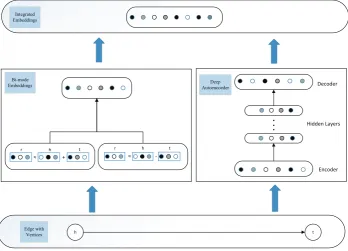
Figure 1.Model framework of BimoNet.
1. Related Work
92
1.1. Relation Extraction in Knowledge Graph 93
Knowledge graphs (KG) are typical large-scale multi-relational structures, which comprise a 94
large amount of fact triplets, denoted as (h,r,t). Existing large-scale KGs such as Freebase [8], 95
Wordnet[9] and YAGO[10] are all suffering from incompleteness. So relation extraction is a crucial 96
task in KG embedding work, with the goal of extracting relational facts between entities so as to 97
complement the existing KGs. It usually performs as relation prediction, which is to predict whether 98
a relation is suitable for a corrupted triplet(h,∗,t). The classical KG embedding modelTransE[11] 99
interprets relations as translating operations between head and tail entities in the representation 100
space, i.e.,h+r≈t. We could find thatTransEis actually a variant of the subtract-mode embedding, 101
which suggests that our bi-mode embedding is compatible toTransEand further verifies our model’s 102
ability on handling relationships between vertices and edges. 103
1.2. Deep Neural Network 104
Representation learning has long been an essential problem of machine learning and many 105
works aim at learning representations for samples. Recently, deep neural network models have been 106
proved that they have powerful representation abilities, which can generate effective representations 107
for various types of data. For example, in image analysis field, [12] proposes a seven-layer 108
convolutional neural network (CNN) to generate image representations for classification. [13] 109
proposes a multimodal deep model to learn image-text unified representations to achieve 110
cross-modality retrieval task. 111
However, less works have been done to learn network representation. [14] adopts Restricted 112
Boltzmann Machines to do collaborating filtering. In [15], a heterogenous deep model is proposed 113
to do heterogenous data embedding. NE embedding model TransNet [6] and SDNE [16] both 114
use autoencoder to capture the label information of edges and structural information of vertices, 115
respectively. Our model BimoNet is different from those models. BimoNet aims to leverage the 116
1.3. Network Embedding 118
Our work solves the problem of network embedding which aims to represent the networks 119
through a low-dimensional space. Some earlier works like Local linear Embedding(LLE) [17] and 120
IsoMAP[18] first construct the affinity graph based on the features vectors and obtain the network 121
embedding by solving the leading eigenvectors as the network representations. More recently, 122
DeepWalk [4] performs random walks over networks and introduces SkipGram [19], an efficient 123
word2vec methods to learn the network embedding. LINE[20] optimizes the joint and conditional 124
probabilities of edges in large-scale networks to learn vertex representations.Node2vec[21] proposes 125
a biased random walks strategy to more efficiently explore the network structure. However, these 126
models only encode the structure information into vertex embeddings. Futhermore, some works 127
consider to incorporate heterogenous information into network representation. Text-associated 128
DeepWalk (TADW) [22] uses text information to improve matrix factorization based DeepWalk. 129
Max-margin DeepWalk (MMDW) [23] utilizes labeling information of vertices to learn discriminative 130
network representations. Group-enhanced network embedding (GENE) [24] integrates existing group 131
information into NE. Context-enhanced network embedding (CENE) [25] regards text content as a 132
special kind of vertices, thus leveraging both structural and textual information on learning network 133
embedding. Besides,SiNE[26] learns vertex representations in signed networks, in which each edge 134
is either positive or negative. Nevertheless, it is worth noting that all the models above over-simplify 135
the edges and are not able to perfectly represent a network. 136
To the best of our knowledge, few works consider both the rich semantic information and 137
structure information of edges, and extract and predict relations on edges in a detailed way. Therefore, 138
we propose a novel model BimoNet to fill up such research empty. 139
2. Proposed Model
140
In this section, we propose a novel network embedding model BimoNet to integrate both the 141
semantic information and structure information of edges to learn the representation of networks. 142
A sketch of the model framework is presented in Fig.1. From Fig.1, we could see that BimoNet 143
is composed of two major components, i.e., the bi-mode embedding and deep autoencoder. In the 144
following sections, we will first introduce the mechanism of bi-mode embedding in detail. After that, 145
we will introduce how a deep antoencoder works to capture the structure information of edges. At 146
last, we will present the integration of these two components to obtain the overall objective function 147
of BimoNet. 148
2.1. Bi-Mode Embedding 149
Inspired by knowledge representation which could extract relation features efficiently, we 150
borrow some concepts like triplets in KG to help realize the bi-mode embedding. We first introduce 151
the common notations here. A triplet is denoted as(h,r,t), wherehdenotes a head entity,rdenotes a 152
relation,tdenotes a tail entity, where head entities and tail entities are actually vertices in a network, 153
and relations are actually edges. The bold letter h, r, t represent the embeddings of (h,r,t). To 154
discriminate the add-model and subtract-mode, we denote their embeddings asha, ra, ta and hs,
155
rs, ts, respectively. The entity and relations take values inRn, wheren is the dimension of entity 156
and relation embeddings spaces. Next, we will introduce the detailed mechanism of add-mode and 157
subtract-mode. 158
Add-Mode Embedding: The basic idea of add-mode embedding is that a relation is the
159
abstraction of all the features of entity pairs. That is, some most common features will burst and 160
individual features will correspondingly fade by consolidating all the features of entity pairs. 161
For each triplet (h,r,t), a head entity h and a tail entity t constitute an entity pair together, 162
denoted as(h,t). Given an entity pair (h,t), there could be plenty of relations fits the pair; on the 163
all the shared features of these entity pairs, this could be used to represent the unique features owned 165
by relationr, which is unlikely represented by other entity pairs without having relationr. That is, 166
r≈h+t, mathematically. 167
Motivated by the above theory, we propose an add-mode embedding model, which demonstrates that all the shared features of head entities and tail entities should be close to the features of relationr. In other words, when a triplet(h,r,t)exists, it is expected that
ra=ha+ta. (1)
From this,rashould be the closest relation ofha+ta, otherwiseha+tashould be far away fromra.
Moreover, under an energy based framework, the energy of a triplet is equal to the distance between
ha+taandra, which could be measured by eitherL1or L2norms. So the objective function can be represented as follows:
fr(h,t) =kha+ta−rak2L1/L2. (2)
Subtract-Mode Embedding: Add-mode embedding can express the entity-shared features of
168
relations, but neglects the entity-specific features. Recall the example thatTrump is the president 169
of America, and Putinis the president of Russia. Add-mode embedding could easily capture the 170
representation features between Trump (resp. Putin) and America (resp. Russia). Nevertheless, if 171
we intentionally pairTrumpwithRussia, add-mode embedding may falsely figure that the corrupted 172
entity pair as correct, as the shared features betweenTrump and Russiamay be fairly close to the 173
features of relationPresidentof. We attribute this to that add-mode embedding only focus on shared 174
features while underestimates the significance of individual features of entities. 175
To cover the shortage of add-mode embedding, we further adopt the subtract-mode embedding so as to capture the entity-specific features. For a triplet (h,r,t), the embedding hs of relation r
describes the discrepancies betweenhandtby calculating the differences between their embeddings. That is,rs ≈hs−ts, mathematically. In this case, it is expected thatrs+tsis close tohs, meanwhile
far away from other entities. Similarly, the objective function can be represented as follows:
fr(h,t) =khs−ts−rsk2L1/L2. (3)
Consequently, we can obtain the overall objective function of bi-mode embedding via integrating the two complementary methods together:
fr(h,t) =kha+ta−rak2L1/L2+khs−ts−rsk
2
L1/L2. (4)
To learn such embeddings, for each triplet (h,r,t) and its corrupted sample (h0,r0,t0), we minimize the following margin-based ranking loss function over the training set,
Lbimode=max(f(h,r,t) +γ−f(h0,r0,t0), 0), (5) whereγ>0 is a margin hyperparameter and the loss function above encourages the discrimination 176
between positive triplets and corrupted triplets. (h0,r0,t0)is a negative sample which is obtained by 177
randomly replacing the original head or tail entity (resp. relation) with another disconnected entity 178
(resp. relation). 179
2.2. Deep Autoencoder 180
Here we introduce the detailed mechanism of a deep autoencoder to illustrate its ability on 181
capturing the structure information of edges. Firstly, for easy understanding, we propose a bold 182
conception that we regard edges as nodes and vertices as links to build a new network. However, 183
such changes will not influence the overall structure of the original network so we see this conception 184
Given a modified networkG = (N,L), where Ndenotes the nodes which are actually edges 186
and Ldenotes the links which are actually vertices, we can obtain its adjacency matrix Sof nodes. 187
Scontains minstances denoted as s1,s2, ...,sm. For each instancesi = {si,j}mj=1,si,j > 0 if and only
188
if nodeni and nodenjhave a connected link. Hence,si expresses the neighborhood structure of the
189
nodeniandSencodes the neighborhood structure of each node, thus obtaining the global structure
190
of the network. Next,we introduce how we incorporate the adjacency matrixSinto the traditional 191
deep autoencoder [7]. 192
Deep antoencoder comprises two parts, i.e., the encoder part and the decoder part. The encoder consists of multiple non-linear functions mapping the input data to the representation space. The decoder also consists of multiple non-linear functions that map the representations from representation space to reconstruction space. Given the inputxi, the hidden representations for each
layer are presented as follows:
y(i1)=σ(W(1)xi+b(1)),
yi(k)=σ(W(k)yi(k−1)+b(k)),k=2,· · ·,K.
(6)
After obtainingy(iK−1), we can correspondingly obtain the output ˆxiby reversing the calculation
process of encoder. The autoencoder aims to minimize the reconstruction error of the output and the input. The loss function is shown as follows:
L=
m
∑
i=1kxˆi−xik22. (7)
[7] proved that although minimizing the reconstruction loss does not explicitly preserve the 193
similarity between samples, its reconstruction criterion can smoothly capture the data manifolds, thus 194
preserving the similarity between samples. Therefore, consider our case that we use the adjacency 195
matrixSas the input to the autoencoder, i.e.,xi = si, sincesi encode the neighborhood structure of
196
nodeni, the reconstruction calculation will make the nodes that have similar neighborhood structure
197
have similar representations as well. 198
However, we cannot directly apply this reconstruction function to our problem due to the sparsity of the input matrix. That is, the number of zero elements inSis much larger than that of non-zero elements, which means that the autoencoder tends to reconstruct the zero elements instead of non-zero ones. This is not what we expect. Hence we impose more penalty to the reconstruction error of the non-zero element than that of zero elements. The modified objective function is shown as follows:
Lae= m
∑
i=1k(xˆi−xi)bik22
=k(Xˆ−X)Bk2 2,
(8)
wheredenotes the Hadamard dot,bi ={bi,j}mj=1. Ifsi,j =0,bi,j =0, otherwisebi,j = β>1. Now 199
through utilizing the modified deep autoencoder with the input adjacency matrixS, the nodes that 200
have similar structures will be mapped closely in the representation space, which are guaranteed by 201
the reconstruction criterion. Namely, a deep autoencoder could capture the structure information of 202
the network by the reconstructing process on nodes, in our case, edges. 203
2.3. The Integrated Model 204
the norm in bi-mode embedding asL2norm. Consequently, we obtain the overall objective function as follows:
Lall =Lbimode+αLae+ηLreg, (9)
where α and η are hyperparameters which control the weights of autoencoder objective function and regulation function respectively. Additionally, we take the regularizerLregwhich could prevent
overfitting asL2norm, shown as follows:
Lreg = K
∑
i=1(kW(i)k22+kb(i)k22), (10)
We further adopt dropout [27] to generate the edge representations, so as to prevent overfitting. In 205
the end, we also employ Adam algorithm [28] to minimize the overall the objective function. 206
3. Experiments and Analysis
207
We empirically evaluate our model and related baseline models through conducting the 208
experiment relation extraction on three real-world datasets. Relation extraction usually performs 209
as relation prediction, which is to predict whether a relation fits a specific entity pair. We introduce 210
the data sets in the first place, then introduce other baseline algorithms, along with the evaluation 211
metrics and parameter settings of all models, and finally analyze the experiment results. 212
3.1. Datasets 213
We choose the datasets from ArnetMiner1 [29] which are constructed by TransNet [6], so as 214
to compare our model with this recent state-of-the-art model along with the conventional models. 215
ArnetMiner is an online academic website which provides search and mining service for researcher 216
social networks. It releases a large scale co-author network2, which consists of 1, 712, 433 authors, 217
2, 092, 356 papers and 4, 258, 615 collaboration relations. In this network, authors collaborate with 218
different people on different research fields, and the co-authored papers can reflect the relations with 219
them in detail. Therefore,TransNet constructed the co-authored network with edges representing 220
their shared research topics. Notice that, as the edges in this co-author network are undirected, the 221
constructed datasets replace each edge with two directed edges having opposite dirctions. 222
To better study the characteristics of different model, the datasets are constructed with three 223
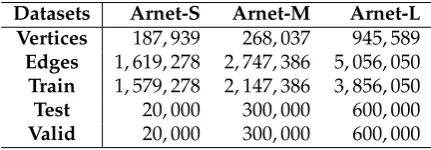
different scales, i.e.,Arnet-S(small),Arnet-M(medium), andArnet-L(large). Table1illustrates the 224
detailed statistics of these three datasets. 225
Table 1.Dataset Statistics
Datasets Arnet-S Arnet-M Arnet-L
Vertices 187, 939 268, 037 945, 589
Edges 1, 619, 278 2, 747, 386 5, 056, 050
Train 1, 579, 278 2, 147, 386 3, 856, 050
Test 20, 000 300, 000 600, 000
Valid 20, 000 300, 000 600, 000
3.2. Baseline Algorithms 226
We introduce the following network embedding models as baselines. 227
1 https://cn.aminer.org/
DeepWalk[4] employs random walks to generate random walk sequences over networks. With 228
these sequences, it adopts SkipGram [19], an efficient word representation model, to learn vertices 229
embeddings. 230
LINE [20] defines objective functions to preserve the first-order or second-order proximity 231
separately. After optimizing the objective functions, it concatenates these representations in large 232
scale networks. 233
node2vec [21] proposes a biased random walk algorithm based on DeepWalk to explore the 234
neighborhood structure more efficiently. 235
TransNet[6] borrows the concept of translation mechanism from the conventional knowledge 236
embedding methodTransE[11] to capture the semantic information of edges. Afterwards, it employs 237
a deep neural network to further mine the label information of edges, which is still an aspect of the 238
semantic information. 239
In addition, we also compare our model withTransEas our training triplets are actually identical 240
to that in a knowledge graph. Hence our datasets could be directly employed to trainTransEand 241
adopt the similarity based predicting method as presented in [11]. 242
3.3. Experiment Setup 243
Relation exteaction is to predict the missing relations in a positive triplet(h,r,t). In this task, we 244
randomly replace the missing relations by the existing relations in knowledge graph, and rank these 245
relations in descending order via the objective function. Instead of finding one best relation, this task 246
stores the rank of the correct relation. After doing this, we have two evaluation metrics based on the 247
rank we get for the correct relation. One is theMeanRankwhich is themeanof predicted ranks of all 248
relations. The other one is the proportion of all correct relations ranked in topk, denoted ashits@k. 249
We choosehits@1,hits@5 andhits@10 in this metric. Obviously, a lowerMeanRankand a higherhits@k 250
represent a better performance for a specific model. When dealing with the corrupted triplets, we 251
should notice that though replacing the relations, a triplet may also exist in a knowledge graph as 252
positive, so it is reasonable to remove those corrupted triplets from the negative triplets set. We call 253
the original evaluation setting as ’Raw’, and the setting filtering the corrupted triplets that appear in 254
either training, validation or test set before ranking, as ’Filter’ [11]. 255
Table 2.Relation Extraction Results onArmet-S
Metric hits@1 hits@5 hits@10 MeanRank hits@1 hits@5 hits@10 MeanRank
DeepWalk 12.35 34.56 48.59 20.55 16.98 38.57 50.97 20.02
LINE 10.23 30.26 42.98 26.78 13.67 32.34 43.77 25.24
node2vec 11.67 36.45 49.39 21.47 17.83 38.27 50.13 20.48
TransNet 43.56 82.87 90.18 5.53 73.43 86.34 90.62 4.45
TransE 39.69 77.27 87.82 5.74 56.74 81.83 90.24 4.62
BimoNet 47.94 87.73 93.25 4.60 78.67 90.05 95.56 3.94
Table 3.Relation Extraction Results onArmet-M
Metric hits@1 hits@5 hits@10 MeanRank hits@1 hits@5 hits@10 MeanRank
DeepWalk 6.53 18.79 26.37 86.45 9.83 21.57 29.92 81.14
LINE 5.16 16.25 22.57 97.04 7.24 17.36 23.57 95.39
node2vec 6.64 19.93 27.18 84.73 9.47 21.46 29.52 80.68
TransNet 24.52 63.47 73.21 28.84 54.58 71.24 74.92 25.76
TransE 17.25 47.64 60.49 29.15 29.72 53.48 62.97 27.28
BimoNet 28.11 67.36 77.49 24.35 60.07 77.54 82.63 21.26
We select the dimensionnof the entities and relations embeddings among {50, 100, 150, 200, 300}, 256
Table 4.Relation Extraction Results onArmet-L
Metric hits@1 hits@5 hits@10 MeanRank hits@1 hits@5 hits@10 MeanRank
DeepWalk 5.27 14.56 21.49 105.36 7.05 15.79 22.37 104.62
LINE 3.68 11.25 17.63 117.04 5.42 12.78 18.92 116.37
node2vec 5.35 14.74 21.68 105.27 6.94 15.93 22.81 103.86
TransNet 25.57 63.24 72.38 32.33 51.48 70.05 76.78 29.81
TransE 13.27 39.89 53.28 33.50 21.26 44.91 57.24 33.43
BimoNet 30.13 69.37 78.51 27.96 58.64 76.71 80.39 25.47
Table 5.Relation Comparisons onArmet-S
Tags Top 5 relations Bottom 5 relations
Metric hits@1 hits@5 hits@10 MeanRank hits@1 hits@5 hits@10 MeanRank
TransNet 73.62 86.22 90.81 4.26 74.54 86.51 90.57 4.12
BimoNet 78.93 90.03 95.42 3.64 79.27 90.35 95.58 3.57
of Adamµamong {0.05, 0.02, 0.01, 0.001, 0.0003}, the hyperparameterαwhich controls the weight of 258
autoencoder loss among {5, 1, 0.5, 0.05, 0.005} and the hyperparameterβwhich balances the weight 259
of non-zero elements in autoencoder among {10, 20, 30, 60, 80 ,100}. Besides, we set the marginγas 260
1. In order to balance the expressiveness and complexity of the deep autoencoder model, we set the 261
hidden layers as 2 for all datasets. ForArmet-S, the best configuration obtained by the valid set is: 262
n= 100,λ=0.003,µ=0.01,α=0.5, andβ=30. ForArmet-M, the best configuration is:n =150, 263
λ=0.001,µ=0.001,α=0.5, andβ=60. ForArmet-L, the best configuration is:n=200,λ=0.001, 264
µ=0.001,α=0.5, andβ=80. 265
3.4. Experiment Results and Analysis 266
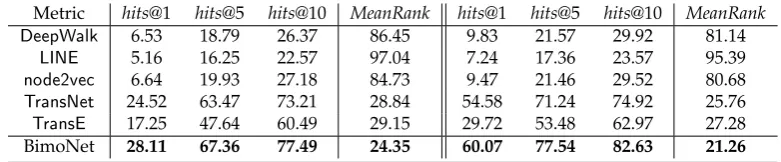
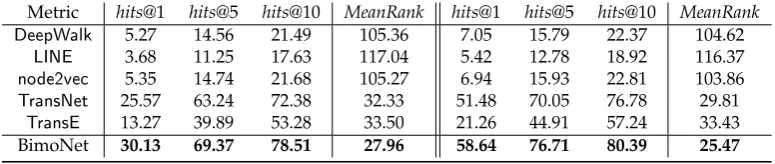
Experiment results on the three datasets are presented in Table2, Table3and Table4. In these 267
tables, the left four metrices are raw results, and the right four are filtered ones. From these tables, 268
we can observe that BimoNet outperforms other baseline models significantly and consistently on 269
all datasets in both Filter and Raw settings. To be more specific, BimoNet even outperforms the best 270
baseline, i.e.,TransNet, by about 10% to 20% absolutely. It illustrates the robustness and effectiveness 271
of BimoNet on modeling and predicting relations between vertices. 272
All traditional network embedding model perform poorly on relation extraction task under 273
various situations, which is attributed to the neglect on semantic and structure information of 274
edges when learning the network representations. As for TransE, TransNet and BimoNet, they 275
all incorporate the semantic information of edges into the learned representations, thus obtaining 276
the relatively decent results. This demonstrates that the semantic information of edges plays 277
an essential part in network embedding, and further proves our bi-mode embedding model’s 278
ability on capturing such information. Nonetheless, comparing BimoNet,TransEandTransNetstill 279
have poor performances, due to its limitation of only focusing on the semantic information while 280
underestimating the structure information of edges. Similarly, this indicates the importance of 281
structure information as well as the rationality of the deep autocoder on exploring such information. 282
To conclude, BimoNet leverages both the semantic information and structure information of edges so 283
as to learn the network representations as completely as possible. 284
In addition, BimoNet performs stably on different scales of networks. Specifically, on filtered 285
hit@10, its performance only has a small decrease from 90% to 80%, despite that datasets become 286
much larger. However, other NE models suffer from a significant drop as the network grow larger. 287
This demonstrates the stability and flexibility of BimoNet, which could be applied to model the large 288
KLWVDW
,WHUDWLRQ
α α
α α α
7UDQV(
(a)α
KLWVDW
,WHUDWLRQ β β β β β
(b)β
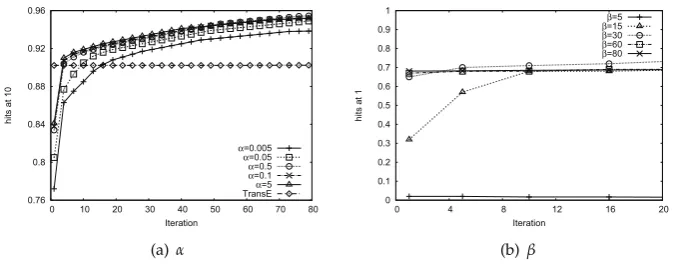
Figure 2.Parameter Sensitivity
3.5. Relation Comparison 290
To further investigate the power of BimoNet on representing relations between vertices, we 291
compare BimoNet withTransNetunder high frequency relations and low frequency relations. We 292
experiment the top-5 relations and bottom-5 relations on Armet-S, and the filtered hits@k and 293
MeanRankresults are presented in Table5. 294
From this, we observe that BimoNet outperforms TransNet consistently on both types of 295
relations. We attribute this to that relations having the similar frequency tend to have similar 296
structures. In other words, relation frequency reflects its structure, to some extent. Therefore, through 297
the usage of the deep autoencoder which could explore the structure information of edges, BimoNet 298
improves its prediction on relations regardless of their frequency. 299
3.6. Parameter Sensitivity 300
We investigate the parameter sensitivity in this section. To be specific, we evaluate two crucial 301
hyperparameters, i.e.,αandβwhich is crucial to experiment results, and experiment onArmet-S. 302
In order to find a good balanced point between bi-mode embedding and deep autocoder, we 303
show how the valueαaffects the performance in Figure2(a). The parameterαbalances the weight of 304
auto-encoder loss and bi-mode embedding loss. We choose the filteredhits@10metric for comparison. 305
From Figure2(a), we observe that the performance of BimoNet improves rapidly at the beginning, 306
and then become stable. Although α varies a lot, all of BimoNet’s performances exceed that of 307
TransEaround 20 iterations. This demonstrates that BimoNet is insensitive to α, so it can be easily 308
implemented and well trained in practice. 309
As forβ, it balances the reconstruction weight of the none-zero elements in autoencoder. The 310
larger theβ, the model will be prone to reconstruct the non-zero elements. The filteredhits@1 results 311
on validation set under different values ofβare presented in Figure2(b). From this, we observe that 312
the performance becomes stable as iteration grows. When β = 5, the autoencoder puts too much 313
weight on zero elements, thus performing rather poorly. Similarly, BimoNet is also not so sensitive to 314
β, which further illustrates its feasibility to real-work networks. 315
4. Conclusions
316
In this paper, we introduce a model BimoNet that embeds a network into low-dimensional vector 317
space. BimoNet mainly have two parts, i.e., the bi-mode embedding part and the deep neural network 318
part. For bi-mode embedding part, we use the add-mode to explore the entity-shared features of 319
edges and the subtract-mode to represent the entity-specific features of edges. For deep neural 320
network, we regard the edges in a network as nodes and the vertices as links in the first place. Then 321
we take the nodes’ adjacent matrix as the input of the deep neural network and it can obtain similar 322
function of these two parts, BimoNet could capture both the semantic and structure information 324
of edges. Experiment results on relation extraction verify BimoNet’s ability on modeling the edges 325
between vertices as it outperforms baseline models significantly and consistently. 326
As future work, we plan to further explore at least the following two directions: 327
• We intend to integrate the semantic and structure information of edges with that of vertices, 328
so as to further mine the network information and obtain an even more powerful network 329
embedding model; and 330
• Existing network embedding model do not consider the new vertices and edges while networks 331
in real world are becoming larger and larger, so it is crucial to find a way to represent these new 332
vertices and edges. 333
Author Contributions: Yang Fang and Xiang Zhao conceived and designed the experiments; Yang Fang 334
performed the experiments; Zhen Tan analyzed the data; Yang Fang and Zhen Tan wrote the paper. 335
Conflicts of Interest:The authors declare no conflict of interest. 336
References
337
1. Liben-Nowell, D.; Kleinberg, J.M. The link prediction problem for social networks. Proceedings of the 338
2003 ACM CIKM International Conference on Information and Knowledge Management, New Orleans, 339
Louisiana, USA, November 2-8, 2003, 2003, pp. 556–559. 340
2. Shepitsen, A.; Gemmell, J.; Mobasher, B.; Burke, R.D. Personalized recommendation in social tagging 341
systems using hierarchical clustering. Proceedings of the 2008 ACM Conference on Recommender 342
Systems, RecSys 2008, Lausanne, Switzerland, October 23-25, 2008, 2008, pp. 259–266. 343
3. Weiss, Y.; Torralba, A.; Fergus, R. Spectral Hashing. Advances in Neural Information Processing Systems 344
21, Proceedings of the Twenty-Second Annual Conference on Neural Information Processing Systems, 345
Vancouver, British Columbia, Canada, December 8-11, 2008, 2008, pp. 1753–1760. 346
4. Perozzi, B.; Al-Rfou, R.; Skiena, S. DeepWalk: online learning of social representations. KDD. ACM, 2014, 347
pp. 701–710. 348
5. Tu, C.; Liu, H.; Liu, Z.; Sun, M. CANE: Context-Aware Network Embedding for Relation Modeling. ACL 349
(1). Association for Computational Linguistics, 2017, pp. 1722–1731. 350
6. Tu, C.; Zhang, Z.; Liu, Z.; Sun, M. TransNet: Translation-Based Network Representation Learning for 351
Social Relation Extraction. IJCAI. ijcai.org, 2017, pp. 2864–2870. 352
7. Salakhutdinov, R.; Hinton, G.E. Semantic hashing. Int. J. Approx. Reasoning2009,50, 969–978. 353
8. Bollacker, K.D.; Evans, C.; Paritosh, P.; Sturge, T.; Taylor, J. Freebase: a collaboratively created graph 354
database for structuring human knowledge. Proceedings of the ACM SIGMOD International Conference 355
on Management of Data, SIGMOD 2008, Vancouver, BC, Canada, June 10-12, 2008, 2008, pp. 1247–1250. 356
9. Miller, G.A. WordNet: A Lexical Database for English.Commun. ACM1995,38, 39–41. 357
10. Suchanek, F.M.; Kasneci, G.; Weikum, G. Yago: a core of semantic knowledge. Proceedings of the 16th 358
International Conference on World Wide Web, WWW 2007, Banff, Alberta, Canada, May 8-12, 2007, 2007, 359
pp. 697–706. 360
11. Bordes, A.; Usunier, N.; García-Durán, A.; Weston, J.; Yakhnenko, O. Translating Embeddings for 361
Modeling Multi-relational Data. Advances in Neural Information Processing Systems 26: 27th Annual 362
Conference on Neural Information Processing Systems 2013. Proceedings of a meeting held December 363
5-8, 2013, Lake Tahoe, Nevada, United States., 2013, pp. 2787–2795. 364
12. Krizhevsky, A.; Sutskever, I.; Hinton, G.E. ImageNet classification with deep convolutional neural 365
networks. Commun. ACM2017,60, 84–90. 366
13. Wang, D.; Cui, P.; Ou, M.; Zhu, W. Deep Multimodal Hashing with Orthogonal Regularization. IJCAI. 367
AAAI Press, 2015, pp. 2291–2297. 368
14. Georgiev, K.; Nakov, P. A non-IID Framework for Collaborative Filtering with Restricted Boltzmann 369
Machines. ICML (3). JMLR.org, 2013, Vol. 28,JMLR Workshop and Conference Proceedings, pp. 1148–1156. 370
15. Chang, S.; Han, W.; Tang, J.; Qi, G.; Aggarwal, C.C.; Huang, T.S. Heterogeneous Network Embedding via 371
16. Wang, D.; Cui, P.; Zhu, W. Structural Deep Network Embedding. KDD. ACM, 2016, pp. 1225–1234. 373
17. Roweis, S.T.; Saul, L.K. Nonlinear Dimensionality Reduction by Locally Linear Embedding. Science2000, 374
290, 2323. 375
18. Tenenbaum, J.B.; Silva, V.D.; Langford, J.C. A Global Geometric Framework for Nonlinear Dimensionality 376
Reduction.Science2000,290, 2319. 377
19. Mikolov, T.; Chen, K.; Corrado, G.; Dean, J. Efficient Estimation of Word Representations in Vector Space. 378
CoRR2013,abs/1301.3781.
379
20. Tang, J.; Qu, M.; Wang, M.; Zhang, M.; Yan, J.; Mei, Q. LINE: Large-scale Information Network 380
Embedding. WWW. ACM, 2015, pp. 1067–1077. 381
21. Grover, A.; Leskovec, J. node2vec: Scalable Feature Learning for Networks. KDD. ACM, 2016, pp. 382
855–864. 383
22. Yang, C.; Liu, Z.; Zhao, D.; Sun, M.; Chang, E.Y. Network Representation Learning with Rich Text 384
Information. IJCAI. AAAI Press, 2015, pp. 2111–2117. 385
23. Tu, C.; Zhang, W.; Liu, Z.; Sun, M. Max-Margin DeepWalk: Discriminative Learning of Network 386
Representation. IJCAI. IJCAI/AAAI Press, 2016, pp. 3889–3895. 387
24. Chen, J.; Zhang, Q.; Huang, X. Incorporate Group Information to Enhance Network Embedding. CIKM. 388
ACM, 2016, pp. 1901–1904. 389
25. Sun, X.; Guo, J.; Ding, X.; Liu, T. A General Framework for Content-enhanced Network Representation 390
Learning. CoRR2016,abs/1610.02906. 391
26. Wang, S.; Tang, J.; Aggarwal, C.C.; Chang, Y.; Liu, H. Signed Network Embedding in Social Media. SDM. 392
SIAM, 2017, pp. 327–335. 393
27. Srivastava, N.; Hinton, G.E.; Krizhevsky, A.; Sutskever, I.; Salakhutdinov, R. Dropout: a simple way to 394
prevent neural networks from overfitting. Journal of Machine Learning Research2014,15, 1929–1958. 395
28. Kingma, D.P.; Ba, J. Adam: A Method for Stochastic Optimization. CoRR2014,abs/1412.6980. 396
29. Tang, J.; Zhang, J.; Yao, L.; Li, J.; Zhang, L.; Su, Z. ArnetMiner: extraction and mining of academic social 397