1114 | P a g e
A Review on MIMO Cognitive Radio User
Selection Network using Multiple CBD and Primary
Channel State Information
Manmeet Kaur , Gagandeep Kaur
Student Dept. of ECE,YcoE , Talwandi Sabo-151306, India
Dept. of ECE, Yadavindra College of Engineering, Talwandi Sabo-151306, India
ABSTRACT
In a cognitive radio network, the common control channels of multiple secondary users are essential for
effective network operations. In this, the problem of assigning common control channels is modeled as a
potential game. Each secondary user is a game player and its game strategy is to choose an available frequency
channel as the control channel. In this work, we study user selection strategies for a input
multiple-output (MIMO) cognitive radio (CR) downlink network, where the r-antenna underlay CR secondary users
(SUs) coexist with a primary user (PU), and all terminals are equipped with multiple antennas. Two main
scenarios are considered: (1) the t-antenna cognitive base station (CBS) has perfect or partial channel state
information at the transmitter (CSIT) from the CBS to the PU receiver (RX), and (2) the CBS has absolutely no
PU CSIT. For these scenarios, we propose and evaluate multiple SU selection schemes that are applicable to
both best-effort PU interference mitigation and hard interference temperature constraints. The cooperative
spectrum sensing can improve the performance of signal detection. In this review the different problems are
studied like the optimization problem that is occurred during the transmission of data and the complexity
problem on multiple cognitive base station and PU. All these types of problems are resolved with the help of
Modified MIMO system with multiple Base station and Multiple PU and SU.
Keywords: primary user, secondary user, cognitive base station, cognitive radio,MIMO, RX etc.
I. INTRODUCTION
1115 | P a g e
from harmful interference. In addition to the ability to adapt, the concept of CR allows for the radio to “learn” in order to make good performance choices for the user’s objectives [1][2].Along the same lines as Dr. Joseph Mitola, Haykin provided a comprehensive definition for CR [5]:
“Cognitive radio is an intelligent wireless communication system that is aware of its surrounding environment (i.e., outside world), and uses the methodology of understanding by- building to learn from the environment and
adapt its internal states to statistical variations in the incoming RF stimuli by making corresponding changes in
certain operating parameters (e.g., transmit power, carrier frequency, and modulation strategy) in real-time,
with two primary objectives in mind: highly reliable communication whenever and wherever needed; efficient
utilization of the radio spectrum.”
In 2003, the Federal Communications Commission (FCC) introduced a much narrower definition of CR as “a radio that can change its transmitter parameters based on the environment in which it operates” [6]. Since the FCC’s definition was coined, many studies in the literature have focused on this narrower view, whereby many adaptive radio resource access techniques to achieve such frequency agility have been proposed. A cognitive radio needs knowledge, or awareness of the environment to make decisions. Knowledge can be gathered from policies and rules, sensors, the radio network infrastructure, propagation data, and the like.
II. COGNITIVE RADIO AND SOFTWARE DEFINED RADIO (SDR)
Software defined radio is a type of radio in which some or all of the physical layer functions (and above) are software defined. This is in contrast to hardware radio, in which changes in communications capabilities may only be achieved through changes to the hardware, or equivalently by software that is programmed once in the factory and cannot be changed due to radio architecture inflexibility. SDR is attractive for many of the same reasons as cognitive radio.
It enables adaptation and reconfiguration. Cognitive radio is seen by many as the next step in reconfiguration flexibility, after SDR. It may be more accurate to say that a cognitive radio is in fact, a software defined radio, where the software implements the cognitive functioning of the radio. SDR is not necessary a CR if it lacks cognition. Also an adaptive radio is not necessarily cognitive as it can simply adapt according to some pre-defined algorithm or rule-set.
1116 | P a g e
Figure 2: Cognitive cycle [3]
III. EXPECTED BENEFITS AND CHALLENGES OF CRN FOR TACTICAL WIRELESS COMMUNICATIONS
Now that we have defined cognitive radio and cognitive radio networks, it should be clear that these concepts can enable a broad range of possible outcomes in tactical wireless communications. We wish to focus our efforts on solving the problems that will most benefit the CAF in their missions. The following high-level benefits and associated challenges of CR and CRN are the ones we find to be the most compelling for our tactical networks.
Improved spectrum utilization
The spectrum limitation problem in tactical wireless communications becomes more and more serious as more bandwidth is needed to support more applications such as situational awareness, video sharing, etc. CRN is a promising technology to solve this problem and to meet growing user demands through dynamic spectrum access.
Increased communication systems resilience
Tactical communications networks are operated in a dynamically changing environment, where interference and sudden changes in the network configuration and radio parameters take place due to mobility of platforms, and variation in other users of the RF environment. CRNs will need to manage interference and avoid detection, thus increasing security and mission effectiveness.
Supporting cyber EM
1117 | P a g e
V. RELATED WORK
In the existing work the different researchers studied MIMO system with the help of different methods like Karama Hamdi et.al.[2009]have studied cognitive users whose channels are nearly orthogonal to the primary user channel are pre-selected so as to minimize the interference to the primary user. Then, M best cognitive users, whose channels are mutually near orthogonal to each other, are scheduled from the preselected cognitive users. A lower bound of the proposed cognitive system capacity is derived. It is then shown that opportunistic spectrum sharing approach can be extended to the multiple input/multiple-output (MIMO) case, where a receive antenna selection is utilized in order to further reduce the computational and feedback complexity. Simulation results show that our proposed approach is able to achieve a high sum-rate throughput, with affordable complexity, when considering either single or multiple antennas at the cognitive mobile terminals. [1] .Lu Yang et.al. [2014]have studied multiuser diversity of uplink MIMO cognitive radio network and proposes a two-stage opportunistic user scheduling scheme. In the first stage, a cognitive beam forming design is proposed to ensure the interference caused by secondary signals is canceled or minimized on the spatial dimensions occupied by primary MIMO system. Then, some secondary users that cause minimal interference leakage at primary system are pre-selected as candidate users. In the second stage, some candidate users that produce maximum sum secondary rate are further selected for uplink scheduling. The proposed scheme enables the secondary link to take advantage of multiuser diversity while ensuring that the interference on primary link is within a certain threshold. Analytical results show that the sum rate of secondary uplink scales as Ns log logK for K secondary users and Ns antennas on secondary receiver for very large K.[2]. Wenhao Xiong et.al. [2015] have studied user selection strategies for downlink of multiple input and multiple output (MIMO) cognitive radio (CR) network. Underlay CR secondary users (SUs) are selected by cognitive base station (CBS) to share sub channel with primary users (PUs). It is assumed that the cross interference channel from cognitive radio base station to PUs is not known. CBS select underlay SUs based on the knowledge of SUs transmission channels in order to reduce the interference from base station to PUs. We propose and evaluate user selection schemes with low computational complexity and best-effort interference mitigation to PUs.[3] Duoying Zhang et.al. [2016] have studied the spectrum sharing multiple-input multiple-output (MIMO) cognitive interference channel, in which multiple primary users (PUs) coexist with multiple secondary users (SUs). Interference alignment (IA) approach is introduced that guarantees that secondary users access the licensed spectrum without causing harmful interference to the PUs. A rank constrained beam forming design is proposed where the rank of the interferences and the desired signals is concerned. The standard interferences metric for the primary link, that is, interference temperature, is investigated and redesigned. The work provides a further improvement that optimizes the
1118 | P a g e
coexist with a primary user (PU), and all terminals are equipped with multiple antennas. Two main scenarios are considered: (1) the t-antenna cognitive base station (CBS) has perfect or partial channel state information at the transmitter (CSIT) from the CBS to the PU receiver (RX), and (2) the CBS has absolutely no PU CSIT. For these scenarios, we propose and evaluate multiple SU selection schemes that are applicable to both best-effort PU interference mitigation and hard interference temperature constraints. The computational complexity of the proposed schemes can be significantly smaller than that of an exhaustive search with negligible performance degradation. For the selection of C SUs out of K candidates, They proposed sliding window scheme for example is of complexity O(Krt2), whereas an exhaustive search is of the order of O(KCC4r3). When t and r are of the same order, the computational complexity of the proposed scheme can be KC C4=K times smaller. Mathematical complexity analysis and numerical simulations are provided to show the advantage of our schemes.[5]VI. INFRASTRUCTURE-BASED ARCHITECTURE
In this architecture, illustrated in Figure 2, the secondary user network is infrastructure-based, which means that the network consists of cells; each cell is managed through a central Base Station (BS) or Access Point (AP) which controls the medium access and the secondary mobile station (MS) . The MSs are synchronized with their BS. The observations and analysis performed by each MS feeds the BS, so that it can make decisions such as how to avoid interfering with primary users. According to the decision, each MS reconfigures its communication parameters.
Each MS connects to a BS/AP with a direct link. MSs in the transmission range of the same BS/AP (one cell) communicate with each other through the BS/AP. Communications between different cells are routed through backbone/core networks. A good example of a cognitive, infrastructure-based network is that of the IEEE 802.22 standard [24] which follows a cellular architecture.
Figure 3. Infrastructure-based network architecture[22]
Table 1: Aspects of infrastructure-based network architecture for CRNs.
Pros Central control, central decision making
Cons Single point of failure, if the BS is down, may take too long time to for MS to communicate. Time consuming to set up the infrastructure.
Possible Remedies Redundant (back-up) base station
1119 | P a g e
VII.MULTIPLE INPUT AND MULTIPLE OUTPUT
In 1948, Claude Shannon [C. E. Shannon, 1948] pioneered the mathematical theory of communication which is based on the concept of mutual information between the input and output of a channel. It is evident that the theory has formed a basis for analyzing the performance of both wired and wireless communication systems. The essence of the theory is the concept of channel capacity which is defined as the maximum data rate over a channel with asymptotically small error probability. In a typical communication system with the additive white Gaussian noise (AWGN) channel as shown in Figure 1.1, the relationship between the output signal and input signal can be expressed as
y = x + n, (1.1)
where y denotes the output signal, x denotes the input signal and n denotes the AWGN noise. That is, the output of the system is the summation of input x and AWGN noise n. Assume that the signal-to-noise ratio (SNR) is the ratio of the power of the output signal in Watts to the power of the noise in Watts, and B is the channel bandwidth in Hz, Shannon capacity in bits per second (bps) of such a channel is given below
C = Blog2(1 + SNR). (1.2)
Since Shannon capacity is the maximum data rate that a communication system can achieve with near zero error probability, the data rate achieved in a practical system is inevitable lower than the Shannon capacity due to the limitation of channel bandwidth and signal power. In other words, Shannon capacity is generally used as an upper bound on the achievable data rate in a real system.
Shannon capacity limit can be applied as the upper bound of a wireless system, such as a cellular system shown in Figure 2.
1120 | P a g e
Figure 5: Wireless cellular system [6]
To meet the demands for higher data rate in wireless systems, MIMO technology has been utilized in various wireless standards. For example, MIMO technology is incorporated in IEEE Standard for local and metropolitan area networks IEEE standard 802.16e. The use of multiple input and multiple output antennas adds another dimension to the wireless communication system, which is known as antenna and space dimension. The MIMO technology can improve system capacity of wireless system. A typical point-to-point (single user) MIMO wireless system is shown in Figure 5.
VIII. PROBLEM FORMULATION
In the research work abnormal behavior detection I have studied the different problems that are given below: The first problem is the optimization problem that is occurred during the transmission of data.
The second problem is the complexity problem on multiple cognitive base station and PU.
Other problems such as to interference channel scenario with multiple CBSs and PUs are of interest. There is primary and secondary cognitive base station and User problem.
Other problem is the transmission rank problem on multiple users.
IX. MULTIUSER MIMO CHANNEL CAPACITY
1121 | P a g e
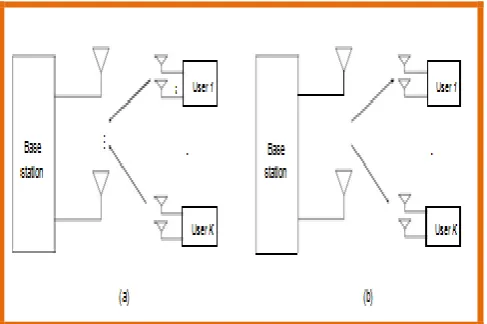
Assume that K users are in a cellular system, the base station is equipped with M antennas and each user terminal equipped with one or more antennas, Figure 7 shows two kinds of channels in the MU-MIMO system, namely uplink channel (or multiple access channels) and downlink channel (broadcast channel). The system performance analysis to MU-MIMO system is more complex than the performance analysis to the SU-MIMO system. In the case of downlink channel, the MU-MIMO channel behaves the same as SU-MIMO if the transmitter has perfect channel information from all users, although different users experience different path loss and channel fading due to the space signature of user terminals. In comparison with SU-MIMO channel, the transmit-receive pairs in MU-MIMO channel can originate from different users. In the case of uplink channel, system capacity achieved depends on if users can cooperate in encoding in the transmission stage.Figure 7: MU-MIMO channel: (a) Uplink, (b) Downlink
X . CONCLUSION
In a cognitive radio network, the common management channels of multiple secondary users are essential for effective network operations. In this thesis, we've investigated the strategies that may be accustomed improve the system performance of MU-MIMO wireless communication channels. In this paper the review of different researchers performed. Each and every author using different methods to perform their better result on MIMO system with PU and SU . Out of these different types of problems are faced during the study of exiting work. All these problems are defined in the problem formulation section. These are resolved in the future with the help of Modified MIMO system with multiple CBS , PU and SU. SO that the problems are resolved and maximum result of work is achieved.
REFERENCES
[1] Karama Hamdi and Wei Zhang,“Opportunistic Spectrum Sharing in Cognitive MIMO Wireless Networks” IEEE
Transactions On Wireless Communications, Vol. 8, No. 8, August 2009.
[2] Lu Yang and P.C.Ching,“Opportunistic User Scheduling In Mimo Cognitive Radio Networks” IEEE International
Conference on Acoustic, Speech and Signal Processing (ICASSP)- 2014.
[3] Lu Yang and Wenhno Xiong, “Underlay MIMO Cognitive Radio Downlink Scheduling with Multiple Primary Users
1122 | P a g e
[4] Duoying Zhang and Yao Zhang,“Rank-Constrained Beam forming for MIMO Cognitive Interference Channel”Hindawi Publishing Corporation Mobile Information Systems Volume 2016.
[5] Wenhao Xiong and Amitav Mukherjee, “MIMO Cognitive Radio User Selection with and without Primary Channel
State Information” IEEE-2016.
[6] 802.22 Working Group, “IEEE 802.22 D1: draft standard for wireless regional area networks,” March 2008. [Online].
Available: http://grouper.ieee.org/groups/802/22/.
[7] A. Ghasemi and E. S. Sousa, “Collaborative spectrum sensing for opportunistic access in fading environments,” in IEEE
Int. Symp. New Frontiers Dyn. Spectrum Access Netw (DySPAN 2005), Baltimore, Md, USA, pp. 131-136, Nov.
2005.
[8] A. Goldsmith, Wireless Communications, Cambridge University Press, New York, USA, 2005.
[9] A. Goldsmith, S. Jafar, I Maric and S. Srinivasa, “Breaking Spectrum Gridlock with Cognitive Radios: An Information Theoretic Perspective,” in Proc. IEEE, Vol. 97, No. 5, pp. 894-914, May 2009.
[10] A. Goldsmith, S. Jafar, N. Jindal, and S. Vishwanath, “Capacity limits of MIMO channels,” IEEE J. Sel. Areas
Commun., Vol. 21, No. 5, pp. 684–702, Jun. 2003.
[11] A. J. Paulraj, D. A. Gore, R. U. Nabar and H. Bölcskei, “An overview of MIMO communications-A key to gigabit wireless,” in Proc. IEEE, Vol. 92, No. 2, pp. 198-218, Feb. 2004.
[12] A. M. Tulino and S. Verdo, Random Matrix Theory and Wireless Communications (2004). [Online]. Available:
www.nowpublishers.com.
![Figure 1: Cognitive radio networks [3]](https://thumb-us.123doks.com/thumbv2/123dok_us/7776299.1282491/2.595.207.393.557.711/figure-cognitive-radio-networks.webp)
![Figure 2: Cognitive cycle [3]](https://thumb-us.123doks.com/thumbv2/123dok_us/7776299.1282491/3.595.169.424.87.287/figure-cognitive-cycle.webp)
![Figure 3. Infrastructure-based network architecture[22]](https://thumb-us.123doks.com/thumbv2/123dok_us/7776299.1282491/5.595.169.425.468.575/figure-infrastructure-based-network-architecture.webp)
![Figure 4: General communication system [4]](https://thumb-us.123doks.com/thumbv2/123dok_us/7776299.1282491/6.595.136.458.432.624/figure-general-communication-system.webp)
![Figure 5: Wireless cellular system [6]](https://thumb-us.123doks.com/thumbv2/123dok_us/7776299.1282491/7.595.158.426.78.249/figure-wireless-cellular-system.webp)