242 | P a g e
AN ECC BASED ROUTING ALGORITHM FOR
DETECTION AND AVOIDANCE OF BLACKHOLE
& WORMHOLE ATTACK IN MANET
Christophel selvi L,
1Caroline Jebakumari S
21
M.E - Communication Systems,
2Assistant Professor Dept of ECE
Easwari Engineering College, Chennai.
ABSTRACT
MANET is a hierarchy of decentralized nodes and dynamically changing network topologies where the nodes
are in mobile conditions for the dissemination of data. But, MANET is liable to attacks such as Wormhole,
Grayhole, and Sinkhole attack where the performance of entire network is degraded. Hence it is necessary to
provide security to the network as the data’s transferred through the attack prone network may be outraged. A
fictitious node mechanism is implemented by the creation of imaginary nodes using T-OLSR routing protocol. In
order to provide security to the network ECC (Elliptic Curve Cryptography) algorithm is implemented. The
reason behind the use of T-OLSR algorithm is better performance, less delay and minimum time utilization for
packet dispatching when compared with Chord algorithm.
Keywords: Security, Cluster head agents, Malicious nodes, Fictitious node, T-OLSR, ECC.
I. INTRODUCTION
Adhoc networks are defined as the category of wireless networks that utilize multihop relaying and are capable of operating without a fixed infrastructure. The absence of any central coordinator or base station makes the routing a complex one compared to cellular networks .The presence of base station in cellular network simplifies routing and resource management as the routing decisions are made based on fixed infrastructure. But in Adhoc networks the routing and resource management are done in a distributed manner in which all nodes coordinate to enable communication among themselves which require each node to be intelligent so that it can function both as network host from transmitting and receiving data as a network router for routing packets from source to destination[10].
The presence of mobility implies that links make and break often in an inter-deterministic fashion. Routing protocols such as distance vector and link based routing is not designed for wireless networks it is still applied for radio networks. These routing protocols are unable to catch up frequent link changes in Adhoc wireless network resulting in poor convergence and very low communication throughput. Hence these protocols are to be modified [11].
243 | P a g e
common one. Malicious node capture the packet and does not forward them but advertise itself as having the shortest path to the packet which it needs to intercept.if more than one malicious nodes occurs as group it is known as blackhole attack. In this paper a mechanism for identifying the Blackhole attack is proposed which works based on the cooperative cluster head mechanism which generates an alert notification to other nodes which improves the performance of network in terms of packet delivery ratio, throughput and end to end delay. The rest of this paper is organized as follows section 2 describes about the related work, section 3 describes about the operation of T-OLSR routing protocol and ECC algorithm, section 4 describes about modules implemented in this project, section 5 about the simulation metric and its discussion in section 6, section 7 describes about conclusion and future work.
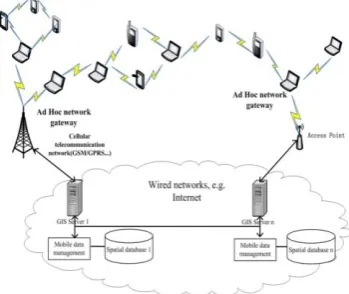
Figure 1.1 Adhoc Network Architecture
II. SIMILAR WORKS
Jay Dip Sen, Sripad Koilakonda [4] have discussed in their paper about the research areas in Adhoc network community. Here AODV works based on the routing information table along with the information obtained from the cached and current routing table. In order to avoid Blackhole attack securing the routing layer is more important. In addition to protect the routing layer attack can be prevented by detecting the misbehaving nodes and giving an error report to source node as false positive. In this paper when the route reply packet is obtained from the intermediate node, source gives another route request packet to intermediate node for ensuring that the path exists.
Yanzhi Ren, Mooi Chao Chuah [5] have discussed in their paper about the surveillance when selective dropping of the packet occur. This concept uses DTN (Delay Tolerant Networks) that is designed to operate over extreme distances such as space communication or interplanetary scales. But DTN seemed to be a failure concept as there cannot be sparse network to act as monitoring nodes. To detect the abnormal behavior of the nodes overhead packets and energy consumption a transitive property is considered which is used to encounter the nodes used in DTN. This method prevents the hacker from non-existence and cannot cope up with packet dropping which is a drawback of this method.
244 | P a g e
about the data nodes for detecting anamoly nodes based on correlating the features available within the networks . This paper uses cluster based detection scheme where periodically every node in the network is updated as cluster agent. Smita Karamakar present a study of voroni and triangular oriented diagram that is used to calculate the size of a coverage hole. Depending on this coverage area the nodes are assigned with the cluster heads. A straightforward algorithm is proposed which detects when the sensor node is dead it assumes that there is no sensor node in that area and it assumes that region has a hole. Tarun Varshney proposed mechanism to prevent Blackhole attack by slightly modifying the AODV called watchdog-AODV that detects normalized routing overhead and generates a new route to the source and isolates the malicious nodes during the route discovery process.
Tamilselvan et al [5] proposed a time based threshold detection scheme where a timer is set for collecting the request from other nodes after establishing the path. This will be stored in the Collect route reply table (CRRT) where the validity is checked based on the arrival time of the first packet and threshold value. This method remains a drawback as overhead is high when compared with AODV. In order to overcome the above drawbacks a new modified chord algorithm is proposed which works based on the update information in the routing table.
III. ALGORITHMS IMPLEMENTED
3.1 T-OLSR
Trusted Optimized Link State Routing protocol is a proactive link state routing protocol. The protocol inherits the stability of link state routing algorithm. Due to its proactive nature it has the ability of providing the routes needed immediately. In a pure link state protocol all the links with neighbor are flooded and declared in the entire network. OLSR protocol is an optimization of pure link state protocol for mobile Adhoc networks. First it reduces the size of control packets; instead of all links it shares only within the subsets who are its multipoint selectors.
3.2 MULTIPOINT RELAYS
245 | P a g e
Figure 3.1 Multipoint Relay
3.3 MULTIPOINT RELAY SELECTION
The interval between the transmission of two TC messages depends upon whether the MPR selector set is changed or not. Since the last TC message transmitted. When a change occurs in the MPR selectors set , the next TC message may be sent either that the scheduled time, but after some pre specified minimum interval ,starting from the time the last TC message was sent.
Upon receipt of TC message, the following proposed procedure may be executed to record the information in the topology table,
1. If there exist some entry in the topology table whose last hop address corresponds to the originator address of the TC message and the MPR selector sequence number in that entry is greater than the sequence number in the received message. Then no further processing of this TC message is done and it is silently discarded(Case: packet received out of order )
2. If there exist some entry in the topology table whose last hop address corresponds to the originator address of the TC message and the MPR selector sequence number in that entry is smaller than the sequence number in the received message, then the topology entry is removed.
3. For each of the MPR selector address received in the TC message :
If there exist some entry in the topology table whose destination address and the last hop address of the entry corresponds to that originating address of the TC message, then the holding time of that entry is refreshed.
Otherwise new topology entry is recorded in the topology table.
3.4 PROTOCOL FUNCTIONING
Neighbor Sensing
246 | P a g e
relay set is re-calculated when, A change in the neighborhood is detected when either a bi-directional link with a neighbor is failed. Or a new neighbor with a bi-directional link is added: or
A change in the two-hop neighbors set with bi-directional link is detected.
3.5. ECC (Elliptic Curve Cryptography)
Majority of public key crypto systems use either integer or polynomial arithmetic with very large numbers/polynomials. This imposes a significant load in storing and processing keys and messages. An alternative is to use an Elliptic curve which offers same security with smaller bit sizes.
IV. FINITE ELLIPTIC CURVES
Elliptic curve cryptography uses curves whose variables & coefficients are finite. ECC have two families commonly used prime curves E p (a,b) defined over Z p binary curves E2m(a,b) defined over GF(2n )
V.ECC Encryption/Decryption
Each user chooses private key n A<n and computes public key
PA= n A*G
To encrypt Pm: Cm ={ k G, Pm+ K PA} ,K
To decrypt Cm compute
Pm+ KPA- n A(KG) = P m+ k(n AG-n A) (KG) = Pm
VI. MODULES IMPLEMENTED
A modular design reduces complexity, facilities change (a critical aspect of software maintainability) and results in easier implementation by encouraging parallel development of different part of system. To identify the nodes that are malicious during Blackhole attack several modules have been implemented in this project. The modules are listed as follows
Node Construction
Data Transmission Based On DTN
Identification Of Selfish/Malicious Node Based False + ve or –ve
Data transmission
Attack detection and avoidance
Performance analysis
VII. PERFORMANCE ANALYSES
6.1 Without T-OLSR& With T-OLSR
247 | P a g e
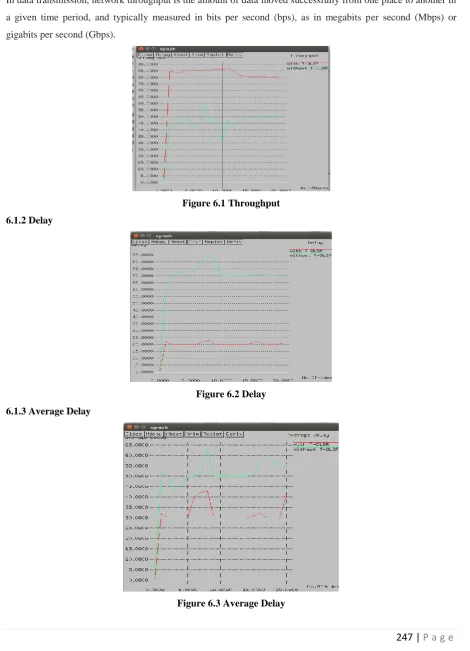
6.1.1 ThroughputIn data transmission, network throughput is the amount of data moved successfully from one place to another in
a given time period, and typically measured in bits per second (bps), as in megabits per second (Mbps) or
gigabits per second (Gbps).
Figure 6.1 Throughput
6.1.2 Delay
Figure 6.2 Delay 6.1.3 Average Delay
248 | P a g e
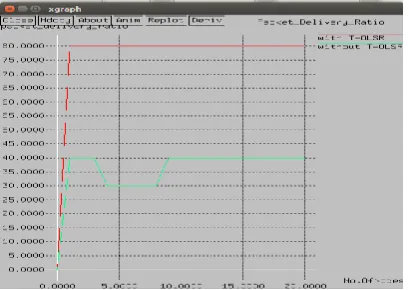
6.1.4 Packet Delivery RatioFigure 6.4 Packet delivery ratio
VIII. CONCLUSION & FUTURE WORK
Thus the security issues in MANET have been explained in detailed manner. There might be a numerous solution in the past for securing the routing protocol, some results work well in detecting the attacks with a single node. In this paper we have deployed 28 nodes and simulated the same scenario. In future the number of fictitious node is reduced in order to obtain the optimal solution better than the result obtained.
REFERENCES
[1] Lata Ragha, Vaishali Gaikwad “Security Agents for Detecting and Avoiding Cooperative Blackhole Attacks in MANET” @ 2015 IEEE.
[2] Chandni Garg, Preeti Sharma, Prashant Rewagad” A Literature Survey of Black Hole Attack on AODV Routing Protocol,” International Journal of advancement in electronics and computer engineering (IJAECE) Volume 1, Issue 6, Sep 2012.
[3] H.A. Esmaili, , Hossein gharaee, M.R. Khalili Shoja “Performance Analysis of AODV under Blackhole Attack through Use of OPNET Simulator”, World of Computer Science and Information Technology Journal (WCSIT), Vol. 1, No. 2, pp. 49-52, 2011.
[4]
[5] Mooi Choo Chuah, Jie Yang, Yanzhi Ren Yingying Chen, "Detecting Blackhole Attacks in Disruption-Tolerant Networks through Packet Exchange Recording", IEEE Wireless Communications, Vol. - 11, 2010.
[6] Y. Chen, M. C. Chuah, J. Yang, and Y. Ren, “Mouton: Detecting malicious nodes in disruption-tolerant networks,” in WCNC 2010, 2010.
249 | P a g e
[8] S. Kurosawa, H. Nakayama, and N. Kato, “Detecting Blackhole attack on AODV based mobile ad-hoc networks by dynamic learning method, ”International Journal of Network Security, pp. 338–346, 2007. [9] B.S.Manoj , C.Sivaramamurthy ”Adhoc wireless networks”,2007
[10] V.Cahill, S. Farrell Delay and Disruption Tolerant Networking. Artech House, 2006.
[11] M. Al-Shurman, S. Park, S-M. Yoo, “Black Hole Attack in Mobile Ad-Hoc Networks,” ACM Southeast Regional Conf. 2004.