© 2017, IRJET | Impact Factor value: 5.181 | ISO 9001:2008 Certified Journal | Page 2141
Performance and Analysis of Masonry Infill in R.C. Frame Structure
Mr. Yash P. Patel
1, Mr. Abbas Jamani
21M.E. Structure Student, L.J. Institute of Engineering and Technology, Gujarat, India
2Assistant. Professor, Structure Engineering Dept., L.J. Institute of Engineering and Technology, Gujarat, India
---***---Abstract -
Masonry infill are used to fill the spansbetween the vertical and horizontal resisting elements of building frames, presuming that these infill will not take part in resisting any kind of load either axial or lateral. In contrary, an infill wall considerably enhances the rigidity and strength of the frame structure. It has been observed through various assessments, that the frame considering no infill has comparatively lesser stiffness and strength than the infill frame and therefore their ignorance cause failure in many multi-storey buildings when subjected to seismic loads that acts out of plane. Masonry materials are considered brittle in nature thus usually referred to be as non-structural element, they contribute to increase in stiffness and rigidity and attract vulnerability to lateral and seismic loadings. Also there is loss of ductility. To observe the effect of masonry infill panel, it is modeled as an equivalent diagonal strut for G+7 and G+12 buildings using ETABS. In present study the responses of infill materials mentioned are to be compared with the storey shear, storey drift, displacements and lateral force for bare frame RC frame; to conclude the work. Cost implications are discussed.
Key Words: Bricks, AAC blocks, Solid cement blocks,
Equivalent Diagonal Struts ETABS.
1. INTRODUCTION
Less- ductile RC frames with Infill is not a rare sight nowadays. Masonry infills are widely used to fill in the voids in Reinforced Concrete Frames. It is presumed that masonry infill is non-structural member of a structure due to brittleness in nature. Hence its consideration while analysis of frame is neglected. In fact, the masonry infill between horizontal and vertical members of frame helps to provide rigidity to the structure. The infills are merely considered as architectural component or just a partition but in fact there is utter need to advance in the analysis and performance check for the infill used.
1.1 Parametric Study
The increase in rigidity and stiffness lead to vulnerability in out plane loadings like lateral loads and seismic loads. Thus it becomes important to consider the loads other than only wind and gravity loads, the seismic events act in 3 Dimensions to all members of structure leaving the infill the weakest component. Thus equivalent diagonal strut approach is adapted to estimate the stiffness provided to the whole structure. The change in results will be seen with change in the material used in filling the voids between beams and columns. Traditional clay bricks , aerated blocks and solid cement bricks are to be checked for. Further the plan is to check for efficiency in stresses and cost. The base shear , storey drifts , storey displacements and lateral loadings are to be compared for each model of G+7 and g+12 and compiled at the end of work.
2. METHODOLOGY
2.1 Model
© 2017, IRJET | Impact Factor value: 5.181 | ISO 9001:2008 Certified Journal | Page 2142
Fig-2.1: Equivalent diagonal strut dimensioning
As per sixth revision of IS 1893(part 1)-2002 draft codes states that the unreinforced masonry infill wall shall be modelled by using equivalent diagonal strut. The diagonals have pinned connection replacing the wall sections. Provide Modulus of elasticity as per Cl.7.9 Thickness of strut may equal the thickness of the wall provided.(sixth revision IS 1893 2002 Cl.7.9.2.2) Equivalent diagonal strut dimensioning,
Where F = Forces applied, Lds = Length of diagonal, Wds = Width of diagonal
The width is proposed to be taken as one-third of the diagonal length i.e length of strut, which is same as proposed by experimental results of Holmes in 1963[8]. For masonry with openings width Wdo of equivalent diagonal strut shall be taken as Wdo= ρw Wds . Presently we have considered fully infilled frames for this study.
2.2 Analysis
Response Spectrum Method using Etabs: The seismic analysis for all models buildings are carried out by response spectrum method by using IS: 1893(part-I) – 2002. The other parameters used in seismic analysis are, seismic zone (III), zone factor 0.16, importance factor 1 and response reduction factor 5.0, the building frame system is special RC moment-resisting frame (SMRF) frame for all configurations and height of buildings. Time period is (t=0.075h0.75) & (t=0.09h/√d).
Fig-2.2: (a)AAC infill 3d (b)Brick infill 3d
Fig-2.2: (c)Solid Block Infill (d)Bare Frame
[image:2.595.313.565.461.735.2]Fig-2.2(e): Plan
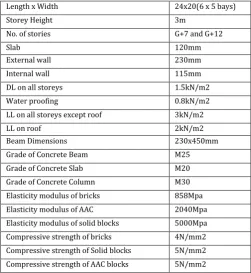
Table -1: Input Data
Length x Width 24x20(6 x 5 bays)
Storey Height 3m
No. of stories G+7 and G+12
Slab 120mm
External wall 230mm
Internal wall 115mm
DL on all storeys 1.5kN/m2
Water proofing 0.8kN/m2
LL on all storeys except roof 3kN/m2
LL on roof 2kN/m2
Beam Dimensions 230x450mm
Grade of Concrete Beam M25
Grade of Concrete Slab M20
Grade of Concrete Column M30
Elasticity modulus of bricks 858Mpa
Elasticity modulus of AAC 2040Mpa
Elasticity modulus of solid blocks 5000Mpa
Compressive strength of bricks 4N/mm2
Compressive strength of Solid blocks 5N/mm2
© 2017, IRJET | Impact Factor value: 5.181 | ISO 9001:2008 Certified Journal | Page 2143
2.3 Seismic Responses
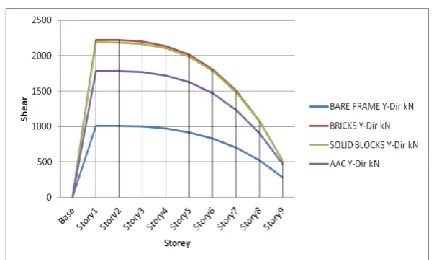
Fig2.3(a) : Storey shears G+7
Fig 2.4(a) Displacements G+7
Fig 2.5(a) Drifts G+7
[image:3.595.46.267.121.251.2]
Fig 2.6(a) Stiffness G+7
[image:3.595.296.527.129.255.2]Fig 2.3(b) : Storey shears G+12
[image:3.595.48.265.291.425.2]Fig 2.4(b) Displacements G+12
Fig 2.5(b) Drifts G+12
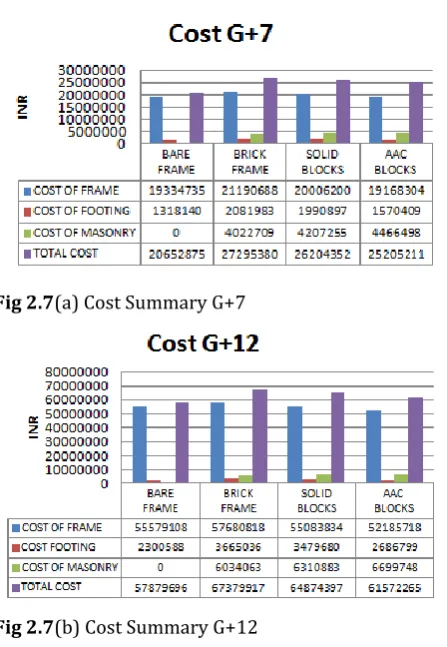
[image:3.595.298.526.300.429.2]© 2017, IRJET | Impact Factor value: 5.181 | ISO 9001:2008 Certified Journal | Page 2144 Fig 2.7(a) Cost Summary G+7
Fig 2.7(b) Cost Summary G+12
3. CONCLUSIONS
1. The weight of structure is less, the smaller the base shear is experienced. The base shear is larger for bricks infill and least for bare frame structure. We can use ACC blocks to gain lightweight structures.
2. Displacement is better controlled with presence of infill. The solid concrete blocks act most efficiently to reduce the displacement than in case of brick infill or bare frame due to increase in mass and stiffness.
3. The drifts are maximum for the bottom most storey of a structure for all infilled frames. The drifts for bare frame is low initially and increases eventually to a value greater than that of infilled structure as we go higher. Solid blocks give the best performance to reduce the drift values.
4. Stiffness of the structure depend on the elasticity modulus of the infill. The stiffer the building the greater will be base shear, the presence of infills increase the stiffness of frame. The solid blocks increase stiffness so high that the ductility of frame is lost. Thus for a balanced structure with ductile design we need to provide AAC blocks to enhance the performance.
5. The lateral loads are minimum at the base but as we go up with the height we see that lateral loads increase and the lateral load is directly proportional to the base shear , the greater the shear the higher is lateral load. Decrease upto 19-23% by use of AAC blocks.
6. Though the cost of solid and AAC block infill is higher by 0.7% and 1.7% compared to brick infill respectively for G+7 building, the reduction in base reaction of the whole structure is achieved and that could help to save total structure cost of 4 % by using solid blocks and 7.66 % by using AAC.
The cost of upgrading from brick to solid blocks and AAC blocks are 0.46% and 1.12% respectively for G+12 storey structure, whereas the saving achieved in structural cost due to lightweight infill and better performance comes around 3.72 % and 8.62 % respectively.
7. The truss action is enabled for frame structure and thus the load transmission has become lenient. This helps us to reduce the size of column and beams and thus optimizing the structure.
Thus better resistance to lateral loadings and seismic events can be achieved with use of AAC block modeled as equivalent diagonal struts over traditional bricks or bare frame structure and also reflects significant economy as we advance with high rise constructions.
ACKNOWLEDGEMENT
I wish to acknowledge Asst. Professor Abbas Jamani and other contributors for their efforts in guiding me out on the work which have been used in the preparation of this template. Also I thank my parents, friends and others for their continuous support in making this work complete.
REFERENCES
[1] Diptesh Das , C V R Murty “Brick Masonry Infills in seismic design of RC building”, Indian Concrete Journal, ISSN 0019-4565, 2004
© 2017, IRJET | Impact Factor value: 5.181 | ISO 9001:2008 Certified Journal | Page 2145 [3] Mainstone, R. J., On the stiffness and strengths of
infilled frames, Proceedings, Institution of Civil Engineers, Supplement IV, 57–90,1971
[4] Dayaratnam, P., Brick and Reinforced Brick Structures, Oxford and IBH, New Delhi, 1987 [5] Meharbi, A. B., and Shing, P. B.,Seismic analysis
of masonry infilled reinforced concrete frames, Masonry Soc. J. 21, 81–94,2003
[6] Polyakov, S. V., 1956. Masonry in Framed Buildings (An investigation into the strength and stiffness of masonry infilling)., National Lending Library for Science and Technology, Boston, Yorkshire, England, 1963
[7] Smith, B. S., and Carter, C., A method of analysis for infilled frames, Proceedings of the Institute of Civil Engineers 44, Paper No. 7218, 31–48,1969
[8] Holmes, M., Steel frames with brickwork and concrete infilling, Proceedings of the Institution of Civil Engineers 19, 473–478 (eISSN 1753-7789), 1961.
[9] Abolghasem Saneinejad and Brian Hobbs “Inelastic design of infilled frames” Journal of Structural Engineering, Vol. 121, No.4, ASCE, 1995
[10]Kaushik, H. B., Rai, D. C., and Jain, S. K., Code approaches to seismic design of masonry-infilled reinforced concrete frames: A state-of-the-art review, Earthquake Spectra 22, 961–983, 2006 [11]IS:1893 (Part 1), (2007), Indian Standard Criteria
for Earthquake Resistant Design of Structures, Bureau of Indian Standards, New Delhi
[12]IS:456, (2000), Indian Standard Code of Practice for Plain and Reinforced Concrete, Bureau of Indian Standards, New Delhi
[13]IS:13920, (1993), Indian Standard Code of Practice for Ductile Detailing of Reinforced Concrete Structures Subjected to Seismic Forces, Bureau of Indian Standards, New Delhi
[14]IS 1077 (1992)_ Common Burnt Clay Building Bricks –Specification
[15]IS 1905 (1987)_ Code of Practice for Structural use of Unreinforced Masonry
[16]IS 2185-2 (1983)_ concrete masonry units, Part 2_ Hollow and solid light weight concrete blocks [17]IS 2185-3 (1984)_ concrete masonry units, Part 3_
Autoclaved cellular Aerated concrete blocks
[18]IS 2250 (1981)_ Code of Practice for Preparation and Use of Masonry Mortars
[19]ASTM C 1314-00a, Standard test method for compressive strength of masonry prisms. In Masonry Test Methods and Specifications for the Building Industry, American Society for Testing
and Materials (ASTM), Pennsylvania, 2001, 4th edn
[20]EN 1996-1-1_ Eurocode 6_ Design of masonry structures - Part 1-1_ General rules for reinforced and unreinforced masonry structures
[21]BIS sixth edition 1893 2002 CED 39(7975)WC
BIOGRAPHIES
Mr. Yash P. Patel M.E. Structure Student,
L.J. Institute of Engineering and Technology,
Ahmedabad, India