546 | P a g e
APPENDIX-II
Outdoor Scene Image Segmentation- State of the Art
M. Tejasvini
1, S.M.Riyajoddin
2, M. Jang Reedy
3CSE,CMR Institute of Technology Hyderabad,( India)
ABSTRACT
In the field of computer vision, the process of partitioning a digital image into multiple sections is called as image segmentation. The basic objective of segmentation is to simplify and/or change the representation of an image into something that is more important and easier to analyze. Image segmentation is typically used to locate objects and background in images. More exactly, image segmentation is the process of assigning a label to every pixel in an image such that pixels with the same label share homogeneous features. This paper describes the different segmentation techniques used to achieve outdoor scene image segmentation.
Keywords:-
Image Segmentation, representation, foreground, back ground images, recognition, etc
I. INTRODUCTION
Digital Image Processing involves using a computer to change the nature of a digital image [2]. Image
processing deals with changing the nature of an image to either develop its pictorial information for human
interpretation or to make it more suitable for autonomous machine perception. Image+ segmentation is one of
the most vital precursors for image processing based applications and has an essential impact on the whole
performance of the developed systems. Image segmentation is to divide an image into number of regions so that
each region gives information about an object or area of interest [3]. In general, objects in outdoor scenes can be
divided into two categories, namely, unstructured objects (e.g., sky, roads, trees, grass, ground etc.) and
structured objects (e.g., vehicles, buildings, people, etc.). Unstructured objects usually consist of the
backgrounds of images. The background objects have nearly homogenous surfaces and are distinct from the
structured objects in images.
.
Scene
Object
Un-Structured
sky,
roads
trees,
grass
ground
Structured
547 | P a g e
II. IMAGE SEGMENTATION TECHNIQUES
The different types of image segmentation methodologies generally used for outdoor scenes are
Graph based Segmentation Region based image segmentation Multiclass image segmentation Boundary detection Segmentation
Image segmentation using perceptual organization Hybrid approach(s)
1.1
GRAPH BASED SEGMENTATION METHOD
The graph based image segmentation approach defines the boundaries between regions by measuring the
dissimilarity between the neighboring pixels. Each pixel is equivalent to a node in the graph. Weights on each
edge determine the dissimilarity between pixels. Shi et.al.(2000) implemented the normalized cut criterion that
removes the significant solutions of cutting small sets of isolated nodes in the graph. Ncut method organizes
nodes into groups so that within the group the similarity is high and/or between the groups the similarity is low.
This method is relatively robust and can be recursively applied to get more than two clusters. Each time the
subgraph is partitioned that has the maximum number of nodes (random selection for tie breaking). When the
bound on the number of clusters is reached or Ncut value exceeds some threshold, the process terminates. Let an
image is represented as
G
(
V
,
E
)
a weighted graph .Now calculate weight of each edge. Also summarizethe values D
N
N
diagonal matrix and W isN
N
symmetrical matrix. Next solve theDy
y
W
D
)
.
(
for the eigenvector with the second smallest eigenvalue. Finally the graph is bipartitionedusing the entries of the eigenvector. However the normalized cut criterion is an NP-hard computational problem.
They also developed methods for computing the minimum normalized cut, but even this could not tackle the
error in these estimates. The computations are hard to compute and take much time to complete and also this
approach works well only for relatively small images. Other problems are the high storage requirement and this
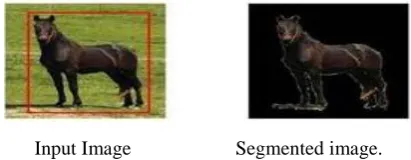
approach is bias towards partitioning into equal segments. Fig 2 illustrates the image segmentation using
Normalized cut approach
Input Image Segmented image.
Fig 2: Segmentation using Normalized Cut
Felzenszwalb et.al.(2004) proposed an efficient graph-based generic image segmentation algorithm which
works directly on the data points in feature space and uses a deviation on single linkage clustering without first
performing a filtering step,. The success of this method is principally due to the adaptive thresholding. A
minimum spanning tree using Kruskal’s algorithm is first generated to perform traditional single linkage
548 | P a g e
The joined components become the clusters in the segmentation. More specifically, letG
(
V
,
E
)
be a a fullyconnected graph, with m edges and n vertices. Each vertex is represented as a pixel x in the feature space. The
final segmentation will be a cluster of data points. This method has high inference and can incorporate data
likelihoods and priors.
2.2. Region based image segmentation
Region-based techniques make use of common patterns in intensity values within a cluster of neighboring
pixels. The cluster is referred to as the region, and the goal of the region based image segmentation algorithm is
to group regions according to their anatomical or functional roles. Micusik et al.(2009) in their work segmented
the semantic street scenes into coherent regions simultaneously categorizing each region as one of the
predefined categories representing an object or background class. A small blob based super pixels is used for
segmentation and it exploits a visual vocabulary tree as an image representation. The goal of the semantic
labeling of street scenes is to automatically annotating different regions by labels of commonly encountered
object and object categories. In this technique, instead of modeling co-occurrences of class labels here the
spatial co-occurrences between visual words of neighboring superpixels are evaluated.
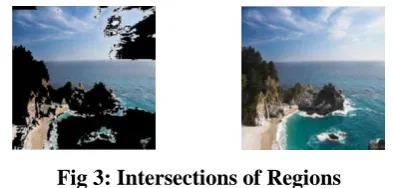
Pantofaru et al.(2008) proposed a method predicting that integrating the information from multiple image
segmentations can offer a more robust basis for object class recognition and object segmentation than for single
image segmentation. It relies on two basic principles First the same segmentation region containing group of
pixels in multiple segmentations should be consistently classified and the pixel groups can be efficiently
classified using multiple image segmentation. Fig 3 shows the object recognition using multiple image
segmentation
Fig 3: Intersections of Regions
Gould et al.(2009) uses the semantic region labels (e.g. road, sky, building etc.) and coherent geometric
placement (orientation and location with respect to horizon) to decompose the scene into regions. An image I is
decomposed into an unknown number (K) of geometrically and semantically consistent regions by iteratively
optimizing an energy function that measures the quality at hand. Classifying large regions rather than individual
pixels can compute more robust features and reduce inference complexity. Multiple over-segmentations allow
refining region boundaries and making large moves in energy space. The context can be easily captured using a
pair wise term between adjacent regions. This approach provides a foundation to integrate many other vision
tasks such as 3D reconstruction and object detection. But it has disadvantage of its reliance on large amount of
549 | P a g e
2.3. Multiclass image segmentation
Multi-class image segmentation uses one of a number of classes (e.g., road, sky, water, etc) for labeling every
pixel in an image. Many state-of-the-art methods first over-segment the image into superpixels (or small
coherent regions) and classify each region since classifying every pixel can be computationally expensive.
Shotton et al.(2009) described the need to label each pixel in the image with one of a set of predefined object
class labels. In this approach a class label is assigned to a pixel based on a joint appearance, shape and context
model. The aim of this approach is that the system should be capable of automatically partitioning it into
semantically meaningful regions each labeled with a specific object class. For this a discriminative model for
object class is learned incorporating texture, layout and context information efficiently. The learned model is
then used for automatic visual understanding and semantic segmentation of images. This technique can model
very long range contextual relationship extending over half the size of the image. Thus this method has a
adaptability to learn classifier based on relative texture locations for each class to
Refine classification with Conditional Random Field (CRF). Improve classification with additional pixel information.
The Text on Boost system has been applied in several exciting new areas like Auto Collage, Semantic Photo
Synthesis, Interactive Semantic Segmentation and Interactive Image Editing. The primary limitation is the
performance of the texture-layout potentials learned by boosting. The classification cost grows sub-linearly with
the number of classes due to the use of Joint Boosting although training time increases quadratically. When
moving to more classes, the simple ontological model is used where each pixel is assigned only one class label.
This can lead to semantic confusions.
The detection of objects at smaller scales is sometimes poor with the current system. Shotton et al (2008)
proposed the use of semantic texton forests for fast classification. The aim of this approach is to perform
simultaneous segmentation and recognition of objects in the images. The two basic applications of STFs are
Image categorization and Semantic segmentation
According to a learned binary function of the feature vector, the decision tree recursively branches left or right
until a leaf node l is reached. The random decision tree training can be done as follows:
Take a random subset of training data. Generate the random features Generate the random threshold t. Split the data into left Il and right Ir Repeat for each side.
The training time speeds up and also over-fitting reduces when decision trees trained on small random subsets of
data are used. As only a small portion of the tree is traversed for each data point, the trees are fast to learn and
evaluate. The total computation time using STF is 605ms whereas the same using TextonBoost is 6000ms. The
disadvantages are low resolution classification, the segmentation forest operates at patches and so the test time
inference is dependent on amount of training. It must iterate through all the trees in the forest at test time. High
supervision is needed for segmenting forests.
550 | P a g e
of categories. Unlike object recognition methods that intend to find a particular object, multi-class imagesegmentation methods are intended at concurrent multi-class object recognition and attempt to classify all pixels
in an image. For each super pixel region, this method first extracts appearance (color and texture), geometry and
location features. Then boosted classifiers are learnt over these features for each region class. Finally, a CRF or
logistic model is learned using the output of the boosted classifiers as features. It does not distinguish between
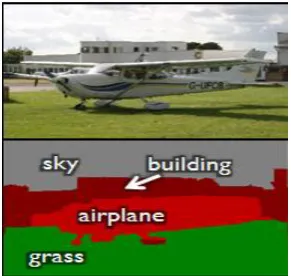
objects at different scales. Fig 4 shows the example results of simultaneous object class recognition and
segmentation algorithm.
Fig 4: Sample results of simultaneous Object Class Recognition and Segmentation
algorithm. Adapted from [5]
2.4 Boundary detection approaches
A boundary is a contour in the image plane that represents dissimilar pixels between the neighboring objects.
Dollar et al.(2006) proposed a boundary detection algorithm based on a large number of generic features
calculated over a large image patch. In this algorithm, the context information is provided by a large aperture.
The algorithm selects and combines a set of features out of a pool in the learning stage with tens of thousands of
generic, efficient Haar wavelets in order to learn a discriminative model. True probabilities are output in this
method whereas other edge detection methods either output a soft value based on edge strength or a binary value
which is not a true probability. When making a decision, this method combines low-level, mid-level and context
information across different scales. Learning edge probability can be done by the classification framework used
which is an extended Probabilistic Boosting Tree that combines the bootstrapping procedure directly into the
tree formation while properly maintaining priors. This approach uses tens of thousands of very simple features
considered over a much larger region. The main advantage of such an approach is that the human effort is
minimized; as an alternative the work is shifted to the classification algorithm. This approach is highly adaptive
and scalable.
Hoeim et al. (2007) predicted a occlusion boundaries based on both 2-D perceptual cues and 3-D cues such as
surface orientation and depth estimates. The boundaries and depth ordering of prominent objects are recovered
in sufficient detail to provide an accurate sense of depth. This strategy is to simultaneously reason about the
regions and boundaries in the image and the 3D surfaces of the scene using learned model. The learned model
551 | P a g e
length of boundaries; 3D surface orientation estimates and depth estimates. Develop the segmentation graduallyby iteratively computing cues over the current segmentation and using them with the learned models to combine
regions that are likely to be part of the same object. Each iteration consists of three steps based on the image and
the current segmentation: (1) compute cues; (2) assign confidences to boundaries and regions; and (3) remove
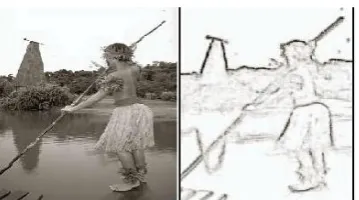
weak boundaries, forming larger regions for the next segmentation. Fig 5 shows the example result of
supervised learning of edges and object boundaries.
Fig 5: Example result of Supervised Learning of Edges and Object Boundaries. a) Gray scale image from
Berkeley Dataset. (b) BEL result. Adapted from [1]
2.5 Image Segmentation based on perceptual organization
Perceptual organization refers to a basic capability of the human visual system to obtain relevant groupings and
structures from an image without having prior knowledge of the contents of the image. The Gestalt
psychologists summarized some underlying principles (e.g., proximity, similarity, continuity, symmetry, etc.)
that lead to human perceptual grouping.
Maire et al.(2008) proposed a state-of-the-art solution for the problems related to finding contours
(segmentation curves), and finding junction (points joined by multiple contours). The contours are found by
combining the local and global features. The local cues are combined in a multi-scale oriented signal including
brightness, color and texture gradients. The global information is considered to be in the first 9 generalized
eigenvectors, from which a signal is extracted with Gaussian directional derivatives at multiple orientations. The
local and global information are then linearly combined, resulting in a globalized probability of boundary, which
claims the top spot in the standard Berkeley segmentation benchmark. The procedure for contour detection can
be briefly stated as:
Collect Data Set of Human segmented images.
Learn the local boundary model for combining brightness, color and texture. Global framework to capture closure, continuity.
Detect and localize junctions.
Integrate the low, mid and high-level information for grouping and figure-ground segmentation.
Chang et al.(2012) explores detecting object boundaries in outdoor scene images based on some general
properties of the real world objects such as perceptual organization without depending on a priori knowledge of
the object. It is well accepted that segmentation and recognition should not be separated and should be treated as
an interleaving procedure. This method basically follows this scheme and requires identifying some background
552 | P a g e
common background objects in outdoor scenes. These background objects have low visual variety and hencecan be reliably recognized. After background objects are identified, it is roughly know where the structured
objects are and delimit perceptual organization in certain areas of an image. For many objects with polygonal
shapes, such as the major object classes appearing in the streets (e.g., buildings, vehicles, signs, people, etc.) and
many other objects, this method can piece the whole object or the main portions of the objects together without
requiring recognition of the individual object parts. In other words, for these object classes, this method provides
a way to separate segmentation and recognition. Fig 6 illustrates the result of implementation of outdoor scene
image segmentation based on background recognition and perceptual organization.
III. CONCLUSION
To summarize, a comprehensive survey highlighting different outdoor scene image segmentation techniques
have been presented. The techniques discussed were graph based approaches, region based image segmentation,
multiclass image segmentation, boundary detection approach, image segmentation based on perceptual
organization and hybrid approach. The future work can include improving the outdoor scene image
segmentation using background recognition and perceptual organization by solving the problem caused by
strong reflection and over-segmentation.
Acknowledgement:-
Thanks to all the authors who made available literature in compiling this survey paper.REFERENCES
[1] Elizabeth Sama Sam .A. Kethsy Prabhavathy .J. Devi Shree, “ A Survey on Outdoor Scene Image Segmentation” International Journal of Computer Applications (0975 – 8887) Volume 55– No.9, October
2012
[2] Solomon C.J. and Breckon T.P., Fundamentals of Digital Image Processing: A Practical Approach with Examples in Matlab, Wiley-Blackwell,2010.
[3] T. Malisiewicz and A. A. Efros, “Improving spatial support for objects via multiple segmentations,” in
Proc. BMVC.
[4] C. Cheng, A. Koschan, D. L. Page, and M. A. Abidi, “Outdoor scene image segmentation based on
background recognition and perceptual organization,” in Proc. IEEE Trans, vol.21, no.3,pp. 1007–1019,
March 2012.
[5] E. Borenstein and E. Sharon, “Combining top-down and bottom-up segmentation,” in Proc. IEEEWorkshop
Perceptual Org. Comput. Vis.,CVPR, 2004, pp. 46–53.
[6] P. Felzenszwalb and D. Huttenlocher, “Efficient graph-based image segmentation,” Int. J. Comput. Vis., vol.
59, no. 2, pp. 167–181, Sep.2004.
[7] J. B. Shi and J. Malik, “Normalized cuts and image segmentation”, IEEE Trans. Pattern Anal. Mach. Intell.,
553 | P a g e
[8] J. Shotton, J. Winn, C. Rother, and A. Criminisi, “Textonboost for image understanding: Multi-class objectrecognition and segmentation by jointly modeling texture, layout, and context,” Int. J. Comput. Vis.,vol.
81, no. 1, pp. 2–23, Jan. 2009.
[9] B. Micusik and J. Kosecka, “Semantic segmentation of street scenes by superpixel co-occurrence and 3-D geometry,” in Proc. IEEE Workshop VOEC, 2009.
[10] J. Shotton, M. Johnson, and R. Cipolla, “Semantic texton forests for image categorization and
segmentation,” in Proc. IEEE CVPR, 2008, pp. 1–8.
[11] C. Pantofaru, C. Schmid, and M. Hebert, “Object recognition by integrating multiple image
segmentations,” in Proc. ECCV, 2008, pp.481–494.
[12] S. Gould, R. Fulton, and D. Koller, “Decomposing a scene into geometric and semantically consistent
regions,” in Proc. IEEE ICCV, 2009, pp. 1–8.
[13] S. Gould, J. Rodgers, D. Cohen, G. Elidan, and D. Koller, “Multi-class segmentation with relative location
prior,” Int. J. Comput. Vis., vol. 80, no. 3, pp. 300–316, Dec. 2008.
[14] M.Maire, P. Arbelaez, C. C. Fowlkes, and J.Malik, “Using contours to detect and localize junctions in natural images,” in Proc. IEEE CVPR, 2008, pp. 1–8.
[15] D. Hoiem, A. N. Stein, A. A. Efros, and M. Hebert, “Recovering occlusion boundaries from a single
image,” in Proc. IEEE ICCV, 2007, pp. 1–8.
[16] P. Dollar, Z. W. Tu, and S. Belongie, “Supervised learning of edges and object boundaries,” in Proc. IEEE