A Sub-Nyquist Sampling Digital Receiver System Based on Array
Compression
Tao Chen, Xutian Han, and Yongzhi Yu*
Abstract—In order to obtain the carrier frequency (CF) and direction-of-arrival (DOA) estimation, a uniform linear array (ULA)-based modulated wideband converter (MWC) discrete compressed sampling (CS) digital receiver system is proposed. It can achieve sub-Nyquist sampling, save the storage space, and obtain the CF and DOA estimation by processing the CS data directly. However, the existing method for this system needs more branches to get better performance. In this paper, a compressed ULA (CULA)-based MWC discrete CS digital receiver system is proposed. First, a compression matrix is used to reduce the number of branches behind the antennas. Then, the MWC discrete CS structure is used to reduce the data volume. Finally, the multiple signal classification (MUSIC) algorithm is used to jointly estimate the CF and DOA by processing the CS data directly. The simulation results validate the effectiveness of the proposed system and the proposed method for the joint CF and DOA estimation.
1. INTRODUCTION
Traditional wideband digital receivers for electronic reconnaissance are commonly utilized to sample and process radar signals at the Nyquist sampling rate or the band-pass sampling rate [1–3]. However, with the increasing complexity of the electronic environment, bottleneck problems have been encountered with traditional digital receiver systems, such as complex hardware structure and large-volume data processing. Therefore, it is necessary to consider a new receiver system.
The compressed sensing theory is a new concept to acquire data at a low sampling rate [4–6]. In 2010, the MWC structure was proposed by Mishali and Eldar to achieve sub-Nyquist sampling [7]. However, most research on MWC structures has focused on signal reconstruction, and few studies have considered the direct processing of the CS data [8–10]. In [11], we extended the MWC to the discrete-time domain and proposed a new CS-based wideband digital receiver, where the CS data were processed directly to reduce the complexity. This digital receiver can effectively reduce the sampling rate of each channel, save the storage space, and increase the sensitivity of the receiver [11]. In particular, this digital receiver can solve the cross-channel signal problem flexibly [12]. However, because of the phase loss of the CS data, it is difficult to obtain the true CF. In addition, it is difficult to obtain the DOA of the signal, which is another important feature. In [13], Ioushua et al. proposed a ULA-based MWC system and used a signal reconstruction method to obtain the CF. This system exhibited better reconstruction performance than the MWC. In addition, the authors extended the ULA configuration and proposed the CompreSsed CArrier and DOA Estimation (CaSCADE) system which achieved good estimation performance of the CF and DOA. However, the CaSCADE system is more difficult to implement than the ULA configuration. In [14], the authors suggested to use the first sensor of the ULA-based MWC structure as the reference element and used multiple MWC channels to reconstruct the signal. This
Received 10 October 2019, Accepted 23 November 2019, Scheduled 1 December 2019 * Corresponding author: Yongzhi Yu ([email protected]).
method increased the complexity of the system. In [15], we proposed a ULA-based MWC discrete CS structure and achieved the joint estimation of the CF and angle-of-arrival (AOA) by processing the CS data directly. The cyclic-shifted pseudo random sequence (PRS) was used to mix the signal in each branch of the MWC, causing a special phase difference in the CS data. Subsequently, we corrected the phase and used the MUSIC algorithm to estimate the CF and AOA. In [16], we extended the structure proposed in [15] and obtained the better estimation. However, in order to improve the performance, more branches are needed.
The compression matrix method was proposed to reduce the numbers of branches behind the antennas in [17]. This method uses a complex compression matrix Ψ∈CM×L at the antenna output, whereLis the number of antennas, andM is the number of branches behind the antennas withM < L. The dimension of received signal is reduced from L to M by multiplying the received signal with the compression matrix. It is known that there is an information loss (L−M)/L when a ULA is used as the receiver antenna array [18]. Considering the characteristics of compression matrix and the complete study about the linear array [19], in this paper, we propose a CULA-based MWC receiver system. In this system, the compression consists of two steps. The first step is the compression of the branches. A compression matrix is used to compress the number of MWC branches so that the number of MWC branches is much lower than the number of antennas. The second step is data compression. The data are compressed by using the MWC structure. After the compression, the dimension of both the structure and data have been reduced. In order to obtain the CF and DOA estimation, we propose to use the MUSIC algorithm [20, 21] to conduct a two-dimensional (2D) search for the peak in the spatial and frequency domains to joint the CF and DOA estimation.
The rest of this paper is organized as follows. Section 2 presents the scheme of the CULA-based MWC discrete CS receiver. In Section 3, we describe the joint estimation method to determine CF and DOA. The simulation results and discussions are presented in Section 4. Finally, we conclude the paper in Section 5.
Notations: we use lower-case letters (e.g.,a), lower-case bold letters (e.g., a), and upper-case bold letters (e.g., A) to represent scalars, vectors, and matrices, respectively. SuperscriptsT and H denote the transpose and complex conjugate transpose, respectively. In addition,E{·}is used to represent the expectation operation, and{·}↓Mp denotes the down-sampling operation. I denotes the identity matrix with a suitable dimension.
2. PRINCIPLE OF THE CULA-BASED SYSTEM
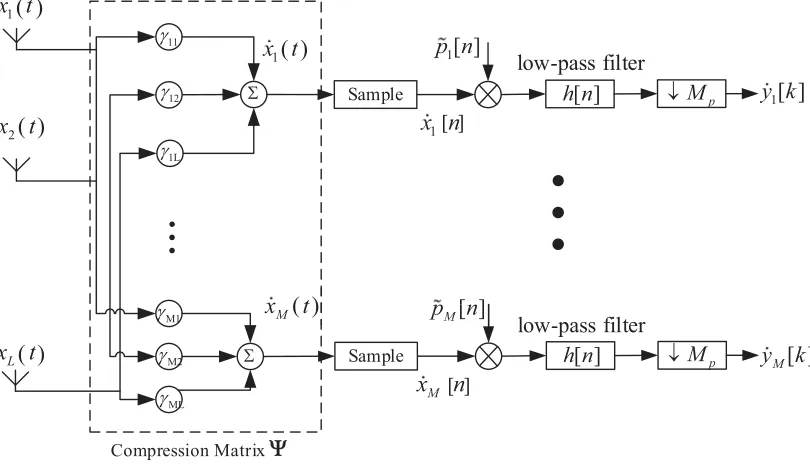
In this section, we describe the scheme of the proposed CULA-based MWC discrete CS receiver. As shown in Fig. 1, the number of array elements is L, and the number of branches is M with M < L. We design to detect and acquire the signal pulse in a very short time by using the proposed receiver. There would be only one signal detected and acquired in the short time [15]. Suppose that there is only one far-field narrowband signal s(t) impinging on the proposed CULA-based system with a Nyquist sampling rate fNY Q= 1/TNY Q; the signal vector x(t) received byL antennas is
x(t) =As(t) +η(t) (1)
where η(t) = [η1(t), η2(t), . . . , ηL(t)]T is the independent and identically additive white Gaussian noise vector with mean zero and variance σ2I, and A = [a(θ)] is the array manifold matrix, in which
a(θ) = [1, e−j2πdλ sinθ, . . . , e−j
2π(L−1)d
λ sinθ]T is the steering vector corresponding to the signal whose DOA
isθ.
As demonstrated in [17], the essence of a compressed array is to reduce the dimensionality of the received signal. This can be achieved by multiplying the received signal with a complex compression matrixΨ∈CM×L, and elements of the complex compression matrix are generated by independent and identically distributed random entries. Hence, the output signal vector x˙(t) after the CULA is sampled by the analog to digital converter (ADC) expressed as:
˙
low-pass filter [ ]
h n ↓Mp
1[ ] p n
1[ ] y k
1 x t
M x t Σ 11 γ 12 γ 1L γ ML γ M1 γ M2 γ Σ
1 x t
2 x t
L x t
Compression Matrix ΨΨ
1 x n
low-pass filter [ ]
h n ↓ Mp
[ ] M p n [ ] M y k M x n ( ) ( ) ( ) ( ) ( ) [ ] [ ]
Figure 1. The CULA-based MWC discrete CS system.
Subsequently, the signal is processed by the MWC discrete CS structure [11]. The period of the PRS isTp, and there areMp =TpfNY Q elements per period. The periodic PRS ˜pm[n] in themth branch can be described as
˜
pm[n] = 1 Mp
Mp−1
l=0
Pm(l)ejMp2πnl (3)
where l is the index of the sub-band and 0 ≤l ≤Mp−1; the digital Fourier transform coefficients of the principal value sequencepm[n] can be expressed as:
Pm(l) = Mp−1
n=0
pm[n]e−jMp2πln (4)
The low-pass filter h[n] is designed as an ideal filter with the cut-off frequency fs/2. We denote the mixing rate fs as fs = fp = 1/Tp = fNY Q/Mp, and fp ≥ B is designed to avoid edge effects [15]. According to spectrum segmentation characteristics of the MWC discrete CS system analysed in [15], the incident signal will only exist in an unknown sub-bandl, and the spectrum information in other sub-bands can be approximately ignored. Thus, the output of themth branch of the proposed CULA-based system can be expressed as
ym[k] = {( ˙xm[n]·p˜m[n])∗h[n]}↓Mp
=
1 MpPm
lejMp2πnlgms[n]
↓Mp
+
1 MpPm
lejMp2πnlνm[n]
↓Mp
= 1
MpPm
lgms¯[k] +vm[k] (5)
where ˙xm[n] denotes the sampled signal in the mth branch; ¯s[k] = {ejMp2πnls[n]}↓M
p denotes the CS
the output of basic receiver proposed in [15] and [16], it is known that the new receiver has the same capabilities using less branches.
Then, considering the output of all branches, we obtain the output of the proposed CULA-based
system as ⎡
⎢ ⎢ ⎣
˙ y1[k]
˙ y2[k]
.. . ˙ yM[k]
⎤ ⎥ ⎥
⎦= 1
Mp ⎡ ⎢ ⎢ ⎣
P1(l)g1 P2(l)g2
.. . PM(l)gM
⎤ ⎥ ⎥ ⎦s¯[k] +
⎡ ⎢ ⎢ ⎣
¯ v1[k] ¯ v2[k]
.. . ¯ vM[k]
⎤ ⎥ ⎥
⎦ (6)
According to Eq. (6), we can learn that the CF of the CS data is lost due to the mixing operation, and the phase difference between the mth branch and the (m − 1)th branch is converted to Pm(l)gm/Pm−1(l)gm−1.
3. JOINT CF AND DOA ESTIMATION METHOD
In this part, we describe the use of the high-resolution MUSIC method to conduct a 2D search in the spatial and frequency domains to jointly estimate the CF and DOA. We rewrite Eq. (6) as
˙
y[k] =ACULAs¯[k] +¯v[k] (7)
where y˙[k] = [ ˙y1[k], . . . ,y˙M[k]]T is the output of the system; ¯s[k] is the CS data vector of the original signal vector; and v¯[k] = [¯v1[k], . . . ,v¯M[k]]T is the CS data vector of the noise vector. We define the array manifold matrix ACULA of the CULA-based system as
ACULA=acsθ, lT= 1 Mp
⎡ ⎢ ⎢ ⎣
P1(l)g1 P2(l)g2
.. . PM (l)gM
⎤ ⎥ ⎥
⎦ (8)
Then, the covariance matrix is calculated as
R˙y=Ey ˙˙yH=ACULAR¯sAHCULA+R¯v (9)
where R¯s =E{¯s¯sH} is the covariance matrix of the CULA-based CS data, and R¯v =E{¯v¯vH} is the covariance matrix of the CS data vector of the original additive Gaussian white noise. Because the data are finite in one branch, the practical sampling covariance matrix is expressed as
R˙y= 1 K
K−1
k=0
˙
y[k]y˙H[k] (10)
whereK denotes the CS data volume.
The MUSIC spectrum can be obtained by eigenvalue decomposition forR˙y, which is expressed as
PMUSIC(θ, l) = 1
aHcs(θ, l)UNUHNacs(θ, l) (11) whereUN denotes the noise sub-space.
The wavelength of the signal can be expressed as λ=c/fc, wherec denotes the light speed, and fc denotes the true frequency of the original signal. The CF and DOA estimation is performed by traversing the frequency and the DOA using an intentional range and l from (0, Mp−1).
According to Eq. (28) in [15], it can be learned that the true CFfc of the signal can be expressed as
fc =l×fp+fb (12)
wherefbis the CF estimate of the baseband signal, which can be obtained by the fast Fourier transform (FFT) method [22]. The indexl of the sub-band can be determined instead of the frequency to reduce the search time. Thus, the 2D MUSIC spectrum is defined as
PMUSIC(θ, fc) = 1
Finally, the joint CF and DOA estimation is performed by searching the peak of the MUSIC spectrum PMUSIC(θ, fc) in the frequency and spatial domain sequentially. The estimated CF and DOA values are defined as
(θ, fc) = arg(f,θ)minaHcs(θ, fc)UNUHNacs(θ, fc) (14)
4. SIMULATION RESULTS
In this section, a CULA-based MWC discrete CS system is created to estimate the CF and DOA. The root mean square error (RMSE) is used to access the joint CF and DOA estimation performance. The RMSE of the estimation performance is defined as
RM SE=
1
N N
n=1
(an−ˆan)2 (15)
where N represents the number of independent Monte Carlo simulations; αn is the value of the CF or DOA estimate, and the true CF or DOA value is expressed as ˆαn for thenth trial.
The CULA-based system is uniformly spaced with d = λ/2. The periodic PRS based on the Bernoulli random binary ±1 sequence is designed with the period length Mp= 100. An ideal low-pass filter with a cutoff frequency fp/2 = 10 MHz is used, and the down-sampling rate fs=fp = 20 MHz is created. A narrow band far-field radar signal with a Nyquist sampling ratefNY Q = 2 GHz impinges on the CULA-based system.
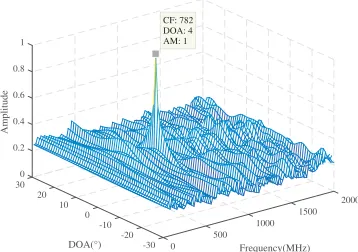
First, we determine the 2D MUSIC spectrum of the array CS data with SNR = 20 dB to illustrate the effectiveness of the method. Fig. 2 shows the 2D MUSIC spectrum when the signal with a fixed CF fc = 782 MHz and fixed DOA θ = 4◦ is received by the system. A 20-element ULA (L= 20) is compressed to 10 branches (M= 10). It can be seen that the maximum peak occurs at the location where the CF and DOA have the highest accuracy. The CF and DOA estimates are obtained by searching the MUSIC spectrum peak in the frequency and spatial domains.
Subsequently, the performance of the CF estimation of the proposed method using the CULA-based system is evaluated. The CF is randomly chosen from fc ∈ (600 MHz,1200 MHz) to determine
0 30 0.2
20 0.4
2000
Amplitude
10 0.6
1500
DOA(°)
0.8
0
Frequency(MHz)
1
1000 -10
500 -20
-30 0
CF: 782 DOA: 4 AM: 1
the RMSE of the signal CF. The SNR ranges from −10 dB to 20 dB in 5 dB steps. 1000 Monte Carlo simulations are conducted for each SNR step. A 20-element ULA (L= 20) is compressed to 10 branches (M= 10) and 15 branches (M= 15), respectively. We also conduct experiments using the ULA-based
-10 -5 0 5 10 15 20
SNR/dB
0 10 20 30 40 50 60 70 80 90 100
RMSE(MHZ)
ULA-based system L=20 CULA-based system L=20 M=10 CULA-based system L=20 M=15 ULA-based system L=10
14.9 15 15.1 0.2
0.4 0.6 0.8
Figure 3. RMSEs of the CF estimation versus the SNR.
-10 -5 0 5 10 15 20
SNR/dB
0 1 2 3 4 5 6 7
RMSE(°)
ULA-based system L=20 CULA-based system L=20 M=10 CULA-based system L=20 M=15 ULA-based system L=10
system proposed in [15] with the antennas numbers L= 10 andL= 20. Fig. 3 shows the RMSEs of the CF estimation for the three experiments. The RMSE decreases with the increase in the SNR, and the RMSE is close to 0 MHz while SNR≥10 dB.
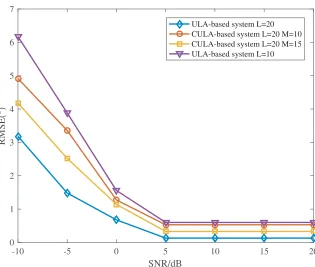
The performance of the DOA estimation of the proposed system is evaluated. The DOA is randomly selected fromθ∈(−15◦,15◦) to determine the RMSE of the signal DOA. The SNR varies from −10 dB to 20 dB in 5 dB steps. Similar to Fig. 4, 1000 Monte Carlo experiments are performed for each SNR step, and RMSEs of the ULA-based systems with L= 20 and L= 10 are determined. Fig. 4 shows the RMSEs of the DOA estimation for the three experiments. The RMSEs decrease with increasing SNR. The RMSE of the DOA estimation is close to zero while SNR≥10 dB.
It can also be learned from Fig. 3 and Fig. 4 that the RMSE of the proposed system is worse than that of the ULA-based system with L= 20 but better than that of the ULA-based system with L= 10 in the low SNR. When the antennas number is fixed, more signal processing branches can obtain better estimations. However, when the SNR is high enough (SNR≥15 dB), the proposed system can achieve the same performance with the ULA-MWC system. It means that the CULA-based systems proposed in this paper can get the same estimation using less branches.
5. CONCLUSION
In this paper, we propose a CULA-based MWC discrete CS system to reduce branches of the system for joint CF and DOA estimation. This system can be used in electronic reconnaissance equipment and passive radar systems. The proposed system allows for sub-Nyquist sampling, the number of sampling data can be reduced, and the hardware complexity is significantly lower. An arbitrary periodic PRS is used to mix the received signals into basebands and other sub-bands, which makes the system more universal. In order to verify the effectiveness of the system, we use the MUSIC algorithm to conduct a 2D search in spatial and frequency domains by processing the CS data directly for the joint CF and DOA estimation. The simulation results validate the effectiveness of the proposed CULA-based system and demonstrate the good performance of the joint CF and DOA estimation and anti-noise performance for low SNRs. We plan to use the proposed CULA-based system and joint CF and DOA estimation method for practical applications in the future.
ACKNOWLEDGMENT
This work was supported by the National Natural Science Foundation of China (No. 61571146) and the Fundamental Research Funds for the Central Universities of China (No. HEUCFP201808).
REFERENCES
1. Hamdaoui, B., B. Khalfi, and M. Guizani, “Compressed wideband spectrum sensing: Concept, challenges, and enablers,” IEEE Communications Magazine, Vol. 56, No. 4, 136–141, 2018. 2. Qiu, Z. Y., P. Wang, and J. Zhu, “A parameter estimation algorithm for LFM/BPSK hybrid
modulated signal intercepted by Nyquist folding receiver,” EURASIP Journal on Advances in Signal Processing, Vol. 2016, No. 1, 90–90, 2016.
3. Zhang, M., M. Diao, L. P. Gao, et al., “Neural networks for radar waveform recognition,”Symmetry, Vol. 9, No. 5, 75–75, 2017.
4. Pinto, R. G. D. C. P. and R. Merched, “A compressed sensing approach to block-iterative equalizers,” IEEE Transactions on Signal Processing, Vol. 66, No. 4, 1007–1022, 2018.
5. Shahbazi, N., A. Abbasfar, and M. Jabbarian-Jahromi, “Efficient two-dimensional compressive sensing in mimo radar,” EURASIP Journal on Advances in Signal Processing, Vol. 2017, No. 1, 23–23, 2017.
7. Mishali, M. and Y. C. Eldar, “From theory to practice: Sub-Nyquist sampling of sparse wideband analog signals,” IEEE Journal of Selected Topics in Signal Processing, Vol. 2016, No. 1, 375–391, 2010.
8. Liu, W. S., Z. T. Huang, X. Wang, et al., “Design of a single channel modulated wideband converter for wideband spectrum sensing: Theory, architecture and hardware implementation,” Sensors, Vol. 17, No. 5, 1035–1035, 2017.
9. Lv, W. H., H. L. Wang, and S. X. Mu, “Spectrum sensing using co-prime array based modulated wideband converter,” Sensors, Vol. 17, No. 5, 1052–1052, 2017.
10. Yang, E. P., X. Yan, and K. Y. Qin, “Modulated wideband converter with run length limited sequences,” IEICE Electronics Express, Vol. 13, No. 17, 20160670–20160670, 2016.
11. Chen, T., L. Z. Liu, and L. M. Guo, “Wideband signal detection based on MWC discrete compressed sampling structure,”Transactions of Nanjing University of Aeronautics and Astronautics, Vol. 34, No. 2, 105–114, 2017.
12. Chen, T., S. C. Wang, and L. M. Guo, “Recognition and parameter estimation of wideband LFM signal based on MWC discrete compressive sampling structure,” Journal of Harbin Engineering University, Vol. 39, No. 8, 1415–1412, 2018.
13. Ioushua, S. S., O. Yair, D. Cohen, et al., “CaSCADE: Compressed carrier and DOA estimation,”
IEEE Transactions on Signal Processing, Vol. 65, No. 10, 2645–2658, 2017.
14. Cui, C., W. Wu, and W. Q. Wang, ““Carrier frequency and DOA estimation of sub-nyquist sampling multi-band sensor signals,”IEEE Sensors Journal, Vol. 17, No. 22, 7470–7478, 2017. 15. Chen, T., L. Z. Liu, and D. P. Pang, “A ULA-based MWC discrete compressed sampling structure
for carrier frequency and AOA estimation,”IEEE Access, No. 5, 14154–14164, 2017.
16. Chen, T., L. Z. Liu, and L. M. Guo, “Joint carrier frequency and DOA estimation using a modified ULA based MWC discrete compressed sampling receiver,” IET Radar, Sonar and Navigation, Vol. 12, No. 8, 873–881, 2018.
17. Guo, M. R., Y. D. Zhang, and T. Chen, “DOA estimation using compressed sparse array,” IEEE Transactions on Signal Processing, Vol. 66, No. 15, 4133–4166, 2018.
18. Pakrooh, P., A. Pezeshki, L. Scharf, et al., “Analysis of fisher information and the Cram´er-Rao bound for nonlinear parameter estimation after random compression,”IEEE Transactions on Signal Processing, Vol. 63, No. 23, 6423–6428, 2015.
19. Morabito, A. F., A. R. Lagan`a, and T. Isernia, “On the optimal synthesis of ring symmetric shaped patterns by means of uniformly spaced planar arrays,” Progress In Electromagnetics Research B, Vol. 20, 33–48, 2010.
20. Si, W. J., P. J. Zhao, Z. Y. Qu, et al., “Real-valued DOA estimation for a mixture of uncorrelated and coherent sources via unitary transformation,” Digital Signal Processing, Vol. 58, No. 2016, 102–114, 2016.
21. Jiang, J. J., F. J. Duan, and J. Chen, “Three-dimensional localization algorithm for mixed near-field and far-near-field sources based on ESPRIT and MUSIC method,” Progress In Electromagnetics Research, Vol. 136, 435–456, 2013.