© 2014, IJCSMC All Rights Reserved 291
Available Online at www.ijcsmc.com
International Journal of Computer Science and Mobile Computing
A Monthly Journal of Computer Science and Information Technology
ISSN 2320–088X
IJCSMC, Vol. 3, Issue. 8, August 2014, pg.291 – 296
REVIEW ARTICLE
Image Compression Techniques: A Review
1
Sonal Chawla,
2Meenakshi Beri,
3Ritu Mudgil
1,2,3M.Tech Student, CSE Department, PDM College of Engineering [email protected], [email protected], [email protected]
Abstract: Image compression is the application of data compression on digital images. The objective is to reduce redundancy of the image data in order to be able to store or transmit data in an efficient form. This paper gives review of types of images and its compression techniques. An image, in its original form, contains huge amount of data which demands not only large amount of memory requirements for its storage but also causes inconvenient transmission over limited bandwidth channel. So, one of the important factors for image storage or transmission over any communication media is image compression. Compression makes it possible for creating file sizes of manageable, storable and transmittable dimensions. Keywords: Image, Image compression technique, Lossless and lossy image compression
I. INTRODUCTION
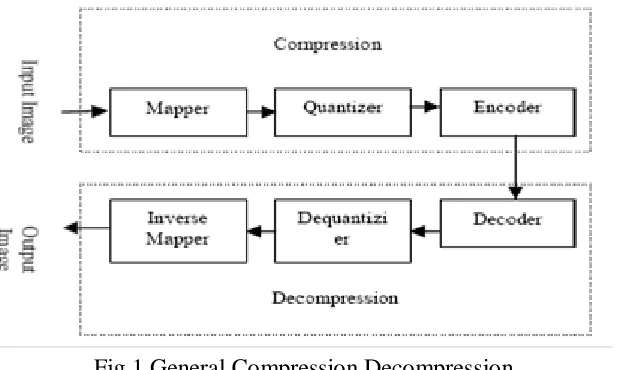
© 2014, IJCSMC All Rights Reserved 292 Fig 1 General Compression Decompression
First of all the image is taken from the image dataset. The mapper converts the input image into inter pixel coefficients. Transformation for the mapper may be DCT, wavelet or Curvelet transform. Each has its own advantages and disadvantages. Second stage is the quantizer which simply reduces the number of bits needed to store the transformed coefficients. It is many to one mapping in which larger values are quantized into smaller value. It is a lossy process and it is the main source of compression in an encoder. Quantization reduced the number of bits so it results some kind of information loss. Quantizer can be scalar or vector quantization. An entropy encoder compressed the quantized values and improves the compression. The reverse Process Decoder, Dequantizer and inverse mapper is obtained to reconstruct the image and it is called decompression.
In image compression, redundancies are classified into three types namely coding redundancy, inter-pixel redundancy and psycho visual system. Coding redundancy is present when less than optimal code words are used, which results in coding redundancy. A result from correlations between the pixels of an image is called inter-pixel redundancy. Due to data, omitted by the Human Visual System (HVS) that is visually non-essential information is called psycho visual redundancy. The reconstructed image can be obtained by compressed data. This process is called inverse process or decompression.
II. TYPES OF IMAGES
In a raw state, images can occupy a large amount of memory both in RAM and in storage. Image compression reduces the storage space required by an Image and the bandwidth needed when streaming that image across a network. Generally images are classified as the following.
JPG: JPG is optimized for photographs and similar continuous tone images that contain
© 2014, IJCSMC All Rights Reserved 293
images, it is very difficult for the eye to discern any difference from the original, even at extreme magnification. Compression factors of more than 20 are often acceptable.
TIFF: The TIFF (Tagged Image File Format) is a flexible format that can be lossless or lossy
compression [8]. It normally saves 8 bits or 16 bits per color (red, green, blue) for 24-bit and 48-bit totals, respectively. The details of the image storage algorithm are included as part of the file. In practice, TIFF is used almost exclusively as a lossless image storage format that uses no compression at all. TIFF files are not used in web images. They produce big files, and more importantly, most web browsers will not display TIFFs.
JPEG: Joint Photographic Expert Group (JPEG) is an excellent way to store 24-bit
photographic images, such as those used for imaging and multimedia applications. JPEG 24-bit (16 million color) images are superior in appearance to 8-24-bit (256 color) images on a Video Graphics Array (VGA) display and are at their most spectacular, when using 24-bit display hardware (which is now quite inexpensive) [5]. JPEG was designed to compress, color or gray-scale continuous-tone images of real-world subjects, photographs, video stills, or any complex graphics, that resemble natural subjects. Animations, ray tracing, line art, black-and-white documents, and typical vector graphics don’t compress very well under JPEG and shouldn’t be expected to. And, although JPEG is now used to provide motion video compression, the standard makes no special provision for such an application.
GIF: Graphics Interchange Format (GIF) is useful for images that have less than 256-(2^8)
colors, grayscale images and black and white text. The primary limitation of a GIF is that it only works on images with 8-bits per pixel or less, which means 256 or fewer colors. Most color images are 24 bits per pixel [4]. To store these in GIF format that must first convert the image from 24 bits to 8 bits. GIF is a lossless image file format. Thus, GIF is “lossless” only for images with 256 colors or less. For a rich, true color image, GIF may “lose” 99.998% of the colors. It is not suitable for photographic images, since it can contain only 256 colors per image.
PNG: Portable Network Graphics (PNG) is a file format for lossless image compression.
Typically, an image in a PNG file can be 10% to 30% more compressed than in a GIF format [4]. It allows making a trade-off between file size and image quality when the image is compressed. It produces smaller files and allows more colors. PNG also supports partial transparency. Partial transparency can be used for many useful purposes, such as fades and antialiasing for text.
BMP: The Bitmap (BMP) file format handles graphics files within the Microsoft Windows
OS. Typically, BMP files are uncompressed, hence they are large; advantage is that their simplicity, wide acceptance, and use in Windows program [8].
RAW: RAW refers to a family of raw image formats (output) that are options available on
© 2014, IJCSMC All Rights Reserved 294
compression, and produce file sizes much smaller than the TIFF formats of full-size processed images from the same cameras. The raw formats are not standardized or four smaller than TIFF files of the same image. The disadvantage is that there is a different RAW format for each manufactures and so has to use the manufacturer’s software to view the images.
III. COMPRESSION TECHNIQUES
Digital image is basically array of various pixel values.[1] In the digital image Pixels of neighborhood are correlated and so that this pixels contain redundant bits. By using the compression algorithms redundant bits are removed from the image so that size image size is
reduced and the image is compressed. There are Two types of compression algorithm: Lossless
and Lossy.
Fig2. Classification of compression techniques
A. Lossless Compression
In the lossless compression the compressed image is totally replica of the original input image, there is not any amount of loss present in the image.
a. Run Length Encoding
Run length Encoding (RLE) is one of the simplest image compression techniques. It consists of replacing a sequence (run) of identical symbols by a pair containing the symbol and the run length [7]. It is used as the primary compression technique in the 1-D CCITT Group 3 fax standard and in conjunction with other techniques in the JPEG image compression standard.
b. Entropy encoding
variable-© 2014, IJCSMC All Rights Reserved 295
length prefix-free output codeword. The length of each codeword is approximately proportional to the negative logarithm of the probability. Therefore, the most common symbols use the shortest codes.
c. Predictive Coding
Predictive Coding Technique constitute another example of exploration of interpixel redundancy, in which the basic idea to encode only the new information in each pixel. This new information is usually defined as the difference between the actual and the predicted value of the pixel. The predictor’s output is rounded to the nearest integer and compared with the actual pixel value: the difference between the two- called prediction error. This error can be encoded by a Variable Length Coding (VLC). The distinctive feature of this method lies in the paradigm used to describe the images. The images are modeled as non-causal random fields
B. Lossy Compression
In lossy compression the compressed image is not same as the input image, there is some amount of loss is present in the image.
a. Transform encoding
Transform coding is a type of data compression for "natural" data like audio signals or photographic images. The transformation is typically lossy, resulting in a lower quality copy of the original input. In transform coding, knowledge of the application is used to choose information to discard, thereby lowering its bandwidth. The remaining information can then be compressed via a variety of methods. When the output is decoded, the result may not be identical to the original input, but is expected to be close enough for the purpose of the application.
b. Vector Quantization
Vector quantization (VQ) technique is the extension of Scalar quantization in multiple dimensions. This technique develops a dictionary of fixed-size vectors which are called code vectors. A given image again partitioned into non-overlapping blocks called image vectors. Then for each image vector, the closest matching vector in the dictionary is determined and its index in the dictionary is used as the encoding of the original image vector.
c. Fractal Coding
© 2014, IJCSMC All Rights Reserved 296
IV. CONCLUSION
This paper represents the concept of image compression and various technologies used in the
image compression. All the image compression techniques are useful in their related areas and
every day new compression technique is developing which gives better compression ratio. This review paper gives clear idea about basic compression techniques and image types.
REFERENCES
[1] Subramanya A. “Image Compression Technique,”potentials IEEE, Vol. 20, issue 1, pp19-23, Feb-March 2001.
[2] Woods, R. C. 2008. Digital Image processing. New Delhi: Pearson Pentice Hall, Third Edition, Low price edition, Pages 1-904.
[3] Er. Preetinder Kaur , “ Image Compression- A Succinct Review” , Preetinder / International Journal of Engineering Associates Vol. 2, 2013.
[4] Athira B. Kaimal, S. Manimurugan, C.S.C .Devadass, “Image Compression Techniques: A Survey” International Journal of Engineering Inventions e-ISSN: 2278-7461, p-ISBN: 2319-6491 Volume 2, pp: 26-28 Issue 4 (February 2013).
[5] M. Puttaraju, Dr. A. R. Aswatha,” FPGA Implementation of 5/3 Integer DWT for Image Compression”, (IJACSA) International Journal of Advanced Computer Science and Applications, Vol. 3, No. 10, 2012.
[6] Asha Lata, Permender Singh, “Review of Image Compression Techniques” International Journal of Emerging Technology and Advanced Engineering (ISSN 2250-2459, ISO 9001:2008 Certified Journal, Volume 3, Issue 7, July 2013.
[7] G. M. Padmaja, P. Nirupama, “Analysis of Various Image Compression Techniques” ARPN Journal of Science and Technology ISSN 2225-7217 vol. 2, no. 4, May 2012.
[8] J.M. Shapiro, “Embedded image coding using zero tree of wavelet coefficients”, IEEE Trans.
on Signal Processing,vol. 41, 3445-3462, 1993.
[9] A. Said, W.A. Pearlman, “A new, fast, and efficient image codec based on set partitioning in hierarchical trees”, IEEE Trans. on Circuits and Systems for Video Technology, vol. 6, 243-250, 1996.