Electronic Thesis and Dissertation Repository
6-28-2016 12:00 AM
Designing A Hybrid Experience: The Effect of Experience Structure
Designing A Hybrid Experience: The Effect of Experience Structure
on Consumers' Evaluations
on Consumers' Evaluations
Juan Wang
The University of Western Ontario Supervisor
Mira Goode
The University of Western Ontario Joint Supervisor June Cotte
The University of Western Ontario Graduate Program in Business
A thesis submitted in partial fulfillment of the requirements for the degree in Doctor of Philosophy
© Juan Wang 2016
Follow this and additional works at: https://ir.lib.uwo.ca/etd Part of the Marketing Commons
Recommended Citation Recommended Citation
Wang, Juan, "Designing A Hybrid Experience: The Effect of Experience Structure on Consumers' Evaluations" (2016). Electronic Thesis and Dissertation Repository. 3811.
https://ir.lib.uwo.ca/etd/3811
This Dissertation/Thesis is brought to you for free and open access by Scholarship@Western. It has been accepted for inclusion in Electronic Thesis and Dissertation Repository by an authorized administrator of
i
Abstract
A hybrid experience refers to an experience that is composed of two or more separable
constituent experiences that are traditionally consumed independently of one another. A
good example is an educational trip where sightseeing tours and educational engagements
are combined in a single market offering for consumers. In this dissertation, I consider
whether the structure of a hybrid experience impacts its evaluation. Through six
experiments, I demonstrate that alternately structured hybrid experiences (e.g., partaking
in both sightseeing tours and educational engagements within each day of a six-day trip)
are more favourably evaluated than sequentially structured ones (e.g., completing all
sightseeing tours and then engaging in educational engagements afterwards). This is
because the benefits consumers infer from consuming an alternately structured hybrid
experience may exceed the benefits inferred from a sequential structure. In addition, the
positive effect of an alternating structure is greater for hybrids composed of less similar
constituent experiences. Script theory, conversational implicature, variety seeking,
service bundling, and schema congruity literatures are foundational to this investigation,
and these results will add to the literature on experiential consumption and hybrid
products by clarifying how consumers learn and evaluate this increasingly popular
market offering. From a managerial perspective, the findings will improve
understandings of how to design and market hybrid experiences.
Keywords:
Hybrid Experience, Experience Structure, Complementarity Inference,ii
I am deeply indebted to my principle supervisor, Miranda Goode, for her continuous
guidance, support and encouragement. I am thankful for the countless hours Miranda has
spent discussing, proofreading, and providing thoughtful comments and criticism on my
work. Miranda, thanks for being positive and patient all the time. Your optimism and
patience have really helped to go through those “ups and downs” to complete this
journey.
I would also like to express sincerest gratitude to the other members of my supervisory
committee, June Cotte and Matt Thomson. June, thank you for your insightful comments
and suggestions on my dissertation. I have really appreciated the effort you made to make
time for my work. Matt, thank you too for all the help in the past six years. I would also
like to extend my thanks to Allison Johnson. Allison, thank you for the lots of
encouragement you have given to me. I really appreciate it.
I would like to thank my dearest parents and my friends for their patience and support in
the pursuit of this particular endeavor as well as in life in general.
Most importantly, the journey to complete my dissertation would not have been possible
without my husband, Jun Shi. Jun, thank you for being such a true and great supporter,
and thank you for loving me unconditionally during my good and bad times. My son
Jayden, I owe you lots and lots of fun hours. Thank you for being such a good boy, and
you really gave me the reason to continue. Words would never say how grateful I am to
iii
Table of Contents
Abstract ... i
Acknowledgments ... ii
Table of Contents ... iii
List of Table ... vi
List of Figures ... vii
List of Appendices ... viii
Chapter 1 ... 1
1 Introduction ... 1
Chapter 2 ... 7
2 Literature Review ... 7
2.1 Experiential Products and the Consumption of Experiences ... 7
2.2 Sources of Pleasure ... 9
2.2.1 Pleasure from Comparisons to Material Purchases ... 10
2.2.2 Pleasure from the Involvement of Others ... 11
2.2.3 Pleasure from the Inherent Properties of an Experience ... 13
2.3 Categorization of Experiences ... 16
2.3.1 Experiences and Category Cues ... 16
2.3.2 Downstream Effects of Experience Categorization ... 18
2.4 Conceptualization of Hybrid Experiences ... 20
2.4.1 Hybrids in the Innovation Literature ... 20
2.4.2 Hybrids in the Service Literature ... 22
iv
Chapter 3 ... 30
3 Theoretical Development ... 30
3.1 The Role of Script Theory and Conversational Implicature ... 31
3.2 Alternative Explanations ... 37
3.2.1 Satiation Avoidance as an Alternative Explanation ... 37
3.2.2 Perceived Variety as an Alternative Explanation ... 40
Chapter 4 ... 43
4 The Effect of Experience Structure on Evaluation ... 43
4.1 Experiment 1 ... 43
4.1.1 Fitness–Leisure Choice Task ... 43
4.1.2 Summer Camp Design ... 44
4.1.3 Experiment 1 Discussion ... 46
4.2 Experiment 2 ... 47
4.2.1 Design and Procedure ... 47
4.2.2 Measurements ... 48
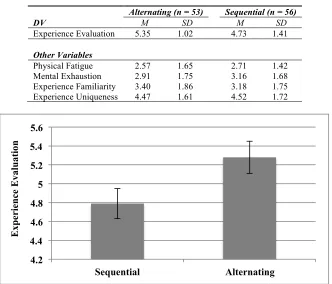
4.2.3 Results ... 49
4.2.4 Experiment 2 Discussion ... 50
Chapter 5 ... 52
5 The Role of Complementarity Inferences ... 52
5.1 Experiment 3 ... 53
5.1.1 Design and Procedure ... 54
5.1.2 Measurements ... 54
5.1.3 Results ... 56
v
5.2.1 Design and Procedure ... 62
5.2.2 Measurements ... 64
5.2.3 Results ... 65
5.2.4 Experiment 4 Discussion ... 67
5.3 Experiment 5 ... 68
5.3.1 Design and Procedure ... 70
5.3.2 Results ... 76
5.3.3 Experiment 5 Discussion ... 84
Chapter 6 ... 90
6 Constituent Experience Similarity and Experience Evaluation ... 90
6.1 Experience Similarity ... 90
6.2 Hypothesis Development ... 93
6.3 Experiment 6 ... 95
6.3.1 Design, Procedure, and Measurements ... 95
6.3.2 Results ... 98
6.3.3 Experiment 6 Discussion ... 100
Chapter 7 ... 103
7 General Discussion ... 103
7.1 Theoretical and Managerial Contributions and Implications ... 103
7.2 Limitations and Future Research ... 109
Chapter 8 ... 112
8 Bibliography ... 112
Appendices ... 131
vi
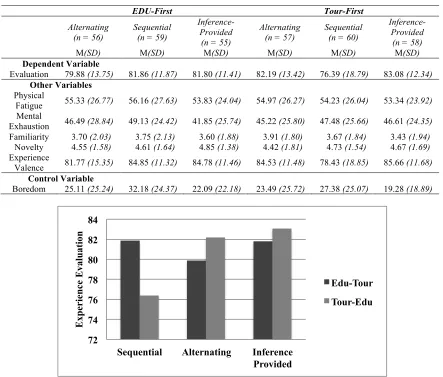
Table 1: Experiment 2 summary statistics. ... 50
Table 2: Experiment 3 summary statistics. ... 57
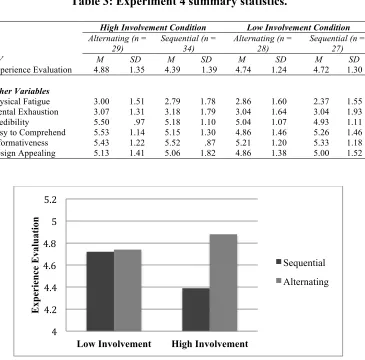
Table 3: Experiment 4 summary statistics. ... 66
Table 4: Experiment 5 summary statistics. ... 78
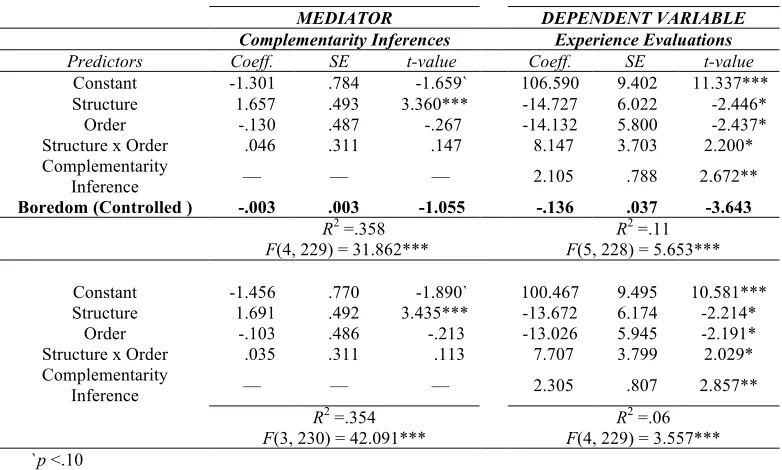
Table 5: Experiment 5 moderated mediation coefficients. ... 82
vii
Figure 1: An overview of the full conceptual model and the experiments. ... 4
Figure 2: Example illustration of hybrid experience. ... 23
Figure 3: Temporal variation in hybrid experience structure. ... 26
Figure 4: Conceptual model for the role of complementarity inferences. ... 30
Figure 5: Visual illustration of complementarity inferences for a voluntour trip. ... 36
Figure 6: The effect of experience structure on evalauiton in Experiment 2. ... 50
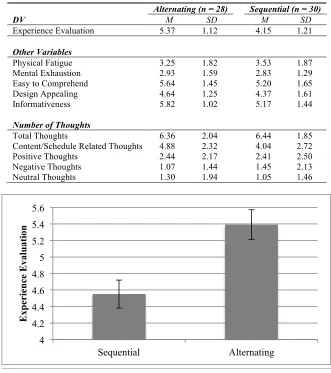
Figure 7: The effect of experience structure on evalaution in Experiment 3. ... 57
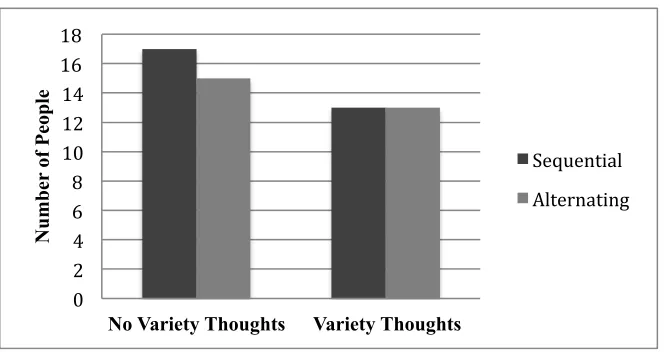
Figure 8: Number of people with/without CIs in Experiment 3. ... 58
Figure 9: Number of people with/without variety related thoughts in Experiment 3. ... 58
Figure 10: The effect of task involvmemnt and experience structure on evaluation in Experiment 4 . ... 66
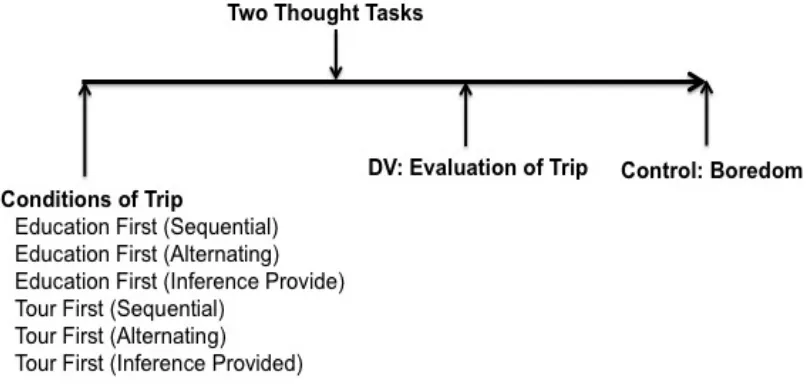
Figure 11: The experiment procedure of Experimetn 5. ... 70
Figure 12: The effect of experience structure and constituent experience order on evaluation in Experiment 5. ... 78
Figure 13: Hedonic-utilitarian perceptions across experiments. ... 89
Figure 14: Conceptual mode for the role of constituent experience similarity. ... 95
viii
Appendix A: Fitnness-Leisure Choice Task in Experiment 1 ... 131
Appendix B: Summer Camp Design Task in Experiment 1 ... 132
Appendix C: Sequential French Festival Itinerary in Experiments 2 & 3 ... 133
Appendix D: Alternating French Festival Itinerary in Experiments 2 & 3 ... 134
Appendix E: High Task Involvement Manipulation in Experiment 4 ... 135
Appendix F: Low Task Involvement Manipulation in Experiment 4 ... 135
Appendix G: Sequential Sunday Funday Tour Itinerary in Experiment 4 ... 136
Appendix H: Alternating Sunday Funday Tour Itinerary in Experiment 4 ... 137
Appendix I: Sequential and Inference-Provided Educaitonal Trip (EDU-first) Itinerary in Experiment 5 ... 138
Appendix J: Alternating Educational Trip (EDU-first) Itinerary in Experiment 5 ... 139
Appendix K: Sequential & Dissimilar Haunt Adventure Schedule in Experiment 6 ... 140
Chapter 1
1
Introduction
Imagine that you are planning a spring vacation and have come across an ad
featuring a six-day volunteer–tour trip. The ad suggests an exciting itinerary where you
will spend half of the trip volunteering in jungle restoration in the Amazon and the other
half leisurely touring popular destination sites in Peru. This is a prime example of what is
called a hybrid experience, an experience that is composed of two or more separable
constituent experiences that are traditionally consumed independently of one another. To
maximize consumers’ desire for this experience, an important decision must be made by
marketers: how should the experiences in the trip be structured? Should a marketer
structure the trip such that consumers will complete the jungle restoration experience in
the first three days before moving to the touring portion (i.e., sequential structure), or
should a marketer structure each day to include both jungle restoration and touring
activities (i.e., alternating structure)? Before this decision is even made, however, a
marketer must consider what type of experiences should be offered together. Would the
jungle restoration experience be more attractive paired with sightseeing in Peru (i.e., a
less similar experience to jungle restoration) or with the experience of teaching English in
villages within the jungle (i.e., a more similar experience to jungle restoration)? In this
dissertation, I demonstrate that both decisions impact how consumers evaluate hybrid
I suggest that an alternating structure will be more favourably evaluated because
the benefits consumers infer may go beyond those inferred from a sequential structure.
When the volunteer–tour trip is structured sequentially, consumers may infer that the
jungle restoration experience will be spiritually rewarding and that the touring experience
will be fun. In other words, the multisensory elements, events, and benefits of each
experience will be processed independently from one another in comparison to when the
same trip is structured alternately. However, script theory and the conversational
implicature literature suggest that consumers will perceive added benefits from an
alternating structure where the jungle restoration and touring experiences are staggered
throughout the trip. Not only will consumers expect that the jungle restoration will be
spiritually rewarding and the touring will be fun, but they may also assume that a touring
event, such as boating along the Amazon River, will be more relaxing after finishing a
volunteer event, such as a half-day of tree planting. Additionally, a consumer’s
appreciation for the importance of a river maintenance volunteer event may be enhanced
if it follows boating on the Amazon River, a touring event. I call these additional inferred
benefits with the alternately structured hybrid experience complementarity inferences,
and provide the first investigation of how these inferences may increase consumer
preference for alternately structured hybrid experiences.
I further suggest that the positive effect of an alternating structure on hybrid
experience evaluation may be a function of constituentexperience similarity. In
designing a hybrid experience, marketers must determine whether the constituent
experiences should be more or less similar. In other words, is it better to pair two
taxonomical experience categories, or evoking similar or dissimilar emotions, or
contributing to similar or dissimilar consumption goals? In the volunteer-tour trip
example, an English teaching experience may be perceived as more similar to the jungle
restoration experience because both involve a significant amount of preparation and
contribute to the goal of intellectual development. In contrast, visits to popular beach
destinations may be perceived as less similar to the jungle restoration experience because
they differ in their potential to contribute to a goal of relaxation. My findings suggest that
preference for an alternating structure is greater for hybrids composed of less (vs. more)
similar constituent experiences. While hybrids that are composed of less similar
constituents may make it more difficult for consumers to infer obvious value, an
alternating structure motivates and facilitates the generation of more complementarity
inferences. These inferences help integrate disparate constituent experiences and enhance
experience evaluations. For example, an alternating structure will enhance evaluation of a
hybrid experience composed of jungle restoration activities and beach visits in
comparison to a hybrid experience involving jungle restoration and English teaching
events.
I examined the impact of experience structure (alternating or sequential) and
constituent experience similarity (more or less) on the overall evaluation of a hybrid
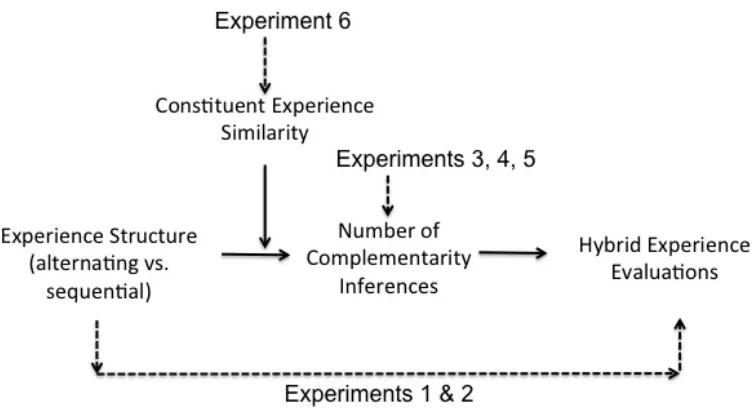
experience through six experiments (see Figure 1 for an overview). Experiments 1 and 2
show that alternately structured hybrid experiences are evaluated more favourably.
Experiment 3 replicates the main effect of experience structure and provides evidence
that individuals are more likely to generate complementarity inferences when evaluating
mediating role of complementarity inferences in enhancing the overall evaluation of
alternately structured hybrid experiences. Experiment 5 also accounts for satiation
avoidance as an alternative explanation. Finally, Experiment 6 demonstrates that
preference for an alternating structure is greater for hybrid experiences composed of less
similar constituent experiences.
Figure 1: An overview of the full conceptual model and the experiments.
The contributions of this work are as follows. I extend current literature on
experiential consumption and hybrid product learning by demonstrating how consumers
learn and evaluate hybrid experiences, an increasingly popular experience offering in the
market. Specifically, I am the first to demonstrate that hybrid experience structure and the
similarity of constituent experiences jointly affect experience evaluations. Moreover, I
conceptualize, develop, and provide the first empirical test for the role of
experience. Findings of this work provide insight to practitioners on how to better design
and market hybrid experiences.
This dissertation is organized as follows. In Chapter 2, I begin with a review of
research related to experiential consumption, focusing on the factors that impact
experience evaluation. Next, I introduce the concept of a hybrid experience and suggest
that such experiences can be structured either alternately or sequentially. Then, I
introduce and define a construct central to my dissertation, complementarity inference.
In Chapter 3, I focus on theory development and introduce the first set of
hypotheses to be tested in this dissertation. I argue that consumers evaluate an alternating
(vs. sequential) hybrid experience more favourably. This is because the benefits
consumers infer from consuming an alternately structured hybrid experience exceed the
benefits inferred from a sequential structure.
The effect of experience structure and the underlying mechanism are tested in five
studies in Chapters 4 and 5. In Chapter 4, I show, by using different experimental designs
and employing multiple hybrid experiences as well as diverse measurements of
experience evaluation, that an alternating structure is more preferred to a sequential one.
In Chapter 5, I demonstrate how the number of complementarity inferences drives
preference for an alternating structure, while also ruling out several alternative
explanations to the effects.
In Chapter 6, I introduce the concept of constituent experience similarity. I
experience are perceived moderates the effects of experience structure on experience
evaluation. The preference for an alternating structure is only prevalent when the
constituent experiences are perceived as less similar. I discuss the contributions and
Chapter 2
2
Literature Review
The main purpose of my dissertation is to explore two factors that may influence
the evaluation of a hybrid experience. To situate my dissertation research, I first review
the experiential consumption literature with a focus on factors that are known to
influence the pleasure associated with an experience. Then, I review literature on
experience categorization to highlight an important assumption for my theorizing.
Finally, I define the concept of a hybrid experience as well as introduce hybrid
experience structure and complementarity inferences, two constructs that are central to
my dissertation.
2.1
Experiential Products and the Consumption of
Experiences
The experiential consumption literature has researched both experiential goods
(e.g., wines and music CDs) and life experiences (e.g., balloon trips and white water
rafting), both of which are consumed primarily for enjoyment purposes (Cooper-Martin,
1992; Hirschman & Holbrook, 1982; Holbrook & Hirschman, 1982). While experiential
goods are usually material and tangible, life experiences are not; they refer to intangible
events or episodes within a person’s life (Van Boven & Gilovich, 2003). In this
dissertation, I focus on life experiences (Goode, Hart, & Thomson, 2016; Keinan &
Prior investigations have primarily examined why and how people consume
extraordinary life experiences, such as white water rafting, skydiving, or climbing
Kilimanjaro or Machu Picchu (Abrahams, 1986; Arnould & Price, 1993; Belk & Costa,
1998; Celsi, Rose, & Leigh, 1993; Kozinets, 2002; Tumbat & Belk, 2011). These
experiences are often characterized in the consumer research literature as novel, unusual,
infrequently consumed, and emotionally rich events (Arnould & Price, 1993;
Bhattacharjee & Mogilner, 2014; Goode, Hart, & Thomson, 2016). Consumption of these
experiences can be independently or jointly driven by emotional, social, and cognitive
factors, among which emotional factors are usually considered as central to motivating
consumption (Hirschman & Holbrook, 1982). For instance, purchasing a white water
rafting experience is primarily motivated by joy-seeking (Arnould & Price, 1993).
Skydiving is driven by thrill-seeking but also by desire for group membership and
inclusion (Celsi et al., 1993). Recently, researchers identified that a productivity mindset
can influence consumption of extraordinary experiences. Keinan and Kivetz (2011)
examined why extraordinary experiences, especially less pleasant ones such as staying at
freezing ice hotels or tasting peculiar foods in restaurants, are desired by consumers.
Their findings suggest that the consumption of these experiences is motivated by an
individual’s desire to build up an experiential résumé; making them feel more productive.
Clarkson, Janiszewski, and Cinelli (2013) also suggest that the consumption of
extraordinary experiences may be influenced by a desire for knowledge development.
Novice consumers pursue experiences that help grow the breadth of their consumption
knowledge, and expert consumers look for experiences that contribute to the depth of
In addition to extraordinary experiences, the consumption of ordinary experiences
(i.e., frequently consumed experiences, such as dining in a restaurant) has also garnered
attention. By comparing the consumption of extraordinary and ordinary experiences
across age groups, Bhattacharjee and Mogilner (2014) found that younger people expect
to gain more happiness from extraordinary experiences. In contrast, ordinary experiences
are increasingly associated with happiness as people age or anticipate a limited lifespan.
Regardless of the type of experience, a consistent finding is that consuming life
experiences provides people with pleasure and happiness (Cooper-Martin, 1992). An
important question that follows is: What factors determine the amount of pleasure
consumers may derive from an experience? The answers are important and may suggest
factors that influence evaluations of a hybrid experience.
2.2
Sources of Pleasure
Some experiences are inherently more pleasurable than others. For most people,
attending a concert is more enjoyable than attending a lecture on mathematics. However,
even with the concert, the amount of pleasure consumers derive may vary (see Alba &
Williams, 2013 for a review). In short, the variation in pleasure may come from (1)
comparisons made between an individual’s experiential and material consumption, (2)
the involvement of others in consuming and/or communicating the experience, and/or (3)
2.2.1
Pleasure from Comparisons to Material Purchases
Consumers may derive more pleasure from an experience (e.g., taking a hot air
balloon ride) if it is compared to consuming a similarly priced material product (e.g.,
purchasing a piece of antique furniture).
Experiential purchases are typically made for the purpose of acquiring a life
experience, and material purchases are made for obtaining a tangible possession (Van
Boven, 2005). A direct comparison of these two types of purchases suggests that
experiential purchases have more positive outcomes than material purchases. Experiential
purchases not only promote anticipatory pleasure before consumption (Kumar,
Killingsworth, & Gilovich, 2014; Lowenstein et al., 2001), but they also make people
happier when the purchase is reflected upon after completion (Van Boven & Gilovich,
2003). The happiness generated from an experiential purchase is more enduring (Nicolao,
Irwin, & Goodman, 2009); purchasing is more psychologically satisfying (Howell & Hill,
2009); and the downstream effects are more positive, such as fostering social
connectedness and prosocial behaviour (e.g., making donations; Kumar, Mann, &
Gilovich, 2014). Further, when the experience is given as a gift, the gift can make a
recipient feel closer to the giver (Chan & Mogilner, 2013). Indeed, the consumption of
experiences seems to have many positive outcomes in comparison to material purchases.
One explanation for this difference is attributed to hedonic adaptation, the
tendency of humans to quickly return to a relatively stable level of happiness despite
positive or negative stimuli (Frederick & Loewenstein, 1999). Hedonic adaptation
because the intangible nature of an experience makes the pre-living and reliving of it
more malleable. For example, individuals may focus on different sensory or emotional
aspects of an experience every time they pre-live or relive it in their minds. The
malleability thus slows down the rate of adaptation (Nicolao et al., 2009). Another theory
is that the intangible nature of experiences makes them less subject to direct comparisons,
a process that can be carried out more easily for material purchases and which usually
results in reduced enjoyment (Carter & Gilovich, 2010).
2.2.2
Pleasure from the Involvement of Others
In addition to comparisons made between an individual’s experiential and
material consumption, involving others in the consumption or communication of an
experience usually increases pleasure. In contrast, learning about experiences from others
can have mixed results on one’s desire for an experience.
Consuming Experiences with Others: Experiences can be consumed alone, such
as listening to music on an iPod, or with others, like attending a concert (Caprariello &
Reis, 2013; Raghunathan & Corfman, 2006; Ramanathan & McGill, 2007). The presence
of others, or co-consumption, has been found to impact how individuals enjoy life
experiences. When consuming an experience, people report enjoying it more in the
presence of another person, presumably due to a feeling of companionship and sharing
(Caprariello & Reis, 2013). They rate an experience more special or unusual if it is
consumed with others, and to protect such specialness, they avoid consuming the same
experience again when planning for future consumption (Zauberman Ratner, & Kim,
throughout the experience) or retrospective (i.e., measured after consuming the
experience), becomes greater if the person who shared the same experience offers
positive and consistent opinions towards that experience (Raghunathan & Corfman,
2006; Ramanathan & McGill, 2007).
Communicating about Experiences with Others: Consumers like to share personal
life experiences with others, through photos (Barasch, Diehl, & Zauberman, 2015),
journals (Lambert et al., 2013, Study 1), and social media, such as Twitter and Facebook.
Interestingly, communicating through these various forms can have mixed effects on
one’s enjoyment of the experience. Taking photos during a positive experience can
enhance pleasure, due to enhanced engagement in the experience, but doing so actually
makes a negative experience worse (Barasch, Diehl, & Zauberman, 2015). Relative to a
goal of taking photos for oneself (e.g., to preserve one’s memories), taking pictures with
the intension to share with others (e.g., to post on Facebook) reduces pleasure derived
from the experience (Barasch, Zauberman, & Diehl, 2016). Sharing positive experiences
through journals also affects experience evaluation. In Lambert et al. (2012), people were
asked to jot down either positive or neutral experiences for four weeks. Post-enjoyment
was measured, and sharing positive experiences with a partner twice a week through
journals was found to increase retrospective enjoyment of the experience.
Learning about Experiences from Others: People sometimes receive information
about an experience from friends via word-of-mouth (Goode et al., 2016; Yaniv,
Choshen-Hillel, & Milyavsky, 2011). There is no doubt that opinions from others affect
reviews to decide where to go for dinner and which movie to watch. However, the source
of information (e.g., friends or strangers) affects the decision making process, resulting in
differences in one’s desire for an experience. For example, individuals who are more
confident in their experiential tastes are more likely to follow opinions coming from
demographically (e.g., ages) and/or behaviorally (e.g., frequency of listening to rock
music) similar others for experience purchases. Individuals who are less confident in their
experience tastes, on the other hand, are more likely to follow opinions coming from the
popular majority (Yaniv et al., 2011). The amount of pleasure that consumers anticipate
from new experiences is also affected by the closeness of the person who provides
word-of-mouth information. Goode and colleagues (2016) found that an extraordinary
experience was perceived as less desirable when the memory of it experience was shared
by a close friend. This may be because memories shared by close others are more likely
to transport recipients into the experience; enabling the recipient to see and feel the
experience as if actually living it. Unfortunately, pre-living details of an extraordinary
experience before consumption can dampen desire for the experience.
2.2.3
Pleasure from the Inherent Properties of an Experience
Finally, the pleasure consumers derive from an experience can also be influenced
by the experience’s inherent properties. In general, an experience (e.g., a piece music)
can be characterized by its sequence and intensity (Ariely, 1998; Ariely & Carmon, 2000;
Ariely & Zauberman, 2000; 2003). Correspondingly, research has identified three effects
Trend Effects: Hedonic trend refers to how experiences change in
positive/negative intensity over time, such as when an experience becomes increasingly
more pleasant or unpleasant. In general, people prefer experiences that increase in
positive intensity over time (also called improving-trend experiences; Loewenstein &
Prelec, 1993). Postponing the consumption of a more positive experience extends
anticipatory pleasure, that is, the pleasure that people experience just by thinking about a
future experience (Loewenstein et al., 2001). For example, Loewenstein and Prelec
(1993) asked individuals to choose between two experience options: visiting an abrasive
aunt the coming weekend and friends the next weekend (an improving-trend experience)
or visiting friends the coming weekend and the abrasive aunt the next weekend (a
deteriorating-trend experience). Ninety-percent of participants selected the first option.
Additionally, experiences that increase in negative intensity over time are rated more
unpleasant (also called deteriorating-trend experiences; Ariely, 1998). To illustrate,
Ariely (1998) found that experiences that increased in negative intensity (e.g. pain) over
time were evaluated as more painful than were constant experiences, which in turn were
evaluated as more painful than experiences that decreased in negative intensity over time.
Both improving-trend and deteriorating-trend effects, however, are contingent on the
perceived cohesiveness of an experience. That is, whether the experience is continuous or
can be partitioned into multiple discontinuous parts (Ariely & Zauberman, 2000; 2003).
For example, a continuous experience may involve a concert by a single musician. This
experience would be evaluated primarily based on the overall trend. In contrast, a
discontinuous experience involving multiple musical acts at a festival would be evaluated
Peak and End Effects: The peak and end affect refers to the maximum and final
intensities associated with an experience (e.g., Fredrickson & Kahneman, 1993).
Research has shown that the pleasantness of an experience can be well predicted by peak
and end affect (Fredrickson and Kahneman 1993; Redelmeier and Kahneman 1996; Ross
& Simonson, 1991). For example, the most enjoyable moment consumers feel at a
concert, as well as their feelings at the ending moment, contribute more to their overall
evaluations of the concert in retrospect. Similar findings have been found with
advertising, where liking for a TV advertisement was predicted by the peak and the end
affect, regardless of the length of the ad itself, unless extra length was used to create
another peak moment (Baumgartner, Sujan, and Padgett, 1997). In addition to the peak
and end effects, Anderson (1981) also reported evidence for the primacy effects, which
suggests that affective reactions at the early stage of an experience can also be influential.
In sum, experiences are consumed primarily for enjoyment and pleasure
(Cooper-Martin, 1992). In this section, I discussed three sources from which consumers may
derive pleasure in an experience: comparisons to material purchases, the involvement of
others, and/or the inherent properties of the experience. While the first two sources may
be less controllable from a managerial perspective, the last one, on the other hand, can be
manipulated through the design of an experience. For example, it is likely quite difficult
to constrain with whom people consume an experience. Certainly, it could be possible,
through advertisements or post-purchase communications, to encourage consumers to
compare an experience with a material good to increase pre-purchase desire or enhance
post-purchase satisfaction. It is very feasible to design an experience to optimize
moments and a good ending. With respect to hybrid experiences, I explore how changing
the inherent properties of the experience, by varying the experience structure of a hybrid,
may influence consumer evaluations.
2.3
Categorization of
Experiences
An important assumption in my dissertation is that consumers think about
experiences as belonging to distinct categories. Otherwise, the concept of hybrid
experiences would not pose a worthwhile investigation. For example, if consumers do not
perceive educational engagements and sightseeing tours as experiences from separate
categories, then the combination of the two would not be perceived as a hybrid offering
but instead as a collection of various events. Furthermore, only if consumers think about
experience categories would they engage in inferential processes to make sense of
category-inconsistent events that are incorporated into an experience. This inferential
process in turn leads to the identification of additional value for hybrid experiences.
Research reviewed in this section indicates that consumers think about experiences as
belonging to distinct categories, which provides important evidence for a major
assumption in my dissertation.
2.3.1
Experiences and Category Cues
Categories are cognitive representations of the world’s structure in people’s mind
(Rosch, 1978). They not only help individuals to mentally organize knowledge about
known objects (e.g., animals, desks, computers) but also facilitate the retrieval of such
knowledge when individuals try to understand a new encounter. For example, learning
previously learned information about the category of smartphones. Based on the retrieved
information, consumers are then able to infer that the new product could help make
phone calls, surf online, access social media, etc. A tangible product, like the LG G5, can
be categorized by its physical appearance (i.e., whether the new product resembles the
look of smartphones; Gregon-Paxton et al., 2005); the product label (i.e., whether it is
labeled as a smartphone in the advert; Moreau, Markham, & Lehmann, 2001); the
dominant attribute (i.e., whether the product can be used to make phone calls, a dominant
feature of smartphones; Noseworthy & Goode, 2011); or even the context into which the
product is placed (i.e., the LG headphone-smartphone hybrid is categorized as a
smartphone when placed near other smartphones but a headphone when placed with other
headphones; Noseworthy, Wang, & Islam, 2012). When multiple category cues exist, the
first encountered or the most obvious cue determines a product’s categorization
(Gregon-Paxton et al., 2005). Similar to tangible products, experiences can also be categorized by
various cues, such as activity type, a combination of activity type and other experience
differences, as well as abstract conceptual cues, like goals.
In cognitive psychology, the categorization of experiences has been studied from
a top-down perspective, where activity type serves as the superordinate category cue used
to mentally organize and access all other knowledge related to a specific experience
(Schank, 1982; Schank & Kolodner, 1979). For instance, all experiences that involve a
focal activity of eating may be stored under the activity type of “eating.” Other activity
types that can be used to classify experiences include entertainment, school, sports,
hygiene, shopping, crime, transportation, and housework (Rifkin, 1985). Moreover,
such as locations, time, and participants. For instance, eating might be further organized
into eating at restaurants or at home, eating for breakfast, lunch, or dinner, and eating
with family, with friends, or alone.
In addition to top-down activity-based categorization, a network view of how
consumers categorize experiences is also present in the cognitive psychology literature.
According to the network view, experiences are classified simultaneously using a variety
of cues, such as activity type, location, participants, and time (Barsalou, 1988; Lancaster
& Barsalou, 1997). Instead of assuming that activity type supersedes all other knowledge
related to a specific experience (e.g., location, participants, time), the network view
suggests that all relevant cues work simultaneously to determine an experience’s category.
The third approach to investigating experience categorization examines the
categorization of experiences via abstract conceptual cues, such as goals (e.g.,
experiences for leisure or for work; Barsalou, 1983; Conway, 1990), emotional valence
(e.g., positive or negative experiences; Conway, 1990), and temporal structure (e.g.,
experiences when I was in college or in high school; Conway & Bekerian, 1987). This
approach, compared to the first two, has been adopted more extensively in consumer
behaviour research.
2.3.2
Downstream Effects of Experience Categorization
How experiences are categorized has a profound impact on experience perception,
planning and consumption. For example, Bhattacharjee and Moligner (2014) investigated
how age affects the purchase of extraordinary (e.g., skydiving) or ordinary (e.g., dining at
these two experience categories, extraordinary versus ordinary, resides in the frequency
of consumption, the goals they meet, and the emotions they elicit. Younger people expect
to gain more happiness from extraordinary experiences, as they consider memories of this
type of experience are important in defining who they are (Zauberman et al., 2009). On
the other hand, ordinary experiences are increasingly associated with happiness as people
age or when individuals expect to have limited time remaining in their lives.
Categorizing experiences by valence (i.e., positive or negative) can influence how
individuals plan and consume experiences. The hedonic editing hypothesis (Thaler, 1999;
Thaler & Johnson, 1990) suggests that when facing multiple experiences, consumers
prefer to segregate positive events to maximize enjoyment and integrate negative events
to minimize displeasure.1 For example, researchers would prefer to receive two
manuscript acceptances on different days rather than on the same day but receive two
manuscript rejections on the same day rather than on different days (Linville & Fischer,
1991). Similarly, consumers prefer to delay a positive experience in order to extend
pre-consumption savouring, but prefer to expedite a negative experience to minimize anxiety
associated with anticipation (Hardisty, Frederick, & Weber, 2011). Consumers also rely
on the valence of an experience to plan how to consume event categories involved in an
experience (Shah & Alter, 2014). Consumers prefer to consume in a way that eliminates
event categories within an experience if it is framed negatively, but are reluctant to do so
if the experience is framed positively. To illustrate, consider that an individual plans to
1 Prospect theory (Kahneman & Tversky, 1979) focused on monetary gains and losses, but Thaler and
visit six cities in Canada. These cities can be further classified into two location
categories: West and East. If a person has already visited two western cities and one
eastern city, and is deciding which city to visit next, findings from the Shah and Alter
(2014) study would predict that the last city from the West category would be chosen
(thus eliminating the category of western cities). However, this prediction would only
hold if the whole trip is framed as an unpleasant journey. The person would be expected
to choose to visit another city from the East category if the trip is framed as a pleasant
journey. This is because eliminating categories leads to a greater subjective feeling of
making progress. This is more important in the consumption of negative experiences than
positive experiences.
Research on experience categorization has important implications for my
dissertation research. It provides evidence that consumers think about experiences as
belonging to distinct categories and also shows that experience categorization can be
determined by various cues. These findings are fundamental to my conceptualization of
hybrid experiences and theorizing related to the role of complementarity inferences.
Next, I introduce and define the concept of hybrid experiences and discuss two other
constructs central to my thesis.
2.4
Conceptualization of Hybrid Experiences
2.4.1
Hybrids in the Innovation Literature
Much as consumer goods can have hybrid functionality (e.g., Apple’s iWatch or
LG’s smartphone–headphone hybrid), experiences from different categories can be
engagements and sightseeing activities are often combined to create educational trips for
students. Voluntourism combines volunteer work and tourism to attract consumers who
would like to consume leisure activities while contributing to society. “Cook-the-book”
experiences combine learning to cook with a book club. Recently, some tourism websites,
such as expedia.com and viator.com, have started to help consumers to design their own
hybrid experiences. For example, on one site consumers are provided with a list of more
than fifty-five tours from various experience categories, such as sports events, local
museum tours, food-tasting trips, and visits to famous attractions. They are then allowed
to pick three to ten tours from the list to customize a trip to New York
(
https://www.expedia.ca/things-to-do/explorer-pass-choose-3-4-5-7-or-10-museums-tours-attractions.a182983.activity-details).
Despite market popularity, knowledge of how consumers understand and evaluate
hybrid experiences is limited. What is known about how consumers learn about and form
preferences for more utilitarian and functional hybrid products is not directly transferable
to hybrid experiences. For example, hybrid functional products are better designed
integratively (i.e., the hybridization gives rise to new features that do not belong to any of
the composing products) than additively (i.e., the hybridization simply combines features
of the two composing products; Gibbert et al., 2012). This is because a more integrative
design offers additional product benefits that make the hybrid seem more cohesive. To
illustrate, adding a flashlight to a pair of slippers creates an additive hybrid. An
integrative hybrid would introduce new features, such as a battery that recharges as you
walk or a pressure sensor built into the slippers that turns on the flashlight when the
immediately transferable to hybrid experiences. Hybrid products are tangible, and new
features that arise from integrative hybridization can often be visually detected and
understood with ease. In contrast, experiences are intangible, and there is no physical
design to prompt appreciation of new benefits. Consequently, the advantages of an
integrative design may not be as readily realized for hybrid experiences.
2.4.2
Hybrids in the Service Literature
To define hybrid experiences, it may help to look at hybrid offerings in the service
marketing literature. A hybrid offering is defined as a combination of one or more goods
or one or more services that create more customer benefits than if the good or service
were available separately (Shankar, Berry, & Dotzel, 2007, p. 2). Adopting this
conceptualization, I define a hybrid experience as being composed of two or more
separable constituent experiences that are traditionally consumed independently of one
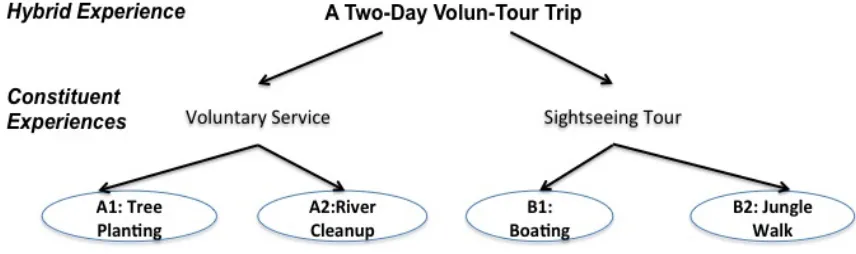
another. In Figure 2, I offer the example of a two-day voluntour trip as a hybrid
experience, because it consists of volunteering events (e.g., tree planting and river
cleanup) as well as sightseeing events (e.g., boating and jungle walk). More commonly,
one would expect volunteering and sightseeing events to be consumed as two
Figure 2: Example illustration of hybrid experience.
A hybrid experience is conceptually different from a complex experience. The
latter concept refers to a single experience that has more than one experiential dimension,
such as social, cognitive, or sensory dimensions (Gentile et al., 2007; Schmitt, 2010;
Tsiotsou & Goldsmith, 2012). My conceptualization of a hybrid experience refers to a
combination of two or more separate experiences, each of which may or may not be a
complex experience. A good example of a complex experience is wine tasting (Tsiotsou
& Goldsmith, 2012). For novice wine tasters, it is a novel sensory experience, intensively
involving many of the senses (sight, touch, smell, and taste). It is also a social experience
as wines tasters interact with hosts from whom they learn about different wines and with
other guests with whom they communicate their feelings about wine. It is also a cognitive
experience, as wine tasters improve their knowledge about wines. This complex
experience can be combined with other experiences, such as wine making, to make a
hybrid experience for consumers, but wine tasting alone is not a hybrid.
A hybrid experience is also different from a service constellation. The latter is a
combination of multiple interdependent experiences or services that are often produced
hybrid experience, but it also includes other services that are inter-related. For example, a
two-day voluntour trip is a hybrid experience, as it consists of volunteering and
sightseeing activities. To create a service constellation, this hybrid experience can be
combined with a transportation service that enables optimal time management during the
trip or a review service that facilitates prioritization of the activities in the trip. In other
words, a service constellation involves not only the core experience(s) to be consumed
but also services that enhance consumption of the core experience(s) and of which are
usually offered by different providers. For my dissertation, I focus only on hybrid
experiences and not service constellations.
2.5
Hybrid Experience
Structure
Although the categorization of experiences has been studied from at least three
different perspectives (i.e., top-down, network, and conceptual), there is agreement that
information about experiences is stored in memory as abstract knowledge, which could
take the form of scripts or memory organization packets (MOPs). MOPs are also scripts
but a more generalized form (Schank & Abelson, 1977; Schank, 1982). By definition, a
script is a hypothesized cognitive structure that organizes the way in which event-based
experiences are understood (Abelson, 1981). It consists of not only information on
experience categories (e.g., activity types), but also procedural information on
inter-correlated events that one performs in an experience (Tversky, Zacks, & Hard, 2008;
Tversky, Zacks, Morrison, & Hard, 2011; Zacks & Tversky, 2001). In the strongest
format of a script, order and the occurrence of events for an experience are ritualized and
strictly followed, such as in a Japanese tea ceremony. In a weaker format, a script
the script of “going to a movie” provides events and procedures usually involved in
executing the experience, such as “driving to the movie theatre,” “purchasing tickets,”
“entering the theatre,” and “watching the movie.” In a weak format, a script supplies a
bundle of the potential events without any predetermined sequence (Abelson, 1981). A
weak script format for a voluntary service experience might involve events like “tree
planting,” “river cleanup,” and “animal protection.” They are all potential events that
belong to the overall experience, but their sequential order is unnecessary for the
experience to occur (i.e., consumers can go through the three events in different orders).
The script-based knowledge of experiences enables structural flexibility. A hybrid
experience can therefore be structured integratively, sequentially, or alternately with its
constituent experiences. Differences among these structures arise from the extent to
which the consumption of the independent events of each constituent experience in a
hybrid temporally overlaps (see Figure 3). At one extreme, two constituent experiences
can be integrated and simultaneously consumed. An example of this type could be a
dinner theatre event where attendants dine while watching a show. At another extreme,
two constituent experiences could be combined sequentially without any temporal
overlap, as in a two-day voluntour trip where the itinerary involves a full day of
sightseeing followed by a full day of voluntary service. Between these two extremes is a
hybrid model where the constituent experiences and their corresponding events are
consumed in an alternating pattern, such as having both voluntary services and
sightseeing tours integrated in each of the two days of the voluntour trip. To illustrate,
assume that a hybrid experience is composed of constituent experiences A and B, each
would be shown as A1A2B1B2, while the alternating structure would be illustrated as
A1B1A2B2.
Figure 3: Temporal variation in hybrid experience structure.
In the next section, I review the literature relating to service bundling and
complementarity, and then define the concept of complementarity inference that is
foundational to my thesis.
2.6
Complementarity Inference
I define a complementarity inference as a judgment that a consumer makes about
the added value generated from pairing two experiences, based on the conceptualization
of complementarity from Popkowski Leszczyc, and Häubl (2010). When a hybrid
experience is structured alternately (vs. sequentially), there is the possibility of a greater
number of complementarity inferences to be generated; this may lead to an enhanced
experience evaluation. For example, consider that volunteering and sightseeing activities
are structured alternately in a voluntour trip, such as scheduling a boating tour after tree
planting. Consumers may infer that boating may feel more rewarding after working hard
inferences could relate to functional, economic, and emotional/sensory evaluations, each
of which will be illustrated using examples below.
In the field of microeconomics, complementarity is often measured through
cross-price elasticities. In essence, goods are considered complements if a change in the cross-price
of one good leads to a change in the quantity demanded of the other. For instance, if the
price of gasoline increases and consumption falls, the consumption of motor oil will fall
(Pindyck & Rubinfeld, 2001). The marketing literature regards complementary goods as
those consumed jointly to fulfill different aspects of a consumer’s need, such as coffee
and donuts (Lattin & McAlister, 1985). The notion of complementarity has also been
extended beyond product-level descriptions to describe the marginal utility one feature
can add in the presence of another (e.g., adding tartar protection to a toothpaste that
already has the cavity prevention feature; Chernev, 2005, p. 749).
Implicit in the marketing literature is the idea that consumers can easily generate
complementarity inferences with complementary products, services, or product features
(Telser, 1979; Harlam et al., 1995; Popkowski Leszczyc & Häubl, 2010). Inferencing
refers to the construction of meaning that goes beyond the information explicitly given
(Harris, 1981). Because most stimuli used in this research involve well-established
complementary pairs, such as VCRs and videocassette tapes (Gaeth et al., 1990),
shampoos and conditioners (Harlam et al., 1995), or a centralized security system and an
alarm system bundled in a package (Hermann, Huber, & Coulter, 1987), the inferencing
process has been assumed to be automatic and, thereby, not of focal interest to consumer
(2007). They found that consumers deliberately infer the value (i.e., quality) of one item
in a bundle based on that of another bundled item. Interestingly, this inferencing takes
place even if the two bundled items are neither substitutes nor complements. This finding
suggests that consumers may also engage in an effortful inferencing process to evaluate
experience bundles, of which may be relevant to the hybrid experiences I investigate.
So far, consumer research has tended to focus on only one of the dimensions of
complementarity inference—the functional value of the combinations (Gaeth et al., 1990;
Harlam et al., 1995; Hermann et al., 1987). This emphasis on functional complementarity
is partially due to the nature of products examined. For example, complementarities
inferred from combinations such as VCRs and videocassette tapes are often thought of as
being functional, such as enhanced product usefulness and quality (Gaeth et al., 1990).
Other research has looked at economic considerations, suggesting that purchasing a
complementary combination is anticipated to effectively save time, effort, and money
(Guiltinan, 1987; Simonin & Ruth, 1995). For instance, the observation that the
consumers’ preferences for a combined offering of oil and filter changes at the same gas
station suggests that consumers see additional value in saving time and effort by making
a combined purchase (Guiltinan, 1987). While both functional and economic dimensions
are relevant in the consumption of experiences, I propose that complementarity
inferences may also involve sensory and emotional aspects. For example, sensory or
emotional complementarity inferences may arise when scheduling a boating event
between tree planting and river cleanup events in a voluntour trip. Consumers may infer
that boating in the river will be rewarding and relaxing after planting trees, but the
the significance of helping with river cleanup the following day. In other words, a greater
number of sensory and emotional inferences may be generated by having three
independent events sequenced in such a way.
In the following chapter, I use the concepts of hybrid experiences, experience
structure, and complementarity inferences to develop my theory and generate hypotheses.
Specifically, I demonstrate how and why preferences for hybrid experiences may vary as
Chapter 3
3
Theoretical Development
I propose and show that a greater number of complementarity inferences will be
generated when a hybrid experience is structured alternately, and this will in turn enhance
experience evaluations (see Figure 4). My theorizing is motivated by three converging
streams of research. Script theory indirectly suggests that the processing of a hybrid
experience may be contingent on its structure (Abelson, 1981). That is, when structured
sequentially, the constituent experiences of the hybrid will be processed largely
independently from each other. When the hybrid is structured alternately, however, the
conversational implicature literature (Grice, 1975; Schwarz, 1996) suggests that
individuals will generate complementarity inferences to meaningfully integrate events
from different constituent experiences. Similar to Goode et al. (2010), it is expected that
the more inferences that are generated, the more benefits individuals will associate with
the hybrid experience, and the more favourably the experience will be evaluated.
3.1
The Role of Script Theory and Conversational
Implicature
To determine the completion of an experience is to judge whether or not all
anticipated events in the experience have been finished. Once the experience is complete,
adding another event does not exert any effect on the finished experience; instead, the
added event is viewed as a separate experience in itself or as the beginning of a new
experience. With a voluntour trip, once all of the volunteering events are finished,
consumers would perceive this constituent experience to be complete. Adding a
sightseeing event, such as boating, to the end of the trip, would not likely alter the
number of inferences generated for the volunteering or boating events. While there is
general agreement regarding what constitutes a completed experience (Tversky et al.,
2008), it remains unclear as to how consumer learning and evaluations would be affected
if an unrelated event (e.g., boating) were scheduled between volunteering events. To
address this, it is necessary to understand how individuals generate inferences when
learning about experiences, especially those with script-inconsistent (i.e., unrelated)
events as with the boating and volunteering example.
Although an experience script also involves the executive order of anticipated
events (i.e., the sequence in which events are executed), both its content and structure are
quite malleable (Abelson, 1981). This is because individuals actively engage in
gap-filling procedures to understand encountered experiences (an inferencing process noted
by Abelson [1981]). Inferences about a new experience can be made based on existing
scripts of comparable experiences stored in memory, and/or generated ad hoc based on
comprehension of new but familiar experiences even if the event sequence of the
encountered experience is atypically arranged (Lichtenstein & Brewer, 1980) or if
important events are omitted from the experience (Bower, Black, & Turner, 1979). To
illustrate, think about the experience of going to a movie. The script includes “driving to
the movie theatre,” “purchasing tickets,” “entering the theatre,” and “watching the movie.”
Now imagine an occasion where the event “purchasing tickets” is arranged to come after
“watching the movie.” Would this atypical sequence arrangement impede people’s
understanding of the experience? Script theory would suggest no. Because individuals are
familiar with the film watching script, they are able to rely on the memorized script to
infer that all the described events, albeit atypically ordered, are still present. At the same
time and to make sense of the atypical sequence, consumers may also infer that the
cinema is running a sales promotion for films where customers pay whatever they want
after watching the movie. Similarly, omitting the event of “purchasing tickets” from the
description is not expected to hinder experience comprehension either, as individuals may
understand event omission by inferring that the person may have a coupon or a free pass.
Do consumers generate ad hoc inferences to understand experiences that consist
of script-inconsistent events? With the hybrid experiences investigated in my dissertation,
script-inconsistency is most predominant with alternately structured experiences (e.g.,
A1B1A2B2). With this level of script-inconsistency, it is unclear as to how the generation
of inferences by consumers would be affected. To date, it has only been shown that
script-inconsistent events are marked with distinct tags and stored in memory separately
from experience consistent events; thus, resulting in greater accuracy when recalled later
memory perspective of script-inconsistency offers little insight into how the inference
generation process might be affected by script-inconsistency.
Anecdotally, it would seem that people also generate ad hoc inferences to
understand the details and benefits of an experience with script-inconsistent events.
Consider watching a romantic comedy at the theatre. Imagine being offered a nice cup of
latte between the events of “entering the theatre” and “watching the movie.” Clearly, this
new event is not typical in a script that involves film watching. However, it will not likely
be difficult for consumers to draw their own conclusions as to why such an atypical event
was involved. In other words, I expect this novel event may spur the generation of
additional inferences. People may infer that the theatre wants them to feel more
comfortable and romantic by pairing a latte with a heart design in the foam with the
romantic comedy they are going to watch. Further, by generating ad hoc inferences to
resolve script inconsistency, consumers may find the experience more appealing as new
benefits are inferred. I next turn to conversational implicature research for indirect
theoretical support.
The conversational implicature literature assumes that all information provided by
individuals during a conversation is relevant. This assumption allows people to engage in
a sense-making process to understand information that might otherwise be seen as
uninformative or ambiguous. This inferencing process has been used by participants to
make sense of research experiments (Schwarz, 1996) and by recipients to understand
various marketing communications (Miller & Kahn, 2005). That is, any and all
where a consumer is learning about a new experience, the conversational implicature
literature suggests that individuals may view all events involved in a particular
experience to be relevant. Consequently, individuals will try to understand the experience
by generating ad hoc inferences intended to bridge all the events together. In the example
of going to a movie, consumers may have assumed that the event of “being offered a cup
of latte” should be relevant to the experience. Motivated by this assumption, they engage
in a process to make sense of this new event, which may lead to inferences that the
theatre pairs free latte with romantic comedies to enhance consumers’ film-watching
experience.
Taken together, script theory suggests that when a script-inconsistent event is
added to the end of an existing experience, it will be processed separately from the focal
experience. For example, if the event of “being offered a cup of latte” is added after the
event of “watching the movie”, it will be processed, in large part, independently from the
film watching experience. Movie-goers will not actively attempt to link the latte to
watching the movie. Watching the movie will be perceived as enjoyable, and drinking a
free latte will also be perceived as enjoyable. On the other hand, if a script-inconsistent
event is included among the events of the focal experience, the conversational
implicature literature suggests that individuals will generate ad hoc inferences to
meaningfully integrate the inconsistent event. If “being offered a latte” is scheduled
between “entering the theatre” and “watching the movie”, consumers may infer that the
free latte is offered as a token of customer appreciation. As stated before, consumers may
also infer that drinking a latte with a heart design in the foam while watching a love
the value of the script-inconsistent event itself (e.g., having a cup of latte is enjoyable) to
demonstrate that complementarities could arise when a script-inconsistent event is
incorporated into an otherwise unrelated experience.
This theoretical reasoning is critical to understanding what drives preferences for
sequentially or alternately structured hybrid experiences. When two constituent
experiences of a hybrid are structured sequentially (e.g., A1A2B1B2), each constituent
experience will be processed independently. When events from the constituent
experiences are structured in an alternating manner (e.g., A1B1A2B2), overall
comprehension of the hybrid experience will involve inference generation that is likely to
be motivated by a process attempting to reconcile script inconsistency. For example, if
volunteering and sightseeing activities are structured sequentially in a voluntour trip, they
will be mainly processed independently from each other with few inferences generated to
integrate the constituent experiences. As a result, consumers may feel that the voluntary
service is meaningful, and the sightseeing tour is fun. On the other hand, if volunteering
and sightseeing activities are structured alternately, such as scheduling the boating tour
between tree planting and the river cleanup, more integrative inferences may be
generated. After working hard at tree planting, boating may feel rewarding and more
relaxing. In addition, the beautiful views of the river seen while boating may help people
further appreciate the significance of the river cleanup scheduled the following day.
Finally, scheduling a jungle walk after the river cleanup may increase one’s connection
with nature, as both activities take place in the same day. These inferences go beyond the
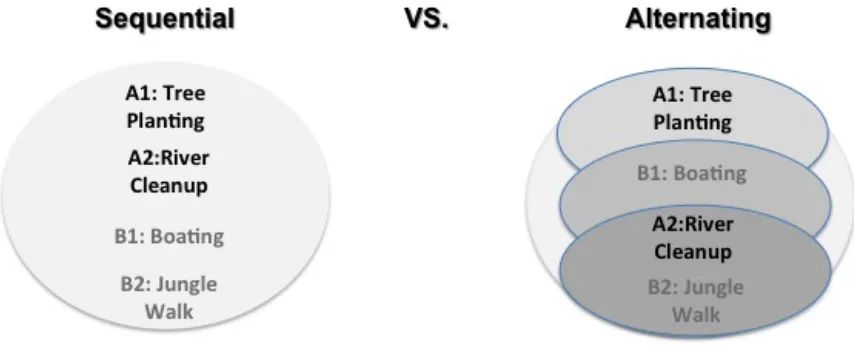
value of each constituent experience (voluntary services and sightseeing tours). In Figure
sequentially and alternately structured voluntour trip. Each circle in the figure represents
the places in the trip where complementarity inferences are expected to be generated.
Figure 5: Visual illustration of complementarity inferences for a voluntour trip.
Further, the greater the number of complementarity inferences generated, the
more favourably a hybrid experience will be evaluated. Inferences and the extent to
which inferences are generated have been found to increase evaluations of products and
brand extensions probably due to increased comprehension and appreciation of benefits
(Goode et al., 2010; Maoz & Tybout, 2002; Moreau et al, 2001; Mukherjee & Hoyer,
2001). I also expect that complementarity inferences will be generated when consumers
learn about a sequentially structured hybrid experience. Consumers almost always
generate inferences to understand a new marketplace offering. However, I propose that an
alternately structured hybrid experience will lead to a greater number of complementarity
inferences as a result of the consumer trying to meaningfully integrate a staggered
schedule of events. With a sequentially structured hybrid experience, consumers may still