Available Online atwww.ijcsmc.com
International Journal of Computer Science and Mobile Computing
A Monthly Journal of Computer Science and Information Technology
ISSN 2320–088X
IJCSMC, Vol. 4, Issue. 1, January 2015, pg.314 – 319
RESEARCH ARTICLE
A Comparison of Thresholding Based
Image Enhancement Techniques
Rajat Butola
1, Sparsh Pratik
2, Upendra Kumar*
1Department of Electronics & Communication, Amity University Haryana, India
2Department of Electronics & Communication, Amity University Haryana, India
*Department of Electronics & Communication, Amity University Haryana, India
Email Id- 1 [email protected], 2 [email protected], * [email protected]
Abstract - Image Enhancement is a vast area of Image Processing with its applications in different areas. Image Enhancement is used to transform digital images to enrich the visual information inside it. It is an initial operation for almost all vision and image processing assignment in several areas such as computer vision, biomedical image Processing, forensic image analysis, remote sensing and fault detection. In image enhancement certain transformations are applied upon an input image to obtain a visually more acceptable, more comprehensive and less noisy output image. In this paper four histogram equalization based Image Enhancement Techniques, CHE (Conventional Histogram Equalization), BBHE (Brightness Preserving Bi-Histogram Equalization), DSIHE (Dual Sub-Image Histogram Equalization) and MMBEBHE (Minimum Mean Brightness Error Bi-HE), are compared. All these techniques are based on partitioning of histogram of image and then equalizing each part separately. These techniques are assessed qualitatively and after examining output image visually, we see if it retains an appearance which is perfectly natural.
Keywords:BBHE, Brightness, DSIHE, Histogram Equalization, MMBEBHE, Thresholding Technique.
1 INTRODUCTION
on the probability distribution of the input gray levels [8]. When we apply HE in a digital image it simply distributes all the pixels equally throughout the gray level range. So after HE each gray level has almost equal number of pixels. So the mean of image is always middle gray level in spite of the nature of image i.e. whether the image is a dark image or bright image [10]. Actually this is the main drawback of Histogram Equalization technique that it shifts the mean of output image regardless the mean of input image. In effect the mean of histogram equalized image is always the middle gray level.
So if HE is applied in those images which have background either completely dark or completely bright the mean changes drastically and image experience unnatural changes. This reduces the quality of image further instead of enhancing it. So merely applying Histogram Equalization blindly in all images does not solve the purpose. Therefore when HE is applied in digital images the aim should be to retain the mean of the output image.
Some improved histogram equalization have been introduced such as Brightness Preserving Bi-histogram Equalization (BBHE), Dualistic sub-image histogram equalization (DSIHE) and Minimum Mean Brightness Error Bi-histogram Equalization (MMBEBHE), which enhance the quality of image and also preserve the mean.
In BBHE the histogram of input image is divided into two equal parts based on input mean. The input mean is called threshold point. Each part is then equalized separately and the above problem of brightness preservation is resolved [6]. In DSIHE input image‟s histogram is separated in two parts from the point where each part has equal area or image pixels. MMBEBHE is the novel extension of BBHE that provides maximum brightness preservation. These techniques are upgraded version of conventional histogram equalization, which utilize separate equalizations of sub-images obtained by decomposing the input image.
2 HISTOGRAM EQUALIZATION TECHNIQUES
2.1 Conventional Histogram Equalization (CHE)
Histogram equalization is a simple and effective method for image enhancement. Based on the original gray level distribution of image, histogram of the image is reshaped into a different one with uniform distribution property in order to increase the contrast [19]. The essentiality of histogram equalization is to decrease the number of gray levels so that the contrast of the image can be enhanced.
Let X = { X ( i ,j ) } denote a given image composed of L discrete gray levels denoted as:
{X0, X1, … XL-1}
where X ( i , j ) represents an intensity of the image at the spatial location ( i , j )
and X ( i , j ) ϵ { Xk,X1, ……XL-1 }.
For a given image X, the probability density function p(Xk) is defined as
for k = 0 , 1 , . . . , L - 1, where nk represents the number of times that the level Xk appears in the input image X and n is the total number of samples in the input image [23][19]. Note that p(Xk) is associated with the histogram of the input image which represents the number of pixels that have a specific intensity Xk. The plot of nk vs Xk is known as the
histogram of X. Based on the PDF (probability density function), we describe the cumulative density function as:
2.2 Brightness Preserving Bi-Histogram Equalization (BBHE)
A novel extension (Brightness Preserving Bi-Histogram Equalization) of histogram equalization is proposed to overcome such drawback of the histogram equalization. The essence of BBHE algorithm is to utilize independent histogram equalizations separately over two sub images (Fig.1) obtained by decomposing the input image based on its mean with a constraint that the resulting equalized sub-images are bounded by each other around the input mean [3]. It will be shown mathematically that the proposed algorithm preserves the mean brightness of a given image significantly well compared to typical histogram equalization while enhancing the contrast and, thus, provides much natural enhancement that can be utilized in consumer electronic products. Denote byXm, the mean of the image X and assume that
Xm ϵ { Xo,X1, ……XL-1 }
based on the mean, the input image is decomposed into two sub images XL and XUas
X = XL U XU.
Note that the sub image XLis composed of:
(Xo,X1, ……Xm,)
and the other sub imageXUis composed of :
(Xm+1,Xm+2, ……XL-1)
Fig. 1. The Functional Block Diagram of the BBHE
Based on these transform functions, the separated sub images are equalized independently and the composition of the resulting equalized sub images constitutes the output of the BBHE. That is, the output image of the BBHE, Y, is finally expressed as:
Y= fL(XL) U fU(XU)
If we note that 0≤ CL(x), CU (x) ≤1 it is easy to see that fL(XL) equalizes the sub image XL over the range (X0, Xm) whereas fU(XU) equalizes the sub image XU over the range (Xm+1, XL-1). As a consequence, the input image X is equalized over the entire dynamic range (X0, XL-1) with the constraint that the samples less than the input mean are mapped to (X0, Xm) and the samples greater than the mean are mapped to (Xm+1, XL-1).
2.3 Dualistic Sub-Image Histogram Equalization (DSIHE)
In this technique also we do the same thing as in BBHE, but here the original image is segmented into two equal area sub-images based on its gray level probability density function [5]. After that the two sub-images are equalized independently, and then we get the resultant image after the processed sub-images are composed into one image. This algorithm not only effectively enhances the image visual information, but also constrains the original image's average brightness from great shift. That makes it possible to be utilized in video system directly.
Assuming that image X is decomposed by a section with gray level of X=XT, and the two sub-images are XL, and XU, Where
XL = {X(i, j) │X(i, j) > XT, X(i, j) X }
and XU = {X(i, j) │X(i, j) ≥ XT, X(i, j) X }
The rest calculations will remain same as in previous technique.
2.4 Minimum Mean Brightness Error Bi - Histogram Equalization (MMBEBHE)
However, there are still cases that are not handled well by BBHE, as these images require higher degree of preservation [4]. A novel extension of BBHE referred to as Minimum Mean Brightness Error Bi-Histogram Equalization (MMBEBHE) is proposed to provide maximum brightness preservation. BBHE separates the histogram of the input image into two based on input mean before equalizing them independently. But in this technique the separation is done by the threshold level, which gives minimum Absolute Mean Brightness Error (AMBE - the absolute difference between input and output mean). An effective recursive integer-based computation for AMBE has been formulated to facilitate real time implementation [5]. Simulation outcomes using
sample image which represent images that have too low, too high and medium mean brightness show that the cases which are not managed
well by HE, BBHE and Dualistic Sub Image Histogram Equalization (DSIHE), can be properly enhanced by MMBEBHE [4].
2.4.1 Algorithm for MMBEBHE
1. Calculate the AMBE for each of the threshold level as:
AMBE = | E(X) – E(Y) |
2. Find the threshold level, XTthat yield minimum AMBE.
3. Separate the input histogram into two based on the XT found in step 2 and equalized them independently as in
3.RESULT &DISCUSSION
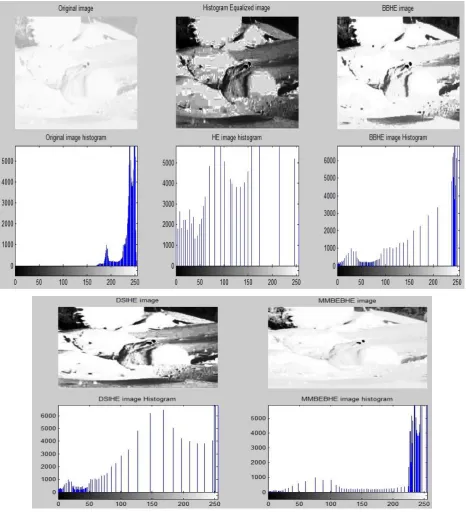
The previous sections describes methods which use Histogram Equalization for preserving the brightness of gray-level images and also enhance the contrast. Now Fig.2 below shows, for the input images, the output images and respective histograms produced by these HE methods.
4.CONCLUSION
We see above contrast enhancement algorithms referred to as BBHE and DSIHE is simulated. These techniques are novel extension of typical histogram equalization. They equalize histogram of image independently over two sub images obtained by decomposing the input image. The ultimate goal behind the BBHE and DSIHE is to preserve the mean brightness of a given image while enhancing the contrast of the image. The simulation results shown above indicate that MMBEBHE better preserve the brightness than HE, BBHE and DSIHE.
So, it is noticed that the cases where the background is completely dark or bright, and are not handled well by HE, BBHE and DSIHE the MMBEBHE gives better result. These types of images generally require higher degree of brightness preservation to avoid annoying artefacts. MMBEBHE provides better brightness in these cases. The main idea lies on separating the histogram using the threshold level that would yield minimum Absolute Mean Brightness Error (AMBE). The ultimate goal behind the MMBEBHE is to allow maximum level of brightness preservation in Bi-Histogram Equalization to avoid unpleasant artefacts and unnatural enhancement due to excessive equalization while enhancing the contrast of a given image as much as possible. MMBEBHE demonstrate comparable performance with HE, BBHE and DSIHE.
R
EFERENCES[1] R. C. Gonzalez and R. E. Woods, „Digital Image Processing‟, 2nd Ed., Prentice Hall, 2002.
[2] K.Yeong-Taeg, „Contrast Enhancement Using Brightness Preserving Bi-Histogram Equalization‟, IEEE
Transactions on Consumer Electronics, Vol. 43, No. 1, pp. 1-8, 1997.
[3] Soong - Der Chen, A. R. Ramli, „Minimum Mean Brightness Error Bi-Histogram Equalization in Contrast
Enhancement‟, IEEE Transactions on Consumer Electronics, Vol. 49, No. 4, NOVEMBER 2003.
[4] S. D. Chen, and A. R. Ramli, „Contrast Enhancement using Recursive Mean-Separate Histogram Equalization for
Scalable Brightness preservation‟, IEEE Transactions on Consumer Electronics, Vol. 49, No. 4, pp.1301-1309, 2003.
[5] W. Yu, C. Qian, and Z. Baeomin, „Image Enhancement Based on Equal Area Dualistic Sub-Image Histogram
Equalization Method,‟ IEEE Transactions on Consumer Electronics, vol. 45, no. 1, pp. 68-75, 1999.
[6] G. Park, H. Cho, and M. Choi, „A Contrast Enhancement Method using Dynamic Range Separate Histogram
Equalization‟, IEEE Trans, 2008.
[7] Maini. R. and A. Himanshu, „A Comprehensive Review of Image Enhancement Techniques‟, Journal of
Computing, Vol 2, Issue 3, MARCH 2010,
[8] T.Singh., and Nagraja .M, „Enhancing Image Contrast of Mammogram & Equalization of Histograms‟
International Journal of Engineering Science and Technology, Vol. 3 No. 1 Jan 2011
[9] V. Govind, Arun, A. Balakrishnan and D. Mathew, “A Novel Approach for Contrast Enhancement and Noise
Removal of Medical Images,”accepted in 2013 International Conference on Control, Communication and Computing (ICCC 2013), College of Engineering, Trivandrum, 13 – 15 December 2013.
[10] P. Welling. S.H. Kim, S and B. Cho, “Brightness Preserving Contrast Enhancement using Polynomial Histogram
Amendment”accepted in 2012 SoC Design International Conference (ISOCC), pp. 41 – 44, 4-7 Nov. 2012. [11] Chauhan, Ritu, and Sarita Singh Bhadoria. "An improved image contrast enhancement based on histogram