Computerized Green House Data Acquisition
System Using Arduino with LabVIEW
Swarna Prabha Jena
1, Shanaz Aman
2, Rupanita Das
3Assistant Professor, Dept. of ECE, SOET,CUTM University, Jatani, Odisha, India 1,2,3
ABSTRACT: In this paper, the design had been aimed for data acquisition of Green house environment. In green house we use multiple sensors to measure the parameters, here in this we used DHT11 sensor, soil moisture sensor etc. to make use of data for simulation or processing to achieve the better enhancement of growth in green house, this data has effect on the environment of green house, Graphical User Interface (GUI) had been used through LabVIEW Firmware of Arduino Uno as software and Arduino Uno board and sensors as hardware by using Arduino Uno board provides multiple analog input and digital I/O to made read data sensor easy to take temperature, humidity, CO2 gas, also measuring the soil moisture that needed for irrigation plants and the intensity of lights that applied for greenhouse . These parameters has the major effect on increase growth plants [1]. The system for this purpose had been provided and given ability to control on environment of greenhouse
KEYWORDS: Arduino Uno, LabVIEW2010, Data Acquisition, DHT11, CO2 gas Sensor, Soil Moisture Sensor.
I.INTRODUCTION
The plant in greenhouse is highly affected by the surrounding environmental conditions. The important environmental parameters for the quality and better productivity of the plants growth are temperature, relative humidity, Lighting, moisture soil, and the CO2 amount in greenhouse. Continuous monitoring of these factors gives relevant information which leads towards obtaining maximum crop production[7]. Arduino Uno is an open-source electronics prototyping platform based on flexible, easy-to-use hardware and software. Arduino Uno can sense the surroundings by receiving input signal from a variety of sensors. Arduino Uno projects can be stand-alone or they can communicate with software running on a computer.
A greenhouse is seen as a multivariable process presents a nonlinear nature and is influenced by biological processes. The five most important parameters must be taken into consideration when design a green house are temperature, relative humidity, ground water, illumination intensity and CO2 concentration. This parameters is important to realize that the five parameters mentioned above are non linear, the computer control system for the greenhouse involves the following steps
1. Acquisition of data through sensors.
2. Processed data, compare it with desired states and finally decide to change the state of system. 3. Actuation component carrying the necessary action.
In this paper we describe a solution to the acquisition of data through sensors, where we interface Arduino Uno with LABVIEW2010.
II.RELATED WORK
The objective of the paper [6] is to design a simple, easy to install, AT89C51 Microcontroller based circuits to monitor and record the values of temperature, humidity, soil moisture which continuously modified and controllers in order to achieve maximum plant growth.
The main aim of the paper [1] is data acquisition in green house for multiple sensor to use data for simulation or processing to achieve the better enhancement of growth in green house. This is achieved by using GUI has been through LabVIEW, Firmware of Arduino as software and Arduino Mega and Sensors as hardware.
III. SYSTEM ARCHITECTURE
The System architecture for monitoring greenhouse shows in figure (1) below. The system design consists of two parts Hardware and Software
Figure (1): System Architecture
III. HARDWARE PART
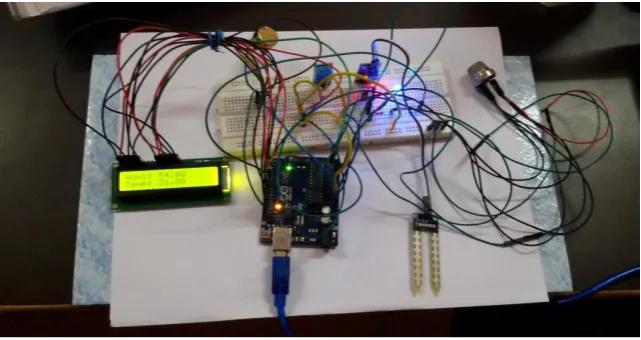
The core of the hardware part is the data Acquisition card that is used as a mean between PC and sensors circuit, Arduino Uno is used here for this purpose, which is shown in figure(2) below. The Arduino Uno is a microcontroller board which uses AVR ATmega328.It has 6 analog inputs pins and 14 digital input/output pins.
Figure (2): Hardware Set–up
IV. TEMPERATURE AND HUMIDITY SENSOR
decimal and integral portions. An entire data transmission is 40bit, and the DHT11 sends response as higher bit first. Also the time of sensor is very sensitive to distinguish zero and one bits as show in Figure (3) below.
Figure (3):DHT11 Communication Process
Data form: 8bit integral RH data + 8bit decimal RH data + 8bit integral T data +8bit decimal T data + 8bit check sum. If the data transmission is valid, the check-sum should be the last 8bit of "8 bit integral RH data + 8bit decimal RH data + 8bit integral T data + 8bit decimal T data". In the present work one of digital I/O of Arduino Uno is used for DHT11 sensor. By approach of a handshake the values are pulse out over the single digital line and connected GND and VCC as show in Figure (4).
Figure (4):DHT11 Sensor Interfacing with Arduino Uno
V. SOIL MOISUTRE, LIGHT AND CO2 GAS SENSORS
a) Soil Moisture Sensor
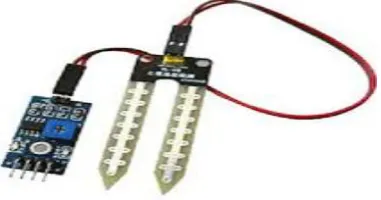
The Soil Hygrometer detection module moisture sensor had been used for greenhouse monitoring, this module has the important benefit in process of irrigation. The sensor as show in Figure (5)
Two approach in the soil moisture, less than a set threshold value when the D0 pin output high, when soil moisture surpass the threshold value is set, the module D0 pin output low, digital outputs D0 can be directly connected with the MCU, Arduino Uno to distinguish high and low, and thus to alarm about soil moisture. The output of the sensor goes into the analog pin A0 of the Arduino Uno through this connection the Arduino Uno can read the analog voltage output from the sensor. The Arduino Board has built in ADC so it is able to read analog values without any external ADC chip[1].
c) Lighting sensor
The Photo sensitive resistance module light sensor is used to adjust the amount of light need for irrigation[1], the condition circuit is same as the soil moisture sensor shown in Figure (5),we have connected light sensor with D7 digital pin of Arduino Uno which is shown in figure(1).
d) CO2 concentration
The CO2 Gas Sensor (MQ-2) is highly sensitive to Methane, Butane, LPG and Smoke. This sensor i s connected to analog input pin A1 and other pins of sensor is connected with Arduino Uno accordingly the figure (6) given below. We manually supply the heat to heat up the sensor.
Figure (6): CO2 Gas Sensor (MQ-2)
VI.SOFTWARE PART
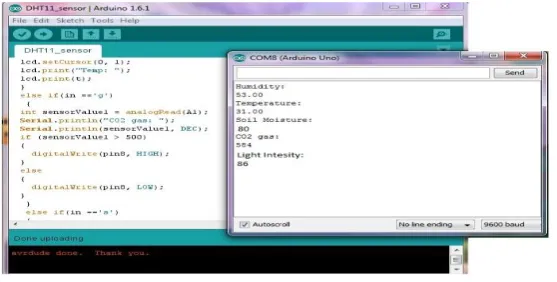
The hardware design had been completed and the next step is to define the software part, which is composed of two main parts. First part is downloading the code into the Arduino Uno using Arduino1.6.1 IDE and testing the above hardware set-up which gives different sensor values which is shown in given below figure(7)
Figure (7):Different Sensors Reading.
Arduino board. Once the data is in LabVIEW2010, it will be analyzed using the hundreds of built-in LabVIEW2010 functions, improve algorithms to control the Arduino hardware. The LabVIEW2010 tools kit feature is easy using Arduino digital input/output , analog input, I2C, and SPI from LabVIEW. We have tested the above Hardware set-up by writing code in Arduino1.6.1 IDE.
Figure (8):LIFA-BASE FIRMWARE
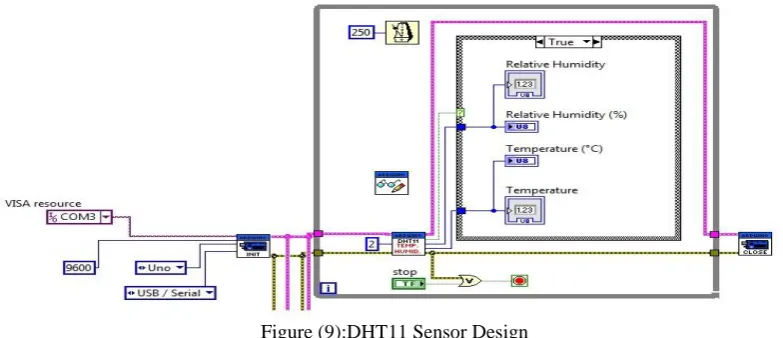
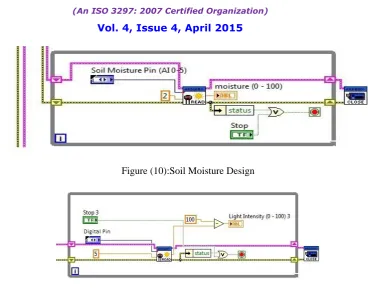
Now the firmware wrote in C\C++ language support all sensors in the greenhouse except the DHT11 sensor because this sensor is very sensitive for time (cannot process by LabVIEW [1], thus we needed to edit modified firmware by add two files to firmware one DHT11.cpp contain the main program of DHT11 sensor and declaration of parameters, DHT11.h contain process and function of DHT11 sensor, these files are called by main firmware. The software design of LabVIEW is a development environment which is the user graphical programming to interact with real world data. The block code shown in Figures (9,10,11,12) illustrate the design.
Figure (9):DHT11 Sensor Design
Figure (10):Soil Moisture Design
Figure (11):Light Intensity Design
The Figure (10,11) shown acquisition data of light and soil moisture and final Fig shown the CO2 concentration read from sensor.
FIGURE (12):CO2GAS SENSOR DESIGN
.
V. RESULT AND DISCUSSION
Figure (13): The temperature and humidity data measured in the greenhouse.
Figure (13) shows the measured value of temperature and relative humidity in green house. Humidity is temperature-dependent. Warm air has a higher moisture-holding capacity than cooler air; therefore as the temperature of air increases, the relative humidity decreases even though the amount of w ater remains constant. Air at 29° C will have 33% humidity.
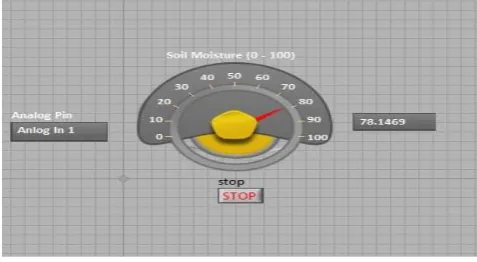
Figure (14): Soil Moisture Measured
Figure (14) shows the measured value of moisture in the soil. Since plant growth was highly correlated with the amount of water the plants received, monitoring soil water content through data acquisition system may be a feasible method for controlling the growth of rapidly elongating plants.
Light is a critical component to photosynthesis and proper plant growth. All other plant needs can be met in the greenhouse, but unless light is carefully evaluated and managed, plants will not grow properly and yields will be lower or fail entirely.
Figure (16): CO2 Gas Monitor
In additional the change of light intensity and carbon dioxide in Figures (15,16), we notice that the CO2 concentration is very low because light intensity is high .
VIII.CONCLUSION
Thus it allows the acquisition of data using Ardiuno Uno board with the ability of increasing the size and number of greenhouses by using one board because it has multiple analog inputs, digital inputs/outputs in additional to other specifications, and by designing and simulating in LABVIEW help us to monitor the green house remotely.
REFERENCES
[1] Diaa Mehdi Faris and Mahmood Basil Mahmood, "Data Acquisition of Green House Using Arduino ", Journal of Babylon university\Pure and Applied Sciences, vol.22,pp.1908-1916,2014.
[2] Anuj Kumar, Abhishek Singh, I. P. Singh, and S. K. Sud, "Prototype greenhouse environment monitoring system," Proc. International Multiconference of Engineers and Computer Scientists, Vol. II, pp.17-19, 2010.
[3] MAHMOUD OMID , .”A Computer-Based Monitoring System to MaintainOptimum Air Temperature and Relative Humidity in
Greenhouses”, International Journal Of Agriculture & Biology, Vol.6, pp.1084–1088,2004.
[4] Shi-feng Yang and Daudi S. Simbeye “Computerized Greenhouse Environmental Monitoring and Control System Based on LabWindows/Cvi
Journal Of Computers”, Vol. 8, pp.399-408, 2013.
[5] Putter, E. and J. Gouws, .“An automatic controller for a green house using a supervisory expert system”, Electrotechnical Conference,
MELECON 96, 8thMediterra-nean,Vol.2, pp.1160-1163, 1996.
[6] Kiran Sahu, Susmita Ghosh Mazumdar ,“Digitally Green House Monitoring and Controlling of System based on Embedded System”,
International Journal of Scientific & Engineering Research, Vol. 3, Issue 1, pp.1-4,January,2012.
[7] Robotics D UK, “DHT11 Humidity & Temperature Sensor”, www.micro4you.com/files/sensor/DHT11.pdf. 2010