Scholarship@Western
Scholarship@Western
Electronic Thesis and Dissertation Repository
9-27-2013 12:00 AM
Cognitive Activity Support Tools: Design of the Visual Interface
Cognitive Activity Support Tools: Design of the Visual Interface
Paul Parsons
The University of Western Ontario
Supervisor Kamran Sedig
The University of Western Ontario Graduate Program in Computer Science
A thesis submitted in partial fulfillment of the requirements for the degree in Doctor of Philosophy
© Paul Parsons 2013
Follow this and additional works at: https://ir.lib.uwo.ca/etd
Part of the Cognition and Perception Commons, Graphics and Human Computer Interfaces Commons, and the Instructional Media Design Commons
Recommended Citation Recommended Citation
Parsons, Paul, "Cognitive Activity Support Tools: Design of the Visual Interface" (2013). Electronic Thesis and Dissertation Repository. 1708.
https://ir.lib.uwo.ca/etd/1708
This Dissertation/Thesis is brought to you for free and open access by Scholarship@Western. It has been accepted for inclusion in Electronic Thesis and Dissertation Repository by an authorized administrator of
Cognitive Activity Support Tools: Design of the Visual Interface (Thesis format: Integrated Article)
by
Paul Parsons
Graduate Program in Computer Science
A thesis submitted in partial fulfillment of the requirements for the degree of
Doctor of Philosophy
The School of Graduate and Postdoctoral Studies The University of Western Ontario
London, Ontario, Canada
Abstract
This dissertation is broadly concerned with interactive computational tools that support the performance of complex cognitive activities, examples of which are analytical reasoning, decision making, problem solving, sense making, forecasting, and learning. Examples of tools that support such activities are visualization-based tools in the areas of: education, information visualization, personal information management, statistics, and health informatics. Such tools enable access to information and data and, through interaction, enable a human-information discourse. In a more specific sense, this dissertation is concerned with the design of the visual interface of these tools. This dissertation presents a large and comprehensive theoretical framework to support research and design. Issues treated herein include interaction design and patterns of interaction for cognitive and epistemic support; analysis of the essential properties of interactive visual representations and their influences on cognitive and perceptual processes; an analysis of the structural components of interaction and how different operational forms of interaction components affect the performance of cognitive
activities; an examination of how the information-processing load should be distributed between humans and tools during the performance of complex cognitive activities; and a categorization of common visualizations according to their structure and function, and a discussion of the cognitive utility of each category. This dissertation also includes a chapter that describes the design of a cognitive activity support tool, as guided by the theoretical contributions that comprise the rest of the dissertation. Those that may find this dissertation useful include researchers and practitioners in the areas of data and information visualization, visual analytics, medical and health informatics, data science, journalism, educational technology, and digital games.
Keywords
Co-Authorship Statement
Chapters 1 and 2 are my own original work in introducing the dissertation and providing a brief background. Chapters 3, 4, 6, and 7 werea collaborative effort with my
Acknowledgments
First and foremost, I would like to offer my sincerest thanks to my supervisor, Kamran Sedig. You have taught me how to be a scientist and a researcher, and what it means to do true interdisciplinary research. I am eternally grateful for your dedication. No one can hope for a better supervisor.
Special thanks goes to my examiners—Drs. Bob Mercer, Lu Xiao, Bethany White, and Judi McCuaig. Thank you for giving your time both before and during the examination, and for your helpful comments on the dissertation.
A special note of thanks goes to my beloved wife, Caity. Thank you for putting up with me these past few years when my research often left no time for other things! You are my best friend and my greatest supporter.
“In the temple of science are many mansions, and various indeed are they that dwell therein and the motives that have led them thither.”
Table of Contents
Abstract ... ii
Co-Authorship Statement ... iii
Acknowledgments ... iv
Table of Contents ... vi
List of Tables ... ix
List of Figures ... x
Chapter 1 Introduction... 1
1.1 Motivation ... 1
1.2 Structure of the Dissertation ... 4
1.3 References ... 5
Chapter 2 Background and Terminology ... 7
2.1 Conceptual and Theoretical Background ... 7
2.2 The EDIFICE Framework ... 7
2.3 Terminology ... 8
2.4 Acronyms... 9
2.5 Science, Design, and Creativity ... 10
2.6 References ... 11
Chapter 3 Interaction Design for Complex Cognitive Activities with Visual Representations: A Pattern-Based Approach ... 12
3.1 Introduction ... 12
3.2 Conceptual and Theoretical Foundations ... 18
3.2.1 Frameworks ... 18
3.2.2 Information and Information Space ... 19
3.2.3 Visual Representations ... 20
3.2.4 Complex Cognitive Activities, Tasks, Actions, and Events ... 22
3.2.5 Pragmatic vs. Epistemic Actions ... 24
3.2.6 Epistemic Action Patterns ... 25
3.3 The EDIFICE-AP Framework ... 28
3.3.1 Characteristics of EDIFICE-AP ... 28
3.3.2 Methodology ... 36
3.3.3 Catalog of Action Patterns ... 41
3.3.4 Integrated Scenario: A Sense Making Activity ... 48
3.3.5 Comparison to Existing Work ... 56
3.4 Summary and Future Work ... 58
3.5 Acknowledgements ... 62
3.6 References ... 62
Chapter 4 Adjustable Properties of Visual Representations: Improving the Quality of Human-Information Interaction ... 86
4.1 Introduction ... 86
4.2 Interactivity: Quality of Interaction ... 92
4.3 Human-Information Interaction in Complex Cognitive Activities ... 94
4.3.1 Complex Cognitive Activities as Emergent Phenomena ... 95
4.3.2 Structure and Process of Human-Information Interaction in Complex Cognitive Activities ... 96
4.3.3 Role of Interactive VRs in Performing Complex Cognitive Activities ... 99
4.4 Related Work ... 101
4.5 The EDIFICE-PVR Framework ... 103
4.5.1 Rationale ... 103
4.5.2 Identification and Development of Properties ... 105
4.5.3 Properties ... 108
4.5.4 Integrated Scenario: Epidemiological Analysis ... 123
4.6 Discussion ... 128
4.6.1 Comparison to Existing Work ... 130
4.7 Summary and Future Work ... 132
4.8 Acknowledgments ... 134
4.9 References ... 135
Chapter 5 Human–centered interactivity of visualization tools: Micro– and macro– level considerations ... 149
Chapter 6 Distribution of information processing while performing complex
cognitive activities with visualization tools ... 151
6.1 Abstract ... 151
Chapter 7 Common Visualizations: Their Cognitive Utility ... 153
7.1 Abstract ... 153
Chapter 8 Research Application: Design of a Cognitive Activity Support Tool... 155
8.1 Introduction and Motivation ... 155
8.2 Background and Context ... 157
8.2.1 Information Space ... 157
8.2.2 Tasks and Activities ... 158
8.2.3 Implementation Details ... 158
8.3 Design Process ... 159
8.3.1 Choice of Visual Representations ... 159
8.3.2 Interaction and Interactivity Design ... 160
8.4 Summary ... 171
8.5 References ... 171
Chapter 9 Summary, Contributions, and Future Work ... 173
9.1 Chapter Summaries and Contributions ... 173
9.2 General Contributions and Conclusions ... 177
9.2.1 Scientific and Research Contribution ... 177
9.2.2 Design Contribution ... 178
9.3 Future Work ... 178
9.3.1 Descriptive and Explanatory Models, Taxonomies, and Frameworks ... 179
9.3.2 Prescriptive Design Support ... 181
9.3.3 Empirical Studies ... 182
Chapter 10 Appendices... 184
10.1 Additional Action Patterns ... 184
10.1.1 Unipolar Actions ... 184
10.1.2 Bipolar Actions ... 203
10.2 List of Examined CASTS for EDIFICE-PVR ... 213
List of Tables
Table 3-1 Catalog of epistemic action patterns ... 41
List of Figures
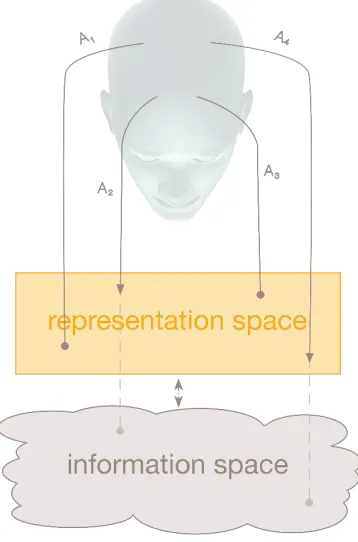
Figure 3-1 Action choices operating as mental tentacles to reach into an information space. ... 29
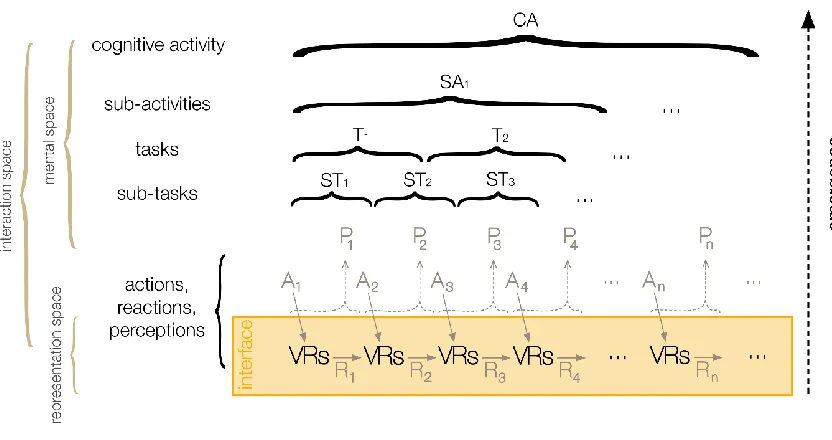
Figure 3-2 The hierarchical structure of a complex cognitive activity and its emergence over time. ... 30
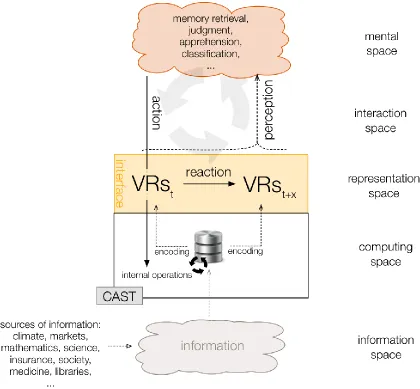
Figure 3-3 The human-information interaction epistemic cycle. ... 32
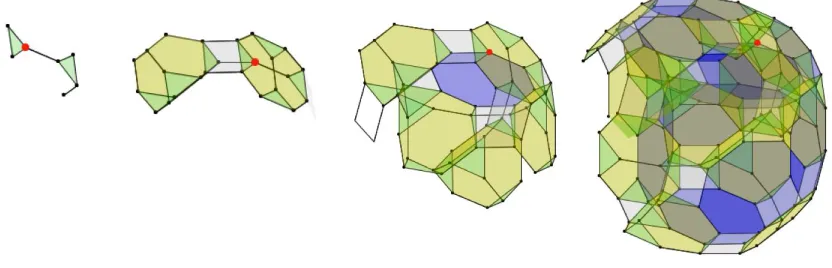
Figure 3-4 An implementation of the scoping pattern: Acting upon a VR of a 4D shape to explore its compositional structure. ... 44
Figure 3-5 An implementation of the translating pattern: Acting upon a VR to convert it from one form to another. ... 46
Figure 3-6 An implementation of the collapsing and expanding patterns: Acting upon a VR to fold in and fold out some of its constituent components... 48
Figure 3-7 Filtering a VR to display only stocks with high relative activity ... 50
Figure 3-8 Comparing the Microsoft and IBM stocks. ... 51
Figure 3-9 Arranging a VR to reorder it according to market capitalization (L) and trading activity (R). ... 52
Figure 3-10 Translating the Treemap VR (L) to an alternative form (R). ... 53
Figure 3-11 Different actions allow the user to operate on represented information in different ways, and to mentally 'reach into' an information space. ... 55
Figure 3-12 Emergence of the overall sense making activity over time from the
performance of actions, tasks, and activities. ... 56
Figure 4-2 The performance of a cognitive activity through information discourse that is
mediated by a CAST. ... 101
Figure 4-3 Adjusting the value of complexity of a VR. ... 111
Figure 4-4 Adjusting the value of configuration of a VR. ... 113
Figure 4-5 Adjusting the value of density of a VR. ... 114
Figure 4-6 Adjusting the value of geometric fidelity of a VR. ... 117
Figure 4-7 Adjusting the value of fragmentation of a VR. ... 118
Figure 4-8 Adjusting the value of interiority of a VR. ... 120
Figure 4-9 Adjusting the value of scope of a VR. ... 121
Figure 4-10 Adjusting the value of type of a VR... 123
Figure 4-11 VR of disease occurrences and relationships (L). Adjusting the scope of the VR to locate the origin of the disease and determine its direction of spread (R). ... 125
Figure 4-12 Adjusting interiority value to encode latent information. ... 126
Figure 4-13 Adjusting values of properties during the performance of an analytical reasoning activity. ... 127
Figure 4-14 Considering the properties of EDIFICE-PVR in an integrated manner for design and evaluation. ... 127
Figure 8-1 The four VRs used in this tool to support the overall sense making activity.160 Figure 8-2 The result of arranging the VR according to departments to which individuals belong. ... 162
Figure 8-4 Successive stages of a scoping action, showing growth of the network until 2009 (L), 2010 (TR), and 2011 (BR). ... 163
Figure 8-5 An implementation of the searching pattern. ... 164
Figure 8-6 The result of the user translating the VR. ... 165
Figure 8-7 Adjusting the density setting of the VR to assist with identifying clusters of collaboration. ... 166
Figure 8-8 An implementation of the transforming pattern to adjust the appearance of the VR. ... 167
Figure 8-9 Adjusting the settings of the VR to increase the fragmentation (L to R). ... 168
Figure 8-10 Combining filtering and scoping to show co-publications between two departments until 2010 (L) and 2012 (R). ... 170
Figure 9-1 Major aspects of the dissertation as components of a coherent framework. . 176
Figure 10-1 An implementation of the annotating pattern: Acting upon a VR to add a layer of personal meta-information ... 186
Figure 10-2 An implementation of the cloning pattern: Acting upon a VR of a protein network to duplicate a portion of it. ... 190
Figure 10-3 An implementation of the measuring pattern: Acting upon a VR to quantify one of its angles. ... 195
Figure 10-4 An implementation of the navigating pattern: Acting upon a VR to move across its components. ... 197
Figure 10-5 An implementation of the searching pattern: Acting upon a VR to seek out the existence of items related to 'neck pain'. ... 198
Figure 10-7 An implementation of the composing/decomposing patterns: Acting upon VRs to bind them to create a VR of the human foot or to break them into constituent components. ... 207
Figure 10-8 An implementation of the gathering/discarding pattern: Acting upon VRs to place them into a temporary collection. ... 208
Chapter 1
Introduction
The general concern of this dissertation lies at the intersection of interactive
computational technology, informatics, and human cognition. While residing within the domain of computer science, this dissertation draws from research in the following areas: cognitive psychology, educational psychology, information visualization,
human-computer interaction, information science, and philosophy of mind. As a result of its interdisciplinary nature, ascribing a single, descriptive label to this dissertation is a difficult task. If one performs a search for the term human-centered (or –centric) within this dissertation, it will become evident that it is used consistently throughout to modify important concepts—e.g., as in human-centered: visualization, informatics, approach, perspective, research, and design. Thus, while this research is certainly concerned with technological issues, and may in particular contexts focus almost exclusively on them, the ultimate focus is always on how computational technology can best enhance and support the cognitive needs, preferences, and characteristics of its human users. Although the more particular concerns of this dissertation should become clear as one peruses its contents, this brief introduction will hopefully give the reader a general idea of what this dissertation is about.
1.1
Motivation
It is not uncommon nowadays to encounter concerns about how we manage and work with information, in both the popular and scholarly media and literature. Such concerns— often expressed idiomatically as information overload, information explosion,
consistently throughout history. Two thousand years ago, Seneca complained about the “abundance of books”, suggesting that it was “a distraction” (Blair, 2010, p. 15). Erasmus, living after the invention of the printing press, disdainfully longed for a place on earth that was exempt from the “swarms of new books” (Barker, 2001, p. 145). While their concerns were centered mostly on ‘inferior’ information being overabundant and more accessible than ‘useful’ information, such statements, along with a host of other recorded examples, attest to the enduring concern for how and why people access, manage, and use the information that is available to them in their own time.
Although historical antecedents exist, there seem to be at least two distinctive
characteristics of the information concerns with which we are currently challenged: 1) A much larger segment of the population than in any previous time is engaged in
information-intensive knowledge work in their daily lives. This includes, among others, scientists, clinicians, journalists, doctors, lawyers, librarians, students, engineers, policy makers, and analysts. While in previous times information overload was mostly the concern of scholars, this is perhaps the first time that such a concern is shared by and affects the general population. 2) The ubiquity of computational technology adds new dimensions to age-old information concerns. A large portion of the population—
including, but not even limited to, the aforementioned ‘knowledge workers’—regularly uses computational devices to access and work with digital information. Related to the ubiquity of computational technology is the proliferation of devices that are capturing data at a pace never seen before. Making sense of and analyzing such data—whether in the realm of genomics, climate science, astronomy, healthcare, education, urban
planning, agriculture, or otherwise—is becoming increasingly important for dealing with challenges of the 21st century.
Since the beginning of recorded history, human beings have utilized visual
remains constant: the use of visual representations to communicate information and to support the performance of cognitive activities. Such cognitive activities range from the simple (e.g., identifying the location of a food source with a cave painting) to the more complex (e.g., making sense of the origin and spread of a disease with a geospatial map). While present-day visual representations share many characteristics with ancient cave drawings and Enlightenment-era charts, modern computational technology—on which visual representations are being increasingly displayed—adds some significant features: namely, information processing, automation, and interactivity. One could say that modern computational technology has brought visual representations to life. These additional features, as will be demonstrated throughout the dissertation, add great potential for visual representations to support human cognitive activities—especially those at the more complex end of the spectrum.
In today’s information society, the aforementioned knowledge workers are constantly engaged in information-intensive, complex cognitive activities. Moreover, they regularly use interactive visual representations to support such activities. A quick survey of the literature of the past few years reveals a number of examples: social scientists using interactive visual representations to assist with social network analysis (e.g., Krempel, 2011); biologists using interactive visual representations for analysis of gene expressions (e.g., Melo et al., 2013); clinicians using interactive visual representations for decision support and promotion of evidence-based medicine (e.g., Mane et al., 2012); journalists using interactive visual representations for telling data-driven stories (e.g., Weber & Rall, 2012); policy makers using interactive visual representations for predicting climate change impacts and developing policy responses (e.g., Bennett et al., 2012); and many other examples too numerous to list here. While once a marginal interest of only a small group of computer scientists, psychologists, and statisticians, interactive visual
representations are now entering the lives and discourse of seemingly all knowledge workers. Therefore, if we are to effectively deal with the information challenges of our time, we would do well to carefully investigate the use of interactive visual
1.2
Structure of the Dissertation
The rest of this dissertation is broken into 8 chapters as follows:
Chapter 2 briefly discusses the issue of conceptual and theoretical background for the dissertation, clarifies the use of some synonymous terms, and briefly discusses the intention of the research presented herein with regard to its scientific contribution and its role in supporting design.
Chapter 3 syncretizes a number of foundational concepts related to interaction and complex cognitive activities into a coherent theoretical framework. Included in the framework is a catalog of 32 fundamental epistemic action patterns, with each action pattern being characterized and examined in terms of its utility in supporting different complex cognitive activities.
Chapter 4 presents 10 properties of interactive visual representations that are essential, relational, and whose values can be adjusted through interaction. By adjusting the values of these properties, better coordination between humans and tools can be effected, leading to higher-quality performance of complex cognitive activities.
Chapter 5 presents a framework that analyzes interactivity, where interactivity is conceptualized as the quality of interaction. As interactivity is a broad and complex construct, it is categorized into two levels: micro and macro. Interactivity at the micro level emerges from the structural elements of individual interactions. Interactivity at the macro level emerges from the combination, sequencing, and aggregate properties and relationships of interactions as a user performs an activity. Twelve micro-level interactivity elements and five macro-level interactivity factors are identified and characterized.
identifies and elaborates upon some key concerns, integrates some fundamental concepts, and highlights some current research gaps that require future study.
Chapter 7 divides visual representations into six high-level categories, and discusses their perceptual and cognitive influences, with a concerted effort to identify utility for complex cognitive activities. Most typical visual representations are instantiations of one or a combination of multiple of these abstract categories.
Chapter 8 presents an application of the research in the previous chapters. In this
chapter, the design of the visual interface of a cognitive activity support tool is described. This chapter demonstrates how the research in this dissertation can enable systematic and principled design of interactive tools for supporting complex cognitive activities.
Chapter 9 draws some conclusions from the research reported in the previous chapters, postulates on the contributions of this research to the wider scientific community, and suggests some possible lines of future work.
It should be noted that while the dissertation can be read sequentially from beginning to end, particular chapters of interest can be read in isolation. Chapters 3,4,5,6, and 7 have been published individually, and each one is thus self-contained and meant to be read on its own.
1.3
References
Barker, W. (2001). The Adages of Erasmus. Toronto: University of Toronto Press Bennett, R., Senot, H., Pettit, C. J., Aurambout, J.-P., Sheth, F., Soste, L., & Sposito, V.
(2012). Using digital globes to visualize climate change impact. In W. Shi, M. F. Goodchild, B. Lees, & Y. Leung (Eds.), Advances in Geo-Spatial Information Science, pp. 205-218. London, UK: Taylor & Francis.
Blair, A. M. (2010). Too Much to Know: Managing Scholarly Information before the Modern Age. Newhaven, CT: Yale University Press.
Mane, K. K., Bizon, C., Schmitt, C., Ownen, P., Burchett, B., Pietrobon, R. & Gersing, K. (2012). VisualDecisionLinc: A visual analytics approach for comparative effectiveness-based clinical decision support in psychiatry. Journal of Biomedical Informatics 45(1), 101-106.
Massironi, M. (2002). The Psychology of Graphic Images: Seeing, Drawing, Communicating. Mahwah, NJ: Lawrence Erlbaum Associates.
Melo, C., Orphanides, C., McLeod, K., Aufaure, M.-A., Andrews, S., & Burger, A. (2013). A conceptual approach to gene expression analysis enhanced by visual analytics. In Proceedings of the 28th Annual ACM Symposium on Applied Computing (SAC ’13), Coimbra, Portugal, pp. 1314-1319. NY: ACM.
Chapter 2
Background and Terminology
2.1
Conceptual and Theoretical Background
In this dissertation each chapter is self-contained. Therefore, each one provides a conceptual background that is appropriate for its own content. In addition, Chapter 3 likely provides adequate background information for any reader to proceed with the rest of the dissertation. Although customary to provide a background chapter in which fundamental concepts and assumptions are explicated, to repeat this information here is unnecessary and would likely make for tedious reading. The reader can simply proceed to Chapter 3 to gain a conceptual and theoretical background necessary for comprehending the remainder of the dissertation. However, if the reader is interested in a very thorough background, the following sections should be perused: 3.1, 3.2, 4.1-4.4, 5.1-5.3, 6.1-6.3, 7.1, and 7.2. It is worth noting here that there is some repetition across the chapters, mostly concentrated in the background sections listed above. Such is an inevitable result of having self-contained chapters.
2.2
The EDIFICE Framework
elaboration on this issue). Thus the goal of EDIFICE is a general, comprehensive, and syncretic theoretical framework that can facilitate systematic research and design. The three chapters that comprise EDIFICE are Chapters 3, 4, and 5. As components of EDIFICE, they are given identifying acronyms: EDIFICE-AP (Action Patterns),
EDIFICE-PVR (Properties of Visual Representations), and EDIFICE-IVT (Interactivity of Visualization Tools), applying to Chapters 3, 4, and 5 respectively. Chapters 6 and 7, while not formal components of EDIFICE, are compatible with and complement the other chapters. A fourth component of EDIFICE, concerned with the systematic design of visual representations, is currently under development and should be available sometime in the near future.
2.3
Terminology
As each chapter of this dissertation was written for a particular audience and venue, different terms have been used to refer to the same underlying concepts. The main terms are listed below in an attempt to remove any confusion that may arise in the mind of the reader.
User, actor, human: User and actor are particular categories relative to the universal human, and thus emphasize certain characteristics of the universal concept—namely, in the context of this dissertation, humans that use or make use of a tool, and humans that act and perform activities with tools (see Section 4.1 for a brief comparison of these two terms). When the term human is used—e.g., as in human-centered design—it is generally used to emphasize more universal characteristics of humanness (e.g., perceptual and cognitive characteristics) rather than the particular habits or preferences of a certain group of users or actors. For the most part, however, it would not do any great harm to think of these terms as synonymous while reading this dissertation.
consistent vocabulary. When the term visualization is used in the existing
literature, it is often not clear whether it refers to a whole tool, to a process (as in the process of encoding, representing, or visualizing), or to an instance (i.e., a visual representation). In each chapter, distinctions have been made between visualization tool, visualization as a process, and visual representations (see also Section 7.2.1 for a brief discussion). The acronyms VT (Visualization Tool) and VR (Visual Representation) are frequently used. When the term visualization is used, the context should be sufficient to determine its meaning.
Visualization tool, cognitive activity support tool: Section 3.1 describes the motivation for inventing (as far as we know) and using the term cognitive activity support tool (CAST). Because CAST is not a widely used term in the literature, we have also used the term visualization tool (VT) in certain chapters, as it was more appropriate for the publication venue and audience. While there are
differences in these two terms, they can be treated as synonymous throughout the dissertation without any repercussions.
2.4
Acronyms
A complete list of acronyms used throughout the dissertation is given below.
CAST: Cognitive Activity Support Tool
EDIFICE: Epistemology and Design of human-InFormation Interaction in complex Cognitive activitiEs
EDIFICE-AP: Action Patterns
EDIFICE-PVR: Properties of Visual Representations EDIFICE-IVT: Interactivity of Visualization Tools VR: Visual Representation
2.5
Science, Design, and Creativity
One major goal of this research has been to encourage and facilitate a more scientific approach to the conceptualization and analysis of human-information interaction for complex cognitive activities, as well as to the design and evaluation of tools that support such activities. Accordingly, this dissertation shares the goals of all scientific
endeavors—to systematically and coherently explain, describe, and/or predict the
properties and relationships of some phenomena under investigation. Thus, although this research is intended to facilitate design, it is not geared towards purely subjective and arbitrary issues that tend to fall under the purview of the applied arts. However, although the concern here is with design based on scientific principles and coherent theoretical foundations, creativity in the design process is not precluded. In much the same way that an architect may use abstract principles of physics and mathematics to design a building, and yet still have infinite creativity at more concrete levels of design, designers of tools for supporting cognitive activities can use the research herein as a foundation for sound design, and still have a large degree of creativity at the level of implementation.
There is a long history in the area of design theory concerning the role of logic, rationality, and method in design (see Alexander, 1964, Cross, 1981, 2011; Gedenryd, 1998; Stolterman, 2008). Early attempts to turn design into a science seem to have given way to a more dichotomous attitude about the nature of science and design. As design theorist Nigel Cross has recently noted, designers and scientists have radically different goals: “Unlike the scientist, who searches for many cases to substantiate a rule, and then one case to falsify it, the designer can be gratified in being able to produce just one satisfactory case that gives an appropriate result.” (Cross, 2011, p. 28). This separation of goals does not, however, remove the possibility incorporating a scientific (i.e.,
process (Chapter 9 deals with this issue in more detail). A review of design studies suggests that designers appreciate and are inclined to use “frameworks that do not prescribe but that support reflection and decision-making”, and “high-level theoretical and/or philosophical ideas and approaches that expand design thinking” (Stolterman, 2008, p. 63). It is hoped that the research presented in this dissertation will not only motivate further scientific investigation, but will also inform designers and inspire them to create tools that extend the reaches of the human mind.
2.6
References
Alexander, C. (1964). Notes on the Synthesis of Form. Harvard University Press. Cambridge, MA.
Cross, N. (1981). Design method and scientific method. Design Studies, 2(4), 195-201. Cross, N. (2011). Design Thinking: Understanding how Designers Think and Work.
Berg, Oxford, UK.
Gedenryd, H. (1998). How Designers Think. Doctoral Dissertation. Lund University. Stolterman, E. (2008). The nature of design practice and implications for interaction
Chapter 3
Interaction Design for Complex
Cognitive Activities with Visual
Representations: A Pattern-Based Approach
This chapter has been published as Sedig, K. and P. Parsons (2013). Interaction Design for Complex Cognitive Activities with Visual Representations: A Pattern-Based
Approach, AIS Transactions on Human-Computer Interaction 5(2), 84-133.
Please note that the format has been changed to match the format of the dissertation. Figure numbers mentioned herein are relative to the chapter number. For instance, “Figure 1” corresponds to Figure 3-1. Additionally, when the term “paper” is used, it refers to this particular chapter.
3.1
Introduction
Many common activities nowadays are information-intensive and involve complex human cognition (Funke, 2010; Sternberg and Ben-Zeev, 2001). Such activities include decision making, problem solving, sense making, learning, and analysing, all of which can be referred to as complex cognitive activities (see Ericsson and Hastie, 1994). Knauff and Wolf (2010) identified two essential characteristics of complex cognitive activities: 1) the use of complex psychological processes, and 2) the presence of complex
memory. Furthermore, they may involve many variables that exhibit a high level of interdependence and may change over time.
In recent years, computational tools and technologies have become deeply embedded in the performance of many complex cognitive activities (Dascal and Dror, 2005). These technologies play two important roles: epistemic and ontic (Brey, 2005). In their epistemic role, they act as tools that extend, partner, supplement, and support human cognitive faculties and functioning by maintaining, operating upon, and displaying digital information. In their ontic role, they act as tools that extend the world and simulate it. In this paper, we are concerned with the epistemic role of these computational tools, particularly as it relates to the aforementioned complex cognitive activities. In this role, depending on the context and activity for which they are used, different terms are used to refer to them, such as cognitive technologies, decision support systems, knowledge support systems, cognitive tools, learning support tools, mind tools, and the like (e.g., Markus et al., 2002; Fischer and Sharff, 1998; Kim and Reeves, 2007; Bhargava et al., 2007; Sedig and Liang, 2008). As the focus here is on tools that mediate and enable complex cognitive activities, we unify all of them under one umbrella term to emphasize their epistemic support role, and will henceforth refer to all such tools as cognitive activity support tools (CASTs). In this context, the term ‘support’ suggests that CASTs can partner, distribute, augment, amplify, canalize, guide, offload, cognize with, shape, and/or transform human activities and thinking. Additionally, we broadly refer to people who use these tools as users, even though other terms, such as knowledge worker, learner, problem solver, analyzer, planner, or decision maker, can be contextually more accurate.
Sedig et al., 2012b). The information with which users of CASTs interact can originate from all kinds of concrete or abstract sources, such as genes and other biological phenomena, historical records, scientific experiments, mathematical objects and
processes, hospitals and medical clinics, research and social networks, library collections, and financial markets. For the purposes of this paper, the common feature of all CASTs is that they have a visually perceptible interface that mediates between a user and
information. This is done by providing interaction mechanisms through which users can access and process displayed representations of information as well as input new
information into the CASTs. Hence, these tools participate in the interplay between external representations of information and internal mental representations of users. Accordingly, the epistemic locus of CASTs is their information interface (Lovett and Shah, 2007; Sedig, 2008).
Viewed from this perspective, we can identify two main components that comprise the information interface of CASTs: representation and interaction (Sedig, 2004; Yi et al., 2007). Design of the representation component of CASTs is concerned with how
information can and should be encoded and displayed. The purpose of this component is to support users in their perceptual as well as their cognitive processing of the
information. Design of the interaction component of CASTs is concerned with what users can and should do with the represented information, what actions should be made
available to them to work and think with the represented information, and what their subsequent reactions should be. The focus of interaction design, then, is on the discourse that takes place between users and the represented information. It is through interaction with the represented information that users can restructure and modify the form and amount of displayed information in order to optimize and enhance its epistemic utility for performing complex cognitive activities. Hence, the representation and interaction
Although some fundamental concepts and techniques regarding representation and interaction design have been in place for a while (e.g., Bertin, 1983; Beynon et al., 2001; Lohse et al., 1994; Shneiderman, 1991; Tufte, 1983; Yi et al., 2007), many researchers suggest that we do not yet have a generalized, principled, and systematic understanding of the representation and interaction components of CASTs, and how these two
components should be analyzed, designed, and integrated to support complex cognitive activities. For instance, in their seminal report on visual analytics, Thomas and Cook (2005) stated that “we lack fundamental understanding of the basic principles for
effectively conveying information using graphical techniques” (p. 70), and that “although a lot of isolated design work has been done in specific aspects of interaction science, little systematic examination of the design space has been done” (p. 76). While this was stated a number of years ago, numerous researchers have more recently suggested that this is an extant issue. Consider the following statements:
“the process of stimulating and enabling human reasoning with the aid of interactive visualization tools is still a highly unexplored field.” (Meyer et al., 2010, p. 227);
“with all of this research, there is still a lack of precedent on how to conduct research into visually enabled reasoning. It is not at all clear how one might evaluate interfaces with respect to their ability to scaffold higher-order cognitive tasks.” (Green and Fisher, 2011, p. 45);
“we still know little about the effectiveness of graphic displays for space-time problem solving and behavior, exploratory data analysis, knowledge exploration, learning, and decision-making”. (Fabrikant, 2011, p. 1);
“there is hardly ever an explanation of what these benefits [of interaction] actually are as well as how and why they work.” (Aigner, 2011, p. 18); and,
“we have barely scratched the surface of this exciting new line of research [regarding interaction], and much work remains to be done.” (Elmqvist et al., 2011, p. 337).
practitioners in terms of understanding how these two components relate in the context of
performing complex cognitive activities. The relevant body of research dealing with these components is fragmentary and scattered across a set of disciplines (such as cognitive and learning sciences, information visualization, educational technologies, visual analytics, and human-computer interaction), often involving minimal interaction and collaboration between them.
Many researchers concerned with different facets of human-information interaction have recently suggested that a necessary theoretical substrate is not well developed (e.g., Fidel, 2012; Kaptelinin and Nardi, 2012; Liu and Stasko, 2010; Purchase et al., 2008; Sedig et al., 2013). Such is to be expected, however, as this is a relatively young research area. Indeed, it is typically the case that the theoretical scope of any scientific discipline expands to become generally applicable and to encompass a wide range of phenomena only after an initial phase of specialization and division (Bohm and Peat, 1987). While discussing the development of scientific theories, von Baeyer suggests that “increased abstraction is the hallmark of growing maturity” (2004, p. 36) of any scientific discipline. Recent emphasis on the need for a more coherent and abstract theory of interaction and its related areas may signify an important stage in the evolution and growing maturity of human-information interaction research. The development of such a theoretical
framework is one of the goals of this paper.
Throughout the past decade, a number of researchers have been working on the development of frameworks dealing with different aspects and levels of interaction design, such as benefits, costs, activities, techniques, and tasks (Amar et al., 2004; Amar and Stasko, 2005; Gotz and Zhou, 2008; Lam, 2008; Sedig and Sumner, 2006;
Shrinivasan and van Vijk, 2008; Liu and Stasko, 2010; Nakakoji and Yamamoto, 2003; Yi et al., 2007; Pike et al., 2009; Fast and Sedig, 2011). Much of this research has been in the context of specific domains and tools, such as visual analytics and information
values). As valuable as this research is, it has not been—and cannot be—generalized beyond these CASTs and their pertinent activities, tasks, representations, interactions, and users, to sufficiently address the theoretical need discussed above. For instance, an oft-quoted and valuable prescription “overview first, zoom and filter, details-on-demand” (Shneiderman, 1996), which is applicable to some information visualization tools, does not necessarily generalize to other types of CASTs and their related representations and complex cognitive activities (e.g., see Sedig et al., 2001).
This paper presents a framework that supports systematic thinking about interaction design for complex cognitive activities. The framework has been developed to have the following four important characteristics, which position it to address existing research gaps and challenges and to make a valuable contribution to the existing literature: 1) to be syncretic, unifying a number of previously disconnected ideas into a coherent theoretical model; 2) to be general, operating at a level of abstraction that is applicable to all kinds of technologies, activities, users, and visual representations; 3) to be comprehensive,
identifying patterns that cover an extensive range of actions; and, 4) to be generative, possessing the ability to motivate design creativity as well as to stimulate further theoretical and applied research.
No one framework or paradigm can address all possible tasks and situations (Purchase et al., 2008; Thomas and Cook, 2005). Accordingly, this paper is not complete in its
characterization, but is a part of a broader research agenda to develop a comprehensive, principled, and systematic framework concerned with the information interface of
CASTs, called EDIFICE (Epistemology and Design of human-InFormation Interaction in complex Cognitive activitiEs). This paper complements the other components of
EDIFICE, which include: 1) a framework dealing with the design of visual
representations, 2) a framework dealing with the analysis of the ontological properties of visual representations that affect the performance of complex cognitive activities, and 3) a framework dealing with the detailed analysis of the anatomical structure of an
interaction that takes place between a user and a CAST can be characterized at multiple levels of granularity (see Sedig et al., 2013). Such levels include macro-level activities, tasks, individual actions and reactions (i.e., interactions), and micro-level events. Even though this paper discusses interaction at all these levels, its focus is mainly on
interaction at the level of individual actions and reactions, dealing primarily with pattern-based characterizations of actions and their utility in supporting complex cognitive activities. Because this framework is human-centered, focusing on the action component of interaction, and because it takes a pattern-based approach, we will henceforth refer to it as EDIFICE-AP (where AP stands for Action Patterns).
The rest of this paper is divided into 3 main sections: 1) conceptual and theoretical foundations; 2) the EDIFICE-AP framework; and 3) summary and future directions.
3.2
Conceptual and Theoretical Foundations
This section serves a twofold function. First, it examines the utility of, and need for, frameworks; second, it identifies and explicates a number of terms and concepts that are necessary for discussing human-information interaction in the context of CASTs. These terms and concepts have been used in different contexts often with different meanings and connotations. It is necessary, therefore, to characterize them and examine their relationships before presenting the EDIFICE-AP framework.
3.2.1
Frameworks
explain (explain processes to support education), 3) predict (predict performance in different situations), 4) prescribe (suggest guidelines and best practices), and 5) generate (facilitate innovation). In the case of interaction design for CASTs, a framework
concerned with epistemic action patterns can serve each of these roles. Moreover, by classifying the space of potential actions and characterizing these actions, a catalog of action patterns can provide a common language for referring to potential actions, and can provide opportunities for their systematic analysis and comparison. As we try to design CASTs that require attentive, mindful engagement with information, some researchers are highlighting the importance of careful study of the transactions that users make as they interact with these tools (e.g., Kim and Reeves, 2007; Brey, 2005; Dascal and Dror, 2005; Thomas and Cook, 2005). A framework such as EDIFICE-AP can provide
investigators with a systematic support structure for thinking about these transactions. Without frameworks that organize and characterize fundamental aspects of the interaction design space, the approach to both research and practice must be largely ad-hoc and rely mostly on personal anecdotes and intuition.
3.2.2
Information and Information Space
Information can originate from many different sources (Bates, 2006). These sources can be concrete (e.g., a molecule), existing within a physical space, or abstract (e.g., financial markets), originating from a non-tangible, non-perceptible source. An information space is an environment, source, domain, place, or area of containment from which a body of information originates. The concept of information does not yet have a universally agreed-upon definition, and is defined in different ways depending on the context in which it is used (Marchionini, 2010). We adopt Bates’ (2005, 2006) definition of information—that information is the pattern of organization of matter and energy—e.g., physical objects, energy fields and forces, conceptual structures, and semantic
relationships. This definition of information is broad and encompasses all visible,
waves travelling through space have no meaning until they are interpreted in a contextual setting. As such, giving meaning to information and integrating it into other pre-existing mental forms is an essential feature of any complex cognitive activity (Bates, 2005; Sternberg and Ben-Zeev, 2001).
When performing complex cognitive activities, users often need to access and combine information from different sources. For instance, an analyst reasoning about a financial event may need to access financial records, historical reports, legal information, and social or business networks. As CASTs can mediate access to any blending of different sources of information in a seamless manner, in this paper the term information space refers to any source of information, whether simple and from a single domain or complex and spanning multiple sources. It is important to note that in some research areas, the term information space refers to a dataset or the data records in a database. In this paper, however, we use the term in its broadest sense, encompassing datasets and data records— whether structured or unstructured, homogeneous or heterogeneous, dynamic or static— as well as web logs, images, videos, text documents, and any other item or collection of items that contains information. For instance, an analyst could be working with multiple datasets, streams of incoming data, unstructured text documents, audio and video
recordings, and photographs, all of which are contained within the information space with which the analyst is concerned.
3.2.3
Visual Representations
Because CASTs are computational environments, all information within them, whether originating from concrete or abstract spaces, needs to be visually encoded in a
interface, they seldom encode the totality of an information space. VRs usually encode only a subset of an information space. To provide an example, an information space may consist of climate data from a 100-year period. A given VR would be unlikely to encode the whole space (information regarding temperature, humidity, rainfall, atmospheric pressure, meteorological measurements, and their trends, outliers, cycles, and changes, for example), but would be likely to encode only some subset of the whole space, such as trends in global temperature change or the relationship between temperature change and CO2. When VRs are made interactive, however, users can act upon them to alter the
manner in which information is encoded, such as by encoding hidden information, hiding encoded information, or interjecting new information.
In order to design, analyze, and evaluate VRs systematically, a common
items are encoded as simple visual marks. Using general systems theory, researchers and designers can not only discuss the structure of VRs and how their sub-systems relate to communicate emergent features of an information space, but can also discuss interaction design in a precise manner. If a VR has a particular number of sub-VRs at different hierarchical levels, for instance, designers can think about sub-VRs with which a user should be able to interact, how such interaction should take place, how the overall state of the system will be affected in terms of its entities, properties, and relationships, and how emergent features of an information space are communicated.
3.2.4
Complex Cognitive Activities, Tasks, Actions, and Events
Similar to VRs, complex cognitive activities can be regarded as hierarchical and
emergent in nature (Funke, 2010). In the context of CASTs, complex cognitive activities emerge from lower-level tasks, which emerge from lower-level actions, which emerge from lower-level events. In addition, each level may be classified at finer levels of granularity: a complex cognitive activity may include sub-activities, a task may include sub-tasks, and so on. For instance, the activity of triaging a set of documents to find out whether they are semantically related may be comprised of lower-level tasks such as scanning the documents, extracting information, building associations among similar information items, and comparing these items. The task of extracting information may involve such actions as selecting a document, opening it, navigating it, selecting some items in it, and copying some items from it. Each of these actions in turn can be implemented in many different ways and using different input techniques, all the way down to low-level events, such as mouse-clicks or gestures and touches at the physical level of the interface (see Sedig et al., 2013; Sedig et al., 2012a for a more detailed discussion of these different levels). In this paper, we are mainly concerned with actions and how different actions enable and facilitate higher-level tasks and activities.
cognitive activities are: analytical reasoning, problem solving, planning, sense making, forecasting, knowledge discovery, decision making, and learning (Bransford et al., 2000; Fildes et al., 2006; Funke, 2010; Hogarth and Makridakis, 1981; Klein et al., 2006; Knauff and Wolf, 2010; LeBoeuf and Shafir, 2005; Leighton and Sternberg, 2004; Mason, 2002; Morris and Ward, 2005; Sternberg and Ben-Zeev, 2001). Although future research is needed to explicate these activities in the context of interaction design, we briefly characterize three of them (analytical reasoning, problem solving, and sense making) to demonstrate their particular characteristics.
Analytical Reasoning. Analytical reasoning is a special type of reasoning. Reasoning itself refers to an activity in which information is used to draw inferences or conclusions (Leighton, 2004). In other words, reasoning can be seen as a transformative process in which new information is derived from the old, given information (Gilhooly, 2004). Analytical reasoning is based on rational, logical analysis and evaluation of information. It is an umbrella term covering many different kinds of reasoning: inductive, deductive, analogical, probabilistic, hypothetico-predictive, heuristic, syllogistic, categorical, and others (Halpern, 2003; Leighton and Sternberg, 2004). Analytical reasoning is a core concern of visual analytics (Thomas and Cook, 2005). As opposed to other complex cognitive activities, such as sense making and knowledge discovery, analytical reasoning is a structured, disciplined activity. Moreover, it is usually an iterative and non-linear process that involves tasks such as determining which resources to use, tracing and identifying cause-effect relationships, assessing the state of an information space, predicting future states of an information space, asserting and testing key assumptions, testing biases, and identifying and assessing alternatives (Heuer, 1999; Thomas and Cook, 2005).
desired goal (Morris and Ward, 2005; Thagard, 2000). Problem solving typically begins by constructing a mental representation of the information space—i.e., a set of possible states of the problem, the current state, and possible goal states—as well as identifying the possible actions that can be performed to bridge the gap between information states (Fischer et al., 2012). Problem solvers then use strategies to reach desired goals or sub-goals, which involves changing their internal, mental representations and/or changing external representations—i.e., VRs (Fischer et al., 2012). A common heuristic strategy is means-end analysis, in which the goal or sub-goal is compared to the current state, the difference between them is assessed, and an action is chosen to reduce the difference and to gradually bridge the gap between information states (Sternberg and Ben-Zeev, 2001).
Sense making. This activity is concerned with developing a mental model of an
information space about which one has insufficient knowledge (Dervin, 1992; Klein et al., 2006). Sense making often involves a sequential process of performing tasks such as scanning the information space, assessing the relevance of items within the space,
selecting items for further attention, examining them in more detail, and integrating them into mental models (Pirolli and Card, 2005). Other interlocking tasks and sub-tasks include discovering the space’s structure and texture (e.g., vocabulary, resources, missing items), establishing questions to be asked, determining how to organize the answers, searching for pieces of information, encoding information to answer task-specific questions, reducing operational costs, filtering aspects of information, and categorizing items of information (Qu and Furnas, 2005; Pirolli and Russell, 2011; Russell et al., 1993).
3.2.5
Pragmatic vs. Epistemic Actions
Kirsh and Maglio (1992, 1994) have identified two types of actions: pragmatic and
planning and sense making, see Clark, 1998a; Liang and Sedig, 2010). Performing
external epistemic actions on visible VRs or latent parts of an information space (which is stored in computer memory) not only change and alter the VRs, but also affect and shape the information-processing functions of users of a CAST and help set and define new goals (Brey, 2005; Kirsh, 1997).
3.2.6
Epistemic Action Patterns
Although cognitive scientists have made a distinction between pragmatic and epistemic actions, they are not clear about the level at which such actions take place. In other words, it is not clear whether such phenomena occur at the level of tasks, actions, or events. While it may not be important to make such distinctions for cognitive science research, as discussed above, such distinctions are important to provide clarity and
precision in the context of CASTs. In this paper, we are concerned with epistemic actions at the level of individual action-reaction pairs, rather than at the level of tasks—which typically involve many actions and reactions, or at the level of events—which involve physical occurrences at the interface. That is, for the purposes of this paper, epistemic actions occur between these two levels. In this context, epistemic actions are those
actions that are performed with CASTs to facilitate mental information-processing needs. In this paper we are interested in epistemic actions at a level of abstraction that is
independent of their physical performance, the manner in which they are implemented, the techniques that may be used to perform them, the users who perform them, and the technologies and tools that mediate their performance. A pattern can be defined as a regularity in some dimension (Salingaros, 1999). An epistemic action pattern, then, is a regularity in terms of an action-based characterization and its utility in the context of performing complex cognitive activities, and not necessarily in terms of other
3.2.7
Interactive Coupling and Complex Cognitive Activities
Over the past few decades, cognitive science research has increasingly emphasized the distributed nature of cognitive phenomena (e.g., Brey, 2005; Hollan et al., 2000;
Salomon, 1993; Zhang and Norman, 1994). The theory of distributed cognition states that cognitive processes are not solely the product of the inner functionings of the brain. Rather, they result from relationships between internal mental representations and the external environment. These relationships with the external environment take place at several levels: relationships with culture, society, other individuals, computational artifacts, and external representations. Cognitive functions are, hence, emergent phenomena taking place across the brain, body, and these aforementioned levels. As such, the external environment aids the mind, becomes coupled with it, and can extend it (Clark, 1998a). When using CASTs, cognitive processes emerge from a coupling that is formed between the internal representations and processes of the user and external representations and processes at the interface (Kirsh, 2009). Numerous sources suggest that external representations and actions play an important role in facilitating the
performance of all complex cognitive activities. For instance, VRs can facilitate learning (Greeno and Hall, 1997), and acting upon them is important in learning (Burdea and Coiffet, 2003; Cairncross and Mannion, 2001; Cobb and Fraser, 2005; Rogers and Scaife, 1997). The same is true of planning (Cox and Brna, 1995; Neuwirth and Kaufer, 1989; Morris and Ward, 2005); problem solving (Jonassen, 2003; Zhang, 2000); decision making (Beach and Connolly, 2005; Kleinmuntz and Schkade, 1993); sense making (Qu and Furnas, 2005; Sedig et al., 2005b); and knowledge discovery (Fayyad et al., 2002).
basic level, complex cognitive activities involve the performance of simple visual sub-tasks, such as identifying an item or locating two close information items. However, even with the best-designed VRs, beyond the performance of simple tasks, the form, structure, amount, degree of abstraction, complexity, density, and other properties pertaining to how information is encoded affect the quality and process of complex cognitive activities (Anderson et al., 2002; Blackwell et al., 2004; Hegarty et al., 2002; Parsons and Sedig, in press; Peterson, 1996; Shah and Miyake, 2005; Zhang and Norman, 1994). The features of a VR can create a perceptual and cognitive distance between the VR and a user’s mental processes. This distance needs to be bridged for people to carry out mental activities using the VR. During these activities, it may be necessary to switch from one form of observation to another. Because processing VRs in the mind is not easy (Sloman, 2002), to support their mental activities, humans tend to externalize their mental
processes by externally acting upon VRs (Clark, 2008; Kirsh, 2009; Sedig, 2009). As cognitive processes are intrinsically temporal and dynamic, interactive VRs potentially create a harmony and a tight temporal coupling with cognitive processes (Kirsh, 1997; 2005). As part of this dynamically coupled cognitive system, the user and the CAST each have a causal influence—in other words, the user and the CAST are continuously
affecting and simultaneously being affected by each another (see Clark, 1998b).
Brey (2005) suggests that the distributed coupling between a user and a tool can be weak or strong. In the case of weak coupling, the external aids are usually tools (e.g.,
representational or physical) that do not actively participate in the information-processing functions of the mind. These tools do not necessarily need to be static. They can be dynamic, but not inviting of explicit action choices for human participation. In distributed cognitive phenomena, interactive engagement with an external tool can strengthen the coupling and create a dialogical relationship with it. In other words, in distributed
complex cognitive activities, interaction can make the coupling stronger. Unlike ordinary representational or physical tools, since CASTs are made of interactive visual
actions can be performed to support information-processing functions and complex cognitive activities—i.e., rather than performing “in-the-head operations,” external actions provide emergent “operational capabilities” (Clark, 1998a).
3.3
The EDIFICE-AP Framework
The presentation of EDIFICE-AP is divided into 5 sections: First, some of the
characteristics of the framework will be examined. This includes a discussion of how such characteristics address many of the research needs previously identified. Second, the methodology for devising EDIFICE-AP will be examined. Third, EDIFICE-AP’s catalog of action patterns will be presented. Thirty-two epistemic action patterns are identified and characterized. For ease of reading, only four of the action patterns are elaborated upon in this section—that is, their utilities in supporting different complex cognitive activities are discussed, and examples of CASTs from different domains in which such actions have been and can be used are given. Readers are referred to Appendix 10.1 for detailed discussion of the additional 28 actions. Fourth, a scenario involving a sense making activity is used to demonstrate how EDIFICE-AP can help with the systematic analysis and design of epistemic actions in CASTs. Finally, in light of these four sections, some existing work is discussed to demonstrate how EDIFICE-AP is unique and novel.
3.3.1
Characteristics of EDIFICE-AP
As was mentioned in the introduction, EDIFICE-AP is intended to achieve a number of goals that address extant research needs: 1) to be syncretic, unifying a number of previously disconnected ideas into a coherent theoretical model; 2) to be general,
3.3.1.1Syncretic
EDIFICE-AP is not simply a list of actions; rather, it unifies and integrates a number of ideas that are often discussed in isolation, in a logical and coherent manner, in order to provide a theoretical foundation that informs the conceptualization of human-information interaction in the context of complex cognitive activities.
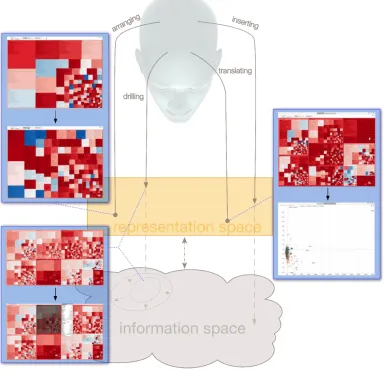
As was discussed earlier, actions can be divided into two types: epistemic and pragmatic. Epistemic actions—those related to knowledge and knowing—are the concern of this paper. Just as different physical tools can extend one’s reach into a physical space, the action choices offered by a CAST can extend the human mind, like tentacles, to reach into an information space to perform operations upon it, such as by bringing into view portions of the information that have not been encoded and displayed by the VRs at the interface level, or by viewing information from different perspectives, or by reorganizing the information (see Figure 1).
Figure 3-1 Action choices operating as mental tentacles to reach into an information
Note: Vector art adapted from www.vectoropenstock.com under the Attribution Creative Commons 3.0
license
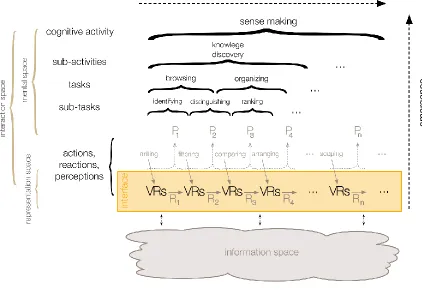
Unlike simple structured tasks, complex cognitive activities do not usually follow a programmed, recipe-like model (Clark, 1998a; Thomas and Cook, 2005). Individuals deploy general, high-level strategies to operate upon an information space. In this process, they actively perform all kinds of epistemic actions upon the external environment to help them alter it, and as a result, transform and support their own cognitive functions to gradually achieve the overall goals of the activity. Therefore, complex cognitive activities emerge at a macro level while actions are occurring at a lower level. A sequence of epistemic actions creates a chain that represents the trajectory for the emergence of the macro-level activity (see Figure 2).
Figure 3-2 The hierarchical structure of a complex cognitive activity and its
emergence over time.
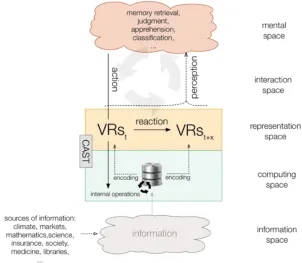
The sequence of epistemic actions that allows users to carry out an information-based complex cognitive activity can be conceptualized as an epistemic cycle. Figure 3-3 depicts this cycle and its categorization into five spaces: information, computing,
Figure 3-3 The human-information interaction epistemic cycle.
3.3.1.2General
Action-pattern-based rather than technique-based. EDIFICE-AP identifies and characterizes epistemic actions as general patterns rather than as technology- or implementation-dependent techniques. Even though interaction techniques can also be patterns, they are typically characterized at a lower level and are often technology-dependent. For example, one of the epistemic action patterns identified in EDIFICE-AP is drilling. Drilling is a general pattern that refers to all instances of acting upon VRs to drill into them and get more detail about latent, interior information that is not
perceptually accessible—that is, it is latent in the information space and has not been encoded at the interface level. This is a conceptual, pattern-based characterization of the action and its utility that is not concerned with how the action is carried out. However, designers can develop many techniques to enable users to perform this action. Examples of these techniques include mouse-over, right-clicks, spatial proximity, semantic
zooming, gestures, and digital probes. No matter what technique is used, by applying it to a VR, some of its hidden and latent information can be displayed.
Making the distinction between epistemic action patterns at this level and techniques at a lower level is crucial for two reasons. First, there are many existing techniques already, with all kinds of names and characterizations, and many more that can be developed in the future. Organizing many techniques under the umbrella of an action-pattern-based characterization makes it much easier to navigate the landscape of design possibilities by making the number of action possibilities manageable. Second, techniques vary in how they are characterized. By unifying many of them under one pattern, designers and researchers can focus on the conceptual utility of the action and worry about techniques and implementations later. Therefore, given a deep information space, a subset of whose items has been encoded by a VR, it can be easily predicted that at some stage of
breadth, and/or scope of perception of an information space. Thus, pattern names suggest both the actions that may be needed as well as their epistemic utility.
Technology independent. The epistemic actions in EDIFICE-AP are independent of the technology through which complex cognitive activities are carried out. This is
important—as technological platforms on which complex cognitive activities are performed change, EDIFICE-AP can remain resilient to these changes and still be
applicable. Continuing with the drilling example, as new technological innovations (such as interactive tabletops, motion sensing input devices, virtual reality, augmented reality, and interactive surface projection environments) come into existence, these may result in the development of new techniques and methods for drilling into VRs. However, at a conceptual, general level, drilling will always exist as a distinct pattern of action with utility for performing complex cognitive activities, and designers will decide how to implement it using new technologies.
Activity independent. The epistemic actions in EDIFICE-AP are not directly linked to and dependent on the complex cognitive activities that they support. Since complex cognitive activities are emergent phenomena, combining different epistemic actions can result in countless trajectories of macro tasks and activities. Hence, whether the activity be sense making, decision making, planning, learning, knowledge discovery, or problem solving, a subset of the epistemic actions in EDIFICE-AP can be used to support it, depending on the contextual and situational needs of the activity and its users.