An Effective Algorithm for Power Line
Detection from UAV Images
Nasrullah U Alka1, Jibril D Jiya2, Ejike C Anene3 , Ya’u S Haruna4, Mahmud Abdulhamid5
PG Student, Dept. of EEE, Abubakar Tafawa Balewa University, Bauchi, Nigeria1 Professor, Dept. of MSE, Abubakar Tafawa Balewa University, Bauchi, Nigeria2
Professor, Dept. of EEE, Abubakar Tafawa Balewa University, Bauchi, Nigeria3 Associate Professor, Dept. of EEE, Abubakar Tafawa Balewa University, Bauchi, Nigeria4
Assistant Lecturer, Dept. of EEE, Abubakar Tafawa Balewa University, Bauchi, Nigeria5
ABSTRACT: Digital image processing techniques in computer vision have been developed over the years for applications such as facial recognition in crowded settings, finger print identification, retinal scans, image segmentation and filtering and also in power lines detection (PLD) from aerial imagery. This paper proposes an algorithm to detect and track power lines from clustered backgrounds using the homogeneity, linearity and longevity characteristics of power lines in aerial images. Canny filter (CF) was used to detect edges in digital images followed by a morphological operation which filters and smoothens the binary output after which after which a parameterized Hough transform (HT) extracts the power lines from the filtered binary image. Sample images were simulated to test the performance of the algorithm. The proposed algorithm (CF-HT) achieved a positive detection rate (PDR) of 86.61% which showed a better detection over a Gabor filter with Hough transform (GF-HT) based PLD algorithm which obtained a PDR of 51.79%.
KEYWORDS: UAV, Canny Filter, Gabor Filter, Hough Transform, Power Line Detection.
I. INTRODUCTION
The increase in the world’s population has necessitated for an increase in food production and other amenities of life such as energy. Growing energy demands have led to construction of additional thermal and hydro power generation stations and other alternative energy sources mostly renewable in line with the climate control initiatives. These remotely located energy sources have made power system line networks to expand in architecture and connectivity spanning across swamps, darks forests and vast vegetation zones in order to transfer large amounts of power to industries and mega cities. Monitoring and surveillance of such vast networks cannot be efficiently carried out with primitive methods such as foot patrol due to time consumption and also the risk attached. Manned aerial surveillance with helicopters have also proved too expensive coupled with the possibility of collisions with undetected wires [6, 12]. A better alternative thanks to technology is to use unmanned aerial vehicles (UAVs) which have taken center stage in many applications such as military intelligence gathering, agriculture, entertainment, and computer vision.
Recently, application of UAVs have been extended to power lines detection (PLD) from aerial captured images using various techniques digital image processing techniques allowing for algorithms to be developed in order to ease surveillance in the case of power infrastructure and also for detection purposes in aerial navigation systems hovering close to trees over dense vegetation. The basic idea for such algorithms are edge detection or background suppression and linear feature extractions, of which various filters and mathematical expressions have been used in different research works.
II. RELATED WORKS
In the recent years, research works have been done on power lines detection from aerial images with various successes recorded. [4] developed a technique using background suppression, sky segmentation and Hough transform and was able to obtain power lines from aerial images with some discontinuities occurring due to line orientation and camera position.
[6] developed a thin line detection algorithm for low altitude aerial vehicles used in search and rescue, utilizing motion estimation at pixel level combined with edge detection and a windowed Hough transform thus detecting cables, power line and wires.
[16] introduced a voxel-based piece wise line detector (VPLD) for constructing 3-D images of power lines from LiDAR data using the perpetual grouping framework achieving a good detection rate in a number of images.
[18] proposed an algorithm to detect thin wires in image cluster and background noise using sub-pixel edge detection and subsequent post-processing, and the method was able to detect wires as long as the wires were not too thin.
[20] used a pulse coupled neural filter with Hough transform on power line characteristics to successfully detect power lines although fence lines were also detected.
[21] proposed a strategy using steerable filters and line fitting technique to extract linear features and the method was able to detect power lines with less false positives.
[26] proposed a power line detection algorithm using Gabor filter and Hough transform which was tested on controlled samples using threads and pringle cans to successfully detect the threads (power lines) even though the parameters of the filter had to be changed continuously in order to obtain a very good detection.
[38] presented a technique to automatically extract railway power lines from mobile laser scanning (MLS) data using principal components analysis (PCA), information entropy and least square fitting algorithm to efficiently detect the power lines according to junction type but this method could be expensive owing to the hardware attached (i.e. MLS system).
[39] proposed an algorithm to detect power lines from forest environment using statistical analysis and 2-D image processing technology achieving a high rate of power line points classification.
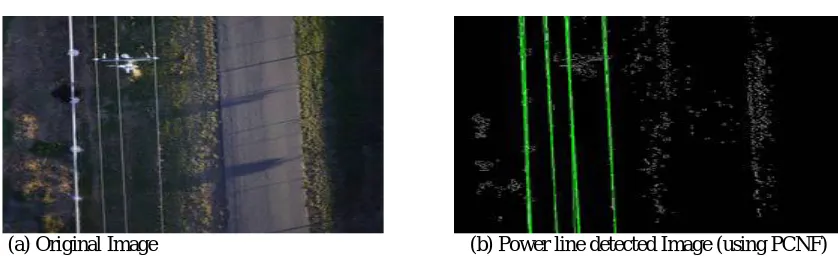
All the above techniques have achieved certain levels of performance, but are not without shortcomings and/or limitations especially detection of fences, false detection rates and computational expense and complexities. A typical detection of fence in addition to power lines is shown in figure 1.
A. DETECTING FENCE LINES PARALLEL TO POWER LINES
(a) Original Image (b) Power line detected Image (using PCNF)
III. PROPOSED METHOD
In this section, the proposed power line detection algorithm is presented. The main idea of the method is centered on utilizing the characteristics of power lines as observed from aerial images captured. The characteristics as highlighted by [20] are i) Linearity, ii) Parallelism, iii) Uniform brightness, and iv) Identical shapes. Canny filter with Hough transform will be used to detect power lines rather than the Gabor filter with Hough transform due to the directional dependence of the Gabor filter thereby producing less feature details in object detection.
A. EDGE DETECTION USING CANNY FILTER
[7] designed an edge detection filter which has become a widely used detector in computer vision. The Canny filter uses the magnitude of the convolution of an image with the first derivative of a Gaussian to detect the presence of an edge in an image.
The equation of a 2-D Gaussian function and its first derivative are
where σ is the standard deviation of the Gaussian function over the x-y domain.
The three main criteria of Canny edge are; 1) Low error rate:
Good detection of only true edges. This is shown in the signal to noise ratio (SNR) equation as
2) Good localization
Distance between edge pixels detected and real edge pixels have to be minimized as mathematically described by
where is the impulse response of the filter, denotes the edge itself , is the first derivative of the edge point assuming that the edge is located at x = 0 in the absence of noise, is the first derivative of the filter response and n2o is the mean-squared noise amplitude per unit length, assuming the filter has a finite impulse response bounded
by [- W, W].
3) Single response per edge.
[10] calculates the edge gradient and inclination angle of the Sobel operator as
Due to the high level of computational accuracy attached to the Canny filter in detecting pixel points as edges, the Canny filter is widely used in many feature extraction applications.
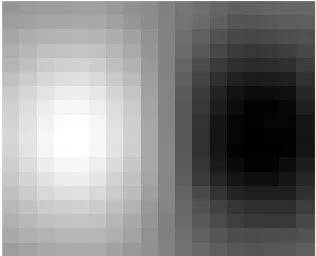
A. DERIVATIVE INTENSITIES CANNY FILTER IN X AND Y DIRECTIONS
(a) Derivative Intensity in x Direction (b) Derivative Intensity in y Direction
Fig 2 Derivative Intensities of Canny filter in x and y Directions
B. HOUGH TRANSFORM LINE EXTRACTION
When applied to extract straight lines in an image, the Hough transform usually parameterizes a line in the Cartesian coordinate to a point in the polar coordinate based on the point line duality. The polar equation of a straight line as described by [10] is given as
where, ρ is the perpendicular distance from the coordinate system center to the line and ϴ is the angle of inclination
with one of the axis.
Line points defined by (ρ, ϴ) are plotted in an accumulator after which voting procedure helps to locate the maximum point with the highest number of votes indicating a straight line. A typical polar representation of a straight line and Hough transform accumulator is illustrated in figure 3.
A. PARAMETRIC LINE REPRESENTATION
(a) Polar Representation of a Straight line (b) Hough Transform Accumulator
C. MORPHOLOGICAL OPERATIONS
Morphology is a tool used to extract image features which are useful in representation and description of region shapes such as boundaries and skulls. Morphologic operations are mostly related to set theory and logic operations [10]. The fundamental operations performed in image digital morphology upon which other more complex operations are built upon are dilation and erosion which are described as
where A is the image and B is a structuring element.
Dilation is an ‘OR’ operation which could be used in widening edge pixels in an image while erosion is an ‘AND’ operation which tends to shrink the edges detected in an image.
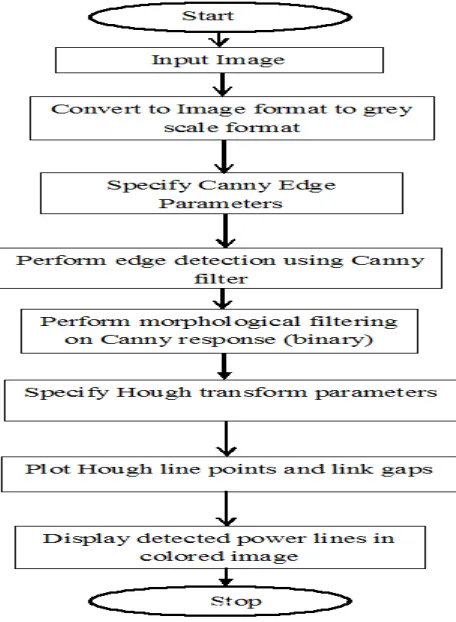
The block diagram as well as the flowchart of the proposed power line detection method using the described tools are shown.
B. POWER LINE DETECTION METHOD
Fig 4 Power Line Detection Method Image Format
conversion (colored to greyscale)
Edge detection using filter
Parametric Line Extraction using Hough transform Image
C. FLOWCHART OF THE PROPOSED METHOD FOR POWER LINE DETECTION
Fig 5 Flowchart of the Proposed Method for Power Line Detection
VI. RESULT AND CONCLUSION
28 sample images containing power lines in different cluster backgrounds were captured in Bauchi metropolis, Nigeria.
Simulation of the samples using the proposed Canny filter with Hough transform (CF-HT) PLD algorithm was performed on a MATLAB software and the results were compared with the same samples simulation using a Gabor Filter with Hough transform (GF-HT) PLD algorithm based on positive detection rates (PDR), false detection rates (FDR), and simulation times.
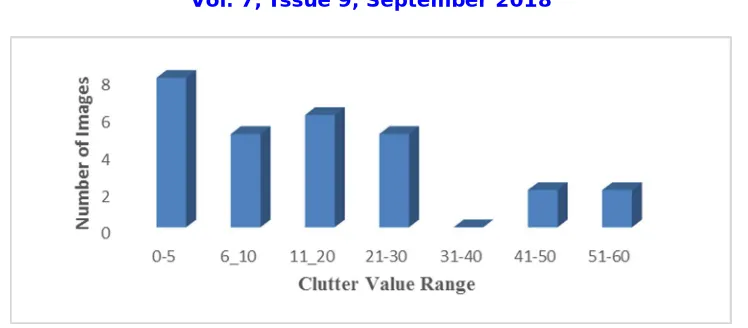
Fig 6 Histogram of Clutter Values Distribution
(a) Original Image
(b) Proposed Algorithm’s Edge Detected Image (c) Gabor Filter’s Edge Detected Image
(a) Proposed PLD Algorithm (CF-HT) (b) GF-HT PLD Algorithm
Fig 8 Power Lines Detection using the Proposed Algorithm and a Gabor Filter with Hough Transform Power Line Detection Algorithm
The quantified results of the simulation are in table 1.
Table 1: Summary of Simulation Results of the Proposed Power Line Detection Algorithm (CF-HT) and a Gabor Filter with Hough Transform (GF-HT) Power Line Detection Algorithm.
PLD
Algorithm
Average
PDR (%)
Average
FDR (%)
Average
Simulation Time (s)
GF-HT 51.79 33.93 3.28
Proposed (CF-HT) 86.61 12.50 2.73
The proposed Canny filter with Hough transform power line detection algorithm performed better than the Gabor filter with Hough transform by obtaining a better positive detection rate (PDR) with lower false detection rate (FDR) and processing time. The edged images shows that the proposed method was better at filtering by retaining mostly the power line candidate points while suppressing most of the background objects in the image though the processing time of the proposed algorithm still needs to be improved to enable real time processing of images.
This paper presented an effective algorithm for power line detection from aerial images. A Canny filter was used to detect edge points from the greyscale converted image after which morphological operation was performed in order to further suppress background objects and filter unconnected pixels in the binary image. Hough transform was finally used to extract the power lines in the image. Simulation results of captured sample images showed that the proposed method performed much better than a Gabor filter with Hough transform detection algorithm.
REFERENCES
[1] Adak C., (2013). “Gabor Filter and Rough Clustering Based Edge Detection”, IEEE International Conference on Human Computer Interactions (ICHCI), 1, 653- 657.
[2] Barapatre O. and Roy D., (2013). “Digital Image Line Extraction using Adaptive Filtering and Edge Smoothing using Cluster Analysis”,
[3] Bassil Y., (2012). “Image Steganography Based on a Parameterized Canny Edge Detection Algorithm”, International Journal of Computer Applications, 60, 35-40.
[4] Bhujade R. M., Adithya V., Hrishikesh S. and Balamurali P., (2013). “Detection of Power-lines in Complex Natural Surroundings”, Computer Science and Information Technology (CS & IT), 10. 101-109.
[5] Cai L., Ma Y., Yuan T., Wang H. and Xu T., (2015). “An Application of Canny Edge Detection Algorithm to Rail Thermal Image Fault Detection”, Journal of Computer and Communications, 3. 19-24.
[6] Candamo J., Kasturi R., Goldgof D. and Sarkar S., (2010). “Detection of thin lines in low quality video”, IEEE Transactions on Aerospace and Electronic Systems, 45. 939-947.
[7] Canny J., (1986). “A Computational Approach to Edge Detection”, IEEE Transactions on Pattern Analysis and Machine Intelligence, 8, 679-698.
[8] Ceron A., Mondragon I., and Prieto F., (2014). “Research on Power Line Inspection By Visual Based Navigation”, Research in Computing Science, 7, 23–32.
[9] Fisher R., Perkins S., Walker A., and Wolfart E., (2003). “Image Transforms-Hough Tranforms”, Retrieved July 12, 2017, from: homepages.info.ed.ac.uk/rbf.
[10] Gonzalez R. C. and Woods R. E., (2002). “Digital Image Processing”, Prentice Hall Publishers (2nd Ed), Pp.570-590. [11] Han B. and Wang X., (2017). “Detection for Power line Inspection”, MATEC Web of Conferences, 100, 03010-03016.
[12] Hassanein A. S., Muhammad S., Sameer M. and Ragab M. E., (2015). “A Survey on Hough Transform, Theory, Techniques and Applications”,
International Journal of Computer Science Issues (IJCSI), 12. 139-156.
[13] Hoiem D., (2011). “CS543/ECE549: Computer Vision: finding edges and straight lines”, University of Illinois, USA, Lecture Slides, Retrieved June 15, 2017, from: https://courses.engr.illinois.edu.
[14] Ilonen J., Kämäräinen J. K., and Kälviäinen H., (2005). “Efficient Computation of Gabor Features”, Research Report, Department of Information Technology, Lappeenranta University of Technology.
[15] IRETECH, (2012). “Sobel Operator Simplified”. Video lecture, Retrieved August 18, 2017, from: m.youtube.com/watch/Sobel operator. [16] Jwa Y., Sohn G., and Kim H. B., (2009). “Automatic 3D Power line Reconstruction using Airborne LiDAR Data”, Conference paper,
International Archives of Photogrammetry and Remote Sensing (IAPRS), 3. 106-110.
[17] Kapadia H. and Patel A., (2013). “Application of Hough Transform and Sub-Pixel Edge Detection in 1-D Barcode Scanning”,
International Journal of Advanced Research in Electrical, Electronics and Instrumentation Engineering (IJAREEIE), 2, 2173-2184.
[18] Kasturi R. and Camps. O. I., (2002). “Wire Detection Algorithms for Navigation”, Technical Report submitted to NASA, Retrieved June 8, 2017, from: https://ntrs.nasa.gov/casi.
[19] Katrašnik J., Pernuš F. and Likar B., (2010). “A Climbing-Flying Robot for Power Inspection”, IEEE Conference on Robotics, Automation and Mechatronics, 25, 1195–1200.
[20] Li Z., Liu Y., Walker R., Hayward R. and Zhang J., (2009). “Towards Automatic Power Line Detection for UAV Surveillance System Using Pulse Coupled Neural Filter and Hough Transform”, Journal ofMachine Vision and Applications, 5. 677-686.
[21] Li Z., Bruggemann T. S., Ford J. J., Mejias L. and Liu Y., (2012). “Towards Automated Power Line Corridor Monitoring using Advanced Aircraft Control and Multi-source Feature Fusion”, Journal of Field Robotics, 1. 4-24.
[22] Liu Y., Mejias L. and Li Z. (2012). “Fast Power Line Detection and Localization using Steerable Filter for Active UAV Guidance”
International Archives of Photogrammetry, Remote Sensing and Spatial Information Sciences ( ISPRS), 1.491-496.
[23] Luque-Vega L. F., Castillo-Toledo B., Loukianov A., and Gonzalez-Jimenez L. E., (2014). “Power Line Inspection via an Unmanned Aerial System Based on the Quadrotor Helicopter”, IEEE Mediterranean Electrotechnical Conference, 34, 393-397.
[24] Ma Q., Goshiy D. S., Buiy L., and Sun M., (2012). “An Algorithm for Radar Power Line Detection with Tracking”, IEEE Transactions on Image Processing, 20, 3534–3543.
[25] Mahmudi A. and Poor I. A., (2015). “A Hybrid Method for Edge Detection using Fuzzy Rules and Coordinate Logic Operators”, International Journal of Computer Science and Mobile Computing (IJCSMC), 4, 310-317.
[26] Manlangit C. and Green R., (2012). “Automatic Power Line Detection for a UAV system”, Allen Institute for Artificial Intelligence (AIAI), 1, 1-6.
[27] Mathworks, (2016). “help/:documentation”. Retrieved June 8, 2017, from: www.Mathworks.com/MATLAB R2016a.
[28] McGee T. G., Sengupta R. and Hedrick R., (2006). “Obstacle Detection for Small Autonomous Aircraft using Sky Segmentation”, IEEE International Conference on Robotics and Automation, 4. 4679—4684.
[29] Negi N. and Mathur S., (2015). “An Improved Method of Edge Detection Based on Gabor Wavelet Transform”, Recent Advances in Electrical Engineering and Electronic Devices, 1, 184-191.
[30] Reddy D. N., Yerigeri V. V. and Sanu H., (2014). “Design and Simulation of Canny Edge Detection”, International Journal of Engineering Sciences and Research Technology (IJESRT), 3. 304-311.
[31] Oyibo P.O., (2017). “Development of an Improved Algorithm for Power Line Detection Optical Images using Frangi Filter and First Order Derivative Of Gaussian”,Master Thesis, Department of Electrical and Computer Engineering, Ahmadu Bello University, Zaria.
[32] Rupalatha T., Rajesh G., Nandakumar K., (2013). “Implementation of Distributed Canny Edge Detector on FPGA”, International Journal of Computer Engineering Science (IJCES), 2. 22-28.
[33] Sampedro C., Martinez C., Chauhan A. and Campoy P., (2014). “A Supervised Approach to Electric Tower Detection and Classification for Power Line Inspection”, International Joint Conference on Neural Networks (IJCNN), 2. 1479-1484.
[34] Sikorska S., (2011). “Application of the Hough Transform to Digital Image Analysis”, Bibiloteka Cyfrowa Politechniki Krakowskiej, 7, 458-463.
[37] Yetgin O. E., Şentürk Z. and Gerek O. N., (2015). “A Comparison of Line Detection Methods for Power Line Avoidance in Aircrafts”,
International Conference on Electrical and Electronics Engineering (ELECO), 2, 241-248.
[38] Zhang S., Wang C., Yanga Z., Chena Y., and Li J., (2016). “Automatic Railway Power Line Extraction using Mobile Laser Scanning Data”,
International Archives of Photogrammetry, Remote Sensing and Spatial Information Sciences (ISPRS), 59,615-619.