ISSN 2286-4822 www.euacademic.org
Impact Factor: 3.4546 (UIF) DRJI Value: 5.9 (B+)
Transformation of ICT in Research and
Development Libraries in Chennai
A. JANAKIRAMAN Librarian M S Swaminathan Research Foundation, Chennai KARTHICK RADHAKRISHNAN
Research Assistant Madras Institute of Development Studies (MIDS), Chennai DR.N.SUBRAMANIAN Professor & University Librarian
Periyar University, Salem
Abstract:
Key words: ICT technology tools, ICT resources, Usage pattern, Gender, ICT Experience, Social network, R & D libraries.
INTRODUCTION
Recently the library world has observed Information Communication technology (ICT) is a circle in every domain of our life. Using ICT in libraries is not only noticed extraordinary options in their library operations and services, but also associated a creative and modernised responsibility for librarians and the authorities of the research and development institutions. Computerization is an important implementation of ICT in R & D libraries. It helps sharp operations, services, enabling access and retrieval of information. This study reflects the construction of Information and Communication Technology; libraries now use different types of technologies to provide the services they render. New technological developments affect the process of information is managed in libraries. The applications of current technologies are felt by R & D libraries in all aspect like ICT, communication technology and storage technology are some of the components of continuous process that remodel the way that libraries access, retrieve, store, control and disseminate information to users. The research and development library has been from its inception an integral part of institutions of higher learning and research, rather than a supplement or complement.
Chennai were, therefore, selected as a case to study the current level of ICT applications.
REVIEW OF LITERATURE
SINGH (KP), (2003) describes that access to the ICT has brought many advantages to the users of libraries in Thailand as well as other Thai institution. The support of the Thai government, in development of the ICT for the country especially in the libraries of higher education colleges, institutes and universities. Watts (2006) suggested that the ICT tools have been used in the library field should provide better services than traditional method. Varalakshmi(2009) pointed out that the situation with regard to information communication technology (ICT) usage in Pakistan and other developing countries is not stimulating. He noted that veteran educators and librarians have observed that general librarians in developing countries were prone to implement information communication technologies, and that librarians in Pakistan were not prepared to squeeze the changes strength on them by modern technologies. Dr. Varalakshmi enumerate that most of them were unresolved about ICT applications in their libraries and the ultimate benefits to their institutions. Evan & Zarnosky (2007) examined the utilization of ICT to disseminate the core subject of the institution and also the ICT application used research scholars in the library. Rahman Ebrahimi (2007) identified that special libraries in Kerala had basic computer applications and communication facilities to some level. They provided a variety of measures of accepted orientation and training on ICT to become more efficient clientele.
This study focuses to:
2. Enumerate the problems that research and development libraries in Chennai are facing with respect to ICT applications
3. To compare the ICT status among the research and development libraries in Chennai.
4. To assess the current status of state-of-the-art on ICT infrastructure in research and development libraries in Chennai.
5. Current librarians' suggestions for improving ICT applications, barriers in application of ICT inresearch and development libraries in Chennai.
RESEARCH METHODOLOGY:
ANALYSIS AND INTERPRETATION
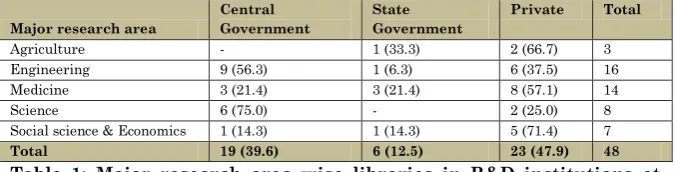
Analysis has been done as per the order of questionnaire. Simple statistical calculations and tables have been used in evaluating the collected data. Analysis of the effect of ICT on the research scholars and students is offered under the following heads. Major research areas have been identified in 5 subject areas and grouping with Central, State and Private. 56.3% engineering R & D institutes are central govt and 37.5% institutes are in private. In Science 75% R & D institutes are classified as central govt and 25 % are in private libraries.
Major research area
Central Government
State Government
Private Total
Agriculture - 1 (33.3) 2 (66.7) 3
Engineering 9 (56.3) 1 (6.3) 6 (37.5) 16
Medicine 3 (21.4) 3 (21.4) 8 (57.1) 14
Science 6 (75.0) - 2 (25.0) 8
Social science & Economics 1 (14.3) 1 (14.3) 5 (71.4) 7
Total 19 (39.6) 6 (12.5) 23 (47.9) 48
Table 1: Major research area wise libraries in R&D institutions at Chennai
The respondents were asked about their gender, professional qualification, age, status of institution, and types of library. The data circulate that out of 48 research and development libraries, 11 (50.0%) were headed by male and 11 (50.0%) by female librarians. 25 libraries are public sector (52.1 and 23 (47.9 %) in Private. All 48 libraries were special.
Distribution of librarian status by Gender:
Major research area Male Female Total
Agriculture 3 (100.0) 0 3
Engineering 14 (87.5) 2 (12.5) 16
Medicine 7 (50.0) 7 (50.0) 14
Science 6 (75.0) 2 (25.0) 8
Social science & Economics 6 (85.7) 1 (14.3) 7
Total 36 (75.0) 12 (25.0) 48
The Distribution of the librarian status can be seen in table 2. The analysis reveals that the majority (75%) of them were male and (25%) were female. As seen in the above table the majority of the male librarians are from engineering and technology libraries (87.5%) and majority of the female librarians (50%) from medical libraries.
Figure 1 - Distribution of librarian status by gender
Status Classification System in the R & D Libraries:
Table: 4 Major research wise classification system followed in R & D Institutions Libraries in Chennai
Major research area Central Government
State Government
Private
Institution Total
Agriculture
DDC - 1 (50.0) 1 (50.0) 2
UDC - - 1 (100.0) 1
Engineering
DDC 7 (63.6) - 4 (36.4) 11
UDC 2 (40.0) 1 (20.0) 2 (40.0) 5
Medicine
DDC 1 (14.3) 1 (14.3) 5 (71.4) 7
UDC 2 (40.0) 2 (40.0) 3 (60.0) 7
Science
DDC 5 (100.0) - - 5
UDC 1 (33.3) - 2 (66.7) 3
Social Science and
Economics
DDC - - 1 (100.0) 1
UDC 1 (16.7) 1 (16.7) 4 (66.7) 6
Table 3 mentioned above the classification system followed by the research libraries in Chennai, the data collected in 48 libraries, out of 48 respondents, this table showed 13
Table 4 - Gender based ICT experience
Libraries in central govt research and development libraries followed both DDC and UDC. From the below table, it has been inferred that in medicine libraries are following UDC and DDC equally. In science 38% and 62% the libraries are following DDC and UDC respectively. In agriculture 50% of the central govt libraries are following DDC and 50 % of private libraries are following UDC respectively. In engineering 70% of the libraries are following DDC and 30 percentages of the libraries following UDC. In social science and economics 66.73% of the private libraries are following UDC whereas 100% of the private libraries are followed DDC. In science & medicine each 50% of the libraries are following DDC and UDC respectively. In science & agriculture 35% of the libraries are following DDC and 65% of the libraries are following UDC.
GENDER VS EXPERIENCE
From the above table 4 shows that in agriculture libraries greater than 6 years’ experience have 100 % male professionals.
Major Research area Less than One year Greater than 1 less than equal to 5 Years Greater than 6 Less than equal to 10 Years More than 11 and less than equal to 15 years More than 16 years Total M a le
Agriculture 0 0 1 (33.3) 1 (33.3) 1 (33.3) 3
Engineering 0 0 1 (7.1) 8 (57.1) 5 (35.7) 14
Medicine 0 0 1 (14.3) 3 (42.9) 3 (42.9) 7
Science 0 0 1 (16.7) 2 (33.3) 3 (50.0) 6
Social Science& Economics 1 (16.7) 0 5 (83.3) 0 0 6
Total 1 (2.8) 0 9 (25.0) 14 (38.9) 12 (33.3) 36
F
em
a
le
Engineering 0 0 1 (50.0) 1 (50.0) 0 2
Medicine 0 1 (14.3) 4 (57.1) 2 (28.6) 0 7
Science 0 0 0 1 (50.0) 1 (50.0) 2
Social Science& Economics 0 0 0 0 1 (100.0) 1
In engineering each 50 % female professionals have more than 6 less than 15 years’ experience. In engineering 92.9% male professionals are having more than 11 and less than 15 years’ experience. In social science and economics 100 % female staff having more than 15 years’ experience rather than male professionals having only 50 % experience. Comparatively male professionals are greater than female for having experience in ICT based libraries R &D libraries.
Status of Library Software in R & D Libraries
Table 5 – LIS Automation Software status in R & D Libraries
From the above table it is occurred that in science research area, 57.17% of the libraries are fully automated and used commercial software whereas 12.5 % libraries are used in house developed software from their own technology people. And 25% of the libraries in science category adopting OSS from web. In engineering research area 53.3% libraries are used commercial software and 33.3% libraries are used OSS from web. In social science and economics based libraries are used commercial software in 57.1% and 28.6 % libraries are having Open source software for their libraries. 78.6% of the medicine libraries are almost automated. In agriculture 66.7% of the libraries doesn’t have the library software. Still they are used traditional method of library operations. 100%of Social science and economics institutions libraries are having LIS software both commercial and OSS.
Major research area
Library Software Status
Tot al Commercial
software
In house
developed software
Open source software
No Automati on
Agriculture 1 (33.3) 0 0 2 (66.7) 3
Engineering 8 (53.3) 2 (13.3) 5 (33.3) 0 15
Medicine 5 (35.7) 6 (42.9) 3 (21.4) 0 14
Science 4 (50.0) 1 (12.5) 2 (25.0) 1 (12.5) 8
Social Science
& Eco 4 (57.1) 1 (14.3) 2 (28.6) 0 7
Web OPAC status in R & D Libraries:
Major research area
Web OPAC
Total Web OPAC access
Does not have web OPAC access
Agriculture 0 3 (100.0) 3
Engineering 5 (31.3) 11 (68.8) 16
Medicine 3 (21.4) 11 (78.6) 14
Science 4 (50.0) 4 (50.0) 8
Social science & Economics 3 (42.9) 4 (57.1) 7
Total 15 (31.3) 33 (68.8) 48
Table 6 – Web OPAC status in R & D Libraries
From the above table it has been identified that in science, 50% of the libraries have their Web OPAC, and 42.9% of the Social science and economics libraries have the same. In engineering 31.3% of the libraries have their own Web OPAC. In agriculture no library has this facility. In medicine 11 libraries are doesn’t have this facility and only 21.4 % institutions are having this application for the benefit of clientele.
Library professional status in major research area wise in R & D Libraries
Designation Agriculture Engineering Medicine Science
Social science & Economics
Librarian 3 (7.5) 15 (37.5) 11 (27.5) 6 (15.0) 5 (12.5) Assistant Librarian 2 (3.9) 26 (51.0) 13 (25.5) 6 (55.6) 4 (22.2) Library Assistant 2 (22.2) 0 0 5 (50.0) 2 (25.0)
Deputy Librarian 0 0 1 (25.0) 2 (50.0) 1 (25.0)
Technical Assistant 1 (3.4) 13 (44.8) 4 (13.8) 9 (31.0) 2 (6.9)
Technical officer 0 0 2 (22.2) 7 (77.8) 0
Scientific Officer 0 0 1 (14.3) 5 (71.4) 1 (14.3)
Total 8 (5.4) 54 (36.2) 32 (21.5) 40 (26.8) 15 (10.1) Table 7 – Library Professional status in R & D Libraries
all designation. 40 library employees are working in science based libraries. Out of that 77.8 % are technical assistants.
Type of Internet Connection in R & D Libraries
Major research area
Category of Internet
Total Leased
line
Ordinary dialup
RF tech (Wi-Fi)
Wireless (Wi-Fi)
Broad Band V SAT
Agriculture 3 (100.0) 0 0 0 0 0 3
Engineering 14 (87.5) 0 0 0 2 (12.5) 0 16
Medicine 13 (92.9) 1 (7.1) 0 0 0 0 14
Science 4 (50.0) 1 (12.5) 1 (12.5) 0 1 (12.5) 1 (12.5) 8
Social science & Economics 3 (42.9) 0 0 2 (28.6) 2 (28.6) 0 7
Total 37 (77.1) 2 (4.2) 1 (2.1) 2 (4.2) 5 (10.4) 1 (2.1) 48
Table 8 – Type of Internet connection in R & D Libraries
From the above table focussed that all 48 respondents are having internet connections from various service providers. In engineering, 87.5% of the libraries are using leased line, and 12.5% are using broad band connection. In medicine 92.9% of the libraries are using leased line and rest of them are used others like dial-up, Wi-Fi and broadband connections. In agriculture, 100% of the libraries are using lease line connections. In science, 50% of the libraries are using leased line network and rest of them equally used other networks.28.6% of the social science& economics institutions libraries used broad band connections and 42.9% institutions are used leased line. Interestingly 28.6% of these libraries are used Wi-Fi Connection for their effective ICT services of the users.
LIS Software used by R & D Libraries in major research area wise institutions:
based libraries in research institutions 25% are having Koha, 33.36% are having Lib,14.3% are having Autolib. In social science and economics based libraries are having own software by 100%.
Name of the Library software
Research Area
Agriculture Engineering Medicine Science Social science & Economics
Autolib 1 (7.1) 4 (28.6) 5 (35.7) 2 (14.3) 2 (14.3)
Koha - 3 (37.5) 2 (25.0) 2 (25.0) 1 (12.5)
Lib - - 2 (66.7) 1 (33.3) -
Libasoft - - 1 (100.0) 0 -
Library information system - - - 1 (100.0) -
Libsys - 5 (55.6) - 2 (22.2) 2 (22.2)
Microsoft Excel pus VB macros - 0 1 (100.0) - -
NewGen - 2 (100.0) - - -
Software by Institution( own) - - - - 1 (100.0)
soul - - - - 1 (100.0)
Total 1 (2.4) 14 (34.1) 11 (26.8) 8 (19.5) 7 (17.1) Table 9 – LIS Software used in R & D Libraries
Social Network status in R & D Libraries in Chennai:
The below table 10 has been analysed that in agriculture 33.3 % of the libraries are used Twitter for the purpose of sharing information to users. In engineering 56.3 % of the libraries are used face book for social network status. And 25 % of the libraries doesn’t have any social network. In medicine 35.7 % libraries using Google Plus and 21.7 % of the libraries doesn’t have social network. In Social Science and Economics based libraries are using face book in 42.9%, and 28.6 % of the libraries doesn’t have social network.
Major Research area
Availability of Social Network
Total Facebook
Plus LinkedIn Twitter Whatsapp
All the above
Don’t have social network
Agriculture - - - 1 (33.3) - - 2 (66.7) 3
Engineering 9 (56.3) - 1 (6.3) 2 (12.5) - - 4 (25.0) 16 Medicine 1 (7.1) 5 (35.7) 2 (14.3) 2 (14.3) 1 (7.1) - 3 (21.4) 14
Science 1 (12.5) 3 (37.5) - 1 (12.5) - - 3 (37.5) 8
Social Science &
Economics 3 (42.9) 1 (14.3) - - - 1 (14.3) 2 (28.6) 7
Total 14 (29.2) 9 (18.8) 3 (6.3) 6 (12.5) 1 (2.1) 1 (2.1) 14 (29.2) 48
Constraints of library professionals for using ICT:
Table 11 shows below, the problems faced by R & D libraries in Chennai for implementing ICT applications in their respective libraries. 37.5% of female librarians are suggested that the communication gaps between the users and professionals, but 37.5% of the male professionals are disagree about the above statement. 47.9% of the male librarians enumerated that lack of staff training is the main reason behind the problem faced by the libraries in ICT implementation. 45.8% of the male librarians and 12.5 % of the female librarians are suggested that insufficient fund for implementing ICT. But 33.3% of the male library professionals and 8.3 % of the female librarians are felt disagree about the lack of support from the authorities of the institution for implementing ICT.
Problem Faced by R&D libiaries implementing ICT
Agree Disagree Male Female Male Female
Communication gap between LIS professionals and library
users 18 (37.5) 11 (22.9) 18 (37.5) 1 (2.1)
Lack of staff training 23 (47.9) 9 (18.8) 13 (27.1) 3 (6.3)
Library staff are not interested to implement ICT 17 (35.4) 7 (14.6) 18 (37.5) 5 (10.4)
Lack of awareness about the ICT in the management of the
organization 23 (47.9) 6 (12.5) 14 (29.2) 6 (12.5)
Insufficient fund for implementing ICT 22 (45.8) 6 (12.5) 14 (29.2) 6 (12.5)
Lack of support from the authorities 20 (41.7) 8 (16.7) 16 (33.3) 4 (8.3)
Increasing operating cost of ICT applications 24 (50.0) 9 (18.8) 12 (25.0) 3 (6.3)
Table 11 – Constraints faced by in R & D Libraries for using ICT
SUGGESTIONS
valuable publications should be digitized in a phased manner for preservation and for future use. Research library professionals should get different training programmes for maximum usage and development of Information Communication Technology based library facilities and services. The Central & state Government can provide more funds for the technology development of Research and development libraries. Specific consideration may be provided for development of subject oriented information centres. All research libraries should safeguard their resources by implementing any one of the ICT tool, so that the preservation of electronic version is easy to offer the users in future.
CONCLUSION
The Research & Development libraries have given more priority for recognition and importance concerning, electronic collection like e-books, e-journals, collections, budget, infrastructure facility, staff and users. In the meantime the R & D libraries are using Information and Communication Technology, as a key source for book selection, display of new arrivals for library publications and for database creations. Most of the research libraries have good adequate facilities to provide the electronic services to the clientele through ICT tools and Web based library services by using the ICT in efficient way, and also to increase the library activities in a structured manner.
Reference -
2. Varalakshmi, R SR (2009)” Future of Library and Information Centres in Knowledge Society of India: The Expected Role of Knowledge Professionals” DESIDOC Bulletin of Information Technology, 29(2): 75-81
3. Sreenivasulu, R. (1999) “Role of lnformation Technologies in Electronic lnformation Transfer and in Providing Value-added lnformation Services” DESIDOC Bulletin of Information Technology, 19(4): 35-38
4. Evan, G. E., & Zarnosky, M. R. (2000). Developing library and information center collections (4th ed.). Englewood, CO: Libraries Unlimited. pp. 180-206
5. Watts, Chris, & Ibegbulam, Ijeoma. (2006). Access to electronic healthcare information resources in developing countries: Experiences from the medical library, College of Medicine, University of Nigeria. IFLA
Journal, 32(54). Retrieved May 15, 2010 from
http://ifl.sagepub.com/content/32/1/54.full.pdf+html 6. Chetan Sharma “Information Technology and Online
Resources in Dental College Libraries of Haryana “Library Philosophy and Practice (e-journal), November, pp1-9, 2009.