Optimization of Construction Projects Scheduling Using Primavera
and Genetic Algorithm
Ahmed Faez Abdulameer & Prof.Ravande Kishore
1)Master of Civil Eng., Construction Engineering and Management, Osmania University, India
2)Professor ,Dean faculty of Engineering, Osmania University, India
ABSTRACT
Resource allocation and leveling are among the top challenges in project management, due to the complexity of projects. The main objective of this project is to optimize the schedule of construction project activities in order to minimize the total cost with
resource constraints using Genetic
Algorithm (GA optimization technique). This
work describes a genetic algorithm
approach to Resource Constraint Project
Scheduling Problems (RCPSP) in
construction industry. The GA procedure searches for an optimum set of tasks and priorities that produce shorter project duration and better-leveled resource profiles using Evolver software. Major advantage of the procedure is its simple applicability within commercial project management
software systems to improve the
performance.
KEYWORDS: Genetic Algorithm,
Resource Scheduling, Resource constraint Scheduling, Construction management, Evolver.
1. Introduction
Resource management is one of the most Chan,et al., 1996, Cengiz 2002, Ahmed important aspects of construction project 2008). management in today’s economy because the compared with traditional heuristic and construction industry is resource intensive and mathematical models, the genetic algorithm scheduler the costs of construction resources have steadily has
Risen over the last several decades. the objectives of time/cost trade-off,
Every project schedule has its own resource-constraints allocation, and precedence Constraints, which means that each resource leveling for traditional models activity can be processed when all its to have such a function. It has more predecessors are finished. In general, the flexibility to solve scheduling problems purpose of project scheduler is to minimize of different types, because no heuristic the completion time or make span, subject to rules are necessary. precedence constraints. 1.2 Genetic Algorithm
This paper brings out the drawback in existing Genetic Algorithm (GA) are inspired by Scheduling software and the method of using Darwin’s theory about evolution. The GA for resource constraint scheduling by means is a global search
procedure that searches of a case study. From one population of solutions to another
Traditional scheduling methods using scheduling focusing on the area of the best solution. It rules specific to the project model or constraint models with a set of solutions (represented formulation, this method uses a direct by chromosomes) called initial population, representation of schedules and a search computation is performed through the algorithm that
objective of a population of solutions over a large function measures both resource constraint number of generations followed by the violations and overall performance. The evolution, a satisfactory solution is The advantages of using GA based optimization found. This process is designed to Technique for resource based scheduling has to produce successive populations.
1.2.1 Fitness Function
The fitness function is the function to be optimized. For standard optimization algorithms, this is known as the objective function.
1.2.2 Individuals
An individual is any point to which the function can be applied. The value of the fitness of an individual is its score; an individual is a single solution. A chromosome is a set of parameters which define a proposed solution to the problem that the genetic algorithm is trying to solve. The chromosome is often represented as a simple string.
1.2.3 Populations and Generations
A population is an array of individuals. At each iteration, the genetic algorithm performs a series of computations on the current population called parents to produce a new population called children. Each successive population is called a new generation. Typically, the algorithm is more likely to select parents that have better fitness values.
1.2.4 Encoding
A chromosome is subdivided into genes. A gene is the GA representation of a single factor for a control factor. The process of representing the solution in the form of a string that conveys the necessary
information is called Encoding. Each gene controls a particular characteristic of the individual; similarly, each bit in the string represents a characteristic of the solution. Encoding Methods are Binary Encoding, Permutation Encoding (Real number encoding), and Value Encoding.
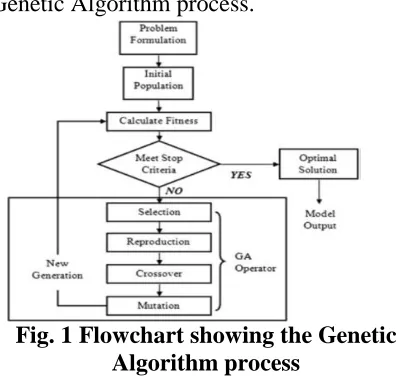
2. Basic Outline of Genetic Algorithm Figure 1 shows the various steps involved in Genetic Algorithm process.
Fig. 1 Flowchart showing the Genetic Algorithm process
2.1 Importance of GA
Genetic algorithm technique provides best solutions in comparison with the other classic approach. Because traditional techniques like Microsoft project and Primavera scheduling software do not consider resource constraints, actual cost and duration may vary from the estimated one. An effective GA representation and meaningful fitness evaluation are the keys to the success in GA applications. The method of solving resource constraint problem using the software Evolver which uses GA optimization technique is presented in this paper.
allows the user to run an optimization problem from Microsoft Excel, as well as a Dynamic Link Library of genetic algorithm functions that may be called from programming languages such as Microsoft Visual Basic or C.
3. Problem Formulation
In order to solve a project scheduling problem involving resource constraint, activities involved in a real-time construction project has been considered. The resource constraint in the form of number of skilled and unskilled labourers available per day is taken.
3.1.2 Evolver’s Excel Interface
Creating a problem solving model in Evolver requires that the relevant data is entered into a Microsoft Excel spreadsheet and specify problem solving parameters. Evolver actually solves the problem by allowing the less fit individuals in the population to die, and selectively breeding the fit individuals. The process is called selection, as in selection of the fittest. Two individuals are taken and mated (crossover), the offspring of the mated pair will receive some of the characteristics of the mother and some of the father. In nature, offspring often have some slight abnormalities, called mutations. Usually, these mutations are disabling and inhibit the ability of the offspring to survive, but once in a while, they improve the fitness of the individual. Evolver occasionally causes mutations to occur. As Evolver mates fit individuals and mutates some, the population undergoes a generation change. The population will then consist of offspring plus a few of the older individuals which Evolver allows to survive to the next generation. These are the most fit in the population, and we will want to keep them breeding. These most fit individuals are called elite individuals. After dozens or
even hundreds of "generations," a population eventually emerges wherein the individuals will solve the problem very well. In fact, the fit individual will be an optimum or close to optimum solution.
3.1.3 Evolver Dialog Screen
Fig.2 Evolver Dialog Screen
The Evolver Dialog screen shown in Figure 2 to identify the cells in the spreadsheet involved in solving the problem. The list of constraints that should be met by the solution can also be listed.
3.1.4 Fitness Function Cell
The Fitness Function box tells Evolver the location of the cell which contains the formula that measures Evolver's success in finding a solution to the problem. The formula may be created using any of the Excel functions that are available from the Insert menu, such as average, sum, percentage, etc., Use of Excel macros or Visual Basic functions to create a formula that allows solving very complex problems. A neural net may even be used to model the process if an appropriate mathematical formula is not available.
3.1.5 Chromosomes
value that may be within a continuous range, such as the value 1.5 with the range 0 to 2. Continuous chromosomes may also be integers if the search space is to be restricted. Enumerated Chromosomes are used when the problem involves finding an optimal combination of tasks, resources, duties, etc.
3.1.6 Constraints
The constraint portion of the Evolver dialog box allows doing the following: Limit the range of values that Evolver will search for a solution, thus limiting the time taken to find an optimal solution. This is called hard constraint. Add restrictions or sub-goals to the original fitness function. This is called a soft constraint. Solutions are
attempted to be found that meet the soft constraints, as well as optimize the fitness function.
4. Case Study
The project case study consists of construction of hospital building, which is located at Al-Diwaniya city in the middle part of Iraq and It is consists of three floors ( ground floor, first floor and second floor ). The Iraqi government planned to improve and construct the hospital buildings distributed all around the country due to the special political, security and the war conditions which are lasting in the country since 2003.
The project is implemented by Al-Andulos construction company. Total construction area is about 1300 𝑚^2 ( 14000 〖𝑓𝑡〗^2 ), and the total cost estimated for Al-Diwaniya general hospital is about ( 1,200,000 $ ). Taking Al-Diwaniya General Hospital building as case study to realize the actual uses and benefits of using the genetic algorithm to solve the problem of optimization of recourses scheduling .
4.1 Objective function: The objective function is to find the best schedule that gives minimum total project duration (T), Minimize (T)
where,
T depends on start date (Si) of activity and its duration (Di), i.e,
T=Maximum(Si+Di) subjected to resource constraint
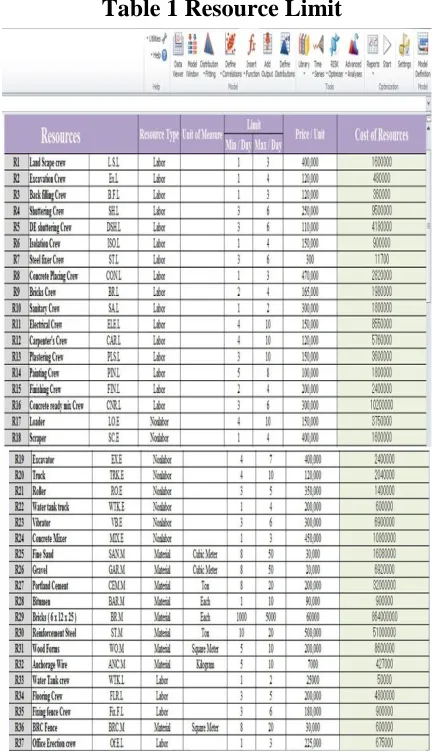
4.1.1 Resource Limit:
The following table shows the range of resource limits. This is input in Evolver,
Table 1 Resource Limit
5. Results
5.1 Primavera Software
Implementation of this problem in Primavera with unlimited resources gives total project duration as 345 days. Resource Profile for a resource is shown in the Figure 3,
5.2 Evolver Solution
Problem is executed by using many generations. The converging result obtained was T = 317 days by applying resource constraints. Best fitness is obtained in 200 generations.
5.3 Comparison Between Two Solutions Intended goal of achieving the best schedule with resource constraints gives optimized duration of the project is T = 317 days.
Solution obtained from Primavera is practically not possible for tracking process and for execution. Hence optimized duration is 317 days.
Table: 2 Comparison Actual Usage of Resources and Cost
Input can be real values or variables in Evolver whereas it is only variables in Primavera. Both Evolver undertake time and Predecessor constraint, but resource constraint can be incorporated in Evolver alone.
6. Conclusion
An implementation of the GA developed model for resource-constrained project scheduling has resulted in optimized output with reduced cost. A real time project solved using this optimization software shows that best converging result can be obtained, the total cost of the project has been reduced by 6.4%, the total duration of the project has been reduced by one month.
References
[1] Ahmed B. Senouci and Neil N. Eldin [2] Genetic Algorithms in Resource Scheduling of Construction Projects", Journal of Construction Engineering and Management , Vol. 130, No. 6, pp. 869 877.
[3] Cengiz Toklu Y.C (2002),
"Application of GA to Construction Scheduling with or without Resource Constraints", Canadian Journal of Civil Engineering, Vol.29, No. 3, pp 421-429. [4] Jin-Lee Kim and Ralph D. Ellis Jr. “Permutation-Based Elitist Genetic Algorithm for Optimization of Large-Sized Resource Project Scheduling”, Journal of
Construction Engineering and
Management, Vol. 134, No.11, pp. 904 913.
[5] Sou-Sen Leu, An-Ting Chen, and (1999), “Fuzzy Optimal Model for Resource Constrained Construction Scheduling”, Computing in Civil Engineering, Vol. 13, No. 3, pp. 207-216. [6] Tarek Hegazy and Moustafa Kassab Optimization Using Combined Simulation and Genetic Algorithms”, Journal of
Construction Engineering and
Management, Vol. 129, No. 6, pp. 698 [7] Tarek Hegazy, (1999), "Optimization of Resource Allocation and Leveling Using Genetic Algorithms", Journal of Construction Engineering and Management Vol. 125, No. 3, pp. 167-175.
[8] Weng-Tat Chan, David K. H. Chua [9] Kannan (1996), "Construction
Resource Scheduling wi Genetic
Algorithms", Journal of Construction Engineering and Management, Vol. 122, No. 2, pp. 125 132.
[10] E-ISSN 0976-3945
[11] SP. Eldin, (2008), " Use of 869- (2008), Resource-Constrained , 904- Chung-Huei Yang