Memory-Constrained Implementation of
Lattice-based Encryption Scheme on the
Standard Java Card Platform
⋆Ye Yuan1⋆⋆, Kazuhide Fukushima2Junting Xiao1, Shinsaku Kiyomoto2, and Tsuyoshi Takagi3,4
1
Graduate School of Mathematics, Kyushu University 2 KDDI Research, Inc.
3
Department of Mathematical Informatics, The University of Tokyo 4
CREST, Japan Science and Technology Agency
Abstract. Memory-constrained devices, including widely used smart cards, require resisting attacks by the quantum computers. Lattice-based encryption scheme possesses high efficiency and reliability which could run on small devices with limited storage capacity and computation re-sources such as IoT sensor nodes or smart cards. We present the first im-plementation of a lattice-based encryption scheme on thestandard Java Card platformby combining number theoretic transform and improved Montgomery modular multiplication. The running time of decryption is nearly optimal (about 7 seconds for 128-bit security level). We also op-timize discrete Ziggurat algorithm and Knuth-Yao algorithm to sample from prescribed probability distributions on the Java Card platform. More importantly, we indicate that polynomial multiplication can be performed on Java Card efficiently even if the long integers are not sup-ported, which makes running more lattice-based cryptosystems on smart cards achievable.
Keywords: Post-Quantum Cryptography, Lattice-based Encryption Scheme, Java Card, Discrete Gaussian Sampling, Montgomery Modular Multipli-cation, Number Theoretic Transform
⋆
A preliminary version of this paper appeared with the title ”Memory-constrained implementation of lattice-based encryption scheme on standard Java Card” in Pro-ceedings of 2017 IEEE International Symposium on Hardware Oriented Security and Trust (HOST)[43].
⋆⋆
1
Introduction
Java Card is a mainstream applet development platform which allows developers to program in a subset of the Java language or run applets on a deployed smart card virtual machine. It is now widely used in telecommunications, finance, and banking, and aims to define a standard smart card computing and developing environment [20]. The card vendors and issuers can develop and test applets on smart cards quickly due to its interoperability and standard development interface; hence, the costs of applet development, employment, and maintenance are reduced significantly. Accordingly, Java Card has rapidly become the most popular smart card platform.
In the IoT era, tons of devices will be connected to the Internet and need cryptographic schemes for the security and privacy. As an essential part of IoT ecosystems, embedded devices like smart cards also require safe and reliable data protection features. A significant unique benefit for Java Card vendors and issuers is inherent security, including secure memory/data protection and cryp-tographic support. Typically, standard Java Card platform has an insufficient computational capability (see [17,40]). To make up for the processing capacity, almost all Java card manufacturers install dedicated cryptographic co-processors to speed up the operations of encryption algorithms such as 2048-bit RSA. How-ever, Shor’s algorithm that was introduced in [39] for factorization and compu-tation of discrete logarithms on quantum computers can efficiently break the traditional RSA and elliptic curve cryptography (ECC). Since National Security Agency (NSA) announced that they planned to transition from RSA and the ECC to a new set of quantum resistant algorithms, post-quantum cryptography (PQC) has attracted more attention from academic and industries.
Lattice-based cryptography [30] is known to be secure against attacks by quantum computers. As one of the variants of lattice-based cryptography, ring-LWE based encryption schemes (see [26]) possess high efficiency and reliability. In recent years, the interest of implementation of ring-LWE based cryptography on various devices has emerged. Some previous works such as [4,16,27,34,35] have reported practical implementations on hardware or small devices. However, very limited literatures provided the implementation of ring-LWE based cryptogra-phy on individual smart cards, e.g., [5,6]. Considering the extensive usage of smart card markets, PQC needs to be implemented on the standard Java Card platform, imperatively.
and Technology (NIST) (see [31]); hence, it is necessary to investigate the perfor-mance of ring-LWE based cryptography on memory-constrained devices such as widely used smart cards. We also have implemented several famous ring-LWE based encryption schemes around 128-bit security on IoT devices successfully (see [42]). We noticed that polynomial multiplication is a challenge as well as the most expensive operation on memory-constrained devices due to the fact that there is insufficient computing capacity. Some literature provides polyno-mial operations optimized for specific parameters or architecture used in exper-iments such as [1,6], but we would like to find a general solution for all possible parameter sets and see the performance on the Java Card platform.
On the other hand, concerning the implementation of ring-LWE encryption scheme, the function of sampling from a target discrete Gaussian distribution is an indispensable component. However, sampling random values from a discrete Gaussian distribution on standard Java Card platform is still a quite tricky task. Studies were performed to deal with discrete Gaussian sampling in some litera-ture, e.g., rejection sampling methods in [12,15,18], inversion sampling method in [33], discrete Ziggurat method in [3], and Knuth-Yao method in [23]. Rejec-tion sampling does not require too much memory consumpRejec-tion but needs lots of time on high-precision computing. Inversion algorithm pre-computes and stores the cumulative distribution function (CDF) of the sampled distribution. When a probability is generated uniformly at random, it is very convenient to use the CDF in determining the sampled value directly. However, when applied to the standard Java Card platform, it is quite time-consuming to generate high-precision decimals. These two discrete Gaussian sampling methods are relatively straightforward but inefficient on such memory-constrained device. Therefore, we apply discrete Ziggurat algorithm [3] and Knuth-Yao algorithm [23] to sample random values from a target probability distribution. Different from rejection sampling and inversion algorithm, discrete Ziggurat algorithm and Knuth-Yao algorithm are aimed at getting a speed-memory trade-off. However, due to the limited computational capacity of Java Card, there is not enough space for a large look-up table storage, and it is inefficient to simulate floating-point num-ber arithmetic using small integers, which is essential for many discrete Gaussian sampling algorithms.
1.1 Paper contribution
and optimize discrete Ziggurat method and Knuth-Yao method on Java Card by reducing the storage consumption. The results show that even slight optimization of storage space can decrease those running time significantly. Secondly, we re-visit the approach of the polynomial multiplication using more memory efficient algorithms and then improved the implementation of Java Card. In our previ-ous work, we have shown polynomial multiplication is a challenge as well as the most expensive operation because of the insufficient computing capacity of Java Card. Compared to the previous work, further improvements of the implementa-tion are achieved by reducing local method invocaimplementa-tion and the use of temporary arrays. Thirdly, we propose an improved Montgomery modular multiplication from [2], which can be carried out for big integer arithmetic using only small integer operations without loss of accuracy and integer overflow. By combin-ing efficient multiplication approach such as number theoretic transform (NTT) with the improved modular multiplication, we are the first to perform efficient polynomial multiplication with arbitrary large coefficients or moduli on Java Card, that means it is possible to apply ring-LWE based cryptography on more memory-constrained devices. Our solution obtains the nearly optimal running time (about 7 seconds of decryption, and it ismore than 10 times faster than our previous result) for an approximate security level of AES-128. With the performance boost over upgrading hardware, apparently, there is much room for improvement in our future work.
1.2 Differences
The major differences between this extended version and the previous conference paper [43] are as follows:
– We refactor our implementation of modular multiplication (see [2]), NTT, and inverse NTT methods (see [24,35]) on Java Card. We reduce the memory overhead of creating temporary instances and the number of function calls, and vastly improve the efficiency of modular multiplication and polynomial operations.
– We rewrite the descriptive portions and explain the motivation and signif-icance of our work in detail. We also report our experimental results and compare with our previous work, e.g., decryption is more 10 times faster than that of our previous work, and only costs about 7 seconds using 128-bit security parameter set. The results show that this combination method requires far less memory capacity and significantly improves computational speed.
1.3 Outline
The rest of this paper is organized as follows. We give a brief mathematical background of discrete Gaussian sampling and the ring-LWE based encryption scheme in Section 2. We introduce the specification of Java Card in Section 3 and describe our implementation techniques in Section 4. We then give the ex-periment reports of our implementation on a standard Java Card in Section 6. Finally, we conclude this paper in Section 6.
2
Preliminaries
In this section, we introduce the relevant mathematical background for discrete Gaussian sampling and the ring-LWE based encryption scheme [26].
Throughout this paper, the symbolsZandZq denote the ring of integers and ring of integers modulo a positive integerq, respectively, andZq[x], denotes the polynomials overZq. Polynomials are denoted by bold italic letters such asfor A, while vectors, bold small letters such as v and matrices, bold large letters such asA.
2.1 Discrete Gaussian sampling
We define discrete Gaussian distributionDL,σ for given latticeL and deviation σ, and exp(−π∥x∥/s2) is the probability centered at zero of any x∈ L, where s=σ√2π. In our case, we setL=Zso that each integer is sampled randomly fromDZ,σ.
the maximum statistical distance allowed by the security parameters discussed in [38].
Sampling from a target discrete Gaussian distribution on Java Card is a big challenge due to its specification (these features will be discussed in Section 3). Computing the probabilities is a resource-consuming operation that depends on the floating-point capabilities of the devices. In general, the high precision floating-point operation or large storage is required as explained in [9]. Therefore, setting the suitable precision is very significant. In our case, the random values are pre-computed and stored in particular ways to reduce computation cost and storage, and a detailed introduction of discrete Gaussian sampling will be discussed in Section 4.1.
2.2 Ring-LWE based encryption scheme
The definition of the ring-LWE problem in [26] is similar to the original LWE problem presented by Oded Regev in [36] firstly. Let a polynomial ring Rq = Zq[x]/(xn+ 1), calledR
q an ideal lattice if each polynomial inRq has a bijective mapping to an ideal in Zn
q. Given a pair of polynomials (a, b)∈Rq×Rq, the search version of the ring-LWE problem is to find the secret s ∈ Rq, where a is chosen uniformly andb=as+e with an “error”egenerated from a target probability distribution. The decision version can be defined as follows: given a pair (a,b)∈Rq×Rq whereais chosen uniformly, we distinguish whether bis also chosen uniformly, or there exists a polynomials∈Rq such thatb=as+e. In the worst-case, the ring-LWE problem can be reduced to approximate shortest vector problem (α-SVP) on ideal lattices.
Here, we investigate the ring-LWE based encryption scheme [26] which is more efficient than the Regev’s LWE schemes [30,36]. It uses constructed poly-nomials over Rq instead of the structured integer matrices, which is based on the hardness of solving the ring-LWE problem with IND-CPA (short for indis-tinguishability against chosen plaintext attacks) security by appropriately pa-rameterized ideal lattices. In this paper, we refer to [26] as LPR-LWE.
LetΣbe a message alphabet, the message encoder and decoder are a pair of functions within a certain tolerance, that is,encode: Σn → R
q and decode: Rq
→ Σn, such that decode(encode(m) +e) =m is an anti-operation of encoding for any “small enough” errore∈Rq.DL,σdenotes a discrete Gaussian distribu-tion as mendistribu-tioned earlier. The following procedures define LPR-LWE encrypdistribu-tion scheme:
Samplee ←DL,σ; choose a “small” random polynomials ∈Rq and a uni-formly random polynomiala∈Rq, then computeb=a·s+e∈Rq. The public key is the pair (a,b) and the secret key iss.
Encryption:
Choose a “small” random polynomialt∈Rq, sample e1, e2 ←DL,σ. Given a plaintextm∈ {0,1}n, let ¯m=encode(m)∈Rq; computec1=a·t+e1∈R
q andc2=b·t+e2+ ¯m∈Rq. The ciphertext is the pair (c1,c2).
Decryption:
Outputdecode(c2−c1·s)∈ {0,1}n.
Table 1: The selected Ring-LWE parameters works on Java Card
n q s ⌈log2(q)⌉bit sec
dimension 128 128 3329 8.62 12 ≥80 dimension 256 256 7681 11.31 13 ≥128
In our case, we select the parameters from [15] in Table 1, corresponding to medium-level security (AES-128) forn= 256 the least (see [15,25]). The primary reason is that those parameters are not too large, and suitable for implementation using NTT on Java Card. We could find that the size of the modulusqis far less than that of the 2048-bit. Note that the concrete quantum security levels of those parameters are still debatable, depending on the secure estimation algorithms (e.g., see [44,45,46,47]).
3
Java Card platform specification
In this section, we introduce some general information and features about the specification of the standard Java Card platform. Throughout the paper, we use the Java Card Platform Specification 2.2.2 [40] (Classic Edition) and GlobalPlat-form Card Specification 2.1.1 [17] as our standard.
A typical Java Card has the same shape and size of a credit card, i.e., an integrated circuit is embedded in a plastic card. Java Card is a small device with limited capacity and processing power, and its physical characteristics are defined
byISO/IEC 7816-1standard [19]. Java Card applets execute on the Java Card
virtual machine (JCVM) which is a subset of the Java virtual machine (JVM), thereby achieves hardware-independent compatibility and reduces costs.
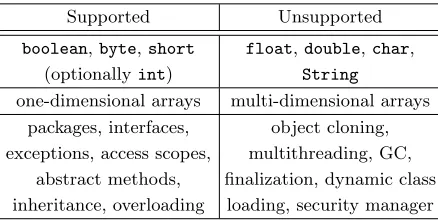
Table 2: Features of Java Card Platform Specification 2.2.2
Supported Unsupported
boolean,byte,short
(optionallyint)
float,double,char,
String
one-dimensional arrays multi-dimensional arrays packages, interfaces,
exceptions, access scopes, abstract methods, inheritance, overloading
object cloning, multithreading, GC, finalization, dynamic class
loading, security manager
of which electrically erasable programmable read-only memory (EEPROM or E2PROM) and Flash are the two most common NVM. Only a section of RAM and NVM is available for the user. EEPROM allows code and data to be read, erased, and rewritten individually; hence it could be used to save the applets and data. RAM has a faster processing speed with unlimited use times in Java Card, especially writing data to RAM is about 1000 times faster than writing to EEPROM, that makes it suitable for allocating transient objects. Ordinarily, the available RAM (up to about 10 KBytes) is less than NVM, but it is better suited to temporary process data. In our implementation, the run-time data are all stored in RAM, rather than EEPROM, that means we can update those data quite fast in the process of responding.
Card perform integer calculations for RSA internally, they only offer limited ex-ecution functionality (see [41]) which does not support modular multiplication and polynomial operations used in the ring-LWE encryption scheme.
For some lattice-based cryptography in the matrix form such as [13,25,30,36], although the matrices can be converted to one-dimensional arrays for multipli-cation, the sizes of those matrices are too large to hold in RAM or EEPROM when the security level reaches a predetermined level, e.g., 128-bit security. Poly-nomials, by contrast, can be stored in memory using one-dimensional coefficient arrays, and the required key sizes are also small (e.g., see [42]). Therefore, ring-LWE based cryptography is suited to implement on memory-constrained devices such as Java Card.
For the standard Java Card platform, a message can be represented as bit-stream or binary data. Hence, we use a binary array to express a plaintext in our implementation, and this allows the ring-LWE scheme to perform bit-wise text encryption.
4
Implementation techniques of ring-LWE scheme on
Java Card
In this section, we describe our implementation techniques for discrete Gaussian sampling, improved modular multiplication, and efficient polynomial multiplica-tion on Java Card.
4.1 Discrete Gaussian sampling
Algorithm 1: Discrete Ziggurat sampling algorithm on Java Card (DZ) Input: m, n, l, t∈Z, σ∈R, a probability arrayp= (p0,p1, ...,pn−1)
∈Zn(l+1)
2 , ay-coordinate value arrayy= (y0,y1, ...,ym)
∈Z(m+1)(l+1)
2 , ax-coordinate value arrayx= (x0, x1, ..., xm)
∈Zm+1, and an arrayr= (r0,r1, ...,rm
−1)∈Zm(l+1)2 . Output: Sample value s∈Z∩[−tσ, tσ]
1 Leta= (a0, a1, ..., al)∈Zl+1,b= (b0, b1, ..., bl)∈Zl+1, and c= (c0, c1, ..., cl)∈Zl+1;
2 whiletruedo
3 i← {1,2, ..., m}uniformly at random; sign← {−1,1} uniformly at random;x← {0, ..., xi}uniformly at random;
4 if 0< x≤xi−1 then returns=sign∗x 5 else
6 if x= 0thend← {0,1}uniformly at random; 7 else
8 forj= 0 tol by 1do 9 aj =yi[j];
10 forj= 0 tol by 1do 11 bj=r(i−1)[j];
12 c=generate(b);
13 forj= 0 tol by 1do 14 bj+ =aj+cj; 15 if bj >1then 16 bj−= 2;bj−1+ = 1; 17 forj= 0 tol by 1do 18 aj =px[j];
19 forj= 0 tol by 1do
20 if bj > aj then returns=sign∗x 21 else continue
Algorithm 2: Optimized binary number generator Input:l∈Z, an arrayc′= (c0′, c′1, ..., c′l)∈Z
l+1 2 Output: An arraya′= (a′0, a′1, ..., a′l)∈Z
l+1 2 1 fort= 0 toc′0−1 by 1do
2 a′t= 0;
3 whiletruedo
4 fori=c′0tolby 1do
5 a′i← {0,1}uniformly at random;
6 forj= 0 tolby 1do 7 if a′j< c′j then
8 return a′;
9 else if a′j> c′jthen
10 break;
11 if a′l=c′lthen return a′
Discrete Ziggurat algorithm Some sampling methods, with large look-up ta-bles or floating-point calculations, are less feasible to be implemented in memory-constrained platforms. Nevertheless, the discrete Ziggurat sampling method pro-posed in [3] allows for a flexible time-memory trade-off.
Lett >0 be the tail-cut factor, for a realσ >0, the sampled value is chosen uniformly at random from {−tσ, ..., tσ}. Letm∈Z be the number of horizon-tal rectangles which cover the probability density function (PDF) of the target probability distribution. More memory could be saved by sampling an integer x∈Z∩[−tσ, tσ] since the target discrete Gaussian distribution is symmetric. If x= 0, we accept with probability 1/2, otherwise a signs∈ {−1,1}is generated uniformly at random and return sx. Firstly, discrete Ziggurat method chooses a rectangle, then a point (x, y) with x ∈ Z, y ∈ R is sampled inside the cho-sen rectangle [3,9]. According to the location of that point inside the rectangle, either xis accepted as a sampled value, or be rejected.
Floating-point arithmetic is unsupported because of the features of the Java Card Platform Specification 2.2.2 (see Section 3), hence the floating-point num-ber needs to be converted into its binary expansion with a finite precision. Let l ∈Z+ be the precision of the binary expansion of the floating-point number. Both integral and fractional part of the floating-point number has to be stored into a look-up table.
look-up table. Let n ∈ Z, there are n binary expansions of the probabilities p0,p1, ...,pn−1 ∈ Zl+1. x
0, x1, ..., xm ∈ Z are the values of x-coordinates, and y0,y1, ...,ym ∈ Zl+1 are the valuesy-coordinates with (l+ 1)-bit precision of m rectangles. For i∈Z∩[0, m), let ri =yi−yi+1∈Zl+1 be the difference of neighboring y-coordinates. Note that the value of y-coordinate of the vertex is not less than one in order to cover the PDF.
Floating-point arithmetic is infeasible on Java Card due to limited memory and computing power. In addition, the multi-dimensional array cannot adapt to this environment. Therefore, the floating-point number is converted to its binary expansion and a multi-dimensional array is transformed to a one-dimensional array in our case. We modified the discrete Ziggurat sampling on Java Card as written in Algorithm 1. In Step 12 of Algorithm 1, the supported method generate() generates a (l+ 1)-bit precision binary number less than or equal to the input value. In consideration with the problem of time-consuming in this process, we could improve the efficiency by optimizing the leading zeros for every ri as shown in Algorithm 2.
When an array is inputted, Algorithm 2 searches the numbers of leading zeros and inserts them directly into the generated array. This method will increase the speed of discrete Ziggurat algorithm remarkably. At the beginning of each ri, only a 1-bit number is required to represent the numbers of leading zeros.
Knuth-Yao algorithm Donald Ervin Knuth and Andrew Chi-Chih Yao pro-posed an algorithm which aims to sample values from the non-uniform distri-bution in [23]. Precomputation has to be executed in Knuth-Yao algorithm. Similar to discrete Ziggurat algorithm, floating-point number of the probabili-ties should be converted to its binary expansion with finite precision. Note that multi-dimensional array is unsupported on Java Card. Therefore, we stored these probabilities in a one-dimensional array as the look-up table.
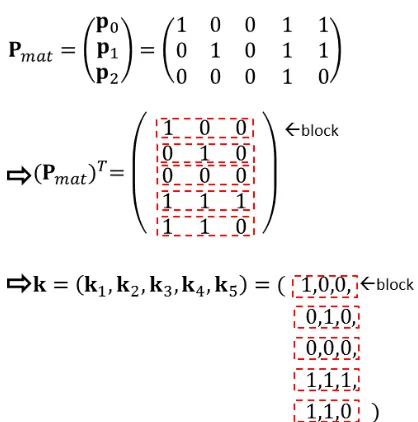
Fig. 1: Probability arraykincludinglblocks
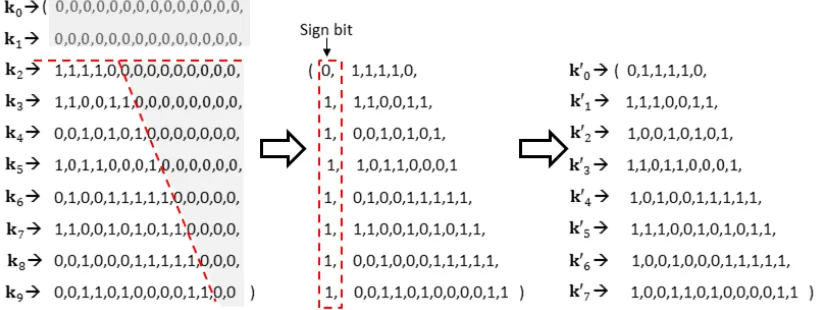
Note that the scale of the look-up table should be as less as possible because of limited memory in Java Card. It is clear that there are many zeros in probability arraykand these zeros can be compressed as in [11].
Figure 2 shows that by “deleting” zeros in grey areas, less memory can be used. Similar to Algorithm 3,Pmat is divided intol blocks k′0,k′1, ...,k′l−1. Let q ∈ Z represents the numbers of the first several blocks whose elements are all zeros. After the optimization of zeros, the length differences between two consecutive blocks can be marked with 1 or 0 [38]. A 0 is inserted as a sign bit at the front of the 0-th block firstly. Next, the length of 0-th block with its next neighboring block is compared. Then a sign bit 0 for no-increment or 1 for an increment by one is inserted. Hence, all sign bits for every block can be obtained by this method. As shown in Algorithm 4, h ∈ Z is the total length of all blocks which have been scanned, and g ∈ Z is the length of probability arrayk′= (k′0,k′1, ...,k′l−1) = (k0′, k1′, ..., k′g−1). This method consumes less time because these zeros can be skipped when scanning the look-up table.
Algorithm 3: Knuth-Yao Sampling algorithm on Java Card (KY) Input:l, n∈Z, a probability arrayk= (k0,k1, ...,kl−1)∈Zln2 Output: Sample values∈Z∩[−tσ, tσ]
1 Letd= 0,x= 0,sign= 0 ;
2 whiletruedo r← {0,1}uniformly at random;
3 d= 2d+r;
4 fori=ndown to 0 by 1do d=d−kx[i];
5 if d=−1then
6 if i= 0thensign← {0,1}uniformly at random;
7 else
8 sign← {−1,1}uniformly at random;
9 returns=sign∗row;
10 if sign= 1then returns=i;
11 else
12 d= 0;
13 r← {0,1}uniformly at random;
14 d= 2d+r;
15 x= 0;
16 continue
17 x+ = 1;
4.2 Montgomery modular multiplication
Implementation of multiplications on small devices, especially on Java Card, is a difficult task that not only due to its constrained memory, but also because of its limited computational capacity. Basically, according to the Java Card Platform Specification 2.2.2, only signed small integer types (short, byte) are supported that are represented in 2’s complement form in the most common cards, which means the signed integer larger than 15 bits is unavailable. However, choosing a modulusqfrom the Table 1 and then multiplying two positive coefficientsaand b ∈ Zq, the multiplication will be probably out of bounds of the signed short
integer. Even worse, the running time of integer operations on Java Card is quite slow, for instance, it takes about half of a second for 10000 times byteinteger multiplication on our experimental Java card. Therefore, we need to find a way to achieve polynomial multiplications which support small integer computation.
Fig. 2: Optimized probability array by deleting zeros in grey areas, the sign bit indicates the difference between two consecutive block lengths
Integrated Operand Scanning method (FIOS), Finely Integrated Product Scan-ning method (FIPS) and Coarsely Integrated Hybrid ScanScan-ning method (CIHS). Some literature such as [14,28,29,32] reported the implementation results for MMM methods on different platforms. However, according to their implemen-tation, some local variables in calculation might be still out of the signedshort
integer boundary using the parameters in Table 1; hence, those methods cannot be used in such memory-constrained device. To fit modular multiplication into the standard Java Card platform, we adopted an improved algorithm in [2] that we refer to asR-MMM, which can compute radix-2ωMMM by only usingsblocks forn-bit multipliers.
Algorithm 4: Optimized Knuth-Yao Sampling algorithm on Java Card (KYO)
Input: g, q∈Z, an optimized probability arrayk′= (k′0, k1′, ..., k′g−1)∈Z
g
2 Output: Sample values∈Z∩[−tσ, tσ]
1 Letd= 0,len=F irstBlockLength,sign= 0,h= 0forj= 0 up toq−1 by 1 do
2 r← {0,1}uniformly at random;
3 d= 2d+r;
4 whiletruedo
5 r← {0,1}uniformly at random;
6 d= 2d+r;
7 fori=len−1 down to 0 by 1do
8 d=d−k′i+1+sum;
9 if d=−1then
10 if i= 0thensign← {0,1}uniformly at random;
11 else
12 sign← {−1,1}uniformly at random;returns=sign∗i;
13 if sign= 1then returns=i;
14 else
15 d= 0;
16 r← {0,1}uniformly at random;
17 d= 2d+r;
18 len=F irstBlockLength;
19 sum=−F irstBlockLength−1;
20 continue
21 h=h+len+ 1 ;
22 if k′h= 1then
23 len+ = 1;
i.e., ω= 8 so thatb= 28, and R=b2= 216, then we can pre-computeM′ 0 and the inverseR−1.
4.3 Number theoretic transform
Algorithm 5: Radix-2ω Montgomery modular multiplication (R-MMM) Input: n-bit integersM = (Ms, ..., M0)b,X= (Xs−1, ..., X0)b,
Y = (Ys−1, ..., Y0)bwhere 0≤X, Y ≤M,b= 2ω,s=⌈n/ω⌉,R=bs
withgcd(M, b) = 1 andM0′ =−M− 1 0 modb Output: Non-negative integerA=X∗Y ∗R−1 modM
1 LetA= 0 = (As, ..., A0)b; // in our case, we setn= 16, ω= 8;
2 fori= 0tos−1do
3 temp= 0;
4 forj= 0 tos−1do
5 (temp, Aj) =Xj∗Yi+Aj+temp;
6 As=temp,temp= 0,µi=A0∗M0′ modb; 7 forj= 0 tosdo
8 (temp, Aj) =Mj∗µi+Aj+temp;
9 A=A/b;
10 if A≥M thenA=A−M; 11 returnA.
process. For example, we have tried Karatsuba algorithm on Java Card using the parameters in Table 1, and the running time of decryption is more than 500 seconds for n = 64. We also have rewritten Karatsuba algorithm into the non-recursive form. However, its computing speed is still slow, and the number of temporary arrays could not be reduced greatly.
Therefore, we follow the state-of-the-art and use the NTT which has asymp-totic complexityO(nlogn) for multiplying polynomials with higher degrees. The NTT is similar to the fast Fourier transform (FFT), but transforms overZq in-stead of the complex numbersC. In our previous work [42,43], we implemented a non-recursive forward number theoretic transform (NTT, see [8,37]) for ring-LWE based encryption schemes. For polynomial multiplication c=a·b∈Rq, it is required to compute the inverse (NTT−1), so thatNTT−1(NTT(f)) =ffor all f∈Rq, thus the multiplicationc=NTT−1(NTT(a) ⊗NTT(b)), where ⊗denotes component-wise multiplication.
More efficient approaches of NTT are presented in [24,35], which focus on the optimization of NTT’s bit-reverse computation, as shown in Algorithm 6 and Algorithm 7. Compared with our previous NTT implementation, Algorithm 6 and Algorithm 7 do not increase the length of the polynomial multipliers. We can pre-compute a table of the bit-reversed order to reduce the running time and the cost of RAM.
Algorithm 6:Cooley-Tukey forward number theoretic transform (CT-NTT) Input: Polynomiala∈Rq=Zq[x]/(xn+ 1), and a LUTΨrev∈Znq in
bit-reversed order
Output: Polynomiala′=CT-NTT(a)∈Rq
1 t=n;
2 form= 1ton−1 bym= 2mdo
3 t=t/2;
4 fori= 0tom−1do
5 j1= 2∗i∗t; 6 j2=j1+t−1; 7 S=Ψrev[m+i];
8 forj=j1 toj2do 9 U=a[j];
10 V =R-MMM(q,a[j+t], S);
11 a[j] =U+V modq; 12 a[j+t] =U−V modq;
13 returna.
primitive root of unity overZq. We write two polynomialsf= (f0, f1, ..., fn−1) and ¯f = (f0, ψf1, ..., ψn−1fn−1) ∈ Rq. First, we compute all 2n powers of ψ and ψ−1, and then storen powers ofψand ψ−1 with the bit-reversed order in look-up tables Ψrev, Ψrev−1 ∈ Znq, respectively. All the coefficients of input poly-nomials are in the standard order for Algorithm 6, and in bit-reversed order for Algorithm 7, so the bit-reverse operation for input polynomial can be merged into pre-computation. Then one gets the output the negative wrapped convolu-tionc= (1, ψ−1, ..., ψ−(n−1))⊗
GS-INTT(CT-NTT(¯a)⊗CT-NTT(¯b)), andcis the polynomial multiplication.
Algorithm 7: Gentleman-Sande inverse of number theoretic transform (GS-INTT)
Input: Polynomialb∈Rq=Zq[x]/(xn+ 1), and a LUTΨrev−1 ∈Znq in
bit-reversed order
Output: Polynomialb′=GS-INTT(b)∈Rq
1 t= 1;
2 form=nto2 bym=m/2do
3 h=m/2, j1= 0; 4 fori= 0toh−1do
5 j2=j1+t−1; 6 S=Ψ−1
rev[h+i];
7 forj=j1 toj2do 8 U=b[j];
9 V =b[j+t];
10 b[j] =U+V modq;
11 b[j+t] =R-MMM(q,(U−V), S);
12 j1=j1+ 2t; 13 t= 2t;
14 fori= 0ton−1do
15 b[i] =R-MMM(q,b[i], n−1);
16 returnb.
5
Performance of ring-LWE scheme on Java Card
In this section, we report the experimental results of running discrete Gaus-sian sampling methods and LPR-LWE scheme on a standard Java Card (JCOP v2.4.1 NXP J3A081 Dual Interface Card: Java Card Version: 2.2.2; Global Platform: 2.1.1; ISO/IEC 7816, T=0, T=1 (kbit/s): 223.2; ISO/IEC 14443 T=CL (kbit/s): 848; available EEPROM Options KByte: 80; ROM (free for Applets, up to KBytes): 76; APDU Buffer (RAM/Bytes): 1462). In our case, the random values are generated by pre-computing using our improved discrete Gaussian sampling methods.
5.1 Performance results of discrete Gaussian sampling on Java Card
Table 3: Experimental comparison of discrete Gaussian sampling methods on Java Card for different parameter sets
Sampling method Running time (s)
(𝑛, 𝑠) = (128, 8.62) (𝑛, 𝑠) = (256, 11.31)
Storage (KBytes)
(𝑛, 𝑠) = (128, 8.62) (𝑛, 𝑠) = (256, 11.31)
DZ[Alg.1]
DZO[Alg.2]
DZO-SP[Alg.2]
KY[Alg.3]
KYO[Alg.4]
KYO-SP[Alg.4]
11.01 24.49
2.25 5.01
1.92 3.89
22.40 24.29
22.51 24.39
18.16 19.67
4.87 12.37
1.15 2.47
1.11 2.41
6.19 7.95
4.32 5.48
3.29 4.24
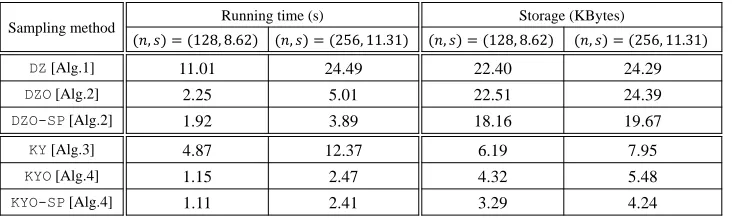
the statistical distances for the discrete Ziggurat algorithm and the Knuth-Yao algorithm are at most 2−100as in [5]. The number of rectangles is 63 for discrete Ziggurat algorithm [3]. To ensure the security and accuracy of discrete Gaussian sampling, the precisionl= 128 bits for these algorithms is sufficient in our case. However, the memory size and computing power are limited according to the specification of Java Card. Under this circumstance, it is necessary to use a rel-atively less precision. Moreover, when a smaller look-up table comes true, larger parameters can be used on Java Card. According to Lemma 2 in [11], a more suitable precision can be used. For each algorithm with n= 128 (resp.256), we choose the precisionl = 104 (resp.105) bits. As shown in Table 3, we compare the following sampling methods on Java Card: the original discrete Ziggurat (DZ, Algorithm 1)/Knuth-Yao algorithm (KY, Algorithm 3), the optimized discrete Ziggurat algorithm by using Algorithm 2 (DZO), and our optimized Knuth-Yao algorithm (KYO, Algorithm 4). Moreover, DZO-SP denotes the discrete Ziggurat algorithm with optimization using a suitable precision, andKYO-SPdenotes the Knuth-Yao algorithm with optimization using a suitable precision. For each al-gorithm with n= 128 and 256, Table 3 shows the running time in seconds (s) and storage in kilobytes (KBytes).
Apparently, there are notable improvements by means of the appropriate optimizations for not only Knuth-Yao algorithm, but also discrete Ziggurat al-gorithm from Table 3.
Compared with KY, KYO takes less running time and memory consumption that is about 5 times faster thanKYfor any selected parameter sets. Compared with DZ, DZO shows better performance that is more than 4 times faster than
DZfor any chosen parameter sets. It is clear thatKYO-SPuses much less storage
Note thatKY,KYO, and KYO-SPhave better performances thanDZ,DZO, and
DZO-SP for both running time and memory consumption. The calculation of
discrete Ziggurat algorithm can be sped up by two different ways. The first way is to optimize the time-consuming operation of generating random l-bit binary numbers such as Algorithm 2. It is clear that this technique improves the efficiency of discrete Ziggurat algorithm significantly. However, for any random l-bit binary number, there are at most 2l−1 numbers which are not greater than it. It is difficult to store such scale of numbers on Java Card. Therefore, these numbers cannot be pre-determined. Another method could be increasing the number of rectangles. If there are more rectangles, the area covered by them will tighter enclose the area under the probability density function [3]. However, if a larger m is chosen, the additional values of coordinates have to be stored, increasing the memory requirements. Hence, the promotion of discrete Ziggurat algorithm is limited to a certain level. For these reasons, we noticed that DZ
and DZO are much slower than KY and KYO on standard Java Card. On the other hand, Knuth-Yao algorithm has less precomputation and a smaller look-up table than discrete Ziggurat algorithm, because it only pre-computes the probabilities of all values in the specified range and stores their binary expansions into a probability array. Apart from this, discrete Ziggurat algorithm has to pre-compute the coordinates of all rectangles as well. Hence, Knuth-Yao algorithm is better than discrete Ziggurat algorithm for a memory-constrained device such as the standard Java Card platform.
5.2 Performance results of LPR-LWE on Java Card
In this subsection, we only report the performance results of key generation, encryption, and decryption of LPR-LWE without discrete Gaussian sampling, since we have generated all random values by pre-computing. We implement LPR-LWE scheme and generate key pairs by using parameters in Table 1.
Table 4: Performance results (seconds) of LPR-LWE on Java Card for different param-eter sets (comparing with our previous work in [43])
Key-Gen Enc Dec
dimension 128
Previous [43] Now Previous [43] Now Previous [43] Now
44.748 4.887 89.762 10.685 45.012 3.682
dimension 256
Previous [43] Now Previous [43] Now Previous [43] Now
104.005 10.358 208.188 16.050 103.761 7.398
233-bit ECC [10] -- ≈11.618 ≈5.845
2048-bit RSA [10] -- ≈0.123 ≈622.009
Comparing the performance between ring-LWE scheme and other cryptosys-tems on the standard Java Card platform is quite difficult. Firstly, we had tried to choose the prevailing public-key encryption algorithms such as RSA or ECC for comparison with the ring-LWE scheme at the approximate security level of 128 bits. However, Java Card needs some additional cryptographic co-processors that support such public encryption algorithms as RSA. Hence, because of the limited hardware resources, Java Card only offers asymmetric cryptographic sup-port for RSA up to 2048 bits (112-bit security) and ECC up to 320 bits (160-bit security). Therefore, we can only compare our implementation of ring-LWE scheme achieving 128-bit security to 2048-bit RSA and 233-bit ECC that achieve same security level (112-bit security). According to the implementation results in [10], encryption of 233-bit ECC (Menezes-Vanstone ECC) takes about 12 sec-onds, and decryption takes less than 6 seconds. Encryption of 2048-bit RSA is also faster that only takes about 0.1 seconds. However, its decryption is quite slower, which running time is more than 600 seconds, i.e., over 80 times slower than that of LPR-LWE scheme (n = 256). Even considering the differences of the test platform specifications and bit-security, decryption of LPR-LWE is still comparable to that of ECC, and much more efficient than that of RSA.
mod-25.488
14.297
7.312
4.192
1.006
0.765
0
5
10
15
20
25
30
35
40
dimension 256 dimension 128
CT-NTT (including MMM) [Alg.6] GS-INTT (including MMM) [Alg.7] Other
seconds
19.254
33.806
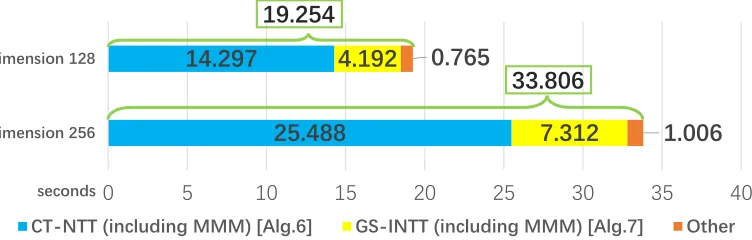
Fig. 3: Decomposition of the total running time (seconds) for different parameter sets
uli selected by them are much larger than 215, and we can find that in their source code they used the signedintinstances andintarrays. That indicates their environment should support big integer operations, but it also means the backward compatibility and portability of the programs are probably dismal. The authors did not discuss these in their papers. Therefore, the performance of implementations executed on different smart card platforms are hard to be compared.
5.3 Detailed running time of LPR-LWE on Java Card
Figure 3 shows the decomposition of the total running time including key gen-eration, encryption and decryption time for different parameter sets. Including
manyR-MMMloops in polynomial multiplication, we tested the execution time of
CT-NTTandGS-INTT.
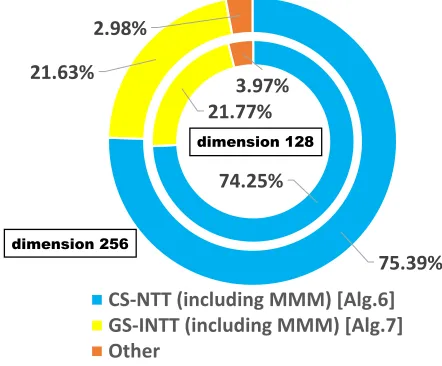
The running time of LPR-LWE with dimension 128 is less than half of that with dimension 256 due to the smaller parameter sizes. Compared with those methods, we noticed that polynomial multiplication is the single bottleneck computation that accounting for about 90% by summing both running time of
CT-NTTandGS-INTT. In fact, most time is spent onR-MMMinCT-NTT/GS-INTT,
and as the parameters increases, the running time of R-MMM loop within NTT increases too. As we have expected, in Figure 3, the running time required for polynomial multiplication is nearly equal to the total running time.
75.39%
21.63%
2.98%
CS-NTT (including MMM) [Alg.6]
GS-INTT (including MMM) [Alg.7]
Other
74.25%
21.77%
3.97%
dimension 128
dimension 256
Fig. 4: The proportions of computation time for different parameter sets
of polynomial multiplication. Overall, as moduli diminish in size, the amount of modular multiplication within NTT will be reduced.
6
Conclusion
References
[1] Erdem Alkim, L´eo Ducas, Thomas P¨oppelmann, and Peter Schwabe. “Post-quantum key exchange - a new hope.” InProceedings of the 25th USENIX Security Symposium, pp. 327–343, 2016.
[2] Toru Akishita and Tsuyoshi Takagi. “Power analysis to ECC using differen-tial power between multiplication and squaring.” InProceedings of the 7th IFIP WG 8.8/11.2 International Conference on Smart Card Research and
Advanced Applications, LNCS, Vol. 3928, pp. 151–164, 2006.
[3] Johannes Buchmann, Daniel Cabarcas, Florian G¨opfert, Andreas H¨ulsing, and Patrick Weiden. “Discrete Ziggurat: A time-memory trade-off for sam-pling from a Gaussian distribution over the integers.” In Proceeding of the 20th International Conference on Selected Areas in Cryptography – SAC 2013, LNCS, Vol. 8282, pp. 402–417, 2013.
[4] Johannes Buchmann, Florian G¨opfert, Tim G¨uneysu, Tobias Oder, and Thomas P¨oppelmann. “High-performance and lightweight lattice- based public-key encryption.” In Proceedings of the 2nd ACM International Workshop on IoT Privacy, Trust, and Security – IoTPTS ’16, pp. 2–9, 2016.
[5] Ahmad Boorghany and Rasool Jalili. “Implementation and comparison of lattice-based identification protocols on smart cards and microcontrollers.” In IACR Cryptology ePrint Archive, Report 2014/078, 2014.
[6] Ahmad Boorghany, Siavash Bayat Sarmadi, and Rasool Jalili. “On con-strained implementation of lattice-based cryptographic primitives and schemes on smart cards.” In ACM Transactions on Embedded Computing Systems (TECS) – Special Issue on Embedded Platforms for Crypto and Regular
Pa-pers, Vol. 14, Issue 3, No. 42, pp. 1–25, 2015.
[7] Jung Hee Cheon, Duhyeong Kim, Joohee Lee, and Yongsoo Song. “Lizard: Cut off the tail! Practical post-quantum public-key encryption from LWE and LWR.” In IACR Cryptology ePrint Archive, Report 2016/1126, 2016.
[8] Ruan De Clercq, Sujoy Sinha Roy, Frederik Vercauteren, and Ingrid Ver-bauwhede. “Efficient software implementation of ring-LWE encryption.” In Proceedings of 2015 Design, Automation & Test in Europe Conference & Exhibition (DATE), pp. 339–344, 2015.
Work-shop on Post-Quantum Cryptography – PQCrypto 2014, LNCS, Vol. 8772, pp. 22–39, 2014.
[10] Aaradhana A. Deshmukh, Manali Dubal, TR Mahesh, and CR Chauhan. “Data security analysis and security extension for smart cards using Java Card.” InInternational Journal of Advanced Information Technology (IJAIT), Vol. 2, No. 2, pp. 41–57, 2012.
[11] Nagarjun C. Dwarakanath and Steven D. Galbraith. “Sampling from dis-crete Gaussians for lattice-based cryptography on a constrained device.” In Applicable Algebra in Engineering, Communication and Computing, Vol. 25, Issue 3, pp. 159–180, 2014.
[12] L´eo Ducas and Phong Quang Nguyen. “Faster Gaussian lattice sampling using lazy floating-point arithmetic.” InProceedings of the 18th International Conference on the Theory and Application of Cryptology and Information Security – ASIACRYPT 2012, LNCS, Vol. 7658, pp. 415–432, 2012.
[13] Tore Kasper Frederiksen. “A practical implementation of Regev’s LWE-based cryptosystem.” Technical report, 2010.http://daimi.au.dk/~jot2re/
lwe/
[14] Junfeng Fan, Kazuo Sakiyama, and Ingrid Verbauwhede. “Montgomery mod-ular multiplication algorithm for multi-core systems.” InProceedings of 2007 IEEE Workshop on Signal Processing Systems (SIPS), pp. 261–266, 2007.
[15] Norman G¨ottert, Thomas Feller, Michael Schneider, Johannes Buchmann, and Sorin Huss. “On the design of hardware building blocks for modern lattice-based encryption schemes.” InProceedings of the 14th International Conference on Cryptographic Hardware and Embedded Systems – CHES 2012, LNCS, Vol. 7428, pp. 512–529, 2012.
[16] Tim G¨uneysu, Vadim Lyubashevsky, and Thomas P¨oppelmann. “Practical lattice-based cryptography: A signature scheme for embedded systems.” In Proceedings of the 14th International Conference on Cryptographic Hardware
and Embedded Systems – CHES 2012, LNCS, Vol. 7428, pp. 530–547, 2012.
[17] GlobalPlatform. “GlobalPlatform Card Specification 2.1.1.” 2003.http:// www.win.tue.nl/pinpasjc/docs/Card%20Spec%20v2.1.1%20v0303.pdf
[19] ISO/IEC 7816–1:2011. “ISO/IEC 7816–1: Cards with contacts – Physical characteristics.” Updated in 2011. Preview:https://webstore.iec.ch/preview/
info_isoiec7816-1{ed2.0}en.pdf
[20] Java Card Forum. “Java Card Platform vs. Native Cards (White Paper).”
2013.https://javacardforum.files.wordpress.com/2013/11/jcf-java-vs-native-final.
[21] C¸ etin Kaya Ko¸c, Tolga Acar, and Burton S. Kaliski Jr.. “Analyzing and comparing Montgomery multiplication algorithms.” InIEEE Micro, Vol. 16, Issue 3, pp. 26–33, 1996.
[22] Charles F. F. Karney. “Sampling exactly from the normal distribution.” InACM Transactions on Mathematical Software (TOMS), Vol. 42, Issue 1, No. 3, pp. 1–14, 2016.
[23] Donald Ervin Knuth and Andrew Chi-Chih Yao. “The complexity of non uniform random number generation.” In Algorithms and complexity: New directions and recent results, Academic Press, pp. 357–428, 1976.
[24] Patrick Longa and Michael Naehrig. “Speeding up the number theoretic transform for faster ideal lattice-based cryptography.” InProceedings of the 15th International Conference on Cryptology and Network Security – CANS 2016, LNCS, Vol. 10052, pp. 124–139, 2016.
[25] Richard Lindner and Chris Peikert. “Better key sizes (and attacks) for LWE-based encryption.” InProceedings of the 11th International Conference on Topics in Cryptology – CT-RSA 2011, LNCS, Vol. 6558, pp. 319–339, 2011.
[26] Vadim Lyubashevsky, Chris Peikert, and Oded Regev. “On ideal lattices and learning with errors over rings.” InProceedings of the 29th Annual interna-tional conference on Theory and Applications of Cryptographic Techniques – EUROCRYPT 2010, LNCS, Vol. 6110, pp. 1–23, 2010.
[27] Zhe Liu, Hwajeong Seo, Sujoy Sinha Roy, Johann Großsch¨adl, Howon Kim, and Ingrid Verbauwhede. “Efficient ring-LWE encryption on 8-bit AVR pro-cessors.” In Proceedings of the 17th International Conference on Crypto-graphic Hardware and Embedded Systems – CHES 2015, LNCS, Vol. 9293, pp. 663–682, 2015.
[29] Ciaran McIvor, M´aire McLoone, and John Vincent McCanny. “FPGA Mont-gomery multiplier architectures - a comparison.” InProceedings of 12th An-nual IEEE Symposium on Field-Programmable Custom Computing Machines (FCCM), pp. 279–282, 2004.
[30] Daniele Micciancio and Oded Regev. “Lattice-based cryptography.” In Post-Quantum Cryptography, pp. 147–191, Springer-Verlag, 2009.
[31] National Institute of Standards and Technology. “Post-Quantum Cryptogra-phy.” 2017.https://csrc.nist.gov/Projects/Post-Quantum-Cryptography/
[32] Sıddıka Berna ¨Ors, Lejla Batina, Bart Preneel, Joos Vandewalle. “Hardware implementation of a Montgomery modular multiplier in a systolic array.” In Proceedings of 2003 IEEE International Parallel and Distributed Processing Symposium (IPDPS), p. 8, 2003.
[33] Chris Peikert. “An effcient and parallel Gaussian sampler for lattices.” In Proceedings of the 30th Annual Conference on Advances in Cryptology – CRYPTO 2010, LNCS, Vol. 6223, pp. 80–97, 2010.
[34] Thomas P¨oppelmann and Tim G¨uneysu. “Towards efficient arithmetic for lattice-based cryptography on reconfigurable hardware.” In Proceedings of the 2nd International Conference on Cryptology and Information Security in Latin America – LATINCRYPT 2012, LNCS, vol. 7533, pp. 139–158, 2012.
[35] Thomas P¨oppelmann, Tobias Oder, and Tim G¨uneysu. “High-performance ideal lattice-based cryptography on 8-bit ATxmega microcontrollers.” In Proceedings of the 4nd International Conference on Cryptology and
Infor-mation Security in Latin America – LATINCRYPT 2015, LNCS, Vol. 9230, pp. 346–365, 2015.
[36] Oded Regev. “On lattices, learning with errors, random linear codes, and cryptography.” In Proceedings of the Thirty-Seventh Annual ACM Sympo-sium on Theory of Computing – STOC ’05, pp. 84–93, 2005.
[37] Sujoy Sinha Roy, Frederik Vercauteren, Nele Mentens, Donald Donglong Chen, and Ingrid Verbauwhede. “Compact ring-LWE cryptoprocessor.” In Proceedings of the 16th International Conference on Cryptographic Hardware and Embedded Systems – CHES 2014, LNCS, Vol. 8731, pp. 371–391, 2014.
International Conference on Selected Areas in Cryptography – SAC 2013, LNCS, Vol. 8282, pp. 383–401, 2013.
[39] Peter Williston Shor. “Polynomial time algorithms for prime factorization and discrete logarithms on a quantum computer.” InSIAM Journal on Com-puting, Vol. 26, Issue 5, pp. 1484–1509, 1997.
[40] Sun Microsystems, Inc.. “Java Card Platform Specification 2.2.2.” 2006.
http://www.oracle.com/technetwork/java/javacard/specs-138637.html
[41] Hendrik Tews and Bart Jacobs. “Performance issues of selective disclosure and blinded issuing protocols on Java Card.” InProceeding of the Third IFIP WG 11.2 International Workshop on Information Security Theory and Prac-tice. Smart Devices, Pervasive Systems, and Ubiquitous Networks – WISTP 2009, LNCS, Vol. 5746, pp. 95–111, 2009.
[42] Ye Yuan, Chen-Mou Cheng, Shinsaku Kiyomoto, Yutaka Miyake, and Tsuyoshi Takagi. “Portable implementation of lattice-based cryptography using JavaScript.” InInternational Journal of Networking and Computing, Vol. 6, No. 2, pp. 309– 327, 2016.
[43] Ye Yuan, Kazuhide Fukushima, Shinsaku Kiyomoto, and Tsuyoshi Takagi. “Memory-constrained implementation of lattice-based encryption scheme on standard Java Card.” InProceedings of 2017 IEEE International Symposium on Hardware Oriented Security and Trust (HOST), pp. 47–50, 2017.
[44] Robert Primas, Peter Pessl, and Stefan Mangard. “Single-trace side-channel attacks on masked lattice-based encryption.” InProceedings of the 19th In-ternational Conference on Cryptographic Hardware and Embedded Systems – CHES 2017, LNCS, Vol. 10529, pp. 513–533, 2017.
[45] Martin R. Albrecht, Rachel Player, and Sam Scott. “On the concrete hard-ness of learning with errors.” InJournal of Mathematical Cryptology, Vol. 9, Issue 3, pp. 169–203, 2015.
[46] Tobias Oder, Tobias Schneider, Thomas P¨oppelmann, and Tim G¨uneysu. “Practical CCA2-secure and masked ring-LWE implementation.” In IACR Transactions on Cryptographic Hardware and Embedded Systems, Vol. 2018, Issue 1, pp. 142–174, 2018.
![Table 4: Performance results (seconds) of LPR-LWE on Java Card for different param-eter sets (comparing with our previous work in [43])](https://thumb-us.123doks.com/thumbv2/123dok_us/7963446.1320921/22.612.138.482.152.265/table-performance-results-seconds-java-dierent-comparing-previous.webp)