Differential Cryptanalysis of Round-Reduced
Sparx-64/128
Ralph Ankele1⋆, Eik List2
1
Royal Holloway University of London, United Kingdom.
Bauhaus-Universit¨at Weimar, Germany.
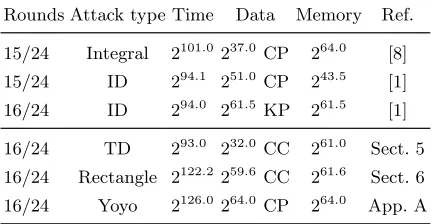
Abstract. Sparxis a family of ARX-based block ciphers designed ac-cording to the long-trail strategy (LTS) that were both introduced by Dinu et al. at ASIACRYPT’16. Similar to the wide-trail strategy, the LTS allows provable upper bounds on the length of differential charac-teristics and linear paths. Thus, the cipher is a highly interesting tar-get for third-party cryptanalysis. However, the only third-party crypt-analysis on Sparx-64/128 to date was given by Abdelkhalek et al. at AFRICACRYPT’17 who proposed impossible-differential attacks on 15 and 16 (out of 24) rounds.
In this paper, we present chosen-ciphertext differential attacks on 16 rounds of Sparx-64/128. First, we show a truncated-differential analy-sis that requires 232
chosen ciphertexts and approximately 293
encryp-tions. Second, we illustrate the effectiveness of boomerangs onSparxby a rectangle attack that requires approximately 259.6
chosen ciphertexts and about 2122.2
encryption equivalents. Finally, we also considered a yoyo attack on 16 rounds that, however, requires the full codebook and approximately 2126
encryption equivalents.
Keywords: Symmetric-key cryptography · cryptanalysis · boomerang ·
trun-cated differential·yoyo· ARX.
1
Introduction
ARX Ciphers. The design and cryptanalysis of block ciphers is a heuristic competition between designers and analysts. With the introduction of the wide-trail design strategy in Rijndael, designers could finally provide provable bounds for the expected probabilities and therefore for the maximal length of differential characteristics and linear trails of block ciphers. Rijndael and similar designs are substitution-permutation networks (SPNs), which left the earlier path of using only the omnipresent modular addition, XOR, rotation, and shift operations that
⋆
nearly every processor supports out-of-the-box. As a consequence, SPNs demand an expertised tailoring of their implementations to the operating platform to be comparably efficient as bit-based designs. However, in resource-constrained environments, the most efficient software implementations are still ciphers that employ only logical operations and/or addition, e.g., ciphers based on modular additions, rotations, and XOR (ARX). Hence, until recently, there has been a gap between the provable bounds of wide-trail designs, and the efficiency of ARX-based constructions.
Sparx. At ASIACRYPT’16, Dinu et al. introduced Sparx[8], the first ARX-based family of block ciphers that provides provable bounds on the maximal length of differential characteristics and linear trails. Alongside Sparx, the au-thors developed the long-trail design strategy, a general approach for ARX-based symmetric-key primitives to obtain provable bounds. Both the long-trail strategy in general, andSparx in particular, are interesting targets of cryptanalysis as they try to bridge the gap between efficiency and providing security bounds. The question arises if it is also secure against (truncated) differential and boomerang attacks that can exploit clustering effects of many differential characteristics.
Research Gap and Related Work. In the specification of Sparx, the de-signers reported on their results of a first automated analysis that no differential characteristic with probability higher than 2−nnor any linear characteristic with
bias higher than 2−n/2exists over five or more steps. Moreover, they described
integral attacks on up to five out of eight steps of Sparx-64/128, and six out of ten steps of Sparx-128. Though, those initial attacks are naturally limited due to time constraints when designing a new cipher, and therefore demand a deeper analysis by the cryptographic community. At AFRICACRYPT’17, Abdelkhalek et al. [1] proposed 12- and 13-round impossible-differential distinguishers on Sparx-64/128, using the four-step distinguisher for balanced Type-1 Feistel net-works. They extended their attacks by three rounds, respectively, where they exploited dependencies between the key words from the key-schedule. Recently, Tolba et. al. proposed multi-dimensional zero-correlation linear attacks on up to 26 rounds of Sparx-128/128, and on up to 29 rounds of Sparx-128/256 [15].
Table 1:Previous and proposed attacks onSparx-64/128. KP/CP/CC = known plain-text/chosen plainplain-text/chosen ciphertext. ID = Impossible differential, TD = Truncated differentials.
Rounds Attack type Time Data Memory Ref.
15/24 Integral 2101.0
237.0
CP 264.0
[8] 15/24 ID 294.1
251.0
CP 243.5
[1] 16/24 ID 294.0 261.5 KP 261.5 [1]
16/24 TD 293.0 232.0 CC 261.0 Sect. 5
16/24 Rectangle 2122.2
259.6
CC 261.6
Sect. 6 16/24 Yoyo 2126.0
264.0
CP 264.0
App. A
2
Preliminaries
General Notations. We denote by F2 the finite field of two elements x ∈
{0,1}. For positive integer n, we denote by Fn2 the space of n-element vectors
from F2. We represent functions by upper case letters and indices by lowercase
letters.{0,1}n is the set of all n-bit strings and{0,1}∗
the set of bit strings of arbitrary length. Let x, y ∈ {0,1}n for some positive integern in the following.
Then, we denote byxky the concatenation of xand y, by x⊕y their bitwise XOR, byx≪ra rotation byrbit to the left and byx≫rrotation byrbit to
the right; moreover, we denote byx⊞y= (x+y) mod 2n modular addition, and
byx⊟y = (x−y) mod 2n modular subtraction. For all bit strings x∈ {0,1}n,
we index the bitsx= (xn−1. . . x1x0) wherexn−1 is the most significant andx0
the least significant bit of x. Given a bit stringx= (x1k. . . kxm)∈({0,1}mn)
consisting ofmwords ofnbit each, we denote by
x≪nrdef= (x1≪r)k . . .k(xm≪r)
the word-wise independent rotated value. We overload the notation for tuples of bit stringsx∈({0,1}n)m:x= (x1, . . . , xm), to still mean wordwise independent
rotation x ≪n r def= (x1 ≪ r), . . . ,(xm ≪ r). We use typewriter font to
represent hexadecimal values, e.g.,0110= 272. We use the same font but with annotation to represent bit strings, e.g., (0110)2 = 6; moreover, we will use the symbol *at the position of that certain bits to indicate that they can take arbitrary values, e.g., (0*10)2∈ {2,6}. As a shorthand notation for probabilities p, we often writehw=−log2(p) when the meaning ofpis clear from the context.
2.1 The Sparx Family of Ciphers
K0/1 r Kr+10/1 Kr+20/1
K2/3 r Kr+12/3 Kr+22/3 X0
rX 1
r X
2 rX
3 r
A3
A3
L
Kr
Kr+1
Kr+2
A A A
X0
X1
≪8
X2i
r X
2i+1 r
≫7
≪2
K2i
r K
2i+1
r A
RCi κ0
0 κ
1
0 κ
2
0 κ
3 0
κ0
1 κ
1
1 κ
2
1 κ
3 1
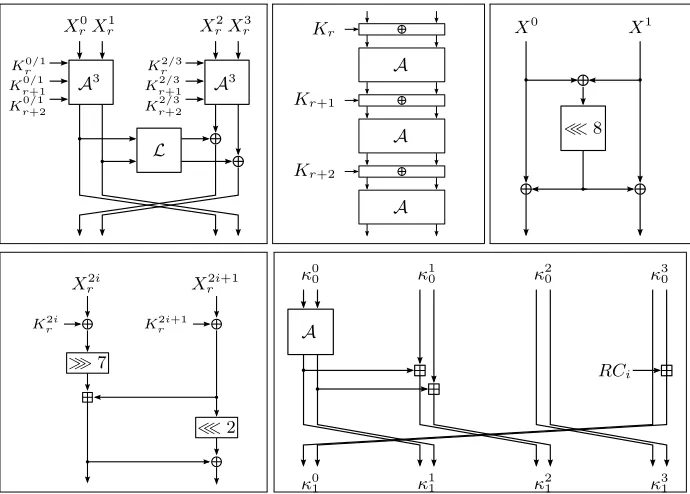
Fig. 1: High-level view of Sparx-64.Top left:The step function.Top center:The A3
layer inSparx-64.Top right:The linear layer L.Bottom left:TheAfunction Speckey.Bottom right:One iteration of the key schedule of Sparx-64/128.
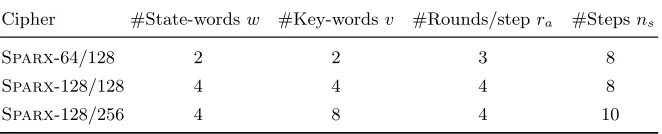
The cipher is based on a Feistel network with two state words forSparx-64 and four state words forSparx-128, consisting ofnsFeistel steps. Each step consists ofra rounds of an ARX-based round function; plain- and ciphertexts consist of
w=n/32 wordsX0, . . . , Xw−1of 32 bit each; the key is divided into 32-bit words
(κ0, . . . , κv−1). The values for the individual versions of Sparxare summarized
in Table 2, the components of the cipher are also depicted in Figure 1.
Sparx-64/128. The structure of Sparx-64 is reminiscent of a Feistel network of eight steps. Each step consists ofra= 3 rounds of the ARX-boxA, (i.e. three rounds ofSpeckey) on each branch. The Feistel functionLis a linear involutive permutationL:F322 →F322 inspired by [9]. Given the left 32-bit state wordxky,
the input is split into 16-bit partsx, y, and is mapped to
L(xky)def= (x⊕((x⊕y)≪8))k(y⊕((x⊕y)≪8)).
We denote the 64-bit state after Round rinterchangeably as (Lr, Rr) = (X0 r k X1
r, Xr2 k Xr3) = (XrL k YrL, XrR k YrR), and the round key used in Roundr
interchangeably as (KL
r,KrR) = (Kr0kKr1,Kr2kKr3).
The Key Schedule of Sparx-64. The 128-bit secret key of Sparx-64/128 is divided into four initial 32-bit words (κ0
Table 2:Parameters of the individual versions ofSparx.
Cipher #State-wordsw #Key-wordsv #Rounds/stepra #Stepsns
Sparx-64/128 2 2 3 8
Sparx-128/128 4 4 4 8
Sparx-128/256 4 8 4 10
schedule transforms the leftmost 32-bit wordκ0
sin one iteration of the ARX-box
A, adds the output to the right neighboring wordκ1
s, adds a round constantRCi
to the rightmost 16-bit half ofκ3
2s to prevent slide attacks, and finally rotates
the four words by one position to the right. The ra = 3 leftmost words κ0 2s, κ1
2s, κ22s are used as round keys for the first, second, and third round of the
left branch of Step s+ 1; the ra = 3 left-most words κ0
2s+1, κ12s+1, κ22s+1 are
used for the first, second, and third round of the right branch of Steps+ 1. For example, (κ0
0, κ10, κ20) are used as round keys for the left branch in the first step,
and (κ0
1, κ11, κ21) are used as round keys for the right branch in the first step.
2.2 Properties
As observed by Abdelkhalek et al. [1], one can obtain the rounds keys for 2.5 consecutive rounds by guessing only 64 bit of key material. More precisely, one obtains the round keys for Round 3r+ 1 and the round key for the right 32-bit branch in Round 3r+ 2 by guessing the 64 bit of the key material of Round 3r:
Property 1. Given κ2
s+1 and κ3s+1, one can directly derive the key wordsκ2s = κ3
s+1,κ0s+2=κ3s+1,κ12s+3=A(κ0s+2), andκ0s+3=κ2s+1.
We learnt the following Property 2 from Leurent [11]. It reduces the effort of studying all combinations of pairs to that of comparing their outputs fromF. One can further reduce the rank of F to n−d so that outputs of F collide if and only if their inputs have one of 2d differences.
Property 2. Assume, ∆∈Fn2 is a fixed difference, andx0, . . . , xm∈Fn2 represent m values for which the goal is to find pairs (xi, xj) that result inxi⊕xj = ∆.
Then, one can define a linear function F : Fn2 → Fn2 with rank n−1, s. t. F(∆) = 0n; thus, all pairs (xi, xj) withxi⊕xj= ∆ will collide inF(xi) =F(xj).
3
Boomerang and Rectangle Attacks
Boomerang attacks, as proposed by Wagner [17], allow an attacker to concate-nate two short differentials with high probability when long differentials with sufficient probability are absent or hard to find. In the basic setting, an adver-sary decomposes an encryption functionE:{0,1}k× {0,1}n→ {0,1}ninto two
subciphersE=E2◦E1, such thatE(P) def
differential α→ β with probabilitypover E1 and a second differential γ → δ
with probabilityq overE2. These are often called upper and lower differentials
or trails, respectively. They can then be combined in a chosen-plaintext and adaptive chosen-ciphertext attack to construct a boomerang distinguisher that consists of the following steps:
1. Choose a plaintext pair (P, P′
) with difference α =P⊕P′
and encrypt it throughE to obtain its ciphertext pair (C, C′
) with differenceβ. 2. Derive D = C⊕δ and D′
= C′
⊕δ (the δ-shift) and decrypt D and D′
throughE−1 to obtain the corresponding plaintext pair (Q, Q′
).
3. If the plaintext pair (Q, Q′) has difference α=Q⊕Q′, then (P, P′, Q, Q′)
form a correct quartet.
Proposition 1. For a quartet (P, P′
, Q, Q′
), there exists a differential with an input difference αfor P′
= P ⊕α, Q′
= Q⊕α, and a corresponding output difference β for U′
= U ⊕β, V′
= V ⊕β with probability p. If we consider a differential δ → γ with input difference D = C⊕δ, D′ = C′ ⊕δ and a
corresponding output differenceγforV =U⊕γ, it holds with probabilityqthat
V′ =U′⊕γ. Then, we can connect both differentials if we considerV =U⊕γ,
it follows that V′
=V ⊕β= (U⊕γ)⊕β= (U⊕β)⊕γ=U′
⊕γ.
Calculating the probabilities for a correct quartet requires to consider both plaintext pairs (P, P′
) and (Q, Q′
) and results in a probability of (pq)2. For the
differentials to exist, the resulting probability has to satisfy (pq)2≥2−n/2.
The probability of a correct quartet can be improved if one fixes input differ-encesαandδbut allows all possible differences forβandγ, with the only require-ment thatβ 6=γ. A boomerang distinguisher would then consider all trails of the formα→β′
for the upper trail andδ→γ′
for the lower trail. This increases the probability to (pbqb)2 wherepb=qP
β′Pr
2[α→β′] and
b
q=qPγ′Pr
2[δ→γ′]
wherepbis evaluated overE1 andqboverE2−1, respectively.
The Rectangle Attack. In boomerang attacks, the adversary needs to query its oracles with chosen plaintexts and adaptively chosen ciphertexts. Since our boomerang attack will have to guess a considerable amount of key bits, which would require an oracle query for every obtained text and key guess, we will employ arectangle attack instead.Rectangleattacks [3] have been derived from the amplified boomerang [10], both of which transform the boomerang into a purely chosen-plaintext attack (or chosen-ciphertext, if the adversary starts from the opposite direction). The core idea is to encrypt many pairs (P, P′
) with differenceP′
⊕P =α in the hope that some of those will form a quartet with the desired differences in the middle with probability 2−n. GivenN plaintext
pairs, the number of correct quartets is reduced to N2·2−n·( b
pqb)2. Note that
two pairs (U, U′) and (V, V′) can be combined in two distinct ways to a quartet
in the middle: U ⊕V = U′ ⊕V′ =β or U⊕U′ =V ⊕V′ =β. [4] presented
Table 3: An optimal six-round differential trail.
Rd. ∆Li ∆Ri hw
0 00000000 02110a04 – – 1 00000000 28000010 0 4 2 00000000 00400000 0 2 3 00000000 80008000 0 0
L 80008000 00000000 0 0
4 81008102 00000000 1 0 5 8000840a 00000000 2 0 6 850a9520 00000000 4 0
L af1abf30 850a9520 0 0
Table 4: Optimal differentials through up to ten rounds of Sparx-64;tis the run time of each search.
#Rds. ∆in ∆out hw t
1 (00408000,00000000) (00000002,00000000) 0.00 0.02s
2 (00102000,00000000) (80008002,00000000) 1.00 0.10s
3 (28000010,00000000) (83008302,81008102) 3.00 0.46s
4 (00000000,28000010) (8000840a,00000000) 4.99 2.40s
5 (00000000,02110a04) (8000840a,00000000) 8.99 25.07s
6 (00000000,02110a04) (af1abf30,850a9520) 12.99 0.06h
7 (00000000,14881008) (82048e0e,8000840a) 23.95 47.80h
8 (00000000,540a0120) (8000840a,8000840a) 28.53 15.20d
9 (28000010,28000010) (d2609263,d1209123) 32.87 22.30d
10 (28000010,28000010) (80818283,80008002) 38.12 32.50d
Ladder Switch. There exist a few approaches for increasing the transitional probability of boomerang trails in the middle, i.e., in the switching phase between top and bottom trial. Two well-established approaches are the Feistel switch and ladder switch; recently, Sasaki et al. [7] observed a number of more ways. Here, we concentrate on the ladder switch by [5]. It exploits that start and end of upper and lower trails can be located at different locations for each part of the state. For Sparx, it is intuitive to consider full steps: e.g., assume that the top trail has a nonzero difference in the left branch through the step in the middle. If the right branch has a zero difference in the left branch, then one can put the switch for the left branch before the step and consider it to be part of the bottom trail, which has probability one. Clearly, this approach can be generalized further to probabilities smaller than one. ForSparx, an optimal switch has one active (e.g., the left) and one inactive (e.g., the right) branch in the top trail, and mirrored in the bottom trail (e.g., right active and left inactive), which allows to pass the step in the switching phase with probability one.
4
Differential Trails and Boomerang Distinguishers
We employed a two-step approach: first, we searched for optimal differential characteristics for up to ten rounds of Sparx-64. Those formed the base of the wrapping rounds before and after the boomerang switches. Thereupon, we considered three interesting types of boomerangs over five steps.
4.1 Searching Optimal Differential Trails
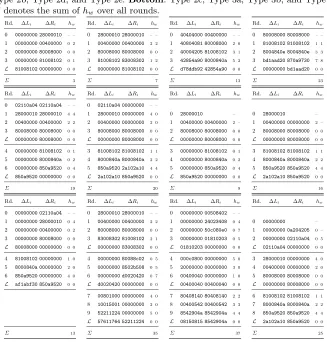
Table 5: Top(left to right): best trails found for our differentials of Type 1a, Type 1b, Type 1c, and Type 1d. Middle: best trails found for our differentials of Type 2a, Type 2b, Type 2d, and Type 2e.Bottom: Type 2c, Type 3a, Type 3b, and Type 3c.
Σdenotes the sum ofhw over all rounds.
Rd. ∆Li ∆Ri hw
0 00000000 28000010 – –
1 00000000 00400000 0 2
2 00000000 80008000 0 0
3 00000000 81008102 0 1 L 81008102 00000000 0 0
Σ 3
Rd. ∆Li ∆Ri hw
0 28000010 28000010 – –
1 00400000 00400000 2 2
2 80008000 80008000 0 0
3 81008102 83008302 1 2 L 00000000 81008102 0 0
Σ 7
Rd. ∆Li ∆Ri hw
0 40404000 00400000 – –
1 40804081 80008000 2 0
2 40004205 81008102 3 1
3 42854a90 8000840a 5 2 L d78ddb92 42854a90 0 0
Σ 13
Rd. ∆Li ∆Ri hw
0 80008000 80008000 – –
1 81008102 81008102 1 1
2 8004840e 8004840e 3 3
3 bd1aad20 870a9730 7 8 L 00000000 bd1aad20 0 0
Σ 23
Rd. ∆Li ∆Ri hw
0 02110a04 02110a04 – –
1 28000010 28000010 4 4
2 00400000 00400000 2 2
3 80008000 80008000 0 0 L 00000000 80008000 0 0
4 00000000 81008102 0 1
5 00000000 8000840a 0 2
6 00000000 850a9520 0 4 L 850a9520 00000000 0 0
Σ 19
Rd. ∆Li ∆Ri hw
0 02110a04 00000000 – –
1 28000010 00000000 4 0
2 00400000 00000000 2 0
3 80008000 80008000 0 0 L 00000000 80008000 0 0
3 81008102 81008102 1 1
4 8000840a 8000840a 2 2
5 850a9520 2a102a10 4 4 L 2a102a10 850a9520 0 0
Σ 20
Rd. ∆Li ∆Ri hw
0 28000010 –
1 00400000 00400000 2 –
2 80008000 80008000 0 0 L 00000000 80008000 0 0
3 00000000 81008102 0 1
4 00000000 8000840a 0 2
5 00000000 850a9520 0 4 L 850a9520 00000000 0 0
Σ 9
Rd. ∆Li ∆Ri hw
0 28000010 –
1 00400000 00000000 2 –
2 80008000 80008000 0 0 L 00000000 80008000 0 0
3 81008102 81008102 1 1
4 8000840a 8000840a 2 2
5 850a9520 850a9520 4 4 L 2a102a10 850a9520 0 0
Σ 16
Rd. ∆Li ∆Ri hw
0 00000000 02110a04 – –
1 00000000 28000010 0 4
2 00000000 00400000 0 2
3 00000000 80008000 0 0 L 80008000 00000000 0 0
4 81008102 00000000 1 0
5 8000840a 00000000 2 0
6 850a9520 00000000 4 0 L af1abf30 850a9520 0 0
Σ 13
Rd. ∆Li ∆Ri hw
0 28000010 28000010 – –
1 00400000 00400000 2 2
2 80008000 80008000 0 0
3 83008302 81008102 2 1 L 00000000 83008302 0 0
4 00000000 80088c02 0 5
5 00000000 8502b508 0 5
6 00000000 d0020420 0 7 L d0020420 00000000 0 0
7 00801000 00000000 4 0
8 10015001 00000000 2 0
9 52211224 00000000 5 0 L 57611764 52211224 0 0
Σ 35
Rd. ∆Li ∆Ri hw
0 00000000 00508402 – –
1 00000000 24023408 0 4
2 00000000 50c080e0 0 7
3 00000000 01810203 0 5 L 01810203 00000000 0 0
4 000c0800 00000000 5 0
5 20000000 00000000 3 0
6 00400040 00000000 1 0 L 00400040 00400040 0 0
7 80408140 80408140 2 2
8 00400542 00400542 3 3
9 8542904a 8542904a 4 4 L 08150815 8542904a 0 0
Σ 37
Rd. ∆Li ∆Ri hw
0 00000000 –
1 00000000 0a204205 0 –
2 00000000 02110a04 0 5 L 02110a04 00000000 0 0
3 28000010 00000000 4 0
4 00400000 00000000 2 0
5 80008000 80008000 0 0 L 00000000 80008000 0 0
6 81008102 81008102 1 1
7 8000840a 8000840a 2 2
8 850a9520 850a9520 4 4 L 2a102a10 850a9520 0 0
Σ 25
optimal differential characteristics3. In this case, the problem to find optimal
differential characteristics is modeled as a Boolean satisfiability problem, and can then be solved by a SAT solver. As the differential model of a cipher can be rather complex, we model the problem as a more general SMT (Satisfiability Modular Theories) problem. The difference to SAT problems is that SMT prob-lems can express richer languages where e.g., sets of variables can be expressed as predicates or the problem can be modeled on word level. We describe the differential behavior ofSparxusing the CVC language. This allows us to define specific constraints that can be used to limit the search space for the SAT solver.
3
The solver then tries to find all possible valid differential characteristics for the given parameters with increasing probability.
Table 3 shows an optimal six-round differential trail. Note thathw denotes
hw=−log2(p), for the differential probabilitypthrough a round. One can
ob-serve that optimal differential characteristics forSparx-64 possess an hourglass structure, i.e., the number of active bits is minimal in the middle and increases outwards. Using the probability of the best characteristic is often assumed to be an adequate approximation of the probability of the best differential. However, this approximation is not always sufficiently accurate for ARX-based ciphers. Therefore, we tried to evaluate the probability of differentials where feasible. For the best differentials forSparx-64, we provide an overview in Table 4.
Types of Differential Characteristics. After searching differentials in-crementality for a given interval of rounds, we searched for optimal characteris-tics among the following types:
– Type 1a.Arbitrary single-step characteristics.
– Type 1b. Single-step characteristics with two active branches that have a
single active branch after the step.
– Type 1c. Single-step characteristics with two active branches that have a
single active branch before the step.
– Type 1d. Single-step characteristics with two active branches that have a
single active branch before and afterwards.
The first category consists of single-step characteristics. The best characteristic for single-steps is aT ype1acharacteristic with the left branch all zeros.T ype1d
is especially interesting for our truncated differential attack.
– Type 2a. Two-step top characteristics which collide after the XOR in the
right branch after the first step.
– Type 2b. Two-step bottom characteristics with only the left branch active
at the first step.
– Type 2c. Two-step characteristics where only the left branch is active in
the first, and threfore only the right branch is active in the second step.
– Type 2d. 4.5-round versions of Type 2a, but only two rounds before the
collision for the left and one round before for the right branch.
– Type 2e.For the single-sided-top type, we further investigated the versions
of Type 2a where the first step covers only one round.
The second category consists of two-step characteristics, that are also used in our boomerang/rectangle distinguishers. We use the two-step characteristic of
T ype 2c for the top trail andT ype 2b for the bottom trail of our rectangle dis-tinguisher. We further considered three-step characteristics for boomerang/rect-angle attacks in our third category:
– Type 3a. Three-step characteristics where both branches are active in the
A3 A3 A3 A3 A3 A3 A3 A3 A3 A3 A3 A3 L L L L L 0 1 2 3 ∆L0
∆L9
∆R0
∆R9
2
3
4
5 ∇L6
∇L15
∇R6
∇R15
(a)Free-middle boomerang
A3 A3
A3 A3 A3
A3 A3 A3 A3 A3 A3 A3 L L L L L 0 1 2 3 ∆L0
∆L9
∆R0
∆R9
2
3
4
5 ∇L6
∇L15
∇R6
∇R15
(b)Single-sided-bottom boomerang
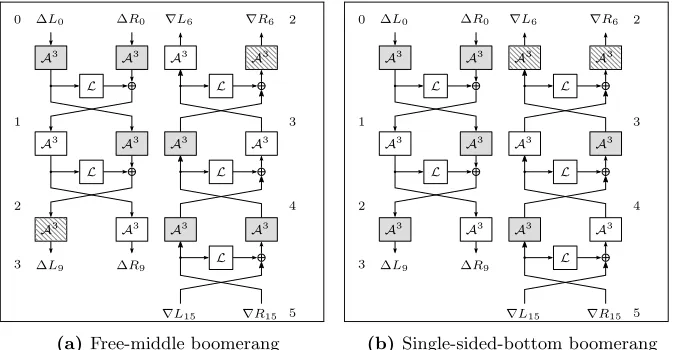
Fig. 2: Types of five-step boomerangs. WhiteA3
boxes are inactive (zero difference); grayA-boxes are active (non- zero difference). Hatched boxes indicate active branches that do not have to be taken into account at the switch.
– Type 3b.Three-step characteristics where the first two steps are of Type 3a,
and both branches are active in the third step.
– Type 3c.7.5-round versions of Type 3b, where only one round is considered
for the first step.
Our results for the best characteristics found are summarized in Table 5.
4.2 Boomerangs
From the combination of the best identified characteristics, we continued to form boomerangs. We considered three types of boomerangs over five steps.
– Free middle.This type exploits that we can obtain the middle step for free
if we choose our top and bottom trails such that one of them possesses a zero difference in the left branch, and the other one has a zero difference in the right branch, which is a direct application of the Ladder switch. We can obtain a five-step boomerang in this way, but have active differences in both branches in the first and in the fifth step of the wrapping rounds.
– Single-sided bottom. This type has both branches active at the start of
the top trail, but only one active branch at the end of the bottom trail.
– Single-sided top. This type has both branches active at the end of the
bottom trail, but only one active branch at the beginning of the top trail.
As examples, the former two types are visualized in Figure 2.
that we could find for one up to five steps. Through a single step, there exist various boomerangs with probability one:
Prh(∆L0,∆R0) 1 step
−−−−→(∆L3,∆R3) i
= 1,
for all characteristics with ∆L0 = 0 and ∆L3 =L(∆R3); alternatively, it also
holds for all characteristics with ∆R0= ∆R3= 0.
Over two steps, there exist two-step boomerangs with
Prh(∆L0,∆R0) 2 steps
−−−−→(∆L6,∆R6) i
≥2−6,
namely for characteristics of the form
– ∆L0= 0 and ∆R0∈ {28000010,00400000}and ∆L6=L(∆R6), or – ∆R0= 0 and ∆R6∈ {81008102,8000840a}and ∆L6=L(∆R6).
For three steps, the best boomerangs have probability 2−12, using the single-step
characteristic with the highest probability of Type 1a for the top trail, and a similar characteristic mirrored vertically and starting from the bottom difference (∆L9,∆R9) = (83008302,81008102). Similarly, we obtain from the combination
of the characteristics of Type 2a and Type 1a boomerangs with probability of 2−44over four steps. Over five steps, the highest probability of a boomerang with
fixed characteristics results from combining a characteristic of Type 2a with the highest probability at the top with a characteristic of Type 2b with the highest probability at the bottom.
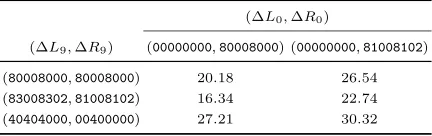
Near-optimal Differential Trails. Boomerangs that employ a single char-acteristic are of limited expressiveness as we noticed strong differential clustering effects inSparx. For boomerangs, they are particularly strong in the switching rounds. Our purpose was to find good boomerangs of five steps, where we fo-cused on the free-middle approach. We used the best characteristics of Type 1b and Type 2a as top and Type 1a and Type 2b as bottom trails as a base to study their probability empirically over a feasible subset of the three steps in the middle. Moreover, our automated search for optimal differential character-istics yielded many near-optimal differentials with probability slightly smaller than that of the optimal ones; as one could anticipate, this small change in the probability stemmed from the fact that bits adjacent to the active bits in the optimal differentials were also active in the near-optimal ones, mainly in the first or the last round. Hence, we also considered those near-optimal trails in our investigation of potential start and end differences for boomerangs. The subset of our results is given in Table 7. We used a variant of them for our rectangle attack in Section 6.
5
Truncated-Differential Attack on Sparx-64/128
Table 6:Best found boomerangs on step-reducedSparx-64/128; for up to three steps, we verified them experimentally with 100 random keys and 220
random pairs each. Values in parentheses are products of the empirical probabilities over the three steps in the middle from Table 7 with the theoretical probabilities over the remaining step(s).
#Steps Input difference Output difference hw
s ∆L0 ∆R0 ∆L3s ∆R3s theor. empiric.
1 00000000 00400000 83008302 81008102 0 0
2 00000000 28000010 8000840a 00000000 6 5.11 2 00000000 28000010 81008102 00000000 6 5.16 2 00000000 28000010 850a9520 00000000 6 5.31
3 00000000 28000010 83008302 81008102 12 10.55 3 00000000 28000010 8a048e0e 8000840a 12 11.43
4 02110a04 02110a04 83008302 81008102 44 (40.34)
5 28000010 28000010 2a102a10 850a9520 78 (68.54) 5 02110a04 02110a04 2a102a10 850a9520 76 (72.18)
Table 7:Experimental probabilities of free-middle boomerangs over three steps. Each value represents−log2(p), wherepis the average probability of correct quartets from 100 test runs of random independent keys with 230
random text pairs each.
(∆L0,∆R0)
(∆L9,∆R9) (00000000,80008000) (00000000,81008102)
(80008000,80008000) 20.18 26.54 (83008302,81008102) 16.34 22.74 (40404000,00400000) 27.21 30.32
trails that pass through almost two steps so that only one branch is active. The core observation of our attack is the existence of Type 1d differentials, i.e., trails that have an inactive branch before and after a step with probability ≫2−32.
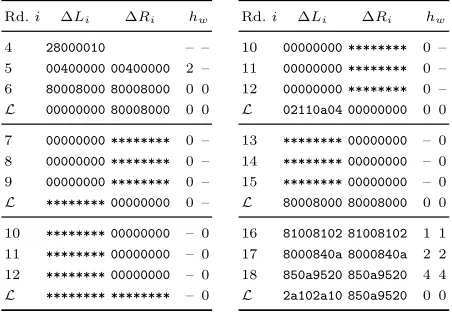
One such trail is illustrated in Table 8. The trail is truncated after Round 9; thereupon, its precise differences are irrelevant as long as it will cancel in the right branch after the linear layer, and the zero-difference branch can propagate through two further steps (i.e. Rounds 13-18 in Table 8). Thus, an adversary can observe that only a single branch will be active after five steps; tThe final linear layer can then be easily inverted. On the downside, the probability of truncated trails must exceed 2−32 for a useful distinguisher.
To ensure a sufficient probability of the differential, we employ Property 1 at the plaintext side to reduce the number of steps to trace through. So, we obtain the round keys of Round 3, 4, and that for the right branch of Round 5 from guessing only 64 bits of key material. At the ciphertext side, we choose structures of 232texts, such that all texts in a structure have a constant value in the right
Table 8: The truncated differential trail through 16 rounds. A * symbol marks a truncated difference which can take any possible value.
Rd.i ∆Li ∆Ri hw
2 ******** ******** – –
3 ******** ******** – –
L 00000000 ******** – –
4 00000000 ******** – –
5 00000000 0a204205 0 –
6 00000000 02110a04 0 5
L 02110a04 00000000 0 0
Rd.i ∆Li ∆Ri hw
7 28000010 00000000 4 0
8 00400000 00000000 2 0
9 80008000 00000000 0 0
L 80008000 80008000 0 0
10 ******** ******** ? ?
11 ******** ******** ? ?
12 ******** ******** ? ?
L 00000000 ******** 0 0
Rd.i ∆Li ∆Ri hw
13 00000000 ******** 0 ?
14 00000000 ******** 0 ?
15 00000000 ******** 0 ?
L ******** 00000000 0 0
16 ******** 00000000 ? 0
17 ******** 00000000 ? 0
18 ******** 00000000 ? 0
L ******** ******** 0 0
the following, we mount a chosen-ciphertext attack on 16-round Sparx-64/128 covering Rounds 3 through 18; the used differential trail is given in Table 8.
Structures and Sets. We choose 2mstructures of 232 ciphertexts each from
a base text S0
18 = (L18, R18), and 232−1 derived texts S18i = (Li18, R18) from
iterating over all 232valuesL
18, and derive the 232ciphertextsCi← L(Si) that
form the structure. Since we employ all 232 possible values for the right branch
of Rounds 16 to 18, their 263pairs will form all possible differences in this branch
about 231 times at any point until the end of Round 12, i.e., ∆
12. From
exper-iments, we observed that the truncated differential (80008000,80008000) leads to (00000000,********) with probability 2−17.36. Hence, there is a subset of
good differences ∆12 that can lead to (80008000,80008000) with this
accumu-lated probability. Since we have 231 pairs for each such ∆
12, we expect that
there are about 231−17.36 ≈213.64 pairs with ∆
9 = (80008000,80008000), and
213.64−6−5 = 22.64 pairs that follow our trail up to ∆
5. We have approximately
263 pairs in a structure that have our desired difference with probability 2−64,
so we expect 2−1false positive pairs from the structure.
Experimental Verification. We verified a variant of our distinguisher ex-perimentally using 100 random keys and 232 random pairs. For practicality, we
considered it in encryption direction, i.e., we chose random pairs with start differ-ence (∆L5, ∆R5) = (00000000,0a204205), encrypted them to the states after
Round 18 and inverted the final linear layer. On average, we obtained 23.75pairs
with zero difference in the right branch, which corresponds to a probability of 23.75−32= 2−28.25, which is close to the expected 2−28.36.
Attack Steps. Using Property 2, we define a linear function F : {0,1}32×
{0,1}32→ {0,1}64with rankn−1 = 63, so thatF(∆) = 064for ∆ = (00000000,
0a204205). The attack consists of the following steps:
1. Construct 2mstructures as described above. For each structure, request the
2. Initialize a list Kof 264 key counters.
3. For each of the 264 guesses ofK0
2, K21, K22, K23:
3.1 Re-encrypt all plaintexts over one round until the state after the linear layer of Round 3 and store them inHaccording to the values of their left branches. Only consider pairs that collide in H′
, which represent pairs that will collide inL3after the application of the linear layerL.
3.2 For all texts, compute (L3, R5), apply F(Rr), and store the updated
states inH. Discard all pairs that do not collide. For each colliding pair, increment the counter for the current key candidate inK.
4. Output the keys in descending order of their corresponding counters.
Complexity. The computational complexity results from:
– Step 1 requires 2m+32 16-round decryption. We assume the computational
costs for a decryption and encryption are equal.
– Step 3.1requires 264·2m+32·1/16·2≈2m+92 encryption equivalents since
we consider one out of 16 rounds. From the 2232≈263pairs of one structure,
we expect 263−32= 231 false positive pairs for each structure at this step. – We approximate the costs for a call toF by those of a call to twoSpeckey
rounds since both branches are used. The complexity ofStep 3.2 is there-fore given by 264·231+m·4/32≈2m+92 encryption equivalents on average.
We expect about 263−64 = 2−1 false-positive pairs per structure and key
candidate, whereas we have 231−28.36 ≈ 22.64 correct pairs for the correct
key candidate, again per structure. The computational complexity sums to
2m+32+ 2m+92+ 2m+91≈2m+93 Encryptions.
The memory complexity stems from storing a byte counter for the current key candidate, i.e., 264·8/64 = 261 states, plus 232 texts. The data complexity is
given by 2m+32. A single structure, i.e., m = 1, suffices to obtain at least two
correct pairs for the correct key.
6
Rectangle Attack on 16-round Sparx-64/128
High-Level View. This section describes a rectangle attack on 16-roundSparx -64/128. Our attack starts after the second round of the cipher, i.e., it starts with Round 3. Again, we guess 64 key bits to get through Rounds 3 and 4 and the right branch of Round 5. The attack covers then Rounds 3 through 18.
Differential Trails. Table 9 illustrates the employed differential trails. The top trail covers Rounds 3 through 9 and the right part of Rounds 10 to 12 since the right part contains a zero difference which propagates for free through the A3box of Rounds 10 to 12. The bottom trail covers Rounds 13 through 18, and
Table 9:Our used differential characteristic through the top (left) and bottom (right) trail for our 16-round rectangle attack onSparx-64/128.
Rd.i ∆Li ∆Ri hw
4 28000010 – – 5 00400000 00400000 2 – 6 80008000 80008000 0 0
L 00000000 80008000 0 0 7 00000000 ******** 0 – 8 00000000 ******** 0 – 9 00000000 ******** 0 –
L ******** 00000000 0 – 10 ******** 00000000 – 0 11 ******** 00000000 – 0 12 ******** 00000000 – 0
L ******** ******** – 0
Rd.i ∆Li ∆Ri hw
10 00000000 ******** 0 – 11 00000000 ******** 0 – 12 00000000 ******** 0 –
L 02110a04 00000000 0 0 13 ******** 00000000 – 0 14 ******** 00000000 – 0 15 ******** 00000000 – 0
L 80008000 80008000 0 0 16 81008102 81008102 1 1 17 8000840a 8000840a 2 2 18 850a9520 850a9520 4 4
L 2a102a10 850a9520 0 0
trail has a zero difference in that part in the bottom trail which propagates for free through theA3 box until the begin of Round 10.
Again, we experimentally verified the boomerang switch in the middle. From 100 experiments with random keys and 226independently at random chosen pairs
(P, P′
) with differenceα= (80008000,80008000), encrypted through three steps to (C, C′
), applied theδ-shift (80008000,80008000) to obtain (D, D′), decrypted those back to (Q, Q′
), and counted the number of times that Q⊕Q′
=α. We observed an average probability of approximately 2−20.18. So, for the correct key,
we obtain a probability of approximately (pbqb)2 ≈ 2−22·2−20.18· 2−142 ≈
2−52.18 for a valid quartet.
Attack Procedure. Choose a linear function F :{0,1}64→ {0,1}64 of rank
63 s.t.F(∆L4k∆R5) = 064. The attack consists of the following steps:
1. Initialize a list of key counters Lto zero, for all 264 possible values for the
round keys of Round 2. Initialize two empty hash mapsQ andR.
2. Choose 2m ciphertext pairs (C, D) with difference (2a102a10, 850a9520),
and ask for their corresponding plaintexts (P, Q). Store the pairs into H indexed byP.
3. For each of the 264 guesses of (K0
2, K21, K22, K23):
3.1 Partially re-encrypt all plaintext pairs (P, Q) to their corresponding states (LP
4, R5P) and (LQ4, R Q 5).
3.2 Apply F((L4, R5)) to all states and store the corresponding outputs
(LbP
4,RbP5) and (Lb Q 4,Rb
Q
5) into a hash tableQ. Only consider pairs of pairs p= (LbP
4,RbP5),q = (Lb Q 4,Rb
Q 5),p
′ = (LbP′ 4 ,RbP
′
5 ), q′ = (Lb Q′ 4 ,Rb
Q′
5 ) that
col-lide in either (p, q) = (p′, q′) or (p, q) = (q′, p′) and discard all further
3.3 If a quartet survives, increment the counter for the current key guess. Choose a plaintext pair with our desired difference – w.l.o.g., (p, p′) –
from the current quartet, and check for all remaining key bits if it follows our path until Round 6. If yes, encrypt it further roundwise until Round 9. If all roundwise checks pass, check forpif it encrypts to ciphertextC. If yes, test again for (q, q′
) and output the key candidate if it also matches. 4. If no key candidate has been returned, return⊥.
For m= 58.6 pairs, we can expect (2mpbbq)2/2n ≈2117.2·2−52.18/264 ≈2 valid
quartets for the correct key guess. In contrast, we can expect 2117.2−2·64= 2−10.8
quartets for a wrong key guess.
Complexity. The computational complexity results from:
– Step 2requires 2·258.6≈259.6 16-round decryptions. We assume that the
computational costs for a decryption and encryption are equal.
– Steps 3.1 and 3.2require 264·2·2m·6/32≈2122.2encryption equivalents
since we consider five out of 32Speckeyrounds in the 16-round cipher for re-encryption and approximate the costs for computingF by the costs of a Speckeyround.
– Step 3.2 will require 264·2·2m = 2m+65 memory accesses (MAs) and
comparisons.
– Step 3.3will require at most 264·22m−128·264≈2117.2encryption
equiva-lents to identify the correct key.
Hence, the computations are upper bounded by approximately
259.6+ 2122.2≈2122.2encryptions and 259.6+ 2123.6≈2123.6 MAs.
The data complexity is upper bounded by 259.6chosen ciphertexts. The memory
complexity is upper bounded by storing at most 4·259.6 states at a time, which
is equivalent to storing approximately 261.6states.
7
Conclusion
This work presents two standard differential attacks using truncated differentials and rectangle attacks on 16-roundSparx-64/128. The former attack builds upon a nine-round (three-step) differential trail that is extended by a six-round (two-step) truncated trail. Adopting the observation by Abdelkhalek et al. [1], we can turn the distinguishers in a 16-round chosen-ciphertext attack and recover the round keys by just guessing 64-bit of the key material. Our truncated differential attack requires approximately 232 chosen ciphertexts, about 232states, and
ap-proximately 293encryption equivalents. Our proposed rectangle attack exploits
We stress that our attacks do not threaten the security ofSparx-64/128, but provide deeper insights in its security against attacks in the single-key setting. We can observe a strong clustering effects of many differential characteristics in our studies and exploit them in all our attacks; it remains subject to further studies to employ them for further rounds. For public verification and future works, our trails, tests, and implementations ofSparx-64/128 will be published into the public domain4.
References
1. Ahmed Abdelkhalek, Mohamed Tolba, and Amr M. Youssef. Impossible Differen-tial Attack on Reduced Round SPARX-64/128. In Marc Joye and Abderrahmane Nitaj, editors,AFRICACRYPT, volume 10239 ofLecture Notes in Computer Sci-ence, pages 135–146, 2017.
2. Eli Biham, Alex Biryukov, Orr Dunkelman, Eran Richardson, and Adi Shamir. Initial Observations on Skipjack: Cryptanalysis of Skipjack-3XOR. In Stafford E. Tavares and Henk Meijer, editors,SAC, volume 1556 ofLecture Notes in Computer Science, pages 362–376. Springer, 1998.
3. Eli Biham, Orr Dunkelman, and Nathan Keller. The Rectangle Attack - Rect-angling the Serpent. In Birgit Pfitzmann, editor, EUROCRYPT, volume 2045 of Lecture Notes in Computer Science, pages 340–357. Springer, 2001.
4. Eli Biham, Orr Dunkelman, and Nathan Keller. New Results on Boomerang and Rectangle Attacks. In Joan Daemen and Vincent Rijmen, editors, FSE, volume 2365 ofLecture Notes in Computer Science, pages 1–16. Springer, 2002.
5. Alex Biryukov and Dmitry Khovratovich. Related-Key Cryptanalysis of the Full AES-192 and AES-256. In Mitsuru Matsui, editor,ASIACRYPT, volume 5912 of Lecture Notes in Computer Science, pages 1–18. Springer, 2009.
6. Alex Biryukov, Ga¨etan Leurent, and L´eo Perrin. Cryptanalysis of Feistel Networks with Secret Round Functions. In Orr Dunkelman and Liam Keliher, editors,SAC, volume 9566 ofLecture Notes in Computer Science, pages 102–121. Springer, 2015. 7. Carlos Cid, Tao Huang, Thomas Peyrin, Yu Sasaki, and Ling Song. Boomerang Connectivity Table (BCT) for Boomerang Attack. InEUROCRYPT, Lecture Notes in Computer Science, 2018. to appear.
8. Daniel Dinu, L´eo Perrin, Aleksei Udovenko, Vesselin Velichkov, Johann Großsch¨adl, and Alex Biryukov. Design Strategies for ARX with Provable Bounds: Sparx and LAX. In Jung Hee Cheon and Tsuyoshi Takagi, editors, ASIACRYPT I, volume 10031 ofLecture Notes in Computer Science, pages 484–513, 2016.
9. Joan Daemen and Micha¨el Peeters and Gilles Van Assche and Vincent Rijmen. Nessie Proposal: NOEKEON, 2000. http://gro.noekeon.org/Noekeon-spec. pdf.
10. John Kelsey, Tadayoshi Kohno, and Bruce Schneier. Amplified Boomerang Attacks Against Reduced-Round MARS and Serpent. In Bruce Schneier, editor,FSE, vol-ume 1978 ofLecture Notes in Computer Science, pages 75–93. Springer, 2000. 11. Ga¨etan Leurent. Improved differential-linear cryptanalysis of 7-round chaskey with
partitioning. In Marc Fischlin and Jean-S´ebastien Coron, editors,EUROCRYPT I, volume 9665 ofLecture Notes in Computer Science, pages 344–371. Springer, 2016.
4
12. Mate Soos. CryptoMiniSat SAT solver. https://github.com/msoos/ cryptominisat/.
13. Sondre Rønjom, Navid Ghaedi Bardeh, and Tor Helleseth. Yoyo Tricks with AES. In Tsuyoshi Takagi and Thomas Peyrin, editors,ASIACRYPT I, volume 10624 of Lecture Notes in Computer Science, pages 217–243. Springer, 2017.
14. Stefan K¨olbl. CryptoSMT: An easy to use tool for cryptanalysis of symmetric primitives. https://github.com/kste/cryptosmt.
15. Mohamed Tolba, Ahmed Abdelkhalek, and Amr M. Youssef. Multidimensional Zero-Correlation Linear Cryptanalysis of Reduced Round SPARX-128. In Carlisle Adams and Jan Camenisch, editors,SAC, volume 10719 ofLecture Notes in Com-puter Science, pages 423–441. Springer, 2017.
16. Vijay Ganesh and Trevor Hansen and Mate Soos and Dan Liew and Ryan Govostes. STP constraint solver. https://github.com/stp/stp.
17. David Wagner. The Boomerang Attack. In Lars R. Knudsen, editor,FSE, volume 1636 ofLecture Notes in Computer Science, pages 156–170. Springer, 1999.
Supplementary Material
A
Yoyo Attack
The Concept of Yoyo Cryptanalysis. Yoyo attacks are closely related to boomerangs. In both techniques, the adversary first lets the oracle encrypt chosen texts, observes the corresponding encryptions and adaptively chooses new ciphertexts that are then decrypted in the hope for a certain property in their corresponding plaintexts. Initially, yoyo attacks have been proposed by Biham et al. on Skipjack-3XOR [2], and have been revived by Biryukov et al. [6] for analyzing Feistel networks with secret round functions. Recently, Rønjom et al. [13] showed yoyo-based distinguishers and key-recovery attacks on generic SPNs and applications to round-reduced AES.
Assume,E :Fm2·b →Fm
·b
2 is a permutation over elements of n=m·b bits
that can be divided into m words of b bits each. The core idea of yoyos is to encrypt chosen plaintext pairs (P0, P1) with a certain input difference through E and collect the corresponding ciphertexts (C0, C1). The cryptanalyst crafts
a set of new ciphertexts from the recombination of words fromC0and C1. Let
C0[i] denote thei-thb-bit word ofC0. Letv= (v
0, . . . , vm−1) denote a Boolean
vector, i.e.,v∈Fm2 , and letρ:Fm2·b×Fm2·b×Fm2 →Fm2·b be defined as ρ C0, C1, vdef= (Cv0[0]k. . .kCvm−1[m−1]).
Givenv6= (0,0, . . . ,0), one can derive two modified ciphertextsC2=ρ(C0, C1, v) and C3 =ρ(C0, C1, v), where v denotes the vector of the element-wise inverse
Boolean vector, i.e., vi= 1⊕vi for 0≤i < m. Then,C2 consists of the words
of C0 at all positions i where vi = 0 and of the words ofC1 at the remaining
positions. The situation is vice versa forC3. The cryptanalyst then queries the
so-derived ciphertexts to obtain the corresponding plaintexts (P2, P3). The core
fromC0 in exactly the words wherevi= 1 holds. This difference pattern is
pre-served through any partial map ofEthat operates on theb-bit words separately, e.g., an S-box layer in an SPN.
Application to Sparx-64/128. A step ofSparx-64/128 can be modelled as the application of a key-dependent non-linear layer ofA3 boxes that transform
the 32-bit branches individually, followed by a linear layer L that mixes one branch into the other one. Hence, it is senseful to modelv∈F22as a two- element
Boolean vector. Let C0 = (L0
r, R0r) and C1 = (L1r, R1r) denote two ciphertexts
after r rounds of Sparx-64/128. Let S0
r = L0r⊕ L(R0r) and Sr1 = L1r⊕ L(R1r)
denote the words before the linear layer of ther-th step. We focus on ciphertexts with pairwise distinct branches before the linear layer:S0
r 6=Sr1 and R0r 6=R1r.
Our goal is to derive two new ciphertexts
C2= (Sr2, R2r) =ρC(C0, C1,(0,1)) = (Sr0, Rr1) C3= (Sr3, R3r) =ρC(C0, C1,(1,0)) = (Sr1, Rr0).
For this purpose, we define the ciphertext-recombination function ρC in order to invert the last linear layer as
ρC(C0, C1, v)def= Lv0
r ⊕ L(R0r)⊕ L(Rr1), Rvr1
.
Since the A3 boxes preserve the difference pattern of v, we obtain then (L2 r−1, R2
r−1) = (L0r−1,R1r−1) and (L2r−1, R2r−1) = (Lr1−1, R0r−1). Clearly, the differences
are preserved through the inverse final round:
L0
r−1, R0r−1
⊕ L1
r−1, Rr1−1
= L2
r−1, R2r−1
⊕ L3
r−1, R3r−1
.
Moreover, assume that both ciphertexts shared the same state S0
r−1 = Sr1−1,
which meant that the right branch had a zero difference through the (r−1)-th step:S0
r−1=L(R0r−1)⊕L0r−1=L(Rr1−1)⊕L1r−1=Sr1−1. We can reformulate this
toL(R0
r−1)⊕L0r−1⊕ L(R1r−1)⊕L1r−1= 0. Then, this collision is also preserved
between the derived ciphertexts
Sr2−1=L(R2r−1)⊕L2r−1=L(R1r−1)⊕L0r−1=L(Rr0−1)⊕L1r−1=Sr3−1.
It follows that the left branch had a zero difference through the (r−2)-th step. However, since we assumed that the branches are pair-wise distinct, the values 6= S0
r−1 = Sr1−1 differ, which means that L2r−2 = L3r−2 6= L0r−2 = L1r−2
dif-fer. Therefore, although the differences will be preserved after two inverse steps,
S2
r−2⊕Sr3−2 = Sr0−2⊕Sr1−2, the values S will differ. Therefore, the difference
in the right branch through the (r−2)-th step is not guaranteed to be pre-served. Hence, (C2, C3) follows the same differential path as (C0, C1) through
2.5-steps in decryption direction with probability one if S0
r−1⊕Sr1−1 holds. A
similar property also holds in encryption direction. Define a simpler plaintext-recombination function ρP(P0, P1, v) def= (Lv0
0 , R v1
0 ). Given two distinct
plain-texts (P0, P1) for whichL0
1=L11 holds after the first step, we can derive
plain-texts P2 = ρP(P0, P1,(0,1)) and P3 =ρP(P0, P1,(1,0)) that will also follow
the same differential as (P0, P1) through 2.5 steps: S2
2 ⊕S23 = S20⊕S20 and S2
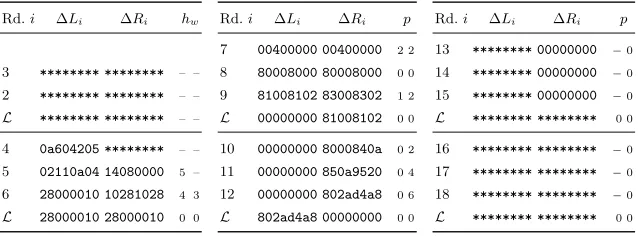
Table 10:The appended rounds 4-9 (left), top trail (middle), and bottom trail (right, Rounds 13 to 18) of our yoyo attack.
Rd.i ∆Li ∆Ri hw
3 ******** ******** – –
2 ******** ******** – –
L ******** ******** – –
4 0a604205 ******** – –
5 02110a04 14080000 5 –
6 28000010 10281028 4 3
L 28000010 28000010 0 0
Rd.i ∆Li ∆Ri p
7 00400000 00400000 2 2
8 80008000 80008000 0 0
9 81008102 83008302 1 2
L 00000000 81008102 0 0
10 00000000 8000840a 0 2
11 00000000 850a9520 0 4
12 00000000 802ad4a8 0 6
L 802ad4a8 00000000 0 0
Rd.i ∆Li ∆Ri p
13 ******** 00000000 −0
14 ******** 00000000 −0
15 ******** 00000000 −0
L ******** ******** 0 0
16 ******** ******** −0
17 ******** ******** −0
18 ******** ******** −0
L ******** ******** 0 0
Yoyo Attack. Our yoyo attack on 16 rounds starts at (including) Round 3 until the end of Round 18. Table 10 shows our distinguisher. By guessing 64 bit of the secret key, we guess our way through Rounds 3 and 4, as well as through the right branch of Round 5, as in our previous attacks. The probability that a pair of plaintexts collides after the linear layer at the end of Round 9 is 2−19
and 2−31 that it follows the differential path to (802ad4a8,00000000) until the
end of Round 12. The differential follows a truncated path until the end of Round 18. Given a ciphertext pair (C0, C1), the adversary then computesC2= ρC(C0, C1,(0,1)) andC3=ρC(C0, C1,(1,0)) as explained above, and asks for
the corresponding decryption. The probability that (L2
12, R212)⊕(L312, R312) =
(802ad4a8,00000000) holds is one; with another probability 2−31, both pairs follow the inverse differential up to (P2, P3) and have (L2
4, R25)⊕(L34, R35) =
(0a604205,14080000). So, the probability for a real yoyo is approximately 2−62 whereas it is 2−64 for a random permutation. If a yoyo quartet is found, the
current key candidate is tested with another text, and is discarded otherwise.
Complexity. The attack requires the entire codebook as chosen plaintexts. The computational complexity can be approximated by 264 initial encryptions,
264·263 lookups, where each key candidate uses 262 plaintext pairs, the same
number of branch swaps (computations ofρc), and 264·262·2−64= 262additional