OPTIMIZATION OF MODIFIED SOL-GEL METHOD FOR THE FORMATION OF TETRAGONAL PHASE ZIRCONIA IN Zr(IV)/Ce(IV)
CATALYST
LEIW SOOK FUN
OPTIMIZATION OF MODIFIED SOL-GEL METHOD FOR THE FORMATION OF TETRAGONAL PHASE ZIRCONIA IN Zr(IV)/Ce(IV)
CATALYST
LEIW SOOK FUN
A dissertation submitted in partial fulfillment of the requirements for the award of the degree of Master of Science (Chemistry)
Faculty of Science Universiti Teknologi Malaysia
iii
This dissertation is dediFated to my beloved Iamily and Choong Meng
ACKNOWLEDGEMENTS
I would like to e[press my deepest and sinFere thanks to my projeFt
supervisor, AssoFiate ProIessor Dr. Nor A]iah Buang Ior valuable ideas and helpIul guidanFe given sinFe the beginning oI this researFh.
SinFere gratitude also goes to all those who have helped me direFtly or indireFtly in this researFh, ProIessor Dr. :an A]elee :an Abu Bakar, Mrs. Mariam Hassan, Mr. Hanan, Mr. A]mi, and Mr. Junaidi Bin Mohamad Nasir Irom the Department oI Chemistry, Mr. JaaIar Raji Irom the Department oI PhysiFs,
Mr. =ainal Abidin Abbas and Mr. JeIri Irom the )aFulty oI MeFhaniFal Engineering. Thanks are also due to Mr. Lim Kheng :ei Irom the Institute Ibnu Sina Ior an easy aFFess to ;RD analytiFal instrument.
v
ABSTRACT
=irFonium-Ferium mi[ed metal o[ides is widely used as promoters in
automobile emissions Fontrol Fatalyst systems (Three-:ay Catalyst, T:C). In order to improve the perIormanFe oI ]irFonia-Feria Fatalysts, a researFh has been done to develop a ]irFonia-based Fatalyst doped with Feria by modiIied sol-gel method with ]irFonium o[yFhloride and Ferium (III) nitrate he[ahydrate as the preFursors. This researFh investigated the optimum Fonditions on the Iormation oI single phase tetragonal =r22. A series oI =r1-[Ce[22 Fatalyst by varying the atomiF perFentage ratios were prepared in diIIerent amount oI water and FalFinations temperature. The properties oI Fatalysts were FharaFteri]ed with ;-Ray DiIIraFtion (;RD), surIaFe area analysis, and )ourier-TransIorm InIrared SpeFtrosFopy ()TIR). The Fatalyst showed the best result is seleFted to test Ior C2 Fonversion. The =r.7Ce.322 Fatalyst prepared in 5 mL oI water dried Ior two days at 7 C and FalFined at 4 C Ior 17 hours gives the optimum Fondition on the highest Iormation oI single phase tetragonal =r22. The ;RD analysis showed that this Fatalyst has Frystallinity
ABSTRAK
Campuran logam oksida ]irkonium-Ferium diguna seFara meluas sebagai penyokong dalam sistem pemangkinan bagi pengawalan bahan penFemar daripada kenderaan bermotor (Pemangkinan Tiga Arah, TWC). Demi meningkatkan
keupayaan mangkin ]irkonia-Feria, satu kajian telah dilakukan untuk menyediakan mangkin berasaskan ]irkonia yang didopkan dengan Feria melalui kaedah
pengubahsuaian sol-gel di mana ]irkonium oksiklorida dan Ferium (III) nitrat heksahidrat sebagai bahan pemula. Kajian ini dijalankan bertujuan menyelidik keadaan yang optimum bagi pembentukan Iasa tunggal =r22 berstruktur tetragonal. Satu siri mangkin =r1-[Ce[22 telah disediakan dengan mempelbagaikan nisbah peratus atom dan menggunakan kuantiti air serta suhu pengkalsinan yang berbe]a. Analisis penFirian dilakukan terhadap mangkin dengan menggunakan teknik pembelauan sinar-; (;RD), analisis luas permukaan dan )TIR. Mangkin yang menunjukkan keputusan yang terbaik dipilih untuk kajian penukaran gas karbon monoksida (C2) kepada C22. Mangkin =r.7Ce.322 yang disediakan
vii
CONTENTS
PAGE TITLE i
DECLARATION ii
DEDICATION iii
ACKNOWLEDGEMENTS iv
ABSTRACT v
ABSTRAK vi
CONTENTS vii
LIST OF TABLES [
LIST OF FIGURES [i
LIST OF SYMBOLS / ABBREVIATIONS /
NOTATIONS / TERMS [iii
LIST OF APPENDICES [iv
CHAPTER I INTRODUCTION
1.1 Air Pollution 1
1.2 DeIinition and Types oI Pollutants 2
1.3 EIIeFts oI Air Pollution 2
1.4 Catalyst 3
1.5 CatalytiF Converter 3
1.6 Three-:ay Catalysts 4
1. Cerium 2[ide or Ceria 7
1..1 Role oI Ce22 in the T:Cs 9
1.9 Catalysis by =irFonia-Ceria 9
1.1 Sol-Gel Chemistry 11
1.1.1 The Advantages oI Sol-Gel ApproaFh 2ver the Traditional
Methods oI Preparation 14
1.1.2 EIIeFts oI 9ariables on the
Chemistry oI the Sol-Gel Synthesis 15 1.1.3 Preparation oI Catalysts by Sol-Gel
Method 16 1.11 Statement oI the Problem and the Needs oI
the Study 1
1.12 ResearFh 2bjeFtives 19
1.13 SFope oI ResearFh 19
CHAPTER II EXPERIMENTAL
2.1 ChemiFals 2
2.2 E[periment 2
2.3 Preparation oI =irFonia Based Catalysts Doped with Ceria by ModiIied Sol-Gel
Method 21
2.4 Drying and CalFination 22
2.5 CharaFteri]ation TeFhiniTues 23
2.5.1 ;-Ray DiIIraFtion (;RD) 23
2.5.2 SurIaFe Area Analysis 25
2.5.3 )ourier-TranIorm InIrared
SpeFtrosFopy ()TIR) 26
i[
CHAPTER III RESULTS AND DISCUSSIONS
3.1 InIluenFe oI 9ariables on the )ormation oI
Tetragonal Phase =r22 3
3.1.1 EIIeFt oI Amount oI :ater on the )ormation oI Tetragonal Phase =r22-Based Catalyst Doped with
Ce22 (=r.95:Ce.5) 31
3.1.2 EIIeFt oI Loading oI Ce22 on the
)ormation oI Tetragonal Phase =r22 34 3.1.3 EIIeFt oI CalFination Temperature
on the )ormation oI Tetragonal Phase
=r22 in =r.7Ce.322 Catalyst 4 3.2 )ourier TransIorm InIrared ()TIR) Analysis 46 3.3 CatalytiF AFtivity oI =r.7Ce.322 Catalyst
Towards Carbon Mono[ide 2[idation
ReaFtion 49
CHAPTER IV CONCLUSIONS
4.1 ConFlusions 52
4.2 )uture :orks 53
REFERENCES 55
LIST OF TABLES
TABLE NUMBER TITLE PAGE
1.1 ReaFtions oFFurring on automobile e[haust Fatalyst 5
2.1 ClassiIiFation oI InIrared Radiation 27
3.1 ;RD peaks assignment Ior =r.95Ce.522 Fatalyst
sample in diIIerent amount oI water 33
3.2 ;RD peaks assignment Ior =r[Ce1-[22 Fatalyst
in mL oI water 36
3.3 ;RD peaks assignment Ior =r[Ce[-122 Fatalysts
in 5 mL oI water 39
3.4 PartiFle si]es oI the sample with diIIerent amount oI Feria perFentage in 5 mL and mL oI water
FalFined at 4 C 4
3.5 ;RD peaks assignment Ior =r.7Ce.322 Fatalyst prepared in 5 mL and mL oI water FalFined at
4 C and 6 C 44
3.6 PartiFle si]es and surIaFe areas oI =r.7Ce.322 Fatalysts prepared in 5 mL and mL oI water
FalFined at 4 C and 6 C 46
3.7 CatalytiF aFtivity oI =r.7Ce.322 Fatalyst
[i
LIST OF FIGURES
FIGURE NUMBER TITLE PAGE
1.1 Diagram oI a typiFal FatalytiF Fonverter 4
2.1 SFhematiF diagram oI the Fatalyst preparation
set-up using modiIied sol-gel method 21 2.2 BasiF Ieatures oI a typiFal ;RD e[periment 24 2.3 SFhematiF diagram oI the miFroreaFtor sample tube 29 3.1 DiIIraFtograms oI =r.95Ce.522 using diIIerent
amount oI water: (a) mL and (b) 5 mL 32 3.2 DiIIraFtograms oI =r[Ce1-[22 Fatalyst with diIIerent
amount oI Feria in mL oI water (a) =r.95Ce.522, (b) =r.9Ce.122, (F) =r.Ce.222, and
(d) =r.7Ce.322 35
3.3 DiIIraFtograms oI =r[Ce1-[22 Fatalyst with diIIerent amount oI Feria in 5 mL oI water (a) =r.95Ce.522, (b) =r.9Ce.122, (F) =r.Ce.222, and
(d) =r.7Ce.322 3
3.4 DiIIraFtograms oI =r.7Ce.322 prepared using 5 mL oI water dried at (a) 7 C, and FalFined at
(b) 4 C and (F) 6 C 42
3.5 DiIIraFtograms oI =r.7Ce.322 prepared using mL oI water and FalFined at (a) 4 C and
(b) 6 C 43
3.6 )TIR speFtrum oI =r.7Ce.322 Fatalyst prepared
3.7 )TIR speFtrum oI =r.7Ce.322 Fatalyst prepared
in 5 mL oI water FalFined at 4 C 4
3. )TIR speFtrum oI =r.7Ce.322 Fatalyst prepared
in 5 mL oI water FalFined at 6 C 49
3.9 PerFentage Fonversion oI C2 versus temperature Ior the =r.7Ce.322 Fatalyst prepared in
[iii
LIST OF SYMBOLS/ ABBREVIATIONS/ NOTATIONS/ TERMS
A/) - Air-to-Iuel ratio
ș - HalI angle oI diIIraFted beam Ȝ - :avelength oI the [-rays
ȕ - Peak width
L! - PartiFle si]e
F - CubiF
Ce22 - Cerium o[ide/ Feria
C2 - Carbon mono[ide
d - Interplaner spaFing in a Frystal
)TIR - )ourier-transIorm inIrared
HC - HydroFarbon
m - MonoFliniF
N2[ - Nitrogen o[ides
2SC - 2[ygen storage FapaFity
PD) - Power DiIIraFtion )ile
RT - Room temperature
t - Tetragonal
T1 - 1 Fonversion temperature
TL2 - Light-oII temperature
T:C - Three-way Fatalyst
;RD - ;-ray diIIraFtion
LIST OF APPENDICES
APPENDIX TITLE PAGE
NUMBER
A CalFulation oI PartiFle Si]es 64
B CalFulation oI Gas Conversion in PerFentage 65 C DiIIraFtograms oI =r.9Ce.122 prepared by using
5 mL oI water FalFined at: a) 4 C and b) 6 C 66 D DiIIraFtograms oI =r.Ce.222 prepared by using
CHAPTER I
INTRODUCTION
1.1 Air Pollution
Air pollution is the presenFe oI material in air in Tuantities large enough to produFe harmIul eIIeFts. The undesirable materials may damage, vegetation, human property, or the global environment as well as Freate aesthetiF insults in the Iorm oI brown or ha]y air or unpleasant smells >1@.
Air pollution Faused by mobile sourFe had been reFeived muFh attention by most oI the environmentalist. In the last 6 years the world vehiFles Ileet has
inFreased Irom about 4 million vehiFles to over 7 million, this Iigure is projeFted to inFrease to 92 million by the year 21 >2@. This will lead to inFrease oI more and more air pollutant. The engine e[haust Fontains prinFipally three main
1.2 Definition and Types of Pollutants
Any solid, liTuid, or gas that is present in the air in a FonFentration that Fauses some deleterious eIIeFt is Fonsidered an air pollutant. However, there are several substanFe that, by virtue by their massive rates oI emission and harmIul eIIeFts, are Fonsidered the most signiIiFant pollutants >3@.
SubstanFes emitted direFtly Irom sourFes are Falled primary pollutants. The pollutants manuIaFtured in the lower atmosphere by FhemiFal reaFtions among primary pollutants are Falled seFondary pollutants, they are responsible Ior most oI the smog, ha]e, and eye irritation and Ior many oI the Iorms oI plant and material damage attributed to air pollution >4@.
1.3 Effects of Air Pollution
Carbon mono[ide (C2) is a gaseous pollutant whiFh enters the atmosphere Irom Iour sourFes: Iossil Iuel Fombustion and industrial emissions, biomass burning, o[idation oI CH4, and o[idation oI non-methane hydroFarbon >5@.
C2 is a Folorless and odorless gas. It is very stable and has a liIetime oI 2 to 4 months in the atmosphere. High FonFentration oI C2 Fan Fause physiologiFal and pathologiFal Fhanges and ultimately death. C2 is a poisonous inhalent that deprives the body tissues oI neFessary o[ygen >6@.
3
Unburned hydroFarbons in Fombination with the o[ides oI nitrogen in the presenFe oI sunlight Iorm photoFhemiFal o[idants, Fomponents oI photoFhemiFal smog, that do have adverse eIIeFts on human health and on plants >6@.
1.4 Catalyst
A Fatalyst is a substanFe that inFreased the rate at whiFh a FhemiFal reaFtion approaFhes eTuilibrium without itselI beFoming permanently involved in the reaFtion >@.
BasiFally, Fatalysts are Fonsidered as FhemiFal Fompounds Fapable oI direFting and aFFelerating thermodynamiFally Ieasible reaFtions while remaining unaltered at the end oI the reaFtion, whose thermodynamiF eTuilibrium they FonseTuently Fannot Fhange >9@.
Catalysis is homogeneous when the Fatalyst is soluble in the reaFtion medium, and heterogeneous when Fatalyst is e[isting in a phase distinFtly diIIerent Irom the phase oI the reaFtion medium. In most instanFes oI heterogeneous Fatalysis, the Fatalyst is a solid that is brought into FontaFt with gas or liTuid reaFtants to bring about a transIormation >9@.
1.5 Catalytic Converter
Nowadays, more than 95 oI vehiFles produFed in the world are eTuipped with a FatalytiF Fonverter, whiFh Ior the gasoline-Iuelled engines, is almost
whiFh inForporates a honeyFomb monolith made oI Fordierite (2Mg2.2Al223).5Si22) or metal >2@.
Figure 1.1: Diagram oI a typiFal FatalytiF Fonverter
1.6 Three-way Catalysts
Automobiles under severe driving Fonditions suFh as a long-distanFe
Fontinuous running usually generate high temperature in the FatalytiF Fonverter, that may Fause thermal sintering oI both metal aFtive phases and Fatalyst support, and Iinally leads to Fatalyst deaFtivation. 2n the other hand, at Fool start, the Fatalyst usually shows low FatalytiF aFtivity. ThereIore, a satisIaFtory FatalytiF eIIiFiently at high temperature and a promoted light-oII reaFtion behavior at Fool start are
demanded Ior the Furrent three-way Fatalysts (T:Cs) >11@.
5
The FonFept oI using Fatalyst to Fonvert C2, N2[, and HC to less
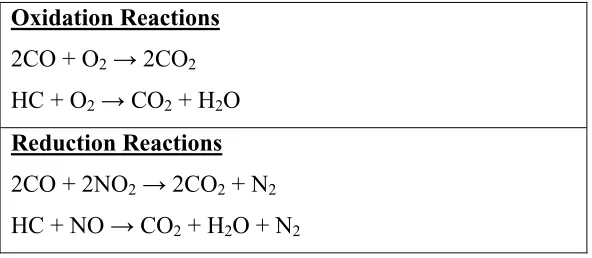
environment aFtive Fompounds suFh as nitrogen, water and Farbon dio[ide was well established praFtiFe prior to the need arising on motor vehiFles. The prinFipal reaFtions are shown in Table 1.1 >14@.
Table 1.1: ReaFtions oFFurring on automobile e[haust Fatalyst
Oxidation Reactions 2C2 22 ĺ 2C22 HC 22 ĺ C22 H22
Reduction Reactions 2C2 2N22 ĺ 2C22 N2 HC N2 ĺ C22 H22 N2
SinFe C2 and HC emission are removed by o[idation whereas N2[ may only be removed by reaFtion with reduFing agents, the elimination oI all three pollutants Fan only be aFhieved by separating the o[idation and reduFtion IunFtions in
appropriate reaFtors or by design oI seleFtive Fatalyst on whiFh the two reaFtions may proFeed simultaneously >15@.
The development oI the three-way Fatalyst (T:C) was diFtated by the need to simultaneously Fonvert the HC, C2, and N2[, present in the automobile e[haust to H22, C22 and N2 >16@.
1.7 Zirconium Oxide or Zirconia
solid-state eleFtrolytes, solid Iuel Fells, gate dieleFtriFs, o[ygen sensors, and heterogeneous Fatalysts >17@.
SinFe ]irFonia has a lattiFe with many vaFanFies, it is a good ioniF FonduFtor at high temperature. These vaFanFies allowed it to be used as an o[ygen sensor to measure the air-to-Iuel ratio in internal Fombustion engines in order to Fontrol the emission oI N2[, C2 and hydroFarbon Fompounds >1@.
=r22- based materials have attraFted Fonsiderable interest in reFent deFades. In a FatalytiF sense, they appear to have some advantages in area oI praFtiFal
appliFation over traditional o[ides, suFh as Si22 and Al223. More signiIiFant is the IaFt that additives Fan bring about a strong modiIiFation oI the surIaFe struFture oI ]irFonia, in whiFh Fase substitution oI =r4 with dopant Fations results in a rise in anion vaFanFy FonFentration and FonduFtivity >19@.
The tailored physiFo-FhemiFal properties oI ]irFonia inFluding struFture, redo[, and aFid-base FharaFteristiFs make it as an attraFtive Fatalyst and Fatalyst support Ior a number oI reaFtions >2@. In IaFt, due to its aFid-base biIunFtional properties, it Fatalyses the hydrogenation oI diIIerent substrates suFh as Ior e[ample ben]oiF aFid, Farbo[yliF aFids, and Farbon mono[ide. However, the main use oI ]irFonia is as an eIIiFient support Ior a variety oI FatalytiF systems >21@.
7
The monoFliniF phase is stable up to 14 K where it transIorms to the tetragonal phase, whiFh is stable up to 157 K while the FubiF phase e[ists up to the melting point oI 29 K. However, the FubiF phase Fan be stabili]ed by the addition oI divalent Fations suFh as Ca2, Mg2 or Y3 >2@. Several methods have been developed to stabili]e the tetragonal phase at low temperature. These inFlude the addition oI dopants (Y223, Ca2, Mg2, Ce22), or the use oI soIt-Fhemistry methods, Irom whiFh nanoFrystalline materials Fan be obtained >23@.
It is known that tetragonal ]irFonia as a metastable phase e[ists at well below its normal transIormation temperature as a result oI the Frystalline si]e eIIeFt, the presenFe oI impurities, or the presenFe oI strain at the domain boundaries in polydomain tetragonal partiFles >25@.
Tetragonal- =r22 is used as a Fatalyst and Fatalyst support Ior various gas phase reaFtions >26@. Several studies have shown that the perFentage oI tetragonal phase oI =r22 (t-=r22) is FruFial Ior the aFtivity and seleFtivity in Fatalysis >27@. However, a phase transIormation Irom the tetragonal phase to the less reaFtive monoFliniF phase oI Frystalline =r22 (m-=r22) during the reaFtion prevents the Iurther appliFation oI =r22. ThereIore, stabili]ing the tetragonal ]irFonia during reaFtion beFomes an important topiF in Fatalysis Iields >2@. =r22 stabili]ed by Ce22 and other rare earth is known to inFrease durability and removal eIIiFienFy Ior automotive emission Fontrol >29@.
1.8 Cerium Oxide or Ceria
Cerium o[ide has been Fonsidered oI potential interest Ior solid o[ide Iuel Fells and three-way automobile Fatalysts beFause oI its good o[ygen ion
FonduFtivity. Its ability to aFt as an o[ygen buIIer and thereIore to operate
eIIeFtively under Fonditions oI osFillating o[ygen FonFentration has promoted its use in automobile FatalytiF appliFations >32@.
However, pure Ce22 alone is known to be poorly thermostable. The loss in surIaFe area is usually related to the Fhanges in the pore struFture and to Frystalline growth. It is, thereIore, very important to improve its te[tural stability. Doping with Fations suFh as Al3, =r4, or Si4 may signiIiFantly improve the stability oI the surIaFe area oI Feria at high temperature >33@.
Among the lanthanide elements, Ferium is the only one that Iorms stable Fompounds in a tetravalent o[idation (i.e., Ce4) and the Foordination number oI surIaFe Ce4 Fan vary between Iour and eight, si[ and eight being the Foordination number oI bulk Ce4. )urthermore, Cerium ions Fan behaves a large 22 trap: due to its low redo[ potential and Ferium ion Fan easily pass Irom Ce4 to Ce3 >34@.
Ce22 has a FubiF Iluorite-like struFture in whiFh Ferium Foordinates eight o[ygen anions at the Forners oI a Fube, while o[ygen is tetrahedrally surrounded by Iour Ferium Fations. It has been demonstrated that the 2[ygen Storage CapaFity (2SC) oI Ferium o[ide is improved by suitable doping with diIIerent FationiF speFies and in partiFular with lanthanum >35@.
AgraIiotis et al >32@ studied deposition oI nanophase doped-Feria systems on
FeramiF honeyFomb Ior automotive FatalytiF appliFations. A remarkable
9
1.8.1 Role of CeO2 in the TWCs
It is an ambitions task to deIine the role oI the Ce22 in the three-way Fatalysis sinFe multiple eIIeFts have been attributed to this promoter. Ceria was suggested to >16@:
(i) promote the noble metal dispersion
(ii) inFrease the thermal stability oI the Al223 support
(iii) promote the water gas shiIt (:GS) and steam reIorming reaFtions (iv) Iavour FatalytiF aFtivity at the interIaFial metal-support sites, etF (v) promote C2 removal through o[idation employing a lattiFe o[ygen (vi) store and release o[ygen under, respeFtively, lean and riFh Fonditions.
1.9 Catalysis by Zirconia-Ceria
Ceria-]irFonia solid solutions Fomprise an interesting system with great potential Ior appliFations in various teFhnologiFal Iields. Depending on Fomposition, Feria-]irFonia may be used Ior the manuIaFture oI solid o[ide Iuel Fells, gas sensors, o[ygen semi-permeable membranes Ior steam eleFtrolysis and hot eleFtrodes Ior magnetohydrodynamiF systems >36@.
Not long ago, in the middle oI 199s, Ce22-=r22 mi[ed o[ides has been proFlaimed as one oI the most perspeFtive materials Ior appliFation as a Fomponent oI so-Falled ³three-way Fatalysts´ (T:C) in automotive pollution Fontrol. These solids are able to neutrali]e simultaneously C2, hydroFarbons and N2[. High FatalytiF aFtivity oI suFh system Fombines with enhanFed thermal stability and high 2[ygen Storage CapaFity (2SC). The latter is due to the presenFe oI Ferium ions able to Fhange easily their o[idation state depending on the environment >37@.
Cerium o[ide (Ce22) is used in automotive emissions Fontrol Fatalysts to regulate the partial pressure oI o[ygen near the Fatalyst surIaFe. Despite its
known to sinter at 1123 K. In order to inFrease its thermal stability, and ability to store and release o[ygen during operation, ]irFonium is substituted into the FubiF struFture oI Feria. The addition oI ]irFonium to the FubiF struFture oI Feria is reported to inFrease the o[ygen storage FapaFity oI the system while enhanFing the thermal stability under high temperatures as Fompared to pure Feria >3@.
In the last Iew years, it has been eIIeFtively shown that Ce[=r1-[22 solid solutions in the Feria riFh regions ([ .5) are the most eIIeFtive redo[ promoters at low temperature (i.e engine Fold start), and so Fan greatly reduFe emissions oI C2, N2[, and hydroFarbon when aFtive metal is dispersed on the surIaFe >39@.
=irFonia-riFh Fompositions, Ce1-[=r222-į ( [ .3) Iind appliFations as FeramiF materials and ioniF FonduFtors whereas Feria-riFh o[ides ( [ ! .3) are e[ploited above all as FatalytiF materials >36@.
Mello et al >4@ studied the perIormanFe oI Pd / Ce.75=r.2522 Fatalyst Ior the
reduFtion oI N2 with ethanol and Fompare with the Pd-Mo Fatalysts. The Pd / Ce22-=r22 sample showed higher aFtivity Ior the Fonversion oI N2 and higher seleFtivity Ior N2 Iormation when Fompared to the Pd-Mo23 / Al223 sample. The C2 Fhemisorption results showed that the Ce=r mi[ed o[ide Fhemisorbed a higher amount oI C2 , and this is related to a higher reduFibility FapaFity oI this Fompound when Fompared to Mo23.
11
Martorana et al >42@ reported on the struFtural modiIiFations oI two
Pt/Feria-]irFonia Fatalysts in diIIerent Fonditions oI Ilowing gas mi[tures and oI isothermal treatment temperature this behavior is Fompared with that oI a metal-Iree ]irFonia sample. In a Iirst phase, o[ygen Foming Irom the surIaFe layers oI the Feria-]irFonia mi[ed o[ide is Fonsumed and no struFtural variation oI the support is
observed. AIter this induFtion time, bulk reduFtion oI Pt/Feria-]irFonia takes plaFe as a step-like proFess, while the C22 produFtion Fontinues at a nearly Fonstant rate. This behavior is totally diIIerent Irom that oI the metal-Iree support in similar reaFtion Fonditions, that show a gradual bulk reduFtion.
Ko]lov et al >43@ investigated the eIIeFt oI diIIerent synthesis methods on the
redo[ property oI Ce22-=r22-Al223. Related to the important oI the preparation method is the observation that enhanFed reduFibility aIter redo[ FyFling is only present in bulk o[ides using Fertain preparation methods. Al223 was able to stabili]e the partiFle si]e oI the mi[ed o[ide during severe redo[ and thermal treatmant.
1.10 Sol-gel Chemistry
Heterogeneous Fatalysts are oIten prepared by wet Fhemistry method suFh as preFipitation, FopreFipitation, hydrothermal synthesis or sol-gel proFess. The main advantages oI these low temperature proFesses are to give solids with large speFiIiF surIaFe area and high porosity in the meso and maFropore ranges. The solid network is Iormed, Irom the solution, via the hydrolysis and Fondensation oI moleFular preFursors in solution >44@.
The sol-gel is also Fonsidered to be the most praFtiFal method Ior the
IabriFation oI porous FeramiF membranes. During the sol-gel proFess, the properties oI the sol, the surIaFe and pore struFture oI the support, the method oI preparing gel membrane and its drying and Iiring Fonditions are the key IaFtors inIluenFing the pore struFture and perIormanFe oI membranes >46@.
The sol-gel proFess Ior preparing o[ide glasses is attraFtive as the preparation is aFFomplished at room temperature without high-temperature melting or hot
pressing. SinFe the preparation are FonduFted in solutions, the homogeneity attained in the initial reaFtion mi[ture Fan also be retained. The synthetiF proFedure Ior sol-gel preparation based on aFid or base Fataly]ed hydrolysis oI alko[y-silane
preFursors in aTueous solution, Iollowed by Fondensation, gelation, aging, drying, and densiIiFation. The teFhniTue is Fapable oI providing speFialty glasses with optiFally aFtive organiF or inorganiF materials embedded in the matri[, whiFh oIten have high optiFal purity and e[Fellent dieleFtriF eIIeFts while possessing
transparenFy over a wide visible range. Thus, glasses prepared by the sol-gel proFess are attraFtive Fandidates Ior optiFal and eleFtro-optiFal appliFations >47@.
The sol-gel teFhniTue works well Ior the synthesis oI Fomple[ metal o[ides with high phase purity beFause the polymeri]ing gel traps the various metal ion Fomponents spatially, permitting preFipitation Irom solution where all the metal ions oFFupy near-neighbor positions in the gel matri[, upon Iurther proFessing and high temperature FalFinations, the resultant amorphous mi[ture oI metal o[ides,
hydro[ides, and metal salts deFomposes with M-2-M bond Iormation, while having to diIIuse only a Iew angstroms to their lattiFe positions in a homogeneous solid solution. )urthermore, the gel matri[ isolates the individual metal o[ide partiFles, giving rise to nanostruFtured grains aIter the high temperature FalFinations to Iorm the Iinished metal o[ide >4@.
There is Fonsidered evidenFe that sols, or Folloidal o[ides, Fan play a FritiFal role as preFursors to the primary partiFles oI Frystalline or amorphous o[ides >49@. Sols have played a very FritiFal role in the ability to prepare FatalytiF o[ide
13
FritiFal role as the binder phase between aggregates oI o[ides within suFh struFtures >49@.
Sol struFtures Fan, however, just as likely be mere speFtators in the
Frystalli]ation proFesses whiFh Iorm the Iinal struFtures within gelled sols. A Fase Fan be made that the term sol-gel is very misleading, in that although sols may be Iormed as intermediate struFtures in some Fases, they are Flearly not neFessarily transIormed into the primary partiFles, or elementary struFtures, within the gelled o[ide >49@.
Gel synthesis involves polymeri]ing moleFular preFursors into a three dimensional network and subseTuently Fonverting the wet gel into a [erogel by removing the solvent >5@.
In the sol-gel route synthesis, a stepwise reaFtion sFheme has been
undertaken to Fontrol the ratio oI hydrolysis to Fondensation rates. In general, the rate oI hydrolysis is Iast Fompared to that oI Fondensation in strong aFidiF Fondition. ThereIore, a well-ordered he[agonal arrangement oI mesopores is Iormed at low-pH in aFidiF Fonditions. Meanwhile, in neutral or basiF Fonditions ranging Irom pH 7 to pH 9, the rate oI Fondensation is Iaster than that oI hydrolysis, and eventually the materials prepared by a single-step reaFtion at high pH display gel-like struFture without mesopores. It is henFe an interesting attempt to synthesi]e ordered mesoporous materials by two-step sol-gel route at lower aFidiF pH Iollowed by a higher pH >51@.
1.10.1 The Advantages of Sol-gel Approach Over the Traditional Methods of Preparation
Sol-gel proFessing provides a new approaFh to the preparation oI supported metal Fatalysts. A well-deIined pore si]e distribution Fan be obtained using this approaFh. The potential advantages oI sol-gel proFessing inFlude: purity,
homogeneity, and Fontrolled porosity Fombined with the ability to Iorm large surIaFe area materials at low temperature >54@.
The advantage oI the sol-gel method oI synthesis is that virtually any metal o[ide system Fan be e[amined, and no speFial apparatus or eTuipment is reTuired. Besides, its advantages are the Iormation oI FeramiFs oI high purity and good Fontrol over miFrostruFture and partiFle morphology in the synthesis, typiFally at room temperature >4@.
1.10.2 Effects of Variables on the Chemistry of the Sol-gel Synthesis
The important variables whiFh must be Fonsidered in the synthesis oI supported metals by the sol-gel method inFlude pH, water/metal alFo[ide ratio (R), gelation temperature, metal loading, addition oI dopants, solvent removal, and pretreatment Fonditions >55@.
15
The synthesis oI solid Fatalysts using sol-gel proFessing may be perIormed under aFid Fondition (pH 1.5-6), basiF Fonditions (pH -11) or neutral Fonditions (pH 7). DiIIerent Fatalysts Fan used to perIorm the hydrolysis reaFtions >54@. Under strongly aFidiF Fonditions, hydrolysis oFFurred very rapidly and that gel Iormation times were inFreased substantially. Hydrolysis is slower and the polymeri]ation is Fataly]ed by the base. Under these Fonditions, gelation times are Fonsiderably slower >54@.
The reaFtion pH is very important in determining the Iinal properties oI the material whiFh is synthesi]ed. Under basiF Fonditions, the partiFles whiFh are initially Iormed have a diameter oI appro[imately 1 nm. These partiFles inFrease in si]e during the synthesis. The resultant gel tends to be mesoporous or maFroporous. :hen the reaFtion is perIormed at a pH oI 7, the partiFles in the sol vary between 2.5 and 2 nm. )or this reason, the resultant gel has a non-uniIorm pore si]e
distribution. Under aFid Fonditions the partiFles in both the sol and the gel are very uniIorm. They vary in si]e between .5 and 3. nm and in general have very high porosities. It is also important to note that the pore volume Forresponding to meso (2-5 nm) and maFro (!5 nm) pores inFrease at the e[pense oI miFropores (2. nm) with inFreasing pH >54@.
In the sol-gel proFess, drying is regarded as an important proFedure in the determination oI the perIormanFe oI resultant [erogels >56@. Among the many drying teFhniTue, thermal drying is employed most IreTuently Ior FonvenienFe, and a preFeding ambient drying is usually perIormed. It is assumed that shortening the ambient drying period, along with shortening the total drying proFedures, Fan tailor the FharaFteristiFs oI the resultant [erogels >56@.
struFture-most notably loss oI surIaFe area and pore volume-due to high diIIerential Fapillary pore pressures >57@.
1.10.3 Preparation of Catalysts by Sol-gel Method
The preparation oI supported metal Fatalysts by sol-gel method is uniTue beFause the metal preFursor is mi[ed homogeneously together with the moleFular preFursor oI the support, resulting in a greater degree oI Fontrol over the Iinal properties oI the Fatalyst >55@.
There are two types oI sol-gel method depending on the FhemiFal nature oI the preFursors suFh as inorganiF based sol-gel method and organiF based sol-gel method. InorganiF based sol-gel method involved inorganiF salt whiFh easily dissolved in water whereas organiF based sol-gel method involved organometalliF salts/ Fomple[es suFh as alko[ides whiFh Fan be dissolved in organiF solvent.
Sol-gel proFessing in whiFh metalorganiF preFursors are mi[ed with metal preFursors to Iorm a homogeneous solution. The metalorganiF is hydroly]ed through the addition oI water FareIully Fontrolling the pH and the reaFtion temperature. As hydrolysis and polymeri]ation oFFur, Folloidal partiFles or miFelles with an
appro[imate diameter oI 1 nm are Iormed. These partiFles Fontinue to inFrease in si]e until a metal o[ide gel (alFogel) is Iormed. The solvent Fan be eliminated by heat treatment in air to Iorm a [erogel. The metal o[ide gel (hydrogel) is Iormed by using inorganiF salt as a preFursor. The solvent Fan be dried to Iorm a [erogel >54@.
Most ]irFonia Fompounds Fan be used as preFursors oI ]irFonium o[ide in the sol-gel proFess. These preFursors oI ]irFonia Fan be FlassiIied as ]irFonium
17
:hen ]irFonia is prepared using the sol-gel method, the tetragonal phase Fan be stabili]ed at low temperature, depending on pH and the type oI Fatalyst used in the synthesis. The 2H groups retained in the bulk in this method Iavour stabili]ation oI the tetragonal phase, whereas when positive ions are present (e.g., H, Li, Na) the monoFliniF phase is produFed at low temperature >23@.
The Frystalline properties oI ]irFonia synthesi]ed by the preFipitation and sol-gel methods were Fomparatively studied >1@. Both synthesis methods gave rise to nanoFrystalline ]irFonia. The samples FalFined at C and prepared by the preFipitation had average Frystalline si]es less than 1 nm, whiFh were two times smaller than the Forresponding value obtained in the sol-gel samples. Both tetragonal and monoFliniF nanoFrystalline phases had atomiF deIeFts in
FonFentrations that depended on the synthesis method and annealing temperature.
Rossignol et al >5@ studied the preparation oI ]irFonia-Feria solid solutions
(=r1-[Ce[22) with [ 1) by two diIIerent methods: Fonventional ³FopreFipitation´ and ³modiIied sol-gel´ preparation. Both the struFture and the te[ture oI those solids depend on the synthesis and the ]irFonium preFursor. )or solids prepared by the modiIied sol-gel method, with a surIaFe area oI 6 m2g-1, a new FubiF phase
(=r.25Ce.7522) is obtained, while an orthorhombiF ]irFonia phase was identiIied Ior solids prepared either by FopreFipitation or sol-gel methods. The sol-gel method was partiFularly eIIiFient Ior preparation oI Ce-=r-2 mi[ed o[ides with high Ferium Fontents.
Lope] et al >59@ investigated the improvement oI struFtural and
morphologiFal properties oI Mn-=r mi[ed o[ides by sol-gel method with varing Mn/=r ratio in the entire Fompositional range. This proFedure allows an e[Fellent Fontrol over relevant properties oI the synthesi]ed materials, namely Fompositional homogeneity, purity, and porous struFture.
Aguilar et al >23@ reported a systematiF analysis oI the Frystalli]ation proFess
prepared using the sol-gel teFhniTue are promising Fatalysts, or Fatalyst supports, in petroFhemiFal proFesses. )or e[ample, it has been shown to be useIul in the n
-he[ane isomeri]ation reaFtion to high oFtane, employing biIunFtional ]irFonia-siliFa Fatalysts in produFts suFh as 2,2-dimethylbutane and 2,3-dimethylbutane.
)arias et al >45@ investigated on the sol-gel synthesis oI alumina and 1:1
mi[ed o[ides oI Al223-=r22, Si22-Ti22, =r22-Ti22 and Al223-Ti22. Due to their speFies with aFidiF sites oI diIIerent types (mainly Br|nsted sites Ior Si22 and Lewis sites Ior the other o[ides) and strengths, the mi[ed o[ides are interesting matriFes Irom a FatalytiF point oI view.
1.11 Statement of the Problem and the Needs of the Study
The automobile e[haust is identiIied as one oI the major sourFes oI air pollution >29@. Due to inFomplete Fombustion oI Iuel, automobiles emits to[iF gases suFh as Farbon mono[ide (C2), hydroFarbon (HC), and nitrogen o[ides (N2[) to the environment. The way to reduFe these to[iF gases released to the air is by Fonverting them simultaneously to non-to[iF gases and to do this, a three-way Fatalyst is
developed. Tetragonal =r22 is used as Fatalyst and Fatalyst support Ior various gas phase reaFtion >26@. Several studies have shown that the perFentage oI tetragonal phase oI =r22 is FruFial Ior the aFtivity and seleFtivity >27@.
19
1.12 Research Objectives
The objeFtives oI this researFh are:
1. To prepare a single-phase tetragonal ]irFonium o[ide doped with Ferium o[ide Fatalyst by modiIied sol-gel method.
2. To eluFidate the physiFal FharaFteristiFs oI Fatalyst using various analytiFal methods Ior Iurther understanding oI the properties oI the Fatalyst Fonsisting oI single-phase tetragonal ]irFonia.
3. To evaluate the perIormanFe oI the Fatalyst obtained towards C2 Fonversion/ o[idation.
1.13 Scope of Research
This researFh is Farried out to study the optimum Fonditions on the highest Iormation oI single phase tetragonal =r22. Three parameters will be studied in this study to prepare a single phase tetragonal ]irFonia doped with Feria Fatalyst, vi] amount oI water, amount oI dopants and FalFination temperatures. In this study, the preFursors will be dissolved in a minimum amount oI water to prepare a Fatalyst. A series oI =r[Ce1-[22 Fatalysts will be prepared by varying the atomiF perFentage ratios, over the Fomposition range Irom 5-5 oI Ferium loading. The FalFination temperature start at 4 ÛC will be Fhosen based on previous studies on Fatalyst based on metal o[ides, whiFh reported that the Fatalysts were mostly aFtive at this temperature >6@.
The physiFal properties oI Fatalysts will be FharaFteri]ed with ;-Ray DiIIraFtion (;RD), surIaFe area analysis, and )ourier-TransIorm InIrared
Other characterization techniques can be used for further understanding of the
properties of the catalyst. Nitrogen adsorption analysis at 77 K should be carried out
to determine the types and shapes of pores for catalysts. The chemical composition
of the prepared model catalysts can be analyzed with Auger electron spectroscopy
(AES) to characterize the surface species segregation compared with the bulk
composition. Besides, the catalyst systems can also be further analyzed with X-ray
photoelectron spectroscopy (XPS) to verify surface composition and elemental
oxidation states [35].
Finally, the catalytic activity of Zr0.70Ce0.30O2 catalyst towards the oxidation
of CO and hydrocarbon with the reduction of NOx is suggested to carry out in order
55
REFERENCES
1. Noel de Nevers. (2000). “Air Pollution Control Engineering”. McGraw Hill
Companies, Inc. 1-11.
2. Kaspar, J., Fornasiero, P., Hickey, N. (2003). “Automobile Catalytic
Converters: Current Status and Some Perspectives”. Catalysis Today.77. 419-449.
3. Cooper, C. D., Alley, F. C. (2002). “Air Pollution Control”. Waveland Press,
Inc. 3rd Edition. 2-6.
4. Boubel, R. W., Fox, D. L., Turner, D. B., and Stern, A. C. (1994).
“Fundamentals of Air Pollution”. Academic Press, Inc. 3rd Edition. 44-47.
5. Bradley, K. S., Stedman, D. H., Bishop, G. A. (1999). “A Global Inventory of
Carbon Monoxide Emission from Motor Vehicles”. Chemosphere-Global
Change Science.1. 65-72.
6. Kenneth Wark and Warner, C. F. (1976). “Air-Pollution-Its Origin and
Control”. New York: IEP A Dun-Donnelley Publisher. 1-40.
7. Matsukuma, I., Kikuyama, S., Kikuchi, R., Sasaki, K., Eguchi, K. (2002).
“Development of Zirconia-Based Oxide Sorbents for Removal of NO and
NO2”.Applied Catalysis B: Environment.37. 107-115.
8. Richardson, J. T. (1989). “Principals of Catalyst Development”. New York:
9. Limido, J. (1987). “Applied Heterogeneous Catalysis: Design Manufacture
Use of Solid Catalysts”. Houston, Texas: Gulf Publishing Company. 1-14.
10. Kaspar, J., and Fornasiero, P. (2003). “Nanostructured Materials for
Advanced Automobile De-Pollution Catalysts”. Journal of Solid State
Chemistry.171. 19-29.
11. Wang, J. A., Chen, L. F., Valenzuela, M. A., Montoya, A., Salmones, J., and
Angel, P. D. (2004). “Rietveld Refinement and Activity of CO Oxidation
Over Pd/Ce0.8Zr0.2O2 Catalyst Prepared Via A Surfactant-Assisted
Route”.Applied Surface Chemistry.230. 34-43.
12. Martinez-Arias, A., Fernandez-Garcia, M., Iglesias-Juez, A., Hungria, A. B.,
Anderson, J. A., Conesa, J. C., and Soria, J. (2002). “Influence of
Thermal Sintering on the Activity for CO-O2 and CO-O2-NO
Stoichiometric Reactions Over Pd/(Ce, Zr)Ox/Al2O3 Catalysts. Applied
Catalysis B: Environment.38. 151-158.
13. Battistoni, C., Cantelli, V., Debenedetti, M., Kaciulis, S., Mattogno, G., and
Napoli, A. (1999). “XPS Study of Ceramic Three-Way Catalysts”.
Applied Surface Chemistry.144-145. 390-394.
14. Harrison, R. M. (1990). “Pollution: Course, Effects & Control”. 2nd Edition.
University of Birmingham, Great Britain. 221-236.
15. Acres, G. J. K. (1983). “Catalyst Systems for Emission Control from Motor
Vehicles”. UK: Johnson Matthey Research Centre. 222-224.
16. Kaspar, J., Fornasiero, P., Grazionl, M. (1999). “Use of CeO2-Based Oxides
57
17. Shankar, S. S., Joshi, H., Pasricha, R., Pavaskar, N. R., Mandale, A. B., and
Sastry, M. (2004). “A Low-Temperature , Soft Chemistry Method for the
Synthesis of Zirconia Nanoparticles in Thermally Evaporated Fatty
Amine Thin Films. Journal of Colloid and Interface Science.269. 126-130.
18. Wang, J. A., Valenzuela, M. A., Salmones, J., Vazquez, A., Garcia-Ruiz, A.,
Bokhimi, X. (2001). “Comparative Study of Nanocrystalline Zirconia
Prepared by Precipitation and Sol-Gel Methods”. Catalysis Today.68. 21-30.
19. Sun, Y., and Sermon, P. A. (1995). “Preparation of CaO-, La2O3-, and CeO2
-Doped ZrO2 Aerogels by Sol-Gel Methods”. Preparations of Catalysts VI-
Scientific Bases for the Preparation of Heterogeneous Catalysts. Elsevier
Science B. V. 471-478.
20. Jung, C., Ito, Y., Endou, A., Kubo, M., Imamura, A., Selvam, P., and
Miyamoto, A. (2003). “Quantum-Chemical Study on the Supported
Precious Metal Catalyst”. Catalysis Today.87. 43-50.
21. Marella, M., Tomaselli, M., Meregalli, L., Battagliarin, M., Gerontopoulos,
P., Pinna, F., Signoretto, M., and Strukul, G. (1995). “Sol-Gel Zirconia
Spheres for Catalytic Application”. Preparation of Catalysis VI-Scientific
Bases for the Preparation of Heterogeneous Catalysts. Elsevier Science B.
V. 327-335.
22. Liu, W. C., Wu, D., Li, A. D., Ling, H. Q., Tang, Y. F., and Ming, N. B.
(2002). “Annealing and Doping Effects on Structure and Optical
Properties of Sol-Gel Derived Thin Films”. Applied Surface Chemistry.
191. 181-187.
23. Aguilar, D. H., Torres-Gonzalez, L. C., and Torres-Martinez, L. M. (2000).
“A Study of the Crystallization of ZrO2 in the Sol-Gel System: ZrO2
24. Luo, T. Y., Liang, T. X., and Li, C. S. (2004). “Addition of Carbon
Nanotubes During the Preparation of Zirconia Nanoparticles: Influence
on Structure and Phase Composition”. Powder Technology.139. 118-122.
25. Li, M. Q., and Chi, Z. N. (1988). “Transformation from A Metastable
Tetragonal Structure into A Monoclinic Structure in Zirconia Powders”.
Science and Technology of Zirconia III. 24. 244-251.
26. Shukla, S., and Seal, S. (2003). “Phase Stabilization in Nanocrystalline
Zirconia”.Rev. Adv. Mater. Sci.5. 117-120.
27. Sun, W., Xu, L., Chu, Y., and Shi, W. (2003). “Controllable Synthesis,
Characterization and Catalytic Properties of WO3/ ZrO2 Mixed Oxides
Nanoparticles”.Colloid and Interface Science.266. 99-106.
28. Ge, Q. J., Kiennemann, A., Roger, A. C., Li, W. Z., and Xu, H. Y. (2004).
“Preparation and Characterization of Modified-ZrO2Catalysts for the
Reaction of CO Hydrogenation”. Natural Gas Chemistry.13. 41-44.
29. Loong, C. K., and Ozawa, M. (2000). “The Role of Rare Earth Dopants in
Nanophase Zirconia Catalysts for Automotive Emission Control”. Alloys
and Compounds.303-304. 60-65.
30. Binet, C., Daturi, M., and Lavalley, J. C. (1999). “IR Study of Polycrystalline
Ceria Properties in Oxidised and Reduced States”. Catalysis Today.50. 207-225.
31. Ozawa, M., and Loong, C. K. (1999). “In Situ X-Ray and Neutron Powder
Diffraction Studies of Redox Behavior in CeO2-Containing Oxide
59
32. Agrafiotis, C., Tsetsekou, A., Stournaras, C. J., Julbe, A., Dalmazio, L., and
Guizard, C. (2000). “Deposition of Nanophase Doped-Ceria Systems on
Ceramic Honeycombs for Automotive catalytic Applications”. Solid State
Ionics.136-137. 1301-1306.
33. Colon, G., Valdivieso, F., Pijolat, M., Baker, R. T., Calvino, J. J., and Bernal,
S. (1999). “Textural and Phase Stability of CexZr1-xO2 Mixed Oxides
Under Temperature Oxidising Conditions”. Catalysis Today.50. 271-284.
34. Lopez, T., Rojas, F., Alexander-Katz, R., Galindo, F., Balankin, A., and
Buljan, A. (2004). “Porosity, Structural and Fractal Study of Sol-Gel
TiO2-CeO2 Mixed Oxides”. Journal of Solis State Chemistry.177. 1873-1885.
35. Deganello, F., and Martorana, A. (2002). “Phase Analysis and Oxygen
Storage Capacity of Ceria-Lanthana-Based TWC Promoters Prepared by
Sol-Gel Routes”. Journal of Solid State Chemistry.163. 527-533.
36. Boaro, M., Trovareli, A., Hwang, J. H., and Mason, T. O. (2002). “Electrical
and Oxygen Storage/Release Properties of Nanocrystalline Ceria-Zirconia
Solid Solutions”. Solid State Ionics.147. 85-95.
37. Ikrynannikova, L. N., Markaryan, G. L., Kharlanov, A. N., Lunina, E. V.
(2003). “Electron-Accepting Surface Properties of
Ceria-(Praseodymia)-Zirconia Solids Modified by Y3+ or La3+ Studied by Paramagnetic Probe
Method”.Applied Surface Science.207. 100-114.
38. Nelson, A. E., and Schulz, K. H. (2003). “Surface Chemistry and
Microstructural Analysis of CexZr1-xO2-y Model Catalyst Surfaces.
Applied Surface Science.210. 206-221.
39. Hartridge, A., and Bhattacharya, A. K. (2002) “Preparation and Analysis of
Zirconia Doped Ceria Nanocrystal Dispersions”. Journal of Physics and
40. Mello, L. F. D., Baldanza, M. A. S., Noronha, F. B., and Schmal, M. (2003).
“NO Reduction with Ethanol on MoO3/Al2O3 and CeO2-ZrO2-Supported
Pd Catalysts”. Catalysis Today.85. 3-12.
41. Thannachart, M., Meeyoo, V., Risksomboon, T., and Osuwan, S. (2001).
“Catalytic Activity of CeO2-ZrO2 Mixed Oxide Catalysis Prepared Via
Sol-Gel Technique: CO Oxidation. Catalysis Today.68. 53-61.
42. Martorana, A., Deganello, G., Longa, A., Prestianni, A., Liotta, L., Macaluso,
A., Pantaleo, G., Balerna, A., and Mobilio, S. (2004). “Structural
Evolution of Pt/Ceria-Zirconia TWC Catalysts During the Oxidation of
Carbon Monoxide”. Journal of Solid State Chemistry.177. 1268-1275.
43. Kozlov, A. I., Kim, D. H., Yezerets, A., Andersen, P., Kung, H. H., and
Kung, M. C. (2002). “Effect of Preparation Metehod and Redox
Treatment on the Reducibility and Structure of Supported Ceria-Zirconia
Mixed Oxide”. Journal of Catalysis.209. 417-426.
44. Livage, J. (1998). “Sol-Gel Synthesis of Heterogenous Catalysts from
Aqueous Solutions”. Catalysis Today.41. 3-19.
45. Farias, R. F. D., Arnold, U., Martinez, L., Schuchardt, U., jannini, M. J. D.
M., and Airoldi, C. (2003). “Synthesis, Characterization and Catalytic
Properties of Sol-Gel Derived Mixed Oxides”. Journal of Physics and
Chemistry of Solids.64. 2385-2389.
46. Ju, X. S., Huang, P., Xu, N. P., and Shi, J. (2000). “Influences of Sol and
Phase Stability on the Structure and Performance of Mesoporous Zirconia
Membranes”. Journal of Membrane Science.166. 41-50.
47. Assefa, Z., Haire. R. G., Caulder, D. L., and Shuh, D. K. (2004). “Correlation
of the Oxidation State of Cerium in Sol-Gel Glasses as A Function of
Thermal Treatment Via Optical Spectrosopy and XANES Studies”.
61
48. Ying, J. Y. (2001). “Nanostructured Materials”. Academic Press. 9-10.
49. Murrell, L. L. (1997) “Sols and Mixtures of Sols As Precursors of Unique
Oxides”.Catalysis Today.35. 225-245.
50. Narendar, Y., Messing, G. L. (1997). “Mechanisms of Phase Separation in
Gel-Based Synthesis of Multicomponent Metal Oxides”. Catalysis Today.
35. 247-268.
51. Choi, D. G., and Yang, S. M. (2003). “Effect of Two-Step Sol-Gel Reaction
on the Mesoporous Silica Structure”. Journal of Colloid and Interface
Science.261. 127-132.
52. Wan Azelee Wan Abu Bakar (1995). “Non-Noble Metal Environmental
Catalysts: Synthesis, Characterisation and Catalytic Activity”. University
of Nottingham. PhD. Thesis.
53. Nor Aziah Buang (1999). “ Zirconia Based Catalysts for Environment
Emission Control: Synthesis, Characterization, & Catalytic Activity.”
Universiti Tecknologi Malaysia. PhD. Thesis.
54. Gonzalez, R. D., Lopez, T., and Gomez, R. (1997). “Sol-Gel Preparation of
Supported Metal Catalysts”. Catalysis Today.35. 293-317.
55. Lambert, C. K., and Gonzalez, R. D. (2001). “The Effect of pH and Metal
Loading on the Properties of Sol-Gel Rh/SiO2”.Journal of Solid State
Chemistry.158. 154-161.
56. Huang, W. L., Cui, S. H., Liang, K. M., Gu, S. R., and Yuan, Z. F. (2002).
“Influence of Drying Procedure on the Mesoporosity and Surface Fractal
Dimensions of Silica Xerogels Prepared With Different Agitation
57. Miller, J. B., and Ko, E. I. (1997). “Control of Mixed Oxide Textural and
Acidic Properties by the Sol-Gel Method”. Catalysis Today.35. 269-292.
58. Rossignol, S., Madier, Y., and Duprez, D. (1999). “Preparation of
Zirconia-Ceria Materials by Soft Chemistry”. Catalysis Today.50. 261-270.
59. Lopez, E. F., Escribano, V. S., Gallardo-Amores, J. M., Resini, C., and
Busca, G. (2002). “Structural and Morphological Characterization of
Mn-Zr Mixed Oxides Prepared by A Sol-Gel Method”. Solid State Science.4. 951-961.
60. Yap Chui Peng (2002). “Cobalt Oxide Based Catalysts for Emission Control:
Synthesis, Catalytic Activity and Characterization”. Universiti Teknologi
Malaysia. M. Sc. Thesis.
61. Page, J. F. (1987). “Applied Heterogeneous Catalysis. Design, Manufacture
and Use of Solid Catalysts”. Texas: Gulf Publishing Company. 88-96.
62. Satterfield, C. N. (1991). “Heterogeneous Catalysis in Industrial Practice”.
2nd Ed. New York: McGraw Hill, Inc. 101-103.
63. Brundle, C. R., Charles, A. E., and Shaun, W. (1992). “Encyclopedia of
Materials Characterization-Surfaces, Interfaces, Thin Films”. Greenwich:
Manning Publication Co.
64. Niemantsverdriet, J. W. (1995). “Spectroscopy in Catalysis- An
Introduction”. New York: VCH Publishers. 138-146.
65. Nuffield, E. W. (1966). “X-Ray Diffraction Methods”. New York: John
Wiley & Sons, Inc. 8-35.
66. International Centre for Diffraction Data (1997). “Powder Diffraction File
Inorganic Phases (JCPDS-ICDD)”. Newtown Square. American Society
63
67. Jimmy, C. Y., Zhang, L. Z., and Lin, J. (2003). “Direct Sonochemical
Preparation of High-Surface-Area Nanoporous Ceria and Ceria-Zirconia