A Survey on Various Dynamic Power
Management Techniques in Wireless Sensor
Network
Saumya Sharma1, Krishna Kumar Joshi2, Neelam Joshi3
M. Tech, Dept. of CSE, MPCT College, RGPV University, Gwalior, India1
Assistant Professor, Dept. of CSE, MPCT College, RGPV University, Gwalior, India2
Assistant Professor, Dept. of CSE, MPCT College, RGPV University, Gwalior, India2
ABSTRACT: Wireless Sensor Networks (WSN) are used in variety of fields which includes military, healthcare, environmental, biological, home and other commercial applications. This Wireless Sensor Networks (WSN) which are battery powered, present a challenge of long term sustainability. So power management is an import concern which can be done at two levels such as sensor subsystems and network subsystem. The network subsystem aspect of the power management touching the energy conservation schemes like duty cycling, data driven approaches and mobility. The researchers also proposed many different energy efficient routing protocols to achieve the desired network operations. Wireless sensor networks, WSNs, are large networks composed of small sensor nodes, SNs, with limited computer resources capable for gathering, data processing and communicating. Energy consumption represents a barrier challenge in many sensor network applications that require long lifetimes, usually an order of several years. Sensor nodes, as constituents of wireless sensor networks, are battery driven devices and operate on an extremely frugal energy budget. Conventional low-power design techniques and hardware architectures only provide partial solutions which are insufficient for sensor networks with energy-hungry sensors. In Wireless Sensor Network the number of nodes which are organized into a cooperative network. WSN is a network that contained battery-powered nodes which route the data from source node to sink. Each node consumes energy in order to transmit or receive the data on its radio. But it is almost very difficult to change or recharge batteries; therefore, the crucial question is: “how to prolong the network lifetime to such a long time?” Hence, maximizing the lifetime of the network through minimizing the energy is an important challenge in WSN; sensors cannot be easily replaced or recharged due to their ad-hoc deployment in hazardous environment. we will survey the main techniques used for energy conservation in sensor networks. Finally, we will make a review on some communication protocols proposed for sensor networks.
KEYWORDS: Power Management, WSN, Duty cycle, Routing Protocol, Energy efficiency, Power management.
I.INTRODUCTION
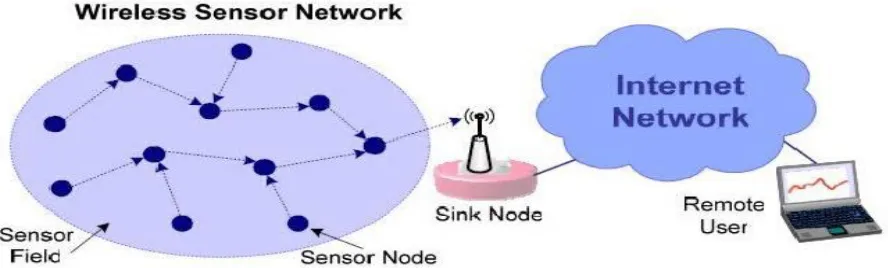
A wireless sensor network is made by a large number of low power sensors. Now days, wireless sensor network having various applications such as radiation level control, battlefield, noise pollution control, biological detection, structural health monitoring etc. A wireless sensor network (WSN) is a collection of sensor nodes which collect data from their network and send the collected data to their neighbouring nodes in hopes. The neighbouring nodes in turn send the data to the nodes which are located in single hop distance. In this way data is transmitted to the sink node and it is responsible for deliver report messages to base station. The basic block diagram of a wireless sensor node is presented in Figure1.It is made by four basic components are:
1) Sensing unit, 2) Processing unit, 3) Transceiver unit and 4) Power unit..
Fault tolerance: Some sensor nodes may fail or blocked due to lack of power, have physical damage or environmental interference. The failure of sensor nodes should not affect the overall task of the sensor network.
Node deployment: Node deployment in WSN is application dependent and can be either manual or randomized. In manual deployment, the sensors are manually placed and data is routed through predetermined paths. However, in random node deployment, the sensor nodes are scattered randomly
Energy consumption without losing accuracy: Sensor nodes can use up their limited supply of energy performing computations and transmitting information in a wireless environment. Sensor node lifetime shows a strong dependence on battery.
Scalability: The number of sensor nodes deployed in the sensing area may be on the order of hundreds or thousands, or more. Any routing scheme must be able to work with huge number of sensor nodes.
Figure 1: Typical WSN architecture and networking.
II.LITERATURE REWIEW
Vijay R. Ghorpade [1] A Survey on Energy Efficient Routing Protocol for Wireless Sensor Networks. The efficient energy consumption is the main issue in wireless sensor network. So power management is an import concern which can be done at two levels such as sensor subsystems and network subsystem. The network subsystem aspect of the power management touching the energy conservation schemes like duty cycling, data driven approaches and mobility
Samira Kalantary and Sara Taghipour [2]” A survey on architectures, protocols, applications, and management in wireless sensor networks. The efficient protocol should minimize the energy consumption. There are many routing protocols have been proposed for wireless sensor networks in terms of energy efficiency. With the recent technological advances in wireless communications.
Raghunandana Alse Airody [4] Energy Conservation in Wireless Sensor Networks Using Data Reduction Approaches: A Survey. WSNs focusing on the hierarchical or clustering based routing protocols. Moreover, extracting the strengths and weaknesses of each protocol, including some metrics like scalability, mobility, power usage, robustness etc. to make it understandable and simple to select the most suitable one as per the requirement of the network. They split the network into “clusters “to proficiently maintain the energy consumption of sensor nodes and also perform “data aggregation and fusion” to lessen the number of transmitted messages to the sink. The clusters are arranged based on the energy backup of sensors and sensor’s nearness to the CH. Thus, we can conclude that the hierarchical protocols are appropriate for sensor networks with the heavy load and wide coverage area. Therefore, the application of the appropriate routing protocol will enhance the lifetime of the network and at the same time it will guarantee the network connectivity and effective and efficient data delivery. Wireless Sensor Networks (WSN) which is battery powered.
Er. Palwinder kaur, Edwin Prem Kumar Gilbert [5,6] Conceptual representation and Survey of Dynamic Power Management (DPM) in Wireless Sensor Network. Present a challenge of long term sustainability. So power management is an import concern which can be done at two levels such as sensor subsystems and network subsystem. It mainly concentrates on the network subsystem aspect of the power management touching the energy conservation schemes like duty cycling, data driven approaches and mobility. It includes in network processing, data compression and data prediction. As WSN’s have a wide variety of applications such as smart video surveillance, smart gas detection, health monitoring, natural hazard predictions as well as weather forecast Thus data reduction approaches have a huge impact on energy conservation. Wireless Sensor Networks (WSN) are used in variety of fields which includes military.
Yoash Levron [8] A Power Management Strategy for Minimization of Energy Storage Reservoirs in Wireless Systems with Energy Harvesting. With the huge advancement in the field of embedded computer and sensor technology, Wireless Sensor Networks (WSN), it is composed of several thousands of sensor nodes which are capable of sensing, actuating, and relaying the collected information, have made remarkable impact everywhere. All sensors present in wireless sensor network are battery operated devices which have limited battery power. After the deployment of sensor nodes it is not possible to replace each and every battery in the network. Therefore optimal energy consumption for WSN protocol is a necessity. In a number of proposed protocols periodic sleep and wake time is used for the reducing the consumption of energy but these protocols result in increased end to end delay. An energy efficient dynamic power management technique which shuts down the sensor node when there is no work. The basic idea behind is to shut down the sensor devices when not needed and wake them up when necessary which yields better savings of energy and enhance lifetime. Sentry based power management.
L. Lin, et al [12] Asymptotically Optimal Power aware routing for multihop Wireless Ad-hoc Networks with Renewable Energy Sources. Depending on the approach that is used, DPM policies are classified as predictive or stochastic policies. Predictive schemes attempt to predict a device’s usage behaviour in the future usually based on the past history of usage patterns and decide to change power states of the device accordingly. A widely used predictive technique consists in turning OFF of the system components if the idle time is greater than or equal to a timeout threshold value T is detected. This approach is based on the assumption that if the idle time is greater than the threshold T, the system is likely to remain idles for a long time enough to save energy. A more accurate method is proposed in.
H. Dai and R. Han, A. Woo, et al[13,14] A Node –Centre Load Balancing Algorithm for wireless sensor Networks, – Wireless Communication. Where the upcoming idle time is predicted by using an exponential-average approach. Work on prediction based dynamic power management can be categorized into two groups: adaptive and non-adaptive. Non-adaptive strategies set the idleness threshold for the algorithm once and for all and do not alter them based on observed input patterns. On the other hand, Adaptive strategies use the history of idle periods to guide their decisions of the algorithm for future idle periods. There have been a number of adaptive strategies proposed in literature.
improve the energy efficiency of sensor nodes. In addition, predictive techniques have limitation: they cannot provide an accurate tradeoff between energy saving and performance degradation. A stochastic policy has been proposed in to overcome these limitations.
.
III.DYNAMIC POWER MANAGEMENT
The problem of power consumption can be approached from two angles: one is to develop energy-efficient communication protocols (self-organization, medium access and routing protocols).The other is to identify activities in the networks that are both wasteful and unnecessary and mitigate their impact. Most inefficient activities are, however, results of non-optimal configurations in hardware and software components. A dynamic power management (DPM) strategy ensures that power is consumed economically. The strategy can have a local or global, or both. A local DPM strategy aims to minimize the power consumption of individual nodes by providing each system with amount of power that is sufficient to carry out a task at hand. When there is no task to be processed, the DPM strategy forces some of the systems to operate at the most economical power mode or puts them into a sleeping mode. A global DPM strategy attempts to minimize the power consumption of the overall network by defining a network-wide sleeping state. There are different ways to achieve this goal. One way is to let individual nodes define their own sleeping schedules and share these schedules with their neighbors to enable a coordinated sensing and an efficient inter-node communication. This is called synchronous sleeping. The problem with this approach is that neighbors need to synchronize time as well as schedules and the process is energy intensive. Another way is to let individual nodes keep their sleeping schedules to themselves; and a node that initiates a communication should send a preamble until it receives an acknowledgment from its receiving partner. This approach is known as asynchronous sleeping schedule and avoids the needs to synchronize schedules. But it can have a latency side-effect on data transmission. Once the design time parameters are fixed, a dynamic power management (DPM) strategy attempts to minimize the power consumption of the system by dynamically defining the most economical operation conditions. This condition takes the requirements of the application, the topology of the network, and the task arrival rate of the different subsystems into account. Whereas there are different approaches to a DPM strategy, they can be categorized in one of the following three approaches: 1. Dynamic operation modes.
2. Dynamic scaling. 3. Task Scheduling
IV.CONCLUSION & FUTURE WORK
The main goal is to prolong the wireless sensor network life time and preventing connectivity degradation through aggressive power management as the most of the devices have limited battery life .So we should follow power conservation techniques in order to the save the energy by improving the existing protocol or algorithm In this paper, we have discussed different low power designing techniques of wireless sensor networks. It is seen that DPM scheme reduces power consumption by selectively shutting down idle components Duty cycle control reduces energy requirements for a specified minimum latency within a network or section of a network. Future work includes design and simulation of low power WSN.In our work an attempt has been made to compare the energy awareness of three prominent routing protocols for MANETs:-Destination Sequenced Distance Vector Routing Protocol (DSDV), Ad hoc On Demand Distance Vector (AODV) and Dynamic Source Routing (DSR) protocols. The performance of these protocols has been analyzed on different parameters with varying simulation time. These simulations are carried out using the ns-2 network simulator. If node energy is consumed, then network will automatically switch to another node for communication. Handoff technique is also used to reduce power consumption in network.
REFERENCES
[1] Pallavi S. Katkar and Prof. (Dr.) Vijay R. Ghorpade” A Survey on Energy Efficient Routing Protocol forWireless Sensor Networks” (IJCSIT) International Journal of Computer Science and Information Technologies, Vol. 6 (1) , 2015, 81-83.
[2] Samira Kalantary and Sara Taghipour ” A survey on architectures, protocols, applications, and management in wireless sensor networks” Journal of Advanced Computer Science & Technology, 3 (1) (2014) 1-11
[4] Ms.Pallavi R ,Shreya Animesh ,Preetesh Shivam ,Raghunandana Alse Airody and Niraj Kumar Jha” Energy Conservation in Wireless Sensor Networks Using Data Reduction Approaches: A Survey” International Journal of Computational Engineering Research,Vol, 03,Issue, 4 April 2013. [5] Er. Palwinder kaur and Anand Nayyar” Conceptual representation and Survey of Dynamic Power Management (DPM) in Wireless Sensor Network” International Journal of Advanced Research in Computer Science and Software Engineering Volume 3, Issue 3, March 2013.
[6] Edwin Prem Kumar Gilbert, Baskaran Kaliaperumal, and Elijah Blessing Rajsingh” Research Issues in Wireless Sensor Network Applications: A Survey” International Journal of Information and Electronics Engineering, Vol. 2, No. 5, September 2012.
[7] Zahra Rezaei and Shima Mobininejad” Energy Saving in Wireless Sensor Networks” International Journal of Computer Science & Engineering Survey (IJCSES) Vol.3, No.1, February 2012.
[8] Yoash Levron, Doron Shmilovitz, and Luis Martínez-Salamero” A Power Management Strategy for Minimization of Energy Storage Reservoirs in Wireless Systems With Energy Harvesting” IEEE transaction on circuit and system-I regular papers, vol.58, no.3, march 2011.
[9] M Pandey and S. Verma,(2011) “Performance Evaluation of AODV for different Mobility Conditions in WSN,” International Conference on multimedia, Signal Processing and Communication Technologies, pp.240-243 IEEE 2011.
[10] D. Y. Kwon, et al., (2009) “A Potential Based Routing Protocol for Mobile Ad hoc networks,” presented at the 11th IEEE International Conference on high Performance Computing and Communication, Seoul, Korea, 2009.
[11] B. Zhang and H. T. Mouftan, (2006) “Energy-aware on – demand routing protocols for wireless ad hoc networks,” Wireless Networks, vol. 12, pp. 481-494.
[12] L. Lin, et al., (2005) “Asymptotically Optimal Power aware routing for multihop Wireless Ad-hoc Networks with Renewable Energy Sources,” in 24th Joint Annual conference of the IEEE Computer and communications Socities, Miami, FL, USA, pp.1262-127.
[13] H. Dai and R. Han, (2003) “A Node –Centre Load Balancing Algorithm for wireless sensor Networks,” in IEEE GLOBECOM – Wireless Communication, San Francisco, USA, pp.548-552.
[14] A. Woo , et al., (2003) “Taming the Underlying Challenges of Reliable Multi hop routing in sensor networks, “in Los Angeles, California , USA, Conference on Embedded Networked Sensor System, pp. 14-27.
[15] H. Dai and R. Han, (2003) “A Node –Centre Load Balancing Algorithm for wireless sensor Networks,” in IEEE GLOBECOM – Wireless Communication, San Francisco, USA, pp.548-552.
[16] I.F. Akyildiz W.Su, Y. Sankarasubramaniam, and E. Cayirci, (2002) “A survey on sensor networks,” IEEE communications Magazine, pp.102-11.
[17] D. B. Johnson, et al., (2000) “DSR: The Dynamic Source Routing Protocol for Multi-hop Wireless Ad hoc Networks, “in Ad hoc Networking, C.E. Perkins, Ed., ed: Addison –Wesley, pp. 139-179.
[18] W. R. Heinzelman , et al .,(2000)“Energy-Efficient Communication Protocol for Wireless Micro sensor Networks, “in 33rd international Conference on system Sciences, Hawaii, USA, pp. 548-552.
[19] G. J. Pottie and W.J. Kaiser, (2000) “Wireless Integrated Network Sensor,” Communications of the ACM, vol. 43, pp. 51-58,
[20] C. E. Perkins and E. M. Royer,(1999) “Ad-hoc On –Demand Distance Vector Routing ,” in Proceedings of the Second IEEE Workshop on Mobile Computer Systems and Applications, Orleans , USA , pp. 90-100.
[21] J.-H Chang and L. Tassiulas, (1999) “Routing for Maximum System Lifetime in Wireless Ad hoc Networks,” in 37th Annual Allertron Conference on Communication, Control and Computing, Monticello, IL, 1999.