Generalized Integral Property
?Yosuke Todo
NTT Secure Platform Laboratories, Tokyo, Japan [email protected]
Abstract. In this paper, we show structural cryptanalyses against two popular networks, i.e., the Feistel Network and the Substitute-Permutation Network (SPN). Our cryptanalyses are distinguishing attacks by an improved integral distinguisher. The integral distinguisher is one of the most powerful attacks against block ciphers, and it is usually constructed by evaluating the propagation characteristic of integral properties, e.g., the ALL or BALANCE property. However, the integral property does not derive useful distinguishers against block ciphers with non-bijective functions and bit-oriented structures. Moreover, since the integral property does not clearly exploit the algebraic degree of block ciphers, it tends not to construct useful dis-tinguishers against block ciphers with low-degree functions. In this paper, we propose a new property calledthe division property, which is the generalization of the integral property. It can effectively construct the integral distinguisher even if the block cipher has non-bijective functions, bit-oriented structures, and low-degree functions. From viewpoints of the attackable number of rounds or chosen plaintexts, the division property can construct better distinguish-ers than previous methods. Although our attack is a generic attack, it can improve several integral distinguishers against specific cryptographic primitives. For instance, it can reduce the required number of chosen plaintexts for the 10-round distinguisher onKeccak-f from 21025to 2515. For the Feistel cipher, it theoretically proves that
Simon32, 48, 64, 96, and 128
have 9-, 11-, 11-, 13-, and 13-round integral distinguishers, respectively.
Keywords: Block cipher, Integral distinguisher, Feistel Network, Substitute-Permutation Network,Keccak,Simon, AES-like cipher, Boolean function
1 Introduction
The structural evaluation of cryptographic networks is an important topic of cryptology, and it helps a designer to design strong symmetric key primitives. There are several struc-tural evaluations against the Feistel Network and the Substitute-Permutation Network (SPN) [BS01,IS13,Knu02,LR88,Pat04]. As one direction of the structural evaluation, there are the security evaluation by “the generic attack,” which exploits only the feature of the network and does not exploit the particular weaknesses of a specific cipher. It is applica-ble to large classes of block ciphers, but it is not often effective than the dedicated attack against the specific cipher. This paper focuses on generic attacks against both the Feis-tel Network and the SPN. The existing generic attack shows that the FeisFeis-tel Network whoseF-functions are chosen from random functions or permutations is vulnerable up to 5 rounds [Pat04,Knu02]. Moreover, Biryukov and Shamir showed that the SPN is vulnerable up to 2.5 rounds [BS01].
Our Contribution This paper shows generic attacks against two networks by improv-ing an integral distimprov-inguisher. The integral attack was first proposed by Daemen et al. to ?IACR 2015. This article is a minor revision of the version that appears in the proceedings ofc
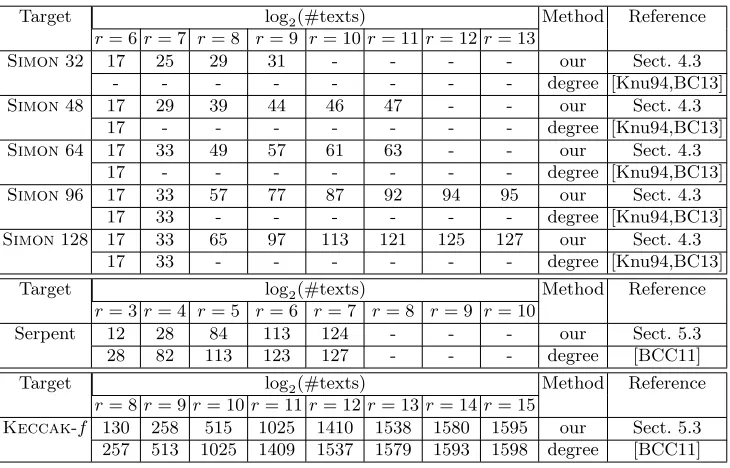
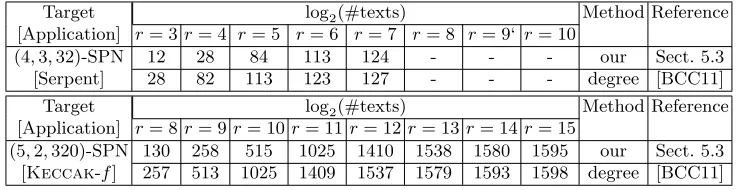
Table 1.The number of required chosen plaintexts to constructr-round integral distinguishers on theSimon
family, Serpent, andKeccak-f.
Target log2(#texts) Method Reference
r= 6r= 7 r= 8 r= 9 r= 10r= 11 r= 12r= 13
Simon32 17 25 29 31 - - - - our Sect. 4.3
- - - degree [Knu94,BC13]
Simon48 17 29 39 44 46 47 - - our Sect. 4.3
17 - - - degree [Knu94,BC13]
Simon64 17 33 49 57 61 63 - - our Sect. 4.3
17 - - - degree [Knu94,BC13]
Simon96 17 33 57 77 87 92 94 95 our Sect. 4.3
17 33 - - - degree [Knu94,BC13]
Simon128 17 33 65 97 113 121 125 127 our Sect. 4.3
17 33 - - - degree [Knu94,BC13]
Target log2(#texts) Method Reference
r= 3r= 4 r= 5 r= 6 r= 7 r= 8 r= 9 r= 10
Serpent 12 28 84 113 124 - - - our Sect. 5.3 28 82 113 123 127 - - - degree [BCC11]
Target log2(#texts) Method Reference
r= 8r= 9r= 10 r= 11r= 12r= 13 r= 14r= 15
Keccak-f 130 258 515 1025 1410 1538 1580 1595 our Sect. 5.3
257 513 1025 1409 1537 1579 1593 1598 degree [BCC11]
evaluate the security of Square[DKR97], and then it was formalized by Knudsen and
Wag-ner [KW02]. Nowadays, many integral distinguishers have been proposed against specific ciphers [KW02,LWZ11,WZ11,YPK02,ZRHD08], and they are often constructed by evalu-ating the propagation characteristic of integral properties, e.g., the ALL property or the BALANCE property. In this paper, we revisit the integral property, and then introduce the division propertyby generalizing the integral property. The division property can effec-tively construct integral distinguishers even if block ciphers have non-bijective functions, bit-oriented structures, and low-degree functions.
The Feistel Network is a generic construction to create a (2`)-bit pseudo-random permu-tation from an`-bit pseudo-random function. We call the`-bit function theF-function, and assume that an attacker can not know the specification of theF-function. Our distinguish-ing attack can attack up to 3 rounds, and it can attack up to 5 rounds if the F-function is limited to a permutation. Unfortunately, they are not improved compared with the previous ones. However, assuming that the algebraic degree of theF-function is smaller than the bit length of theF-function, our attack can attack more rounds than the previous attacks ex-ploiting the low-degree function. We summarize new integral distinguishers in Appendix B. Although the assumption of our attack is only the algebraic degree of the F-function, it can construct new integral distinguishers on theSimonfamily [BSS+13]. SinceSimonhas a
non-bijectiveF-function and a bit-oriented structure, it is complicated task to construct the integral distinguisher. The division property theoretically introduces thatSimon32, 48, 64,
96, and 128 have at least 9-, 11-, 11-, 13-, and 13-round integral distinguishers, respectively. Table 1 shows the comparison between our distinguishers and previous ones.
length of the S-box. This fact implies that the design of the P-Layer that can diffuse more outputs of S-boxes may not derive prospective security improvements. We summarize new integral distinguishers in Appendix C. Similar to the result against the Feistel Network, the division property is also useful to construct integral distinguishers against specific crypto-graphic primitives. For instance, we can reduce the required number of chosen plaintexts for the 7-round distinguisher on Serpent [ABK98] from 2127 to 2124. Moreover, for the integral
distinguisher onKeccak-f [DBPA11], we can reduce the required number of chosen
plain-texts compared with previous ones constructed by Boura et al. [BCC11]. Table 1 shows the comparison between our distinguishers and previous ones.
Organization This paper is organized as follows: In Sect. 2, we show notations, Boolean functions, and the framework of integral distinguishers. In Sect. 3, we propose the division property by generalizing the integral property, and show the propagation characteristic. In Sect. 4 and Sect. 5, we show new distinguishing attacks on the Feistel Network and the SPN, respectively. In Sect. 6, we show that the division property is also useful to construct the dedicated attack against specific ciphers. As an example, we show new distinguishing attacks on the AES-like cipher. Section 7 concludes this paper.
2 Preliminaries
2.1 Notation
We make the distinction between addition ofFn2 and addition ofZ, and we use⊕and + as
addition ofFn2 and addition ofZ, respectively. For anya∈Fn2, thei-th element is expressed
ina[i] and the hamming weightwa is calculated as wa=Pni=1a[i]. Let 1n∈Fn2 be a value
whose all elements are 1. Moreover, let 0n∈
Fn2 be a value whose all elements are 0.
SubsetsSnk andSn,mk LetSnk be a subset ofFn2 for any integerk∈ {0,1, . . . , n}. The subset
Snk is a set of alla∈Fn2 satisfyingk≤wa, and it is defined as
Snk :={a∈Fn2 |k≤wa}.
LetSn,mk be a subset of (Fn2)m for any vectork∈({0,1, . . . , n})m. The subset S
n,m
k is a set of alla∈(Fn2)m satisfying ki≤wai, and it is defined as
Sn,mk :={(a1, a2, . . . , am)∈(F n
2)m|ki ≤wai for 1≤i≤m}.
Bit Product Functions πu and πu Letπu :Fn2 → F2 be a function for any u ∈Fn2. Let
x ∈ Fn2 be an input of πu, and πu(x) is the AND of x[i] satisfying u[i] = 1, namely, it is defined as
πu(x) := n Y i=1
x[i]u[i].
Let πu : (Fn2)m → F2 be a function for any u∈ (Fn2)m. Let x ∈(Fn2)m be an input of πu,
namely,πu(x) is calculated as
πu(x) := m Y i=1
A C C C C A C C C C A C C C C A
A C C C C C C C C C C C C C C C
A A A A
A A A A A A A A A A A A A A A A
B B B B B B B B B B B B B B B B
224sets 224sets 224sets 224sets
C C C C C C C C C C C C
Fig. 1.Integral distinguisher on 4-round AES
2.2 Boolean Function
A Boolean function is a function from Fn2 to F2. Let deg(f) be the algebraic degree of a
Boolean function f. As representations of the Boolean function, we use Algebraic Normal Form, which is defined as follows.
Algebraic Normal Form Algebraic Normal Form (ANF) is a representation of a Boolean function. Any f :Fn2 →F2 can be represented as
f(x) = M u∈Fn2
af u
n Y i=1
x[i]u[i]
!
= M
u∈Fn2
af uπu(x),
where afu ∈ F2 is a constant value depending on f and u. If deg(f) is at most d, all afu satisfying d < wu are 0. An n-bit S-box can be regarded as the concatenation ofn Boolean functions. If algebraic degrees of n Boolean functions are at most d, we say the algebraic degree of the S-box is at mostd.
2.3 Integral Distinguisher
An integral distinguisher was first proposed by Daemen et al. to evaluate the security of
Square [DKR97], and then it was formalized by Knudsen and Wagner [KW02]. It uses a
set of chosen plaintexts that contains all possible values for some bits and has a constant value for the other bits. Corresponding ciphertexts are calculated from plaintexts in the set by using an encryption oracle. If the XOR of the corresponding ciphertexts always becomes 0, we say that this cipher has the integral distinguisher.
Integral Property Nowadays, many integral distinguishers have been proposed against specific ciphers [KW02,LWZ11,WZ11,YPK02,ZRHD08], and they are often constructed by evaluating the propagation characteristic of the integral property. We define four integral properties as follows:
– ALL (A) : Every value appears the same number in the multiset.
– BALANCE (B) : The XOR of all texts in the multiset is 0.
– CONSTANT (C) : The value is fixed to a constant for all texts in the multiset.
– UNKNOWN (U) : The multiset is indistinguishable from one ofn-bit random values. Knudsen and Wagner showed that AES has the 4-round integral distinguisher with 232
chosen plaintexts [KW02]. Figure 1 shows the integral distinguisher.
of non-bijection functions. Moreover, since the propagation characteristic does not clearly exploit the algebraic degree of block ciphers, it tends not to construct effective distinguishers against block ciphers with low-degree round functions.
Degree Estimation As another method to construct the integral distinguisher, there is a higher-order differential attack [Lai94,Knu94], which exploits the algebraic degree of block ciphers. When the algebraic degree of a block cipher is at mostD, the cipher has the integral distinguisher with 2D+1 chosen plaintexts. Canteaut and Videau showed the bound of the
degree of iterated round functions [CV02]. Then, Boura et al. improved the bound [BCC11], and showed integral distinguishers onKeccak[DBPA11] andLuffa[CSW08]. We show the
bound in Appendix A.
3 Division Property
3.1 Introduction of Division Property
We propose a new property calledthe division property, which is the generalization of the integral property. We consider one bijective S-box with degree d. If an input multiset has
A, the output multiset also has A. If an input multiset has B, the output multiset has U. If we have the input multiset with 2d+1 chosen texts, the output multiset has B because
the degree of the S-box isd. The integral property does not exploit this property. We now want to exploit useful properties that are hidden between Aand B. Therefore, we redefine
A and B by the same notation, and then introduce the division property by generalizing the redefinition.
Redefinition of Integral Property Let X be a multiset whose elements take an n-bit
value. We first consider features of the multisetXsatisfying A. If we choose one bit fromn
bits and calculate the XOR of the chosen bit in the multiset, the calculated value is always 0. Moreover, if we choose at most (n−1) bits from n bits and calculate the XOR of the AND of chosen bits in the multiset, the calculated value is also always 0. However, if we choose all bits fromnbits and calculate the XOR of the AND ofnbits in the multiset, the calculated value becomes unknown1. Above features are expressed by using the bit product
functionπu, which is defined in Sect. 2.1, as follows. We evaluate the parity ofπu(x) for all
x∈X, namely, evaluateLx∈Xπu(x). The parity is always even for anyusatisfyingwu< n.
On the other hand, the parity becomes unknown foru= 1n.
We next consider features of the multiset X satisfying B. If we choose one bit from n
bits and calculate the XOR of the chosen bit in the multiset, the calculated value is always 0. However, if we choose at least two bits fromn bits and calculate the XOR of the AND of chosen bits in the multiset, the calculated value becomes unknown. Above features are expressed by using the bit product function πu as follows. We evaluate the parity ofπu(x) for allx∈X. The parity is always even for anyusatisfyingwu <2. On the other hand, the parity becomes unknown for anyu satisfying wu≥2.
1 If all values appear the same even number in the multiset, the calculated value is always 0. If all values
3.2 Definition of Division Property
Section 3.1 redefines both the ALL and BALANCE properties by the same notation. Since the redefinition can be parameterized by the number of product bits wu of the bit product functionπu, we generalize the integral property as follows.
Definition 1 (Division Property). Let X be a multiset whose elements take a value of Fn2, and k takes a value between 0 and n. When the multiset X has the division property Dn
k, it fulfils the following conditions: The parity ofπu(x) for all x∈Xis always even ifwu is less than k. Moreover, the parity becomes unknown if wu is greater than or equal to k.
When the multisetXhas Dkn, it satisfies
M x∈X
πu(x) = 0, for all u∈(Fn2 \Snk),
whereSnk is a subset defined in Sect. 2.1. The parity ofπu(x) for allx∈Xbecomes unknown
for anyu∈Snk. Namely, in the division property, the set ofuis divided into the subset that
L
x∈Xπu(x) becomes unknown and the subset that
L
x∈Xπu(x) becomes 0.
Example 1. Let X be a multiset whose elements take a value of F42. As an example, we
prepare the input multisetX as
X:={0x0,0x3,0x3,0x3,0x5,0x6,0x8,0xB,0xD,0xE}.
A following table calculates the summation of πu(x).
0x0 0x3 0x3 0x3 0x5 0x6 0x8 0xB 0xD 0xE Pπu(x) 0000 0011 0011 0011 0101 0110 1000 1011 1101 1110 (Lπu(x))
u= 0000 1 1 1 1 1 1 1 1 1 1 10 (0)
u= 0001 0 1 1 1 1 0 0 1 1 0 6 (0)
u= 0010 0 1 1 1 0 1 0 1 0 1 6 (0)
u= 0011 0 1 1 1 0 0 0 1 0 0 4 (0)
u= 0100 0 0 0 0 1 1 0 0 1 1 4 (0)
u= 0101 0 0 0 0 1 0 0 0 1 0 2 (0)
u= 0110 0 0 0 0 0 1 0 0 0 1 2 (0)
u= 0111 0 0 0 0 0 0 0 0 0 0 0 (0)
u= 1000 0 0 0 0 0 0 1 1 1 1 4 (0)
u= 1001 0 0 0 0 0 0 0 1 1 0 2 (0)
u= 1010 0 0 0 0 0 0 0 1 0 1 2 (0)
u= 1011 0 0 0 0 0 0 0 1 0 0 1 (1)
u= 1100 0 0 0 0 0 0 0 0 1 1 2 (0)
u= 1101 0 0 0 0 0 0 0 0 1 0 1 (1)
u= 1110 0 0 0 0 0 0 0 0 0 1 1 (1)
u= 1111 0 0 0 0 0 0 0 0 0 0 0 (0)
For allusatisfyingwu <3,Lx∈Xπu(x) becomes 0. Therefore, the multiset has the division
property D4 3.
Each definition of B and U is essentially the same as that of Dn
2 and Dn1, respectively.
However, the definition of Ais different from that of Dn
n. The multiset satisfying Aalways has the division property Dn
EVEN property, which is defined that the number of occurrences is even for all values [SK12], does not always have A, but it always has Dn
n. In this paper, we use only Dnn instead of
A because it is sufficient to use Dn
n from the viewpoint of the construction of integral distinguishers.
Propagation Characteristic of Division Property Let s be an S-box whose degree is d. Let X be an input multiset whose elements take a value of Fn2. Let Y be an output
multiset whose elements are calculated froms(x) for allx∈X. We assume thatXhasDnk, and want to evaluate the division property of Y. In the division property, the set of u is
divided into the subset thatL
x∈Xπu(x) becomes unknown and the subset that L
x∈Xπu(x) becomes 0. Therefore, we divide the set ofvinto the subset that L
s(x)∈Yπv(s(x)) becomes
unknown and the subset that L
s(x)∈Yπv(s(x)) becomes 0. Since the parity of πv(s(x)) for
all s(x)∈Y is equal to that of (πv◦s)(x) for allx∈X, we evaluate Lx∈X(πv◦s)(x).
Proposition 1 (Propagation Characteristic of Division Property).Letsbe an func-tion (S-box) from n bits to n bits, and the degree is d. Assuming that an input multiset X
has the division property Dnk, the output multiset Y has Dndk de
. In addition, assuming that
the S-box is a permutation, the output multiset Y has Dnn when the input multiset has Dnn.
Proof. We represent L
x∈X(πv◦s)(x) by using ANF as
M x∈X
(πv◦s)(x) = M x∈X
M u∈Fn2
aπv◦s
u πu(x)
= M
u∈Snk
aπv◦s
u
M x∈X
πu(x) !
⊕ M
u∈(Fn 2\Snk)
aπv◦s
u
M x∈X
πu(x) !
.
Since the multiset X has Dnk,Lx∈Xπu(x) is always 0 for any u ∈ (F
n
2 \Snk). Therefore, it satisfies
M x∈X
(πv◦s)(x) = M u∈Snk
aπv◦s
u
M x∈X
πu(x) !
.
Ifaπv◦s
u is 0 for allu∈Snk, L
x∈A(πv◦s)(x) always becomes 0. In other words, if there exists
u∈Snk such thataπuv◦sis 1, L
x∈A(πv◦s)(x) becomes unknown. Since the functionπv is the AND of wv bits and the degree of S-box is d, the degree of the Boolean function (πv ◦s) has the following properties:
– The degree of (πv◦s) is at most min{n, wv×d}.
– If the S-box is a permutation, the degree of (πv◦s) is at mostn−1 for wv < n. We first assume that the multiset X has Dnk. In this case, we consider only u satisfying
wu ≥ k. When wv ×d < k holds, aπuv◦s is always 0. Thus, the necessary condition that
aπv◦s
u becomes 1 is wv ×d≥ k, and it is wv ≥ dkde. Namely, the necessary condition that L
x∈X(πv◦s)(x) becomes unknown iswv ≥ d
k
de, and YhasD n
dkde. We next assume that the
multiset X hasDnn and the S-box is a permutation. In this case, we consider only u = 1n. Whenwv < nholds,aπ1nv◦sis always 0 because the degree of the Boolean function (πv◦s) is
at most n−1. Thus, the necessary condition thataπv◦s
1n becomes 1 is v = 1n. Namely, the
necessary condition that L
x∈X(πv◦s)(x) becomes unknown is v= 1
n, and
s
D
D
Set of u Set of u
unknown even parity
Fig. 2.Propagation characteristic of division property
Example 2. Let us consider a following 4-bit S-box.
x 0x0 0x1 0x2 0x3 0x4 0x5 0x6 0x7 0x8 0x9 0xA 0xB 0xC 0xD 0xE 0xF
s(x) 0x8 0xC 0x0 0xB 0x9 0xD 0xE 0x5 0xA 0x1 0x2 0x6 0x4 0xF 0x3 0x7 The S-box is bijective and the algebraic degree is 2. We now prepare the input multiset X
as
X:={0x0,0x3,0x3,0x3,0x5,0x6,0x8,0xB,0xD,0xE},
which is the same as Example 1 and the division property is D4
3. The output multiset is
calculated as
Y:={0x8,0xB,0xB,0xB,0xD,0xE,0xA,0x6,0xF,0x3},
and a following table calculates the summation of πv(y).
0x8 0xB 0xB 0xB 0xD 0xE 0xA 0x6 0xF 0x3 Pπv(y) 1000 1011 1011 1011 1101 1110 1010 0110 1111 0011 (Lπv(y))
v= 0000 1 1 1 1 1 1 1 1 1 1 10 (0)
v= 0001 0 1 1 1 1 0 0 0 1 1 6 (0)
v= 0010 0 1 1 1 0 1 1 1 1 1 8 (0)
v= 0011 0 1 1 1 0 0 0 0 1 1 5 (1)
v= 0100 0 0 0 0 1 1 0 1 1 0 4 (0)
v= 0101 0 0 0 0 1 0 0 0 1 0 2 (0)
v= 0110 0 0 0 0 0 1 0 1 1 0 3 (1)
v= 0111 0 0 0 0 0 0 0 0 1 0 1 (1)
v= 1000 1 1 1 1 1 1 1 0 1 0 8 (0)
v= 1001 0 1 1 1 1 0 0 0 1 0 5 (1)
v= 1010 0 1 1 1 0 1 1 0 1 0 6 (0)
v= 1011 0 1 1 1 0 0 0 0 1 0 4 (0)
v= 1100 0 0 0 0 1 1 0 0 1 0 3 (1)
v= 1101 0 0 0 0 1 0 0 0 1 0 2 (0)
v= 1110 0 0 0 0 0 1 0 0 1 0 2 (0)
v= 1111 0 0 0 0 0 0 0 0 1 0 1 (1)
For all v satisfying wv < 2, Ly∈Yπv(y) becomes 0. Therefore, the multiset Y has the
Figure 2 shows the outline of the propagation characteristic of the division property. LetXand Ybe input and output multisets, respectively. First, the size of the set ofu that
L
x∈Xπu(x) becomes unknown is small. However, the size of the set ofuthat
L
x∈Xπu(s(x))
becomes unknown expands. If the size expands to the universal set except for 0n, we regard that the output multiset is indistinguishable from the multiset of random texts.
3.3 Vectorial Division Property
Section 3.2 only shows the division property for one S-box. However, since practical ciphers use several S-boxes in every round, we can not construct integral distinguishers by only using Proposition 1. Therefore, we vectorize the division property.
Let an S-Layer be any function that consists of m n-bit S-boxes with degree din par-allel. We now consider the propagation characteristic of the division property against the S-Layer. LetXbe the input multiset of the S-Layer, andx∈Xtakes a value of (Fn2)m. The
vectorization is the natural extension of the division property. Namely, the set of u is di-vided into the subset thatL
x∈Xπu(x) becomes unknown and the subset that
L
x∈Xπu(x)
becomes 0, whereuis anm-dimensional vector whose elements take a value ofFn2. Figure 3
shows the difference between the division property and the vectorial one.
Definition 2 (Vectorial Division Property).LetXbe the multiset whose elements take
a value of (Fn2)m, andk is anm-dimensional vector whose elements take a value between0
andn. When the multisetXhas the division property Dkn,m, the multiset fulfils the following
conditions: The parity of πu(x)for all x∈Xis always even if u does NOT belong to Sn,mk . Moreover, the parity becomes unknown if u belongs to Sn,mk .
Propagation Characteristic of Vectorial Division Property Assume that the input multiset of the S-Layer has the division property Dkn,m. The output of the S-Layer is cal-culated as S(x) = (s1(x1), s2(x2), . . . , sm(xm)) for (x1, x2, . . . , xm) ∈ X. We now consider
the set ofv that L
x∈Xπv(S(x)) becomes unknown and the set of v that
L
x∈Xπv(S(x))
becomes 0. Since the output of each S-box is calculated independently, the propagation characteristic of the division property can also be evaluated independently. Namely, the output multiset hasDkn,m0 , wherek0i =dki/deholds. Moreover, if the S-box is bijective and
ki=n holds,k0i=n holds.
3.4 Collective Division Property
By vectorizing of the division property, we can evaluate the multiset whose elements take a value of (Fn2)m. However, it is still insufficient to use only vectorial division property. For
simplicity, we consider a multiset X whose elements take a value of (F82)2. Assume that
the number of elements in X is 256, and two elements of x take all values from 0 to 255
independently. We consider the set of u that the parity of πu(x) for all x ∈ X becomes
unknown and the set ofu that the parity becomes 0.
– The parity becomes unknown if u belongs to S8[8,2,0].
– The parity becomes unknown if u belongs to S8[0,2,8].
– The parity becomes unknown if u belongs to S8[1,2,1].
S
S1 S2 Sm
S1 S2 Sm
division property
vectorizal
collective
n
n
n
Fig. 3.Division property, vectorial division property, and collective division property
We can not express this property by using the vectorial division property. Therefore, we col-lect several vectorial division properties. Figure 3 shows the difference between the vectorial division property and the collective division property.
Definition 3 (Collective Division Property). Let X be the multiset whose elements
take a value of(Fn2)m, andk(j) (j= 1,2, . . . , q) arem-dimensional vectors whose elements
take a value between0 andn. When the multiset Xhas the division propertyDn,mk(1),k(2),...,k(q),
the multiset fulfils the following conditions: The parity ofπu(x) for allx∈Xis always even
if u does NOT belong to the union Sn,mk(1) ∪S
n,m
k(2) ∪ · · · ∪S
n,m
k(q). Moreover, the parity becomes
unknown if u belongs to the union Sn,mk(1)∪S
n,m
k(2)∪ · · · ∪S
n,m k(q).
It is obvious that the collective division property with q = 1 is the same as the vectorial division property.
Propagation Characteristic of Collective Division Property Assume that the input multiset of the S-Layer has the division propertyDkn,m(1),k(2),...,k(q). We now consider the set of v thatL
x∈Xπv(S(x)) becomes unknown, and the set is derived from only the set ofuthat
L
x∈Xπu(x) becomes unknown. Therefore, we can evaluate the propagation characteristic
of Dn,mk(j) for all j independently. Namely, the output multiset has D
n,m
k0(1),k0(2),...,k0(q), where
k0(ij)=dk(ij)/deholds. Moreover, if the S-box is bijective andk(ij)=nholds,ki0(j)=nholds.
4 Improved Integral Distinguishers on Feistel Network
4.1 Feistel Network
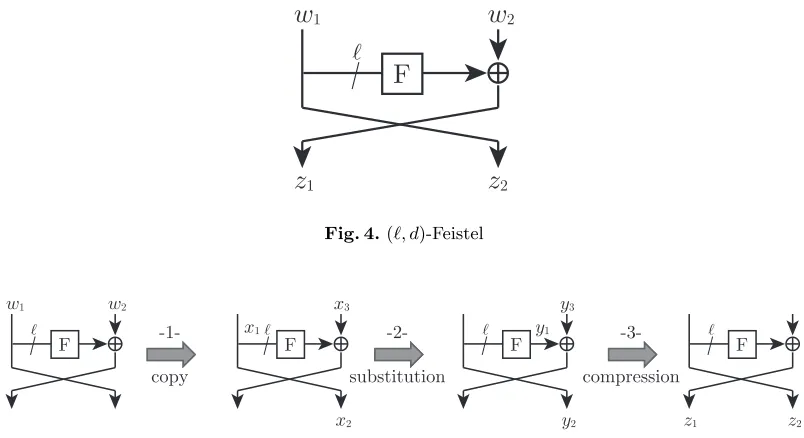
(`, d)-Feistel The Feistel Network is one of the most popular network to design block ciphers. When n-bit block ciphers are constructed by the Feistel Network, the input of the round function is expressed in two (n/2)-bit values. Moreover, an (n/2)-bit non-linear function F is used in the round function, and we call this function the F-function. Let (w1, w2) be the input of the round function, and the output is calculated as (z1, z2) =
(F(w1)⊕w2, w1). We now define an (`, d)-Feistel, whose F-function is an `-bit non-linear
F
w
1w
2z
1z
2Fig. 4.(`, d)-Feistel
F
w1 w2
F
x3
z1 z2
y2
x2
y1
x1
y3
F -3- F
compression
-2-substitution
-1-copy
Fig. 5.Propagation characteristic for Feistel Network
round function of the Feistel Network. There are many block ciphers adopting (`, d)-Feistel, e.g. DES [U.S77], Camellia [AIK+00], and
Simon2n [BSS+13] adopt (32,5)-, (64,7)-, and
(n,2)-Feistel, respectively.
4.2 Propagation Characteristic for Feistel Network
This section shows that the division property is useful to construct integral distinguishers on (`, d)-Feistel. Since the Feistel Network has “copy,” “substitution,” and “compression,” we need to propagate the division property against them. The “copy” creates the input of the F-function, and the “substitution” processes the input by the F-function, and finally the “compression” creates the left half of the output by XOR. Figure 5 shows the outline of the propagation characteristic.
-1- Copy Let W be an input set, and (w1, w2) ∈W denotes the input value. The round
function first creates (x1, x2, x3), wherex1 =w1,x2=w1, andx3 =w2hold. Here,x1 is
the input of theF-function,x2 is the right half of the output of the round function, and
x3 is the right half of the input of the round function. Let X be the output set whose
elements take (x1, x2, x3) for all (w1, w2) ∈ W. Assume that the input set W has the
division property D`,k(1)2 ,k(2),...,k(q). If we use πu satisfying k (j)
1 ≤ u1 and k (j)
2 ≤ u2, the
parity of πu(w) for allw∈W becomes unknown. Sincex1 is equal to x2, the parity of
πv(x) for all x∈ X becomes unknown if we use πv satisfying k1(j)−k0 ≤v1, k0 ≤v2,
and k2(j) ≤v3 for all k0 (0≤k0 ≤k(1j)). Therefore, the set X has the division property D`,3
[0,k(1)1 ,k2(1)],[1,k(1)1 −1,k2(1)],...,[k(1)1 ,0,k(1)2 ],...,[k1(q),0,k(q)2 ].
-2- Substitution The F-function is an `-bit function with degree d. Assume that the input set has the division property Dk`,(1)3 ,k(2),...,k(q). From the propagation characteristic
of the division property, the output set has D`,3
k0(1),k0(2),...,k0(q), where (k 0(j) 1 , k
0(j) 2 , k
(dk(1j)/de, k2(j), k3(j)) holds. If theF-function is limited to a permutation,k0(1j) becomes`
when k(1j)=` holds.
-3- Compression Let Y be the input set, and (y1, y2, y3) ∈ Y denotes the input value,
wherey1 denotes the output of theF-function. Lety1 be XORed withy3, and then the
internal state is expressed in (z1, z2) = (y1⊕y3, y2). Let Z be the set whose elements
take (z1, z2) for all (y1, y2, y3) ∈ Y. To evaluate the division property of the set Z, we
calculate the parity of πv(z1, z2) for all (z1, z2)∈Z as
M
(z1,z2)∈Z
πv(z1, z2) =
M
(z1,z2)∈Z
(πv1(z1)×πv2(z2))
= M
(y1,y2,y3)∈Y
(πv1(y1⊕y3)×πv2(y2))
= M
(y1,y2,y3)∈Y
M cv1
(πc(y1)×πv1⊕c(y3))×πv2(y2)
=M
cv1
M
(y1,y2,y3)∈Y
πc(y1)×πv2(y2)×πv1⊕c(y3)
,
where the set ofcchosen fromcv1denotes the set ofcsatisfyingc∧v1 =c. Assuming
that the input set Yhas the division property D`,k(1)3 ,k(2),...,k(q), the output setZhas the
division property Dk`,0(1)2 ,k0(2),...,k0(q), where (k 0(j) 1 , k
0(j) 2 ) = (k
(j) 1 +k
(j) 3 , k
(j)
2 ) holds. Notice
that the parity of πv(z1, z2) for all (z1, z2)∈Zbecomes 0 if k1(j)+k (j)
3 is more than `.
4.3 Path Search Algorithm for (`, d)-Feistel
This section shows the path search algorithm for integral distinguishers against (`, d)-Feistel. The algorithm is based on the propagation characteristic shown in Sect. 4.2. Assume that
k1 bits of the left half of the input are active and the rest (`−k1) bits are constant.
Moreover, assume that k2 bits of the right half of the input are active and the rest (`−
k2) bits are constant. Namely, we prepare 2k1+k2 chosen plaintexts. The input set has
the division property D`,[k2
1,k2]. Algorithm 1 shows the path search algorithm to create the
integral distinguisher on (`, d)-Feistel. Algorithm 1 does not limit the F-function to be a permutation. If theF-function is limited to be a permutation,Lbecomesk2+`whenX=`
holds (see the 4-th line in Algorithm 1). Algorithm 1 calls SizeReduce, which eliminates
k(i,j) if there exists (i0, j0) satisfying
S`,k(i,j)2 ⊆S
`,2
k(i0,j0).
Results Table 2 shows the number of required chosen plaintexts to construct r-round integral distinguishers on (32,5)- and (64,7)-Feistel, where DES [U.S77] is classified into (32,5)-Feistel with non-bijective function and Camellia [AIK+00] is classified into (64,
7)-Feistel with bijective function. When we construct the integral distinguisher on (`, d)-Feistel with 2D chosen plaintexts, we use (k
1, k2) satisfying
(k1, k2) =
(
(D−`, `) for`≤D,
Algorithm 1 Path search algorithm for integral distinguishers on (`, d)-Feistel 1: procedureFeistelFuncEval(`, d, k1, k2)
2: q⇐0
3: forX = 0 tok1 do 4: L⇐k2+dX/de 5: if L≤`then 6: q⇐q+ 1
7: k(q)⇐(L, k1−X) 8: end if
9: end for
10: returnk(1), . . . ,k(q) 11: end procedure
12: procedureIntegralPathSearch(`, d, r= 0, k1, k2) 13: k(1), . . . ,k(q)⇐FeistelFuncEval(`, d, k1, k2) 14: D⇐max{k1(1)+k(1)2 , k1(2)+k(2)2 , . . . , k(q)1 +k2(q)} 15: while1< Ddo
16: r⇐r+ 1 17: fori= 1 toqdo
18: k(i,1), . . . ,k(i,pi)⇐FeistelFuncEval(`, d, k(i)
1 , k (i) 2 )
19: end for
20: (k(1),k(2), . . . ,k(q0))⇐SizeReduce(k(1,1),k(1,2), . . . ,k(q,pq))
21: D⇐max{k1(1)+k(1)2 , k1(2)+k2(2), . . . , k(q10)+k(q20)} 22: q⇐q0
23: end while 24: returnr
25: end procedure
For the comparison with our integral distinguishers, we consider two previous methods, one is the propagation characteristic of the integral property and another is the estimation of the algebraic degree. We first consider the propagation characteristic of the integral property. If the F-function is a non-bijective function, the propagation characteristic does not construct sufficient distinguishers. Therefore, results introduced by the integral property are only shown when the F-function is bijective. We next consider the estimation of the algebraic degree. Unfortunately, since we do not know the improved bound against the Feistel Network, we use the trivial bound for the Feistel Network. Assume that the left half of the plaintext is constant. For any r-round (`, d)-Feistel, it can be observed that the function, which associates the right half of the ciphertext with the right half of the plaintext, has degree at most dr−2 for 2 ≤ r. Therefore, we can construct the r-round
integral distinguishers with 2dr−2+1 chosen plaintexts. Since the right half of the plaintext
is at most `bits, the distinguisher can be constructed with 2dr−2+1 <2`.
As a result, as far as we try, all distinguishers constructed by the division property are “better” than those by previous methods. We summarize integral distinguishers on other (`, d)-Feistel in Appendix B. We already know a “better” integral distinguisher on Camellia in [YPK02], but it is constructed by using the specific feature of Camellia. On the other hand, our method is generic distinguishing attacks against (`, d)-Feistel. From the result of (64,7)-Feistel, it shows that even if theF-function of Camellia is chosen from any functions with degree 7, the modified Camellia has the 6-round integral distinguisher.
Table 2. The number of chosen plaintexts to construct r-round integral distinguishers on (32,5)- and (64,7)-Feistel. Our distinguishers are got by implementing Algorithm 1.
Target F-function log2(#texts) Method Reference [Application] r= 4 r= 5r= 6r= 7r= 8 r= 9
(32,5)-Feistel non-bijection 26 51 62 - - - our Sect. 4.3 [DES] 26 - - - degree [Knu94,BC13] (64,7)-Feistel bijection 50 98 124 - - - our Sect. 4.3
[Camellia] 50 - - - degree [Knu94,BC13] 64 - - - integral [KW02]
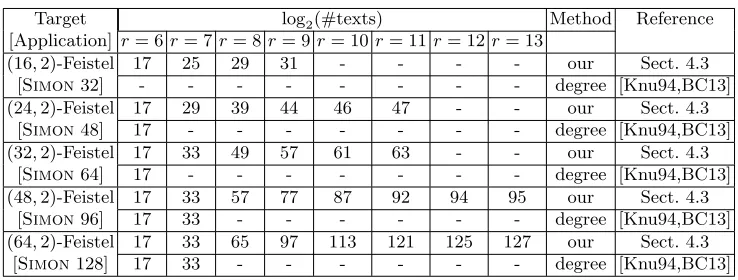
Table 3.The number of chosen plaintexts to constructr-round integral distinguishers on theSimonfamily, where theF-function is not bijective. Our distinguishers are got by implementing Algorithm 1.
Target log2(#texts) Method Reference
[Application] r= 6r= 7r= 8r= 9 r= 10r= 11r= 12 r= 13
(16,2)-Feistel 17 25 29 31 - - - - our Sect. 4.3
[Simon32] - - - degree [Knu94,BC13]
(24,2)-Feistel 17 29 39 44 46 47 - - our Sect. 4.3
[Simon48] 17 - - - degree [Knu94,BC13]
(32,2)-Feistel 17 33 49 57 61 63 - - our Sect. 4.3
[Simon64] 17 - - - degree [Knu94,BC13]
(48,2)-Feistel 17 33 57 77 87 92 94 95 our Sect. 4.3
[Simon96] 17 33 - - - degree [Knu94,BC13]
(64,2)-Feistel 17 33 65 97 113 121 125 127 our Sect. 4.3
[Simon128] 17 33 - - - degree [Knu94,BC13]
block ciphers proposed by the National Security Agency. Since Simon has a non-bijective
F-function and a bit-oriented structure, it is complicated task to construct the integral distinguisher. The division property theoretically shows thatSimon32, 48, 64, 96, and 128
have at least 9-, 11-, 11-, 13-, and 13-round integral distinguishers, respectively. Table 3 shows the comparison between our distinguishers and previous ones by the degree estima-tion. On the other hand, Wang et al. showed that Simon 32 has the 15-round integral
distinguisher by experiments [WLV+14]. Therefore, there are 6-round differences between
our theoretical result and Wang’s experimental result. Our distinguisher is valid against all (32,2)-Feistel and it does not exploit the feature of the round function. Namely, we expect that the 6-round difference is derived from the specification of the round function of Simon
32.
5 Improved Integral Distinguishers on Substitute-Permutation Network
5.1 Substitute-Permutation Network
S1
S2
Sm
P
S-Layer P-Layer
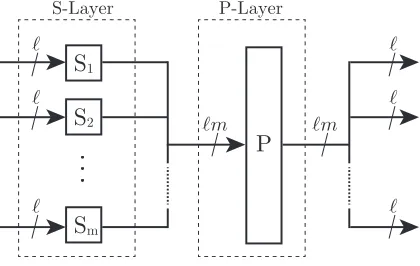
Fig. 6.(`, d, m)-SPN
and Serpent [ABK98] adopt (8,7,16)-, (4,3,16)-, and (4,3,32)-SPN, respectively. More-over, Keccak-f [DBPA11], which is a permutation in the hash functionKeccak, can be
regarded as (5,2,320)-SPN.
5.2 Propagation Characteristic for SPN
This section shows that the division property is useful to construct integral distinguishers on (`, d, m)-SPN. We first prepare the set of the input of the S-Layer such that ki bits of the input of thei-th S-box are active and the rest (`−ki) bits are constant. In this case, the input set has the division property D`,mk . We first evaluate the propagation characteristic against the S-Layer. Next, the P-Layer is applied but the input and output take a value of
F`m2 . Therefore, we need to convert the division propertyD
`,m
k intoDk`m, and then evaluate the propagation characteristic against the P-Layer. Since the S-Layer is applied again after the P-Layer, we convert the division property D`m
k into D `,m
k(1),k(2),...,k(q). After the second
round, we evaluate the propagation characteristic of this collective division property.
- S-LayerAssume that the input set of the S-Layer has the division propertyD`,mk . Since the S-Layer consists of m `-bit S-boxes with degreed, the output set of the S-Layer has
D`,mk0 . Here, ifki< `holds,k0iis calculated aski0 =dki/de. Ifki =`holds,ki0 is calculated aski0 =`.
- Concatenation (Conversion form S-Layer to P-Layer)The output of the S-Layer is expressed in a value of (F`2)m, but the input of the P-Layer is expressed in a value of
F`m2 . LetXbe the output set of the S-Layer whose elements take a value of (F`2)m. LetY
be the input set of the P-Layer whose elements take a value ofF`m2 . The transformation
is generally implemented by a simple bit concatenation, namely, y = (x1kx2k · · · kxm)
where (x1, x2, . . . , xm) and y are values of Xand Y, respectively. We now consider the
conversion of the division property fromD`,mk toD`m
k0 . The parity ofπv(y) for all y∈Y
becomes unknown if and only if we choose v satisfying wv ≥ Pmi=1ki. Therefore, the input set of the P-Layer has the division property D`m
k0 , where k0=Pmi=1ki holds.
- P-Layer The P-Layer consists of an (`m)-bit linear function. Since the degree of the linear function is at most 1, there is no change in the division property.
- Partition (Conversion form P-Layer to S-Layer) The output of the P-Layer is expressed in a value ofF`m2 , but the input of the S-Layer is expressed in a value of (F`2)m.
LetXbe the output set of the P-Layer whose elements take a value ofF`m2 . LetYbe the
Algorithm 2 Path search algorithm for integral distinguishers on (`, d, m)-SPN 1: procedureIntegralPathSearch(`, d, m, r= 0, k1, k2, . . . , km)
2: if ki< `thenki⇐ dki/de .1-st round S-Layer 3: end if
4: k⇐Pm
i=1ki .1-st round Concatenation and P-Layer
5: while1< kdo 6: r⇐r+ 1
7: if k≤(`−1)mthenk⇐ dk/de .(r+ 1)-th round 8: elsek⇐`−1
d
(`m−k) +`(m−`m+k) .(r+ 1)-th round 9: end if
10: end while 11: returnr
12: end procedure
generally implemented by a simple bit partition, namely, (y1ky2k · · · kym) = x where x
and (y1, y2, . . . , ym) are values ofXandY, respectively. We now consider the conversion
of the division property from D`m k to D
`,m
k0 . When the output set of the P-Layer has D`m
k , the sufficient condition that the parity of πu(x) for all x ∈ X becomes unknown
is k≤ wu. Therefore, the input set of the S-Layer has the collective division property
D`,mk0(1),k0(2),...,k0(q), where q denotes the number of all possible vectors satisfying k 0(j) 1 +
k20(j)+· · ·+km0(j)=k(1≤j≤q). After the second round, we evaluate the propagation characteristic of the collective division property.
We can construct the integral distinguisher by evaluating the propagation characteristic of the collective division property. However, since the size of q extremely expands, it is infeasible to execute the straightforward implementation. Therefore, we show more efficient technique. Let Xbe the input set of the S-Layer, and the elements take a value of (F`2)m.
Assume that the input set has the division property Dk`,m(1),k(2),...,k(q) that is created by the
partition of the division propertyD`m
k . Ifk >(`−1)mholds, at least (m−`m+k) elements of k(j) have to become `. In this case, the rest elements have to become `−1. Since the S-Layer derives`−1
d
and`from (`−1) and`, respectively, the output set has the division property D`m
k0 , wherek0 is calculated as
k0 = (`−1
d
(`m−k) +`(m−`m+k) fork >(`−1)m,
k d
fork≤(`−1)m.
Here, if k ≤(`−1)m holds, we simply regard the round function of (`, d, m)-SPN as one (`m)-bit S-box with degreed.
5.3 Path Search Algorithm for (`, d, m)-SPN
We now consider integral distinguishers on (`, d, m)-SPN. We first prepare the set of chosen plaintexts such that ki bits of the input of the i-th S-box are active and the rest (`−ki) bits are constant. Namely, we prepare 2Pmi=1ki chosen plaintexts. The input set has the
division property Dk`,m. Algorithm 2 shows the path search algorithm to construct the integral distinguisher.
Table 4. The number of chosen plaintexts to constructr-round integral distinguishers on (`, d, m)-SPN. Our distinguishers are got by implementing Algorithm 2.
Target log2(#texts) Method Reference r= 3r= 4r= 5r= 6 r= 7
(4,3,16)-SPN 12 28 52 60 - our Sect. 5.3 [PRESENT] 28 52 60 63 - degree [BCC11] (8,7,16)-SPN 56 120 - - - our Sect. 5.3 [AES] 117 127 - - - degree [BCC11]
Table 5. The number of chosen plaintexts to constructr-round integral distinguishers onKeccak-f and Serpent. Our distinguishers are got by implementing Algorithm 2.
Target log2(#texts) Method Reference
[Application] r= 3r= 4 r= 5 r= 6 r= 7 r= 8 r= 9‘ r= 10
(4,3,32)-SPN 12 28 84 113 124 - - - our Sect. 5.3 [Serpent] 28 82 113 123 127 - - - degree [BCC11]
Target log2(#texts) Method Reference
[Application] r= 8r= 9 r= 10r= 11r= 12r= 13r= 14r= 15
(5,2,320)-SPN 130 258 515 1025 1410 1538 1580 1595 our Sect. 5.3
[Keccak-f] 257 513 1025 1409 1537 1579 1593 1598 degree [BCC11]
AES [U.S01] are classified into (4,3,16)- and (8,7,16)-SPN, respectively. When we construct the integral distinguisher on (`, d, m)-SPN with 2D chosen plaintexts, we use a vector k satisfying
ki =
` fori`≤D,
D−(i−1)` for (i−1)`≤D < i`,
0 forD <(i−1)`.
For the comparison with our integral distinguishers, we first consider the propagation characteristic of the integral property. However, it does not construct a sufficient distin-guisher because the P-Layer is any linear function. Next, we estimate the algebraic degree by using the method proposed by Boura et al. We show the method in Appendix A.
As a result, as far as we try, all distinguishers constructed by the division property are “better” than those by previous methods. We summarize integral distinguishers on other (`, d, m)-SPN in Appendix C. We already know the 7-round integral distinguisher on PRESENT in [WW13] and the 4-round integral distinguisher on AES in [KW02]. How-ever, they are constructed by using the specific feature of each block cipher. On the other hand, our method is generic distinguishing attacks against (`, d, m)-SPN. From the result of (4,3,16)-SPN, it shows that even if the P-Layer of PRESENT is chosen from any bijective linear functions, the modified PRESENT has the 6-round integral distinguisher. Similarly, from the result of (8,7,16)-SPN, it shows that even if the P-Layer of AES is chosen from any bijective linear function, the modified AES still has the 4-round integral distinguisher.
Integral Distinguishers on Serpent and Keccak-f Although our attack is a generic attack, it can create new integral distinguishers on Serpent andKeccak-f. Serpent is one
with 2124 chosen plaintexts. Table 5 shows the comparison between our distinguishers and
previous ones by the degree estimation.
Keccakis chosen as SHA-3, and the core functionKeccak-f is classified into (5,2,
320)-SPN. Boura et al. estimated the algebraic degree of Keccak-f in [BCC11]. We search for
the integral distinguisher by using Algorithm 2. As a result, our distinguishers can reduce the number of chosen plaintexts compared with previous ones. Table 5 shows the comparison between our distinguishers and previous ones.
6 Toward Dedicated Attack
We introduced the division property in Sect. 3, and proposed distinguishing attacks against the Feistel Network and the SPN in Sect. 4 and Sect. 5, respectively. In this section, we show that the division property is also useful to construct the dedicated attack against specific ciphers. As an example, we show integral distinguishers on AES-like ciphers.
6.1 AES-Like Cipher
(`, d, m)-AES AES is a 128-bit block cipher, and an intermediate text of AES is expressed in a 4×4 matrix whose elements are 8 bits. The round function of AES consists of SubBytes, ShiftRows, MixColumns, and AddRoundKey, where each function is defined as follows:
– SubBytes (SB) : It substitutes each byte in the matrix into another byte by an S-box.
– ShiftRows (SR) : Each byte of the i-th row is rotatedi−1 bytes to the left.
– MixColumns (MC) : It diffuses bytes within each column by a linear function.
– AddRoundKey (AK) : A round key is XORed with the intermediate text.
We define an (`, d, m)-AES, where `, d, and m denote the bit length of an S-box, the algebraic degree of an S-box, and the size of the matrix, respectively. This intermediate text is expressed in an m×m matrix whose elements are` bits. Let X ∈(F`2)m×m be an
input of the round function, which is arranged as
x1,1 x1,2 · · · x1,m
x2,1 x2,2 · · · x2,m ..
. ... . .. ...
xm,1 xm,2· · ·xm,m
.
Let Y ∈(F`2)m×m be an output of the round function, which is calculated as Y = (AK◦
MC◦SR◦SB)(X). Each function is the same as that of AES except for the scale. For instance, AES [U.S01] andLED[GPPR11] adopt (8,7,4)-AES and (4,3,4)-AES, respectively. Moreover,P256 of PHOTON[GPP11] adopts (4,3,8)-AES2.
6.2 Path Search Algorithm for (`, d, m)-AES
Section 5 shows how to construct integral distinguishers on (`, d, m)-SPN, but practical block ciphers have a specific P-Layer. For instance, the P-Layer in AES consists of ShiftRows and MixColumns, and it is not any linear function. Taking into account the structure of the P-Layer, we can construct more effective algorithm. In this section, as an example, we show a path search algorithm to construct integral distinguishers on (`, d, m)-AES.
2
Algorithm 3 Evaluating algorithm against the round function of (`, d, m)-AES 1: procedureAesFuncEval(`, d, m,K)
2: forr= 1 tomdo 3: forc= 1 tomdo
4: if kr,c< `thenkr,c⇐ dkr,c/de .SubBytes
5: end if 6: end for 7: end for
8: K⇐ShiftRows(K) .ShiftRows
9: kc0 ⇐
Pm r=1k
0
r,c for allc .MixColumns
10: k0⇐sort(k0) 11: returnk0 12: end procedure
Algorithm 4 Path search algorithm for integral distinguishers on (`, d, m)-AES 1: procedureIntegralPathSearch(`, d, m, r= 0,K∈ {0,1, . . . , `}m×m)
2: k(1)⇐AesFuncEval(`, d, m,K) .1-st round
3: D⇐Pm c=1k
(1) c
4: q⇐1
5: while1< Ddo 6: r⇐r+ 1 7: fori= 1 toqdo
8: K(i,1), . . . ,K(i,s)⇐Partition(k(i))
9: forj= 1 tosdo
10: ¯k(1), . . . ,¯k(t)⇐AesFuncEval(`, d, m,K(i,j)) .(r+ 1)-th round
11: if (i, j) = (1,1)then
12: k0(1), . . . ,k0(q0)⇐SizeReduce(¯k(1), . . . ,k¯(t))
13: else
14: k0(1), . . . ,k0(q00)⇐SizeReduce(k0(1), . . . ,k0(q0),k¯(1), . . . ,¯k(t)) 15: q0⇐q00
16: end if
17: end for 18: end for
19: k(i)⇐k0(i)for all 1≤i≤q0
20: q⇐q0
21: D⇐max{Pm c=1k
(1)
c ,Pmc=1k(2)c , . . . ,Pmc=1kc(q)}
22: end while 23: returnr
24: end procedure
Algorithm 3 evaluates the propagation characteristic of the division property against the round function of AES-like ciphers, and it callsShiftRows and sort.ShiftRows performs a similar transformation to SR. sort is the sorting algorithm, which is useful for feasible implementation. Algorithm 4 shows the path search algorithm, and it calls Partition, AesFuncEval, and SizeReduce.Partition(k(i)) calculates all possible K(i,j) satisfying
m X r=1
kr,(i,j1),
m X r=1
kr,(i,j2), . . . ,
m X r=1
kr,m(i,j)
!
= (k(1i), k2(i), . . . , km(i)),
where 0 ≤ k(r,ci,j) ≤ ` holds. SizeReduce eliminates k(i,j) if there exists (i0, j0) satisfying
S`m,mk(i,j) ⊆S
`m,m k(i0,j0).
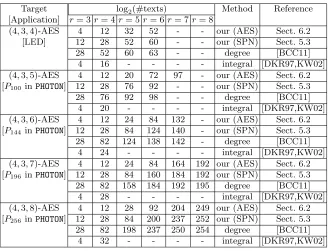
Table 6. The number of chosen plaintexts to construct r-round integral distinguishers on (4,3, m)-AES. Our distinguishers are got by implementing Algorithm 2 and Algorithm 4.
Target log2(#texts) Method Reference [Application] r= 3r= 4r= 5r= 6 r= 7r= 8
(4,3,4)-AES 4 12 32 52 - - our (AES) Sect. 6.2 [LED] 12 28 52 60 - - our (SPN) Sect. 5.3 28 52 60 63 - - degree [BCC11]
4 16 - - - - integral [DKR97,KW02] (4,3,5)-AES 4 12 20 72 97 - our (AES) Sect. 6.2 [P100 inPHOTON] 12 28 76 92 - - our (SPN) Sect. 5.3 28 76 92 98 - - degree [BCC11]
4 20 - - - - integral [DKR97,KW02] (4,3,6)-AES 4 12 24 84 132 - our (AES) Sect. 6.2 [P144 inPHOTON] 12 28 84 124 140 - our (SPN) Sect. 5.3 28 82 124 138 142 - degree [BCC11]
4 24 - - - - integral [DKR97,KW02] (4,3,7)-AES 4 12 24 84 164 192 our (AES) Sect. 6.2 [P196 inPHOTON] 12 28 84 160 184 192 our (SPN) Sect. 5.3 28 82 158 184 192 195 degree [BCC11]
4 28 - - - - integral [DKR97,KW02] (4,3,8)-AES 4 12 28 92 204 249 our (AES) Sect. 6.2 [P256 inPHOTON] 12 28 84 200 237 252 our (SPN) Sect. 5.3 28 82 198 237 250 254 degree [BCC11]
4 32 - - - - integral [DKR97,KW02]
takes large execution time and large memory capacity if we straightforwardly implement our algorithm. Therefore, we use an effective method, which uses the feature of (`, d, m)-AES, for the feasible implementation. Notice that each column of (`, d, m)-AES is equivalent each other. Assuming that the input set has D`m,mk,k0 that k0 is a permutation of elements of k,
the division property of the next round calculated fromk is exactly the same as that from
k0 because columns of (`, d, m)-AES are equivalent each other. Namely, it is enough to save either, and we implement it by a sorting algorithm (see the 10-th line in Algorithm 3). This technique enables us to execute our path search algorithm feasibly in many parameters.
Results Table 6 shows the number of required chosen plaintexts to construct r-round integral distinguishers on (4,3, m)-AES. When we construct the integral distinguisher on (`, d, m)-AES with 2D chosen plaintexts, we carefully choose the input matrix K.
For the comparison with our improved integral distinguishers, we also show integral distinguishers by using the propagation characteristic of the integral property. We also esti-mate the algebraic degree by the method proposed Boura et al. (see Appendix A). Moreover, since (4,3, m)-AES are classified into (4,3, m2)-SPN, we construct integral distinguishers
by Algorithm 2.
As a result, as far as we try, all distinguishers constructed by the division property are at least better than those by previous methods. Especially, the advantage of our method is large when we construct the integral distinguisher with the small number of texts. For instance, our method shows that (4,3,8)-AES, which is adopted byP256inPHOTON, has the
6-round distinguisher with 292chosen plaintexts. If we regard (4,3,8)-AES as (4,3,64)-SPN,
7 Conclusions
In this paper, we proposed the fundamental technique to improve integral distinguishers, and showed structural cryptanalyses against the Feistel Network and the SPN. Our new technique uses the division property, which is the generalization of the integral property. It can effectively construct integral distinguishers even if block ciphers have non-bijective functions, bit-oriented structures, and low-degree functions. For the Feistel Network, when the algebraic degree of the F-function is smaller than the bit length of the F-function, our method can attack more rounds than previous generic attacks. Moreover, we theoretically showed that Simon 48, 64, 96, and 128 have 11-, 11-, 13-, and 13-round integral
distin-guishers, respectively. For the SPN, our method extremely reduces the required number of chosen plaintexts compared with previous methods. Moreover, we improved integral distin-guishers on Keccak-f and Serpent. The division property is useful to construct integral
distinguishers against specific ciphers. As one example, we showed a path search algorithm to construct integral distinguishers on the AES-like cipher, which is the sub class of the SPN. From this fact, we expect that the division property can construct many improved integral distinguishers against specific ciphers by constructing the dedicated path search algorithm.
Acknowledgments. The authors would like to thank Deukjo Hong for his helpful pointing out.
References
ABB+14. Elena Andreeva, Beg¨ul Bilgin, Andrey Bogdanov, Atul Luykx, Florian Mendel, Bart Mennink, Nicky Mouha, Qingju Wang, and Kan Yasuda. PRIMATEs v1.02, 2014. Submission to CAESAR competition.
ABK98. Ross Anderson, Eli Biham, and Lars Knudsen. Serpent: A proposal for the Advanced Encryption Standard. NIST AES Proposal, 1998.
AIK+00. Kazumaro Aoki, Tetsuya Ichikawa, Masayuki Kanda, Mitsuru Matsui, Shiho Moriai, Junko Naka-jima, and Toshio Tokita. Camellia: A 128-bit block cipher suitable for multiple platforms - design and analysis. InSAC, volume 2012 ofLNCS, pages 39–56, 2000.
BC13. Christina Boura and Anne Canteaut. On the influence of the algebraic degree ofF−1 on the algebraic degree ofG◦F. IEEE Transactions on Information Theory, 59(1):691–702, 2013. BCC11. Christina Boura, Anne Canteaut, and Christophe De Canni`ere. Higher-order differential
proper-ties of Keccak andLuffa. InFSE, volume 6733 ofLNCS, pages 252–269, 2011.
BKL+07. Andrey Bogdanov, Lars R. Knudsen, Gregor Leander, Christof Paar, Axel Poschmann, Matthew
J. B. Robshaw, Yannick Seurin, and C. Vikkelsoe. PRESENT: an ultra-lightweight block cipher. InCHES, volume 4727 ofLNCS, pages 450–466, 2007.
BR03. Paulo S. L. M. Barreto and Vincent Rijmen. The Whirlpool hashing function, 2003. submitted to the NESSIE project, available athttp://www.larc.usp.br/~pbarreto/WhirlpoolPage.html. BS01. Alex Biryukov and Adi Shamir. Structural cryptanalysis of SASAS, 2001.
BSS+13. Ray Beaulieu, Douglas Shors, Jason Smith, Stefan Treatman-Clark, Bryan Weeks, and Louis Wingers. The SIMON and SPECK families of lightweight block ciphers. IACR Cryptology ePrint Archive, 2013:404, 2013.
CSW08. Christophe De Canni`ere, Hisayoshi Sato, and Dai Watanabe. Hash function Luffa - a SHA-3 candidate, 2008. Available at http://hitachi.com/rd/yrl/crypto/luffa/round1archive/ Luffa_Specification.pdf.
CV02. Anne Canteaut and Marion Videau. Degree of composition of highly nonlinear functions and applications to higher order differential cryptanalysis. InEUROCRYPT, volume 2332 ofLNCS, pages 518–533, 2002.
DEMS14. Christoph Dobraunig, Maria Eichlseder, Florian Mendel, and Martin Schl¨affer. Asconv1, 2014. Submission to CAESAR competition.
DKR97. Joan Daemen, Lars R. Knudsen, and Vincent Rijmen. The block cipher Square. InFSE, volume 1267 ofLNCS, pages 149–165, 1997.
DPAR00. Joan Daemen, Micha¨el Peeters, Gilles Van Assche, and Vincent Rijmen. The Noekeonblock cipher., 2000. submitted to the NESSIE project, available athttp://gro.noekeon.org/. DR02. Joan Daemen and Vincent Rijmen. The Design of Rijndael: AES - The Advanced Encryption
Standard. Information Security and Cryptography. Springer, 2002.
GPP11. Jian Guo, Thomas Peyrin, and Axel Poschmann. The PHOTON family of lightweight hash functions. InCRYPTO, volume 6841 ofLNCS, pages 222–239, 2011.
GPPR11. Jian Guo, Thomas Peyrin, Axel Poschmann, and Matthew J. B. Robshaw. The LED block cipher. InCHES, volume 6917 ofLNCS, pages 326–341, 2011.
IS13. Takanori Isobe and Kyoji Shibutani. Generic key recovery attack on Feistel scheme. In ASI-ACRYPT (1), volume 8269 of LNCS, pages 464–485. Springer, 2013.
KLL+14. Elif Bilge Kavun, Martin Mehl Lauridsen, Gregor Leander, Christian Rechberger, Peter Schwabe, and Tolga Yal¸cin.Prøstv1.1, 2014. Submission to CAESAR competition.
Knu94. Lars R. Knudsen. Truncated and higher order differentials. InFSE, volume 1008 ofLNCS, pages 196–211, 1994.
Knu02. Lars R. Knudsen. The security of Feistel ciphers with six rounds or less.J. Cryptology, 15(3):207– 222, 2002.
KW02. Lars R. Knudsen and David Wagner. Integral cryptanalysis (extended abstract). InFSE, volume 2365 ofLNCS, pages 112–127, 2002.
Lai94. Xuejia Lai. Higher order derivatives and differential cryptanalysis. In Communications and Cryptography, volume 276 of The Springer International Series in Engineering and Computer Science, pages 227–233, 1994.
LR88. Michael Luby and Charles Rackoff. How to construct pseudorandom permutations from pseudo-random functions. SIAM J. Comput., 17(2):373–386, 1988.
LWZ11. Yanjun Li, Wenling Wu, and Lei Zhang. Improved integral attacks on reduced-round CLEFIA block cipher. InWISA, volume 7115 ofLNCS, pages 28–39, 2011.
MGH+14. Pawe? Morawiecki, Kris Gaj, Ekawat Homsirikamol, Krystian Matusiewicz, Josef Pieprzyk, Marcin Rogawski, Marian Srebrny, and Marcin Wøjcik. ICEPOLE v1, 2014. Submission to CAESAR competition.
Pat04. Jacques Patarin. Security of random Feistel schemes with 5 or more rounds. InCRYPTO, volume 3152 ofLNCS, pages 106–122, 2004.
SK12. Naoki Shibayama and Toshinobu Kaneko. A peculiar higher order differential of CLEFIA. In
ISITA, pages 526–530. IEEE, 2012.
STA+14. Yu Sasaki, Yosuke Todo, Kazumaro Aoki, Yusuke Naito, Takeshi Sugawara, Yumiko Murakami,
Mitsuru Matsui, and Shoichi Hirose. Minalpher v1, 2014. Submission to CAESAR competition. U.S77. U.S. DEPARTMENT OF COMMERCE/National Institute of Standards and Technology.DATA ENCRYPTION STANDARD (DES), 1977. Federal Information Processing Standards Publica-tion 46.
U.S01. U.S. DEPARTMENT OF COMMERCE/National Institute of Standards and Technology. Spec-ification for the ADVANCED ENCRYPTION STANDARD (AES), 2001. Federal Information Processing Standards Publication 197.
WLV+14. Qingju Wang, Zhiqiang Liu, Kerem Varici, Yu Sasaki, Vincent Rijmen, and Yosuke Todo.
Crypt-analysis of reduced-round SIMON32 and SIMON48. InINDOCRYPT, volume 8885 of LNCS, pages 143–160. Springer, 2014.
WW13. Shengbao Wu and Mingsheng Wang. Integral attacks on reduced-round PRESENT. InICICS, volume 8233 ofLNCS, pages 331–345, 2013.
WZ11. Wenling Wu and Lei Zhang. LBlock: A lightweight block cipher. In ACNS, volume 6715 of
LNCS, pages 327–344, 2011.
YPK02. Yongjin Yeom, Sangwoo Park, and Iljun Kim. On the security of CAMELLIA against the Square attack. InFSE, volume 2365 ofLNCS, pages 89–99, 2002.
ZRHD08. Muhammad Reza Z’aba, H˚avard Raddum, Matthew Henricksen, and Ed Dawson. Bit-pattern based integral attack. InFSE, volume 5086 ofLNCS, pages 363–381, 2008.
A Estimation of Algebraic Degree for (`, d, m)-SPN
the round function is at mostd, the degree ofr iterated round functions is bounded bydr. In 2011, Boura et al. showed tighter bound as follows.
Theorem 1 ([BCC11]). Let S be a function from Fn2 into Fn2 corresponding to the
con-catenation of m smaller S-boxes, defined over Fn20. Let δk be the maximal degree of the product of any k bits of anyone of these S-boxes. Then, for any function G from Fn2 into
F2, we have
deg(G◦S)≤n−n−deg(G)
γ ,
where
γ = max
1≤i≤n0−1
n0−i
n0−δi
.
By using this bound, we can estimate the degree of (`, d, m)-SPN. For instance, we show the degree of (4,3,64)-SPN as follows.
Number of rounds 1 2 3 4 5 6 7 8 9
Bound on degree 3 9 27 81 197 236 249 253 255
Therefore, we can construct the 8-round integral distinguisher on (4,3,64)-SPN with 2254
B Integral Distinguishers on (`, d)-Feistel
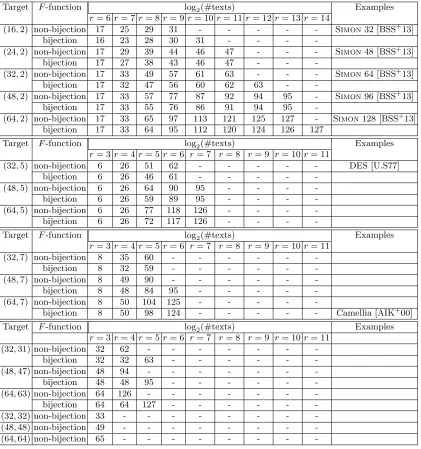
Table 7 shows integral distinguishers on (`, d)-Feistel, where (`, d)-Feistel is defined in Sect. 4.1. If we construct the dedicated path search algorithm for the specific cipher, we expect that the algorithm can create better integral distinguishers.
Table 7.The number of required chosen plaintexts to construct r-round integral distinguishers on (`, d )-Feistel. We get these values by implementing Algorithm 1.
Target F-function log2(#texts) Examples
r= 6r= 7 r= 8r= 9r= 10 r= 11r= 12r= 13 r= 14
(16,2) non-bijection 17 25 29 31 - - - Simon32 [BSS+13]
bijection 16 23 28 30 31 - - -
-(24,2) non-bijection 17 29 39 44 46 47 - - - Simon48 [BSS+13] bijection 17 27 38 43 46 47 - -
-(32,2) non-bijection 17 33 49 57 61 63 - - - Simon64 [BSS+13]
bijection 17 32 47 56 60 62 63 -
-(48,2) non-bijection 17 33 57 77 87 92 94 95 - Simon96 [BSS+13] bijection 17 33 55 76 86 91 94 95
-(64,2) non-bijection 17 33 65 97 113 121 125 127 - Simon128 [BSS+13]
bijection 17 33 64 95 112 120 124 126 127
Target F-function log2(#texts) Examples
r= 3r= 4 r= 5r= 6 r= 7 r= 8 r= 9 r= 10 r= 11
(32,5) non-bijection 6 26 51 62 - - - DES [U.S77]
bijection 6 26 46 61 - - - -
-(48,5) non-bijection 6 26 64 90 95 - - -
-bijection 6 26 59 89 95 - - -
-(64,5) non-bijection 6 26 77 118 126 - - - -bijection 6 26 72 117 126 - - -
-Target F-function log2(#texts) Examples
r= 3r= 4 r= 5r= 6 r= 7 r= 8 r= 9 r= 10 r= 11 (32,7) non-bijection 8 35 60 - - -
-bijection 8 32 59 - - -
-(48,7) non-bijection 8 49 90 - - -
-bijection 8 48 84 95 - - - -
-(64,7) non-bijection 8 50 104 125 - - - -
-bijection 8 50 98 124 - - - Camellia [AIK+00]
Target F-function log2(#texts) Examples
r= 3r= 4 r= 5r= 6 r= 7 r= 8 r= 9 r= 10 r= 11 (32,31) non-bijection 32 62 - - -
-bijection 32 32 63 - - -
-(48,47) non-bijection 48 94 - - -
-bijection 48 48 95 - - -
-(64,63) non-bijection 64 126 - - -
-bijection 64 64 127 - - -
-C Integral Distinguishers on (`, d, m)-SPN
Table 8 shows integral distinguishers on (`, d, m)-SPN, where (`, d, m)-SPN is defined in Sect. 5.1. If we construct the dedicated path search algorithm for the specific cipher, we expect that the algorithm can create better integral distinguishers.
Table 8.The number of required chosen plaintexts to constructr-round integral distinguishers on (`, d, m )-SPN. We get these values by implementing Algorithm 2.
Target Size log2(#texts) Examples
(bits)r= 4 r= 5 r= 6 r= 7 r= 8 r= 9 r= 10
(4,3,16) 64 28 52 60 - - - - PRESENT [BKL+07],LED[GPPR11] (4,3,24) 96 28 76 89 - - -
-(4,3,32) 128 28 84 113 124 - - - Serpent [ABK98],Noekeon[DPAR00] (4,3,40) 160 28 84 136 152 - -
-(4,3,48) 192 28 84 156 180 188 - -(4,3,56) 224 28 84 177 209 220 -
-(4,3,64) 256 28 84 200 237 252 - - Prøst-128 [KLL+14], Minalpher-P [STA+14] (4,3,128) 512 28 84 244 424 484 504 509 Prøst-256 [KLL+14]
Target Size log2(#texts) Examples
(bits)r= 5 r= 6 r= 7 r= 8 r= 9 r= 10r= 11
(5,2,40) 200 18 35 65 130 178 195 - PRIMATE-80 [ABB+14] (5,2,56) 280 18 35 65 130 230 265 275 PRIMATE-120 [ABB+14] (5,2,64) 320 18 35 65 130 258 300 315 ASCON Permutation [DEMS14]
Target Size log2(#texts) Examples
(bits)r= 9 r= 10r= 11r= 12 r= 13r= 14r= 15
(5,2,160) 800 258 515 705 770 790 798 - Keccak-f[800] [DBPA11] (5,2,256) 1280 258 515 1025 1195 1253 1271 1278
(5,2,320) 1600 258 515 1025 1410 1538 1580 1595 Keccak-f[1600] [DBPA11]
Target Size log2(#texts) Examples
(bits)r= 3 r= 4 r= 5 r= 6 r= 7 r= 8 r= 9 (5,4,40) 200 20 65 170 195 - - -(5,4,56) 280 20 65 230 270 - - -(5,4,64) 320 20 65 260 305 - - -(5,4,160) 800 20 65 260 665 770 795
-(5,4,256) 1280 20 65 260 1025 1220 1265 - ICEPOLE Permutation [MGH+14]
(5,4,320) 1600 20 65 260 1025 1460 1565 1595
Target Size log2(#texts) Examples
(bits)r= 3 r= 4 r= 5 r= 6 r= 7 r= 8 r= 9
(8,7,16) 128 56 120 - - - AES [U.S01] (8,7,24) 192 56 176 - - - Rijndael-192 [DR02] (8,7,32) 256 56 232 - - - Rijndael-256 [DR02]