Round-Optimal Fully Black-Box Zero-Knowledge
Arguments from One-Way Permutations
Carmit Hazay1
and Muthuramakrishnan Venkitasubramaniam2
1
Bar-Ilan University 2
University of Rochester
Abstract. In this paper, we revisit the round complexity of designing zero-knowledge (ZK) arguments via a black-box construction from minimal assumptions. Our main result implements a 4-round ZK argument for any language inNP, based on injective one-way functions, that makes black-box use of the underlying func-tion. As a corollary, we also obtain the first 4-round perfect zero-knowledge ar-gument forNPbased on claw-free permutations via a black-box construction and 4-round input-delayed commit-and-prove zero-knowledge argument based on in-jective one-way functions.
Keywords:One-way permutations, zero-knowledge arguments, black-box constructions
1
Introduction
Zero-knowledge (ZK) interactive proofs [GMR89] are paradoxical constructs that al-low one player (called the prover) to convince another player (called the verifier) of the validity of a mathematical statementx∈L, while providing zero additional knowledge to the verifier. This is formalized by requiring that the view of every “efficient” ad-versary verifierV∗interacting with the honest proverP be simulated by an “efficient” machineS (a.k.a. the simulator). The idea behind this definition is that whatever V∗ might have learned from interacting withP, it could have actually learned by itself (by running the simulator S). As “efficient” adversaries are typically modelled as proba-bilistic polynomial-time machines (PPT), the traditional definition of ZK models both the verifier and the simulator as PPT machines.
Several variants of ZK systems have been studied in literature. In this work, we are interested in computational ZK argument systems with black-box simulation, where the soundness is required to hold only against non-uniform PPT provers whereas the zero-knowledge property holds against PPT verifiers which get an auxiliary input. Such systems are referred to as computational zero-knowledge argument systems. We will further focus on the case of black-box constructions3and black-box simulation.4 The main question we address is the the round-complexity of computational zero-knowledge
3
where the construction is agnostic of the specific implementation and relies only on its in-put/output behavior.
argument systems based on minimal assumptions via a fully black-box construction. First, we survey prior work in this area.
Goldreich, Micali and Wigderson [GMW91] constructed the first zero-knowledge proof systems for all ofNPbased on the minimal assumption of one-way functions, where they required polynomially many rounds to achieve negligible soundness. For arguments, Feige and Shamir [FS89] provided a 4-round zero-knowledge system based on algebraic assumptions. In [BJY97], Bellare, Jackobson and Yung showed how to achieve the same assuming only one-way functions.
On the negative side, Goldreich and Oren [GO94] demonstrated that three rounds are necessary for designing zero-knowledge for any non-trivial language (i.e. outside
BPP) against non-uniform verifiers. When further restricting to black-box simulation, Goldreich and Krawcyzk [GK96b] showed that four rounds are necessary for achieving zero-knowledge of non-trivial languages. For the specific case of proofs (i.e. uncondi-tional soundness), Katz [Kat12] showed that only languages inMAcan have 4-round zero-knowledge proof systems.
As such, the works of [BJY97] and [GK96b] identify the round-complexity of zero-knowledge arguments as four when restricting to black-box simulation. However, when considering constructions that are black-box in the underlying primitives, Pass and Wee [PW09] provided the first black-box construction of a 6-round zero-knowledge argu-ment for NP based on one-way permutations5 and seven rounds based on one-way functions. Ishai, Mahmoody and Sahai provided the first black-box sublinear zero-knowledge arguments based on collision-resistant hash-functions [IMS12]. Ostrovsky, Richelson and Scafuro [ORS15] showed how to construct black-box two-party secure computation protocols in four rounds where only one party receives the output from en-hanced trapdoor permutations. As zero-knowledge can be seen as an instance of such a secure computation, their work provides a round-optimal black-box construction based on enhanced trapdoor permutations.
This sequence of prior works leaves the following fundamental question regarding black-box constructions of zero-knowledge arguments open:
What is the weakest hardness assumption for a black-box construction of a 4-round zero-knowledge argument system for all ofNP?
We remark that when considering non-black-box simulation, a recent work due to Bitansky et al. [BKP18] demonstrates how to obtain 3-round zero-knowledge argu-ments forNPbased on multi-collision resistance hash functions. On the negative side, Fleischhacker et al. [FGJ18] proved that 3-round private-coin ZK proofs forNPdo not exist, even with respect to non-black-box simulation assuming the existence of certain program obfuscation primitives.
Our results.In this work we present the first 4-round ZK argument of knowledge pro-tocols based on one-way permutations (injective one-way functions) and claw-free per-mutations. Specifically,
Theorem 1.1 (Informal.) Assuming injective one-way functions, there exists a fully black-box 4-round black-box computational zero-knowledge argument for all ofNP.
As a corollary we obtain the following result regarding perfect zero-knowledge ar-gument systems.
Corollary 1.2 (Informal.) Assuming claw-free permutations, there exists a fully black-box 4-round black-black-box perfect zero-knowledge argument for all ofNP.
Commit-and-prove input-delayed ZK proofs.In [LS90], Lapidot and Shamir pro-vided a three-round witness-indistinguishable (WI) proof for Graph Hamiltonicity with a special “input-delayed” property: namely, the prover uses the statement to be proved only in the last round. Recently, in [CPS+15] it was shown how to obtain efficient input-delayed variants of the related “Sigma protocols” when used in a restricted setting of an OR-composition. In [HV16], starting from a randomized encoding scheme with an additional robustness property and security against adaptive inputs, it was shown how to obtain general constructions of input-delayed zero-knowledge proofs that yield an efficient version of the protocol of [LS90] for arbitraryN P-relations.
The “commit-and-prove” paradigm considers a prover that first commits to a wit-ness wand then, in a second phase upon receiving a statement xasserts whether a particular relationR(x, w) = 1without revealing the committed value. This paradigm, which is implicit in the work of [GMW87] and later formalized in [CLOS02], is a pow-erful mechanism to strengthen semi-honest secure protocols to maliciously secure ones. The MPC-in-the-head approach of [IKOS09] shows how to obtain a commit-and-prove protocol based on one-way functions that relies on the underlying primitives in a black-box way. In [HV16] it was further shown how to extend the above input-delayed ZK proof to further support the commit-and-prove paradigm which is additionally black-box in the underlying one-way functions or permutations.
Instantiating the 3-round honest verifier zero-knowledge proof required in Theorem
1.1with the commit-and-proof and input-delayed protocol from [HV16] implies the following corollary.
Corollary 1.3 (Informal.) Assuming injective one-way functions, there exists a fully black-box 4-round black-box commit-and-prove input-delayed zero-knowledge argu-ment for all ofNP.
We prove the main theorem in Section3and the corollaries in Section4.
1.1 Our Techniques
prover commits to the adjacency matrix of a permutation of the underlying graph in the first round, and either decommits all entries in the matrix along with the permutation or decommits just the entries that form a Hamiltonian cycle depending on the verifier’s challenge. Given the prover’s commitments, the easy challenge can be extracted by observing whether the prover commits to the adjacency matrix of the permutation of original graph or just the entries of a Hamiltonian cycle.
This 3-round protocol already yields a zero-knowledge argument system, but only with constant soundness. To amplify soundness, one can have the entire protocol re-peated in parallel, and have the verifier commit to all the parallel challenges in a first round of the protocol while decommitting in the third round. This 4-round protocol will indeed be zero-knowledge. However, one cannot prove that it is negligibly sound. Specifically, there could be a malleability attack, where, the prover upon receiving the verifier’s commitment in the first round, can maul it to another commitment that can be open to a valid accepting response depending on the decommitment provided by the verifier in the third round. Another way of looking at this is that, one cannot have a black-box reduction of a cheating prover to the hiding property of the commitment used by the verifier in the first round to commit to the challenge. A standard way to circumvent this issue would be to require the verifier to use a perfectly hiding commit-ment and the prover a statistically binding commitcommit-ment. However, this will result in a 5-round protocol (as perfectly hiding commitments require two rounds), and stronger assumptions, such as collision resistant hash functions.
The approach taken by Pass and Wee is to have the prover and verifier commit using a computationally hiding commitment scheme (that can be based on injective one-way functions) but additionally require the prover to prove “knowledge” of the messages in its commitment before the verifier decommits its challenge. This can be done generi-cally using an extractable commitment scheme (introduced in the same work) which is a commitment scheme that has a “proof-of-knowledge” property. Before we go into the details of this construction, we point out that an extractable commitment scheme can be constructed from injective one-way function in three rounds which results in an overall zero-knowledge argument system with six rounds.
To collapse this protocol into four rounds we follow acut-and-chooseparadigm. Namely, our protocol will comprise ofnparallel instances of the basic 4-round pro-tocol. In the third round, the verifier chooses a randomS ⊆ [n]of some size tand decommits to the challenges made in those indices while providing a challenge for the extractable commitment for repetitions outsideS. Then in the fourth round, the prover will complete the zero-knowledge protocol for the parallel repetitions with indexes in
Sand respond to the proof-of-knowledge challenge for the extractable commitment for the remaining indexes. The high-level idea here is that this allows to regain soundness in a simple way. Since the prover does not know the subsetSrevealed by the verifier in the third round, the prover has to “cheat” in most of the parallel invocations. This means we can argue by a simple averaging argument that there is an indexi∈[n]such that the probability that the prover cheats in theithrepetition,iis not included inSand
veri-fier for theithrepetition by running the proof-of-knowledge extractor on the prover’s
commitment in theithrepetition and extracting the easy challenge.
However, proving zero-knowledge of this compilation is subtle and non-trivial. Re-call that the verifier only reveals the challenges for a chosen subsetSin the third round. A simple strategy for the simulator is to obtain the challenge, i.e. “trapdoor” for the indexes inS rewind and setup the prover messages in such a way that will allow for it to cheat in all repetitions inS. Now, the simulator can conclude with an accepting transcript if the verifier opens the same setS. However, the verifier can choose to reveal different subsets in different “rewindings”. Nevertheless, in any rewinding, either the simulator has succeeded in cheating in all the indexes of the subset revealed by the ver-ifier or has learned a new trapdoor. Now it suffices to show that the simulator will only require to perform a bounded number of rewindings before it has extracted most (if not all) trapdoors to complete the execution. A minor subtlety arises as a malicious verifier can abort before revealing the third message and this affects the number of rewindings that needs to be performed. However, this can be dealt with via a standard probability analysis. There is, however, a bigger issue in proving indistinguishability of this simula-tion. As described above, the simulator tries to extract trapdoors and outputs the “first” accepting transcript when it has managed to cheat in all indexes in the revealed subset. This simple idea however has a subtle flaw. The issue is that one can come up with a strategy for a malicious verifier where the distribution of the views output by the simu-lator is not indistinguishable from the real view. Roughly speaking, the distribution of the subsetS in the transcript output by the simulator will be biased towards indexes revealed earlier in the rewindings. Our main technical contribution is to determine a “stopping” condition for the simulator that will result in the right distribution and we describe this below.
We abstract the simulation strategy to the following game. The game proceeds in iterations where in theithiteration the adversary outputs a subsetSi ⊂[n]from some
unknown but pre-determined distributionD. The goal is to determine the iterationjto stop the game and outputSjsuch that the following two conditions are met:
– First,Sj⊆S1∪ · · · ∪Sj−1, and
– Second, ifD′ is the distribution of the subsetSj output, thenD′ = D. In other
words, the distribution of the subset output when the game is stopped is identical to the original distributionD.
Our main technical contribution is to show that the following simple strategy achieves the required goal.
– In any iteration ifSj ⊆S1∪ · · · ∪Sj−1, then halt ifSj ̸⊆S1∪ · · · ∪Sj−2, and proceed to the next iteration otherwise.
We prove this formally in Section3.
2
Preliminaries
Basic notations.We denote the security parameter byn. We say that a functionµ:N→
that µ(n) < 1
p(n). We use the abbreviation PPT to denote probabilistic polynomial-time. We further denote bya←Athe random sampling ofafrom a distributionA, and by[n]the set of elements{1, . . . , n}. For anNPrelationR, we denote byRxthe set
of witnesses ofxand byLRits associated language. That is,Rx ={ω|(x, ω)∈ R}
andLR ={x| ∃ω s.t.(x, ω)∈ R}. We specify next the definition of computationally indistinguishable.
Definition 2.1 LetX = {X(a, n)}a∈{0,1}∗,n∈NandY = {Y(a, n)}a∈{0,1}∗,n∈Nbe
two distribution ensembles. We say thatX andY are computationally indistinguish-able, denotedX ≈c Y, if for everyPPTmachineD, everya∈ {0,1}∗, every positive polynomialp(·)and all sufficiently largen:
Pr [D(X(a, n),1n, a) = 1]−Pr [D(Y(a, n),1n, a) = 1]< 1 p(n).
2.1 Commitment Schemes
Commitment schemes are used to enable a party, known as thesenderSen, to commit itself to a value while keeping it secret from thereceiverRec (this property is called
hiding). Furthermore, in a later stage when the commitment is opened, it is guaranteed that the “opening” can yield only a single value determined in the committing phase (this property is calledbinding). In this work, we consider commitment schemes that arestatistically binding, namely while the hiding property only holds against compu-tationally bounded (non-uniform) adversaries, the binding property is required to hold against unbounded adversaries. Formally,
Definition 2.2 (Commitment schemes) APPTmachineCom=⟨S, R⟩is said to be a non-interactive commitment scheme if the following two properties hold.
Computational hiding: For every (expected)PPTmachineRec∗, it holds that the fol-lowing ensembles are computationally indistinguishable.
– {ViewRecCom∗(m1, z)}κ∈N,m1,m2∈{0,1}κ,z∈{0,1}∗ – {ViewRecCom∗(m2, z)}κ∈N,m1,m2∈{0,1}κ,z∈{0,1}∗
whereViewRCom∗ (m, z)denotes the random variable describing the output ofRec∗
after receiving a commitment tomusingCom.
Statistical binding: For any (computationally unbounded) malicious senderSen∗and auxiliary inputz, it holds that the probability that there exist valid decommitments to two different values for a viewv, generated with an honest receiver while inter-acting withSen∗(z)usingCom, is negligible.
We refer the reader to [Gol01] for more details. We recall that non-interactive per-fectly binding commitment schemes can be constructed based on one-way permutation, whereas two-round statistically binding commitment schemes can be constructed based on one-way functions [Nao91]. To set up some notations, we letcomm←Com(m;rm)
denote a commitment to a messagem, where the sender uses uniform random coinsrm.
rm. This enables the receiver to verify whetherdecomm is consistent with the
tran-scriptcomm. If so, it outputsm; otherwise it outputs⊥. For simplicity of exposition, in
the sequel, we will assume that random coins are an implicit input to the commitment functions, unless specified explicitly.
2.2 Extractable Commitment Schemes
A core building block of our protocol is an extractable commitment schemeExtCom introduced by Pass and Wee in [PW09].
Definition 2.3 (Extractable commitment schemes) LetExtCom = (Sen,Rec)be a statistically binding commitment scheme. We say thatExtComis an extractable com-mitment scheme if there exists an expectedPPToracle machine (the extractor)Ethat given oracle access to anyPPTcheating senderSen∗outputs a pair(τ, m∗)such that: Simulation: τ is identically distributed to the view ofSen∗ at the end of interacting
with an honest receiverRecin commit phase.
Extraction: The probability thatτis accepting andm∗ =⊥is negligible. We remark here that, we only need a weak extraction property where the extraction succeeds if the commitment is well formed. In other words, we allow for “over extraction” where the commitment could be invalid, yet, the extraction returns a value. Binding: Ifm∗ ̸= ⊥, then it is statistically impossible to openτ to any value other
thanm∗.
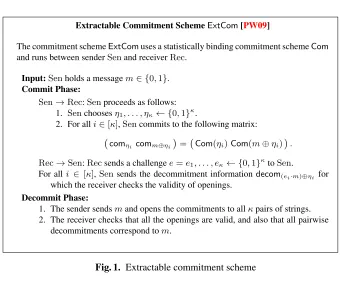
In Figure1we describe their3-round extractable commitment schemeExtComthat is based on one-way permutations. In order to commit to a bitmthe sender splitsminto two shares which are committed using a statistically binding commitment schemeCom. Next, the receiver sends a challenge bitewhere the sender must open one of the two commitments that lie in theeth position. Later, in the decommit phase the sender opens the remaining commitments enabling the receiver to verify that all opening are valid and that all pairs correspond to the same bitm. Loosely speaking, hiding follows from hid-ing of the underlyhid-ing commitment schemeCom. Whereas extractability follows from repetitively rewinding the sender obtaining two shares of a particular instance.
2.3 Zero-Knowledge Arguments
We denote by⟨A(ω), B(z)⟩(x)the random variable representing the (local) output of machineB when interacting with machineAon common inputx, when the random-input to each machine is uniformly and independently chosen, andA (resp., B) has auxiliary inputω(resp.,z).
Definition 2.4 (Interactive argument system) A pair ofPPTinteractive machines(P,V)
is called aninteractive proof system for a languageLif there exists a negligible function neglsuch that the following two conditions hold:
1. COMPLETENESS: For every x ∈ L there exists a string ω such that for every z∈ {0,1}∗,
Extractable Commitment SchemeExtCom[PW09]
The commitment schemeExtComuses a statistically binding commitment schemeCom and runs between senderSenand receiverRec.
Input:Senholds a messagem∈ {0,1}. Commit Phase:
Sen→Rec:Senproceeds as follows: 1. Senchoosesη1, . . . , ηκ← {0,1}κ.
2. For alli∈[κ],Sencommits to the following matrix: (
comηi comm⊕ηi
)
=(Com(ηi)Com(m⊕ηi)).
Rec→Sen:Recsends a challengee=e1, . . . , eκ← {0,1}κtoSen.
For alli ∈ [κ],Sensends the decommitment informationdecom(ei·m)⊕ηi for
which the receiver checks the validity of openings. Decommit Phase:
1. The sender sendsmand opens the commitments to allκpairs of strings. 2. The receiver checks that all the openings are valid, and also that all pairwise
decommitments correspond tom.
Fig. 1. Extractable commitment scheme
2. SOUNDNESS: For everyx /∈ L, every interactive PPT machine P∗, and every ω, z∈ {0,1}∗
Pr[⟨P∗(ω),V(z)⟩(x) = 1]≤negl(|x|).
Definition 2.5 (Zero-knowledge) Let(P,V)be an interactive proof system for some language L. We say that(P,V)iscomputational zero-knowledge with respect to an auxiliary inputif for everyPPT interactive machineV∗ there exists aPPTalgorithm S, running in time polynomial in the length of its first input, such that
{⟨P(ω),V∗(z)⟩(x)}x∈L,ω∈Rx,z∈{0,1}∗
c
≈ {⟨S⟩(x, z)}x∈L,z∈{0,1}∗
(when the distinguishing gap is considered as a function of|x|). Specifically, the left term denote the output ofV∗after it interacts withP on common inputxwhereas, the right term denote the output ofSonx.
If further the distributions are identically distributed, we refer to the proof system as perfect zero-knowledge.
Definition 2.6 (Σ-protocol) A protocolπis a Σ-protocolfor relation Rif it is a 3-round public-coin protocol and the following requirements hold:
– COMPLETENESS:IfPandVfollow the protocol on inputxand private inputωto Pwhereω∈ Rx, thenValways accepts.
– SPECIAL HONEST-VERIFIER ZERO KNOWLEDGE:There exists aPPTalgorithmS such that
{⟨P(ω),V(e)⟩(x)}x∈L ≈ {Sc (x, e)}x∈L
whereS(x, e)denotes the output ofS upon inputxande, and⟨P(ω),V(e)(x)⟩
denotes the output transcript of an execution betweenPandV, whereP has input
(x, ω),Vhas inputx, andV’s random tape (determining its query) equalse.
2.4 Claw-Free Permutations
Definition 2.7 (Claw-free permutations) A triple of algorithms,(I, D, F), is called a claw-free collection if the following conditions hold.
– BothIandDare probabilistic polynomial-time, whereasFis deterministic polynomial-time. We denote byfσ
i (x)the output ofFon input(σ, i, x), and byDiσthe support
of the random variableD(σ, i).
– For everyi in the range of algorithm I, the random variables fi0(D(0, i))and fi1(D(1, i))are identically distributed.
– For every probabilistic polynomial-time algorithm,A′, every polynomialp(·), and all sufficiently large n’s
Pr[fI0n(Xn) =f
1
In(Yn)]≤1/p(n)
whereInis a random variable describing the output distribution of algorithmIon
input1n, and(X
n, Yn)is a random variable describing the output of algorithmA′
on input (random variable)In.
A construction for perfectly hiding commitment scheme based on claw-free permu-tations can be found in [GK96a].
3
The Feasibility of 4-Round BB ZK Arguments from OWPs
In this section we will prove our main theorem, demonstrating the feasibility of black-box 4-round zero-knowledge argument of knowledge. More formally, we prove the following theorem.
Theorem 3.1 Assuming one-way permutations, Protocol1is a 4-round fully black-box zero-knowledge argument for anyNPlanguage.
Building blocks.Our protocol will employ the following cryptographic primitives.
Extractable commitment scheme: We recall that an extractable commitment scheme is a commitment scheme that has in addition an extraction algorithm, such that given an adversarial senderSen∗, can extract the committed message or output⊥if the commitment is invalid. A 3-round extractable commitment scheme can be con-structed based on any non-interactive commitment scheme [PW09]. We denote this scheme byExtCom; see Section2.2for more details. We employ that commitment scheme for the prover.
3-round public-coin honest-verifier zero-knowledge proof: A 3-round zero-knowledge proof with constant soundness for any language inNP, denoted byπZK= (a, e, t), that can be constructed starting from a non-interactive commitment schemeCom and where the witness is only used to in computing the third messaget. For in-stance, the Blum’s Hamiltonicity protocol [Blu] or [IKOS07,HV16]. For concrete-ness, let us consider the former protocol, where given a public input graphG, pro-ceeds as follows. In the first message, the prover commits to the elements of the adjacency matrix{comaij}i,j∈[m] of a random permutation of the input graphG.
The verifier responds with a challenge bite. Ife= 0, then the prover decommits all entries of the matrix and gives the permutation, and the verifier accepts if the permutation maps the input graph to the revealed graph. Ife= 1, then the prover only decommits to elements in the adjacency matrix that form a Hamiltonian cycle. The verifier accepts if the revealed entries form an Hamiltonian cycle.
Protocol’s description:Our protocol executes the honest verifier zero-knowledge proof
πZK in parallel ntimes, where a t subset of these executions (that is picked by the verifier) are completed till end while the rest are used for completing the extractable commitment algorithm.
Protocol 1 (Black-box 4-round zero-knowledge argument)
– Inputs:A public statementx∈ Lfor both and a witnessω∈ Rxfor the proverP.
– The protocol:
1. V → P:The verifier picksnchallenges for the parallel invocations of protocol πZK, saye1, . . . , en, and commits to them using algorithmCom. Denote this set
of commitments by(come1, . . . ,comen).
2. P → V :The prover generates n first-messages (a1, . . . , an) according to
πZK. Here eachai contains commitments to entries of an adjacency matrix
{extcomai[r,c]}r,c∈[m]of an independently and randomly chosen permutation of the input graphGwhere the commitment is computed usingExtComwhere mis the number of nodes in the graph.
3. V → P: The verifier chooses a randomt subsetT ⊂ {1, . . . , n}and sends {decomei}i∈T wheredecomei is the decommitment ofcomei. It also sends a challengech∈([n]−T)for all the extractable commitments.
4. P → V: Condition on valid decommitments sent by the verifier, for every ZK it-erationi∈T, the prover completes protocolπZK, answering challengeeiwith
The verifier accepts if all decommitments are valid, if (ai, ei, ti) is a valid
transcript forπZK for alli ∈ T and if the extractbale commitments protocol has been concluded correctly for all remaining iterationsi /∈T.
Proof (Theorem3.1).Completeness follows directly from the completeness of the un-derlying honest verifier zero knowledge protocolπZK. Below we prove soundness and zero-knowledge of our protocol.
Soundness.On a high-level, the special soundness of the underlying zero-knowledge protocol implies that, on a false statement, and a set of commitments provided by the prover in its first message, there is only one “easy challenge” for which the prover can complete the protocol and convince the verifier. Pass and Wee in [PW09] formalized the notion of “easy challenge” by requiring that the zero-knowledge protocol satisfies the property that there is an efficient procedure that given the input statementxand values in the commitments made by the prover in the second messagev1, . . . , vk, outputs a
stringesuch that if an easy challenge exists then it must equale, and if this challenge is revealed by the verifier the (malicious) prover can convince the verifier even on a false statement. For example, the Blum Hamiltonicity zero-knowledge protocol satisfies this requirement and the easy challenge can be extracted as follows. If the value committed to by the prover is a permutationπand the adjacency matrixAsuch thatArepresents the graphπ(G), then set the easy challenge to be0and otherwise1. We argue soundness based on the following two steps.
1. We show that for a false statement an adversarial prover has to guess the challenge from the commitments made by the verifier before it is revealed in the third message for most of thenparallel instances. More precisely, the “easy challenge” extracted from the messages committed by the prover in most of theniterations must match exactly the challenge committed to by the verifier.
2. There is an extraction procedure to extract the messages committed by the prover in one of these iterations without having to reveal the challenge committed to in the first message.
Combining these two ideas, we can reduce the soundness of the zero-knowledge to the hiding property of the commitments made by the verifier. We remark that our protocol and proof are different from those presented in [PW09] in that the verifier only reveals a subset of the challenges, where essentially the prover is only required to convince the verifier in the executions corresponding to this subset. In contrast, in the protocol presented in [PW09] the verifier opens all challenges. Specifically, as their protocol includes additional rounds between the prover’s second message and when the verifier reveals the challenge in order to extract the prover’s committed message, their analysis becomes easier. In our protocol, on the other hand, we will be able to extract the values in the commitments made by the prover only in the repetitions for which the challenge was not revealed by the verifier. We now proceed to the formal proof.
Assume for contradiction that there exists a PPT proverP∗ and polynomialp(·)
such that for infinitely manyn’s, there existsxn ̸∈ L ∩ {0,1}n such that the prover
arbitrary n for which this happens. We will construct an adversaryB that uses P∗ to break the hiding property of the non-interactive commitment schemeCom. More formally,Bwill internally incorporate the code of the proverP∗on input(1n, x
n)and
feed it with messages according to the honest verifier. That is, on input(1n, x
n)and a
commitmentcfrom the external challenger,Bproceeds as follows.
1. It will begin an internal emulation withP∗. To simulate the first message from the verifier, it will choose a random indexito feed the challenge commitmentcand the rest of them it will generate honestly internally.
2. Next, it will continue the execution to completion where it picks a random subset
S1⊆[n]conditioned oni̸∈S1. Letch1be the challenge it feeds for the extractable commitment. If the prover aborts in the internal emulation thenBaborts.
3. Otherwise, it will record the response to challengeeifor the extractable
commit-ment in repetitioni. Next, it will rewind the prover to the third message, giving another setS2 ⊆ [n]subject toi ̸∈ S2and an independent challengech2 for the extractable commitment. If the prover aborts,Baborts as well. Otherwise, it will use the extractor for the underlying extractable commitment scheme on the com-mitment made for iterationiand the responses given for two challenges. We remark here that our extractor could “over extract”. Namely, extract in case of an invalid commitment. To deal with this, we stipulate that if the extractor extracts a valid graph, the bitbis set to 1 and otherwise 0. If the extractor successfully extracts the committed messages, thenBextracts the easy challengeb, outputsband halts.
We next prove in the claim thatBbreaks the hiding property of the challenge com-mitmentcwith non-negligible probability.
Claim 3.1 There exists polynomialq(·)such that,
Pr[b← {0,1}n:c←Com(1n, b) :B(1n, x, c) =b]≥ 1
q(n).
Proof: Define the random variableΓ to be the set that contains the indexes where the prover commits to the adjacency matrix according to the easy challenge. We will further restrict Γ to be those indices where ifb = 1 (meaning the prover commits to the graph), the index will be included only if the commitment is valid. This means that the prover can successfully convince the verifier only ifT ⊆Γ. Note that this set (even if not efficiently computable) is well-defined as we rely on statistically binding commitments. Our analysis relies on the following two cases:
Case|Γ| ≤ 3n
4: Here the probability that T ⊆ Γ can be bounded by
(3n/4
t )
(n t)
which is negligible. We remark here that ifb = 1and the commitment is invalid, then the Prover can not convince the verifier in that index because all the commitments are decommitted in the fourth message. Based on the observation thatT must be contained inγ, the prover successfully completes the protocol only with negligible probability.
the probability thatP∗ successfully convinces the verifier conditioned oni ̸∈ T
where recall thatT is the set of challenges revealed by the verifier. By a union bound, we have that ∑i∈Γpi ≥ p(1n).Therefore, there existsi such that pi ≥
1 |Γ|p(n)≥
4 3np(n).
Now, we have that ifBpicks this indexiand the prover completes the proof in both the executions performed byB, then with overwhelming probability the extractor reveals the messages committed to by the prover. This in turn reveals the easy chal-lenge for all indexes outsideS1∪S2. In particular, it will obtain the easy challenge
biwhichBoutputs as its guess for the challenge commitmentc. By definition ofΓ
we have thatbiis correct.
Bsucceeds if it picks this indexito feed the external challenge, convincesV∗in the two executions, the extractor succeeds. The right index is chosen with probability
1
2n. for the specific extractable commitment used in the construction (namely, the
construction from [PW09]), the extractor succeeds except with negligible probabil-ity if thech1̸=ch2which happens with probability at most1−2−n. Furthermore,
even if the extractor “over-extracts”, if the extracted value is the valid graph, it can-not be the case that the prover can convince withb= 0and we know that ifi∈Γ
andb= 1then the commitment is valid. Therefore the probability thatBsucceeds is at least1np2i −21n −ν(n)≥
1 2n3(p(n))2.
This concludes the proof of soundness.
Zero-knowledge.We describe our black-box simulator and prove correctness of simu-lation.
Description of simulatorS:More formally, letV∗ be a malicious verifier. We define simulatorSas follows:
1. Sreceives the first messageV∗(x, z)from the malicious verifier.
2. Scontinues the execution by generating the second message according to the hon-est prover’s algorithm. If the verifier aborts, the simulator outputs the transcript and halts.
3. Otherwise,Srecords the challenges that the verifier reveals; denote thistsubset by
T1. SetT0=∅.
4. Next,Srepeatedly rewinds the verifier to the second message to extract some trap-door information, namely, decommitments of the challenges committed by the ver-ifier. It proceeds in iterations. In iterationℓ, we assume that theS holds the sets
T1, . . . , Tℓand at the end of the iteration either the simulator learns a new trapdoor
(and adds a new setTℓ+1) or halts outputting a transcript. More precisely, forℓ= 1 throughn−t+ 1,6the simulator proceeds as follows:
(a) It generates the second prover’s message(a1, . . . , an)as follows:
– Fori̸∈T1∪ · · · ∪Tℓ, run the honest prover strategy to generate the second
messageai. In the particular Blum’s Hamiltonian proof that we use, this
amounts to simply generating commitments to the adjacency matrix of a random permutation of the original graphG.
6
– Fori∈T1∪ · · · ∪Tℓ, leteibe the challenge revealed for indexi. The
sim-ulator runs SZK(x, ei) of the underlying honest-verifier zero-knowledge
proof in order to generate the second and fourth messages(pi
2, pi4)using the knowledge of the challengeei. It then setsai=pi2.
LetT′be the challenge set revealed by the verifier. The simulator repeats until one of the following cases occur:
Case 1.T′̸⊆T1∪ · · · ∪Tℓ: This case implies that the verifier reveals a
chal-lenge of a new ZK repetition that the simulator did not record before. In this case, the simulator setsTℓ+1 =T′and proceeds to the next iteration underℓ(i.e. go to Step 4).
Case 2.T′⊆T1∪ · · · ∪Tℓ: This case implies two subcases.
Case 2.1.T′⊆T1∪ · · · ∪Tℓ−1:The simulator ignores this case and
con-tinues to rewind, i.e. go to step 4(a). We remark here that in this case, the simulator could complete the execution as it has simulated all the second messages according to the challenges corresponding to the setT′. Never-theless, we deliberately make the simulator ignore this case so as to not skew the probability distributions of the simulator’s output.
Case 2.2.T′̸⊆T1∪· · ·∪Tℓ−1andT′ ⊆T1∪· · ·∪Tℓ:This case considers
the event where the revealed subsetT′ is not contained in the firstℓ−1
collected sets, but is contained in first ℓ sets. In this case, the simulator continues the simulation and generates the fourth message(r1, . . . , rn)for everyi∈[n]as follows:
– Ifi ̸∈ T′, the simulator needs to respond to the challenge given for the extractable commitment scheme. In this case, the simulator simply responds to the challenge honestly.
– Ifi∈T′, then recall that the second messageaiwas set topi2, where
(pi
2, pi4)were generated using the honest verifier zero-knowledge sim-ulator based on the challenge ei (which is implied by the fact that
T′⊆T1∪ · · · ∪Tℓ). Therefore, if the revealed challenge for this
rep-etitioniisei, then the simulator sets the fourth messageri =pi4. On the other hand, if the verifier reveals a different challenge for repe-titioni, then the simulator aborts. Note that the simulator will never abort because the challenges are committed using a perfectly binding commitment schemeCom.
The simulator then feeds this last message and outputs the view of the verifier.
Proof of indistinguishability. Denote byViewV∗(P(x, ω),V∗(x, z))the view of the verifierV∗(z)when interacting with the honest prover on inputωand common inputx. We prove the indistinguishability of real and simulated proofs by defining the following intermediate hybrid experiments.
HybridHyb0:In this experiment, we consider the view of the verifier when it interacts with the honest prover with witnessω.
are generated according to the honest prover’s strategy. Define S1(x, ω, z)to be the output of the simulatorS1in this hybrid. We next prove indistinguishability and analyze the running time ofS1in the following claims.
Claim 3.2 The following distributions are identical.
– D0={ViewV∗(P(x, ω),V∗(x, z))}x∈L,ω∈Rx,z∈{0,1}∗
– D1={S1(x, ω, z)}x∈L,ω∈Rx,z∈{0,1}∗
Proof: Fix a random taperforV∗. Letψ = (V1, P
ψ
1, V2, P
ψ
2)be the transcript of a random execution betweenV∗(x, z;r)and an honest proverP(x, ω). We will show that the probability with which this transcript is returned is identical in both distributions. Letpψbe the probability with which this transcript appears inD0conditioned onV∗’s random tape being fixed tor. Clearly, the resulting first message will always beV1, if
S1emulates the interaction withV∗on a random taper. Then we prove that transcript
(V1, P1ψ, V2, P2ψ)is generated byS1(x, ω, z)with the same probabilitypψconditioned
on the random tape ofV∗beingr.
Note first, that by the definition ofS1, the probability with which an aborting tran-script appears in both distributions is identical. We therefore focus on non-aborting transcripts. Therefore, it suffices to compute the probability thatS1(x, ω, z)outputs the (non-aborting) transcript of messages (V1, P
ψ
1, V2, P
ψ
2)conditioned on V∗’s random tape being fixed asr. We continue with some more conventions and notations:
– We denote byS the set that occurs in the target transcriptψ, namely, the set con-tained in messageV2.
– We denote bypT the probability the subsetT occurrs in the real execution. We let
p⊥denote the probability that the verifer aborts before sending its second message in the real execution. In this notationpT =
∑
pψwhere the summation is over all
transcriptsψthat contains the subsetT.
– We denote a tuple of sets byT= (T1, . . . , Tℓ)to denote the sets collected by the simulator before it enters theℓth iteration. Typically, given a tupleT, we useTe
to denote the tuple(T1, . . . , Tℓ−1)and use::for appending a set. In this notation,
T=Te ::Tℓ.
– For1 ≤ℓ ≤n−t+ 1, letValidℓ denote the set of allℓ-tuples(T1, . . . , Tℓ)that satisfy the following two conditions.
1. All setsTiare of sizet.
2. For every1≤i≤ℓ, it holds thatTi̸⊆T1, . . . , Ti−1. (Recall that the simulator moves to the next iteration only if it finds a new trapdoor).
Intuitively, valid sequences captures all sequences that can be obtained by the sim-ulator when entering theℓthiteration.7
– For anyℓ-tupleT= (T1, . . . , Tℓ), we defineqTthe probabilityconditioned on not
abortingthat in a random execution betweenV∗(x, z;r)and the honest prover, the set opened by the verifier is covered by the elementsT1, . . . , Tℓ, i.e.T ⊆ ∪ℓi=1Ti.
7By possibly we mean that it might be the case that the verifier never opens some particular
We setq{∅} = 0. We next observe that, for any tupleT = (T1, . . . , Tℓ), it holds
thatqT = (
∑
pT)/(1−p⊥)where the summation is over allT such that|T|=t
andT ⊆ ∪ℓ i=1Ti.
– For a tupleT= (T1, . . . , Tℓ), letPTψ(ℓ)denote the probability that, starting with setsTand iterationℓ, the simulatorS1outputs the transcriptψ.
Without loss of generality we assumep⊥ <1, since, if the verifier aborts w.p. 1, the simulator outputs the transcript from the first execution and will be distributed identi-cally to the real execution. We begin with the following claim which will be sufficient to prove Claim3.2.
Subclaim 3.3 For1≤ℓ≤n−t+ 1and every tupleT= (T1, . . . , Tℓ)∈Validℓ,
PTψ(ℓ) =
{ p
ψ
(1−p⊥)(1−qTe) ifTe does not coverS, and
0 otherwise.
whereTe = (T1, . . . , Tℓ−1).
Before we prove this claim, we conclude Claim3.2using the preceding subclaim. As argued above, the probability that the simulator outputs aborting transcripts is iden-tical to the real execution. Observing that q∅ = 0, conditioned on not aborting, the probability that the simulator outputs non-abortingψis given byPTψ(0)which from the preceeding claim ispψ/(1−p⊥). Since the probability that the simulator continues
after the first execution is(1−p⊥), Claim3.2follows. Now we proceed to prove Subclaim3.3.
Proof: GivenT= (T1, . . . , Tℓ), supposeTe = (T1, . . . , Tℓ−1)coversS, then from the description of our simulation it follows that it is not allowed to outputψin iterationsℓ
or higher. In other words, whenTecoversS,PTψ(ℓ) = 0as in the claim.
Therefore, it suffices to prove the subclaim whenTe does not coverS. We prove this case using a reverse induction onℓfromn−t+ 1to1.
Base Case:ℓ=n−t+ 1.LetT= (T1, . . . , Tn−t+1)be an arbitrary valid tuple and letTe = (T1, . . . , Tn−t). Recall that, for a general iteration ℓ, the simulator rewinds
until it obtainsT ̸⊆ ∪ℓi=1−1Ti. Then, ifT ⊆ ∪ℓi=1Tiit outputs the transcript. Otherwise,
it has obtained a new trapdoor, setsT to be the new setTi+1and proceeds to the next iteration. However, ifℓ=n−t+ 1, we have that∪in=1−t+1Timust be[n]as at least one
new element is added in each iteration and|T1| =t. Therefore, in this base case, we have thatS̸⊆ ∪ni=1−tTiandS ⊆ ∪ni=1−t+1Ti. This means that if the simulator encounters
the transcriptψin iterationn−t+ 1, it will output it. The probability can be computed as follows:
Pr[ψoccurs in the iteration|not-subset of ∪iℓ=1−1Tioccurs]
= Pr[ψoccurs in the iteration] Pr[not-subset of ∪ℓi=1−1Tioccurs]
= pψ
This completes our base case.
Induction Step:1≤ℓ≤n−t.LetT= (T1, . . . , Tℓ)be an arbitrary tuple inValidi.
SetTe = (T1, . . . , Tℓ−1). Recall that we only need to show the subclaim whenTe does not coverS. There are two cases w.r.tT:
Case 1:TcoversS: In this case, the simulator can outputψonly in this iteration and not higher. Recall that the simulator in this iteration will rewind until it obtains a setT ̸⊆Te. Therefore, the probability that the simulator outputsψis same as in the base case and given bypψ/((1−p⊥)(1−qTe)).
Case 2:Tdoes not coverS: This means that the simulator can outputψonly in iter-ationsℓ+ 1or higher. Then for any subsetT not covered byTthe probability that the simulator outputsψin iterationℓ+ 1or higher is given by
Pr[T occurs in the current iteration|not-subset of ∪iℓ=1−1Tioccurs]
×Pr[ψoccurs in iteration≥ℓ+ 1withT::T occuring in the firstℓiterations] = Pr[Toccurs in the current iteration|not-subset of ∪iℓ−=11Tioccurs]
×PTψ::T(ℓ+ 1)
= pψ
(1−p⊥)(1−qTe)×P ψ
T::T(ℓ+ 1)
This means that the overall probability can be obtained by summing the proceeding expression over all setsTnot covered byT, namely,T ̸⊆T1, . . . , Tℓ.
PTψ(ℓ) = ∑ T̸⊆T1∪···∪Tℓ−1
pT
(1−p⊥)(1−qTe)×P ψ
T::T(ℓ+ 1)
= ∑
T̸⊆T1∪···∪Tℓ−1
pT
(1−p⊥)(1−qTe)×
pψ (1−p⊥)(1−qT)
= pψ
(1−p⊥)(1−qT)×
1−qT
1−qTe
= pψ
(1−p⊥)(1−qTe).
where in the second step we invoke our induction hypothesis thatPTψ::T(ℓ+ 1) =
pψ/((1−p⊥)(1−qT)).
This completes our inductive step and concludes the proof of our subclaim. Claim 3.4 The expected running time ofS1is polynomial.
Proof: We argue by induction on the iterations that the expected running time of the simulatorS1 defined in this hybrid is polynomial. DefineRunTimeT(ℓ)to be the ex-pected total running time of the simulator in iterations ℓ and above conditioned on
T= (T1, . . . , Tℓ)being the sets obtained by the simulator in the firstℓ−1iterations.
Subclaim 3.5 There exists a constant c such that, for any valid tuple(T1, . . . , Tℓ),
RunTimeT(ℓ)≤
nc(n−ℓ)
Proof: As in the previous proof we do reverse induction on iterationℓ.
Base caseℓ=n−t+1.LetT= (T1, . . . , Tn−t+1). Recall that in iterationℓ=n−t+1 we have ∪ni=1−t+1Ti = [n]. Therefore, there are no more iterations and the simulator
stops whenever it finds anyT such that T ̸⊆ ∪ni=1−tTi. The probability of observing
such an execution using our notation defined above is given by (1−p⊥)(1−qTe). Therefore, the expected number of rewindings that the simulator needs to perform in the
(n−t+1)stiteration is1/((1−p
⊥)(1−qTe)). This in turn means the expected time spent by the simulator conditioned on entering iterationn−t+ 1with sets(T1, . . . , Tn−t+1), i.e.
RunTimeT(n−t+ 1) =
nc
(1−p⊥)(1−qTe)
wherenc is an upper bound on the time spent by the simulator in a single rewinding with the verifier.
Induction step:1 ≤ ℓ ≤ n−t.We will compute the expected time spent in this iteration. Suppose that the simulator collected the sets(T1, . . . , Tℓ)in the firstℓ−1 iterations. Recall that the simulator rewinds until it obtainsT ̸⊆ ∪ℓi=1−1Ti and either
outputs the transcript (ifT ⊆ ∪ℓ
i=1Ti) or moves on to the next iteration otherwise. The
number of rewindings in this iteration is therefore 1−1q
e
T in expectation. Now, the total
expected running time in iterationsℓand above can be computed as
E[#rewindings in iterationℓuntil it obtainsT ̸⊆ ∪iℓ=1−1Ti]×nc
+E[time spent in iterations > ℓwithT]
= n
c
(1−p⊥)(1−qTe)+ ∑
T′̸⊆∪ℓ i=1Ti
Pr[T =T′|T ̸⊆ ∪iℓ−=11Ti]×RunTimeT::T(ℓ+ 1)
≤ nc
(1−p⊥)(1−qTe)+
nc(n−ℓ−1) (1−p⊥)(1−qT)
× ∑
T′̸⊆∪ℓ i=1Ti
Pr[T =T′|T ̸⊆ ∪ℓi−=11Ti]
= n
c
(1−p⊥)(1−qTe)+
nc(n−ℓ−1) (1−p⊥)(1−qT)×
∑ T′̸⊆∪ℓ
i=1TiPr[T =T
′]
1−qTe
= n
c
(1−p⊥)(1−qTe)+
nc(n−ℓ−1) (1−p⊥)(1−qT)
×1−qT
1−qTe
= n
c(n−ℓ)
(1−p⊥)(1−qTe)
where the third step follows from the induction hypothesis. The expected total running time of the simulation is given by
p⊥×nc+ (1−p⊥)×RunTime∅(1) =nc+nc(n−1)
and this concludes the proof of the claim.
Hybrid Hyb2: In this experiment we consider the actual simulation as defined by
Claim 3.6 The following distributions are identical.
– {S1(x, ω, z)}x∈L,ω∈Rx,z∈{0,1}∗
– {S(x, z)}x∈L,ω∈Rx,z∈{0,1}∗
Proof. Assume for contradiction that there exists a malicious verifier V∗, a distin-guisher Dand a polynomial p(n) such that for infinitely manyn’s,D distinguishes
S1(x, ω, z) =⟨S1(ω),V∗(z)⟩(x)andS(x, z) =SV ∗
(x, z)with probability p(1n). Fix anynfor which this event occurs.
First, we consider truncated experimentsHyb1(n, x, z)(resp.Hyb2(n, x, z)) which proceeds exactly asHyb1(n, x, z)(resp.Hyb2(n, x, z)) with the exception that the sim-ulation is aborted if it runs more than np(n)t(n)steps wheret(n)is the polynomial bounding the expected running time of S1. If the experiment is aborted then Hyb1 (resp.Hyb2) is set to a special symbol⊥. By an averaging argument we can conclude that the truncated experimentsHyb1(n, x, z)andHyb2(n, x, z)can be distinguished with probability at least2p1(n) by the distinguisherD.
Next, we consider a sequence of intermediate hybridsHyb01, . . . ,Hyb
n−t+1 1 , where in HybridHybℓ1, we define a simulatorS1ℓthat will follow the real simulator’s strategy
Sin the firstℓiterations of the for loop and the remaining according to the honest prover using the real witness. IfS1ℓruns overnp(n)t(n)steps then we stop the simulation and output⊥. LetHybℓ1(n, x, z)be the output of theS1ℓinHyb
ℓ
1. It follows from definition thatHyb01 = Hyb1andHyb1n−t+1 = Hyb2. Therefore, ifDdistinguishesHyb01from
Hybn1−t+1then there exists an indexisuch thatDdistinguishesHybi1 fromHybi1+1
with probability 2np1(n). Since the experiments are truncated afternp(n)t(n)steps the maximum number of rewindings that can occur in iterationiwhere the two experiments differ isnp(n)t(n). We show that usingV∗andDwe can contradict the honest verifier zero-knowledge property (for many parallel repetitions).
Consider an adversaryAthat begins an emulation ofHybi1(n, x, z)until it reaches iterationi. If it halts before,Asimply outputs the output of the experiment. Otherwise, letT1, . . . , Tibe the set of indexes that were obtained by the simulator in the internal
emulation. LetT =T1∪ · · · ∪Tiand let{et}t∈T be the challenges in the indexes inT.
Aforwards these challenges to an external challengerC. The challenger then produces
np(n)t(n)transcripts of the honest-verifier zero-knowledge protocol for each challenge
etfort ∈T.Auses the prover’s messages in these transcripts to generate the prover
messages in the internal emulation in iteration i. Then it completes the experiment, where from iterationi+ 1the adversary plays the honest prover strategy and uses the real witness, and outputs the output of the experiment. By our construction, if the exter-nal challengerCproduces transcripts according to the honest prover, then the internal emulation byAis identical toHybi1. On the other hand if the transcripts received from
Cis according to the honest verifier simulator, then the internal emulation is identical toHybi1+1. Therefore,DandAviolates the honest verifier zero-knowledge property of
πZK.
Proof: Assume for contradiction, the expected running time ofS is not polynomial. Recall that the expected running time ofS1is some polynomialt(n). Then we can con-struct a distinguisher that distinguishes the truncated experiments Hyb1(n, x, z)and
Hyb2(n, x, z)defined above and this is a contradiction to the previous claim. We con-sider truncated experiments Hyb1(n, x, z) andHyb2(n, x, z)where the experiments are truncated after2t(n)steps. Next, consider a distinguisherDthat outputs 1 if the experiment’s output is⊥and0otherwise.Don input view fromHyb1(n, x, z)outputs 1 with probability at least 12. However,Don input a view fromHyb2(n, x, z)outputs 1 is negligible. Therefore,DdistinguishesHyb1(n, x, z)andHyb2(n, x, z)with
non-negligible probability and this is a contradiction.
4
Corollaries
In this section, we provide corollaries to our main techniques. We obtain the first round optimal fully black-box constructions of perfect zero-knowledge arguments and input-delayed commit-and-prove zero-knowledge argument.
4-round Perfect Zero-Knowledge Argument from Claw-free Permutations.As a corollary of Theorem3.1, we prove that there exists a 4-round perfect zero-knowledge argument based on claw-free permutations. This is achieved by replacing the prover’s commitments in Protocol1with perfectly hiding commitments which can be based on claw-free permutations. More formally,
Corollary 4.1 Assuming claw-free permutations, there exists a 4-round fully black-box perfect zero-knowledge argument for anyNPlanguage.
The protocol for the perfect zero-knowledge case is identical to the protocol described in Section3 with the only exception that the commitments made by the prover is re-placed with perfectly hiding commitments that can be based on claw-free permutations [GK96a]. The proof follows is analogous to the proof of Theorem3.1. The soundness argument essentially remains unchanged; we only need to handle the case when the prover violates the binding property of the underlying commitment scheme. The zero-knowledge property follows essentially as before. We observe that the distributions in
Hyb0andHyb1 are already proved to be identical. To conclude we observe that the distributions inHyb1andHyb2are also identical because the underlying commitment scheme is perfectly hiding.
4-round Input-Delayed Commit-and-Prove ZK Argument.As a second corollary, we prove that there exists a 4-round input delayed commit-and-prove zero-knowledge argument. This is achieved by replacing the three-round honest-verifier zero-knowledge argument based on Blum-Hamiltonicity with the three-round commit-and-prove input-delayed protocol of Hazay and Venkitasubramaniam [HV16] in Section 6.2. More for-mally,
5
Acknowledgments
We thank the anonymous TCC reviewers for their detailed comments and Rafael Pass for helpful suggestions. The first author was supported by the BIU Center for Research in Applied Cryptography and Cyber Security in conjunction with the Israel National Cyber Bureau in the Prime Minister’s Office. The second author was supported by Google Faculty Research Grant and NSF Award CNS-1526377. This work was partly carried out by the second author during a visit to DIMACS supported by the National Science Foundation under grant number CNS-1523467.
References
BJY97. Mihir Bellare, Markus Jakobsson, and Moti Yung. Round-optimal zero-knowledge arguments based on any one-way function. InEUROCRYPT, pages 280–305, 1997. BKP18. Nir Bitansky, Yael Tauman Kalai, and Omer Paneth. Multi-collision resistance: A
paradigm for keyless hash functions. InSTOC, 2018.
Blu. Manuel Blum. How to prove a theorem so no one else can claim it. InProceedings of the International Congress of Mathematicians, USA, page 1444–1451.
CLOS02. Ran Canetti, Yehuda Lindell, Rafail Ostrovsky, and Amit Sahai. Universally compos-able two-party and multi-party secure computation. InSTOC, pages 494–503, 2002. CPS+15. Michele Ciampi, Giuseppe Persiano, Alessandra Scafuro, Luisa Siniscalchi, and Ivan
Visconti. Improved OR composition of sigma-protocols. IACR Cryptology ePrint Archive, 2015:810, 2015.
FGJ18. Nils Fleischhacker, Vipul Goyal, and Abhishek Jain. On the existence of three round zero-knowledge proofs. InEUROCRYPT, pages 3–33, 2018.
FS89. Uriel Feige and Adi Shamir. Zero knowledge proofs of knowledge in two rounds. In CRYPTO, pages 526–544, 1989.
GK96a. Oded Goldreich and Ariel Kahan. How to construct constant-round zero-knowledge proof systems for NP.J. Cryptology, 9(3):167–190, 1996.
GK96b. Oded Goldreich and Hugo Krawczyk. On the composition of zero-knowledge proof systems.SIAM J. Comput., 25(1):169–192, 1996.
GMR89. Shafi Goldwasser, Silvio Micali, and Charles Rackoff. The knowledge complexity of interactive proof systems.SIAM J. Comput., 18(1):186–208, 1989.
GMW87. Oded Goldreich, Silvio Micali, and Avi Wigderson. How to play any mental game or A completeness theorem for protocols with honest majority. InSTOC, pages 218–229, 1987.
GMW91. Oded Goldreich, Silvio Micali, and Avi Wigderson. Proofs that yield nothing but their validity for all languages in NP have zero-knowledge proof systems. J. ACM, 38(3):691–729, 1991.
GO94. Oded Goldreich and Yair Oren. Definitions and properties of zero-knowledge proof systems.J. Cryptology, 7(1):1–32, 1994.
Gol01. Oded Goldreich. Foundations of Cryptography: Basic Tools. Cambridge University Press, 2001.
HV16. Carmit Hazay and Muthuramakrishnan Venkitasubramaniam. On the power of secure two-party computation. InCRYPTO, pages 397–429, 2016.
IKOS07. Yuval Ishai, Eyal Kushilevitz, Rafail Ostrovsky, and Amit Sahai. Zero-knowledge from secure multiparty computation. InSTOC, pages 21–30, 2007.
IMS12. Yuval Ishai, Mohammad Mahmoody, and Amit Sahai. On efficient zero-knowledge pcps. In Theory of Cryptography - 9th Theory of Cryptography Conference, TCC 2012, Taormina, Sicily, Italy, March 19-21, 2012. Proceedings, pages 151–168, 2012. Kat12. Jonathan Katz. Which languages have 4-round zero-knowledge proofs?J. Cryptology,
25(1):41–56, 2012.
LS90. Dror Lapidot and Adi Shamir. Publicly verifiable non-interactive zero-knowledge proofs. InCRYPTO, pages 353–365, 1990.
Nao91. Moni Naor. Bit commitment using pseudorandomness. J. Cryptology, 4(2):151–158, 1991.
ORS15. Rafail Ostrovsky, Silas Richelson, and Alessandra Scafuro. Round-optimal black-box two-party computation. InCRYPTO, pages 339–358, 2015.