
Communications in IIoT Environment
Seyed Farhad Aghili and Hamid Mala
Faculty of Computer Engineering, University of Isfahan, Isfahan, Iran
{sf.aghili@eng, h.mala@eng}.ui.ac.ir
Abstract. The concept of the Industrial Internet of Things (IIoT) can be defined as the integration of smart sensor networks and the Internet of Things (IoT). This technology can be employed in various industries such as agriculture, food processing industry, environmental monitoring, security surveillance, and so on. Generally, a smart sensor is a resource-constrained device which is responsible for gathering data from the monitored area. Machine-to-Machine (M2M) communication is one of the most important technologies to exchange information between entities in industrial areas. However, due to the insecure wireless communication channel and the smart sensor’s limitations, security and privacy concerns are the important challenges in IIoT environments. The goal of this paper is to address the security flaws of a recent M2M authentication protocol proposed for employing in IIoT including DoS, router impersonation and smart sensor traceability attacks. Moreover, we showed that an untrusted smart sensor can obtain the secret key of the router and the session key which another sensor establishes with the target router.
keywords: M2M communications, IIoT, Authentication, DoS Attack, Traceability Attack, Impersonation
attack, Disclosure Attack.
1
Introduction
Machine-to-Machine (M2M) is a crucial technology for realization of Industrial Internet of Things (IIoT). In
M2M technology, all devices, machines, and equipments can communicate between each other through
wire-less links. M2M technology can provide the exchange of data between typically resource-constrained devices
without human intervention. M2M networks consist of a number of smart sensors, routers and an
keys for entities. The important concept of M2M is to enable real-time data communications between the
de-vice equipped with smart sensor and the central management applications to collect the vital data transfered
from the remote devices for their users [9, 10].
Since M2M technology lies within embedded cellular via 3GPP technologies such as GSM/GPRS,
UMTS/HSPA(+), and LTE networks, it has become mobile and smarter than before. However, similar to
wireless sensor networks (WSNs), 3GPP cellular networks are vulnerable to some well known information
security threats [7]. So, similar to WSNs, there is a need for assurance regarding the confidentiality, integrity
of the transfered data and robustness against attacks from external entities. These security requirements can
be fulfilled by designing the secure and efficient communication schemes.
To ensure secure communication between M2M devices, authentication and key agreement (AKA)
schemes have been proposed. These schemes not only should be able to securely accomplish mutual
au-thentication and session key establishment but also should meet the high efficiency.
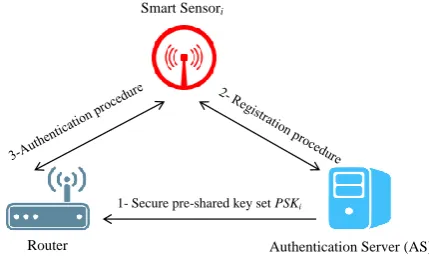
In M2M technology employed in IIoT, the system model is composed of three primary entities: a smart
sensor, router and authentication server (AS), which is described in Fig. 1.
Smart Sensori
1- Secure pre-shared key set PSKi
Authentication Server (AS) Router
Fig. 1.System model of M2M technology employed in IIoT
1.1 Threat Model
Our threat model follows the Dolev-Yao model [4]. In this model, an adversary can intercept, modify, delete
2
Related work
Several authentication protocols for M2M communications has been published since 2012. In 2012, Chenet
al.[3] proposed a group authentication and key agreement protocol called G-AKA. In their scheme a
serv-ing network (SN) can authenticate a group of mobile stations (MSs) with assistance of home network (HN).
Chenet al.claimed that their proposed scheme is secure and can satisfy all security requirements. However,
their protocol is vulnerable to man-in-the-middle, DoS and redirection attacks [6]. In 2013, Lai et al. [6]
proposed a group authentication and key agreement protocol, called SE-AKA. Their scheme is efficient and
guarantees privacy and forward/backward key secrecy. Later in [1], the authors proposed a group
authenti-cation and key agreement (GROUP-AKA) protocol designed for M2M communiauthenti-cation. In this protocol, the
authors successfully prevent the DoS attack, but it still suffers from the privacy preservation problem. In
addi-tion, this protocol employs asymmetric cryptosystem based operations with high computation overhead.
In [8] the authors presented another group authentication and key agreement protocol for M2M devices
in 3GPP networks called GLARM. This mutual authentication and secure key agreement protocol has been
proposed for recourse-constrained devices and has two main phases: (1) Initialization phase and (2) Group
authentication and key agreement phase and proposed for resource-constrained devices. In 2017, Chen et al. [2]
proposed an authentication protocol for the IoT, called S2M but the authors did not analyze the performance
of the methods in terms of privacy preservation, especially in comparison to the scheme presented in [8].
Recently, Esfahani et al. [5] proposed a lightweight M2M authentication protocol to ensure secure
inte-gration of Industrial Internet of Things (IIoT) solutions. Specifically, in their work a machine equipped with a
smart sensor which is authenticated by a network element equipped with a Trusted Platform Module (TPM).
Esfahani et al. assumed that their protocol is secure and efficient. However, in this paper we show that their
scheme is vulnerable against DoS and the router impersonation attacks and also we demonstrate that the
ad-versary can trace the smart sensor by eavesdropping only one session. Besides, we show how an untrusted
smart sensor can obtain the secret key of the router,PSK, and the session key which another sensor establishes
with the target router.
Paper organization The remainder of the article is organized as follows. The review of the Esfahaniet al.’s
scheme is presented in Section 3. In Section 4, we discuss serious weaknesses of this scheme. Finally, we
3
Review of Esfahani
et al.
’s scheme
In this section, we review Esfahaniet al.’s authentication protocol [5], which is composed of three phases, i.e.,
initialization, registration and authentication, and key agreement phases.
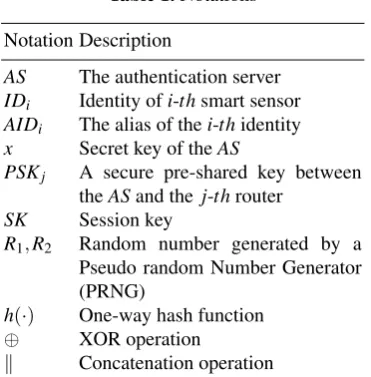
The notations used in this paper are listed in Table 1.
Table 1.Notations
Notation Description
AS The authentication server IDi Identity ofi-thsmart sensor AIDi The alias of thei-thidentity x Secret key of theAS
PSKj A secure pre-shared key between theASand thej-throuter
SK Session key
R1,R2 Random number generated by a Pseudo random Number Generator (PRNG)
h(·) One-way hash function
⊕ XOR operation
k Concatenation operation
3.1 Initialization phase
In this phase, the authentication serverASinitially chooses a long-term secret keyxand generates the secure
pre-shared key setPSKj,j=1, ...,nand sendsPSKjto the j-throuter.
3.2 Registration phase
In this phase, a smart sensor performs the following steps withASthrough a secure channel (Fig. 2).
Step 1. The smart sensor chooses its identityIDiand submits it to theAS.
Step 2. If theASdoes not findIDiin the database, it calculatesf1i=h(IDikx),f2i=h(f1i)andf3i=PSKj⊕f1i
and delivershf2i,f3iito the smart sensor.
Smart Sensori Authentication Server
𝑓1𝑖= ℎ(𝐼𝐷𝑖||𝑥)
𝑓2𝑖= ℎ(𝑓1𝑖)
𝑓3𝑖= 𝑃𝑆𝐾 𝑓1𝑖
𝐼𝐷𝑖
Secure Channel
Stores <𝑓2𝑖, 𝑓3𝑖>
𝑓2𝑖, 𝑓3𝑖
Fig. 2.Registration phase of Esfahani et al.’s scheme [5]
3.3 Authentication and Session Key Agreement Phase
In this phase, a smart sensor and a router are authenticated each other and a session key is established between
them, as shown in Fig. 3.
Step 1. The smart sensor starts the protocol by generating a random numberR1, computingM1=h(f2i)⊕R1,
AIDi=h(R1)⊕IDi,M2=h(R1kM1kAIDi)and sendinghM1,M2,f3i,AIDiito the router.
Step 2. After receiving the messagehM1,M2,f3i,AIDii, the router extracts f1i=f3i⊕PSKj,R1=M1⊕h(f2i)
andIDi=AIDi⊕h(R1), and checks whetherh(R1kM1kAIDi) =M2holds. If it does not hold, the router
terminates the connection; otherwise, it generates the random numberR2, calculatesAIDj=R2⊕h(IDi),
M10 =f1i⊕h(IDi),M20 =h(M10kAIDjkR2)and then computesSKi j=h(R1kR2)as a session key and then
sends the tuplehM10,M20,AIDjito the smart sensor.
Step 3. Upon receiving the message hM10,M20,AIDji, the smart sensor computes R2=AIDj⊕h(IDi) and
checks whetherh(M10kAIDjkR2) =M20 holds. If it does not hold, the smart sensor terminates the session;
otherwise, it computes the session keySKi j=h(R1kR2)andM100=SKi j⊕h(R2). Finally, the smart sensor
sendshM100ito the router.
Step 4. To check the validity of the receivedhM100i, the router checks whether M100⊕SKi j=h(R2)holds. If
it does not hold, the router terminates the session; otherwise, it means the entities mutually authenticate
Smart sensori Router
𝑀1′, 𝑀2′, 𝐴𝐼𝐷𝑗
𝑀1, 𝑀2, 𝑓3𝑖, 𝐴𝐼𝐷𝑖
Insecure Channel
𝑅2= 𝐴𝐼𝐷𝑗 ℎ(𝐼𝐷𝑖)
𝑆𝐾𝑖𝑗= ℎ(𝑅1||𝑅2)
𝑀1′′= 𝑆𝐾𝑖𝑗 ℎ(𝑅2)
If ℎ(𝑀1′||𝐴𝐼𝐷𝑗||𝑅2) ≠ 𝑀2′ then <Reject>
Else
𝑀1= ℎ(𝑓2𝑖) 𝑅1
𝐴𝐼𝐷𝑖= ℎ(𝑅1) 𝐼𝐷𝑖
𝑀2= ℎ(𝑅1||𝑀1||𝐴𝐼𝐷𝑖)
Generates 𝑅1
𝑓1𝑖= 𝑓3𝑖 𝑃𝑆𝐾
𝑅1= 𝑀1 ℎ(𝑓2𝑖)
𝐼𝐷𝑖= 𝐴𝐼𝐷𝑖 ℎ(𝑅1)
𝐴𝐼𝐷𝑗= 𝑅2 ℎ(𝐼𝐷𝑖)
𝑀1′= 𝑓1𝑖 ℎ(𝐼𝐷𝑖)
𝑀2′= ℎ(𝑀1′||𝐴𝐼𝐷𝑗||𝑅2)
𝑆𝐾𝑖𝑗= ℎ(𝑅1||𝑅2)
If ℎ(𝑅1||𝑀1||𝐴𝐼𝐷𝑖) ≠ 𝑀2 then <Reject>
Else Generates 𝑅2
𝑀1′′
If 𝑀1′′ 𝑆𝐾𝑖𝑗≠ ℎ(𝑅2) then <Reject>
4
Security Analysis of the Esfahani
et al.
’s Protocol
In Esfahaniet al.’s Protocol, the authors assumed that the adversaryAis not able to execute replay attack
using the transmitted messages. Moreover, they assumed that the adversary cannot impersonate the router by
accessing to the old login eavesdropped messages and also they assumed that the legitimate smart sensor will
be identified by the router before the calculation of session key.
In this section, we demonstrate DoS attack and the router impersonation attack and also we show that the
adversary can trace the smart sensor by eavesdropping only one session. Besides, we show how an untrusted
smart sensor can obtain the secret key of the router, PSK, and the session key which another sensor has
previously established with the target router.
Router impersonation attack The purpose of adversary in this attack is to cheat the smart sensor to establish
a new session key with her. In this attack it is sufficient for the adversary to eavesdrop the tuple messages
hM10,M20,AIDjiand performs the following steps.
Step 1. The smart sensor starts the protocol by generating the random numberR1, computingM1=h(f2i)⊕
R1,AIDi=h(R1)⊕IDi,M2=h(R1kM1kAIDi)and sendinghM1,M2,f3i,AIDiito the router which is the
adversary.
Step 2. The adversary sends the previously eavesdropped messageshM10,M20,AIDjito the smart sensor.
Step 3. The smart sensor computesR2=AIDj⊕h(IDi). Henceh(M10kAIDjkR2) =M20 holds, the smart sensor
computes the session keySKi j=h(R1kR2)andM100=SKi j⊕h(R2). Finally, the smart sensor sendshM100i
to the adversary.
Hence, by following this attack the adversary is authenticated as a legitimate router, so the smart sensor
be-lieves that the router holds the legitimate session keySKi j=h(R1kR2). The main cause of this attack is that
the parameters used in messageshM10,M20,AIDjiare independent of time and smart sensor’s random number.
DoS attack In the Esfahaniet al.protocol, the adversary starts the attack by eavesdropping the tuple messages
hM1,M2,f3i,AIDiiand simulates the smart sensor by replaying them. The main cause of this attack is that the
parameters used in messageshM1,M2,f3i,AIDiiare independent of time and lack any random generated by
the router. The adversary executes the attack as follows.
Step 2. The router extracts f1i = f3i⊕PSKj, R1 = M1⊕h(f2i) and IDi = AIDi⊕h(R1). Hence
h(R1kM1kAIDi) =M2holds, the router generates the random numberR2, calculatesAIDj=R2⊕h(IDi),
M10=f1i⊕h(IDi),M20=h(M10kAIDjkR2)and then computesSKi j=h(R1kR2)as the session key and then
sends the tuplehM10,M20,AIDjito the smart sensor which is the adversary.
Although the authentication fails in the last step of the protocol, but the adversary has imposed the whole
computations of a session to the router. So, this attack is regarded as a DoS attack.
Smart sensor traceability attack In this attack, the adversary tries to find the link between two sessions of
the protocol. In Esfahaniet al.protocol the attacker eavesdrops the messagehM1,M2,f3i,AIDiiof each session
and becausef3iis unchanged, the attacker can use it to distinguish and track the target smart sensor.
Secret disclosure attack In the Esfahaniet al.protocol, j-throuter pre-shares a unique key,PSKj, withAS.
So, an honest but curious smart sensor, saysensoriwith identityIDi, can obtainPSKjas follows.
– Uses messageM10 =f1i⊕h(IDi)andh(IDi)and obtains f1ifrom equation f1i=M10⊕h(IDi);
– Computes the j-throuter’s secret keyPSKjusing the equationPSKj= f3i⊕f1i.
Thus, Esfahaniet al.’s protocol is vulnerable against secret disclosure attack.
Session key disclosure attack As mentioned above, the honest but curious smart sensor can obtainPSKj.
By employingPSKj, such a smart sensor can obtain anotherl-thsmart sensor’s session keySKl j which is
established with the same router, say the j-throuter, as bellow.
– The honest but curiousi-thsmart sensor uses the message f3l=PSKj⊕f1ltransfered byl-thsmart sensor
andPSKjto obtain f1lfrom equation f1l=f3l⊕PSKj;
– It then uses the messageM10 =f1l⊕h(IDl)andf1land obtainsh(IDl)from equationh(IDl) =M10⊕f1l;
– After that, it employs the messageAIDj=R2⊕h(IDl)andh(IDl)and obtainsR2from equationR2=
AIDj⊕h(IDl);
– Finally, it computesh(R2)and uses the messageM100=SKl j⊕h(R2)to obtainSKl j from equationSKl j=
M100⊕h(R2);
5
Conclusion
In this paper we considered the security of the Esfahaniet al.authentication M2M protocol proposed for
com-munication in IIoT environment [5]. We affirmed that Esfahaniet al.’s protocol is vulnerable to DoS and the
router impersonation attacks. We also showed how an adversary can trace the smart sensor by eavesdropping
only one session. Moreover, we showed that an untrusted smart sensor can obtain the secret key of the router
PSKand the session key which another sensor establishes with the router.
References
1. J. Cao, M. Ma, and H. Li. Gbaam: group-based access authentication for mtc in lte networks. Security and
Commu-nication Networks, 8(17):3282–3299, 2015.
2. D. Chen, N. Zhang, Z. Qin, X. Mao, Z. Qin, X. Shen, and X.-Y. Li. S2m: A lightweight acoustic fingerprints-based wireless device authentication protocol.IEEE Internet of Things Journal, 4(1):88–100, 2017.
3. Y.-W. Chen, J.-T. Wang, K.-H. Chi, and C.-C. Tseng. Group-based authentication and key agreement. Wireless
Personal Communications, 62(4):965–979, 2012.
4. D. Dolev and A. Yao. On the security of public key protocols.IEEE Transactions on information theory, 29(2):198– 208, 1983.
5. A. Esfahani, G. Mantas, R. Matischek, F. B. Saghezchi, J. Rodriguez, A. Bicaku, S. Maksuti, M. Tauber, C. Schmittner, and J. Bastos. A lightweight authentication mechanism for m2m communications in industrial iot environment.IEEE
Internet of Things Journal, 2017.
6. C. Lai, H. Li, R. Lu, and X. S. Shen. Se-aka: A secure and efficient group authentication and key agreement protocol for lte networks.Computer Networks, 57(17):3492–3510, 2013.
7. C. Lai, H. Li, Y. Zhang, and J. Cao. Security issues on machine to machine communications. KSII Transactions on
Internet & Information Systems, 6(2), 2012.
8. C. Lai, R. Lu, D. Zheng, H. Li, and X. S. Shen. Glarm: Group-based lightweight authentication scheme for resource-constrained machine to machine communications.Computer Networks, 99:66–81, 2016.
9. G. Tuna, D. G. Kogias, V. C. Gungor, C. Gezer, E. Ta¸skın, and E. Ayday. A survey on information security threats and solutions for machine to machine (m2m) communications.Journal of Parallel and Distributed Computing, 109:142– 154, 2017.
![Fig. 2. Registration phase of Esfahani et al.’s scheme [5]](https://thumb-us.123doks.com/thumbv2/123dok_us/7973678.1322265/5.595.189.408.105.232/fig-registration-phase-of-esfahani-et-al-scheme.webp)
![Fig. 3. Authentication and key agreement phase of Esfahani et al.’s scheme [5]](https://thumb-us.123doks.com/thumbv2/123dok_us/7973678.1322265/6.595.163.431.228.535/fig-authentication-key-agreement-phase-esfahani-et-scheme.webp)
