April, 13th, 2018
71 | P a g e
COMPARATIVE STUDY OF GREEN AUDITS OF DIFFERENT
EDUCATIONAL BUILDINGS
Sulakhe Prachi Pradiprao
Civil - Construction Management Rajarambapu Institute of Technology, Rajaramnagar, Islampur, Sangli India.
Abstract— Now a days ‘Global Warming' is one of thebiggest issue faced by world. Due to Environmental changes depletion; of natural resources occurs. To solve this issue; flexible, secure, dynamic infrastructure has to be devised. The purpose of the audit was to ensure the practices followed in the campus are in accordance to save the environment or not, therefore, it is essential to explain the conceptual framework of Green Audit. In these research limitations of a green audit, systems are given. After a study, we came to know that there should be quantification for green audit. In this study five green auditreports were analysed and important factors which are affecting highly on the green audit were identified.
Keywords—Water, Waste, Energy, plantation
I. INTRODUCTION
The world today is facing the alarming situation due to an imbalance in the ecosystem. Therefore for the long-term survival of the earth & its habitat, deliberate efforts must be made to achieve sustainable development[1] Organizations are using the natural resources & are putting pressure on the environment. Now the time has came to adopt new techniques like Green Audit.“Green Audit” is a term, which is discussed a lot but not acted much. Therefore it is essential to explain the conceptual framework of Green Audit. The organization should implement ‘Green Audit' compulsorly because it is a tool which can be used to attain sustainable development & competitive advantage. “Green” means eco-friendly or not damaging the environment. Green Auditing is defined as systematic identification, quantification, recording, reporting & analysis of the components of ecological diversity & expressing the same in financial or social terms.[4] The green audit involves issues like energy conservation, use of renewable sources, rainwater harvesting, plantation, hazardous waste management & E-waste management.“Green Auditing”, is also called by another name “Environmental Auditing”[4]
. In the analysis of the reports of the 5 organizations 13 factors on which green report was generated were indentified and comparative study was conducted.
Dr. A. C. Attar
Professor Department of Civil engineering of organization Rajarambapu Institute of Technology, Rajaramnagar, Islampur, Sangli India. [email protected]
II. STEPS UNDER GREEN AUDIT
A. Pre-Audit Plan the audit Select the audit team
Acquire the background information Visit the site B. On-site
Understand the scope of an audit Conduct audit
Evaluate the observations of an audit program Prepare a report of observation side by side
C. Post-Audit
Produce a draft report of the data collected Produce the final report of the observations Distribute the final report to the
management Prepare action plan Keep a watch on the action plan
III. AN EXISTING SCENARIO OF GREEN AUDITING
In this study following five case studies were discussed to find out limitations in the existing scenario of green auditing.
A. Report 1: Green Audit a case study of Art’s, Science& Commerce College, Manmad.[4]
The green audit was done in this college with respect to points such as the use of renewable sources, conservation of the energy, rainwater harvesting program and efforts of carbon neutrality, plantation of trees, E-waste management, and hazardous waste management.
April, 13th, 2018
72 | P a g e
Water consumption by canteen, gardening, and Laboratory purpose was calculated for identifying wastewater generation.
Pollutants discharged to the air per Unit of the output were calculated to analyze air pollution.
Electricity Consumption: Electricity Consumption per Year, per Month, Avg. Electrical Consumption per Day was calculated.
Solid wastes: solid waste from a canteen, tree droppings, and lawn, plastic waste, laboratory wastes were calculated
E-Waste Management: a total number of computers were calculated along with photocopy machine, printers. Storage of defective machinery was checked properly.
Plantation Awareness Program
From all above factors and their analysis different suggestions were given to make campus eco-friendly.
B. Report 2: Assessing Carleton's Sustainability: A campus environmental audit [5]
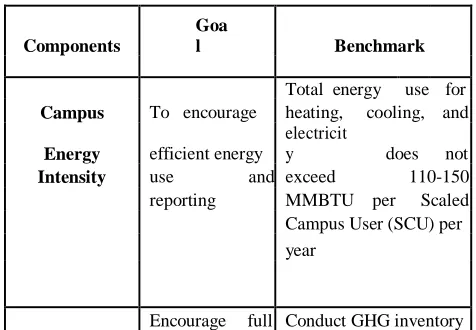
In this report, it is given that Colleges and Universities have broad impacts on the atmosphere around them, both negative and positive. The activities pursued by colleges can create a variety of adverse environmental impacts. Colleges are also in a unique position as educational institutions to be leaders in pursuing environmentally sustainable solutions. Carleton College expresses its commitment to sustainability in many ways. It has taken a number of positive steps to reduce its environmental impact. But many areas remain which substantial improvements can be made. This report serves to highlight Carleton's many accomplishments and to make recommendations for improving the College’s environmental sustainability. This report gives various areas for green auditing along with goals, Benchmark, performance, and recommendations.
Table no 1: Components, Goal, Benchmark for College Audit
Components
Goa
l Benchmark
Total energy use for
Campus To encourage heating, cooling, and
Energy efficient energy
electricit
y does not
Intensity use and exceed 110-150
reporting MMBTU per Scaled
Campus User (SCU) per year
Encourage full Conduct GHG inventory
Green House accounting of for all campus options
Gas Inventory GHG emissions in all areas of
campus
operations
A percentage of energy purchased and/or
Renewable Encourage produced from
Energy purchasing renewable sources
Purchasing and/or (wind, low-impact
production of hydroelectric, renewable geothermal, solar, etc.)
energy Future plans for setting
and attaining a higher percentage
Water use does not exceed 90-120 gallons per scaled campus unit
Water Usage Encourage per day for residential
and Reporting efficient water and non-athletic campus use and facilities. The campus reporting has complete and clear
records of its water use, and there exists a regular, on-going reporting process for all water use and cost data (monitored at the level of individual buildings).Water for irrigation (for maintained grounds and athletic facilities) is tracked separately from other water use. Department provides information to campus users about water use in ways that raise awareness and facilitate action.
April, 13th, 2018
73 | P a g e
Steps should be taken to purchase local food and
organic/fair-trade food
Food Reduce pre- and when feasible, and
procurement post-consumer develop relationships
and disposal food waste and with local food
increase local producers. Steps should
and organic also be taken to reduce
purchasing by pre-consumer and post-
food service consumer food waste,
units on by making connections
campus. with food pantries and
providing better labelled
made-to-order dishes.
For the post-consumer
food waste remaining,
composting would be
the preferred option.
Have in place a program to monitor and maintain
ventilation systems,
major indoor air
Indoor Air Ensure the pollutants/contaminants,
Quality (IAQ) quality of the and standards for
indoor airflow mixing of
environment, fresh/outdoor air.
which is critical Explicit and enforced
for health rules governing smoking
indoors and near the
entrances of buildings.
Have a process of
responding to IAQ
issues and concerns. Use materials for design and
construction that
minimize or eliminate
off-gassing.
Construction and
renovation should
include ventilation that
can be user adjusted There should be in place a policy for the handling
and disposal of
hazardous materials.
Hazardous To ensure The college should have
Materials proper handling in place plans for
and disposal of dealing with hazardous
hazardous wastes in academic
Wastes and departments (art,
materials chemistry, etc.) as well
generated by as facilities plants
campus (paints, etc.).
operations.
Minimize the an Average post- impacts of consumer recycled
Paper Use and paper use by content of paper 30%;
Printing improving the campus paper
environmental purchasing guidelines; characteristics and incentives and of purchased information for paper and by minimizing printing and
lowering total copying
paper use.
Educate all
students in the
Environmental area of
Studies environmental
Curriculum studies in an NA
interdisciplinary framework, and provide
adequately for training for those students
Recommendations:
The College should improve its monitoring and reporting of energy usage and provide information to campus users. In order to do this the College must install meters for campus buildings.
Encourage students to undertake a project this would supply the campus with a full inventory of GHG emissions and enable the College to look into areas where high levels of GHG emissions exist.
Campus should look into offering an option for students, faculty, and employees to contribute money for renewable energy purchasing
The College should improve its monitoring and reporting of water usage, including monitoring irrigation water use separately. Carleton should try to provide information and feedback on water use to campus users in the dormitories and elsewhere.
To reach the goal of a 50% recycling rate, which some institutions have achieved, Carleton should compost food waste and be more vigorous about our recycling education.
April, 13th, 2018
74 | P a g e
Carleton should strongly consider adopting a fee system for printing, which would significantly decrease paper use on campus.
C. Report 3: green audit Report of Kamrup College,Assam (2015-16). This report is made by Green Globe Company. This green audit report based on points Plantation, groundwater level and rainwater harvesting, power saving. [8]
Plantation: according to this report plantation has themajor part in any green audit. In this report, college is divided into 10 different areas including greenery areas.
Groundwater level: Water crises are the very
sensitiveissue these days all over the world. This college developed the new method for groundwater level. They have water reservoir (pond) in the middle of the college campus. The total area covered by water pond is around length 148 feet, breadth 107feet. They also have the less concrete zone, it means that college campus is allowing the rainwater to absorb under the ground to maintain the underground water level.
Rainwater harvesting: In this college, rainwaterharvesting system is used.
Power saving: This college use stickers, labels, postersall around the college campus to aware students about power saving. After all assessment of above mention areas, various suggestions and recommendations were given to the college. They are a use of solar energy, strongly ban to use plastic, set up vermicompost.
D. Report 4: Audit and Evaluation Plan of Surendranath College for 2014-15, Kolkata.
Audit framework is used for conducting Green Audit in 2014-15. The framework also lists the findings and observations for every criterion. The methodology used physical inspection with a review of relevant documentation. Interviews were conducted with a principal and also with faculties and students. In this audit report, 3 columns were made control objectives, controls and audit observation for areas such as waste management and energy consumptions, minimizing consumption of water, environmental awareness after that specific recommendation was given such as,
Implement a mechanism to dispose of waste in a scientific manner to college to improve audit report.
Use of waste segregation at a source.
Dispose of compost waste in a scientific manner. Use energy efficient lighting on a college campus.
E. Report 5: Green Audit report of Nutan Vidya PrasarkMandal's Arts, Commerce and Science College, Lasalgaon, Nashik (2016-17)[6]
In this report, methodology included different tools such as preparation of questionnaire, physical inspection of the campus, observation, and review of the documentation, interviewing key persons and data analysis, measurements, and recommendations. The study covered the following areas to summaries the present status of environmental
management in the campus: Water management, Energy Conservation, Waste management, E-waste management, Green area management. For all above areas, first of all, the observation was done after those recommendations were given for each section.
Water Use: This indicator addresses water consumption,water sources, irrigation, storm water, appliances, and fixtures. A water audit is an on-site survey and assessment to determine the water use and hence improving the efficiency of its use.
Observations
The study observed that Well and Ponds are the two major sources of water. Water is used for drinking purpose, canteen, toilets, laboratory and gardening. During the survey, no loss of water is observed, neither by any leakages, nor by over flow of water from overhead tanks. The data collected from all the departments is examined and verified. On an average the total use of water in the college is 20,000 L/day, which include 5,000 L/day for domestic purposes, 10,000 L/day for gardening and 5,000 L/day for different laboratories.
Recommendations
Need of monitoring, controlling overflow is essential and periodically supervision drills should be arranged. In campus small scale/medium scale/large scale reuse and recycle of water system is necessary. Minimize wastage of water and use of electricity during water filtration process, if used, such as RO filtration process and ensure that the equipment’s used for such usage are regularly serviced and the wastage of water is not below the industry average for such equipment’s used in similar capacity.
Energy Use and Conservation: This
indicatoraddresses energy consumption, energy sources, energy monitoring, lighting, appliance, natural gas, and vehicles. Energy use is clearly an important aspect of campus sustainability.
Observations
Energy source utilized by all the departments and common facility center is electricity only. Total energy consumption is determined as 23308 KWH/Year by major energy consuming equipment’s. All the departments and common facility centers are equipped with CFL lamps.
Approximately 90 CFLs (Capacity) are counted during survey.
Recommendations
Support renewable and carbon-neutral electricity options on any energy purchasing consortium, with the aim of supplying all college properties with electricity that can be attributed to renewable and carbon-neutral sources. Installation of LED lamps instead of CFL.
April, 13th, 2018
75 | P a g e
paper, food, plastic, biodegradable, construction, glass, dust etc and recycling. Solid waste often includes wasted material resources that could otherwise be channelled into better service through recycling, repair, and reuse. Solid waste generation and management is a burning issue. Unscientific handling of solid waste can create threats to everyone. The survey focused on volume, type and current management practice of solid waste generated in the campus. The different solid wastes collected as mentioned above.
Observations
The total solid waste collected in the campus is 21 Kg/day. Waste generation from tree droppings and lawn management is a major solid waste generated in the campus. The waste is segregated at source by providing separate dustbins for Bio-degradable and Plastic waste. Segregation of chemical waste generated in chemistry and zoology laboratories is also practiced. Single sided used papers reused for writing and printing in all departments.
Recommendations
Reduce the absolute amount of waste that it produces from college staff offices. Make full use of all recycling facilities provided by City Municipality and private suppliers, including glass, cans, white, coloured and brown paper, plastic bottles, batteries, print cartridges, cardboard and furniture.
E-Waste Generation: E-waste can be described asconsumer and business electronic equipment that is near or at the end of its useful life. This makes up about 5% of all municipal solid waste worldwide but is much more hazardous than other waste because electronic components contain cadmium, lead, mercury, and Polychlorinated biphenyls (PCBs) that can damage human health and the environment.
Observations
E-waste generated in the campus is very less in quantity. The cartridges of laser printers are refilled outside the college campus. Administration conducts the awareness programs regarding E-waste Management with the help of various departments. The E- waste and defective item from computer laboratory is being stored properly.
Recommendations
Recycle or safely dispose of white goods, computers and electrical appliances. Use reusable resources and containers and avoid unnecessary packaging where possible.
Green Area: This includes the plants, greenery, andsustainability of the campus to ensure that the buildings conform to green standards This also helps in ensuring that the Environmental Policy is enacted, enforced and reviewed using various environmental awareness programmes.
Observations
Campus is located in the vicinity of approximately 80 types (species) trees. Various tree plantation programs are being organized during the month of July and August at college campus and surrounding villages through NSS unit.
Recommendations
Reviews periodically the list of trees planted in the garden, allot numbers to the trees and keep records. Give
scientific names to the trees. Promote environmental awareness as a part of course work in various curricular areas, independent research projects, and community service. Create awareness of environmental sustainability and takes actions to ensure environmental sustainability.
IV. RESULTS AND DISCUSSION
Table no 2: Components of audit reports
Components Report Report Report Report Report
considered 1 2 3 4 5
Renewable sources Rainwater harvesting Carbon neutrality Plantation of trees E-waste management Hazardous waste management. Campus Energy
Intensity Green House Gas Inventory Water Usage and Reporting Food
procurement and disposal Indoor Air Quality Paper Use and Printing Groundwater level
From the above table, it is found that Plantation, Energy Conservation, Water use and waste management are very important components in college campus audit.
Other components such as E-waste
management, Green House Gas Inventory, Food procurement and disposal, Paper Use and Printing were discussed in very few cases. But these points are also having great importance so these points should be considered in future reports.
April, 13th, 2018
76 | P a g e
disposal, Paper Use and Printing can be considered under waste management.
Limitations of Existing Green audit System
- Existing green audit companies considers only few factors among the 13 factors for auditing. There is no - uniformity between them to select the auditing factors. - There is no quantification for existing green audit systems.
V.CONCLUSION
From all above case studies, it is observed that audit were carried out for factors such as waste generation and management, water reuse, Plantation of trees, Campus Energy Intensity, Indoor Air Quality etc. Above 5 reports shows that factors like plantation of trees, hazardous waste management, campus energy intensity and water usage reporting are having more importance so these factors are considered in almost all reports.
Only recommendation and suggestions were given in all cases of green audit report. No one has done quantification of green audit.
There is need to develop rating system which will give proper calculations of all areas of a green audit which
will help institutions/campus to recognize where they were lacking.
REFERENCES
[1] Dr. Joshi Seema Pradip and Dr. Pavitra D. Patil (2014)
“Green Audit – A Tool for attaining Sustainable Development &
Achieving Competitive Advantage” IBMRD's Journal
ofManagement and Research, Print ISSN: 2277-7830,
Online:ISSN 2348-5922
[2] Dr. Mark K.Smith (1994)“ENVIRONMENTAL
AUDITING”, CSTI Environmental Information Paper 2 Prepared
by the CSTI Advisory Committee on the Environment.
[3]Gerald Andrews Emison (2001) “CIVIL ENGINEERS AND
FUTURE ENVIRONMENTAL POLICIES” Journal
ofprofessional issues in engineering education and practice
ASCE 127(3): 130-138
[4]Madhuri Pandit, Prof. Subhash B. Magar (2015) “Green Audit
a case study of Art’s, Science & Commerce College, Manmad”
IOSR Journal of Environmental Science, Toxicology and Food
Technology (IOSRJESTFT) e-ISSN: 2402,p- ISSN:
2319-2399.Volume 9, Issue 8, PP 105-108
[5] Report of Assessing Carleton’s Sustainability: A campus
environmental audit
[6]Report of green audit Nutan Vidya Prasarak Mandal’s Arts,
Science & Commerce College, Lasalgaon, Nashik
[7]Report of green audit Kamrup college, Assam (2015-16)
[8] Report of green Audit and Evaluation Plan of Surendranath College for 2014-15, Kolkata
[9] S. D. Badrinath and N. S. Raman (1995)
“ENVIRONMENTAL AUDIT: INDIAN SCENARIO” Journalof
Environmental Engineering ELSEVIER 121(6): 472-477
[10]Sangita Pradeep Ingole (2012) “Environmental Auditing: Its
Benefits and Counterance” International Journal of
ScienceInnovations and Discoveries
[11]Suvarun Goswami (2012) “Resorting to green audit a path
towards sustainability” Asian Journal of