New Cooperative MAC Protocol for On-Demand
Discovery Dependencies in MANETs
V.Jayapratha S.Venkatesh Babu
PG Scholar Assistant Professor
Department of Computer Science & Engineering Department of Computer Science & Engineering Christian College of Engineering and Technology
Oddanchatram, Tamilnadu-624619, India
Christian College of Engineering and Technology Oddanchatram, Tamilnadu-624619, India
Abstract
The dependencies among the components of service oriented software applications hosted in a mobile ad hoc network (MANET) are difficult to determine due to the inherent loose coupling of the services and the transient communication. To deal with the complicated medium access interactions induced by relaying and leverage the benefits of such cooperation, an efficient Cooperative Medium Access Control (CMAC) protocol is needed. A novel cross-layer distributed energy-adaptive location-based CMAC protocol, namely DEL-CMAC, for Mobile Ad-hoc networks (MANETs). The design objective of DEL-CMAC is to improve the performance of the MANETs in terms of network lifetime and energy efficiency. A practical energy consumption model is utilized in this paper, which takes the energy consumption on both transceiver circuitry and transmit amplifier into account. A distributed utility-based best relay selection strategy is incorporated, which selects the best relay based on location information and residual energy. Current methods for discovering dependencies, developed primarily for fixed networks, assume that dependencies change only slowly and require relatively long monitoring periods as well as substantial memory and communication resources, all of which are impractical in the MANET environment. We describe a new dynamic dependence discovery method designed specifically for this environment, yielding dynamic snapshots of dependence relationships discovered through observations of service interactions.
Keywords: MANETs, Harvesting Algorithm, DEL-CMAC protocol, Co-Operative Communication, ADHOC on Demand vector, Distributed Interface Space, Short Interface Space
________________________________________________________________________________________________________
I. INTRODUCTION
The importance of dependence information increases with the complexity of the system, both in terms of the number of interacting components required to carry out a given computation and the nature of the environment in which the system operates. In service-based systems, such as those based on the Service Oriented Architecture (SOA) [2] or Web Services frameworks, computations are structured as a set of services that respond to requests, where a request typically originates at a user-facing client. Obtaining dependence information in such a system is made difficult by the inherent loose coupling of services, as many dependencies are unknown at design time, and only established at run time through a dynamic, run-time service binding mechanism (so-called “service discovery”). This runtime dynamism is felt even more so when the service-based system is deployed on the mobile nodes of an ad hoc network, where the mobility itself can force reconfigurations of service bindings. The consequence is that the dependencies among runtime instances of services are not something that can be reliably specified before execution, but instead must be discovered during or after execution. We have formulated a relatively simple dependence discovery method that is nonetheless more suitable for services operating in the challenging MANET environment. Our intuition is that dependence discovery must be focused on capturing snapshots of dependence data relevant to each service request of concern, rather than on the tradition of determining statistical averages for long-term, system-wide dependencies as a whole. Furthermore, the method must be lightweight in its resource usage, which to our thinking means that dependence data should be collected locally, aggregated locally, and drawn to some central location only when and if needed. We have designed the method to allow engineers to trade accuracy against cost (i.e., data collection overhead), yielding probabilistically accurate dependence graphs that nonetheless support useful analyses.
to use busy tones to help avoiding collisions in the cooperative scenario at the cost on transmitting power, spectrum, and implementation complexity.
The reminder of this paper is organized as follows. Section II, describes the Related Works. Section III, describes the Proposed work, Section IV summarizes the conclusion.
II. RELATED WORK
Dependence Discovery Method
This method is generally operated [2], [5] network or service level .This level is used for our process occur some discover service dependencies. And it can be used for fault localization like week signal, range, power etc., Statistical method is apply for entire process so it’s difficult to maintain the process and changes also very difficult. Track the monitors work taken a long time for finishing our process. It’s can’t find out the other services dependencies. The major problem is any Fault is occurred first the clients send the request after monitoring the problem is solved after execution.
Here fixed network process is very difficult to find the dependencies and rectify the detection also have a long time completed our process. So the power is waste memory also occupy long place.
It’s a larger problem for critical task analysis and mining dependencies is very complex to detect the process. Accurate view is not possible for this method. And it’s have a long time for entire process so memory and transmitting power is more needed.
Discovering Dependencies For Network Management
In this method [3] Leslie graph discovering the dependencies used for only system components for particular applications only. It’s a major problem for in this process we can’t find accuracy result. The graph format explanation is available is needed so nodes represent computers, routers, and services edges represents the activity for capture the inter-dependencies.
Leslie Graph method is most efficient for un-related conversation and finds the mining dependencies. But traffic observation find method is very challenging process for single method. So it’s used to larger process only and cost also high.
Macro Scope
It’s new concept name End-Point approach. This method is detects the dependencies for network oriented application method only. End-Point method process is extracting the dependencies and automatically combining the process information includes network level tracing the packets. Then discover the dependencies is easy process but maintain and detect the dependencies is long process. So here the transmitting power is high and memory wastage also high level.
Path-Based Failure And Evolution Management
Here we using the [5] concept name is Anomalies and latency profiles. This method is automatically detect the dependencies and it’s have a multiple paths is available. So client work is easy and rectifying the detection also easy. Used transmitting power is low. Here diagnosis the more complex detection. Quick and accurate result gave for our process like system failures, performance, speed, correctness. So less memory is needed for this process. Path detection is advantage for anomalies method. But it have a long time for all process and error detection also complex one for this method.
Magpie
This method [6] name is low overhead instrumentation. Here used the process name is request extraction and workload modeling. The Low overhead instrumentation method is monitoring the system, kernel, and middleware application components. The components are interface to one another. Synthetic data is used for accuracy result. The operation can be performed by individual requests for individual operations. So the long periods is needed for our entire process. So checking the all information is must for this method. So it’s difficult one.
Constellation
In this method [7] learning the difficult dependencies and automatically detect the discover dependencies .it’s have taken to be some time for given accuracy result. So the memory wastage and power wastage is high. And available high cost.
It collects the accurate data. CPU time and the worst case host are reduced. Although some clients will have experience very slow response times during the outage, the majority received good service from the eight healthy proxies so the problem would have only manifested intermittently.
Automating Network Application Dependency Discovery
Here tracking the dependencies following many long periods and also different components. Time is waste and high cost is needed. Power consumption is high.
Unstructured Logs Analysis
Here we are using the concept of Log Key Pairs. And using the method is Bayesian decision theory [9]. The methods detect the dependencies for distributed system. The log key pair methods increase the safety and discover the dependencies also quickly. It’s difficult to find the accuracy result and accurate view also. Here find the mining dependencies process is so difficult so the time management is very difficult and memory occupy area also large. Cost is high for this unstructured logs analysis method.
Dependency Detection Using A Fuzzy Engine Method
The fuzzy engine mechanism [10] is an efficient process. This process using the method name is passive method. The passive methods maintain some attributes. The Fuzzy engine mechanisms predict the performance for full operation in entire system. So it’s a good one for detect the dependencies. It cannot differentiate direct and indirect dependencies.
System and Energy Models
In MANETs domain AODV approach is used. The ADHOC on Demand Vector have some frames. This terminal used for some activities. One is Routing relay terminals and another one is Co-operative relay terminals. The first one is used for select the best path and relay selection .the second one is indicated the source and destination nodes operation. And here we select the source node based on our new approach. The Destination nodes have the same operations.
The system and energy model is mainly used for select the source node with long life time and more energy and efficient transmission. The source nodes select the shortest path and RTS process has been performed. Energy consumption is high so this process is good for proper communication.
Here we select the all methods include fixed network and energy consumption also high. The fixed network not sends the information for another service it’s a larger problem for this method. It cannot differentiate direct and indirect dependencies. So it’s take a long time for complete this process. Maintain process is very difficult.
III. PROPOSED WORK
System And Energy Model Process
In MANETs domain AODV approach is used. The ADHOC on Demand Vector have some frames. This terminal used for some activities. One is Routing relay terminals and another one is Co-operative relay terminals. The first one is used for select the best path and relay selection .the second one is indicated the source and destination nodes operation. And here we select the source node based on our new approach. The Destination nodes have the same operations.
It is reasonable to assume that the energy is consumed both on transmitting and receiving the data. To transmit a packet, the energy cost is Ct = (P+P`) T. And to receive a packet, the energy cost is Cr = P`T. P refers to the power consumption at transmit amplifier and P` refers to the power consumption at transceiver circuitry. To study the effect of energy consumption on transceiver circuitry, the cases P`/P = 0:5, 1, 2 are generally examined. Low P`/ P ratio indicates that the energy consumption on transmit amplifier accounts for great proportion of the total energy consumption. And high P` / P ratio indicates the high circuitry energy consumption case.
DEL-CMAC Process
The DEL-CMAC Protocol is mainly used for MANET domain. When the Co-operative relay enters the process at that time we want some channel reservation space and time for select source node and send the information. The DEL-CMAC Protocol factors here used for select the best path relay selection. Then using the frames are RTS, CTS and ACK for this work. if we want some additional requirement it’s also required from DEL-CMAC Protocol. The ETH control frame is used to select the best relay selection. In this process is improve our network life time and rectifying the total dependencies so this method is best part of this project.
Discovering Dependencies
This method track our activities, because our main thought is reduced the dependencies. In this Method monitoring the dependencies and check the key factors like (network life time, range, signal, power etc.,) want this concept to rectify the correction work activity. The all methods storing one data base and maintain a graph slot format.
Inter-Dependence Discovery
Intra-Dependence Discovery
The monitors want some proof for services work. So the services matched incoming and outgoing activity and send the report for graph format. Here outgoing information only stored in graph. And incoming dependencies want more bits our service transmission.
Dependence Graph
The Dependence Graph is used for all data recorded with individual monitors information. They have two new concepts. They are Nodes and edges. The node represent services and edges represent inter and Intra Dependencies. Each and every node can’t connect with the Intra-dependencies.
Harvesting Algorithm
The Dependence Graph is mainly used monitoring the all time slots and our operation performance so this normal operation but harvesting algorithm is used for increment the construct work for full application graph format is stored this DG. In this method is mainly used for reduced the client work compare than existing system. This DG is commonly used for the client acting in the services in direct or indirect.
Dependence Graph construction much accuracy compare than existing and here this graph detect and rectified work is same time performed with short time.
IV. EXPERIMENTAL WORK AND RESULT ANALYSIS
DEL-CMAC Protocol
The DEL-CMAC Protocol is mainly used for MANET domain. When the Co-operative relay enters the process at that time we want some channel reservation space and time for select source node and send the information. The DEL-CMAC Protocol factors here used for select the best path relay selection. Then using the frames are RTS, CTS and ACK for this work. if we want some additional requirement it’s also required from DEL-CMAC Protocol. The ETH control frame is used to select the best relay selection. In this process is improve our network life time and rectifying the total dependencies so this method is best part of this project.
Operations at the Source
When the source is ready to send the information to destination, it checks our status. First it checks the channel is idle or not. The channel was idle condition for distributed interface space (DIFS). Then it is waiting to back off counter reaches zero. After the source node select the best path included the network life time, energy, and transmitting power. Then send the request for reserves the channel. It’s different from destination Control Frame (DCF). Next Eager To help frame is not receive the source information was correct then the source transmitting another data will be send to ready status. Here message send and receive action performed based on some formulas. They calculate our length, bytes and storage capacity.
Operations at the Destination
The Destination Node received the RTS Frame sends the request for CTS after send Short Interface Space (SIFS). The CTS is mainly used for select the way to transmitting the information for destination. The destination node waits the request from source node. Then the information is received from source node and the destination node is decode the format and getting the original information like audio, video, message.
Operations at the Relay
The new candidate is not affect to another transmission and the new candidate before checking the best path relay selection and fixing the source node for transmitting the new information. And careful to select the source node once we declared the source node can’t change.
Architecture
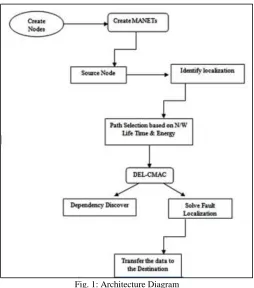
Fig. 1: Architecture Diagram
The Architecture diagram said that our node creation must be selected based on our DEL-CMAC protocol factors and it’s solve fault localization and discover the dependencies. And also transfer the information properly with low cost. In that way is used to the best path selection. The path selection based on network Life time and Energy. Here source node and destination node send the acknowledgment to one another.
V. CONCLUSION
On demand method discover the dependencies operated for services and resource of MANET’S. The Existing system is affected by stable dependencies time and also taken in long periods. Then DEL-CMAC Protocol used for high efficient and user friendly works it’s done. It’s used to highly effective and location. Then energy advantage and network life time also high level. Here proposed effective path selection with low cost and also select the best relay selection. We have concluded that DEL-CMAC can significantly prolong the network lifetime comparing with the IEEE 802.11 DCF and Coop-MAC, at relatively low time and reduces the cost also available in this process.
REFERENCES
[1] Jie Li and Xiaoyan Wang, “Improving the Network Lifetime of MANETs through Cooperative MAC Protocol Design” Ieee Transactions On Parallel And Distributed Systems, Vol. 26, No. 4, April 2015.
[2] Alexander L. Wolf, Bong Jun Ko and Petr Novotny, “On-Demand Discovery of Software Service Dependencies in MANETs” , Ieee Transactions On Network And Service Management, Vol. 12, No. 2, June 2015
[3] Jayapratha.V And Venkatesh Babu.S,(2015), “A Survey on New Cooperative MAC Protocol for On-Demand Discovery Dependencies in MANETs”November,pp 76-79,November 2015.
[4] F. Al Shahwan and K. Moessner, “Providing SOAP web services and RESTful web services from mobile hosts” [5] P. Barham “Constellation: Atomated discovery of service and host dependencies in networked systems”. [6] S. Basu, F. Casati, and F. Daniel, “Toward web service dependency discovery for SOA management”
[7] C. Chen, A. Zaidman, and H.-G. Gross, “A framework-based runtime monitoring approach for service-oriented software systems” [8] P. Choudhury, A. Sarkar, and N. Debnath, “Deployment of service oriented architecture in MANET: A research roadmap”. [9] M. Ding, V. Singh, Y. Zhang, and G. Jiang, “Application dependency discovery using matrix factorization”.
[10] J.-G. Lou, Q. Fu, Y. Wang, and J. Li, “Mining dependency in distributed systems through unstructured logs analysis”.
[11] H. Neema, A. Kashyap, R. Kereskenyi, Y. Xue, and G. Karsai, “SOAMANET: A tool for evaluating service-oriented architectures on mobile ad-hoc networks”.