ISSN (Online): 2320-9364, ISSN (Print): 2320-9356
www.ijres.org Volume 1 Issue 5 ǁ Sep. 2013 ǁ PP.79-84
Microstructures and Mechanical Properties of Composites Based
On Almg Alloys Produced “In Situ”
Raluca Maria Florea
1, Oana Bălţătescu
1, Iulia Muscalu
1, Ioan Carcea
1 1(Faculty of Materials Science and Engineering/”Gheorghe Asachi” Technical University of Iasi Romania, Country)
ABSTRACT :
This paper reports the results of an investigation on the in situ formation of AlNparticles in an Al –Mgalloythroughreactivegas injection.The properties of in situ processedmaterialsprimarilydepend on the matrix and the volume fraction of the constituent phase. The mechanicalproperties, tougheningmechanisms and potential applications are brieflyreviewed.Traditionalmethodswereused for the basic characterization of the composite. The microstructure of the composite wasinvestigated by optical and scanning electronmicroscopy (OM, SEM). SEM analysiswasperformed in order to observe the microstructural evolution as a function of the Mg content and to identifysomereasons of the presence of porosity or anyirregularitieswithin the metal matrixKeywords
-; AlN,casting, composite, ,”in situ” particle formation, magnesium , reactive gas injection.I.
Introduction
A large number of metal and ceramic matrix composites are being developed for high-performance applications in automotive and aerospace industries. In these materials reinforcements can be metallic (intermetallic, metallic glasses) or non-metallic (AlN, SIC, Al2O3), continuous (fibers, ribbons) or discontinuous
(particulates, whiskers, platelets) depending on the application and property requirement. Several processing techniques are developed to disperse these reinforcements uniformly in the matrix [1-3]. However, each fabrication technique has its own advantages and limitations. Some of the problems encountered are: residual microporosity, uneven distribution of reinforcement, non-wetting of the reinforcement, control of matrix-reinforcement interface, scaling up of the process for industrial utilization and processing cost. To overcome some of the inherent problems that are associated with conventionally processed materials, new processing techniques have been developed, where the second phase is formed by controlled reaction.“In situ!compositeis the term applied to a relatively small, but fast expanding domain of materials wherethe reinforcing phase is formed within the parent phase by controlled melt growth, chemical reaction, transformation and deformation. This single stage process has considerable advantages over conventional syntheticcomposites as it avoids complicated additional steps such as sorting, alignment, infiltration and sintering. Hence these processes are cost effective. The interfaces produced are relatively stable and impurity-free. Additionally, the strength of selected in situ composites is better than conventional materials.The term “in situ” with reference to composites was first used with directionally solidified alloys where controlled heat flow results in extended directionality of the micro-constituents to give impressive mechanical properties [4-7].
An economical way of producing metal-ceramic composites is by the direct interaction between the liquid metal (with alloying elements) and the gaseous species to produce fine dispersions of thermodynamically stable refractory compounds. The matrix is usually a non-ferrous metal such as AI, Cu, Mg, Ni or Ti and the reinforcement phase could be carbides, nitrides or a good admixture of both. The reactive gas is bubbled through the molten alloy which is maintained at a pre-determined temperature where accelerated reaction takes place between the gaseous species and the solute element in the alloy [8-10]. Since the reaction takes place in situ, the reinforcement phase is chemicallyclean and the interface is beneficial from the viewpointof property.
II.
Manufacturing and processing
Experimental procedure for obtaining composite materials such AlMg / AlN is based on the "in-situ" technique and consist of introduction of reactive gas (nitrium) into the melt (AlMg alloy melt). Reinforcingparticles (AlN) are formed from the reaction between molten metal and bubbling gas.
Table 1 presents the material and process parameters that have been tested in experiments on the formation of "in situ" AlN reinforcement particles.
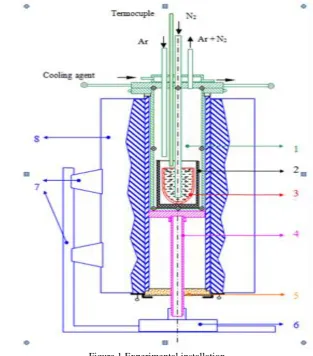
the furnace (8) supported by an L-shape frame (7) which also holds the closed box supporting and adjustable pillar (4).
Figure 1.Experimental installation.
1) melting chamber, 2) graphite crucible, 3) alumina crucible, 4) adjustable pillar, 5) insulation lid, 6) frame base, 7) L-shape frame, 8) furnace [11].
Table 1. Experimental parameters
Composite material type Temperature, ºC
Mg percentage %gr.
Gas flow, l/min.
Bubbling time, min.
AlMg15/AlN 1000 15 0,6 360
AlMg10/AlN 1000 10 0,6 360
AlMg5/AlN 1000 5 0,6 360
The furnace has been provided with a bottom end cover and sealed at the top side by the chamber cover and the refractory material between the chamber and the furnace. The chamber cap has been water-cooled to room temperature and supplied by several tubes for water and argon circulation.
III.
Results and discussion
3.1 Friction wears of AlMg5/AlN and AlMg10/AlN composites obtainted “in situ”
The Universal Micro-Tribometer can be used effectively for the tribological testing of ferrous and non-ferrous metals, plastics, ceramics, paper, composites, thin and thick coatings, as well as of solid lubricants, lubricating fluids, oils and greases.
Figure 2. Universal Micro-Tribometer
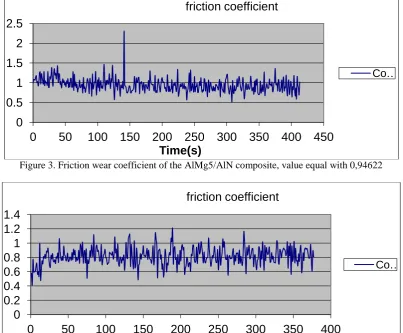
The base of the Testing Unit has a fixture in the shape of a ring for mounting and leveling various drives for the lower test specimen.The friction wear coefficient of the AlMg5/AlN composite samples is showed in figure 3 and has the value equal with 0,94622.
For AlMg10/AlN composite obtained “in situ” via RGI the friction coefficient is presented in figure 4. In this case it has the value equal to 0,81428. It could be easily observed that there is a difference between AlMg5/AlN and AlMg10/AlN composites friction coefficient and, the difference is about 0,14.
Figure 3. Friction wear coefficient of the AlMg5/AlN composite, value equal with 0,94622
Figure 4. Friction wear coefficient of the AlMg10/AlN composite, value equal with 0,81428
0
0.5
1
1.5
2
2.5
0
50
100 150 200 250 300 350 400 450
Time(s)
friction coefficient
Co…
0
0.2
0.4
0.6
0.8
1
1.2
1.4
0
50
100
150
200
250
300
350
400
Time (s)
friction coefficient
3.2. AlMg/AlN composites microhardness
Vickers indentation method, standardized by STAS 492, has been used for mechanical characterization [12].
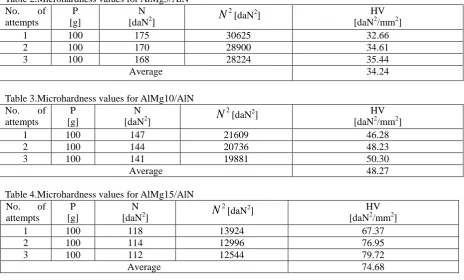
The microhardness has been determined by a PMS 73 Microhardnes machine. Microhardness results are presented in table 8, 9 and 10 (table 8 for AlMg5/AlN composite, table 9 for AlMg10/AlN composite and table 10 for alMg15/AlN composite). There have been three attempts per sample, the penetration was performed using a pyramid penetrator type, pressing the sample and weight was 50g.
Vickers hardness (HV) for every three attempts was calculated using the Eq. 1;
HV = 20000 • P/N2
[daN2/mm2] (1)
where: P = weight of pressing, N2 = number of divisions.
Table 2.Microhardness values for AlMg5/AlN No. of
attempts
P [g]
N [daN2]
2
N
[daN2] HV[daN2/mm2]
1 100 175 30625 32.66
2 100 170 28900 34.61
3 100 168 28224 35.44
Average 34.24
Table 3.Microhardness values for AlMg10/AlN No. of
attempts
P [g]
N [daN2]
2
N
[daN2] HV[daN2/mm2]
1 100 147 21609 46.28
2 100 144 20736 48.23
3 100 141 19881 50.30
Average 48.27
Table 4.Microhardness values for AlMg15/AlN No. of
attempts
P [g]
N [daN2]
2
N
[daN2] HV[daN2/mm2]
1 100 118 13924 67.37
2 100 114 12996 76.95
3 100 112 12544 79.72
Average 74.68
3.3. EDS analyses and chemical composition of AlMg/AlN composites
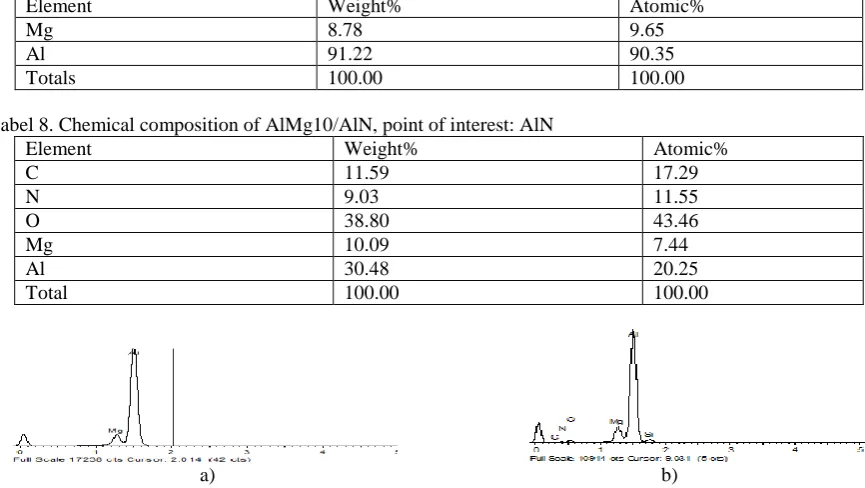
The composition of the isolated particles has been analyzed by EDS. The results revealed that these particles contained mainly Al, Mg, and N, along with a small amount of C, as shown below in tables for every composite in part.
Table 5. Chemical composition of AlMg5 matrix
Element Weight% Atomic%
Mg 3.24 3.58
Al 96.76 96.42
Totals 100.00
Table 6. Chemical composition of AlMg5/AlN composite
Element Weight% Atomic%
C 9.30 13.65
N 4.95 6.23
O 53.33 58.77
Mg 2.11 1.53
Totals 100.00 100.00
a) b)
Figure 5.EDS analyses of the composite AlMg5/AlN (microstructures made at laboratories of Politecnico di Torino, Department of Applied Science and Technology):a) AlMg5 matrix without reinforcement particle; b)
composite with AlMg5 matrix armed with AlN particles by gas infiltation
Table 7. Chemical composition of AlMg10 matrix
Element Weight% Atomic%
Mg 8.78 9.65
Al 91.22 90.35
Totals 100.00 100.00
Tabel 8. Chemical composition of AlMg10/AlN, point of interest: AlN
Element Weight% Atomic%
C 11.59 17.29
N 9.03 11.55
O 38.80 43.46
Mg 10.09 7.44
Al 30.48 20.25
Total 100.00 100.00
a) b)
Figure 6.EDS analyses of the composite AlMg10/AlN (microstructures made at laboratories of Politecnico di Torino, Department of Applied Science and Technology)
a) AlMg10 matrix without reinforcement particles
b) composite with AlMg10 matrix armed with AlN particles by gas infiltation
Table 6. Chemical composition of AlMg15 matrix
Element Weight% Atomic%
Mg 9.22 10.13
Al 90.78 89.87
Totals 100.00
Tabel 7. Chemical composition of AlMg15/AlN, point of interest: AlN
Element Weight% Atomic%
N 8.61 14.85
O 3.95 5.97
Mg 9.65 9.58
Al 77.79 69.60
a) b)
Figure7. EDS analyses of the composite AlMg15/AlN (microstructures made at laboratories of Politecnico di Torino, Department of Applied Science and Technology)
a) AlMg15 matrix without reinforcement particles
b) composite with AlMg15 matrix armed with AlN particles by gas infiltation
IV.
Conclusions
Aluminium alloy matrix composites (AlMMC) are a group of materials more and more frequently used in modern engineering constructions because of their excellent properties, i.e. high specific elasticity modulus, high stiffness.
AlN particles were successfully grown via reaction gas injection of nitrium in melted AlMg matrix at 1000 °C.
It was found that Mg plays a key role in reducing the partial pressure of oxygen in the furnace chamber during the entire process favoring the development of AlN and suppressing the formation of Al2O3.
The experiments have comfirmed that the reaction between liquid aluminium and nitrogen in the conditions of an increased gas pressure may lead to the formation of AlN phases, and the presence of Mg in the matrix speeds up the reaction intensity. In the initial stage, the reaction proceeds on the surface. High pressure of nitrogene inhibit vaporization of Mg and reaction between Al and N2 proceed in limited scope. Since the
reaction is of an exothermic nature, it is difficult to be controled. Usingthe „in situ” reaction in order to form AlN dispersion reinforcement in the AlMg alloy matrix seems possible with limited intensity of the process, for example, through lowering the Mg fraction in the matrix or setting an appropriate reaction time.
V.
Acknowledgement
This paper was realised with the support of POSDRU CUANTUMDOC “DOCTORAL STUDIES FOR EUROPEAN PERFORMANCES IN RESEARCH AND INOVATION” ID79407 project funded by the European Social Found and Romanian Government.
References
Journal Papers:[1] M. Bahgat, M. Radwan, F.E. Farghaly, Formation of AlN from Secondary Al Resources, J. Mater. Sci. Technol., Vol.22 (No.5), 2006.
[2] H.Z. Ye, X.Y. Liu, B. Luan, In situ synthesis of AlN in Mg–Al alloys by liquid nitridation, Journal of Materials Processing Technology, 166, 2005, 79–85.
[3] I. Bello, Y.M Chong, Q. Y Ye, edaltri, Materials with extreme properties: Their structuring and applications, Vacuum 86, 2012, 5755–5785.
[4] M. Ćosić, Z. Aćimović-Pavlović, A. Terzić, M. Dojčinović, L. Pavlović, The possibility of obtaining composite Al18wt%Si/SiC by compocasting process, International Journal of Modern Manufacturing Technologies, Vol. IV, No. 2, 201,) 23–26.
[5] I. Carcea, Composite materials - phenomena at the interface (Politehnium Iasi 2008).
[6] D. Nedelcu, I. Carcea, G. Neagu, edaltri, Composite materials obtaining techniques (Politehnium Iasi 2009). [7] C. Cup, Y. Shen and F. Meng, Journal of Mater. Sc. and Eng. 16 no.6,2000, 619˗626.
[8] D. Litvinov, D.Gerthsen, R.Vohringer, D.Z.Hub, D.M.Schaadt, Journal of Crystal Growth, 338, (2012, 283˗290.
[9] J.A. Aguilar-Martinez, M.B. Hernandez, J. Castillo-Torres, M.I. Pech-Canul, Mexican Journal of Physics 53, 2007, 205˗209.
[10] B. Wu, R. G. Reddy, Metallurgical And Materials Transactions B 33b, 2002, 249˗254.
[11] V. Soare, D. Mitrica, P. Moldovan, I. Carcea, Method and system for obtaining aluminum alloys matrix and reinforcement of carbide particles composite material through the in situ process, Patent no. A2010 00835, 2010.